Showing posts with label de Vere. Show all posts

Friday, April 17, 2015

Sir Godfrey Kneller, the de Veres, and the Beauclerks

by Margaret Porter

Such are thy pictures, Kneller, and such thy skill,
That Nature seems obedient to thy will;
Comes out and meets thy pencil in the draught,
Lives there, and wants but words to speak her thoughts.
                                                       ~~ John Dryden
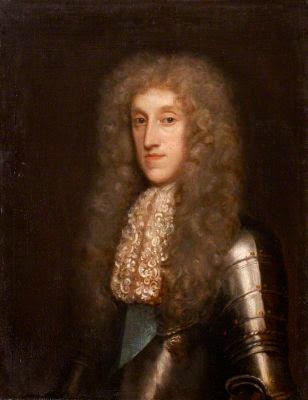
Aubrey de Vere, 20th Earl of Oxford
In 1678, two years after arriving in England with his brother, the German artist Godfrey Kneller produced a magisterial, much-admired portrait of King Charles II. As a result, "his reputation daily increased so that most noblemen and ladies would have their pictures done by him," irrespective of their political affiliation or religious preferences. Aubrey de Vere, 20th Earl of Oxford, a soldier and courtier boasting one of the longest pedigrees in the land, was among the artist's subjects. Kneller painted his illustrious client in battle armour. 

the first portrait
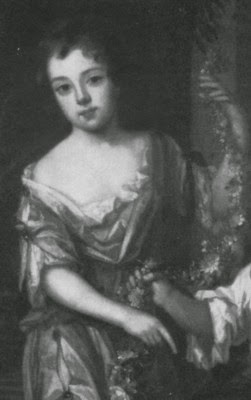
When the Earl's daughter Lady Diana de Vere first posed for Kneller, she was no more than ten years old. Holding up a floral garland, she stands beside her younger sister Mary, seated beside her. By the early 1680s, when this double portrait  was completed, the German artist was at the pinnacle of prominence.

Nell Gwyn, with her son and without, with or without her clothes on, was often painted by renowned portraitists Peter Lely and Simon Verelst. Kneller succeeded them as the most fashionable artist of the day, remaining so after Nell’s death in 1687 and the Glorious Revolution of the following year. King William III and Queen Mary II shared the deposed James II's preference for Kneller's work.

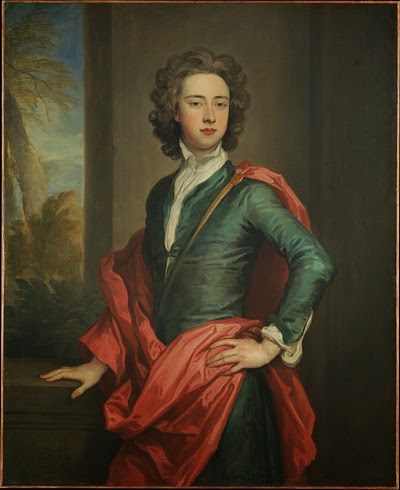
Charles Beauclerk, Duke of St Albans
By 1690 Nell's son and heir, the Duke of St Albans, had embarked upon a military career. At about that time the handsome young man posed for a three-quarter length portrait. This would be the first of many Beauclerk portraits produced by Kneller, now a naturalised Englishman. He'd established a residence and studio in the north east corner of Covent Garden. Not only the nobility flocked there--the Duke’s father, King Charles II, had also visited the artist to sit for his portraits, a mark of great favour.
One of Kneller's most memorable and presumably enjoyable commissions came a year after the double coronation of William and Mary. As the former battled foreign enemies on the Continent, the Queen decided to imitate her own mother's gallery of beauties at Windsor Castle, produced by Lely. Mary proposed a set of paintings for Hampton Court Palace, being altered by Sir Christopher Wren to suit her and William's architectural tastes. Her plan was mocked by her father’s former mistress, Lady Dorchester, who famously quipped, "Madam, if the King was to ask for portraits of all the wits in his court, would not the rest think he called them fools?"

Diana, a Hampton Court Beauty
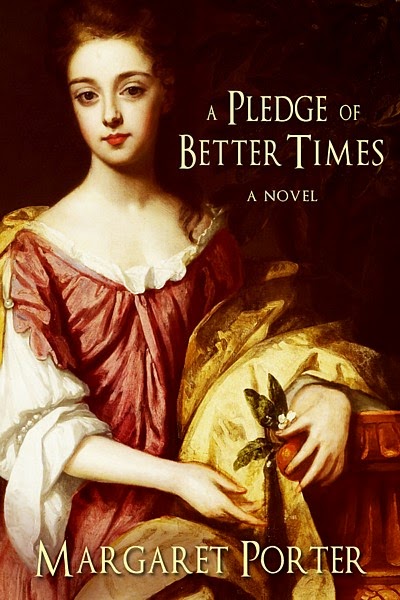
Undeterred, Mary put Kneller to work, and her loveliest and most virtuous attendants made their way to his studio to have their charms preserved as life-sized canvases. Of the twelve original paintings only eight remain. The most admired of the set is that of Lady Diana de Vere, who at that time was either officially or unofficially attached to the court as maid of honor. She poses with an orange tree, holding an orange in her hand—doubtless designating the de Veres’ fealty to the new rulers from the House of Orange. The paintings of Diana and the other ladies were positioned in the narrow spaces between the tall windows of Hampton Court's riverside Water Gallery (later demolished). Each was set within a blue-and-white painted frame to complement the Queen’s extensive Delftware collection. Diana's portrait currently hangs in the King’s Dining Room, and is now surrounded by giltwood frame. Duchess of St Albans, the title she gained at her marriage to Charles Beauclerk, was inscribed at a later date. (A detail of this work appears on the cover of my novel A Pledge of Better Times.)
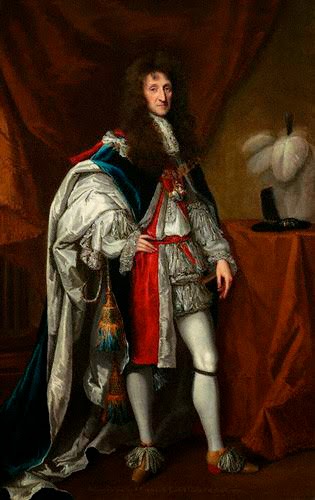
The 20th Earl of Oxford 
in Garter Robes
 Having pleased the monarchs with portraits of beauties and military men, on 3 March 1691/2, Kneller became Sir Godfrey. “His Majesty, to shew his Kingly approbation of his Art and Manners, was pleas’d to confer the Honour of Knighthood upon him…and as an extraordinary Mark of his Grace and Favour, Honour’d him with the Present of a Sword, by the Hands of the Right Honourable Lord Chamberlain." The artist also became a Gentleman of the Privy Chamber, and received an honorary doctorate from Oxford. An acquaintance reported, "In June 1693 Sir Godfrey Kneller told me he has had fourteen persons sett to him in a day." Some of those persons sat to him as many as a dozen times for a single portrait! Diana’s father, Lord Oxford, a Knight of the Garter, a member of the Privy Council, a Lieutenant General, and a Gentleman of the King’s Bedchamber, commissioned a splendid full-length Kneller likeness at approximately the time his daughter was posing for her Beauty portrait.
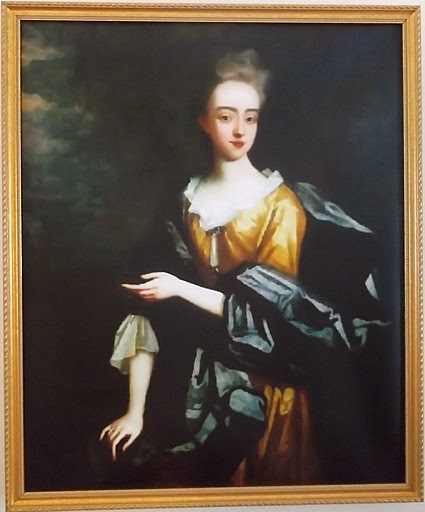
Diana, 1694
Author's collection
Upon her marriage in 1694, Diana became Duchess of St Albans and again sat to Kneller—for a third time. The painting was promptly delivered to engraver John Smith, who revised her features and hair somewhat when producing prints for public sale. One of these holds a special place in my personal art gallery!

 In 1695, the Crown granted Kneller an annuity of £200 per year. Two years afterwards he received additional proofs of William’s admiration, a large gold medal stamped with the King’s image and a golden chain worth £300. It appears in most of the later self-portraits (as seen below) and on the bust attached to his burial monument.

After her accession to the throne, Diana’s friend Queen Mary would sit only to Kneller. A copy of her portrait, or the King’s, could be purchased for the price of £50, and judging from their wide dissemination this was a reliable source of income for Kneller and his assistants. Not only were the paintings acquired for civic and government buildings, they went abroad as presents to fellow rulers, territorial governors, ambassadorial residences, and so forth. And Kneller even travelled with—or without—the King, to make portraits of foreign allies and friends in the Low Countries.
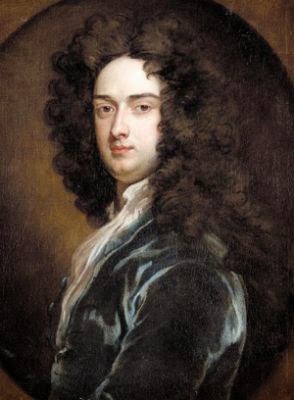
1st Duke of St Albans, 1704
Kneller produced a Kit-Kat style portrait of Charles Beauclerk wearing a blue coat in 1704, as the the Duke was falling out of favour with Queen Anne—not that he ever really had it. Probably at her husband's instigation, Kneller created additional pictures of Diana: seated in a landscape wearing “a dark blue dress with red scarf,” and an oval half-length in which she appears in a “white dress with red mantle and holding a chalice.” These two passed through auction houses and are privately owned. Lord Cholmondeley’s Houghton Hall holds another Kneller portrait of “the Duchess of St. Albans ... in a blue dress, her son in a brown coat and a purple mantle, at her side.”
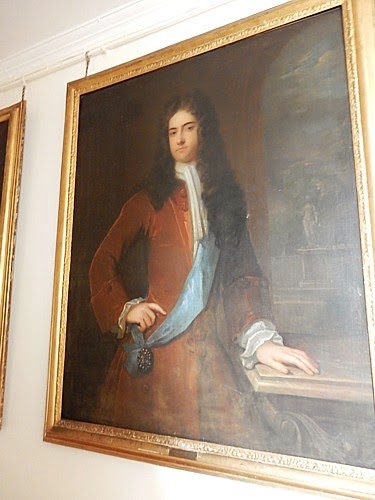
Duke of St Albans
The private family apartments of a Gloucestershire castle contain large three-quarter sized portraits of both Charles and Diana, and I greatly appreciate the owners’ invitation to view and photograph these paintings. They appear to have been created in 1718, after Charles became a Knight of the Garter—he wears a handsome crimson coat crossed with a blue sash from which hangs a jewel-studded Lesser George medallion.


Diana, Duchess of St Albans


Diana sits serenely in a white dress, fingering a blue ribbon. By my count this later painting represents the seventh time she posed for Kneller, indicating that she must have got to know him rather well!


Kneller's Self-portrait
Kneller was a companion of Dryden, Addison, Swift, and Pope, most of whom wrote verses proclaiming his talent and fame and what they regarded as his genius. He died aged seventy-four on 19 October, 1723, three years ahead of his regular client the Duke of St Albans. Two days before his death his friend Pope visited him, and declared, “I believe, Sir Godfrey, if Almighty God had had your assistance, the world would have been formed more perfect.”

These laudatory lines were composed by Addison:

Thou, Kneller, long with noble pride,
The foremost of thy art hast vied
With nature in a generous strife,
And touched the canvas into life.

Though later critics were less enamoured of Kneller’s style and works than his contemporaries, I remain forever grateful to him for touching those canvases and presenting my characters as they appeared to him in life!

~~~~~~~~~~~~~
Images: thepeerage.com, National Portrait Gallery, Wikimedia Commons, author's collection and personal photo archive

Sources: Documents in the British Library; Sir Godfrey Kneller: His Life & Times, Lord Killanin; Beauty, Sex, and Power: A Story of Debauchery and Decadent Art at the Late Stuart Court, Brett Dolman, David Souden, Olivia Fryman; Oxford Dictionary of English Biography

~~~~~~~~~~~~~


Margaret Porter, who can claim a few tiny drops of de Vere blood, is the award-winning and bestselling author of several historical fiction genres, and is also published in nonfiction and poetry. A Pledge of Better Times, the story of courtiers Lady Diana de Vere and Charles Beauclerk, 1st Duke of St. Albans, and of Diana's father Aubrey de Vere, was just released in trade paperback and ebook. Margaret studied British history in the UK and the US. As historian, her areas of speciality are social, theatrical, and garden history of the 17th and 18th centuries, royal courts, and portraiture. A former actress, she gave up the stage and screen to devote herself to fiction writing, travel, and her rose gardens.

Sunday, January 25, 2015

The De Vere Family in the 17th Century

by Margaret Porter

The blood of the English de Veres, which still flows through the veins of Britain’s noble families—and some members of the present royal family—can be traced backwards in time to a Frenchman, Alberic de Vere. He accompanied William the Conqueror to England and in 1066 fought at the Battle of Hastings. Not long afterwards he was granted lands in Essex, the county most closely associated with his descendants. His grandson Aubrey, Count of Guines, was further ennobled as First Earl of Oxford by Empress Matilda when she was Queen of England. And down the centuries, through every reign, the de Veres were prominent as royal chamberlains, courtiers, and favourites.

Edward de Vere, 17th Earl of Oxford
The passage of five hundred years brings us to the 17th century and the waning days of the Seventeenth Earl—by far the most famous and illustrious member of his family. Edward de Vere was a shimmering star in Queen Elizabeth’s court, who referred to himself in his signature variously as "Oxford" or "Oxenford". For those who doubt that the genuine author of Shakespeare’s plays and poetry was a common glover’s son from Stratford, de Vere is most frequently proposed as their probable creator. He was a warrior-poet, in addition to being well-travelled, a gifted dancer, and a court officer. And, in the opinion of his wife Anne Cecil and her powerful father Lord Burghley, a terrible husband! It was his second wife, Elizabeth Trentham, who in 1593 provided an heir to his earldom.

Ten years later, at the death of his beloved Queen, Lord Oxford wrote to his brother-in-law of his grief, saying, “In this common shipwreck, mine is above all the rest.” On the accession of King James I, he asserted his hereditary claim as Lord Great Chamberlain and received from the King’s Wardrobe “forty yards of crimson velvet for the Earl’s own robes” to wear at the coronation on 25 July, 1603. Among his many duties on that date: delivering the uncrowned monarch's shirt, stockings, and underclothing to his bedchamber and dressing him for the coronation. As a perquisite, the Earl received “the bed on which the King had slept the night before the coronation and all his bedding, the coverlet, curtains, pillows, and hangings of the whole room, with the King’s nightgown.” During the coronation banquet, he presented the King's food. Oxford had but a year to enjoy his new possessions, for he died on 24 June, 1604.

Henry de Vere, 18th Earl of Oxford
His son and successor Henry was only eleven years old, the inheritor of a wasted estate. The boy's mother struggled to reclaim Hedingham, the de Veres’ ancestral castle in Essex, and other property in East Anglia. On attaining his majority he departed on a grand tour and spent five years in the Low Countries, France, and Italy. He later became Vice-Admiral of the Fleet, perhaps in order to keep him away from Parliament, where he was reportedly “one of the free-est speakers . . . .” He didn’t last long as a naval commander: disputes with the all-powerful Duke of Buckingham landed him in the Tower more than once. Like his father, he married a Cecil, but she bore him no children. He died at The Hague from a battle wound in 1625, two months after King James I, and was buried in Westminster Abbey.

Robert de Vere, 19th Earl of Oxford
As preparations began for Charles I’s coronation, Henry’s cousin Robert’s right of succession was disputed by another lord, preventing the presumptive Nineteenth Earl from taking part in the ceremony. Nearly a year later the House of Lords affirmed Robert’s status, and he took his seat in April 1626. In February of the following year his countess, Beatrice van Hemmema of Friesland, delivered their son Aubrey.

History repeated—like Edward and Henry de Vere before him, Aubrey became an earl when very young after his father fell at the Siege of Maastricht. Inheriting his title at the age of five, the Twentieth Earl of Oxford spent his childhood and early adolescence in Friesland with his mother’s family.

Aubrey de Vere, 20th Earl of Oxford
By the time Aubrey returned to England at age fourteen with his mother and sister, the de Vere properties were nearly all lost. He attended university at Oxford and began his long and rather distinguished career as a soldier—he loved a good fight on and off the battlefield and was a notorious duelist. In 1647 he took as his bride the ten-year-old heiress Anne Bayning, who brought him much-needed funds and a life interest in her Essex estates. A bright and promising future was dimmed by the execution of Charles I. Aubrey, a devoted royalist, fled to the Netherlands to join the court in exile. His estate was sequestered in 1651. Three years later he returned to England and landed in the Tower after being accused of plotting against Cromwell. This did not deter him--after his release, under the code name "Mr Waller" he participated in further royalist conspiracies and in 1659 was again imprisoned. His wife voluntarily joined him in the Tower, sickened, and died there. He was released a fortnight afterwards.

With the fall of the Commonwealth, the widower Aubrey, premiere earl of the realm, was among the six peers who invited Charles II to return to England. His good friend, the king he’d supported in exile, made him a Knight of the Garter, Lord Lieutenant of Essex, and gave him command of the regiment that was known as the “Oxford Blues.” He became a Privy Councillor and a Gentleman of the Bedchamber.

Aubrey, “the first of his Dignity in the Realm tho’ low in fortune,” was a gallant and courtly man, a gambler, and as lusty as Charles II’s other cronies—in other words, a very typical nobleman of the Restoration court. He arranged a false marriage to an actress who stirred his lust, employing one of His Majesty’s trumpeters to serve as “priest”. Despite the deception, the lady remained with him and in 1664 bore him a son. The mother referred to the boy Lord Bolbec, the courtesy title granted to an Earl of Oxford’s heir apparent, although he was the product of an unlawful marriage. Not surprisingly, the liaison didn’t last.

Aubrey proved himself a friend of the theatre in another way, by loaning out his coronation robes for a production of Shakespeare's Henry IV!

Diana Kirke by Peter Lely
His next mistress of note was the beautiful and immoral Diana Kirke, daughter of Whitehall Palace’s keeper and granddaughter of Aurelian Townsend, who composed court masques for King Charles I and Queen Henrietta Maria. When Di fell pregnant, the King offered the couple an annual pension of £2000 if they married. And so they did, in April 1673. Their first child, Charlotte, arrived not many months later.  She and her brother Charles, the true Lord Bolbec, died very young. Of the Oxfords' three surviving daughters, only one had an unblemished reputation—Lady Diana, the future First Duchess of St. Albans, who married Charles II’s son by Nell Gwyn. Lady Mary and Lady Henrietta, who were very possibly sired by Di's paramours, were as scandalous as their mother but did not succeed in marrying any of their lovers.

At James II’s accession in 1685, Aubrey was appointed Privy Councillor. At the coronation on 23 April his responsibilities were the same as when Charles II was crowned, and his wife took precedence over the other countesses. The Lord Chamberlain's instructions for the coronation clearly outline their positions: In procession of Countesses, four abreast, excepting Diana Countess of Oxford, alone….In procession of His Majesties regalia: The Sword of State in the Scabbard, born by Aubrey de Vere Earl of Oxford, Premier Earl of England, in his Robes of Estate, and Collar of the Order. 

Aubrey and James eventually fell out—the Earl refused to submit to the new King’s pro-Catholic policies and his stubborn intention to abolish the Test Act. Aubrey and his regiment supported the Protestant cause embodied in Prince William of Orange, and he welcomed the Dutch invader to England. After the accession of William and Mary, Aubrey participated in their coronation (his daughter Diana was one of the Queen’s train-bearers), and his former offices and honours were restored to him. He and the Oxford Blues fought against James II’s forces in Ireland, most notably at the Battle of the Boyne. In 1700 and and the following year he was commissioned as Speaker of the House of Lords, serving until William III revoked his privilege in September 1701.

Queen Anne was the last of the many monarchs Aubrey helped to crown. He succumbed to a serious illness in the winter of 1703 and died at his house in Downing Street, aged seventy-six. He was buried with his first wife Anne and many of his ancestors in Westminster Abbey's Chapel of St. John the Evangelist. The historic earldom of Oxford (first creation) died with him, as he had no legitimate son.

His daughter Diana, Duchess of St Albans, was a renowned beauty. Not long after her father's death, a member of the Kit-Kat club (a Whig drinking and discussion society) paid tribute to her and the de Veres' martial exploits by engraving these verses on a toasting glass:

1st Duchess of St Albans, 1694
Author's Collection
The line of Vere, so long renown’d in arms,
Concludes with luster in St. Albans’s charms;
Her conquering eyes have made their race complete,
It rose in valor, and in beauty set. 

Through Diana, the de Vere bloodline extended through her numerous offspring (eight of her nine sons survived) to the present day. Although the Beauclerks are more often described as direct descendants of King Charles II, they are equally connected to Aubrey the great 17th century courtier and his forbears. Murray de Vere Beauclerk, the current and Fourteenth Duke of St Albans, bears the name that Alberic brought to England in the 11th century, as does his eldest son, an author--and biographer of their ancestress Nell Gwyn.

Members of the royal family who carry de Vere DNA are William, Duke of Cambridge (through his mother Diana, Princess of Wales) and his son Prince George.

Sources:

The de Veres of Castle Hedingham, Verily Anderson
Manuscript letters written by Aubrey de Vere, 20th Earl of Oxford, held by the British Library
Beauclerk family papers held by the London Metropolitan Archive
A Genealogical History of the Dormant, Abeyant, Forfeited, and Extinct Peerages of the British Empire, Sir Bernard Burke
The Diary of Samuel Pepys
The Fighting Veres, Sir Clements Robert Markham
Monstrous Adversary: The Life of Edward de Vere, 17th Earl of Oxford, Alan H. Nelson
Dictionary of National Biography

~~~~~~~~~~~~~

Margaret Porter, who can claim a few tiny drops of de Vere blood, is the award-winning and bestselling author of several historical fiction genres, and is also published in nonfiction and poetry. A Pledge of Better Times, the story of courtiers Lady Diana de Vere and Charles Beauclerk, 1st Duke of St. Albans, and of Diana's father Aubrey de Vere, will be available in April 2015. Margaret studied British history in the UK and the US. As historian, her areas of speciality are social, theatrical, and garden history of the 17th and 18th centuries, royal courts, and portraiture. A former actress, she gave up the stage and screen to devote herself to fiction writing, travel, and her rose gardens.