Showing posts with label Art. Show all posts

Friday, May 6, 2016

19th Century Artist in London Residence James McNeil Whistler and visiting friends from across the water

by Michelle Shine

I’ve just spent some time looking through an extensive list of Victorian British painters and did not recognise many names. Dante Gabriel Rossetti is there, reviving medievalism with his pre-Raphaelite art, and JW Turner, the landscape artist whose paintings are characteristically emblazoned with light. Turner died in 1851 and it was often said that his work pre-empted impressionism. I probably missed one or two important names, (as I write this, Constable comes to mind) but nevertheless, there are not many British 19th Century artists, it seems, who are now household names.

By contrast, across the water in France at that time, there was a large group of burgeoning artists living and working in Paris. Unfortunately for them, their creative endeavours — which were cutting edge — were not appreciated by the art establishment, and were consequently ignored by the French art buying public. During their lifetime many were unknown. Some, like van Gogh, never sold a single painting and relied heavily on cash handouts from their families in order to survive. These artists who could live their whole lives in luxury on the proceeds of just one of their paintings now, are famous at last, and celebrated throughout the world: Edouard Manet, Claude Monet, Camille Pissarro, Vincent van Gogh, Auguste Renoir among them.

James Whistler/ Self Portrait
In 1855, an American born painter, James Whistler, made his way across the Atlantic to France where he studied art at atelier Gleyre, an occupation he had shown a flair and inclination for since childhood. Whilst there he frequented the cafes, and ensconced himself fully in bohemian life, making the acquaintanceship of Edouard Manet and Charles Beaudelaire, and no doubt compromising his health by smoking and drinking too much. He also spent a lot of time copying the old masters in the Louvre, and that’s where he first met his lifelong friend, Henri Fantin-Latour.

James Whistler had it in him to be dogmatic. ‘I’m not arguing with you, I’m telling you,’ he once said, demonstrating that he was not a man to accept contradiction lightly. So, when in 1858 one of his works was rejected by Le Salon des Beaux Arts, he upped and left Paris, and took up residence in London to try out his luck there. Not that he was able to leave Paris completely. He returned there many times. For in spite of its prejudice against young innovative artists, the city held a magnetic lure over him.

Whistler’s half-sister, Dasha Delano, who was married to the surgeon and etcher Sir Francis Seymour Haden, lived in Chelsea, and James followed suit. London was good to him, not only for embracing his art, but also his dandyish outgoing personality that soon made him something of a luminary. His quick wittedness was legendary:

When a female admirer came over to introduce herself and said, ‘I know of only two painters in the world; you and Velasquez.’

Whistler replied, ‘Why drag in Velasquez.’

And when a sitter complained that his portrait was not a great work of art. Whistler countered, ‘Perhaps not, but then again, you are hardly a great work of nature.’

On one occasion, he even outwitted his friend Oscar Wilde. In January 1886, The Boston Herald, reported this anecdote:

Whistler pricked this bubble of Wilde very neatly and epigrammatically at a Paris salon last season presided over by a well-known and popular lady. Whistler had been notably witty during the evening and finally made a bon mot more than usually pointed and happy that convulsed his listeners.

Wilde, who was present, approved Mr. Whistler’s brightness, and wondered why he had not thought of the witticism himself. ‘You will,’ promptly replied Whistler, ‘you will.’

This lightning comment on Mr. Wilde’s wonderful ability to think of other people’s bright things and to repeat them as his own had, you may imagine, an immediate and most discomforting effect on Mr. Wilde.

Symphony in White
James McNeil Whistler
In 1860, Whistler met Joanna Hiffernan. She became his live in lover, business manager and was the model in his painting Symphony in White: The White Girl, which in 1863 afforded him yet another refusal from the Académie des Beaux Arts.

The judges felt that the lily she held in her left hand symbolised her deflowering and the bearskin rug that she stood upon was a metaphor for masculine lust, making the picture somewhat obscene in their eyes. The painting almost caused as much of an uproar at the Salon des Refusés (the exhibition of rejected paintings sponsored by Napoleon III in 1863) as his friend, Edouard Manet’s, Dejeuner sur l’Herbe.

Dejeuner sur l’Herbe
Edouard Manet

It is ironic that Victorian England, in spite of all its puritanical ways, embraced Whistler’s controversial work, if not wholly (Symphony in White was also rejected by the Royal Academy, although two other works of his submitted at the same time were accepted) then definitely in part; he was able to exhibit the Symphony in White in a small gallery in Berners Street. The French might have had a reputation for being liberal towards sexual prowess but the English proved to be far more open-minded and forward thinking in general, when it came to art, than their counterparts across La Manche.

So much so, that when Whistler’s friend Henri Fantin-Latour wrote to him complaining about the difficulties of making a living from painting in France, he soon received a letter from Francis Seymour Haden, Whistler’s brother-in-law, enclosing a five pound note in payment for a sketch and an invitation to come to London. Haden asked Fantin-Latour to bring small artworks with him and wrote, ‘Let us see if they can be sold in London. According to Whistler there are weekly sales where small leisure subjects can be sold easily.’ Fantin-Latour took up the offer. His work sold well and later was accepted for the annual exhibition at the Royal Academy.

A studio in the Batignolles
Henri Fantin-Latour

In 1870, both Camille Pissarro and Claude Monet left France for England in order to escape the Franco-Prussian war. Pissarro settled with family in Norwood and painted many London scenes during his stay. After the war finished in 1871 he returned to live in France, but paid four more visits to England during his lifetime. England treated him well too. It was during one of his stays there that he was introduced to the art dealer Paul Durand-Ruel who later organized exhibitions for his work back in France. 

Pissarro was a fan of Whistler’s work and is quoted as saying, ‘This American is a great artist and the only one of whom America can be justly proud.’ Although Pissarro wasn’t too taken with the man himself, he thought Whistler’s flamboyance and celebrity debased his art. 

‘Whistler is even a bit too pretentious for me … I wouldn’t want to be an aesthete, at least like those across the Channel. Aestheticism is a kind of romanticism more or less combined with trickery, it means breaking for oneself a crooked road. They would have liked to have made something like that out of impressionism.’ --Camille Pissarro

No doubt Whistler and Pissarro met at some point. They certainly had a lot of friends and acquaintances in common, but probably didn’t get on too well. Incidentally, they both died in 1903: Whistler from Lyme disease and Pissarro from blood poisoning.

Fox Hill, Upper Norwood
Camille Pissarro
Claude Monet and Whistler, on the other hand, were firm friends, although according to Katherine Lochnan of The Art Gallery of Ontario there is no documented evidence that they met before the 1880’s. They had a lot in common. Their work drew a parallel. Whistler painted the Thames and Monet, the Seine. Both painted their hometown rivers in a whimsical, impressionistic manner. They must have had a lot to speak about when they finally met up.

The Thames
James McNeil Whistler


The Seine
Claude Monet
This post was originally published on May 6, 2014.
~~~~~~~~~~~~~

Michelle Shine lives in London, England. For twenty years she ran a successful homeopathic practice. She is the author of What About the Potency? A homeopathic textbook now in its third edition and The Subtle Art of Healing, a novella which was longlisted for the Cinnamon Press Novella Award in 2007. Her short stories have appeared in Grey Sparrow, Liar’s League, Epiphany, and several collections. She has an MA in Creative Writing from Birkbeck University. Her debut novel Mesmerised is out now in paperback in the UK from all good booksellers and on Kindle worldwide, published by Indigo Dreams.

Watch the Mesmerised trailer here: http://www.youtube.com/watch?v=ULJYdmR0Fnw
Read the Mesmerised blog here: 1writer2.blogspot.co.uk
Buy Mesmerized on Amazon
Michelle's website: http://www.michelleshine.co.uk

Saturday, April 23, 2016

Pinkie and Blue Boy ~ A Matched Set?

by Debra Brown

Pinkie
58 1/4 x 40 1/4 in. (148 x 102.2 cm.)
Oil on Canvas
The Huntington Library,
Art Collections, and Botanical Gardens
The Blue Boy
70 5/8 x 48 3/4 in. (179.4 x 123.8 cm.)
Oil on Canvas
 The Huntington Library,
Art Collections, and Botanical Gardens

Pinkie hangs opposite The Blue Boy in the Huntington Library in San Marino, California, USA. Seeing copies from time to time as I drifted through life, I imagined they were a matched set--perhaps siblings or cousins. Did you?

In fact, they were painted about 24 years apart by two different artists. How lovely for us that Pinkie turns to our right and the Boy to the left, and hanging together they make a wondrous, harmonious pairing.

Titled Sarah Barrett Moulton: Pinkie by the museum, the eleven year old girl's portrait was done by Thomas Lawrence in 1794. The portrait has atmosphere and motion with the storm blowing her gown and ribbons to the left.

Detail of  Pinkie, picture reversed
Sarah Goodin Barrett Moulton, called Pinkie or Pinkey by her family, was born on 22 March 1783, in Little River, St. James, Jamaica. Hersey Barrett, a maternal ancestor, had arrived in Jamaica with Oliver Cromwell's forces in 1655. The family became wealthy landowners, slave owners, and exporters of sugar cane and rum.

By 1789 Sarah's father, Charles Moulton, had left his family. She and her siblings were raised by her mother and the Barrett family. Sarah and two brothers sailed to England in 1792 to continue their educations. Sarah attended Mrs Fenwick's school at Flint House, Greenwich, as did other children from Jamaican colonial families.

Sarah's grandmother in Jamaica, Judith Barrett, wrote to a niece living in Richmond, Surrey, to commission a portrait of her 'dear little Pinkey'. We can be grateful, for Sarah died the following year. The painting was displayed in the Royal Academy exhibition of 1795 which opened the day after her burial. It remained in the family until 1910, at one time a possession of her brother Edward, the father of the poetess and writer Elizabeth Barrett Browning. It was sold for 74,000 guineas in 1926, the highest price ever paid for a painting at auction at that date.

Thomas Lawrence, painter-in-ordinary to George III, was charging 160 guineas for a full length portrait at the time, though we do not know the amount Sarah's grandmother paid for Pinkie.


Thought to be perhaps Thomas Gainsborough's (1727–1788) most famous work, The Blue Boy is possibly a portrait of Jonathan Buttall (1752–1805), the son of a wealthy hardware merchant who owned property in the City of London and Ipswich, Suffolk. Gainsborough was working in Ipswich in the 1750s, and the Buttall family may have met him there. The artist shared a love of music and formed a friendship with the young Jonathan whom he asked to be present at his funeral.

In 1768 Jonathan inherited his father's business and was considered "an immensely rich man," but in 1796 bankruptcy forced him to auction off much property including The Blue Boy and other paintings by Gainsborough. Buttall married Mary Jump on March 31, 1798, but no children are mentioned in his will. He died in 1805 from spasms at his house on Oxford Street.

The painting is certainly a study in 17th-Century apparel and regarded as homage to Anthony van Dyck. It was bought from Buttall by the politician John Nesbitt and then came to be in the collections of the portrait painter John Hoppner followed by the Earl Grosvenor and his descendants, the dealer Joseph Duveen and finally, causing a public outcry in Britain, the American railway pioneer Henry Edwards Huntington.

Before heading to California, the painting was put on display briefly at the National Gallery and viewed by 90,000 people. The Gallery's director, Charles Holmes, wrote on the back, "Au Revoir, C.H.".

So, was it typical in those days, as today, for girls to wear pink and boys to wear blue? Actually, author Tom Williams says no. He writes that in 1918, the advice given to American parents was:
“The generally accepted rule is pink for the boys, and blue for the girls. The reason is that pink, being a more decided and stronger color, is more suitable for the boy, while blue, which is more delicate and dainty, is prettier for the girl.”
While girls obviously wore pink as in the painting above, boys would wear pink coats as a pale imitation of Redcoat uniforms. I think it also interests Americans that British baby boys wear christening gowns. That of litte Prince George is a copy of the one made for Queen Victoria's daughter, Princess Vicky. It seems fashion matters can vary for the genders from time to time and place to place.


Bibliography

Oxford Dictionary of National Biography article by Kate Retford
http://www.oxforddnb.com/view/printable/93084

Wikipedia
http://en.wikipedia.org/wiki/Pinkie_(painting)

The Huntington
http://emuseum.huntington.org/view/objects/asitem/items$0040:353

The Huntington
http://emuseum.huntington.org/view/objects/asitem/search$0040/0?t:state:flow=2cc0f75b-bcf8-4c37-bfc4-20f24d7e41d5

The Huntington
http://emuseum.huntington.org/view/people/asitem/Objects$0040244/1?t:state:flow=74eac449-b05c-4b66-81cc-32931e8733d6

Wikipedia
http://en.wikipedia.org/wiki/The_Blue_Boy

Writing About Writing
http://thewhiterajah.blogspot.com/2014/04/pink-for-girl.html

Images
Wikimedia - Public Domain

ABCGallery.com
http://www.abcgallery.com/L/lawrence/lawrence64.html

Discover Los Angeles
http://www.discoverlosangeles.com/blog/ten-masterpieces-you-wouldnt-expect-find-los-angeles

~~~~~~~~~~~~~

Debra Brown cut her teeth on the Bookhouse Books which created a nagging longing to live in a land of castles and wear flowing gowns and headdresses. Though life was busy and full, she eventually became able to do so vicariously through the characters of her books.

Her first published novel, The Companion of Lady Holmeshire (World Castle Publishing, 2011), is set in early Victorian England. Emma, a former servant girl, was chosen as companion to The Countess of Holmeshire and dragged along into polite society where she was sure to receive a rude reception.

Debra's beloved work-in-progress, For the Skylark, is on the back burner but simmering slowly. She runs the English Historical Fiction Authors blog and is an author and co-editor of Castles, Customs, and Kings: True Tales by English Historical Fiction Authors (Madison Street Publishing, 2013) which will soon be released as an audiobook. Please watch for Volume Two of Castles, Customs, and Kings in the September 2015.

Amazon
This post is an EHFA Editor's choice. It was first published on November 4, 2014.


Sunday, March 27, 2016

A Child’s Portrait in Different Views: Angel’s Heads

by Catherine Curzon

Regular readers of my posts both here and on my own site here will know that I hold something of a soft spot for Sir Joshua Reynolds, the legendary Devonian portrait artist. Reynolds was the darling of the upper classes and his work is among that of a select group who define British art in the long 18th century. Perhaps best known for his portraits, it was a form he took a slightly different approach to with the work I am looking at today, A Child’s Portrait in Different Views: Angel’s Heads, which was painted between 1786–7.

This unusual painting depicts five differing studies of the head of  his infant subject, Lady Frances Isabella Keir Gordon. Lady Frances was the five year old daughter of Frances Ingram-Shepheard and her husband, Lord William Gordon, who had once made scandalous headlines thanks to his youthful elopement with one of George III's old flames.


Now years later and steeped in respectability, Lord William commissioned the portrait in summer 1786. Over the months that followed, Reynolds worked tirelessly on the painting, eventually completing it in March 1787. The canvas was displayed at the Royal Academy and Reynolds took as his inspiration for the style a drawing of cherubs' heads by Carlo Maratta.


A Child’s Portrait in Different Views: Angel’s Heads by Joshua Reynolds, 1786-7


The portrait is clearly very different to those works with which Reynolds has become better associated, a far from formal or traditional work or portraiture. Instead, he has painted the same child five times and each of the heads shows a different expression, from wonder to concern to happiness, capturing the vagaries of Lady Frances's changing moods. In only one part of the canvas does she look directly out of the painting, her attention briefly caught and held by the world beyond the frame.


It is a painting commissioned by parents who clearly adored their child and wanted to remember her in those early years as she grew into a woman. In fact, this picture would far outlast the little girl and when she died in 1831, her bereaved mother passed the work to the National Gallery, where it remains to this day.


The cherubic style and the unusual execution of the work is is not, in all honesty, one to which I am particularly attached. However, it is a work that I have never forgotten in the years since I first saw it and for that reason I present it to you today - after all, one can never have too much Reynolds!


References

Postle, Martin. Joshua Reynolds: The Creation of Celebrity, (Tate Publishing, 2005).
~~~~~~~~~~~~~


Glorious Georgian ginbag, gossip and gadabout Catherine Curzon, aka Madame Gilflurt, is the author of A Covent Garden Gilflurt’s Guide to Life. When not setting quill to paper, she can usually be found gadding about the tea shops and gaming rooms of the capital or hosting intimate gatherings at her tottering abode. In addition to her blog and Facebook, Madame G is also quite the charmer on Twitter. Her first book, Life in the Georgian Court, is available now, and she is also working on An Evening with Jane Austen, starring Adrian Lukis and Caroline Langrishe.

Wednesday, March 9, 2016

Blank Tudor Faces

Judith Arnopp

 We have all become so familiar with royal Tudor images that we no longer really see them. One glance tells us who they are. We think we know them. They exude power, majesty and the iron fist of mastery.

Earlier portraits of the Plantagenet kings, and even the early portraits of Henry VII are very different to that of his son and grandchildren. But it was Henry VII, the first ‘Tudor’ king who began to develop the ‘Tudor’ brand.

The royal portraits of Henry VI, Edward IV, Richard III are all quite sombre, the artist doing his best to portray an ordinary man who was king. Even this portrait of Henry Tudor has nothing overtly regal about it; there is even a glimpse of personality, perhaps a measure of distrust, cynicism, impatience, or is it amusement? However you interpret his expression, it is a portrait of a human being, not a representation of royal supremacy.

 In the early days of Henry’s reign his position was unstable, he was an unknown quantity. There were no guarantees of peace and there were several Yorkist attempts to take his throne. The Tudors were the new kids on the block; nobody could foresee what sort of king Henry would make and his popularity depended very much on that of his wife, Elizabeth of York. Yorkist propaganda demeaned his claim to the throne, declaring that his mother’s line was illegitimate and that Lancaster had stolen the crown in 1399. They also sneered at his great grandfather who had been a lowly innkeeper.

Henry, realising he needed to reinforce his hold on the country, invented (or perhaps ‘embellished’ is a better word) his family history to create an impressive Tudor dynasty. He stressed the royal connection of his mother, Margaret Beaufort, and her descent from John of Gaunt and, to strengthen his claim further, he legally removed the stigma of bastardy from the family. He reiterated the royal descent of his grandmother, Katherine of Valois and, more surprisingly, claimed descent from the ancient Welsh King Cadwaladr, and King Arthur. To further cement his link to Arthur he named his first born son in his honour and embellished the round table at Winchester with the Tudor rose.

With the blood of both York and Lancaster flowing in the veins of his two sons and several daughters the Tudor line looked set to continue but Arthur’s sudden death in 1502 taught Henry that a king can never have too many sons. He lost no time in teaching his remaining son, later to become Henry VIII, the finer points of kingship. He stressed the importance of his role, the unreliability of the fickle populace, and the crucial need for strong male heirs to perpetuate the dynasty. The importance of heirs was a lesson young Henry never forgot, and one he fought tooth and nail for the rest of his life to achieve.

The blooming of the Renaissance and the introduction of men like Holbein to the royal court helped to reinforce this new Tudor image, and during Henry VIII’s reign new style of royal portraiture began.

I think of them as ‘power portraits’ that were loud declarations of Tudor permanence and dominance.
This one was painted by Holbein the younger after 1537, at a time when Henry was at the height of his power. He had freed himself from Anne Boleyn and the Pope, and Jane Seymour had finally provided the son and heir he’d been craving.

Today, we are used to seeing this image and others like it but imagine its impact in a world in which images were rare and people’s lives were not dominated by photographs or colour. Everything in this portrait is designed to impress; we cannot take our eyes from the breadth of shoulder; the sumptuous quality of his clothes; his immovable stance; the potent codpiece, and the unflinching expression in his eye. The portrait exudes wealth, power and uncompromising control. It is an unspoken declaration. ‘I am the king; it shall be as I say.’ There is not the slightest hint of insecurity, yet Henry was very insecure.

We all know about Henry; his failed marriages, his quest for an heir, his break with Rome, his megalomania, and ruthless rule but, what about the man behind the grandeur? Take a closer look at his face. What does it tell us about the inner man?

He looks bullish at first glance but on closer inspection you will see his eyes are blank, his expression closed. You might say he looks belligerent or mean but is that really what we are seeing, or is that a preconceived idea, because of what we already know? Personally, I think his inner feelings are obscured by my pre-knowledge but, if I try to wipe my mind and focus solely on his face, I see ennui, and sadness. As if he is hiding behind his own splendour.


All the Tudor monarchs have this same expression. The portraits as a whole are only concerned with an outward show of majesty, a declaration of authority. Edward VI was ten years old when he became king, a young skinny boy with a burgeoning ego that would soon match his father’s. Here he is carefully painted in a similar stance to Henry. He is well-padded and embellished in satin and fur, and a much smaller cod-piece than his father’s promises future virility and heirs to carry on the Tudor name. But again, it is the image of a king with an empty face. ‘I may be young,’ he is saying, ‘but do not underestimate me; I am my father’s son.’

Edward’s short reign was one of religious persecution as the Protestant king tried to terrorise his subjects into following his will. His premature death was greeted with relief by many Catholics for now it was the turn of the Protestants to be subjected to the will of Mary Tudor.

Unlike her father and brother, Mary is seated, but her portrait is no less authoritative. Her erect posture and uncompromising stare are enough to turn living flesh into stone but there is little to be read there; we cannot see beyond her steely gaze to the woman within.

Her attempts to reinstate the Catholic religion and wipe out the much newer Protestant religion resulted in the burnings and torture that earned her the posthumous name ‘Bloody Mary.’ But viewed more objectively, her personal sorrows were immeasurable. Mary had lived a sorry life; rejected by her father, disinherited from the succession, stripped of her title ‘princess’, separated from her mother, Katherine of Aragon, Mary channelled all her frustration and anger into her religion. Her devotion to God and the Catholic Church was matched only by her passion for her husband, the reluctant Philip of Spain, and her wish for a son to follow after her.

Her health was never good; there is some evidence that her menstrual cycle was erratic and she suffered both physically and mentally from a young age. In later years her failure to conceive, her phantom pregnancies and failing marriage compounded her misery until she died a painful death in 1558 leaving no heir. Mary, who had gone to extreme lengths to rid England of the new religion, was now forced to leave the realm in the hands of a Protestant queen, her sister Elizabeth.


Elizabeth was the greatest Tudor of them all and the one who exploited royal portraiture to the full. The queen was very aware of the power of image and iconography. Encouraged by her adviser, John Dee, her portraits became more and more extreme. In every image she is majestic and fabulously dressed, her tiny frame all but obliterated by satin, velvet, lace and jewels. In looks Elizabeth resembled her great grandmother, Margaret Beaufort and her grandfather, Henry VII but by nature she was very much like her father.

If her grandfather and father had coveted England and parts of Europe, Elizabeth's ambitious eye went further - to the New World. In the Armada painting below, her hand rests on a globe and, just in case the viewer should forget who wears it, the crown of England is just above. If you look closely, her famously long, white fingers are covering the Americas and behind her are commemorative paintings of the Spanish fleet being driven onto a rocky shore by a storm that became known as the 'Protestant Wind,' suggesting God's approval of England's victory over Catholic Spain. Elizabeth is proclaiming herself the saviour of her people; the mother of her expanding empire: a victorious, virgin queen, blessed by God.


These are the things the Tudors wanted the world to see and believe. Their private 'selves', their inner thoughts and feelings were none of our concern and so they turned their faces into masks - a blank page devoid of personality yet replete with majesty.


Although the Tudors are well-documented and easily accessible through portraits and records, writing about them is not easy. We know what they did and when they did it; we know the relationships they had, the political scene, the style of their clothing, the shade of their hair and eye colour but there are only the tiniest glimpses of their inner selves. In order to populate my novels with believable characters I have to mentally prise off their masks, strip off their rich finery, and try to reach inside their minds. What is left are people as ordinary as you and I. In their natural state it is easier to consider these icons of monarchy as human beings, and imagine the emotions that triggered their most bizarre behaviour.  Each Tudor monarch had hopes and fears (mostly of failure) and insecurity, and they had dreams too, and a vast self-disappointment that ate away at them all.

For all their power, all their wealth and status, they could not have or hold the things they most desired: fidelity and adulation.

Photographs in the public domain from Wikimedia Commons


Judith Arnopp is the author of eight historical fiction novels including:

The Beaufort Bride: Book one of The Beaufort Chronicles - Available to pre-order NOW

A Song of Sixpence: the story of Elizabeth of York and Perkin Warbeck

Intractable Heart: the story of Katheryn Parr

The Kiss of the Concubine: a story of Anne Boleyn

The Winchester Goose: at the court of Henry VIII

The Song of Heledd

The Forest Dwellers

Peaceweaver


For more information please visit the webpage

Author page: click here

or look for her on Facebook.

Wednesday, July 8, 2015

Historical Paintings: Authenticity v. Drama

by Anne O'Brien

Is this the real Joanna of Navarre?  If so, it would be a valuable addition to the little we know of this fifteenth century Queen of England.

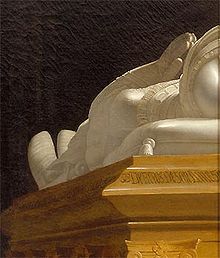
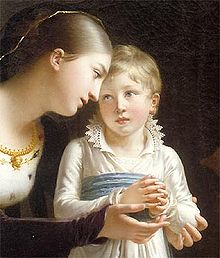
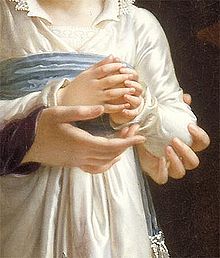
This is a painting of Duke Arthur III of Brittany, painted by the French artist Henriette Lorimier and exhibited in the Paris Salon of 1806 when Romanticism was the order of the day.


It is of interest to me because it is one of the few representations we have of Joanna of Navarre, second wife of King Henry IV of England.  It shows her, beside the tomb of her late husband Duke John V of Brittany, in the role of caring mother, instructing her young son in the need for piety, in the importance of family history, and in his duty to the role of Duke which he would inherit from his dead father, John de Montfort.  Joanna is dark-haired, attractive, every inch a Navarrese and Valois princess.

I would like to think this would be a valuable image for me in bringing Joanna to life when writing about her.  But how accurate a representation is it?  There is much to intrigue the historian in this painting, and the choice that Henriette Lorimier made when deciding to portray Arthur as the young Duke.

In colouring and appearance of Joanna, we have no historical idea.  It is not on record.  We have no contemporary portraits of her.  If she is seen kneeling at her husband's impressive tomb, it would have been after 1409, when Joanna had personally had the alabaster image sculpted in England and sent to Nantes Cathedral.  She would have been at least 40 years old.  Arthur by this time would have been 16.  Yet both mother and son look younger than this - clearly to maintain the romantic image of the young and beautiful widow and the young child with all the duty on his shoulders.  As Queen of England, Joanna never returned to Brittany to see the tomb completed, as far as the records show. 


It could be argued of course that this image was from the date of Duke John's death in November 1399, in which case Joanna was only thirty one, and Arthur was six years old, which makes the image more realistic, but still does not explain the magnificent tomb beside which she is kneeling.

Another interesting point: Arthur was not the heir to the Dukedom when John de Montfort died.  Why chose to paint this child, receiving his mother's encouragement and instruction?  The heir was another John, the eldest son, who became John VI on the death of his father in 1399.  So why paint Arthur?

The choice of costume is also highly romantic.  Joanna is wearing a fur trimmed cote-hardie, which by 1409 would have been regarded as not the height of fashion by members of the Court.  Joanna, who was known to spend extravagantly on clothes, would have worn a houppelande with its high neckline and heavy folds, and her hair would certainly have been covered with a veil or one of the fashionable rolled chaplets or a caul.  Her hair would not have been uncovered in public as it is here.  As for Arthur, he appears to be wearing something  romantically childlike for 1409.  I expect that the artist thought that a romantic, easily recognisable 'medieval' image was more important than authenticity.


And finally to return to why Henriette chose to paint Arthur.  He actually became Duke of Brittany but not until 1457 in the final year of his life, taking the title after his nephew Peter who died childless.  Arthur was 64 years old when he became Duke.  Was he chosen for the subject of this highly romantic picture because he played a notable part in French history?  He fought alongside Joan of Arc.  He was Constable of France and a notable leader of the French army, taking an important part in the negotiation to bring peace between France and Burgundy at the Treaty of Arras. This alliance led ultimately to the end of English pretensions to the French crown.  Furthermore Duke Arthur led the French army in the battle of Formigny in 1450 which resulted in the conquest of Normandy.  Thus Arthur was undoubtedly a heroic figure in French military history.  I can only presume that this was the reason for this painting in the nationalistic days of Napoleonic France.


What a sentimental portrait this is. Do the historical inaccuracies matter?

I would suggest that accuracy has no bearing on the subject.  It was not painted to make a genuine historical comment but to heighten the emotion of the relationship between the young widowed duchess and her little son, to tug at the heart-strings of the onlooker.  It makes her an appealing figure, which is what was intended.  As long as we know the intentions of the artist, then we are able to appreciate the worth of this romantic painting.

As an interesting post script; this painting gained an immense success when it was exhibited in 1806. Empress Joséphine immediately purchased it for her paintings gallery at the Malmaison.

My novel of Joanna of Navarre, The Queen's Choice, will be published in Hardback and eBook in January 2016, followed in May in Paperback.

www.anneobrienbooks.com

Monday, June 29, 2015

William Hogarth and The Shrimp Girl

by Catherine Curzon

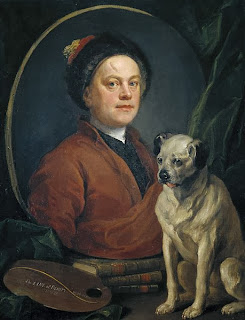
The Painter and his Pug by William Hogarth, 1745In the history of art and painting, some names have endured for centuries. The chroniclers of their times, their reputations have grown through the years and raised them to the status of icon. Of the many glorious artists who emerged from the Age on Enlightenment, one of the most respected, recognised and influential is the great William Hogarth, English painter, satirist and printmaker. 
His work is instantly recognisable and justifiably celebrated, with series such as the magnificent Marriage A-la-Mode endlessly reproduced and rightly lauded. However, my favourite work by Hogarth is not one of his satirical series nor his portraits of the great and good, but a painting of an unknown and far from illustrious young lady, The Shrimp Girl. 

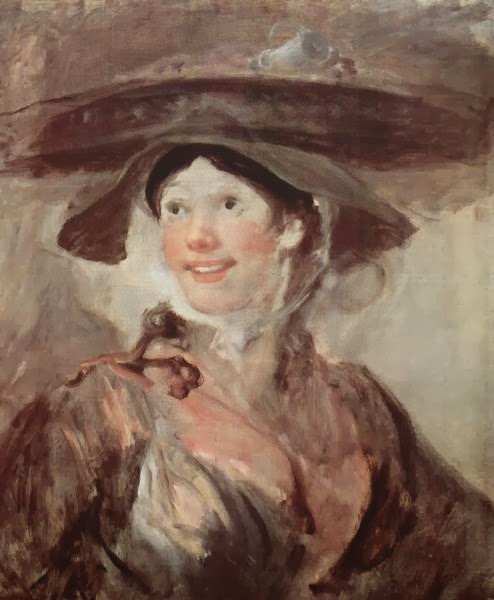
Although the work is undated, experts believe that the unfinished oil on canvas dates from the 1740s, and was most likely begun as an experiment in working with different styles of painting. If this date is correct, then Hogarth was already at the peak of the art world. He was an established, hugely successful figure with nothing left to prove and perhaps was searching, as Joshua Reynolds often did, for new styles and techniques to stimulate his own creativity. By the 1740s, Hogarth's sitters paid vast sums to commission paintings, and his works were instantly recognisable, influential and lauded by the most illustrious names in the country. Deeply embedded in contemporary culture, the public flocked to printshops to purchase prints of his works. However, Hogarth wasn't content to rest on his laurels with these successes, and when he painted The Shrimp Girl he was looking to develop a less formal style, experimenting with elements of impressionism and a light, frivolous touch.


The Shrimp Girl by William Hogarth, 174o-45
The Shrimp Girl by William Hogarth, 1740-45
The identity of the woman in the painting is unknown and sadly, no records exist to lend so much as a clue to who she might be. However, one thing we can be sure of is that young women like this would have been familiar sights around the fish markets of the capital where Hogarth took his inspiration. That is not a hat the young lady wears, but a basket balanced atop her head from which she sells fresh shellfish, the pewter tankard used as a half-pint measure to properly portion out the goods. Although he never finished the work, Hogarth kept the painting at home until his death. When his widow, Jane Thornhill, showed it to people after Hogarth had passed away, she told them, "They say he could not paint flesh. There is flesh and blood for you".

In The Shrimp Girl we see a joyously beaming face free of make up, fashion or guile that is at odds with the idealised formal portraits that lined the walls of galleries and fine homes. This painting illustrates a long-lost, anonymous moment of London street life, one of thousands of such moments that occurred every day yet Hogarth has captured it as clearly as a photograph might today, immortalising the unknown, cheerful young woman forever. The Shrimp Girl is not Hogarth's most dramatic work, nor his most magnificent; it tells no satirical tale, not does it present us with an illustrious figure of national importance, but it does show us the everyday face of Hogarth's London and that is why, for me, it is his one of his greatest works.


Hogarth, William (1833). Nichols, JB, (ed). Anecdotes of William Hogarth, Written by Himself. London: J. B. Nichols and Son.

~~~~~~~~~~~~~

Glorious Georgian ginbag, gossip and gadabout Catherine Curzon, aka Madame Gilflurt, is the author of A Covent Garden Gilflurt’s Guide to Life. When not setting quill to paper, she can usually be found gadding about the tea shops and gaming rooms of the capital or hosting intimate gatherings at her tottering abode. In addition to her blog and Facebook, Madame G is also quite the charmer on Twitter. Her first book, Life in the Georgian Court, is available now, and she is also working on An Evening with Jane Austen, starring Adrian Lukis and Caroline Langrishe.

Wednesday, June 17, 2015

The Death of a Hero - The Story Behind a Painting

by Mark Patton.

Victor Hugo once described the British Channel Islands of Jersey, Guernsey, Alderney, Sark and Herm as "little pieces of France, dropped in the sea and picked up by England." They are certainly closer to France than they are to England, although today they are mainly English-speaking. The coast of Normandy is clearly visible from the north and east coasts of Jersey, and from the eastern coast of Alderney.

In fact, the islands were not dropped by France, but retained by England when, in 1204, King John lost his other possessions in Normandy to the French King Philippe-Auguste. Ever since, the islanders have found themselves on the front line whenever England (or, later, Britain) was at war with France.

In a current exhibition on British history-painting at Tate Britain in London, the centre-piece is a painting by the American artist, John Singleton Copley, of "The Death of Major Peirson." The painting is owned by the Tate, but is, ordinarily, on display in Jersey as part of a loan agreement. From 9th June to 13th September, however, those of us who live in, or have the opportunity to visit, London have the opportunity of viewing it.

"The Death of Major Peirson," 
by John Singleton Copley. Image: Tate Britain

The events depicted took place in January 1781. On the night of 6th January, a French force led by a mercenary adventurer who styled himself "Baron de Rullecourt" (his name was Philippe Macquart, and his noble title self-adopted) landed on the south-east coast of Jersey, under cover of darkness. He had with him around two thousand troops, but his choice of landing ground was disastrous, and he had lost almost half his force by the time he came ashore.

The coast of La Rocque, Jersey, where De Rullecourt landed his force.
A labyrinth of jagged rocks is to be found beneath the shallow waters,
making it the graveyard of many ships.
Photo: Man Vyi (image is in the Public Domain).

Philippe Macquart, "Baron de Rullecourt"

He had luck on his side, however (or perhaps this really was military judgement), in that the night in question was Twelfth Night, the last evening of the Christmas festivities, and most of the British garrison were celebrating, presumably consuming large quantities of the cider for which the island was then renowned. With his remaining troops, he reached the town of Saint Helier and surprised the island's Lieutenant-Governor, Moses Corbet, in bed, placing him under arrest and forcing the "surrender" of the garrison.

Knowing that Corbet's "surrender" had been made at the point of a gun, neither the British garrison, dispersed between several barracks around the island, nor the local Militia, had any inclination to comply with it. Command was assumed by the senior officer of the regular garrison, 24 year old Major Francis Peirson. He mustered his force on a hill overlooking Saint Helier (he had available around 6000 regular troops and 3000 militia, but it is not known how many of these were actually deployed) and advanced into the town.

Major Francis Peirson
thought to be by Jean Sullivan

The actual fighting lasted for less than fifteen minutes, the French force being decisively outnumbered, but both Peirson and De Rullecourt were killed in action. Copley's painting, commissioned by a London Alderman, John Boydell, shows Peirson falling at the centre of the market-place (now the Royal Square), but it is not thought that he ever reached this position: he was taken out by a sniper in the opening moments of the battle.

The painting also shows a black man (supposedly Peirson's servant, Pompey, although it is unclear that any such man existed) taking aim at the sniper. The uniform worn by this man appears to be that of Lord Dunmore's Ethiopian Regiment (which had nothing to do with Ethiopia, but rather was raised from escaped slaves in the American Colonies): soldiers of this regiment never served outside the American colonies.

Detail of Copley's painting,
showing "Pompey" taking aim

Peirson was buried in the crypt of the Town Church nearby, and De Rullecourt in the adjacent church-yard. The context for the invasion, backed by the French King, Louis XVI, was a desire to end the activities of Channel Island privateers, which were harrying French and American shipping on both sides of the Atlantic. With its defeat, these activities were free to continue.

It is unclear whether Copley, who lived and worked in London at the time, actually visited the island, or worked from commercially available prints, but most of the topographical and architectural details are correct, even if aspects of the battle are not.

Saint Helier's Royal Square in the early 19th Century
Visible are the statue of George II and the court-house
behind it, both of which can be seen on
Copley's painting, as well as the church where
Peirson and De Rullecourt lie buried.

Copley's painting went on public display in London in 1784, with an admission charge of one shilling, and attracted lengthy queues. For a brief season, the name of Peirson was celebrated as that of Nelson would later be (it still is on the island, where Copley's painting has featured on bank-notes and stamps).


Poster advertising the public exhibition
of Copley's painting in London.
Photo: Man Vyi (Public Domain).

~~~~~~~~~~~~~

Mark Patton blogs regularly on aspects of history and historical fiction at http://mark-patton.blogspot.co.uk. His novels, Undreamed Shores, An Accidental King and Omphalos, are published by Crooked Cat Publications, and can be purchased from Amazon.