Showing posts with label clothes. Show all posts

Tuesday, August 27, 2013

My New Clothes

by Anne Barnhill


I'm as excited as a school girl!  Why?  Because my Tudor dress, the outer garment, is finished.  Well, almost finished.  The miraculous seamstress, my dear friend from high school, Becky Thacker, must make sure the length is right.  My skirts will not be quite as long as the pattern indicated because I don't want to fall and break a hip while giving readings in my ensemble.  Besides, if I tripped, I might ruin the dress!

When my first book came out in January 2012, (At the Mercy of the Queen) Becky had completed the undergarments and I wore those to promote the book.  It was like that nightmare where you appear in front of people in just your skivvies--let's just say I lived the dream.

Here I am in shift, petticoat, bum roll:


After putting all that stuff on, I definitely see why one might need a lady-in-waiting.  I asked the lucky bookstore person to help (assuming this was a female) if Ms. Thacker couldn't attend me.  Often, there was great entertainment in the 'dressing room' as we struggled to get everything in place.

I expect the dress with be just as challenging.  Plus, I'll have all that underwear on, too. 

Thus far, I have not tried the dress on, but over a year ago, I fell in love with the materials Becky, her sewing advisor, Lisa, and I selected.  I had no idea the dress would be heavy, but I'm told the sleeves alone weigh a ton.

While the outer dress may not be as spot-on, historically speaking, as re-enactors might wish, it will serve my purposes well.  I want to bring listeners back to the 16th century and I believe visual aids help.  I've devised a little talk about the importance of clothing at Court; how, in those days, clothes really did 'make the man.'  Courtiers invested in silks and satins to impress the monarch, the way we might invest in real estate in the hopes of filling our portfolios.  If a courtier could catch the king's (or queen's) eye, establish a relationship and come into royal favor, that courtier would find his purse growing fatter and his future looking brighter.

I'm convinced my new dress would definitely be met with approval.  I used a color chart from The Tudor Tailor by Ninya Mikhaila and Jane Malcolm-Davies to select my cloth and tried to get materials that would have been used in the 1500's by a noblewoman.  I also took into consideration the extremely hot North Carolina summer: no heavy velvets or damasks for me. 

When my second novel, Queen Elizabeth's Daughter, is released next March, I hope to keep cool over the summer, dress and all.

Here's the final product:


I can't wait to try it on!

Thursday, November 22, 2012

Tambour Work

by Lauren Gilbert


Madame de Pompadour at her Tambour Frame by Henri Drouais
 
Regency novels frequently refer to “tambour frames” and “tambour work”.  One novel contained an amusing story where a lady used a tambour frame as a weapon.   I assumed It was a form of embroidery but knew nothing about it.   I enjoy needlework and thought it would be interesting to see what it was.
Tambour embroidery was a very popular and fashionable craft.   Thought to have originated in China, it was supposedly introduced to France in the mid-18th century, and subsequently spread to England and western Europe.   Ladies occupied their time with tambour work as well as other needle crafts, while professionals used this technique on a larger scale until machines were able to produce similar effects.  The stitcher uses a needle with a hook, similar to a modern latch hook, and makes a chain stitch on fabric stretched in a round frame. 
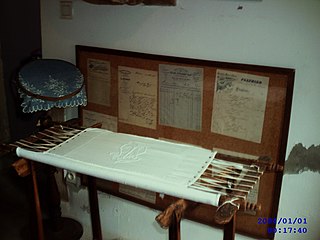
The frame is a two-part object, with an inner frame over which the fabric is stretched with the exterior frame holding it in place.  It is called a tambour or tambour frame because it resembles a drum (“tambour” is French for drum).  It is similar to modern embroidery hoops, but much heavier.   (I can now see how it could actually do some damage if used to strike someone!)  The thread is held underneath with one hand, while the other hand pushes the hooked needle through the fabric to catch the thread and pull it through. 

This shows the position of the hands, and the sturdiness of the frame.

Bringing the thread back up through the same hole forms a loop, and the pattern evolves as each new stitch is formed near the previous stitch, catching the loop from that stitch.  The stitches form a continuous chain.  The hooks used were small, sometimes not much more than a wire bent at the tip, and produced a lacy design.   It was commonly used to produce white on white design, such as the flower and vine designs popular on white muslin.  Tambour work was used to embroider gowns, shawls, reticules and other wearable items.  Using the finest hooks and threads, the chain stitch would also lend itself to monogramming handkerchiefs.  Obviously, fabrics with a more open weave such as muslin, gauze and net lend themselves beautifully to tambour work, as can be seen in the illustration below: 

At Fontenoy Chateau

Tambour embroidery is now also referred to as tambour crochet.  Crochet work as we know it seems to have evolved from tambour embroidery at least in part, being worked as a continuous chain, using a hook and thread or yarn, without the background fabric.  Tambour embroidery is still done today.  There are numerous resources on the internet for supplies, hooks and frames, and videos of instruction.
References:
de Dillmont, Therese.  THE COMPLETE ENCYCLOPEDIA OF NEEDLEWORK.  Third edition.  1996: Running Press, Philadelphia, PA.  (Illustrations of the tambour hook (fig. 280), and the position of the hands with the frame (fig. 281) from p. 144 used with permission.)
The Embroidery Site.  BellaOnline.com.   “Tambour Work” by Megan McConnell.  Not dated.  http://www.bellaonline.com/articles/art67103.asp
Clan Iain Abrach~McClain blog.  “A Brief History of Crochet” by Catie Rua the Weaver.  Posted 11/1/2003. http://www.iainabrach.org/blogitem.asp?ID=6  
Design.Decoration.Craft blog.  “Tambour Emboridery Work.”  (no author shown.) Posted 7/22/2010. http://thetextileblog.blogspot.com/2010/07/tambour-embroidery-work.html  
Illustrations of Madame de Pompadour and the Fontenoy tambour frame are from WikiCommons.  

Lauren Gilbert is the author of  HEYERWOOD: A Novel.  The heroine, Catherine, is a skilled needlewoman.  (More about the novel at http://www.heyerwood.com )
 

Wednesday, September 26, 2012

Women's Periodicals During the Regency: Ackermann's

by Lauren Gilbert

When the name Ackermann's comes to mind, the first thing one thinks of is the fashion plate, the beautifully drawn illustration of the current mode.  However, there was so much more than that...

Rudolph Ackermann published Repository of Arts, Literature, Commerce, Manufactures, Fashions and Politics  (also known as Ackermann's Repository)  in London beginning in 1809 as a monthly periodical.

Originally, this periodical was much more than a fashion magazine.  As its title indicates, each month, the reader was treated to a selection of articles about a wide variety of subjects, ranging from art and architecture, to domestic issues (including needlework patterns and home furnishings), biographical sketches of historical or current figures, reviews of books and art exhibitions, and all manner of things. Even political matters were explored.  Fashion was only one of many subjects addressed in these early magazines.

It was a very influential magazine, providing women with information about many topics, not just domestic matters.Women's buying power was also acknowledged, in that there were product advertisements, not only for cosmetics (such as Gowland's Lotion) but for larger purchases as well, such as furniture like the patent pianoforte advertised in 1812, shown here.


I took the opportunity to browse through the Repository of Arts, Literature, Fashions, Manufactures, &c.  The SecondSeries Vol. II July 1, 1816 No. VII.  Articles included information about architecture (A Gothic Conservatory and the new Customs House were the focus in this edition), saloon draperies, a needle-work pattern (a design for muslin), instructions on how to dye various fabrics certain colors from The Domestic Commonplace Book, poetry and short stories.  Under "Miscellanies", there was a fascinating article titled "Some Particulars Illustrative of the Character of Prince Leopold of Saxe-Coburg."  The fashion items appeared later in the periodical, and discussed English and French fashion issues.   The illustration below is from 1811 issue, and is very typical of the lovely and detailed fashion drawings that appear in every edition:

February 1811 Fur Pelisse

These illustrations and the very detailed descriptions provided were intended to keep women abreast of the current modes, and also to provide dressmakers with the information needed to replicate them.

The periodical ceased operations in 1829.  By that year, it was known as Ackermann's Repository of Fashion and was dedicated primarily to fashion and needlework. 

A quick review of Ackermann's Repository of Fashions, No. I January, 1829 Price 2s shows the beautiful fashion plates, with detailed descriptions and a needlework pattern.  The February 1829 edition includes masquerade costumes and "General Observations on Parisian Fashions", as well as a needlework pattern.  

Considering that, by this time, there was already a shift towards the mores and values we associate with the Victorian period, including the idea that a woman's place was in the home, no longer encouraged to take an interest in matters such as politics, the change in content is significant. 

Suggested reading list:
Blum, Stella, ed.  ACKERMANN'S COSTUME PLATES Women's Fashions in England, 1818-1828.  New York, Dover Publications, Inc. 1978.

On line via GoogleBooks:
The Repository of Arts, Literature, Fashions, Manufactures, &c.  The Second Series. Vol. II July 1 1816 No. VII  (found in REPOSITORY of ARTS, LITERATURE, FASHIONS &c. Rudolf Ackermann, Frederic Shoberl)

Ackermann's Repository of Fashions. No. I January 1829 Price 2s (found in R. ACKERMANN'S REPOSITORY OF FASHIONS [4th ser. of the Repository of arts, literature, fashions, manufactures].

(Both books contain multiple editions, and are fun to go through.)

By Lauren Gilbert, author HEYERWOOD, A Novel.

Monday, October 17, 2011

The Question Of What To Put On When You Go Shooting

A fortnight or so ago I was reading a blog post about the beginning of the shooting season and my imagination was instantly inflamed by images of handsome Regency gentlemen in their shooting-jackets, with guns (Did you know that they used to be called fowling-pieces?) and dogs enjoying a fine day’s sport on the moors or in the woods.

Before long, I had a set of characters and a plot-line for another story that I knew I had to write. Naturally, handsome gentlemen and great country estates is always a pleasure to write about, but there is also a terrible secret to deal with, centuries-old enmity to put an end to, a near-death accident to recover from, and something by way of a nice, satisfying ending for everyone involved.

The only problem was that the major part of the story was taken up by a shooting party and I knew nothing whatsoever about shooting. As always in such cases, I took myself to Google Books and, having found half a dozen books with advice and instruction to young sportsmen to begin with, started my research.

There is a great number of things to talk about in connection with the subject, but I decided to dedicate my first post, in what I imagine will be a series of posts, to those necessary articles of clothing that a Regency sportsman had to garb himself in when going fowling. I must say that they had to put on so many garments and supply their shooting habiliments with so many appendages I am surprised they could actually move, let alone walk long distances or be quick with their piece.

Of course, every author, expanding upon the subject, has his own view on the matter and often enough it is quite different to the one expressed by another author, so the best that a sportsman can do in such a case is to think for himself and choose wisely. Personally, if I were a sportsman, I would care about comfort rather than appearance and, as such, would adhere to a rather more sound advice of the following author, who believes that “a good deal of success, and nine-tenth of the real pleasure derivable from shooting, depends upon the right management of the commissariat department”:

A shooting sportsman should be conveniently and appropriately clad. Ease, comfort, and safety, are the three leading points to be attended to. The coats or jackets should be well supplied with capacious pockets; those for hares should be lined with oil-skin; indeed, all shooting pockets should have a lining of this kind, because there is commonly a multitude of articles to fill them with. To all shooters of forty years and upwards flannel shirts are recommended, no matter how warm the weather.

Laced half-boots, with gaiters to reach above the knee or whole-legged, are desirable things. Thick woollen stockings, made of soft yarn, not worsted. The great secret of keeping the feet in good order during continued walking, is the use of the right sort of stockings or socks: and none really answer the purpose so completely and pleasantly as the fine wool made into thick yarn, and home knit. To those who have tender feet, a little soap rubbed on the sole of a stocking will answer a beneficial end.

Taken from “Shooting: A Manual of Practical Information On This Branch Of British Field Sports” by Robert Blakely.

However, Marmaduke Markwell, Esq., the author of “Advice to Sportsmen, Rural or Metropolitan, Noviciates Or Grown Persons; With Anecdotes Of The Most Renowned Shots Of The Day: Exemplified From Life, etc.” has quite a different set of rules he wishes sportsmen to heed when choosing what to wear on such an occasion:

Gentlemen retiring into the country to follow their favourite pastime, will do well to maintain by their appearance a proper distinction from the country-bred squires. For this purpose, it will be necessary for them, when they appear abroad, to avoid dressing like gamekeepers in fustian jackets, slouched hats, and water proof boots.

In fact, he is adamant that boots have no place during the shooting season:

Boots are quite out of ton, during the shooting months; every thing has its proper use, and boots are certainly fit to be worn by gentlemen during the epoch of racing; those sultry months of June, July, and August are proper periods for appearing in them; the good old Spanish proverb is verified by wearing them at such times: what will keep the cold out, will keep the heat out.

Thus he proposes that light shoes or pumps should be worn:

They are particularly calculated for walking over ploughed lands; the clods of earth adhering to the bottoms of your feet, after wet weather, are quite heavy enough, without encumbering yourself with limbering boots or high-lows.

As for the stockings, he is certain that black silk stockings will do very well:

They will be found equally advantageous should you happen to beat through marshy grounds, or cap into a slough – where by chance you may leave your pumps behind – the soil and mud will bear a sportsman-like contrast to the stockings which, from their colour, have the effect of boots, without their inconvenience and weight.

The next piece of advice on the same subject is taken from “Hints To Grown Sportsmen”, a curious book written as a series of conversations between friends on different shooting-related subjects, while the actual sport is taking place. The author of this manual prefers fustian material for clothes, because it is lasting, strong, impenetrable, and fit enough for the weather later in the season. However, he finds laced boots inconvenient on account of their being too heavy and too small and, as for the stockings, he rather gives preference to very thick worsted socks, instead of long stockings, because they give one much more liberty to move.

And, before we part for today, a few words about the importance of an appropriate colour by the same author:

There are some circumstances in which colour is of great consequence; for instance, stalking a deer. In such a case, the dress should be of the same colour as the surrounding objects; for example, bottle green, is an unremarkable colour. Indeed, for my own part, I conceive that colour is of some consequence in a dog, and the one with little or no white will get nearer the game without disturbing it, than one which is all white. It will not, indeed, be amiss to avoid strong contrasts with surrounding objects on all occasions, such as white hats.

Until next time!

Farida Mestek is the author of “Margaret's Rematch” and “A Secret Arrangement” - romantic stories set against the backdrop of Regency England. You can learn more about her books at her blog Regency Sketches.