Showing posts with label Embroidery. Show all posts

Thursday, October 8, 2020

Stuart Stumpwork

By Prue Batten 

Embroidery – notionally and popularly a woman’s activity throughout history. Something that began as a necessity but developed to become a skill or an artform that an accomplished woman should possess.


And no time more so than the seventeenth century when raised, also called embossed work, was the fashion de jour. Called stumpwork embroidery since the nineteenth century, raised work traces its roots back to the highly padded ecclesiastic work of the fifteenth century. Gradually the three-dimensional stitching and unique subject matter of such embroidery became popular with the more affluent families of Stuart England. They needed to be affluent, because the supplies required to stitch the work (see below), were imported and pure. Nothing at all acrylic, plastic or cheap in those days.

*

Stumpwork relied heavily on detached buttonhole stitch and needlelace stitch, also on wires for supporting the raised or three-dimensional appearance and on silk threads, metal purl and bead work. At the time, colours were bright, and a strict pattern was always followed.

Black outline on extant pieces of raised embroidery leads one to believe that stitchers actually worked from kits in much the same way we do today. There is evidence that embroidery pedlars would travel from wealthy house to wealthy house selling kits with scenes and subject matter tailored cleverly to those families. Wily pedlars would appeal to the vanities of the women of the house by including fashion of the times in the designs, ensuring a ready sale.

*

The kits were luscious, and as mentioned, expensive. ‘Silver and gold thread, fine gimp cords from Italy, lightly twisted silks from the Continent and further afield, thick chenille threads, wools, satin ribbons, tiny brocade tassels, silk-covered purls, painted bullion, spangles, seed pearls, semi-precious stones, (floral glass, amber, turquoise) coral, tiny seashells, slivers of mother of pearl, fine kid leather, peacock plumules, wrapped and looped vellum, sheets of mica and talc and scraps of treasured fabrics.’ To me, it sounds like expansive 17th century trade all stitched up in magnificent caskets, mirrors, frames and boxes and I can almost feel my spine tingling as I read the names of the components.


I can speak from experience when I say the opening of a kit to reveal a heavenly rainbow of silk threads that lie softly but seductively in one’s hand, along with little containers of metallic thread and delicate beading is something that raises the heartbeat of an embroiderer, be they Stuart or contemporary. I can also speak from experience when I say that stumpwork is an extremely challenging artform. It takes hours of concentration to create each of the individual raised elements before one can add them to the embroidery as a whole. 

*

In the Stuart era, political causes inveigled their way into the subject matter – royalist loyalties being signified by Charles I’s caterpillars and Charles II’s butterflies, oaks and acorns. 

But as in all aspects of the arts, flower species were used to define particular emotions and perhaps even convey a message from the soul. 


And of course, when an embroiderer wanted to throw all caution to the wind, they would stitch a cornucopia of fruits, birds and animals from pattern sheets that the same wily pedlar would hawk to the house, no attention being paid to the relative size and shape of subject matter which makes for some fascinating viewing today!

*

The finished piece would then be sent to a carpenter or joiner to be padded and mounted into caskets, mirror-frames, trays and chests. Many pieces exist in museums around the world, but the V&A in particular is renowned for its casket collection. The sad thing is, of course, that the colours have faded through time and so one must use one’s imagination when seeing the collections.

The artform faded from popularity in the eighteenth century when exploration began to introduce new and more fashionable modes of stitchery from across the globe. Fashions and interests changed and women moved on but fashions of stitching tend to move in circles and in the 1990’s stumpwork resurrected itself into a much sought-after form of embroidery and in all countries of the world there are many stunning examples of contemporary stitching based on those age-old techniques.

*

Stumpwork is an extremely exacting form of embroidery which requires good light, good eyes and exemplary patience. The requirements of good light and good eyesight alone make one wonder how such magnificent work was ever achieved in the candlelit domains of the seventeenth century. In current times, most embroiderers will use a magnifying light along with magnifying lenses on their glasses. In the Stuart Era not so much…

I spent a number of years under the tutelage of one of the world’s best teachers, Jane Nicholas, and learned just how difficult stumpwork can be and how testing it is for one’s eyesight and patience.

I’m still chasing the skills needed to stitch a Fritillaria Meleagris…


References:

*Nicholas J. Stumpwork Embroidery – a collection of fruit, flowers and insects for contemporary raised embroidery. Sally Milner Publishing Australia 1995

*Stinton K & Needlework, Royal College of. Stumpwork Search Press Ltd UK 2011


~~~~~~~~~~

A former journalist from Australia who graduated with majors in history and politics, Prue Batten is now a cross-genre writer. Several of her books, including her historical fiction novels, have been privileged to win a number of awards.

To find out more about Prue:

Website

Facebook

Pinterest


Monday, June 8, 2020

Opus Anglicanum: Embroidery in Medieval England

By Mark Patton.

London's Victoria and Albert Museum currently has a major exhibition of English Medieval embroidery, including examples gathered from public collections around the World, and others from private collections never previously seen in public.

The Latin term, Opus Anglicanum, refers to a school of English embroidery that had its origins in the Tenth Century, and flourished, especially, from the mid-Twelfth to the mid-Fourteenth Century. Most surviving examples are priestly and episcopal vestments, and the work of English embroiderers was so widely admired that these were in demand in all of Europe's great cathedral cities, and even in the Vatican itself. Domestic hangings were also made in the English workshops, but many fewer of these have survived.

The Butler-Bowden Cope, 1330-50, silk, silver and silver-gilt thread on Italian silk velvet (a cope is an outer vestment worn by a bishop or priest in a religious procession). Photo: Victoria and Albert Museum (licensed under GNU). 
Cope from the Museum Schnutgen, Cologne. Photo: Raimond Spekking (licensed under CCA CC BY-4.0, via Wikimedia Commons).
Medieval cope-chest at York Minster (protecting vestments from light, damp, and vermin, such chests helped ensure their preservation). Photo: LeMonde1 (licensed under CCA).
The "funeral achievements" of Edward, the Black Prince, at Canterbury Cathedral, including an embroidered surcoat, a rare surviving example of secular embroidery. Photo: Jononmac46 (licensed under CCA).

Among the earliest surviving examples is the stole found in the tomb of Saint Cuthbert, which was made between 909 and 916 AD. The "Bayeux Tapestry" (actually an embroidery) is another notable early example, and this commission was on such a scale that it may, in itself, have played a role in kick-starting the industry. It consists of a strip of  linen, a fabric that had been produced in England since the Bronze Age, embroidered with dyed woolen yarns.

The Saint Cuthbert stole (a stole is a strip of fabric worn by a priest around his neck whilst administering a sacrament). Image is in the Public Domain. 
The Bayeux Tapestry. Photo: Myrabella (licensed under CCA).

Linen was, similarly, the basis for much of the later Medieval Opus Anglicanum, although embroidered strips were sometimes sewn onto garments made of woven silk, imported from Italy, or from farther afield (Iran or Central Asia). The embroidery of the High Middle Ages made extensive use of silk thread, as well as gold and silver thread.

Raw silk was imported from China, via Italy: a cargo of oriental wares, including bales of silk, was unloaded at London by the Frescobaldi Company of Florence in 1304. From the late Fourteenth Century, however, most of the trade was in the hands of the Venetians, who imported dyed silk thread from the ports of Lahidjian and Talich, on the Caspian Sea. Each year, a fleet of Venetian galleys would sail out from the Mediterranean, half of them bound for London, and the other half for Flanders. They carried cotton and ivory, sugar, spices and wine, as well as silk thread; and returned with woolen cloth (England's most significant Medieval export), as well as embroidered vestments commissioned by Italian bishops.

A Venetian "Flanders Galley," built to withstand Atlantic storms (illustration by Michael of Rhodes, a seaman who visited London in the 15th Century - image is in the Public Domain).

Most of the English embroidery was produced in London, in the streets behind Saint Paul's Cathedral. The embroiderers were not, for the most part, monks or nuns, but private contractors, some of whose names are known: Adam de Basing, Maud of Canterbury, Mabel of Bury-Saint-Edmund's, Joan of Woburn, Maud of Bentley, Alice Prince, Matilda le Goldsherer. Whilst it is often difficult to untangle the precise nature of the supply chains, it seems that, whilst men such as Adam de Basing (Lord Mayor of London in 1251) handled much of the outward-facing business: negotiating with bishops, court officials, and Venetian sea-captains; much of the embroidery itself was done by women, who would have been among the best-paid professional women in Medieval society.

The Fishmongers' Pall (used to cover the coffins of fishmongers during their funerals), 1512-38 (image is in the Public Domain). 

The industry declined from the mid-Fifteenth Century. The fall of Constantinople to the Ottoman Turks in 1453 disrupted the supply of silk, and, after 1517, the Protestant Reformation reduced the demand for sumptuously embroidered ecclesiastical vestments. Now, for the first time in my lifetime, some of this industry's finest masterpieces have been brought together in the city where most of them were made.

For more information about the exhibition, see the Victoria and Albert Museum website, "Opus Anglicanum: Masterpieces of English Medieval Embroidery," 

This is an Editor’s Choice from the #EHFA archives, originally published November 10, 2016.

~~~~~~~~~~~~~

Mark Patton blogs regularly on aspects of history and historical fiction at http://mark-patton.blogspot.co.uk. His novels, Undreamed Shores, An Accidental King, and Omphalos, are published by Crooked Cat Publications, and can be purchased from Amazon. 

Monday, November 14, 2016

Extreme Embroidery, 17th Century Style

by M.J. Logue

History isn't just about dates and battles; it's about people, and I don't think people have ever changed. We all want, basically, the same things, to a greater or lesser degree. We want to be warm and dry at night, we want something to eat and something to drink. According to Maslow's Hierarchy of Needs, once you have realised one level of need, you can move onto the next. This is called actualisation:

1. Biological and Physiological needs - air, food, drink, shelter, warmth, sex, sleep.
2. Safety needs - protection from elements, security, order, law, stability, freedom from fear.
3. Love and belongingness needs - friendship, intimacy, affection and love, - from work group, family, friends, romantic relationships.
4. Esteem needs - achievement, mastery, independence, status, dominance, prestige, self-respect, respect from others.
5. Self-Actualization needs - realizing personal potential, self-fulfillment, seeking personal growth and peak experiences.

The level one and two needs, well, they are simple needs, aren't they? The sort of things no one should be without in a civilised world. (She says, channelling her inner Leveller.)

Level three, we're starting to get complicated. And you’re probably thinking, what’s this to do with history?

Embroidery. As George Wingfield Digby says in his 1963 book "Elizabethan Embroidery", it is "....the integrated expression of a society still creative and joyful about the things it could make and use."

Embroidered linen jackets were fashionable, in the 1620s, for undress wear for the lady about town. Some were professionally embroidered, some were bought in pieces with patterns ready drawn on them, and some were drawn up at home from books like Shorleyker’s Scholehouse For The Needle. A woman sat there in 1620-ish, and she made a jacket for the joy of it. Women drew on silly bugs and beasties with a fine-nibbed pen and embroidered them in not-always-realistic colours for the pleasure of owning a pretty thing and for the joy of wearing something that had given her pleasure to create.

The jacket I’m thinking of, Margaret Layton’s jacket, is a distinct level 5 - a lady realising her personal potential, self-fulfillment, personal growth and peak experiences. It's impossible to tell if it was made by a professional embroiderer or a competent, accomplished amateur. A lady four hundred years ago, loving being herself, loving the skill of her fingers, probably loving the way it sparkled and shimmered and the way her Francis might look at her at dinner when she was wearing it. A real person, who had a best jacket that she put on for dressy occasions. Who maybe had little sticky-fingered nieces and nephews admiring her birds and bugs. I imagine her jacket probably smelt of rose-water, or lavender water, and maybe a little bit sweaty under the arms, maybe a little bit of the ghosts of half a hundred suppers. But a woman you could probably sit down and talk to comfortably enough, a woman with whom you might have things in common - who might talk knowledgeably about gardens, and orderly households, and the cost of a loaf of bread.

The jacket was originally owned and worn by Margaret Layton (1579–1641), wife of Francis Layton (1577–1661) who was one of the Yeomen of the Jewel House during the reigns of James I, Charles I and, briefly, Charles II. We know this, because there's a portrait by Marcus Gheerearts the Younger of her wearing it: if you go to the V&A, you can see them side by side. She’s - she was - a real person. That little tiny child-sized jacket belonged to her. I imagine she barely reached to my shoulder.
It’s interesting to compare the obviously amateur homemade version of the very similar embroidery design on the loose at-home jacket from between 1590 and 1630. Although exquisitely worked, this jacket is crudely cut from a single layer of linen, indicating the work of a seamstress or embroiderer, someone without a tailor's training. It has no cuffs, collar or lining, and the sleeves are cut in one piece. The jacket was later altered to fit a thinner person. The sleeves were taken off, the armholes re-shaped, the sides cut down, and the sleeves set in again.

I think they’re beautiful - I love the shape of them, the feminine, but severe style. They’re very simple, there's very little shaping to them and so they lend themselves beautifully to expanses of embroidery, and the kind of tiny, intricate designs by which a clever embroidress could demonstrate her skill, and her wit, to an admiring domestic audience.


I love the personalities of the women that show through the embroidery - the choice of motifs or materials, the levels of ambition versus level of skill.

~~~~~~~~~~~~~


M.J. Logue is a writer, mad cake lady, re-enactor, and 17th century historian.

She's been slightly potty about the clankier side of Ironside for around 20 years, and lists amongst her heroes in this unworthy world Sir Thomas Fairfax, Elizabeth Cromwell and John Webster (for his sense of humour.)

When not purveying historically-accurate cake to various re-enactment groups across the country, M.J. Logue can usually be discovered practising in her garden with a cavalry backsword.

Free this week on Amazon: Entertaining Angels


Wednesday, March 26, 2014

Two #Historicalfiction Authors Chat about costume, sewing and their latest books

Gabrielle Kimm and Deborah Swift in conversation about costume design, seamstresses, lace and their latest novels.

Gabrielle Kimm and Deborah Swift met when they were both shortlisted for the Impress Prize for New Writers in 2007 and have stayed in touch with each other ever since to share their love of writing historical fiction.

G.K. You’ve told me before that you used to be a costume designer for the theatre. Can you tell me a little more about what you did?

D.S. A costume designer’s job is to enhance the character that the actor is playing through the messages conveyed by their clothes. These messages can be subtle – creased or carelessly fastened clothing can suggest a person who is not concerned with their appearance, even if it is a uniform identical to the one someone else is wearing on stage. So a designer’s job also includes suggesting to the actor how the clothes should be worn as well as what they should wear.

G.K. The creation of a piece of theatre is a really complex matter, isn’t it?  And for historical pieces such as Shakespeare, in particular, there must be a tremendous amount of research?


Shylock for His Majesty's Theatre
designed by Percy Macquoid 1908
D.S. Yes, but I used to love it. The best reference sources for costume designers are paintings. For Shakespeare in traditional dress paintings such as Moroni’s The Tailor are invaluable. (GK – Oh, I absolutely love that painting, and used it as a costume reference myself in my second novel) I used to relish finding curtain material (for example) that had just the right brocaded look for a 16th century bodice. Of course many of Shakespeare’s plays are now performed in modern dress, but that doesn’t mean they don’t need designing. The designer can take as much time drawing the right modern clothes as they would for a period piece. Even for a contemporary play actors like to see designs on paper because then they can visualise themselves, and it helps them in creating the role. The designer has often finished the designs by the time rehearsal starts. Often I was supplied with a photo of the actor to help me with the process, so I didn’t design something that would not suit the body shape of the actor. (By the way, these days ‘actor’ is the term given to both male and female members of the profession.) Actors have to get used to period costumes, so the actor is often supplied with a ‘practice’ skirt or corset, or practice shoes to get used to wearing them.
The Tailor by Moroni


GK – my oldest sister Fiona, who is an opera singer, often says just that - that she needs the shoes and the skirt (or at least the underskirt) to get the feel of the role in rehearsal) But I suppose in many ways the research for a theatre production is a similar process to the work we both undertake as novelists.

DS. Yes, to me it’s the same process but in reverse. I used to take a text and make it into images, now I take images and make them into text! It’s probably one of the reasons I write historicals. But I suppose costume design was radically different in the Renaissance. I know you’ve been working on a book about a seamstress in a travelling troupe. Did they have designers in the Renaissance or were theatrical costumes made by seamstresses to the actor’s orders?
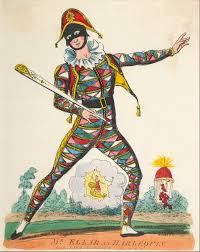
Arlecchino
G.K. The characters in Commedia dell’Arte are traditional – they are archetypes, if you like, and each character had a recognisable costume (and some had masks), with which audiences would have been totally familiar.  People would have been expecting, for instance, Arlecchino (Harlequin) to be in his diamond-patterned jacket and leggings, and Il Dottore (the Doctor) to be in full academic black robes with a skull-cap (later changed to a wide-brimmed flat hat).  So design was not really a feature in the same way as it is in the modern theatre. Some more elaborate garments might have been donated by satisfied wealthy audience members, other costumes would have been customised from everyday clothes already owned. 

The troupes varied in terms of wealth – some, like The Gelosi, were nationally adored, and were also favourites of the French court, so they would no doubt have had far, far more money to spend on their costumes and sets than a little up-and-coming troupe like my Corraggiosi.  My lovely actors work more on the ‘make-do-and-mend’ level !

D.S. One of the things I loved about theatrical costumes was that they were bespoke – often it was the only garment like it anywhere in the world. And today it is hard to think back to a time when everything was hand sewn. What sort of fabrics did they have in the sixteenth century, and does your character love her work or hate it?

G.K. Sofia does enjoy her sewing.  She is a seamstress when the story opens, but as the story begins, she is fleeing her home, falsely accused of theft, so we don’t see her at work at that point.  A little information leaks out about how tough her life has been, however – Sofia’s employer has not been an easy woman to work for. 

It’s perhaps worth mentioning that seamstresses in Renaissance Italy were really menders rather than makers.  The business of designing and creating new garments was largely done by men, and the women performed the more menial, but just as necessary, task of re-fitting, mending and darning.  You couldn’t wash those big heavy embroidered dresses (... not something we would feel comfortable with today!) so I imagine they wore through more easily once they’d picked up dust etc.  Sleeves were removable (fastened to bodices at the shoulder with laces) so those could be replaced or mended quite easily, which is just as well – how many times must people have accidentally dunked their sleeves in the soup, or had the baby be sick on them!

It is Sofia’s skill with a needle which enables her to join the acting troupe in the first place, and she happily settles down to mending and customising the player’s costumes, and is very happy in her new role.  She fairly quickly becomes interested in acting, though, which – for various reasons – rather takes precedence over her sewing ...

You ask about fabrics – linen of varying qualities was used in undergarments in the Renaissance (the finer the better – the aristocracy would have had their undergarments made in near-transparent linen lawn, while the more rustic would have made do with a cloth not far removed from sacking!)  Wool in winter, linen in summer for outer garments, and for the wealthy, all the various types and weights of silk would have been much in demand.  I came across a description of something called cypress gauze when researching – a totally transparent silk lawn.  It sounds absolutely gorgeous!  Other fabrics used - I’ve found doublets made from doeskin and leather as well as wool and silk.

Historical costume is fascinating, isn’t it?  I wonder if it’s partly the drama of the costumes which attracts women readers to historical fiction.  The covers of both our books would suggest that, perhaps.

D.S. I agree, but I try not to be too costume-obsessed in my novels. Obviously having the expertise is useful, but I suspect readers would get bored if I always described the clothes in too much detail. By the way, do you like the costumes on your covers? I  particularly liked the cover for ‘The Courtesan’s Lover’ – she has a very direct gaze!

Manet's Olympia
G.K.   I think it’s fair to say that when my first novel’s cover was designed, it was nothing like the ideas I had had in my head!  I had been thinking along arty lines, with grainy black-and-white images, etc.  But I loved the dress they found for my cover model to wear, so was quickly won over.  I agree with you about the direct gaze of the Courtesan!  When I discussed this cover design with my editor, I told her that I was very taken with Manet’s painting ‘Olympia’ - the model for which was prostitute (and artist) Victorine Meurent, and said I would like my cover model to have something of her confrontational stare – I think they obliged!

 I like your covers very much – the image for ‘A Divided Inheritance’ is particularly lovely, like a glimpse through a part-open window.  I’m guessing from the look of the cover that your new book is set earlier in history than your previous two books.  Did the change in era bring with it any research difficulties?

D.S. Yes it’s set in 1610, just after the Gunpowder Plot, so for me it was a whole new research adventure. One of my characters is a swordsman so I spent a lot of time researching sword-making and swordsmanship. And actually I was surprised that there were more women skilled with the sword than you would imagine. Afternoon fencing matches are described as part of the entertainment at Clerkenwell, with female fighters. 

forging a sword at www.reliks.com
But for Elspet Leviston, my main character, I also had to research the craft of lace-making. Did you know that needle-lace was made by literally sewing individual stitches onto the ‘réseau’ - the net background? Once the net was fully embellished the background was painstakingly snipped away. So much work! Bobbin lace was equally time-consuming, with bone bobbins pinned to a straw-filled pillow upon which the lace was gradually braided and twisted together. It evolved from braid-making in Italy, but soon Flanders and Normandy became the centres of this type of lace-making, and thousands of women in Europe were employed in this craft because it could be done easily at home as ‘piece work’.

G.K. I didn’t know about the needle-lace.  It sounds incredible.  Sometimes I’ve wondered about people’s eyesight in these times.  Given that people only worked by daylight or candlelight, and spectacles were very much in their infancy, people must have strained their eyes so badly!  Your description of lace-making leaves me so keenly aware of the hours and hours and hours people spent on creating things of such beauty, at such potential cost to their own health.

D.S. I suppose labour was very cheap, particularly women’s labour. It makes me so glad we live when we do – where we are free to write and give voice to our stories, and where through the internet we have access to information about so many other people’s lives and cultures. I expect you find that life in the classroom has changed beyond all recognition.

G.K. It’s changed a lot since I trained as a teacher, that’s for certain - it was still chalk and blackboards back then!  The internet has totally revolutionised the way we as teachers are able to access and present material for lessons, which is wonderful (though it has also revolutionised the way the kids communicate illegally too!  Where we scribbled notes and passed them under the desk, they are all texting and Skype-ing and posting photos on Instagram ...).  As an English teacher though, the focus and fundamental core of my lessons is still the power of the written word, and I suppose that hasn’t changed at all.  Luckily..


We hope you've enjoyed our meandering chat and will forgive us our foray from England into Renaissance Italy! We can be contacted through our websites www.gabriellekimm.co.uk and www.deborahswift.com or chat with us some more on Twitter @swiftstory and @gabrielle_kimm