Showing posts with label Heyerwood. Show all posts

Thursday, November 28, 2019

Dorothea Christorovna Benckendorff Lieven, Princess Lieven

Currently here at EHFA we have reasons to look back at the blog's beginnings, so today's post is an Editor's Choice first published in November 2011, and written by one of our regular contributors,
Lauren Gilbert.

Dorothea Lieven by Isabey


Countess Lieven, later known as Princess Lieven, is a frequent character of Regency-era fiction. Long known as one of the patronesses of Almack's Assembly Rooms, she was the wife of General Count Christopher Lieven (later Prince Lieven) who was the Russian Ambassador to Great Britain. In Georgette Heyer's The Grand Sophy, Countess Lieven is mentioned as follows: "I was not aware that you are acquainted with the Countess Lieven," said Miss Wraxton. "Do you dislike her? Sophy asked, aware of the coldness in Miss Wraxton's voice. "Many people do, I know. Sir Horace calls her the great intrigante, but she is clever and can be very amusing." She was a noted hostess, whose salon was famous for society and politics.

Princess Lieven was born December 17, 1785 at Riga. Shortly after completing her education, she married Lieutenant-General Count Lieven in 2/1/1800 in St. Petersburg at age 14. They had 5 children, a daughter who died very young, and 4 sons. Even at that age, she demonstrated significant talent for being a hostess and for conversation. In 1809, then-Count Lieven became the Russian Envoy to the Prussian Court, which was her first public postion. In 1811, Count Lieven was appointed Ambassador to London, a post he held until 1834. As his wife, both of the Lievens used all of their abilities to restore friendly relations between Russia and Great Britain. Countess Lieven became a leader of fashion, and threw herself into society, becoming a prominent hostess whose invitations were highly prized. She was elected a patroness of Almack's sometime in 1814 or earlier, and is credited with introducing the German waltz there. During the Lievens' time in London, Countess Lieven cultivated friendships with those holding political office who could best further the interests of the Russian government. Countess Lieven was definitely a political animal, and contributed significantly to her husband's success as ambassador. In fact, there were very few political events she did not influence to some degree between 1812 and 1857.

Countess Lieven was fully conscious of her own importance and superiority, and had a high opinions of her charms. She did not hesitate to form friendships (sometimes more than friendships) with influential men in a position to influence political matters to suit her. She would drop friends and form new ones, as political matters shifted, which did create some hard feelings, but did not apparently affect her usefulness. She supposed had affairs with every major statesman involved in European politics, including Metternich, George IV and numerous prime ministers, her relationships changing as the Cabinet changed. Her relationship with Metternich is believed to have begun at the Congress of Aix-la-Chapelle in 1819, when Metternich tried to bring Czar Alexander into accord with Austria, and continued until 1825, when (coincidentally?) the accession of Nicholas I caused Russian policy to change. Exerpts of her letters to Metternich are fascinating reading. In 1825, she was entrusted by Czar Alexander to make a secret overture to the British government. In a letter to Count Nesselrode, his foreign minister, he wrote "It is a pity Countess Lieven wears skirts. She would have made an excellent diplomat."

Count Lieven was granted the title prince in 1826. In 1834, he was recalled to Russia. Soon after the Lievens' return to Russia, their two youngest sons died. Princess Lieven subsequently left Russia and settled in Paris, where she continued to involve herself in politics, forming a close relationship with Francois Guizot. Her Paris salon was known as the listening post of Europe. She died at her home in Paris on january 27 1857, and was buried at the Lieven family estate next to her two young sons who died in St. Petersburg. Her letters are fascinating reading.

~~~~~~~~~~~

An avid reader, Lauren Gilbert was introduced to English authors early in life (from classic literature such as PERSUASION by Jane Austen and JANE EYRE by Charlotte Bronte, to period romances by Margaret Campbell Barnes, Victoria Holt/Jean Plaidy/Philippa Carr (all one person!) and Georgette Heyer, and to the mysteries of Dorothy Sayers, Patricia Wentworth and Agatha Christie). Lauren is fascinated by England and its history, and multiple visits to England have only heightened her interest. A member of JASNA since about 2001, she attended the Annual General Meetings in Los Angeles in 2004, and Vancouver, BC, CA in 2007, and the Annual General Meeting in Ft. Worth. Her first book, HEYERWOOD: A Novel was released in 5/2011.

Sunday, February 2, 2014

The Right Honourable Henry Pelham, Prime Minister

by Lauren Gilbert

 Henry Pelham was the second son of Sir Thomas Pelham, baronet, a prominent mover of the Revolution that placed William & Mary on the throne. Sir Thomas was a Whig, and was raised to peerage as Baron Pelham. Henry’s mother was Grace Holles, the daughter of Gilbert, Earl of Clare. He was born in 1696, admitted to Hart-hall in the University of Oxford Sept 6 1710, at age 15.

On July 22, 1715, Henry was appointed Captain in General Dormer’s regiment. This appears to be his first and only commission. He served during the rebellion of 1715, and was known to have participated in the battle of Preston in Lancashire, where the Jacobites were defeated. It seems probable that he did not continue in the army.

On October 29, 1726, Henry Pelham married Lady Catherine Manners, daughter of John Manners, second Duke of Rutland. Rutland also had Whig connections: his father was a Whig, and Catherine’s sister Elizabeth married John Monckton, Viscount Galway, who was also a Whig. They had eight children, including two sons who both died in 1739. They also had six daughters, four of whom lived to adulthood: Catherine, Countess of Lincoln (married Henry Fiennes Pelham-Clinton, a first cousin) 1727-1760; Frances Pelham (never married) 1728-1824; Grace, Baroness Sondes 1735-1777 (married Lewis Watson, Baron Stokes of Lees Court); and Mary Pelham 1739-?, who also never married.

Henry Pelham was, of course, a Whig (this would appear inevitable with his own family tradition subsequently reinforced by his wife’s connections as well as his personal convictions). As so many other second sons did, he turned to politics to make his way. In February 1719, he went into Parliament for the borough of Seaford in Sussex (thanks to family influence). In 1720, he was appointed treasurer of the chamber, thanks to recommendation by Lord Townshend, (the president of the council and his brother-in-law) and Robert Walpole (paymaster of the forces). On May 6, 1720, he made his first speech in the House of Commons.

Henry’s alliance with Robert Walpole, later Lord Orford, continued. When Lord Townshend was returned to his post and secretary of state and Mr Walpole to his post as minister of finance in 1721, Henry was called to the Treasury Board. Mr. Walpole took note of Henry’s diligence and hard work. He was returned as one of the members for Sussex, and continued to represent that county for the rest of his life.

He served as Secretary at War from 1724 until 1730, when he was awarded the advantageous position of paymaster of the forces. In his various positions, he became known for his civility and candour, as well as his hard work and dependability, and was widely respected. He also developed a friendship with Henry Fox, another of Walpole’s supporters.

Henry Pelham’s older brother Thomas, Duke of Newcastle was in the cabinet. They formed an effective political partnership. His brother appears to have been more emotional, sensitive and jealous (the Duke expected deference to his opinion, worried that others had greater influence), while Henry was calmer and more rational. In their working partnership, the Duke was more flamboyant, while Henry was quieter, more “behind the scenes” in the House of Commons. Their combined influence in both houses of Parliament strengthened the stability of the government. Although they did disagree sometimes which caused some stress and difficulty, they managed to maintain a good working relationship and affectionate personal relationship.

The Duke was also a political ally of Robert Walpole. In 1724 he became Secretary of State after Lord Carteret was dismissed, thanks to the influence of Mr Walpole and Lord Townsend.

Lord Carteret was a favourite of George II and actively lobbied the King against the Whigs who were hostile to the King’s foreign policy, which was heavily weighted for the support of Hanover, at the perceived cost for England. Pelham was not a proponent of the wars, and was particularly disturbed by the amount of money required to maintain them. Robert Walpole and Pelham had managed to allay some of the king’s distrust, but Pelham resigned when King George II refused to approve offices for Pitt and Fox. Carteret’s choice Lord Granville was recalled but unable to form a government. Pelham et al returned very quickly.

Pelham served as prime minister 10 years, and was noted for his ability to work with and unite multiple political factions. Although the financial scandals that affected Walpole and Fox seem to have touched him, there appears to have been no significant effect on his career.

Although Henry Pelham’s administration was not particularly flamboyant, and I found several references implying that the successes of his administration were more due to his brother the Duke’s influence, there were significant accomplishments:

He is credited with the reduction of the national debt 1747-48 (improved credit, interest reduced to 3%).

He worked to end of the War of the Austrian Succession in 1748, which resulted in peace with France and trade with Spain.

He supported the Consolidation Act 1749 which was passed and resulted in the reorganization of the Royal Navy.

The calendar was reorganized (in 1751, New Year’s Day changed from March 25 to January first; in 1752, the adoption of Gregorian Calendar was passed).

Pelham attempted several social reforms and, although he did not achieve all he attempted, his administration succeeded in the passage of the “Jew Act” of 1753 which allowed Jews to become naturalized by applying to Parliament, and the Marriage Act of 1753 (aka the Hardwicke Act) which established the minimum age of consent for marriage.

His was a relatively stable administration, with several years of peace.

Henry Pelham died unexpectedly in March 6, 1754. He had had a succession of illnesses during his life, and his sudden death was said to be the result of having eaten too much and exercised too little. He was succeeded by his brother the Duke of Newcastle. At his death, George II, who had not particularly liked Pelham, said, “Now I shall have no peace.”

Sources of information about Henry Pelham include:

Chancellor, E. Beresford. Memorials of St. James’s Street and Chronicles of Almack’s. 1922: Brentano’s, New York.

Tillyard, Stella. ARISTOCRATS Caroline, Emily, Louisa & Sarah Lennox 1740-1832. 1994: Chatto & Windus, London.

Williams, E. N. Life in Georgian England. 1962, 1967: B. T. Batsford LTD, London.

GoogleBooks. Coxe, William. Memoirs of the Administration of the Right Honourable Henry Pelham, Collected from the Family Papers, and Other Authentic Documents. Vol. I. 1829: Longman, Rees, Orme, Brown and Green, London. http://google.com/books?id=jrw_AAAAcAAJ

Gov.UK. Past Prime Ministers. “Henry Pelham Whig 1743 to 1754.” https://www.gov.uk/government/history/past-prime-ministers/henry-pelham

The Peerage online. “Rt. Hon. Henry Pelham.” Person Page 1595. http://www.thepeerage.com/p1595.htm

The University of Notthingham-Manuscripts and Special Collections. “Biography of Henry Pelham (c. 1696-1754; Prime Minister). http://www.nottingham.ac.uk/manuscriptsandspecialcollections/collectionsindepth/family/newcastle/biographies/biographyofhenrypelham(c1695-1754;primeminister).aspx

The World of Heyerwood blog. “An Almack’s Mystery: Who was Miss Pelham?” by Lauren Gilbert, posted 1/12/2014. http://laurengilbertheyerwood.wordpress.com/2014/01/12/an-almacks-mystery-who-was-miss-pelham

~~~~~~~~~~~~~

Lauren Gilbert is the author of HEYERWOOD: A Novel. A long-time member of JASNA and life-long reader of historical novels, she lives in Florida with her husband and is working on her second novel.

Thursday, May 30, 2013

Holyrood Abbey and the Palace of Holyroodhouse

By Lauren Gilbert
The Palace of Holyrood House is one of the most haunting places I have ever visited.  It is inextricably linked to Mary Stuart, Queen of Scotland, who lived there during much of her reign.  However, its history extended back centuries, and continued after her.    It was built next to Holyrood Abbey, where its history actually began.

The Abbey of Holyrood was founded in Edinburgh, Scotland for the Canons Regular of St. Augustine by King David I in 1128.  There is a legend that the foundation was laid as an act of thanksgiving by the king, for a miraculous escape from a hunting accident on Holy Cross Day.  A hart was deflected from goring the king by the reflection of sunlight on a crucifix, according to the legend.  An alternate version has a crucifix appearing between the antlers, while the king was trying to save himself by grabbing the antlers.  Either way, the Abbey was founded and named Holyrood (“rood” meaning cross) in honor of the king’s escape on Holy Cross Day.  A fragment of the True Cross was housed in the Abbey church.  It had been brought to Scotland by King David’s mother, Margaret (canonized as St. Margaret of Scotland) from Waltham Abbey, and became known as the Black Rood of Scotland.   The Abbey survived and continued through the next few centuries.
Remains of Abbey of Holyrood

The Abbey suffered invasion by the English twice, once when it was burned by Richard II in 1305, after which it was restored, and again in 1322 when it was sacked by Edward II’s army.  In 1346, at the Battle of Neville’s Cross, the Black Rood of Scotland was captured by the English and carried off to Durham Cathedral, from where it subsequently disappeared during the Reformation.

Edinburgh became the capital of Scotland in the 15th century, and the guest house of the Abbey of Holyrood was used more and more frequently by the royal family, apparently in preference to the fortress of Edinburgh Castle.  James I of Scotland’s twin sons were born within the Abbey in 1430, and his queen Mary of Gueldres was crowned there in 1449. The younger of the twins became James II and he was crowned in the abbey, married there, and was finally buried there.   In July of 1469, James III married Margaret of Denmark (who was only 13 years old) at least in part to resolve the feud between Scotland and Denmark over the Hebrides. 

During the period from about 1500-1504, James IV built a palace for himself and his bride Margaret Tudor (Henry VIII’s sister) next to the Abbey, of which little remains. His son James V extensively rebuilt the palace, possibly for his bride Madeleine (daughter of Francis I of France). His second wife, Mary of Guise, was crowned in the Abbey of Holyrood.  The north tower, a large tower with round corner turrets built to be royal lodging between 1528-1532, still stands, at the front of the palace.  Between 1535-6, further rebuilding was done on the other wings.  During this time, Edinburgh Castle was used more as a place to confine political prisoners.   James V died of fever December 15, 1542, after the Scots were defeated by the English at the Battle of Solway Moss, leaving his only legitimate child, the infant Mary, to become queen.  During the “rough wooing”, the Abbey was burned and looted by the English in 1544; finally, in 1547, the English destroyed the choir, lady chapel, transepts and monastic buildings of the Abbey.  Although some repairs were made, it was never fully restored.

In 1548, Mary left Scotland for France, and the French troops ended the English occupation.  Her mother, Mary of Guise governed on her behalf under her death in 1560.  During this period, the Reformation gained momentum, and Scotland became increasingly Protestant.  After the death of her husband, Francis II of France, also in 1560, Mary returned to Scotland and made the Palace of Holyrood House her residence.  This remained her primary residence through her tumultuous years as queen.    Ironically, what may be the only building in Scotland directly attributed to her  still remains: the bath house near what was the north side of the palace in her time. 
The Queen's Bath House

In July of 1566, Mary married Henry Stuart, Lord Darnley (her cousin) in 1566 in the Abbey church.  The next year, Mary’s secretary, David Rizzio, was murdered in her private apartments at the Palace, setting in train a series of events that led to the murder of Darnley, her marriage to James Hepburn, Earl of Bothwell, and ultimately the end of her reign.  Religious differences accelerated and exacerbated the tumult; also in 1567, the interior of the church was pillaged by the followers of John Knox.  The bloodstains left by David Rizzio’s murder are still visible on the floor in the palace.

Between the Reformation and the Restoration, the palace and abbey were largely neglected.  However, in 1633, some renovations were carried out to mark the coronation of Mary’s grandson, Charles I.  Unfortunately, during the Civil War, Oliver Cromwell’s troops were quartered in the palace, which resulted in much more damage caused by fire.

 Charles II was crowned in Scotland in 1651 (before the restoration in 1660).  In the 1670’s he ordered a massive rebuilding under Sir William Bruce, Scottish architect, at which time the Abbey Church was made into the Chapel Royal.  When James, Duke of York, succeeded him as King James VII of Scotland/II of England, he restored the Catholic services at Holyrood, and used it as the chapel for the ceremonies of the Order of the Thistle.  Unfortunately the Abbey was plundered again in 1688 by the Edinburgh mob to show their outrage at King James’ Catholic leanings.

Again there was a long period of neglect.  At one point, “grace and favour” housing was provided there to poor and distressed aristocrats.  For a brief period, things improved when Bonnie Prince Charlie used Holyrood as his headquarters in 1745, during his unsuccessful attempt to reclaim the throne.  After that brief moment of glory, the palace sank into neglect again.   The Abbey Church roof collapsed in 1768. 

The site was left as it was until the early 19th century.  Money was voted to improve Holyrood because of George IV’s state visit to Scotland in August of 1822.   George IV decreed that Mary’s apartments in Holyrood should be preserved.  Subsequently, after Queen Victoria fell in love with Scotland and purchased Balmoral, she reintroduced the custom of the Royal Family staying at Holyrood, which inspired the Scots to renovate the palace extensively.  Renovations were continued by King George V and Queen Mary, installing electricity, bathrooms, and other 20th century conveniences.  Today, the palace is still in use by the Royal Family when in Scotland.  When they are not in residence, the palace is open for tourists.  Mary Stuart’s apartments, complete with David Rizzio’s bloodstains  can be seen, just as George IV would have wanted.
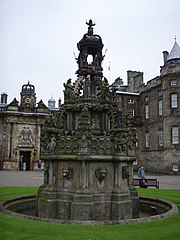
Courtyard and fountain at the Palace of Holyroodhouse


Sources include:

Phillips, Charles.  THE ILLUSTRATED ENCYCLOPEDIA OF ROYAL BRITAIN. Petro Books: New York (no date of publishing shown-sometime after 2005).

Steel, David and Judy.  MARY STUART’S SCOTLAND The landscapes, life and legends of Mary Queen of Scots.  Crescent Books: New York, 1987.

Castles and Palaces of the World (on line). “History of Palace of Holyroodhouse.” http://www.everycastle.com/Palace-of-Holyroodhouse.html

Catholic Encyclopedia: Holyrood Abbey.  http://www.newadvent.org/cathen/07423a.htm

Mary Queen of Scots.com.  “The Palace of Holyroodhouse & Holyrood Abbey.”  http://www.marie-stuart.co.uk/Castles/Holyroodhouse.htm

Website of the British Monarchy-The Royal Residences.  “The Palace of Holyroodhouse.”  http://www.royal.gov.uk/TheRoyal Residences/ThePalaceofHolyroodhouse/History.aspx

SacredDestinations.com.  “Holyrood Abbey – Edinburgh, Scotland.”  http://www.sacred-destinations.com/scotland/edinburgh-holyrood-abbey-and-palace
Images from Wikimedia Commons.
Lauren Gilbert is the author of HEYERWOOD: A Novel.  She lives in Florida with her husband, and is working on another novel which is coming out soon.  You can visit her website HERE.

Thursday, November 22, 2012

Tambour Work

by Lauren Gilbert


Madame de Pompadour at her Tambour Frame by Henri Drouais
 
Regency novels frequently refer to “tambour frames” and “tambour work”.  One novel contained an amusing story where a lady used a tambour frame as a weapon.   I assumed It was a form of embroidery but knew nothing about it.   I enjoy needlework and thought it would be interesting to see what it was.
Tambour embroidery was a very popular and fashionable craft.   Thought to have originated in China, it was supposedly introduced to France in the mid-18th century, and subsequently spread to England and western Europe.   Ladies occupied their time with tambour work as well as other needle crafts, while professionals used this technique on a larger scale until machines were able to produce similar effects.  The stitcher uses a needle with a hook, similar to a modern latch hook, and makes a chain stitch on fabric stretched in a round frame. 
The frame is a two-part object, with an inner frame over which the fabric is stretched with the exterior frame holding it in place.  It is called a tambour or tambour frame because it resembles a drum (“tambour” is French for drum).  It is similar to modern embroidery hoops, but much heavier.   (I can now see how it could actually do some damage if used to strike someone!)  The thread is held underneath with one hand, while the other hand pushes the hooked needle through the fabric to catch the thread and pull it through. 

This shows the position of the hands, and the sturdiness of the frame.

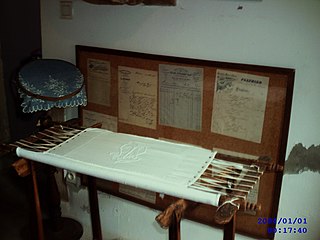
Bringing the thread back up through the same hole forms a loop, and the pattern evolves as each new stitch is formed near the previous stitch, catching the loop from that stitch.  The stitches form a continuous chain.  The hooks used were small, sometimes not much more than a wire bent at the tip, and produced a lacy design.   It was commonly used to produce white on white design, such as the flower and vine designs popular on white muslin.  Tambour work was used to embroider gowns, shawls, reticules and other wearable items.  Using the finest hooks and threads, the chain stitch would also lend itself to monogramming handkerchiefs.  Obviously, fabrics with a more open weave such as muslin, gauze and net lend themselves beautifully to tambour work, as can be seen in the illustration below: 

At Fontenoy Chateau

Tambour embroidery is now also referred to as tambour crochet.  Crochet work as we know it seems to have evolved from tambour embroidery at least in part, being worked as a continuous chain, using a hook and thread or yarn, without the background fabric.  Tambour embroidery is still done today.  There are numerous resources on the internet for supplies, hooks and frames, and videos of instruction.
References:
de Dillmont, Therese.  THE COMPLETE ENCYCLOPEDIA OF NEEDLEWORK.  Third edition.  1996: Running Press, Philadelphia, PA.  (Illustrations of the tambour hook (fig. 280), and the position of the hands with the frame (fig. 281) from p. 144 used with permission.)
The Embroidery Site.  BellaOnline.com.   “Tambour Work” by Megan McConnell.  Not dated.  http://www.bellaonline.com/articles/art67103.asp
Clan Iain Abrach~McClain blog.  “A Brief History of Crochet” by Catie Rua the Weaver.  Posted 11/1/2003. http://www.iainabrach.org/blogitem.asp?ID=6  
Design.Decoration.Craft blog.  “Tambour Emboridery Work.”  (no author shown.) Posted 7/22/2010. http://thetextileblog.blogspot.com/2010/07/tambour-embroidery-work.html  
Illustrations of Madame de Pompadour and the Fontenoy tambour frame are from WikiCommons.  

Lauren Gilbert is the author of  HEYERWOOD: A Novel.  The heroine, Catherine, is a skilled needlewoman.  (More about the novel at http://www.heyerwood.com )
 

Wednesday, April 4, 2012

GIVEAWAY by Lauren Gilbert


Lauren Gilbert is giving away a signed paperback copy of HEYERWOOD: A novel. To see some information about the book, please click HERE
.