Showing posts with label crafts. Show all posts

Saturday, April 19, 2014

Retting and Rippling - The Story of Linen

By Deborah Swift

My novels often include references to the growing of flax and also to linen, which is the cloth produced from it. It became less popular in the early twentieth century because it creases so easily, though it is now more widely used. But in the 17th century it was one of the most commonly used fabrics,and the flax plant was native to English, Scottish and Irish soil.

Sowing of flax was done after the winter frosts, and the growing season was about three months during which time the stalks would grow to three feet high. Sometimes one patch would be left uncut to provide seed for the next year's harvest. The stalks were pulled up by hand and gathered into bundles which were then stacked in stooks.

Fig. 104.   The stooks of flax.
Field of linen stooks

Next the stalks were laid out to decompose - called retting. Spread out on the grass they would rest there for thirty days or so to get the morning dew. If there was not enouigh dew or rain, then the flax would be watered. Sometimes flax was left in steams or ponds but this polluted the water, and clean water was a valuable resource. Once the woody part has decomposed then the flax was dried by turning it regularly in the sun.

Dressing the Flax

The straw had to be broken by a flax breaker, a wooden paddle to bash the stalks. Then the shoves (broken straw ) was removed, and scutching could take place. Scutching was separating the fibres by beating then still further and then dragging the fibres through a long comb (riddling) to take out any remaining straw and smooth the fibres.

Turning flax into linen takes work. This is a hackle. Some call it a heckle - and it is used to comb short fibers out. Moo Dog Knits Magazine.

Line and Tow

Line is the finest threads of flax, and tow the coarsest. Line (from which we get the word linen) produced a cloth suitable for wearing - shirts for example. Tow produced a harder wearing cloth for awnings, sacks and sails.

Spinning and Weaving

Dutch spinning wheels were introduced into Ireland in 1632 by the Earl of Strafford. Ireland was a big centre of flax production in the 17th and 18th centuries, employing thousands of women and the spinning wheel and distaff. (Shakespeare describes one of his characters as having hair 'like flax upon a distaff').

Bleach Green

Linen Garments

Once woven into cloth, linen was widely used for nightclothes and shirts because of its ability to absorb water (sweat) so it was very hygenic to wear next to the skin. Linen was often used for pleated cloths where it would be folded and dried into pleats. If it was ever washed it then had to be re-pleated, as the water would remove the pleats. Kerchiefs to cover the head were usually of fine linen. In England wool was the main industry, so the linen trade is often overlooked in historical novels. In the period I like to write about, tithes were often paid in bolts of linen cloth which, if the cloth was fine, were costlier than wool. White linen was much prized by the aristocracy for bed linen and table cloths. In Ireland the cloth was bleached by laying out the woven lengths on bleach greens, a  custom that actually continued right up until the 1930's.

1640's nighshirt in linen - Fashion Museum, Bath

One of my favourite parts of learning about old crafts is to learn the particular vocabulary associated with them, vocabulary that has almost disappeared from modern English.

And - here are my books! - You can find out more about them by clicking, which will take you to my website.

Deborah


Friday, January 11, 2013

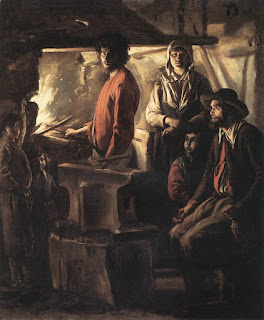
Let's Hear it for the Smith by Deborah Swift

Without the smith most of life in previous centuries would be unthinkable, yet he often does not appear in historical novels. Nearly all of life was supported by the Smith. Forged tools were used by all other craftspeople such as shear hooks for thatchers or chisels for carpenters. All farmers and agricultural workers  relied on him for scythes, ploughs, rakes and so forth. Women used iron cooking pots, metal spoons and knives, all hand-made by the smith.

There were several different types of smith; the traditional blacksmith who shod horses and was an expert in veterinary practice, but also the brightsmith or whitesmith who polished his work to a higher degree of finish.  Cutlers and weaponry makers would come under this category. Some smiths made bells and included the business of bell-hanging in their trade, some were locksmiths manufacturing only locks and keys. Often they worked closely with wheelwrights (sometimes called wainwrights) to make the parts of wagons and coaches - a trade as complex as manufacturing a car today.In the period I enjoy writing about, the 17th century, all transport was by horse or horse and trap/carriage.

As well as large items, the blacksmith would often have apprentices making nails, hooks, hinges and other small items for every day use. Nails were used to hold everything together - furniture, shoes, musical instruments all required hand-made nails.

As the demand for nails was so great, some parts of the country specialized in nail-making. The improvement of slitting the iron into bars came from the France early in the 17th century, and this helped create an English nail trade. Godfrey Box built the first slitting mill in England at Dartford, Kent in 1590. It used water power to slit the iron.

Many forges were close to water because of the need to 'quench' the iron between heatings, and because the wheelwright often required water to soak and bend the wood for wheels. Because their trade involved keeping a fire going all day, villages often built the bake-house with its bread-oven near the smith's. So a symbiotic relationship between all the trades developed with each using the advantages of the other. I'm sure many smiths enjoyed the benefit of a hot pie at the end of their day's work!

18th century painting of a Forge by Wright of Derby

Some blacksmiths specialized in making cutlery and so came to be known as “cutlers”. They had a great knowledge of the properties of iron, and how to control the heating and cooling processes to achieve a particular result. These men made knives, scissors, razors and swords.

For my next novel 'A Divided Inheritance' I researched the making of swords and weaponry, which I will explore in a later post as making a cutting edge is a very specialized skill involving the creation of steel through tempering the metal. But just to whet your appetite, here is a section of a sword discovered hidden in Cropredy Church, believed part of a cache of arms left over from the English Civil War. More about this can be found by following this link.


Quote from www.thomasironworks.com


For more on the history of the Blacksmith I can recommend Simon Grant-Jones'website,
For more on nail-making http://www.sedgleymanor.com/
English Heritage's 'A Book of English Trades'

My book The Gilded Lily is currently this week's Giveaway, so pop over if you'd like to win a copy. You can also win a copy of The Midwife's Tale by Sam Thomas this week, just scroll down from my Giveaway.

Thursday, November 22, 2012

Tambour Work

by Lauren Gilbert


Madame de Pompadour at her Tambour Frame by Henri Drouais
 
Regency novels frequently refer to “tambour frames” and “tambour work”.  One novel contained an amusing story where a lady used a tambour frame as a weapon.   I assumed It was a form of embroidery but knew nothing about it.   I enjoy needlework and thought it would be interesting to see what it was.
Tambour embroidery was a very popular and fashionable craft.   Thought to have originated in China, it was supposedly introduced to France in the mid-18th century, and subsequently spread to England and western Europe.   Ladies occupied their time with tambour work as well as other needle crafts, while professionals used this technique on a larger scale until machines were able to produce similar effects.  The stitcher uses a needle with a hook, similar to a modern latch hook, and makes a chain stitch on fabric stretched in a round frame. 
The frame is a two-part object, with an inner frame over which the fabric is stretched with the exterior frame holding it in place.  It is called a tambour or tambour frame because it resembles a drum (“tambour” is French for drum).  It is similar to modern embroidery hoops, but much heavier.   (I can now see how it could actually do some damage if used to strike someone!)  The thread is held underneath with one hand, while the other hand pushes the hooked needle through the fabric to catch the thread and pull it through. 

This shows the position of the hands, and the sturdiness of the frame.

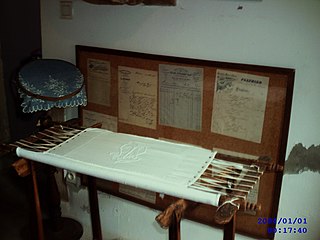
Bringing the thread back up through the same hole forms a loop, and the pattern evolves as each new stitch is formed near the previous stitch, catching the loop from that stitch.  The stitches form a continuous chain.  The hooks used were small, sometimes not much more than a wire bent at the tip, and produced a lacy design.   It was commonly used to produce white on white design, such as the flower and vine designs popular on white muslin.  Tambour work was used to embroider gowns, shawls, reticules and other wearable items.  Using the finest hooks and threads, the chain stitch would also lend itself to monogramming handkerchiefs.  Obviously, fabrics with a more open weave such as muslin, gauze and net lend themselves beautifully to tambour work, as can be seen in the illustration below: 

At Fontenoy Chateau

Tambour embroidery is now also referred to as tambour crochet.  Crochet work as we know it seems to have evolved from tambour embroidery at least in part, being worked as a continuous chain, using a hook and thread or yarn, without the background fabric.  Tambour embroidery is still done today.  There are numerous resources on the internet for supplies, hooks and frames, and videos of instruction.
References:
de Dillmont, Therese.  THE COMPLETE ENCYCLOPEDIA OF NEEDLEWORK.  Third edition.  1996: Running Press, Philadelphia, PA.  (Illustrations of the tambour hook (fig. 280), and the position of the hands with the frame (fig. 281) from p. 144 used with permission.)
The Embroidery Site.  BellaOnline.com.   “Tambour Work” by Megan McConnell.  Not dated.  http://www.bellaonline.com/articles/art67103.asp
Clan Iain Abrach~McClain blog.  “A Brief History of Crochet” by Catie Rua the Weaver.  Posted 11/1/2003. http://www.iainabrach.org/blogitem.asp?ID=6  
Design.Decoration.Craft blog.  “Tambour Emboridery Work.”  (no author shown.) Posted 7/22/2010. http://thetextileblog.blogspot.com/2010/07/tambour-embroidery-work.html  
Illustrations of Madame de Pompadour and the Fontenoy tambour frame are from WikiCommons.  

Lauren Gilbert is the author of  HEYERWOOD: A Novel.  The heroine, Catherine, is a skilled needlewoman.  (More about the novel at http://www.heyerwood.com )