Showing posts with label Victorian London. Show all posts

Saturday, February 21, 2015

It's No Joke: The Life of a Victorian Street Clown

by Grace Elliot

Do you like clowns?

I suspect clowns are one of those things in life (like Marmite) that fall into the ‘love ‘em’ or ‘hate ‘em’ category. Me? I find clowns creepy and they make me cringe.  Sadly, in the modern age, comedians seem to be over-represented when it comes to suffering from depression – perhaps because of the pressure of being funny for a living.


Some things never change, because in 1851 when Henry Mayhew interviewed one of London’s three full-time street clowns, he discovered a pathetic figure who was ashamed of how he made his living.

Mayhew describes a sad man: “He was a melancholy looking man…whilst his face was scored with lines and wrinkles, telling of paint and premature age.”

This clown, it seems, had little to be cheerful about.  Orphaned at the age of nine, he worked as a stable lad and then became a general dogs-body at Astley’s (renowned as the first circus) It was there he watched the other performers and found he had a semi-decent singing voice. 


 He eventually tried his luck entertaining on the streets: “With a heavy heart.”

Some days were better than others. On race days he made ten shillings, but this then had to stretch to cover the lean days. And as he records, the day his wife was in labor he worked for 10 hours straight and earnt one shilling and three pence. Many times he started work without breaking his fast (having breakfast) and didn’t eat until he’d earned enough to buy food.

What made his trade even harder were the ‘part time’ clowns, who emerged on high-paying holidays and at fairs, and taking money away from those who relied on clowning for a living. The part-timers then went back to their trades, leaving thin-pickings for the full-timers.


So how funny was the street clown? Here are some of his jokes so you can judge for yourself.
“A horse has ten legs: he has two fore legs and two hind legs – a total of ten”
“Why is the city of Rome [sic] like a candle? Because it’s in the midst of Greece.”

The street clown costume consisted of red striped stockings, full-trunks dotted red and block, and a tight top with full sleeves and frills. He wore a wig sewn into a white cap, and painted his face with grease then painted it white, coloring his lips and cheeks with vermillion.


He declined, however, to change at home as he strove to keep his trade a secret from his neighbours.  This poor fellow told Mayhew how playing the fool made him feel very sad at heart, but only had to think of the bare cupboards at home to carry on. But as Mayhew goes on to write, a few minutes after their interview he spotted the clown dressed up to perform:  Dancing and singing in the streets as if he was the lightest-hearted fellow in all London.

Who knows, perhaps my instinctive dislike of clowns springs from sensing their inner sadness.

~~~~~~~~~~~~~


Monday, October 7, 2013

The Patterer: News Mongers We Love

by Larry Brill


It came to me in a flash of inspiration.

Late at night and unable to sleep I opened a book, Infamous Scribblers, about the wordsmiths and rabble-rousers that were our first journalists in America. Since too many Americans are only vaguely aware that there were a few significant developments in history between the Bible and the Declaration of Independence, the author, Eric Burns, started with the obligatory chapter tracing journalism in this country back to its roots in England.

And he wrote a very short paragraph describing 18th century fellows known as “patterers.” It was not much more than a throwaway mention of street performers who would run from corner to corner in London hyping the news of the day for the crowds they drew. Burns offered the observation that they might conceivably be considered a forerunner to today’s TV newscaster.

As someone who spent 25 years at a news anchor desk, I knew immediately there was a story there. From that moment, the Patterer became my personal hero.

The rise of the patterer coincided with Britain’s industrial revolution; both gained steam through the first half of the 18th century. By the end of the century, both were running like the well-oiled machines that were turning England into an industrial marvel and global powerhouse. This was also in an age when literacy was on the rise and the number of newspapers in England grew from a smattering when The Daily Courant was launched in 1702, to more than 50 in London by 1776.

London streets were teeming with costermongers back then, vendors who sold anything and everything from their carts, their tables, their haversacks or even their pockets.

Fish and poultry? “Got you covered, Sir.”

Rings and buckles? “Yes Ma’am, step right up.”

Cough drops and elixirs? “Guaranteed, Doctor Maximucel’s potion right here will cure anything that ails ya.”

Many costermongers used their strong lungs, shouting and competing with one another amid the loud and chaotic din on those crowded London streets, in order to sell their wares. And those streets were unquestionably a crowded and noisy place to do business.

“Fresh Fruit. Vegetables and tobacco. Get them here.”

“Oy! Oy, razors. Knives. Sharpen your blade sir, three shilling an’ a half.”

Some started taking the role of common street barker a step further by using interesting stories or jokes to engage passers-by. They might sing or juggle. Or they might, as one 18th century citizen observed, “help off their wares by pompous speeches, in which little regard is paid either to truth or propriety.” Those costermongers would perform with whatever skill they had to steal the attention of potential customers.

Ah, but the “patterers,” the street sellers of news and information, well, they were the elite of their class, and more often than not, looked down their noses at the other costermongers. It was the cachet of having a product for the mind and not the hands.

“We are the haristocracy of the streets.”

That is what one patterer told Henry Mayhew. Mayhew was a contemporary of Charles Dickens and wrote London Labour and the London Poor, the definitive study of the city’s street people in the 1840s. He compiled four volumes from exhaustive interviews with people like rag pickers and rat killers, fish sellers and chimney sweeps, beggars, prostitutes and, yes, the costermongers who sold news and literature and called themselves “patterers.” Mayhew published his work just as the patterers reached their peak.

There were essentially two types. The “running patterer,” who not only had a strong voice, but strong legs. He needed them because he moved quickly up and down streets and alleyways, slowing only long enough to sell a newspaper, or its cousin, the single page broadsheet that might be as long as your arm. The stories they told and the papers they sold dealt almost exclusively with the most lurid and sensational acts of blood and lust that they could find to print. And when they couldn’t find or recycle a decent bit of mayhem, they simply made it up. No news? No problem.

The “standing patterer” was no less prone to embellishing a good murder or scandal in ways that would make even today’s most jaded tabloids cringe. But he had an advantage that allowed him to rely less on sensational details in his stories and more on his imagination and an entertaining delivery. Because he had the luxury of engaging and holding the audience he drew to his corner, he offered a longer, higher quality of storytelling that may have lacked the shock and awe of his running counterpart but was no less compelling.

He would set up on the corners of thoroughfares and use a large placard on a pole with drawings depicting the terrors a reader might find in the newspaper and pamphlets he had to sell. And here we are, more than two hundred years later, using computer-generated graphics on the TV screen to do the same thing.

It was their education, formal or informal, that separated the elite patterers from the rest of the street sellers. They were the “brainy” ones making a living on the street.

"People don't pay us for what we gives 'em, but only to hear us talk. We live like yourself, sir, by the hexercise of our hintellects - we by talking, and you by writing.”

That’s how Henry Mayhew’s patterer explained it in 1840. Many were men with respectable connections and families. These were the sons of gentlemen and even noblemen. Mayhew interviewed patterers who were the sons of high ranking military officers, clergy, two whose families raised them to be in the medical profession, as well as an entire class “who have been educated with no especial calling.” Some took to the streets after a fall-out with their families that deprived them of support. Others took up the street life simply because they were born to be rovers and rogues.

They dressed better than your average costermonger on the street. Mayhew reports that patterers took pride in their looks, probably because it was good for business. He wrote that in dress and appearance, they presented little difference from the “gent.”

The patterer actually advanced and fed the public’s appetite for news. Patterers pitched and sold newspapers and magazines for the growing body of middle class readers. They entertained and informed the illiterate with enough detail that both could share a table at the pub and carry on reasonable dialogue about current affairs. And so it was, in the end, literacy and the masses’ ability to read that killed off the patterer.

Two hundred years hence, he’s back. The patterer has been resurrected by technology and transported right into our living rooms night after night through the magic box we call television.

~~~~~~~~~~~~~

Larry Brill spent 25 years as a modern day patterer, anchoring TV news in several cities across four states. The Patterer is his second novel, and imagines what it would look like if the modern newscast were dropped onto the streets of London in 1765. Brill’s Dickensian satire proves that over the centuries nothing has changed in the news business except the technology that produces it.

Larry is giving away a copy of The Patterer. Please see the giveaway HERE.


Amazon

Larry's Website

Wednesday, July 3, 2013

Baking in Victorian England

by Heather Hiestand


In the Victorian period, food was expensive. A middle class family could expect to spend a little more than half their income on food. Their diet, just like with the upper classes, included a half pound of bread daily. A laborer’s diet might include two pounds of bread, with his wife and children getting something over half this amount.

This was often delivered directly to houses by bakers or pastry cooks. There were also street markets, stalls, and shops called such names as pastry shops, pie-shops and confectioners, where families could purchase a variety of baked goods. Families could prepare their own bread in their own oven or have it baked in a bakehouse, too. The family coal budget was one of the issues that led to making these different choices.

In the home, who was making the bread depended on the size of the household. Servants were relatively inexpensive and readily available during this period. Many families could afford to hire a maid-of-all-work. Next up would be families who could afford this and someone to do “heavy work.” Then, you get into larger households, where there might be cooks, kitchen maids, and scullery maids to specialize in food preparation.

Who made the bread outside of the home? According to A.N. Wilson in The Victorians, the baking life was a tough one. It only became worse during the London Season when bread orders increased. Eleven at night was the start of a baker’s day, when he made the dough. He was able to sleep on the job for a couple of hours while the bread rose, then had to do the rest of the physical tasks of preparing rolls and loaves. Kneading was sometimes done with feet, perhaps making for a less-than-clean product. The bakehouse was alarmingly hot as well, up to ninety degrees Fahrenheit. Some bakers had to deliver the bread they made, too. They only had five to ten hours off per day and all but none during the Season. Wilson says statistics show London bakers rarely lived past the age of forty-two.

Now, having said all this, it is true that in some places in England, the lifestyle of the industrial revolution was killing people even faster than that. In Glasgow, Scotland, for instance, during the middle of this period, men’s life expectancy dropped to thirty-seven and women to forty.

A baker didn’t only have to worry about the process of baking. Getting supplies was more difficult than it is now, though as always, suppliers were important to businesses. They had to choose from various grades of flour, classes of butter, and different kinds of sugar. Eggs needed to be fresh and fruit needed to be best quality.

The market for these building blocks of baked goods was international. Some sources were Ireland, Holland or New Zealand for butter, Hungary and America for flour, and France for eggs. These items affected shelf life, quality and color of the product.

Companies offered other wares such as machinery, tools such as rolling pins and rolling racks, cake boxes and boards, nuts, peels, flavorings, colorings and decorations. As the period continued, manufacturers attempted to invent machines to do some of the hard work. Some machines for sale included those for egg whisking, flour sifting, dough kneading and dough mixing.

During the Victorian period, we see the rise of consumer culture, and women with leisure time to leave the home and shop. By the 1870s, parts of London were safe for women to shop in, and soon came places for women to eat, socialize, and use the facilities. This is the time when ladies’ tea shops came into being. Meals eaten there were usually lunch or tea.


Adventure back in time to a Victorian confectioner’s shop, pastry shop or delicatessen. What would you find available for sale? You might enjoy cakes for various celebrations, gateux and petit fours, biscuits, shortbread, meringues, marzipan, trifles, pound cake, sponge cake and gingerbread, for starters. All of it was perfectly delicious (assuming it was made with the best products and no poisonous fillers) and looked not so different than it might today. Just as now, price point improved the ingredients considerably, with cakes starting at a shilling. Buyer beware, because it wasn’t until the 1870s that the government started policing the adulteration issue. Until then, some of the big issues were chalk in flour, lesser fats being sold as butter and poisonous food dyes.

Americans don’t often, if ever, choose fruit cake for wedding cakes, but it is traditional in England. Even Prince William and Kate Middleton served fruit cake for their wedding. But once again, ingredients and cake processing varied widely based on price point in the Victorian era.

The most basic cake was made from butter or lard, sugar, eggs and flour, and raisins or currants. As cakes became fancier, you see candied peels, fruit, lots of spices and alcohols being added. Food preservation was a major issue before refrigeration and alcohol helped preserve fruit cakes almost indefinitely, so the bakers said.

Cakes were cooked in closed, cast iron ranges by the 1850s. Originally ranges were all coal-based. Then gas versions were available about this time as well but were considered more dangerous.

Ranges required a great deal of maintenance and only rarely had thermometers, so bakers had to come up with methods of checking temperature, like putting paper in the oven until it was dark yellow. That meant the oven was ready to bake cake. Cakes were set on paper or in sand or bran filled trays so the bottom didn’t burn. Smaller baked goods like scones could be cooked on hot plates.

Art and commerce come together for my favorite category of cake, the special occasion cake, such as wedding, christening and birthday cake. Special occasion cakes could be decorated as fancifully as they are today. Smaller cakes were also decorated of course, just to attract the customer. Bright and pretty was important. Cakes were covered with almond paste, then royal icing, then stacked, before being piped around the sides and topped with gum-paste or marzipan decorations, flowers or fresh fruit. There were schools to teach the artistic parts of cake decorating, like modeling, sugar spinning, and fancy pastry making, as well as books. Competitions existed for decorated cakes.


While the process of making baked goods is still labor-intensive today, we can be glad so many improvements have been made to equipment and supplies. I imagine the taste of cake prepared by a conscientious confectioner was just as delicious back then though.

Bibliography:
Davies, Jennifer, The Victorian Kitchen, 1989
Flanders, Judith, Inside the Victorian Home, 2003
Lodge, Nicholas, The Victorian Book of Cakes, 1991
Picard, Liza, Victorian London, 2005
Tabraham, C.J., The Illustrated History of Scotland, 2004
Wilson, A.N.,  The Victorians, 2011

~~~~~~~~~~~~

After a couple of years of writing Victorian-set steampunk, Heather Hiestand went back to what first sold her into the romance market in the first place—Victorian-set romance. Her first novel for Kensington is the 1886-set The Marquess of Cake (July 2013) which will be followed by One Taste of Scandal (December 2013) and His Wicked Smile (2014). All the novels feature a Victorian bakery, a central setting of the Redcakes series. You can learn more about Heather at her website and blog. You can join her newsletter too.


Saturday, June 8, 2013

Victorian Violence: Repelling Ruffians (Part Two)

by Terry Kroenung


 Genteel Self Defense
"I can almost hear people say, ‘Oh, this is all rubbish; I’m not going to be attacked; life would not be worth living if one had to be always ‘on guard’ in this way.’ Well, considering that this world, from the time we are born to the time we die, is made up of uncertainties, and that we are never really secure from attack at any moment of our lives, it does seem worth while to devote a little attention to the pursuit of a science, which is not only healthful and most fascinating, but which may, in a second of time, enable you to turn a defeat into a victory, and save yourself from being mauled and possibly killed in a fight which was none of your own making. 

"Added to all this, science gives a consciousness of power and ability to assist the weak and defenceless, which ought to be most welcome to the mind of any man. Though always anxious to avoid anything like ‘a row,’ there are times when it may be necessary to interfere for the sake of humanity, and how much more easy is it to make that interference dignified and effective if you take your stand with a certainty that you can, if pushed to extreme measures, make matters very warm indeed for the aggressor? 

"The consciousness of power gives you your real authority, and with it you are far more likely to be calm and to gain your point than you would be without the knowledge. Backed up by science, you can both talk and act in a way which is likely to lead to a peaceful solution of a difficulty, whereas, if the science is absent, you dare not, from very uncertainty, use those very words which you know ought to be used on the occasion.” ~ Rowland George Allanson-Winn, 5th Baron of Headley, 1890

Pugilism
"Professional pugilism has died out, as much choked by the malpractices of its followers as strangled by public opinion…The noble art of self-defence is not, however, altogether neglected, but finds its place among the athletic sports, and the clubs by which it is encouraged may be congratulated on keeping alive one of the oldest institutions, in the way of manly exercise, on record.” ~ Charles Dickens, Jr., 1879

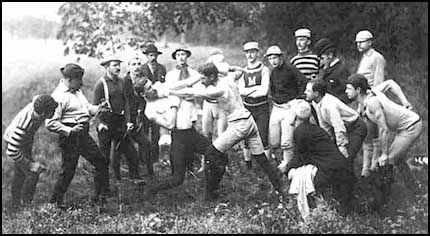
As we are concerned with the employment of self-defense techniques in the protection of one’s person and loved ones on the streets of Victorian London, it is not our purpose here to elaborate upon prize fights. Yet it is indisputably true that the one informed the other. Effective methods of pugilism were developed in the ring and then adopted by gentlemen on the boulevards. British boxing arose from the Age of Enlightenment’s love of all things classical. The ancient Greek sport of pankration, renowned for its brutality, and subsequent Roman variants, were revived in much more genteel versions in the mid 18th century.

It was the upper-classes who led the way in this, as simple brawling with fists had never died out among the working folk. Naturally, gambling was the impetus for injecting rules and order into what had been a mere vulgar scrap. A way had to be found to settle disputes when great sums were being wagered on gentlemen’s champions.

Thus the first regulations were set in place by former fighter John Broughton. His interest in fair play – gloves, set rounds, no attacking a downed man, etc. -- was somewhat selfish: he ran a school to teach pugilism to men of refinement and they did not wish to take broken jaws and black eyes home to their ladies.

Here we see the beginnings of the later Victorian attitude that boxing was a quintessentially English activity to be practiced by the ‘quality.’ To be sure, those less-mannered had always been beating one another to a bloody pulp in the alleys of London, but by the 1780’s pugilism began to evolve into an art that eventually replaced fencing in the hearts of the British middle- and upper-classes.

The decades-long struggle with France accelerated this urge toward the good manly virtue of boxing. Fisticuffs were seen as an antidote to the effeminate ways of the Continent. Less lethal than dueling (a strong selling point with every man needed to carry a musket against Bonaparte) and purely egalitarian (man vs. man with no underhanded doctoring of weapons), boxing became a national craze.


But it was a fad that suffered from early Victorian attitudes. That age’s philosophy stressed morality, faith, and family rather than the violence that Napoleon’s threat had necessitated. So the vogue waned for some time, as fighting was considered as beneath the dignity of a proper man. But when it returned it did so with a vengeance. The Queensberry Rules of 1867 were adopted with alacrity and became so widespread that the very nature of boxing changed.

With padded gloves an absolute requirement, tactics and footwork had to shift. First off, there actually could  be tactics, rather than mere flailing away until someone collapsed. In bare-knuckle boxing the defense, such as it was, was with the forearms rather than the hands. To protect one’s face the stance was upright, leaning the head back to keep it away from the opponent’s fists. Now the heavy gloves served as a shield to crouch behind.

In order to defeat this barrier, the now-familiar bobbing and weaving came into play, along with active footwork. Counter-intuitively, this all made the sport rather more dangerous. With bare knuckles a fighter had to pull a punch somewhat or risk a shattered hand. Now blows were delivered with much more fury and with greater rapidity. As a result men were struck harder and more often, since fights resulted in less bout-ending blood and broken teeth than before.

The cumulative effect of many punches caused more damage and actual knockouts than a few nasty but less forceful knuckle strikes. Brain injuries became common.


In a sense the popularity and widespread adoption of the Queensberry Rules might have been the downfall of many a well-trained but rule-bound gentleman when it came to actual no-holds-barred self-defense in the street. When accosted by an alley ruffian intent on relieving him of his wallet or watch, the club-trained man of means may have found himself at a disadvantage when kicked, grappled, or struck with a club. One can imagine him being overwhelmed mentally, as well, as the thug did not conform to the rules. Fair play did not enter into the equation.

But one can also imagine the contrary. Assailed by an unskilled, desperate, possibly intoxicated street thief, the training in pugilism might have made for a brief encounter. For the value in boxing does not lie only in simple techniques, but in the intangible qualities of confidence, cool-headedness, and quick judgement of the opponent’s strengths and weaknesses. Indeed, simply knowing how to take a punch, and how to mitigate the impact of it, would be of immeasurable value in itself. Attacked by an over-confident, swaggering hooligan who launched a clumsy haymaker, the gentleman’s schooling at his club could very well have resulted in the automatic response of step into the attack,/block, it/simultaneously punch with other fist.

Here we would be well-advised to recall the words of Allanson-Winn at the beginning of this essay, that pugilism is "a science, which is not only healthful and most fascinating, but which may, in a second of time, enable you to turn a defeat into a victory, and save yourself from being mauled and possibly killed in a fight which was none of your own making.”

As proof of the efficacy of pugilism as self-defense, though admittedly not in a historical context, we offer this video of a trained boxer fending off a veritable horde of enraged attackers with only the skills a Victorian gentleman might have learned from his boxing instructor:


In Part 3 we will explore the variety of weapons available to a Victorian in defending against armed or unarmed assailants, from the ubiquitous walking stick or umbrella to the cudgel or loaded riding crop.
Part 4 will conclude the series with an examination of Bartitsu, the only mixed martial art of this era and indeed, the first such.

~~~~~~~~~~~~
Terry Kroenung is the author of Brimstone and Lily, a seriocomic fantasy novel set in 1862, and its sequel, Jasper’s Foul Tongue. Book 3 in the series, Jasper’s Magick Corset, will be available in September. Paragon of the Eccentric, his Steampunk prequel to War of the Worlds, is pending. He has also written dramas set in the 19th century, such as Gentle Rain and Coolness and Courage.

Friday, May 18, 2012

Marketing In Victorian London Circa 1876


Food Supply.—The Quarterly Review, on one occasion, illustrated, in a whimsical way, the vastness of the system.  The following is described as the supply of meat, poultry, bread, and beer, for one year:—72 miles of oxen, 10 abreast; 120 miles of sheep, do.; 7 miles of calves, do.; 9 miles of pigs, do.; 50 acres of poultry, close together; 20 miles of hares and rabbits, 100 abreast; a pyramid of loaves of bread, 600 feet square, and thrice the height of St. Paul’s; 1000 columns of hogsheads of beer, each 1 mile high.


Markets.—London contains nearly 40 markets for cattle, meat, corn, coal, hay, vegetables, fish, and other principal articles of consumption.  The meat-markets are of various kinds—one for live animals, others for carcases in bulk, and others for the retail of meat; some, also, are for pork, and others principally for fowls.  The New Cattle Market, Copenhagen Fields, near Pentonville, built, in 1854, to replace old Smithfield Market, covers nearly 30 acres, and, with outbuildings, slaughterhouses, &c., cost the City Corporation about £400,000.  It is the finest live stock market in the kingdom.  The present Smithfield Market, near the Holborn Viaduct, for dead meat and poultry, is a splendid building, 625 feet long, 240 feet wide, and 30 feet high.  Wide roads on its north, east, and west sides, accommodate its special traffic.  A carriage road runs right through it from north to south, with spacious and well ventilating avenues radiating from it.  There are in this market no less than 100,000 feet of available space.  It has cost upwards of £180,000 already.  There are underground communication with several railways, to bring in, right under the market, meat and poultry from the country, and meat from the slaughterhouses of the Copenhagen Fields Cattle Market.  Newgate Market, as a market, no longer exists.  Leadenhall Market is a depôt for meat and poultry.  At Whitechapel there is a meat market also.  The minor meat markets require no special note here.  Billingsgate, the principal fish market of London, near the Custom House, was greatly extended and improved in 1849.  It is well worth visiting any morning throughout the year, save Sunday, at five o’clock.  Ladies, however, will not care to encounter its noise, bustle, and unsavoury odours.  The fish arriving in steamers, smacks, and boats from the coast or more distant seas, are consigned to salesmen who, during the early market hours, deal extensively with the retail fishmongers from all parts of London.  The inferior fish are bought by the costermongers, or street-dealers.  When particular fish are in a prime state, or very scarce, there are wealthy persons who will pay enormously for the rarity; hence a struggle between the boats to reach the market early.  At times, so many boats come laden with the same kind of fish as to produce a glut; and instead of being sold at a high price, as is usually the case, the fish are then retailed for a mere trifle.  Fish is now brought largely to London by railway, from various ports on the east and south coasts.  The yearly sale of fish at Billingsgate has been estimated at so high a sum as £2,000,000.

Covent Garden Market (connected by Southampton Street with the Strand) is the great vegetable, fruit, and flower market.  This spot, which is exceedingly central to the metropolis, was once the garden to the abbey and convent of Westminster: hence the name Convent or Covent.  At the suppression of the religious houses in Henry VIII.’s reign, it devolved to the Crown.  Edward VI. gave it to the Duke of Somerset; on his attainder it was granted to the Earl of Bedford; and in the Russell family it has since remained.  From a design of Inigo Jones, it was intended to have surrounded it with a colonnade; but the north and a part of the east sides only were completed.  The fruit and vegetable markets were rebuilt in 1829–30.  The west side is occupied by the parish church of St. Paul’s, noticeable for its massive roof and portico.  Butler, author of Hudibras, lies in its graveyard, without a stone to mark the spot.  In 1721, however, a cenotaph was erected in his honour in Westminster Abbey.  The election of members to serve in Parliament for the city of Westminster was held in front of this church: the hustings for receiving the votes being temporary buildings.  The south side is occupied by a row of brick dwellings.  Within the square thus enclosed fruit and vegetables of the best quality are exposed for sale.  A large paved space surrounding the interior square is occupied by the market-gardeners, who, as early as four or five in the morning, have carted the produce of their grounds, and wait to dispose of it to dealers in fruit and vegetables residing in different parts of London; any remainder is sold to persons who have standings in the market, and they retail it to such individuals as choose to attend to purchase in smaller quantities.  Within this paved space rows of shops are conveniently arranged for the display of the choicest fruits of the season: the productions of the forcing-house, and the results of horticultural skill, appear in all their beauty.  There are also conservatories, in which every beauty of the flower-garden may be obtained, from the rare exotic to the simplest native flower.  The Floral Hall, close to Covent Garden Opera House, has an entrance from the north-east corner of the market, to which it is a sort of appendage as a Flower Market.  Balls, concerts, &c., are occasionally given here.  The Farringdon, Borough, Portman, Spitalfields, and other vegetable markets, are small imitations of that at Covent Garden.


Malt liquors.—The beer and ale consumed in the metropolis is, of course, vast in quantity, though there are no means of determining the amount.  If, by a letter of introduction, a stranger could obtain admission to Barclay & Perkins’s or Truman & Hanbury’s breweries, he would there see vessels and operations astonishing for their magnitude—bins that are filled with 2,000 quarters of malt every week; brewing-rooms nearly as large as Westminster Hall; fermenting vessels holding 1,500 barrels each; a beer-tank large enough to float an up-river steamer; vats containing 100,000 gallons each; and 60,000 casks, with 200 horses to convey them in drays to the taverns of the metropolis!

Shops and Bazaars.—The better-class London retail shops, for wealth, variety, and vast number, are among the greatest wonders of the place.  They speak for themselves.  The wholesale establishments with which New Cannon Street, Wood Street, and the south side of St. Paul’s Churchyard—noticeably the gigantic warehouses of Messrs. Cook & Co.—abound, if, by a letter of introduction, an order of admission can be obtained, would strike a stranger—in spite of less external display, save as regards size—as more wonderful still, so enormous is the amount of their business operations, and of capital incoming and outgoing.

There are about 7,400 streets, lanes, rows, &c., in the metropolis.  From Charing Cross, within a six miles radius, there are something over 2,600 miles of streets.  As regards trades generally, it is hard even to get anything like an approximate notion of their numbers.  As the Post Office London Directory says, new trades are being added to the list every year.  Thus, we are told, 57 new trades were so added in the year 1870.  But to specify a few, there are, say, about 130,000 shopkeepers, or owners of commercial establishments, who carry on more than 2,500 different trades.  Loss of much of London’s shipping trade, &c., has indeed driven hundreds of emigrants of late from our east-end waterside neighbourhoods.  But London has gone on growing all the same, and trade with it.  Among these trades are, without counting purely wholesale dealers, about 2,847 grocers and tea dealers, 2,087 butchers, 2,461 bakers, 1,508 dairymen, &c., 2,370 greengrocers and fruiterers, more than 595 retail fishmongers, 891 cheesemongers, (this computation does not include the small shops in poor neighbourhoods which sell almost everything,) 2,755 tailors, (not including about 500 old-clothesmen, wardrobe-dealers, &c.,) about 3,347 bootmakers, about 450 hatters, and so forth.  All these are master tradesmen or shopkeepers, irrespective of workmen, foremen, shopmen, clerks, porters, apprentices, and families.  We may add, that in the pages of that very large book the London Post Office Directory, no less than 52 columns and over are occupied by the long list of London publicans.

The principal Bazaars of London are the Soho, London Crystal Palace, (Oxford Street,) and Baker Street bazaars, to which should be added the Burlington Arcade, Piccadilly, and the Lowther Arcade, (famous for cheap toys,) in the Strand.  The once celebrated Pantheon, in Oxford Street, is now a wine merchant’s stores.  Many small bazaars exist.

The Bazaar system of oriental countries, in which all the dealers in one kind of commodity are met with in one place, is not observable in London; yet a stranger may usefully bear in mind that, probably for the convenience both of buyers and sellers, an approach to the system is made.  For instance, coachmakers congregate in considerable number in Long Acre and Great Queen Street; watchmakers and jewellers, in Clerkenwell; tanners and leather-dressers, in Bermondsey; bird and bird-cage sellers, in Seven Dials; statuaries, in the Euston Road; sugar-refiners, in and near Whitechapel; furniture-dealers, in Tottenham Court Road; hat-makers, in Bermondsey and Southwark; dentists, about St. Martin’s Lane; &c.  There is one bazaar, if so we may term it, of a very remarkable character—namely, Paternoster Row.  This street is a continuation of Cheapside, but is not used much as a thoroughfare, though it communicates by transverse alleys or courts with St. Paul’s Churchyard, and, at its western extremity, by means of Ave-Maria Lane, leads into Ludgate Hill.  Paternoster Row, or ‘the Row,’ as it is familiarly termed, is a dull street, only wide enough at certain points to permit two vehicles to pass each other, with a narrow pavement on each side.  The houses are tall and sombre in their aspect, and the shops below have a dead look, in comparison with those in the more animated streets.  But the deadness is all on the outside.  For a considerable period this street has been the head-quarters of booksellers and publishers, who, till the present day, continue in such numbers as to leave little room for other tradesmen—transacting business in the book-trade to a prodigious amount.  At the western extremity of Paternoster Row a passage leads from Amen Corner to Stationers’ Hall Court, in which is situated Stationers’ Hall, and also several publishing-houses.

Mudie’s Library.—While on the subject of books, we may remind the visitor that the most remarkable lending library in the world is situated in London.  Mudie’s, at the corner of New Oxford Street and Museum Street, affords a striking example of what the energy of one man can accomplish.  At this vast establishment the volumes are reckoned by hundreds of thousands; and the circulation of them, on easy terms, extends to every part of the kingdom.  The chief portion of the building is a lofty central gallery, of considerable beauty.
 
 Compiled From Sources In The Public Domain.

Teresa Thomas Bohannon,
MyLadyWeb, Women's History, Women Authors
Regency Romance A Very Merry Chase
Historical Fantasy Shadows In A Timeless Myth.

FenMaric, one of the main characters in my historic fantasy novel, Shadows In A Timeless Myth, was a member of the ninth legion who fought and died attempting to stop Boudicea in ancient Roman London.  He still exists to appear in Shadows because he was battle cursed by a Druid Priest to the same fate that the Druid Priests believed themselves fated for, soul transmigration...but with a vengefully, punishing twist!