by Terry Kroenung
Genteel Self Defense
"I can almost hear people say, ‘Oh, this is all rubbish; I’m not going to be attacked; life would not be worth living if one had to be always ‘on guard’ in this way.’ Well, considering that this world, from the time we are born to the time we die, is made up of uncertainties, and that we are never really secure from attack at any moment of our lives, it does seem worth while to devote a little attention to the pursuit of a science, which is not only healthful and most fascinating, but which may, in a second of time, enable you to turn a defeat into a victory, and save yourself from being mauled and possibly killed in a fight which was none of your own making.
"Added to all this, science gives a consciousness of power and ability to assist the weak and defenceless, which ought to be most welcome to the mind of any man. Though always anxious to avoid anything like ‘a row,’ there are times when it may be necessary to interfere for the sake of humanity, and how much more easy is it to make that interference dignified and effective if you take your stand with a certainty that you can, if pushed to extreme measures, make matters very warm indeed for the aggressor?
"The consciousness of power gives you your real authority, and with it you are far more likely to be calm and to gain your point than you would be without the knowledge. Backed up by science, you can both talk and act in a way which is likely to lead to a peaceful solution of a difficulty, whereas, if the science is absent, you dare not, from very uncertainty, use those very words which you know ought to be used on the occasion.” ~ Rowland George Allanson-Winn, 5th Baron of Headley, 1890
Pugilism

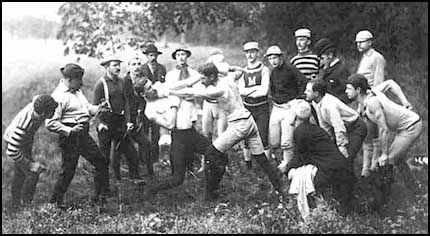
As we are concerned with the employment of self-defense techniques in the protection of one’s person and loved ones on the streets of Victorian London, it is not our purpose here to elaborate upon prize fights. Yet it is indisputably true that the one informed the other. Effective methods of pugilism were developed in the ring and then adopted by gentlemen on the boulevards. British boxing arose from the Age of Enlightenment’s love of all things classical. The ancient Greek sport of pankration, renowned for its brutality, and subsequent Roman variants, were revived in much more genteel versions in the mid 18th century.
 It was the upper-classes who led the way in this, as simple brawling with fists had never died out among the working folk. Naturally, gambling was the impetus for injecting rules and order into what had been a mere vulgar scrap. A way had to be found to settle disputes when great sums were being wagered on gentlemen’s champions.
Thus the first regulations were set in place by former fighter John Broughton. His interest in fair play – gloves, set rounds, no attacking a downed man, etc. -- was somewhat selfish: he ran a school to teach pugilism to men of refinement and they did not wish to take broken jaws and black eyes home to their ladies.
Here we see the beginnings of the later Victorian attitude that boxing was a quintessentially English activity to be practiced by the ‘quality.’ To be sure, those less-mannered had always been beating one another to a bloody pulp in the alleys of London, but by the 1780’s pugilism began to evolve into an art that eventually replaced fencing in the hearts of the British middle- and upper-classes.
The decades-long struggle with France accelerated this urge toward the good manly virtue of boxing. Fisticuffs were seen as an antidote to the effeminate ways of the Continent. Less lethal than dueling (a strong selling point with every man needed to carry a musket against Bonaparte) and purely egalitarian (man vs. man with no underhanded doctoring of weapons), boxing became a national craze.

But it was a fad that suffered from early Victorian attitudes. That age’s philosophy stressed morality, faith, and family rather than the violence that Napoleon’s threat had necessitated. So the vogue waned for some time, as fighting was considered as beneath the dignity of a proper man. But when it returned it did so with a vengeance. The Queensberry Rules of 1867 were adopted with alacrity and became so widespread that the very nature of boxing changed.
With padded gloves an absolute requirement, tactics and footwork had to shift. First off, there actually could be tactics, rather than mere flailing away until someone collapsed. In bare-knuckle boxing the defense, such as it was, was with the forearms rather than the hands. To protect one’s face the stance was upright, leaning the head back to keep it away from the opponent’s fists. Now the heavy gloves served as a shield to crouch behind.
In order to defeat this barrier, the now-familiar bobbing and weaving came into play, along with active footwork. Counter-intuitively, this all made the sport rather more dangerous. With bare knuckles a fighter had to pull a punch somewhat or risk a shattered hand. Now blows were delivered with much more fury and with greater rapidity. As a result men were struck harder and more often, since fights resulted in less bout-ending blood and broken teeth than before.
The cumulative effect of many punches caused more damage and actual knockouts than a few nasty but less forceful knuckle strikes. Brain injuries became common.

In a sense the popularity and widespread adoption of the Queensberry Rules might have been the downfall of many a well-trained but rule-bound gentleman when it came to actual no-holds-barred self-defense in the street. When accosted by an alley ruffian intent on relieving him of his wallet or watch, the club-trained man of means may have found himself at a disadvantage when kicked, grappled, or struck with a club. One can imagine him being overwhelmed mentally, as well, as the thug did not conform to the rules. Fair play did not enter into the equation.
But one can also imagine the contrary. Assailed by an unskilled, desperate, possibly intoxicated street thief, the training in pugilism might have made for a brief encounter. For the value in boxing does not lie only in simple techniques, but in the intangible qualities of confidence, cool-headedness, and quick judgement of the opponent’s strengths and weaknesses. Indeed, simply knowing how to take a punch, and how to mitigate the impact of it, would be of immeasurable value in itself. Attacked by an over-confident, swaggering hooligan who launched a clumsy haymaker, the gentleman’s schooling at his club could very well have resulted in the automatic response of step into the attack,/block, it/simultaneously punch with other fist.
Here we would be well-advised to recall the words of Allanson-Winn at the beginning of this essay, that pugilism is "a science, which is not only healthful and most fascinating, but which may, in a second of time, enable you to turn a defeat into a victory, and save yourself from being mauled and possibly killed in a fight which was none of your own making.”
As proof of the efficacy of pugilism as self-defense, though admittedly not in a historical context, we offer this video of a trained boxer fending off a veritable horde of enraged attackers with only the skills a Victorian gentleman might have learned from his boxing instructor:
In Part 3 we will explore the variety of weapons available to a Victorian in defending against armed or unarmed assailants, from the ubiquitous walking stick or umbrella to the cudgel or loaded riding crop.
Part 4 will conclude the series with an examination of Bartitsu, the only mixed martial art of this era and indeed, the first such.
~~~~~~~~~~~~
Terry Kroenung is the author of Brimstone and Lily, a seriocomic fantasy novel set in 1862, and its sequel, Jasper’s Foul Tongue. Book 3 in the series, Jasper’s Magick Corset, will be available in September. Paragon of the Eccentric, his Steampunk prequel to War of the Worlds, is pending. He has also written dramas set in the 19th century, such as Gentle Rain and Coolness and Courage.