Showing posts with label George III. Show all posts

Tuesday, December 29, 2020

An Amiable Wife

 By Lauren Gilbert

Portrait of Anne Law, nee' Towry, 1st Lady Ellenborough by John Linnell


As a female, I cannot help being interested in the lives of women of earlier times. Finding information about some is easy, thanks to published letters and memoirs, newspaper archives, and (because of their own personal status or accomplishments or notoriety) even biographies. With others, it is a challenge, and we may find ourselves finding that little data is available, and that as side details provided in the information related to a father, husband or other male relative. One such lady is Anne Law, Lady Ellenborough. The November/December issue of JANE AUSTEN’S WORLD magazine included a reference to her in “What Made The News in November & December 1812” that caught my attention.

Anne was born about 1769, and possibly christened in St. Pancras Church in London. Her father was George Phillips Towry and his wife Elizabeth More. Mr. Towry served in the Royal Navy, commissioned a lieutenant in 1757. He inherited an estate from his uncle in 1762, and subsequently married the well-to-d0 and well-connected Miss More (possibly descended from Sir Thomas More) in June 1766 at St. Martin’s in the Fields. She had two brothers George Henry and Charles George. Elizabeth died, and her father remarried on April 3, 1770 to Susannah Haywood. In November of 1770, Mr. Towry won 20,000 pounds in a lottery. He became a Commissioner of the Naval Victualling in 1784, rising to Deputy Chairman of the Victualling Board November 4, 1803. He was considered an able administrator.

I found no information about Anne’s youth or education or her introduction to society. She was considered a great beauty, with regular features, rosy complexion, and a good figure. She was painted by Sir Joshua Reynolds in March of 1789, but that portrait was lost at sea. She had numerous admirers, among them a successful lawyer named Edward Law.


Mr. Law was the son of the Bishop of Carlisle, had attended school at the Charterhouse, and went on to Cambridge, obtaining a B.A. and an M.A. He decided to pursue law and was admitted to Lincoln’s Inn as a student in 1769. In 1771, he studied in London with George Wood (a special pleader (a lawyer who specialised in drafting statements of cases, give opinions, and prepare papers for various court proceedings) who was knighted, taught many students, and became famous). In 1775, Mr. Law became a special pleader himself, and was called to the bar in 1780. He built a successful practice and was elected to the Inner Temple in 1782. He gained a level of fame as leading counsel for Warren Hastings, a long-drawn-out trial that began in February of 1788. Although he was not handsome and was apparently socially awkward, he had acquired the reputation as something of a rake (and kept a mistress), prior to meeting Anne Towry. He pursued her fixedly, and asked her father for her hand. Being of good family and successful in his work, her father gave his consent to Mr. Law’s courtship.

Regardless of her father’s approval, Anne Towry refused his hand as she had already refused other suitors. In fact, she refused him three times. Each time, Mr. Law continued to court her despite her determined refusal. Finally, Anne consented to marry him the fourth time of asking. There is a suggestion that, at this point, members of her family pressured her to reconsider because he was such a promising suitor. According to THE LIVES OF THE CHIEF JUSTICES OF ENGLAND From the Norman Conquest Till the Death of Lord Tenterden, “…her aversion was softened, and she became tenderly attached to him.” (1) They were married by special license at her father’s home in Great Ormand Street on October 17, 1789.

On all counts, the marriage was successful. The couple had their first child, a son named Edward, about September of 1790. He was the first of thirteen children. Mr. Law’s career continued successfully-he became quite wealthy, he was involved with numerous high-profile cases and was instrumental in the ultimate acquittal of Mr. Hastings in 1795. He became Attorney General February 1801, and was knighted February 20, 1801 by George III. Shortly after being knighted, Mr. Law was returned as member for the borough of Newtown, Isle of Wight, to the House of Commons. His career in the House was short-lived, as he was appointed Lord Chief Justice April 11, 1802. On April 19, 1802, Mr. Law was created Baron Ellenborough in the county of Ellenborough, sworn a member of the privy council on April 21, and took his seat in the House of Lords on April 26th.

What little data is available indicates that Anne was busy with home and children, acting as her husband’s hostess. After their marriage, she was known to have retained her beauty, causing her to be pursued by followers at social events, and strangers gathering to watch her tend her flowers at their home. Their marriage was considered an affectionate and harmonious one. (2) She was painted by Sir Thomas Lawrence in 1811 and again in 1813, and by other artists. In addition to residence in London, the couple also had for some years a principal residence at Waldershare in Kent near Dover. This property was owned by the Earl of Guildford, and apparently leased by Lord Ellenborough.

The reference to Anne as Lady Ellenborough in JANE AUSTEN’S WORLD occurred in December of 1812: because of her generosity, one hundred poor women and girls were completely clothed, taken to church and then back to the mansion where they were provided with soup to take home and a shilling each. (There were 12 pennies in a shilling; in 1812, a pound of cheese cost about 9 pence.) This action was mentioned in the SUN (London) of Wednesday, September 16, 1812, in which Lady Ellenborough was described as “the amiable hostess of Waldershare-house”. While similar acts of charity were not uncommon, one of the things that struck me about this was the specific focus being on women and girls.

In early 1816, Lord Ellenborough began experiencing health problems but continued working. Anne’s father died March 12, 1817. His obituary describes him as “Commissioner of the Victualling-office, father of Lady Ellenborough.” Lord Ellenborough went abroad in the fall of 1817 in an attempt to improve his health, and returned to the bench on his return. He was very upset about the acquittals resulting in the winter of 1817, and his health deteriorated to the point that he was periodically absent from court. In September of l1818, he gave notice of his intent to resign, and executed his deed of resignation on November 6, 1818. He died December 13, 1818 at home in St. James’s Square. He was buried in the chapel of the Charterhouse, and a monument was raised there in his honour. At the time of his passing, he was survived by nine of his children with Anne, including their son Edward (now married) ranging to their youngest a daughter named Frances Henrietta born in 1812. (It appears he was also survived by some children born out of wedlock.) Anne was left a very wealthy widow.

The house at Waldershare was no longer in their possession, as it appears to have been occupied by the Earl of Guildford at the time of Lord Ellenborough’s death. Anne was seldom mentioned in print, other than at attendance at weddings. She outlived her husband by almost 25 years and never remarried. She apparently suffered ill health before her death at her home in Stratford-place in London. She died August 16, 1843. She left a rather detailed will, in which she left specific requests of jewelry to her daughters with other provisions, which was proved September 13, 1843. 


FOOTNOTES:

1. Campbell, John Lord, LLD, FRSE, THE LIVES OF THE CHIEF JUSTICES OF ENGLAND FROM THE NORMAN CONQUEST TILL THE DEATH OF LORD TENTERDEN. P. 164

2. Ibid.


Sources include:

JANE AUSTEN’S REGENCY WORLD. November/December 2020, Issue 108. “WHAT MADE THE NEWS IN NOVEMBR & DECEMBER 1812”, compiled by Judy Boyd from the British Newspaper Archives.

Britishnewspaperarchive.com.uk  Numerous articles including the Hereford Journal for Wednesday, October 28, 1789; the Derby Mercury for Friday, December 7, 1770; the Leeds Mercury for Saturday, December 19, 1818; the Kerry Evening Post for Saturday, October 23, 1841; the Lincolnshire Chronicle for Friday, August 25, 1843; the home page is HERE

Thegazette.co.uk  THE LONDON GAZETTE for Tuesday February 17 to Saturday February 21, 1801. P. 202. https://www.thegazette.co.uk/London/issue/15338/page/202 ; THE LONDON GAZETTE FOR TUESDAY APRIL 13 to SATURDAY April 17, 1802. P. 386. HERE

Books.google.com FRAGMENTIA GENEALOGICA, Volume 10. Great Britain: Private Press of Frederick Arthur Crisp, 1904. P. 43 HERE ;  The Annual Register or A View of the History and Politics of the Year 1843. London: F. & J. Rivington, 1844. P. 286.HERE ; THE UNIVERSAL MAGAZINE, NEW SERIES. VOL. XVIII. July to December, Inclusive. 1812. London: Sherwood, Neely, and Jones. P. 521 HERE; THE ROYAL KALENDAR AND COURT AND CITY REGISTER FOR ENGLAND, SCOTLAND, IRELAND, AND THE COLONIES FOR THE YEAR 1820. London: William Stockdale. P. 31. HERE

Minnesotalegalhistoryproject.org Campbell, John Lord, LL.D, FRSE. THE LIVES OF THE CHIEF JUSTICES OF ENGLAND FROM THE NORMAN CONQUEST TILL THE DEATH OF LORD TENDERDEN. Third Edition. In Four Volumes-Vol. IV. London: John Murray, 1874. Pp. 163-164. (PDF) HERE

Wikisource.org THE DICTIONARY OF NATIONAL BIOGRAPHY 1885-1900, Vol.32. “Law, Edward (1750-1818)” by George Russell Barker. HERE

Images:

Anne Law, nee’ Towry, 1st Lady Ellenborough by John Linnell. Wikimedia Commons. Photo by Wmpearl, May 21, 2012. HERE
Edward Law, 1st Lord Ellenborough by Sir Thomas Lawrence. Wikimedia Commons. Photo by Donan.raven, November 20, 2012. HERE

~~~~~~~~~~

Lauren Gilbert lives in Florida with her husband. She earned a B.A. degree in liberal arts English, minoring in Art History. She has presented programs for the South Florida region of JASNA. Her first book, HEYERWOOD A Novel, is still in print, and her second novel,  A RATIONAL ATTACHMENT, is out now. She has articles in both volumes of CASTLES, CUSTOMS AND KINGS: True Tales by English Historical Fiction Authors. She is also working on a non-fiction book about seven powerful women.  Please visit her website for more information. 


Monday, July 6, 2020

George III – Not a Mistress in Sight, But a Prolific Parent

by Mike Rendell

The grandson of George II was twenty-two when he came to the throne. It is ironic that his reign coincided with an explosion in the trade of satirical prints. They mocked his avarice, they mocked his miserliness, they mocked his simple tastes, and his interest in agriculture, but the one thing they could not do was mock his family values and constancy to the woman who became his queen.

Not that this stopped a curious story emerging in 1770. This was to the effect that, as Prince of Wales, he had secretly married ‘a fair Quakeress’ by the name of Hannah Lightfoot on 17 April 1759, at Curzon Street Chapel, and that they had two children together.

In 1788 S.W. Fores published a caricature entitled The Fair Quaker of Cheltenham showing the young monarch addressing his ardour to a young lady under the shade of an overhanging tree. In the background, by way of being a complete anachronism, Queen Charlotte is spying on the couple. Not a shred of evidence supported this wild allegation, but ‘the story had legs’ to the extent that in the course of the next century various spurious claims were put forward. Futile applications were made through the courts, seeking to declare the children of Queen Charlotte illegitimate, on the basis that the King had married her bigamously. It shows the willingness of people to publish (and read) scandalous stories about the Royals. The idea that ‘truth should never get in the way of a good story’ is nothing new….

The legend of George Ill's attachment to the 'fair Quakeress' can be traced back to a paragraph in a newspaper from 1776, and it was not finally discredited until 1866. One rather suspects that the rumours started after King George had returned to Cheltenham at a time when he was suffering mentally, and perhaps he was overheard gabbling on about some imagined episode of his earlier life.

What appears to be the case is that George was faithful to Charlotte (and probably didn’t have the energy to be anything else, given that he gave her fifteen children). He had never met Charlotte until the occasion of their marriage on 8 September 1761. Mind you, she was not the first woman propelled in his direction. He had previously thought of marrying Lady Sarah Lennox, sister of the Duke of Richmond but Lord Bute managed to talk him out of the alliance, and she went off and married Sir William Bunbury. Her “disappointment” at failing to make it to the dizzy heights of Queen was lessened by the fact that, as she said, "Luckily for me, I did not love him, and only liked him." She was invited by the King to be one of his ten bridesmaids, which must have been a small consolation!

Whether he stayed faithful throughout his marriage to Charlotte I do not know, but certainly if there had been any whiff of scandal, the Press and in particular the caricaturists, would have surely alluded to it. After all, the King’s siblings were constantly in the news for their infidelities and peccadilloes, and no-one felt under any restraint in publicising the facts in great detail!

~~~~~~~~~~~~~

The story of George III and of the bedspring-busting antics of his entire family, is featured in Mike Rendell's book In Bed with the Georgians, Sex Scandal and Satire in the Eighteenth Century, published by Pen & Sword Books.

Amazon

Tuesday, February 27, 2018

Hannah Lightfoot, “The Fair Quakeress”- Historical Hoax?

by Lauren Gilbert

Portrait of A Lady-Attributed to Sir Joshua Reynolds,
this may be a portrait of Hannah Lightfoot.


Historical hoaxes crop up from time to time. Examples ranging from the Piltdown Man in England (here) to Francis Drake’s Plate (here) in the US and others abound. Some are found to be pranks, some deliberate hoaxes. Then there are stories about people and personal relationships. They start with whispers, then printed hints and finally, hey presto! We now have full blown “history”. Gossip? Undoubtedly. True? No one really knows. Sometimes there simply aren’t enough known facts to determine the answer. A case in point is the story of Hannah Lightfoot and the very young Prince of Wales who became George III.

THE LEGEND

Young George, Prince of Wales, saw Hannah Lightfoot’s beautiful, unblemished face through a window (or maybe at a masquerade) and fell immediately in love with her sometime in 1753, and she with him. At some point, they began a passionate affair. She married Isaac Axford in December of 1753, and was snatched from the doors of the church (or maybe 6 weeks later) by the prince (or by the prince’s mother’s orders), who took her to live in one of the royal residences or another residence connected with the royal family. One particularly lurid account has the prince and Hannah in a coach pursued up the turnpike by Mr. Axford. George cleared the tolls by shouting “Royal Family”(1) at the tollkeepers, while poor Mr. Axford had to stop and pay each toll, ultimately losing the couple.

There is also an account that George was married to Hannah in the spring of 1759 by James Wilmot. They had at least one child (some accounts list 3, and the story has grown to a point where there seems to have been many children). When King George II died in October of 1760, Prince George’s mother and Lord Bute convinced him of the need to make a marriage of state to a royal princess, and he bigamously married Princess Charlotte of Mecklenburg-Strelitz. Hannah and her child(ren) left. Some accounts place her in South Africa, others in America. Some sources indicate that Charlotte found out about this previous marriage; she insisted on being married again to George III in 1765 (again by James Wilmot), supposedly after the death of Hannah in 1764.

THE FACTS

GEORGE

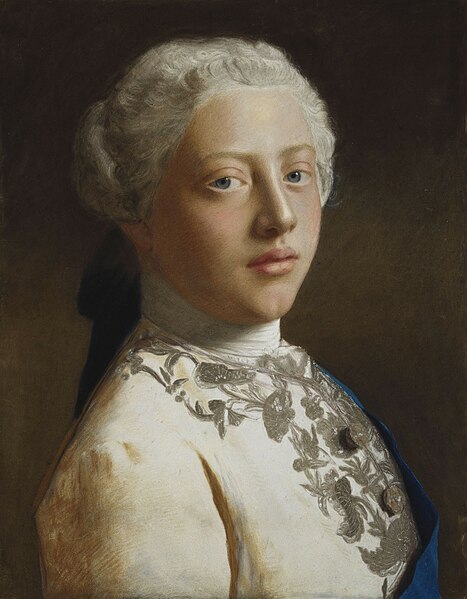
George III as Prince of Wales by Jean-Etienne Liotard, painted 1754

George was born June 4, 1738, the second child and oldest son of Frederick, Prince of Wales, and his wife Augusta, Princess of Saxe-Gotha. He was the grandson of King George II and Queen Caroline. He was born two months prematurely and tended carefully so that he became a healthy child. Prince Frederick was interested in the arts, sciences, writing and sports, and was quite involved with his children’s education. George and his younger brother Edward studied with Rev. Ayscough, learning to read and write both English and German well. It is likely that, thanks to Prince Frederick’s interests, they had exposure to literature, including Jonathon Swift and Alexander Pope, music, including the work of Bononcini and Handel, and fine art, thanks to Frederick’s personal collection, which included works by Van Dyck, Rubens and Breughel. Frederick also played with his children when he was available.

When he was age 11, a new tutor, George Lewis Scott, was assigned to George. He and his brother also were appointed a governor, Lord North. Their schedule expanded to include Latin and Greek, with a work day that started at 8:00 in the morning and continued until bedtime (between 9:00 and 10:00 at night), 6 days per week. On Sundays, they attended church multiple times and studied religion with Dr. Ayscough in the time available. (This schedule is outlined in Christopher Hibbert’s biography of George III.) This schedule was maintained, wherever they were in residence, until Prince Frederick died suddenly on March 31, 1751. George became the heir apparent at age 12.

Because of the antipathy George II had felt for Frederick, changes were made in the children’s household to get rid of those appointed by Frederick. Lord Harcourt replaced Lord North and Dr. Thomas Haytor. George’s studies continued, including Latin, mathematics, trigonometry, algebra, history, sciences, etc. He had a music master, drawing master, dancing master, fencing master, riding master, and went to outside lectures as well. He was shy, reserved and somewhat melancholy. Still living with his mother Princess Augusta, George came under the influence of Lord Bute, who had many political enemies. When George turned 18 in 1756, George II offered George his own household, but George refused, choosing to stay with his mother. His education continued, with interests expanding into agriculture, architecture and international trade. He received input from conflicting sources regarding current affairs and politics, but placed a lot of trust in Lord Bute.

Prince George turned 21 in June of 1759, at which point (according to Stella Tilyard in Aristocrats), he was still a virgin(2). In November 1759, Prince George took his seat in the House of Lords. Also in November of 1759, Sarah Lennox (one of the famous Lennox sisters) arrived at Holland House in London. She was almost 15 years old. She was presented at court in late November and met Prince George again. Sarah was known to the King and the royal family. She had participated in Protestant Irish society, so was more socially sophisticated than the Prince. Prince George apparently fell in love with Sarah immediately. Sarah was much admired at court. In addition to coping with his passion for Sarah, Prince George was also trying to convince his grandfather George II to give him something more to do politically. Somewhere around this time, he confessed to Lord Bute that he was interested in girls, Sarah in particular. Since Prince George was expected to marry for state reasons, his interest in Sarah was not encouraged.

Although Prince George yearned for Sarah, and it appears he asked her to marry him at least once, nothing came of this romance. On October 25, 1760, King George II died, making George king. Meetings with Lord Bute, William Pitt, Cabinet ministers and government business dominated the new king’s time. George III ultimately married Princess Charlotte of Mecklenburg-Strelitz on September 8, 1761. They were crowned king and queen together on September 22, 1761. In spite of his passion for Sarah Lennox, George III was devoted to his wife almost from the beginning, and to their family (they had 15 children.)

HANNAH


Hannah Lightfoot was the daughter of Matthew Lightfoot, a shoemaker by some accounts, and Mary Wheeler his wife, and was born in approximately 1730. Matthew died in 1732 or 1733. The Lightfoots and Wheelers were members of the Society of Friends. Mary’s brother Henry Wheeler, a linendraper, took Hannah and her mother into his home at some point. Accounts indicate he had a shop in St. James’s Market that was apparently not far from the Opera House and Pall Mall. Most accounts indicate Hannah was expected to work for or with her uncle in the family business. On December 11, 1753, Hannah married Isaac Axford, a grocer, in Dr. Keith’s marriage chapel in Mayfair. Isaac’s parents were Baptists (although other family members may have been members of the Society of Friends). The records of the Westminster Society of Friends indicate Hannah was expelled from the society in 1756 for being married by a priest to a non-member. Data indicates she had left and could not be contacted.

In 1757, a man named Robert Pearne of Isleworth left a will leaving Hannah (Mrs. Hannah Axford, formerly Miss Hannah Lightfoot) an annuity of 40 pounds per year. Mr. Pearne was reportedly a wealthy, single man with property in England and Antigua.  He may, or may not, have been known to Hannah's family.  No one really knows why he left her the annuity.  (I saw nothing to indicate anyone has discovered if it were claimed.)  Isaac Axford, claiming to be a widower, remarried in December of 1759. Hannah’s mother, Mary Wheeler Lightfoot, made a will in January of 1760 leaving her property to Hannah, stating she had not heard from her daughter in 2 years and did not know if she were alive or dead. Mary died in May of 1760. By all accounts that I have read indicate Hannah disappeared shortly after her marriage in December of 1753. To date, there is no indication that a date, place or cause of death has been established for her.

CONCLUSION

In 1753, George, Prince of Wales, was 15 years old and engaged with studies 6 days a week under the supervision of a governor, tutors and multiple masters, as well as his mother and Lord Bute, with Sundays equally occupied with multiple church attendances and religious studies. In 1753, Hannah would have been somewhere between approximately 23 years old, a member of a conservative and devout religious sect, and probably working in her uncle’s shop. There is no indication of any contemporary gossip of the prince being involved with any girl at this time in his life. Frankly, I don’t know when he would have had the time or the opportunity. It also does not seem likely that a young woman working for her keep in her uncle’s shop would have had much spare time to carry on a flirtation with passing royalty.

There is no contemporary record indicating a meeting between George and Hannah or of Hannah’s presence in any of the royal residences or of any gossip concerning the prince’s romance with Hannah. (One would think that someone would have noticed, given the intense supervision to which the prince was subjected.) I think that a mad flight up the turnpike would have been noted somewhere. The idea that a 15-year old Prince of Wales could organize such an event without getting caught by one or more of his many minders also seems wildly improbable.

We do know that by the end of 1759, George was madly in love with and wanted to marry Sarah Lennox. This seems completely out of character if he were in fact happily ensconced in a family relationship with Hannah and a child or children. After his grandfather’s death October 25, 1760, he was occupied with matters of state and forming a government as king, working closely with Lord Bute and his mother. He was married to Charlotte September 22, 1761. A letter was written by Lady Sophia Egerton to her uncle William Bentinck (who became the Duke of Portland) in December of 1759 that indicated that George had kept a beautiful Quaker, had a child by her, and she was dead. The Quaker in question was not named. There is nothing to indicate where she got the story, and there is no indication of similar stories in other sources. The timing is certainly odd, given the then-Prince’s known feelings for Sarah Lennox. I have not been able to find the full text of this letter, and I’ve seen no discussion regarding the existence and the validity or otherwise of this letter.

Subsequently, no rumors concerning a romance between Hannah and the Prince of Wales surfaced until the 1770’s, when an account was published that the prince had had this relationship, after which they popped up occasionally. By this time, George had been king and a contented family man for at several years. While it has been noted that George III was aware of and respected the Society of Friends, no evidence indicates this viewpoint on a personal relationship with an affair with a young woman. From 1779 until 1820, the story did not appear to be in circulation. In 1817, a woman named Olive Wilmot Serres contacted the Prince of Wales, claiming to be the daughter of the Duke of Cumberland.  After the death of George III, she revised her story to say she was the legitimate daughter of the Duke of Cumberland.  Such documentation of the relationship between George and Hannah that has been located include marriage certificates indicating that a marriage was performed between George and Hannah by James Wilmot in Curzon Street Chapel in either April or May of 1759 (apparently there are 2 certificates, each with a different date) and a will signed in 1762 by Hannah Regina appeared in a case filed by the illegitimate daughter of Olive Serres in a last attempt to establish that her mother was Princess Olive, daughter of the Duke of Cumberland and petitioned King George III for a pension. (For Princess Olive’s story go HERE and HERE  and in THE GREAT PRETENDERS shown in Sources below). The royal family contested Olive's allegations and, after Olive's death, her daughter Lavinia took the case to court in 1866. The documents (including those related to Hannah Lightfoot and George III) were finally pronounced at best suspicious, probably forgeries. (There are indications that George III’s oldest son, George IV, spread the story, using it to tease Queen Charlotte about the legitimacy of her marriage to his father.(3))  It is worth noting that the chapel where the wedding of George and Hannah allegedly occurred in 1759 was closed in 1754.(4)   The story grew throughout the Victorian era. There is also no evidence linking the portrait shown, attributed to  Joshua Reynolds, to Hannah Lightfoot Axford.  It is a portrait of a woman in an elegant gown, not in Quaker attire.  (There is a similar portrait, painted in 1756 by Joshua Reynolds, hanging at Knole, titled "Miss Axford, "The Fair Quakeress", also in fashionable garb.)  Either or both portraits could be portraits of Miss Ann Axford, who was not a Quaker but a member of a well-to-do family of grocers in Ludgate Hill. 

While Hannah Lightfoot Axford did exist, and did disappear sometime after her marriage to Isaac Axford on December 11, 1753, there is nothing linking her disappearance to the then-Prince of Wales. The inheritance of an annuity in 1757 from Robert Pearne would indicate other possibilities. Is it completely impossible that, at some point, she may have met George? No. I do however, feel a relationship of any kind between the two would not have gone unnoticed and undocumented, and a passionate romance that included living together and producing a child (or several) without any contemporary record does seem impossible to me.

Footnotes

(1) Bondeson, Jan. THE GREAT PRETENDERS The True Stories behind Famous Historical Mysteries. P. 175.

(2) Tilyard, Stella. ARISTOCRATS. P. 112

(3) Hampden, John Jr. THE ARISTOCRACY OF ENGLAND A History for the People. P. 204.

(4) Bondeson, Jan.  Op. Cit. P. 181

SOURCES INCLUDE

Bondeson, Jan. THE GREAT PRETENDERS The True Stories behind Famous Historical Mysteries. 2004: W. W. Norton & Co., New York.

Hibbert, Christopher. GEORGE III A Personal History. 1998: Viking of Penguin Books. Reprinted by Basic Books, a Member of the Perseus Books Group, New York.

Pendered, Mary Lucy. THE FAIR QUAKER Hannah Lightfoot and Her Relations with George III. 1911: D. Appleton and Co., New York. Kessenger Legacy Reprint.  (historical book reprint including imperfections) in my possession.

Tilyard, Stella. ARISTOCRATS. 1994: Farrar, Straus and Giroux, New York.

Archive.org. Doran, Dr. LIVES OF THE QUEENS OF ENGLAND. Second Edition in Two Volumes. Vol. II. . 1855: Richard Bentley, London. HERE

Chest of Books. “True Love Stories of Famous People-29. King George III and Hannah Lightfoot” from EveryWoman’s Encyclopaedia, 1910-1912.  HERE

GoogleBooks. Ashdown-Hill, John. ROYAL MARRIAGE SECRETS: Consorts & Concubines, Bigamists and Bastards. 2013: History Press. (Preview)  HERE

GoogleBooks. Hampden, John Junior (annotated William Howiitt). THE ARISTOCRACY OF ENGLAND A History for the People. 1856: Chapman Brothers, London.   HERE
Wikipedia.  "Olive Serres"(last edited 30 June 2017). No author or date provided. HERE
Illustrations:
Joshua Reynolds' Portrait of Hannah: HERE
Liotard's portrait of George: HERE
Imaginary portrait of Hannah is the frontispiece from Mary Lucy Pendered's THE FAIR QUAKER Hannah Lightfoot, and Her Relations with George III (1911) as reprinted by Kessinger Legacy Reprints, p. vii. in my possession.  (THE MYSTERIES OF THE COURT OF LONDON by G. W. M. Reynolds, from which she obtained this portrait, was a "penny dreadful" published in 1849 by J. Dicks.)


~~~~~~~~~~


Lauren Gilbert lives in Florida and is a long-time member of the Jane Austen Society of North America. An obsessive reader, she has been writing since childhood, and achieved her dream of publishing a book with HEYERWOOD: A Novel in 2011. She is working on her second novel A RATIONAL ATTACHMENT. Visit her website HERE for more information.


Wednesday, August 9, 2017

Cheltenham Spa

by Lauren Gilbert

The location is excellent.   On the edge of the Cotswolds, in a valley with good arable land and water, it is surrounded by defensible hills.  Originally an agricultural settlement, the area has been occupied for hundreds of years, with the original settlement taken over by Romans, subsequently Saxon, Norman, etc.  Mentioned in the Domesday Book, the town was awarded a market charter in 1226 and was a royal gift for centuries. The excellence of the site was enhanced by the number of roads that went through the area. However, the town remained a fairly small town occupied by and visited by farmers and local gentry for markets and fairs.

Salt springs were discovered 1716. People drank the waters for health, found them good, and more came. After a while, the waters were sold. The original site was enclosed in 1721. Then Captain Henry Skillicone, owner of the spring, turned the spring into a well with an avenue of trees leading to the well, a pump room, and assembly rooms between  1738-1742. This is the beginning of the development of Cheltenham as a health center and the growth of the town to a thriving medical and social center.

In 1740 a book was written about the healthful qualities of the waters by a Doctor Short. More new spas were built in the area. Gradually the spas were visited by more upper crust and celebrities. Handel and Samuel Johnson visited. However, a visit by George III and the royal family for a month in the summer of 1788 put the town on the map and allowed the appellation “Royal Cheltenham Spa”.

Constitutional Club-satire shows
George III with a jug of Cheltenham Water,
Constitutional Restorer 

The Prince of Wales (later George IV) visited in 1806. He gave a ball attended by leading nobility and gentry, one of the largest and most elaborate gatherings. He visited again as George IV in 1821.  Other royalty visited. The Duke and Duchess of Angouleme (daughter and son-in-law of late King Louis XVI) visited in 1811 and 1813; Louis XVIII visited in 1813. Visits by aristocracy and royalty continued well into the Victorian era.

Education was always a major focus. The city’s motto is “Salubritas et Eruditio” (Health and Education). The Free Grammar School was established in 1574 by Richard Pates and endowed by Queen Elizabeth.

Richard Pate, later in
life by an unknown artist
Wikimedia Commons

Sunday School was established in 1787 at the parish church only 7 years after the first of the nation was established in Gloucester. The Duke of Wellington made donations to the National School and School of Industry during his visit in 1816.

During the Georgian/Regency era, the baths were the major draw.  The waters were supposedly good for skin ailments and scurvy.  The baths included salt baths and hot and cold baths. In 1803, a sulphur spring was discovered by Dr. Thomas Jameson and was supposedly good for jaundice and diseases of the liver, dyspepsia, and conditions resulting from living in a hot climate. The Duke of Wellington took the waters during his visits, and Jane Austen visited Cheltenham Spa for 2 weeks in 1816 with her sister Cassandra. Nearby spas included Montpellier Spa (about ½ mile away) and the Imperial Spa which opened in 1818.  Dr. Jenner (of vaccination fame) was a local practitioner for some years.

The inside of the rotunda
of Montpellier Spa
Wikimedia Commons

Of course, while taking the water people expected to be entertained, especially gentry, aristocracy, and royalty. Although never attaining the status of Bath for its social season, Cheltenham Spa certainly provided entertainment. There was a circulating library: Mr. Harward proprietor of a subscription service also let harpsichords, piano-forte’s, and other instruments and provided people to tune them. The social bustle became significant enough that there were elected masters of ceremonies to regulate amusements. The first one was Simon Moreau, Esq. who greeted George III at his visit and held the position until his death in 1810. He wrote the first guide to Cheltenham.

There were assembly rooms used for balls, card parties, and other entertainments.  The Long Room was the original and smallest of the rooms. The Upper and Lower Rooms opened in 1791. The Assembly Rooms were opened July 29, 1816, by the Duke and Duchess of Wellington with a ball attended by 1400 of the aristocracy.

There is a long history of drama in Cheltenham. The Manor Rolls contain an entry in 1612 regarding the production of a play at the Sign of the Crown. Cheltenham saw performances by Mrs. Siddons, Kemble, Kean, and others.  Dramas and tragedies seem to have been especially popular in Cheltenham, particularly works of Shakespeare.  The original theatre in the early 18th century was located in Coffee House Yard.

George III and his family attended the Cheltenham Theatre in 1788, and he constituted it a Theatre Royal by letters patent. Mrs. Jordan performed in “The Merry Wives of Windsor” during the King’s visit. Lord Byron also patronized the Cheltenham Theatre. Nightly performances were held. The professional troupe of actors was considered extremely proficient. Regular amateur performances also held. Could over-wrought amateur performances, especially if in plays or readings of works by local residents be the origin of the use of “a Cheltenham tragedy”?  The Sadler’s Wells Puppet Theatre was established in 1795 by Samuel Seward, who made automaton figures and marionettes.

Horse racing became established in 1815 with the first organized Flat race held on Notthingham Hill.  In 1818, races were held at Cleeve Hill, and the Gold Cup was established.  (Racing was extremely popular for the next ten years, until religious objections to the evils of horse racing resulted in the grandstand being burned to the ground, and the racecourse was relocated in 1831.)  Other events also were celebrated, such as a balloon ascension in 1813.

Cheltenham was known for its elegant buildings and the wide range and quality of its accommodations. Georgian crescents, houses, villas etc. were constructed. (It is today considered a Regency town). Royal Crescent was built between 1806-1810, and the Promenade (a tree-lined walk that was then developed) in 1818. In 1786, the Paving Commissioners were established to pave and light the streets and keep them clean. The Commissioners’ Act of 1786 allowed 120 oil lamps to be established in the streets. In 1818, gas lamps were put in to light the streets. Hotels and inns were constructed to accommodate increasing number of visitors (up to 15,000 during the season).

Cheltenham maintained its popularity as a spa well into the Victorian era supported by the growth of the railroad. The popularity of horseracing at the nearby track continued, and a music festival was established in 1902. Visitors continue to have a major impact on the town, thanks to the popularity of the music festival and racetrack.

[This post is an Editors' Choice and was originally published on this blog on 29th September, 2014]

British History On LineA Topographical Dictionary of England, Samuel Lewis, ed. Published 1848. Pages 562-569.

Internet ArchiveNorman's History of Cheltenham (with Eighty Illustrations) by John Goding.  1863. London: Longman, Green, Longman, Roberts & Green.  Cheltenham: Norman.

Medical Humanities website.  “Jane Austen’s lifelong health problems and Final Illness: New Evidence points to a fatal Hodgkin’s disease and excludes the widely accepted Addisons.”  By A. Upfal.  March 1, 2005.

Political cartoon from Wikimedia Commons

Images from the Library of Congress PD 1923
Files generated with WMUK equipmentContent media by years - Supported by Wikimedia UK - 2014

Picture of Richard Pate Wikimedia Commons


~~~~~~~~~~~~~

Lauren Gilbert is the author of HEYERWOOD: A Novel. She lives in Florida with her husband, and is working on another novel which is coming out soon.Visit her website HERE.


Wednesday, October 12, 2016

Alfred and Octavius, the Lost Princes

By Catherine Curzon

George III by Ramsay
There is much to be said for a loving home and a warm hearth, and George III was fond of both. Whatever challenges he faced in Parliament and no matter how much the government niggled and needled, George could always take comfort in his domestic life. As war raged, he took refuge in the gentle comfort of his devoted consort, Queen Charlotte, and their growing brood of children, using Richmond Lodge as a family home and commissioning a sweeping programme of renovation and repair at Windsor Castle. 

George was devoted to his children who were expected to study hard and behave in a manner befitting the offspring of the very pious king. Even so, he loved to spend time in the company of his children, playing with them and sharing with them his own favourite pastimes. They were permitted to attend the theatre and other entertainments and, behind the scenes, all seemed happy.

It would not last.

Real life was set to force its way into his family idyll in the most upsetting way and the household would never quite recover. So far, George and Charlotte had welcomed fourteen children (the last would be born in 1783) and remarkably for an eighteenth century couple, all of the children survived infancy. Tragically, that was about to change and in the space of less than twelve short months, those loving parents would lose not only one child, but two.

In the Georgian era, smallpox was a very real and present threat to the lives of everyone, whether king or pauper. The disease claimed hundreds of thousands and survivors rarely escaped devastating side effects that ranged from scars to blindness. For any parent, the news that their child had been infected would be terrifying and for the royal couple, things were no different.
Queen Charlotte by Ramsay

In 1782, George and Charlotte took the decision to have their youngest children inoculated against smallpox and by June, they no doubt rued that day. Little Alfred, the couple’s youngest son who was a full eighteen years younger than his oldest brother, fell ill not long after receiving the treatment. In order to speed his recovery he was taken to enjoy the sea air at Deal in the care of Lady Charlotte Finch, his devoted nurse.

A cheery little boy with a bright disposition, Alfred was nevertheless laid terribly low by his inoculation and began to experience smallpox-like blemishes on his face, whilst his breathing grew ever more laboured. Only when it appeared that the seaside was not working its magic was he returned to Windsor. Here he was attended by court physicians and their conclusion, when it came, was devastating.

Little Alfred would be dead within weeks.

“Yesterday morning died at the Royal Palace, Windsor, his Royal Highness Prince Alfred, their Majesties youngest son. The Queen is much affected at this domestic calamity, probably more so on account of its being the only one she has experienced after a marriage of 20 years and having been the mother of fourteen children.”1

Alfred by Gainsborough
Prince Alfred of Great Britain passed away on 20 August 1782, just a month shy of his second birthday, and the royal family were rocked by his unexpected death. Protocol did not demand official mourning for one so young but, officially or not, his parents and siblings wept for the cheerful child. He was buried at Westminster Abbey with full honours and though George and Charlotte mourned his loss, they could at least take comfort in their surviving children. The king, in particular, doted on the boy who was now his youngest son, three year old Octavius. In his darkest moments he admitted that, should Octavius have died, then he would wish himself dead too.

These were to be fateful words.

Despite Alfred’s death, it was still reckoned that inoculating the children against smallpox posed less of a risk than leaving them open to the infection so little Octavius and his best friend, five year old Princess Sophia, were given the treatment. Whilst Sophia suffered no ill effects and would live to a ripe old age, things did not go so 

Octavius by Gainsborough
The queen was pregnant with her final child when, just days after receiving the smallpox inoculation, Octavius grew terribly ill. Unlike Alfred, whose sickness progressed over time, Octavius declined with alarming speed and died on 3 May 1783. The king was beyond devastated, tormented to distraction by grief and as the situation in America neared its endgame, George was perhaps lower than he had ever been.

“On Saturday, on the Majesties arriving at Kew, in their way to Windsor, and finding Prince Octavius in a dangerous Way, they determined to stay there all Night and sent an Express to Windsor to acquaint the Attendants of the Reason of their continuing there.

The same Night died at Kew, his Royal Highness Prince Octavius, his Majesty’s youngest Son, in the fifth Year of his Age.”2

The king brooded on the loss of his children, wondering whether their inoculation against smallpox had contributed to their early deaths. Where once there had been the laughter of infants, the gentle distraction offered when Charlotte and George played adoringly with the youngsters, now there was only silence and grief, the royal household plunged into sadness. A little respite came with the birth of Princess Amelia in August of that same year and George showered her with love, filling the void where his sons had been with the cheer of this new daughter. Little Amelia, or Emily, as she was known, lived through childhood but years later it would be her death that was to have a catastrophic effect on the father who adored her.

Sources
1. London Chronicle (London, England), August 20, 1782 - August 22, 1782; issue 4014, p.1.
2. Daily Advertiser (London, England), Monday, May 5, 1783; issue 17249, p.1.

Bibliography

Anonymous. George III: His Court and Family, Vol I. London: Henry Colburn and Co, 1821.
Black, Jeremy. George III: America’s Last King. New Haven: Yale University Press, 2008.
Craig, William Marshall. Memoir of Her Majesty Sophia Charlotte of Mecklenburg Strelitz, Queen of Great Britain. Liverpool: Henry Fisher, 1818.
David, Saul. Prince of Pleasure. New York: Grove Press, 2000.
Hadlow, Janice. The Strangest Family: The Private Lives of George III, Queen Charlotte and the Hanoverians. London: William Collins, 2014.
Hibbert, Christopher. George III: A Personal History. London: Viking, 1998.

~~~~~~~~~~
Glorious Georgian ginbag, gossip and gadabout Catherine Curzon, aka Madame Gilflurt, is the author of A Covent Garden Gilflurt’s Guide to Life. When not setting quill to paper, she can usually be found gadding about the tea shops and gaming rooms of the capital or hosting intimate gatherings at her tottering abode. In addition to her blog and Facebook, Madame G is also quite the charmer on Twitter. Her first book, Life in the Georgian Court, is available now, and she can be seen performing in An Evening with Jane Austen, starring Adrian Lukis and Caroline Langrishe, at Gloucester Cathedral on 22nd October.

Monday, August 1, 2016

The Royal Spy ~ Prince William Henry

by M.M. Bennetts


Spies.  We love them.  We love the idea of them.  So daring.  So intelligent.  So clever.  So wily.  What's not to love?  From Walsingham in the 16th century to Sidney Reilly in the early 20th (credited with being the first modern spy) to the world of John le Carre's George Smiley to Ian Fleming's James Bond, we cannot get enough of them.

Yet, for a long period, there was almost an official denial about not just their role in war or international relations but about their very existence--a very British stiff upper lip "we would never do anything so dishonourable as spying..." response to any attempt to properly investigate the subject.

However, over the last two decades, a great deal of new information has been fossicked out by some very determined historians leading to the conclusion that not just were the British spying their cotton socks off over the centuries, they were good at it--excellent at it, one might say.  Moreover, as with the 18th and early 19th century Russians, individuals of the highest birth were employed by the British government to act as spies.  And the highest ranking of them all was Prince William Henry, third son of King George III.

In 1778, when he was twelve, Prince William's concerned parents conceived the idea that he should be educated at sea in the service of the Royal Navy, as a sort of royal "leading from the front" kind of exercise.  As a dutiful parent, King George visited Portsmouth and boarded the 90-gun flagship, Prince George, to see for himself the accommodation; he "visited the three Decks to see the Men exercise as in action..." and decided firmly that the Navy was an ideal environment for the education of this starting-to-be-dangerously-wild third son.

Coincidentally, Prince William's embarkation on a naval career would also have the effect of stirring up patriotic support for the Navy during this awkward period of war with the American colonies.  A win-win situation in the king's mind.

Thus on 15 June 1779, Prince William Henry boarded the Prince George to begin his new life at sea.  He'd been kitted out with the finest naval uniform by his father--including some 3 dozen shirts and stocks, a mattress, bolster and pillows, pens, ink powder and paper, log books and journal books and a number of weighty tomes on navigation and mathematics--and a special tutor, a Cantabrigian, by the name of Mr. Majendie.  Both the Prince and his tutor were given the rank of Midshipman.

The Prince was, by all accounts, quite eager to fit in with his fellows, learning their slang and fulfilling his duties with the all the application and occasional silliness one expects from a 12-year old.  If his father had thought that the Navy would cure all Prince William's wayward tendancies, he was to be disappointed.  Even so, within two months of being at sea, William was pleased to write in his logbook that at last he had seen the decks "cleared for action," though that came to nothing as the Spanish fleet avoided them and confrontation.

Again on 8 January 1780, more enemy ships were sighted and this time Prince William was not disappointed.  He took his place beside Admiral Digby on the Quarterdeck and saw action against a Spanish fleet of merchantmen.  The Royal Navy gave chase and took prizes, much to William's glee as he "received from Captain MacBride the Colours and Pendant of the Spanish 64-gun ship named the Prince William Henry..." [It was customary to rename the ships taken as prizes...]

A few days later, his logbook recorded another encounter with a Spanish ship, this time a full-scale bombardment which led to total disintegration of the ship.  He wrote: "a most shocking and dreadful sight. Being not certain whether it was enemy or friend, I felt horror all over me..." 

Yet the Prince had just seen action in one of the great naval victories of the day, the Battle of Cape St Vincent!  During the course of the action, seven Spanish ships had surrendered to the British fleet, whilst several others had been blown up or sunk, and the Spanish admiral, Don Juan de Langara, had been taken prisoner.  And when the Prince returned home two months later, the public saw him as having led the fleet to victory and he was the hero of the hour--a very young one at that.

However, at home, the King and Queen were having to digest the unpleasant information that was filtering through about their heroic son's less-than-heroic behaviour during shore leave, which included tales of carousing and brawling in the streets of Gibralter, spending the night in the town lock-up, arrest by military patrol...And of course, now the young tearaway was starting to keep company with his dangerously dissolute elder brother, the Prince of Wales.

So his father conceived of a new plan for Prince William Henry: the war with the Colonies in North America had been dragging on now for several years and the British weren't doing all that well, so sending the young hero there would allow for the young hothead to see further action, which he craved, and rally the loyalists with the royal presence.

And, significantly, the prince was now to embark upon a further mission--after a brief schooling in the art of intelligence gathering courtesy of Mr. Majendie and others--he was to provide his father with reliable intelligence on everything he saw and everyone he met and all that he read... (Remember, the Prince was only 16...)

On 24 September 1781, the British fleet, with the Prince aboard the Prince George, arrived at Sandy Hook, the gateway to the harbour of New York.

Prince William Henry was the first member of the royal family ever to visit North America and the loyalists received him with rapturous delight, and indeed--just as the king had hoped--rallied to the royal banner.  He was feted and flocked to, he attended a council of war, and by the 28th he was dispatching to his father the following intelligence:

"...they had intelligence that Mon. de Graves' fleet from the West Indies were anchored in order to assist and cooperate with the Rebel Army against Earl Cornwallis [and] would soon reduce Lord Cornwallis to the utmost distress if he were not soon relieved...There is but one Church, all the others being converted either into magazines or Barracks...[the navy is] in a most wretched condition...The inhabitants of the town are in number 25,000.  They have 3,000 Militia, besides which there are about 1000 men raised at their own expense...There is a very great disunion between the French and American...the French treat the Americans with a great deal of hauteur."

A fortnight later, the Prince was back aboard the Prince George as the fleet was sailing to relieve Yorktown, having learned that Lord Cornwallis had surrendered on the 19th...

But still, the war dragged on and the loyalists in New York were not ready to yield.  The Prince, meanwhile, had returned to New York and was frequently to be seen over the winter, on or near "a small freshwater lake in the vicinity of the city, which presented a frozen sheet of many acres: and was thronged by the younger part of the population for the amusement of skating."  A pastime at which the young Prince apparently didn't excel, hence "as the Prince was unskilled in that exercise, he would sit in a chair fixed on runners, a crowd of officers environed on him, and the youthful multitude made the air ring with their shouts for Prince William Henry."

And then, things got interesting.  By March 1782, General George Washington was tired of waiting, tired of the winter, tired of the long war and was looking for some way to finish it and throw the British out of North America once and for all.  Across the river from New York, one Colonel Ogden, commander of the 1st Jersey regiment, conceived the breathtaking plan:

"First -- Two men with a guide, seconded by two others, for the purpose of seizing the sentinels, these men to be armed with naked bayonets and dressed in sailors' habits: they are not to wait for anything but immediately to execute their orders.

"Second -- Eight men, including guides, with myself, preceded by two men with each a crow-bar, and two with each an axe --  these for the purpose of forcing the doors, should they be fast -- and followed by four men entering the house and seizing the young Prince, the Admiral..."

It was a brilliant if daring plan.  But Washington thought it just might work.  And, he was ready to try anything.  And if it succeeded, he would trade the life of the Prince for the liberty of the American colonies. Win-win.

Unfortunately for Washington--remember those British spies that allegedly didn't exist?--the British spy network got wind of Ogden's plan and doubled the guard assigned to protecting the Prince.  With some reluctance, Washington abandoned the plot to seize the Prince...

With the signing of the Peace of Versailles in January 1783 and the freeing of the American colonies, Prince William Henry returned home to Britain, his fighting and spying career at an end. Still, no doubt it served him well in preparing him for his future as King William IV.

This Editor's Choice Post was originally published on July 19, 2013. Sadly, M.M. Bennetts is no longer with us to share her immense erudition and wit - but her words still live on! 


~~~~~~~~~~~~
M.M. Bennetts was a specialist in early 19th century British and European history and the Napoleonic wars and is the author of two novels (both coincidentally about spies), May 1812 and Of Honest Fame set during the period.  

Thursday, July 14, 2016

"The tax which Greatness pays for its station": celebrating the Royal Birthday in 1790s Britain

by Jacqueline Reiter

The pattern of high society life in 1790s Britain was dictated by the sittings of Parliament, which called all the nobility and gentry to London in January and sent them back to their country estates when it rose in the summer. Two other significant events in Georgian Britain, however, also helped set the court calendar for the upper classes: the official birthdays of the King and Queen.

St James's Palace (Pyne's Royal Residences, 1819) (Wikimedia Commons)

George III's birthday was 4 June. His consort, Queen Charlotte, was born on 19 May, but because this was so close to her husband's birthday she celebrated it officially on 18 January. The Queen's Birthday thus opened the calendar of Court events, and the King's closed it. In between there were weekly levees (for the gentlemen, usually on Wednesdays) and drawing-rooms (mixed company, usually on Thursdays), but the Birthdays were the biggest draw.

George III in Windsor uniform, by C.W. Hunneman (Wikimedia Commons)

The Birthdays were not, of course, celebrated only by the Court. They were official public holidays, and celebrated nationwide with bell-ringing and patriotic sermons. In London, the royal standard was hoisted all over town (including on the ships lying in the Thames) and at noon the guns at Green Park and the Tower fired a royal salute of 21 guns. At six, the London mail companies ran a parade of new coaches in St James's Street while the royals watched. In 1796 this parade consisted of eighteen coaches, "each drawn by four beautiful blood horses, decorated with ribbons".[1]

At night the city was illuminated with candles and "transparencies", or coloured devices. The theatres, clubs and trades operating "by royal appointment" led the way, but some private residences also lit up in celebration.

The biggest spectacle of the day, however, was the official Drawing-Room held at St James's Palace. This was undoubtedly the place to be, and the aristocracy turned out in numbers twice each year to show off their wealth and status with swanky new coaches and extravagant Court dress. Spectators lined the streets as double lines of vehicles dropped off their hugely overdressed occupants outside the Palace from noon onwards.

Like all late Georgian Court events, the Royal Birthdays were governed by very strict etiquette. As such, although they provided an interesting diversion for the hoi polloi, they were not very comfortable to take part in. "A Court day is a day of pennance [sic], upon which royalty and rank pay the tax of their station" – a tax which was "frequently ... paid with an aching heart as well as a head-ache".[2]

Princess Augusta's Birthday gown in June 1799, from here

Dress and behaviour were strictly regulated, and Court fashion was stuck in a fossilised rut. Ladies had to wear large hoops and mantua gowns long after these fashions had been abandoned elsewhere (this continued even after the fashionable waistline had crept up to empire length towards the end of the 1790s, with ridiculous results). Gentlemen wore outdated long coats, either heavily-embroidered suits, plain "Windsor dress" (blue coat, red collar, gold lace), or military or naval uniform: the knights of the various Orders also wore their collars. 

Men's Court dress, ca. 1800 (LACMA)

Every year the newspapers described the gowns, but with increasingly obvious distaste:

The newspapers have been in the habit for some years past to detail ... the dresses made up for the Ladies; though year by year it is a repetition of the same unintelligible gibberish. It eternally consists of a satin or velvet train, and an embroidered petticoat, which glitter with half a dozen ornaments of tassels and fringe, flowers and foil, gold and silver, through as many insipid columns. The etiquette of Court demanding the obsolete hoop in the Ladies' dress, and the standing collar in the Gentlemen's, there is no scope for the exercise of either fancy or taste ... All of [this] is extremely useful to the Court milliners, and interesting to no human creature besides.[3]

Embroidery on a Court coat, showing sequins and gold thread (LACMA)

The drawing-room began each year at noon with a procession of royal coaches up the Mall from the Queen's House (modern Buckingham Palace). The royal family retired to their apartments to dress, after which the Queen would give a small-scale drawing-room in her own levee rooms. The reason for this was because formal introductions could not take place at the Birthday, and only those who had been formally introduced could attend the official celebrations. Young debutantes, newly-married couples, aristocrats in possession of a new title, freshly-appointed ambassadors, and people returning from trips abroad all had to be officially presented before the birthday "Great Circle" began. 

Queen's Levee Rooms (Pyne's Royal Residences, 1819) (Wikimedia)

At half past one the Poet Laureate read either the Ode to the New Year (at the Queen's Birthday) or the Birthday Ode (for the King). From 1790 the Laureate was Henry Pye, more distinguished for his political loyalty than for the quality of his writing. At two (or occasionally half past), the King and Queen entered the Grand Council Chamber. The company present – normally several hundred people (in 1790 the World named 250 gentlemen and 180 women, excluding, no doubt, several unrecognised faces and latecomers) – would have fought their way "with the utmost exertions" up the grand staircase and struggled in their swords and wide-hooped finery to pack themselves into the long, narrow state room.[4]

Drawing-Room in the Great Council Chamber (Wikimedia)


Once the royals entered, the company formed themselves into a circle as best they could while the King and Queen went round in opposite directions, making informal and probably highly stressful small-talk with their subjects. Nobody was allowed to sit or turn their back on the Royal presence. Three hours of standing in uncomfortable shoes later, the King and Queen returned to their apartments and the nobility fought their way out again.

Their ordeal was not yet over, for an official Ball was held at eight or nine. Everyone wore the same clothes they had worn at the Drawing-Room, and (like every other aspect of the day) the dancing was strictly controlled. The royal children opened the Ball with a series of minuets – the Birthday Balls were the only places these were still danced by the end of the century. These went on for an hour and a half. At about eleven the first of two "country dances" began. Balls rarely went on past midnight, and must have been very formal, and tedious, affairs.

The gowns and suits were the most interesting features of the day, antiquated as they were. The newspapers had their favourites, and often waxed lyrical in describing the dress of the foppish Prince of Wales:

[the Prince was dressed in] a very superb garter blue silk coat and breeches, with a narrow pale blue silk stripe, most beautifully embroidered in front, and down all the seams with silver, gold, and stones, and handsomely variegated with silk flowers, white cuffs, and silk waistcoat, both very richly embroidered all over. The effect of this dress is beyond description grand.[5]

The Prince was usually diamond-studded from head to foot, including diamond epaulettes, diamond-encrusted Garter star and George, and a sword decorated with "upwards of 3000 diamonds".[6] Whenever he did not appear, he must have left an enormous sparkly hole in St James's. After the start of the war, the newspapers grew more critical of his spendthrift ways and his vicarious attempts to harness the military glory of others. In 1793 the Morning Chronicle panned the uniform he wore as honorary Colonel of the 10th Light Dragoons, "which the Ladies say but ill accords with the increasing rotundity of his figure".[7]

The rest of the royals were generally more restrained. The King and Queen had a tradition of wearing plain clothes on their own Birthdays (the Queen, for example, would leave off the diamonds, of which she was notoriously fond). On the King's birthday in 1791, however, Charlotte wore "a most beautiful and costly dress" with a hat of green silk trimmed with blonde and decorated with diamonds, a garter blue and silver train trimmed with silver fringe, and a white crepe petticoat embroidered all over with silver stars and spangles.[8] On the Queen's birthday in 1794 the King wore "a purple cloth coat, richly embroidered in gold, with a gold tissue waistcoat, covered with a very elegant embroidery".[9]

Court dress, ca. 1796, from the back, showing the train (N. von Heideloff, Gallery of Fashion vol. II, found here)

After the outbreak of war in 1793, the newspapers found little to say about men's court dress. Every year it was always the same: "The marking character of the dress for the day was, that the gentlemen were chiefly in military uniform".[10] In June 1799, the King preceded his birthday celebrations with a review of 8000 London volunteers in Hyde Park. The Morning Chronicle, a cynical chronicle of Court events at the best of times, damned the volunteers' military character with faint praise: "The corps in general conducted themselves with great propriety, and performed both their firing and their evolutions with precision, considering the short time they have been under drill. It would be too much to expect from corps, so constituted, all the minute regularity of regular troops."[11]

Military uniform ca. 1799 (LACMA)

Between 1793 and 1798, when the war was going badly, the economy suffered, and political unrest stalked the land, the Birthdays were thinly attended and the clothes more restrained. The Birthdays became an opportunity for the aristocracy to show their patriotism by "buying British": "We are happy to observe the great attention paid to the manufactories of the country, as the Spitalfields silks – fancy metal buttons – and shoes and buckles, were generally worn, which ... must give renewed vigour to trade, and bread to thousands".[12] Mostly, however, the war affected the rich by keeping them more on their country estates and forcing them to spend less on expensive outdated gowns: "These are not times for the indulgence of magnificent expence."[13]

In 1799, however, there was a resurgence of interest. The King's birthday celebrations that year, possibly because of the volunteer review that preceded it, was "one of the most splendid and brilliant Courts that has been witnessed for many years ... It would be impossible to enumerate the numbers who were present". It was a fitting close for a decade that had seen the British royal family endure so much political, social and private turbulence.


References

[1] True Briton, 6 June 1796
[2] Morning Chronicle, 5 June 1795, 20 January 1796
[3] Morning Chronicle, 20 January 1795
[4] Morning Chronicle, 5 June 1794
[5] World, 5 June 1790
[6] Morning Chronicle, 19 January 1791
[7] Morning Chronicle, 5 June 1793
[8] World, 6 June 1791
[9] Morning Chronicle, 19 January 1794
[10] Morning Chronicle, 20 January 1795
[11] Morning Chronicle, 5 June 1799
[12] Morning Chronicle, 19 January 1794
[13] Morning Chronicle, 20 January 1797
[14] Morning Chronicle, 5 June 1799

~~~~~~~~~~~~~

Jacqueline Reiter has a Phd in 18th century political history. Her first book, The Late Lord: the life of John Pitt, 2nd Earl of Chatham, will be published by Pen & Sword Books in January 2017. When she finds time she blogs about her historical discoveries at http://thelatelord.com/, and can be found on Twitter as https://twitter.com/latelordchatham.