Showing posts with label Carol McGrath. Show all posts

Monday, May 28, 2018

The Enchantment of The Bayeux Tapestry

by Carol McGrath

The Bayeux Tapestry has retained its enchantment and its vivid colour almost a thousand years after it was embroidered. It tells the story of The Norman Conquest through beautifully framed vignettes and long-shot depictions made in embroidery from Harold Godwinson's departure on a mysterious mission to Normandy in 1064 until his death at Hastings in October 1066.  I have often wondered about the fabric and the natural dyes used for the embroidery wools in the Tapestry's construction.
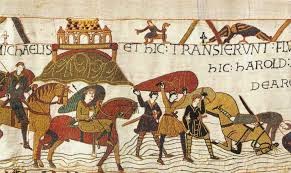
Scene from The Bayeux Tapestry

Carola Hicks wrote in her wonderful book The Bayeux Tapestry, The Life Story of a Masterpiece, "Made from the workaday fabrics of linen and wool, the Tapestry has often been described as an uncharacteristically humble artifact when compared to other works of the period, even an example of quaint folk art."

It is true that the Tapestry is not sewn with valuable gold, silver, and gems, or silk embroidery threads. It is by Anglo-Saxon standards a modest work, and yet it is a glorious feat of craftsmanship and artistry. The Tapestry is constructed in the everyday fabrics of linen and wool. Even so, its fabrics were designed and executed as the result of practice by extremely talented craftsmen.
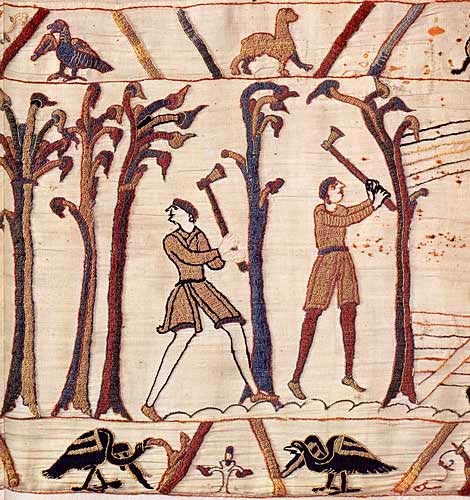
Woodland Scene from the Tapestry

Here in Tapestry the dramatic story of the Norman invasion of England is stitched out and embroidered on strips of linen. It is seventy meters in length and half a meter wide. The fact that these homely though durable fabrics, linen and wool, were used are the reason for its preservation despite its great age and fragility. Most of what we see today is original. Even where the Tapestry has been repaired we can still see the original stitch marks.
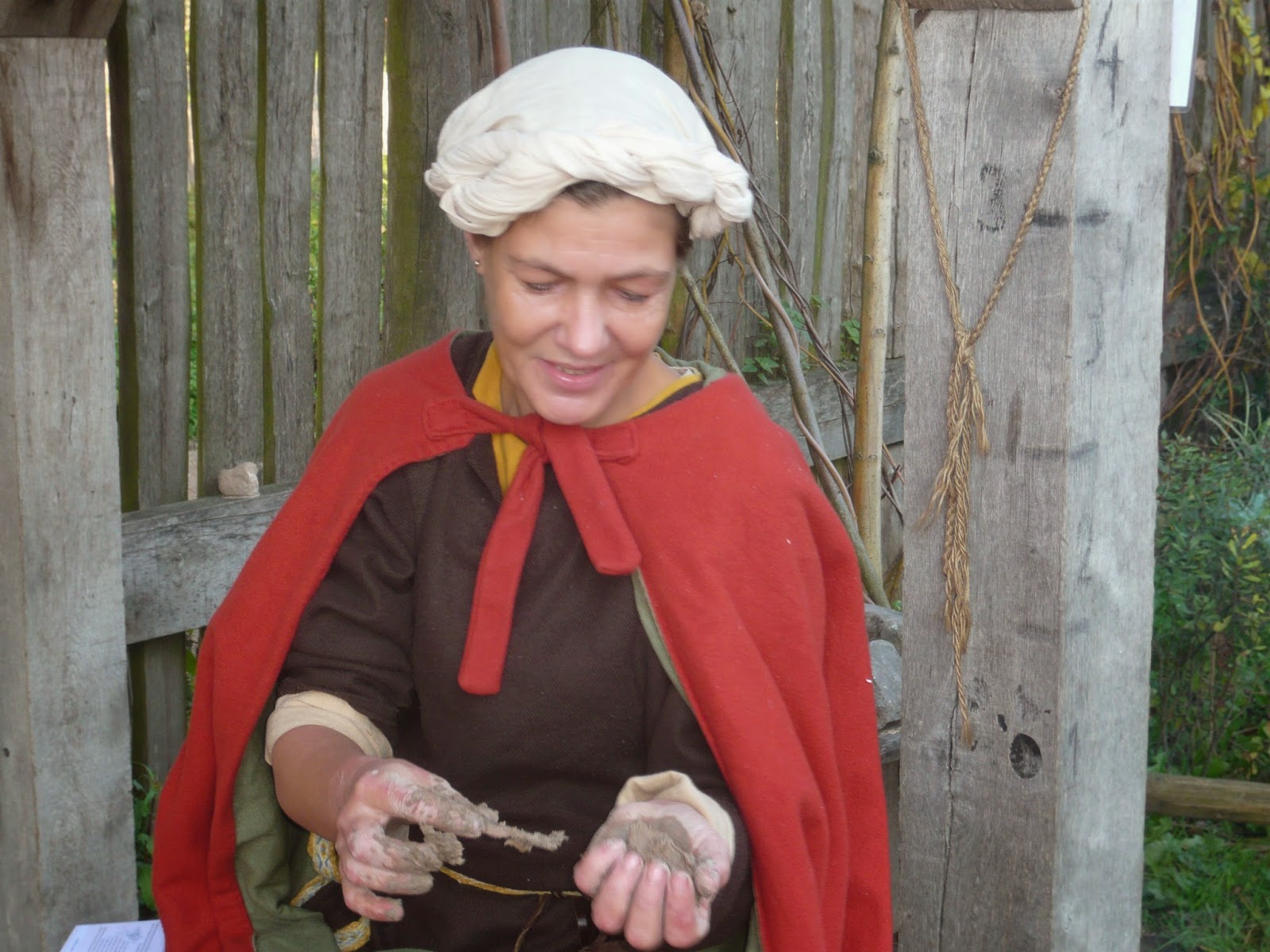
Spinning

Linen and The Tapestry

Linen has a long history. The ancient Egyptians found linen's sweat-absorbent and cooling properties divine. They attributed the invention of linen to the goddess Isis. With the advent of Christianity linen was used for priestly garments. It actually had a high status. It comes from the flax plant which was sown after Easter and harvested three months later. In the Middle-Ages the young plants were pulled by hand and never cut. Cutting might damage the stems. Plant stalks were soaked till they were decomposing, dried out, then smashed with mallets to separate the outer bark from the inner fibres. These were spun into thread on a hand spindle. Medieval women spun constantly. They attached a bundle of flax fibres to the cone-shaped top of a pole , the distaff. Then the other end was tucked under the spinner's arm. A spinner drew the fibres out from the top, twisted them onto a weighted whorl, then spun them tightly into a thread.
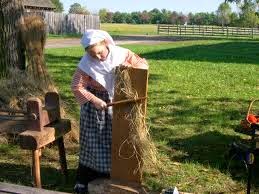
Retting (cleaning) the flax

The Bayeux Tapestry consists of nine separate panels sewn together after they were embroidered. The two longest strips measure nearly 14 meters. This suggests a long warp or length setting. Other Tapestry sections are shorter. The original lengths were woven a meter wide and then cut to make strips that would be comfortable to embroider. A loom is used to weave the threads into lengths of fabric.  Carola Hicks thought that professional weavers made the linen on a horizontal treadle loom, a more advanced machine than an upright warp-weighted loom that was used to make woollen cloth.
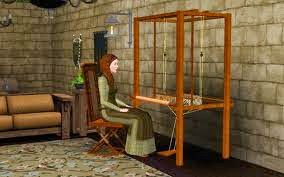
Upright weaving frame

When the linen was woven it was a natural brown in colour. The linen was bleached by boiling it in a solution of water alkalized by the addition of wood ash, fern or seaweed. It was stretched out on frames for exposure to the light. It was still kept damp. After a period of three weeks or so the linen was soaked in a solution of sour milk fermented by rye or bran. The fabric was pounded with a piece of marble or glass to create a smooth silky texture.

Wool Embroidery on The Tapestry

It is considered by most Tapestry historians that there was a common cartoon source  for the Tapestry design. There is a similarity between the images, especially those of figures, emblems, plants, and animals, and those depicted on Canterbury manuscripts of the period. This suggests Canterbury as the location for the Tapestry's overall design. However, between three and eight workshops are suggested for the linen's weaving. There were probably several embroidery workshops involved as well. Likely contenders were Canterbury and Wilton.

Queen Edith, the widow of Edward the Confessor, was one of the most notable embroiderers of the era, and after her husband's death she retired to Wilton Abbey which had a school for embroiderers. She may have had a hand in the execution of the Bayeux Tapestry. It is recorded in The Vita Edwardi Regis, completed around 1066-69, a few years after Edward's death, that several people were with Edward just before his death.  There were Harold Godwin and Archbishop Stigund. Edith, one of three women depicted on the Tapestry, who warmed his feet in her lap can be seen kneeling at the bottom of his bed. According to the Vita, Edward gave a prophetic vision and then said a few words to comfort Edith. Interestingly, Edward's death scene as depicted in embroidery on the Tapestry corresponds to that described in the Vita which was commissioned by Queen Edith. Wilton Abbey is, I suggest, one of the locations for the Tapestry's construction. Queen Edith may even contributed to which scenes should be included and their depiction.
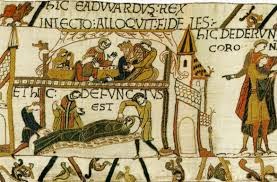
 
King Edward's Death Scene

The embroidery is stitched in strands of worsted wool, the end product of an old and complicated process. An enormous amount of wool was dyed. Carola Hicks states more than 45 kilograms was used for the embroidery. The original wools remain vivid. They are also more resistant to moth than chemically dyed wools. Winchester was one of the cities that monitored the practice of dyers within its jurisdiction since dyes produced noxious waste products and hideous odours. Alum which was valuable was the favoured mordant. Dye ingredients came from animal, vegetable or mineral products acquired locally. Sometimes ingredients were imported from further afield to be smashed, boiled, and simmered, concentrated to extract the essence of a hue.

There are ten main tones on the Tapestry. They came from only three plants, woad, madder and weld. The dyes were blended into two reds, a yellow and a beige, three tones of blue and three tones of green.

Weld

Beige and yellow came from the flowers and leaves of weld.

Green also came from weld but it was mixed with the leaves of woad.

Woad produced the blues.
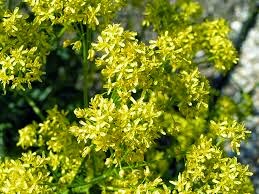
Woad

The reds came from madder. The roots of madder were ground into a powder, heated and simmered with added chalk or lime at a constant temperature for not more than two hours. Once a whole fleece was dyed to the required colours, a hand held spindle was used to turn the fibres into bales of worsted.

A friend of mine, Charles Jones, has had spinners and embroiderers working on a tapestry to tell the story of The Battle of Fulford September 1066. Here are a few of the dying recipes he has used to reproduce authentically the colours which his embroiderers used. Be careful if you try them out.

Weld

Chop lengths to boil for one and a half hours
Add wool and pinch of tartar
simmer for one hour
one hank of woad dyed wool added to light green will produce dark yellow.

Walnuts

5lbs of walnuts smashed and put to soak for twenty four hours
Tap water and a half cup of vinegar

Soak the wool for two days and then simmer for half an hour will produce a nut brown shade

Oak Gall Powder

20 gm of oak gall powder
boil for 30 minutes
teaspoon of salt
alum mordanted wool added
cook for twenty minutes
fix with salt and vinegar

Produces a light green-brown

These are just a few of the recipes used for dying wool used in embroidering a latter-day tapestry replica. I wonder if EHFA readers have had experience of creating dyes for wool using similar methods.

[This is an Editors' Choice archive post, originally published on this blog on 18th November 2014]

~~~~~~~~~~~~~

Carol McGrath is the author of The Handfasted Wife (2013) published by Accent Press and inspired by The Bayeux Tapestry.

The Swan-Daughter published by Accent Press (2014) is available now from Amazon.co.uk and from Amazon.com.


Friday, September 25, 2015

Sumptuous Dressing in the Late Medieval Era

by Carol McGrath

I am fascinated by clothing and fabrics sold by drapers and merchants during the late medieval and early Tudor period. Wool was England's most valuable export. It was sold in quantity all over Europe.

I have been studying pictures of clothing that appear on illuminated manuscript work- those fabulous tiny figures dressed in gorgeous bright colours and in exotic fabrics other than wool. Velvet, silk and damask were the most expensive fabrics that were popular among society's elite.

Beautiful fabrics and colours for the elite

However, by the end of this period there was a market for what was known as the new draperies. They were made from wool that was combed out rather than felted and which at the weaving stage was mixed with silk, linen and even cotton. These new fabrics were often light and had a variety of interesting names such as serges, bayes, sayes, perpetuanas, frisadoes, minikins, bombasines, grosgraines, buffins, russells, sagathies, mockadoes, shalloons and tammies. They actually varied little from each other except in firmness, weight and size.

Notice the pattern woven into this new fabric

The woolen industry proper involved the manufacture of broadcloth, dozens, penistones and medley cloth. These names may seem complicated to our minds, and I have only mentioned a selection of them. Yet, I have no doubt that the medieval merchant knew what he or she was looking at when they purchased fabric in the great cloth fairs such as the September fair of St Bartholomew in London or The Northampton Cloth Fair in November.

One of the most fascinating aspects of the clothing and fashion industry are the Sumptuary laws.  In 1513 such laws were passed in England to define what different classes of people were allowed to wear. They should not just know their station, but they should look it as well. I often think as John Ball, the hedge-priest said at the time of the Peasant's Revolt,  'When Adam delved, and Eve spun, who was then a gentleman?' Equality was idealism. It could not exist within a society ruled by a feudal system.


Fashion was an important way in which identity, values and status could be displayed within society. Before the 14th century status was simply indicated by the quality of clothing worn. After this there were concerns about style and tailoring. Buttons were used from circa 1350. This meant that tight fitting garments were easier to wear. There was also an increased range of imported dyes and fabrics for the elite which could afford the latest trends. There was also a greater use of fur and embroidery. Head-dresses became more complex. The higher the rank, the more choice there was of materials and colour. The upper classes could wear taffeta, velvets, silks, furs and lace. Poor Tudors wore wool and linen.

The poor throughout the seasons
Thus, in England sumptuary rules dictated the colour and types of clothing allowed to persons of various ranks and incomes. An extremely long list of items specifying colour and materials existed well into the 17th century. Only royalty could wear purple. Gold, silver, crimson, scarlet, deep blue were for the nobility and royalty only. Poor Tudors wore browns, beige,yellow, orange, russet, green, grey and paler blues.

So, you see, the beautifully clothed figures we see in illuminated manuscripts did not represent the unfashionable poorer majority in society. Rather, they show societal elite.

~~~~~~~~~~~~~

Carol McGrath lives near Oxford. She is the author of The Daughters of Hastings Trilogy. Her latest novel is The Betrothed Sister. Her WIP is set in the early Tudor period. She can be found at:

https://www.facebook.com/daughtersofhastings
Follow me on Twitter @carolmcgrath
www.carolcmcgrath.co.uk
 

Friday, July 17, 2015

Thinking Medieval

by Carol McGrath

It is always difficult for the writer of historical fiction to completely slip into the mind set of a particular era. The old adage applies- "The past is a foreign country; they do things differently there." Sometimes, the best that fiction writers can do is to be aware of the thinking that dominated a particular era and to create within an historical story a sideways glance to fool us into believing in the authenticity of the recreated world. Writers achieve this through meticulous research about day to day life such as clothing, homes, architecture, country, town, food , occupations and so on.

Medieval Kitchen at Chenonceau Castle in France Stock Photos
Inside the Kitchen of a Medieval Castle

For my first set of novels which have been set in medieval England, Denmark, Ireland and Russia I did, in fact, research how religion dominated contemporary thought. The Norman Conquest, for example, brought a significant wave of religious changes to England. Before the eleventh century, the English Church was a Royal Church. It was freer than the Continental Church. For example, there was a Bible in the Vernacular. Ordinary people could understand the Mass and Plain Song which was not always conducted or sung in Latin.

Southwall Minster

William the Conqueror sailed to England from Normandy with the Pope's banner fluttering amongst his pennants. In partnership with the Church, he had been able to claim support for what he 'sold' as a crusade against the perjurer King Harold. Harold had sworn to support William's claim to England's throne on relics gathered from all over Normandy. This event is depicted on the Bayeux Tapestry and is recorded in many Norman Sources of the period. At the time the reforming Roman Church was  was increasing its control.  The Augustine Reforms were aimed at preventing priests from marrying and bishops from holding more than one see simultaneously, amongst other agendas. After the Norman Conquest, Cathedrals replaced old Minsters, just as castles represented secular control over the kingdom. There was the tightening of an already existent Feudal System.

Image result for The Bayeux Tapestry free images
Harold's Oath as depicted on The Bayeux Tapestry

The Church controlled peoples' thoughts. A duel interactive secular and non secular control meant that individuality of thought was suspect. People, of course, had personal conflicts. They cherished emotions such as love, jealousy, greed, joy, sorrow etc. None the less, the Church controlled their souls and, as a consequence, the way these emotions played out. Think of Heaven and Hell paintings in Medieval Churches. Consider reenactments of Biblical, particularly Apocryphal episodes that were dramatized for audiences from Church to market place. Simply, people believed in Divine Providence as the cause of human affairs.

Image result for medieval heaven and hell painting
Medieval Heaven and Hell Depiction

Society was organic. This was in itself Body Politic. By this, I mean that each member of society was meant to work in cooperation with all others, each performing its divinely appointed and fixed function that in turn contributed to the welfare of the whole. Antithetical movements were dangerous. Why did Robin Hood live as an outlaw? Why was Wat Tyler's rebellion ruthlessly quashed? Medieval thought process continued into the Tudor period despite movements such as Humanism which encouraged study and discussion of texts, despite the rise of the merchant middle class, despite the increase of literacy with the development of the printing press. Despite all these factors, the early Tudor monarchy fostered a sense of unity and common purpose.

Image result for Robin Hood free images
Robin Hood, the rebellious thinker.

However, change was in the air. Men began to seek for policies that might create a new England. It was initially more of a literary than political movement. In fact, new concepts had emerged in literature between the thirteenth and fifteenth centuries. A social comment is apparent in Piers Plowman, a text which blended secular and religious problems into a single moral analysis pointing out society's ills. It is not the same as addressing these ills. There remained the sense that social problems were moral in origin. Landlords, tenants, churchmen would all suffer in proportion to their sins. If individuals acted towards each other as Christian precept would have them act, the conflicting situation would vanish. There was no real thought given to manipulating social problems such as poverty prior to the Elizabethan Age using governmental legislation.  The ideal remained that of an ordained society of rigid divisions dependent on the proper conduct of each person in his or her appointed place. Moreover, usury was a sin!

Thomas More educated his daughters, was a Humanist thinker but would not criticize the Church

Human nature outs. With huge profits to be made for merchants, particularly cloth merchants, with the printing of Bibles in the vernacular, with increased literacy, the dissolution of monasteries, enclosures of common land for profitable sheep farming, individualism emerges within society during the sixteenth century. In England, people are not quite controlled in the same way by the Church and State as they were in the era of Heaven and Hell paintings and reenactments of Biblical and Apocryphal episodes that were dramatized throughout the land on saint's feast days. Society begins to break free of the notion that the process of knowledge is only completed by one's elevation to a state of grace achievable only by each member of society performing its divinely appointed and fixed function for the welfare of the whole.

~~~~~~~~~~~~~

Carol McGrath's The Betrothed Sister, to be released in September, is the third in Carol McGrath's acclaimed historical series, the Daughters of Hastings Trilogy.

Carol McGrath lives in Oxfordshire with her husband and family. She taught History until she took an MA in Creative Writing at The Seamus Heaney Centre, Queens University Belfast, followed by an MPhil in Creative Writing at Royal Holloway, University of London. Her debut novel, The Handfasted Wife, first in a trilogy about the royal women of 1066 entitled The Daughters of Hastings, was shortlisted for the RoNAS, 2014 in the historical category. The Swan-Daughter and The Betrothed Sister followed to complete this best-selling trilogy. Carol reviews for the HNS. She is the co-ordinator of the 2016 Conference in Oxford.  Find Carol on her website:

www.carolcmcgrath.co.uk.

Facebook: The Daughters of Hastings series

The Handfasted Wife
The Swan Daughter
The Betrothed Sister

Tuesday, December 30, 2014

Medieval Dishes fit for a Monarch

by Carol McGrath

Keeping nutmeg in your  pocket during New Year's Eve will protect you throughout the next year- so says one old medieval belief. I discovered this nugget whilst browsing www.moonsmuses.com , a blog devoted to medieval recipes, herbs and plant lore. Nutmeg would protect you if you happened to fall from a roof, cliff, ladders or other high places.  It was, of course, a highly expensive spice during the middle ages. Reading about spices has sent me on a search for medieval Christmastide recipes fit for a monarch which I thought might also interest historical fiction readers as we approach the New Year.

Medieval Feasts, a cook book

In most medieval households cooking was done on an open hearth in the middle of the main living area. For most of the medieval period, for most households, the kitchen was connected with the dining hall. It was towards the end of this period that the kitchen generally became separated, though change is a slow process. Often, separate kitchens did exist in castle baileys as they could be a fire risk. By the late middle ages, however, a separate building or wing that contained a kitchen area was created from the main building by a covered walkway. Here, one would find frying pans, pots, kettles, waffle irons, spits skewers of all sizes, pots and cauldrons, ladles and graters, just to name but a few of the utensils they had then and which we use to this day.

Importantly, there would also be mortars, pestles and sieve cloths because fine textured food was deemed good for you. The body could more easily absorb nourishment. Skilled cooks could shape the results. Farcing, for instance, was to skin and dress an animal, grind up the meat, mix with spices and other ingredients and return it to its own skin or mould it into the shape of a completely different animal.

Pies were ever popular and called coffins

During the Christmas period the kitchen staff of royal courts were extremely busy. The staff consisted of pantlers, bakers, waferers, sauciers, larderers, butchers, page boys, milkmaids, butlers and scullions who were kept incredibly busy preparing at least two meals a day for several hundred people. Importantly the chief cook would need at least a thousand cartloads of dry wood and a barnful of coal to hand for  the preparation of the two day long banquet. ( Du fait Cuisuine 1420, written by Maister Chiquart for the then Duke of Savoy). Here are a few recipes that would have been cooked in the royal kitchens over the festive season. These are adapted for the modern cook.

An ordered medieval kitchen

Medieval Roast Chicken ( from foodnetwork.com)

Ingredients
1 roasting chicken
2 cups of water
a half cup of paprika
2 cups of lemon juice
a half cup of lemon pepper
a quarter cup of Italian spice
2 teaspoons of salt

Preheat the oven to 325 f. Combine all the ingredients to prepare the marinade. Dip the whole chicken into it. Let it sit for 4 to 5 minutes. Place the chicken on a sheet pan and cook for 50 minutes uncovered, or until the chicken juices run clear.

Or why not try this easy medieval inspired recipe (from coquinaria.nl) for Medieval Apple fritters, traditional fare on New Year's Eve in the Low Countries.

Apples and quinces were regarded as a similar fruit during the period. They were originally small and sour. By the end of the medieval period there were several apple varieties. The Costard was a large kitchen variety and the Pearmain Green, which was green and red coloured, were both known by the thirteenth century. Other medieval apples were Nonpareil, White Joaneting and the Royal Russet. Fritters appeared frequently on the medieval banquet table. There were sweet and savoury fritters.

Time for Feasting

Fritters

Take wheat flour. Take ale yeast, saffron and salt. Beat all together as thick as you would make other batter on meat days. Then take good apples and cut them in the manner of fritters. Dip in batter up and down and bake them in good oil. Lay them on a dish, sprinkle with sugar and serve them.

To make these nowadays you would have to use yeast. English ale was originally the same as medieval beer. It was top fermenting and instead of hop gruit was used, a mixture of sweet gale and other herbs such as rosemary and sage. Ale could be sweet or sour depending on the composition of gruit and the brewing. Medieval beers were never bubbly because the carbon dioxide escaped during the fermenting.

On the Medieval New Year's Day everybody celebrated The Feast of Fools. For that celebration class distinctions were abolished. Most Europeans elected a Lord of Misrule or a king of fools. In England he went as King of the Bean or in Scotland, the Abbot of Misrule. They had the power to call everybody to disorder with cross-dressing, bawdy songs and drinking to excess. The end came when the Protestant Reformation condemned all politically incorrect excesses claiming their roots in paganism. The Feast of Fools has since been celebrated on the twelfth night after Christmas.

Other recipes you might be interested in investigating which were popular over the twelve days of Christmas included:

Venison in a Sack
Goose in Sawse Madame
Wild Boar Stew
Leavened Bread
Extraordinary Spiced Wine
Ancient Fruit Dumplings

Just taste the ale before bringing it to table

Finally I leave you with a medieval caudle recipe.

Medieval Caudle

Beat up egg yolks with wine, sugar and saffron. Heat the mixture over a medium flame. Stir continually until the caudle is hot and thick and fluffy. Beat well together; set it on the fire on clean coals. Stir well the bottom and sides until just scalding hot; you will be able to tell when it becomes fluffy. Then take it and stir fast & if you need add more wine; or if it rises too quickly, put it in cold water to the middle of the outside of the pot, stir it away fast, and serve.

Thanks for this recipe to godecookery.com.

~~~~~~~~~~~~~

Carol McGrath is the author of The Handfasted Wife published 2013 by Accent Press
The Swan-Daughter published 2014 by Accent Press. Both available as paperbacks and for all e readers.