Showing posts with label Norman Conquest. Show all posts

Monday, May 28, 2018

The Enchantment of The Bayeux Tapestry

by Carol McGrath

The Bayeux Tapestry has retained its enchantment and its vivid colour almost a thousand years after it was embroidered. It tells the story of The Norman Conquest through beautifully framed vignettes and long-shot depictions made in embroidery from Harold Godwinson's departure on a mysterious mission to Normandy in 1064 until his death at Hastings in October 1066.  I have often wondered about the fabric and the natural dyes used for the embroidery wools in the Tapestry's construction.

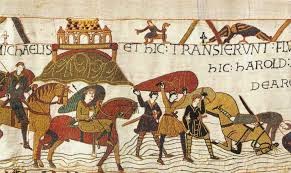
Scene from The Bayeux Tapestry

Carola Hicks wrote in her wonderful book The Bayeux Tapestry, The Life Story of a Masterpiece, "Made from the workaday fabrics of linen and wool, the Tapestry has often been described as an uncharacteristically humble artifact when compared to other works of the period, even an example of quaint folk art."

It is true that the Tapestry is not sewn with valuable gold, silver, and gems, or silk embroidery threads. It is by Anglo-Saxon standards a modest work, and yet it is a glorious feat of craftsmanship and artistry. The Tapestry is constructed in the everyday fabrics of linen and wool. Even so, its fabrics were designed and executed as the result of practice by extremely talented craftsmen.

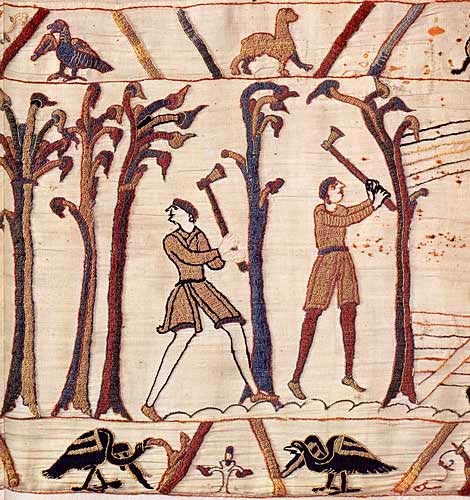
Woodland Scene from the Tapestry

Here in Tapestry the dramatic story of the Norman invasion of England is stitched out and embroidered on strips of linen. It is seventy meters in length and half a meter wide. The fact that these homely though durable fabrics, linen and wool, were used are the reason for its preservation despite its great age and fragility. Most of what we see today is original. Even where the Tapestry has been repaired we can still see the original stitch marks.

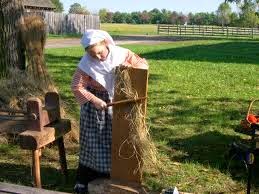
Spinning

Linen and The Tapestry

Linen has a long history. The ancient Egyptians found linen's sweat-absorbent and cooling properties divine. They attributed the invention of linen to the goddess Isis. With the advent of Christianity linen was used for priestly garments. It actually had a high status. It comes from the flax plant which was sown after Easter and harvested three months later. In the Middle-Ages the young plants were pulled by hand and never cut. Cutting might damage the stems. Plant stalks were soaked till they were decomposing, dried out, then smashed with mallets to separate the outer bark from the inner fibres. These were spun into thread on a hand spindle. Medieval women spun constantly. They attached a bundle of flax fibres to the cone-shaped top of a pole , the distaff. Then the other end was tucked under the spinner's arm. A spinner drew the fibres out from the top, twisted them onto a weighted whorl, then spun them tightly into a thread.

Retting (cleaning) the flax

The Bayeux Tapestry consists of nine separate panels sewn together after they were embroidered. The two longest strips measure nearly 14 meters. This suggests a long warp or length setting. Other Tapestry sections are shorter. The original lengths were woven a meter wide and then cut to make strips that would be comfortable to embroider. A loom is used to weave the threads into lengths of fabric.  Carola Hicks thought that professional weavers made the linen on a horizontal treadle loom, a more advanced machine than an upright warp-weighted loom that was used to make woollen cloth.

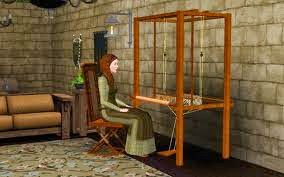
Upright weaving frame

When the linen was woven it was a natural brown in colour. The linen was bleached by boiling it in a solution of water alkalized by the addition of wood ash, fern or seaweed. It was stretched out on frames for exposure to the light. It was still kept damp. After a period of three weeks or so the linen was soaked in a solution of sour milk fermented by rye or bran. The fabric was pounded with a piece of marble or glass to create a smooth silky texture.

Wool Embroidery on The Tapestry

It is considered by most Tapestry historians that there was a common cartoon source  for the Tapestry design. There is a similarity between the images, especially those of figures, emblems, plants, and animals, and those depicted on Canterbury manuscripts of the period. This suggests Canterbury as the location for the Tapestry's overall design. However, between three and eight workshops are suggested for the linen's weaving. There were probably several embroidery workshops involved as well. Likely contenders were Canterbury and Wilton.

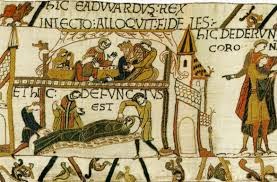
Queen Edith, the widow of Edward the Confessor, was one of the most notable embroiderers of the era, and after her husband's death she retired to Wilton Abbey which had a school for embroiderers. She may have had a hand in the execution of the Bayeux Tapestry. It is recorded in The Vita Edwardi Regis, completed around 1066-69, a few years after Edward's death, that several people were with Edward just before his death.  There were Harold Godwin and Archbishop Stigund. Edith, one of three women depicted on the Tapestry, who warmed his feet in her lap can be seen kneeling at the bottom of his bed. According to the Vita, Edward gave a prophetic vision and then said a few words to comfort Edith. Interestingly, Edward's death scene as depicted in embroidery on the Tapestry corresponds to that described in the Vita which was commissioned by Queen Edith. Wilton Abbey is, I suggest, one of the locations for the Tapestry's construction. Queen Edith may even contributed to which scenes should be included and their depiction.
 
King Edward's Death Scene

The embroidery is stitched in strands of worsted wool, the end product of an old and complicated process. An enormous amount of wool was dyed. Carola Hicks states more than 45 kilograms was used for the embroidery. The original wools remain vivid. They are also more resistant to moth than chemically dyed wools. Winchester was one of the cities that monitored the practice of dyers within its jurisdiction since dyes produced noxious waste products and hideous odours. Alum which was valuable was the favoured mordant. Dye ingredients came from animal, vegetable or mineral products acquired locally. Sometimes ingredients were imported from further afield to be smashed, boiled, and simmered, concentrated to extract the essence of a hue.

There are ten main tones on the Tapestry. They came from only three plants, woad, madder and weld. The dyes were blended into two reds, a yellow and a beige, three tones of blue and three tones of green.

Weld

Beige and yellow came from the flowers and leaves of weld.

Green also came from weld but it was mixed with the leaves of woad.

Woad produced the blues.

Woad

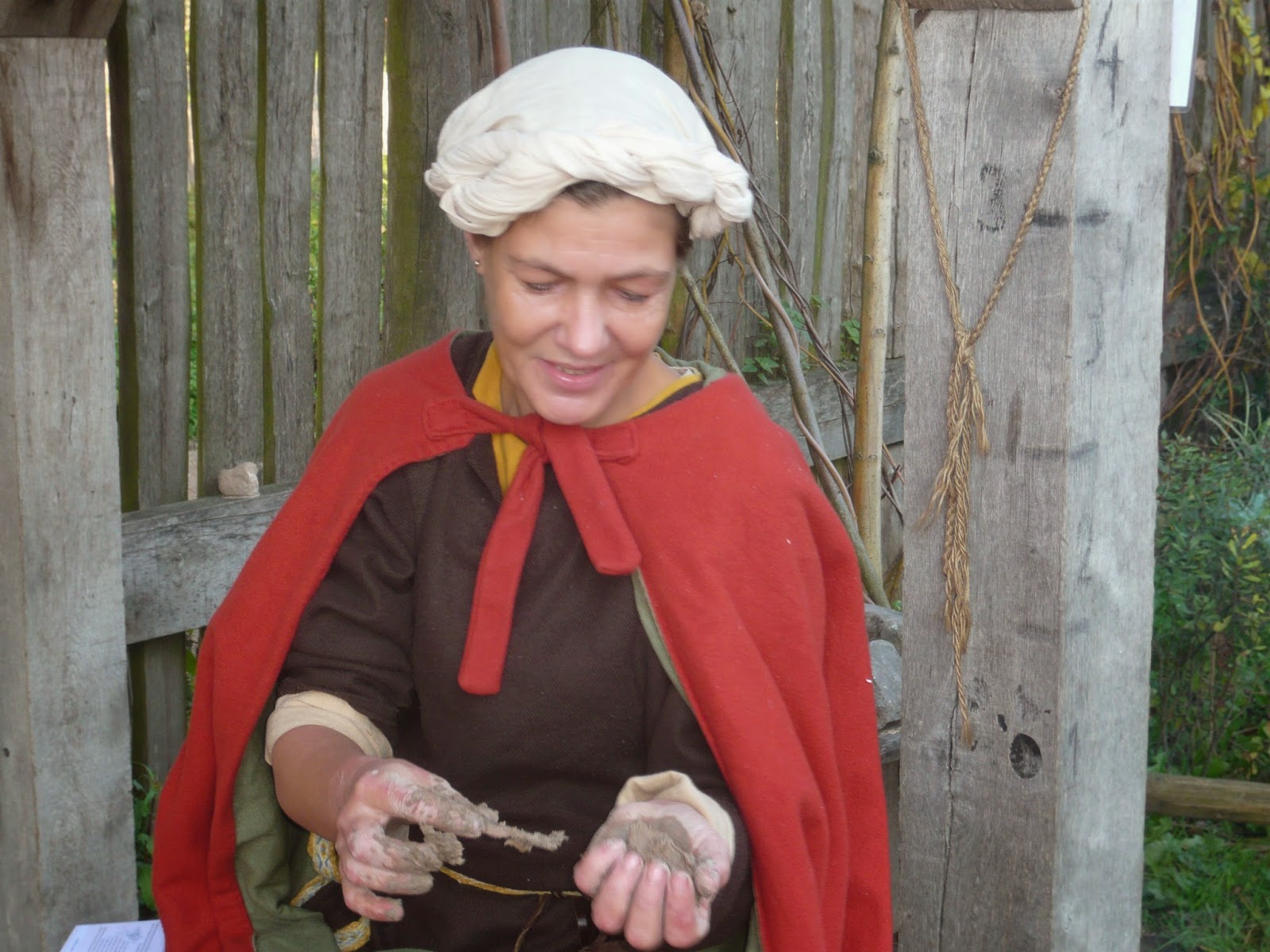
The reds came from madder. The roots of madder were ground into a powder, heated and simmered with added chalk or lime at a constant temperature for not more than two hours. Once a whole fleece was dyed to the required colours, a hand held spindle was used to turn the fibres into bales of worsted.

A friend of mine, Charles Jones, has had spinners and embroiderers working on a tapestry to tell the story of The Battle of Fulford September 1066. Here are a few of the dying recipes he has used to reproduce authentically the colours which his embroiderers used. Be careful if you try them out.

Weld

Chop lengths to boil for one and a half hours
Add wool and pinch of tartar
simmer for one hour
one hank of woad dyed wool added to light green will produce dark yellow.

Walnuts

5lbs of walnuts smashed and put to soak for twenty four hours
Tap water and a half cup of vinegar

Soak the wool for two days and then simmer for half an hour will produce a nut brown shade

Oak Gall Powder

20 gm of oak gall powder
boil for 30 minutes
teaspoon of salt
alum mordanted wool added
cook for twenty minutes
fix with salt and vinegar

Produces a light green-brown

These are just a few of the recipes used for dying wool used in embroidering a latter-day tapestry replica. I wonder if EHFA readers have had experience of creating dyes for wool using similar methods.

[This is an Editors' Choice archive post, originally published on this blog on 18th November 2014]

~~~~~~~~~~~~~

Carol McGrath is the author of The Handfasted Wife (2013) published by Accent Press and inspired by The Bayeux Tapestry.

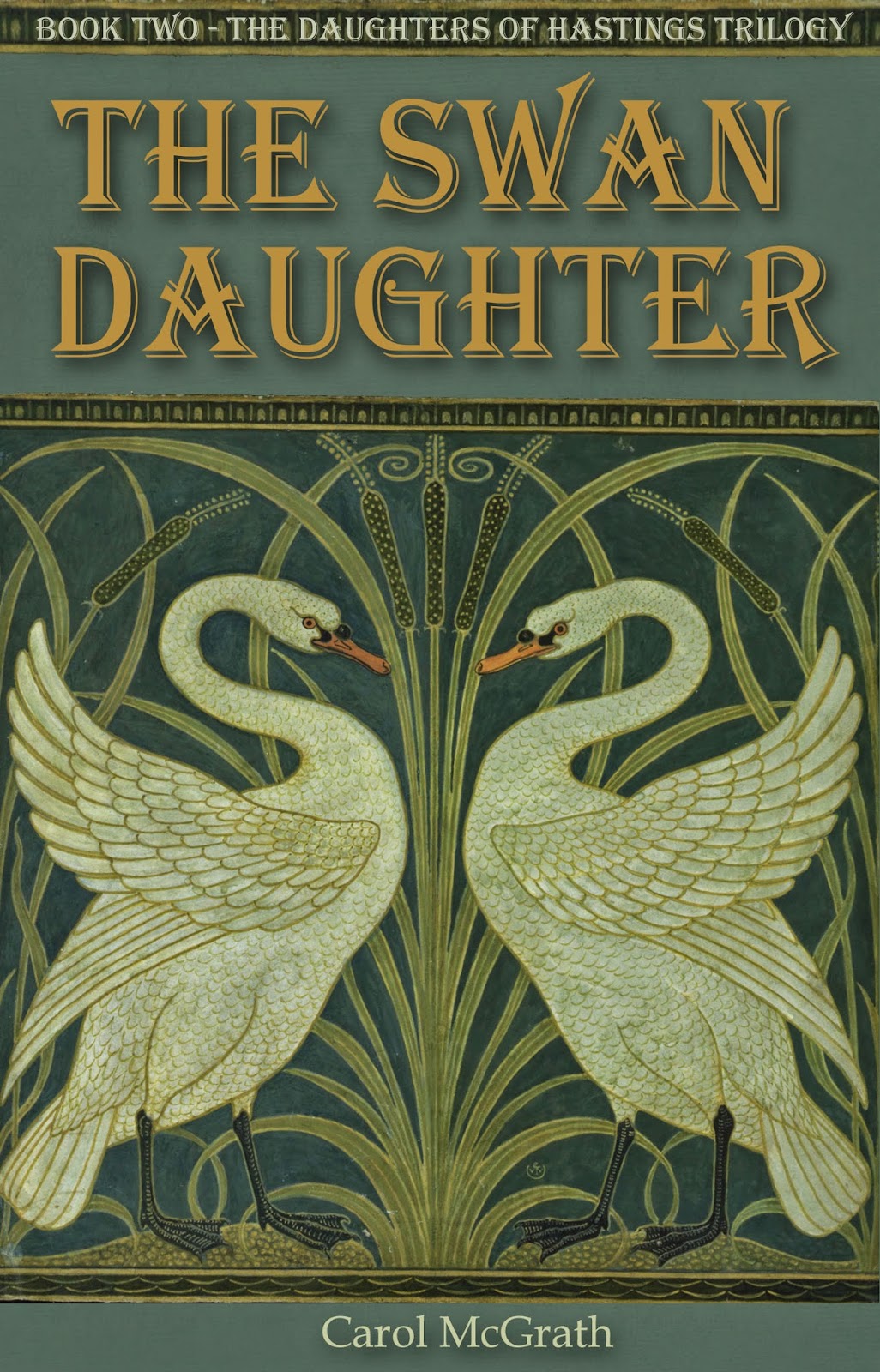
The Swan-Daughter published by Accent Press (2014) is available now from Amazon.co.uk and from Amazon.com.


Tuesday, November 22, 2016

The Early History of English

By Annie Whitehead

Here’s a little test: Torpenhow. Know how to pronounce it? Know its derivation? If it helps at all, it’s in Cumbria, and it’s a hill… and its name means hill hill hill. That’s English for you. But why? How did our language become so, well, strange? Or should that be weird? Why do we have so many different words for the same thing, and why does our spelling not even abide by its own rules?

I think the first clue might be that, as historian Ann Williams remarked, “We have little idea about what ‘spoken’ English was like before 1100 - virtually all the surviving texts are written in the literary standard (Standard West Saxon in modern scholarship) which was never a spoken language. The abrupt change in the Peterborough Chronicle in 1121 (pictured below) marks the moment when the scribe ceased to write in Standard West Saxon, and began to write in something like the local spoken dialect.”


And in reply, historian Stephanie Evans Mooers Christelow had this to add: “There is also the fact that people speak the language of their mothers: French men who married English women had bicultural children who most likely spoke English. French soldiers stationed in English towns had to learn English, and the French who resided in English villages did as well. According to the Cambridge History of the English Language, French vocabulary and syntax did not begin to significantly affect the English language until about 1300.”

So, there are two intriguing pieces of information here: a hint at the marked differences between written and spoken language, and the fact that it’s too easy, and inaccurate, to blame all our language anomalies on the Norman Conquest. So where did they come from?


Two thirds of England’s rivers take their names from ‘Celtic’ words, for example, Avon. We have place names which are a mixture - in the case of Much Wenlock, Much is from Anglo-Saxon mycel, meaning great, Wenlock comes from Celtic wininicas, white area, and the Anglo-Saxon loca, (place.) We have Roman influence, too, with castra (fort), seen in places such as Chester, and Manchester. Of course, the Anglo-Saxons did build forts of their own - burhs, which give Britain all the burgh and borough place names. But the Anglo-Saxons didn’t just come to fight, and/or defend, they also came to stay. They cleared places, to make space for their settlements, and gave us word endings like ley, ly, leay and leigh, which all mean 'clearing'. The Scandinavians followed suit and also added place names - by, booth, and thwaite.

The Normans did add a few of their own - Ashby was given to the de la Zuche family, (giving us Ashby de la Zouche) and Bewdley came from Beau Lieu (beautiful place).

But the Norman-French did not settle in with the same comfort as the Anglo-Saxons and the Scandinavians, nor in the same number. As we saw above, the commoners kept speaking English, which was still evolving, nevertheless, and came to add many French words.

There is a wealth of information to be gleaned from the study of our place names, and as Margaret Gelling says in her Signposts to the Past, “The linguistic agility which enables modern English speakers to accept Salop as a form of Shropshire is paralleled by the ease with which Keighley is an accepted spelling form of a name pronounced Keethley.” (If you can, get a copy of her book and marvel at her enlightening discourse on the ‘correct’ pronunciation of Shrewsbury!)

Of course, places names have different pronunciations not just because of language development, as in the case of Shrewsbury (Shrowsbury/Shroosberry.) So what can regional dialect tell us?

What Fettle Mun is a book on Cumbrian dialect by Tim Barker. Remember Torpenhow? Well, it is pronounced Tra’penner, or Truhpenner. The Tor bit is from an ancient British word, meaning hill. The Pen is from Celtic (Welsh) and it means hill. How is Old Norse, and it means… hill. Yes, Barker confirms that our language is definitely a hybrid.


Cumbria has the same root as the Welsh word for Wales - Cymru. The shepherds’ counting system, Yan, T’yar, tethera, methera, pimp, is very close to the Welsh for 1-5 (Un, dai, tri, pedwar, pimp).

The Lakeland dialect contains lots of thees and thous, similar to older English - Dost thou is still in evidence is phrases like Duster, as in "Duster want a cup o’tea?"

English development is not unique, but it is unusual. Other languages have remained more pure; Canadian French, for example, is much closer to medieval French, and American English bears traces of that spoken by those on the Mayflower who, being English, would nevertheless have talked of fall coming after summer, and of having ‘gotten’ things.

But here in England we can find even earlier traces. Staying in Cumbria, The Dictionary of Cumberland Dialect (Ed. Richard LM Biers) tells us that gang means go, remarkably similar to the Old English (OE) for 'going' : gangan.

At the other end of the country, In Broad Norfolk, Jonathan Mardle tells us that in the ninth century the Danes invaded the East coast and martyred the Christian king, Edmund. People in East Norfolk used to call the carrion-crow ‘Harra the Denchman’ (Harold the Danishman) which suggests a very long folk-memory of the Anglo-Saxon terror of the heathen vikings.

Norfolk shepherds also have a counting system which sounds rather familiar - Ina, tina, tether, wether, pink.

They still call a song thrush a Mavis, the OE name, and they retain OE plurals - childr, housen. There is much of what we would term biblical language:  "Go ye into the village."

East Anglia became part of the Danelaw. The Danes inter-mingled and Danish became part of the East Anglian dialect. Then came the Flemish weavers in the 14th century. Then an influx of Dutch and Walloon weavers in the 16th century - the ‘strangers’ - brought the word ‘lucum’ (attic window) from the French ‘lucarne’. So not all of our French words come necessarily from Norman French. But we’re getting ahead of ourselves.


Those who came to England early on spoke a Germanic language (Indo-European). The word for father in a document of AD800 is faeder. In Old High German it’s Fater and in Old Frisian fadar or feder. Modern German gives us Vater. We can see the connection. The Story of English (McCrum, Cran & MacNeil) adds that other Frisian words, ko (cow) lam (lamb) goes (goose) boat (boat) dong  (dung) and rein (rain) suggest that had the Conquest not happened, we might all be speaking something akin to modern Dutch.

We should therefore expect some hybrids (as we’ve seen in the place names) and some alternatives with the arrival of the Normans eg wedding/marriage. Although why we don’t have Lapin for rabbit, when it was the French who introduced rabbits to England - can anyone tell me?? (Seriously, I would love to know!)

But leaving aside hybrids, dialect and alternatives, why the different spellings of seemingly similar words?

OE contains barely a dozen Celtic words, and most of them, as we have seen, are geographical. And most place names are English or Danish. OE was not uniform, it had local varieties which as we’ve seen are still discernible today, and also regional accents as diverse as 'Geordie' in the north-east, Dorset with its soft ‘burrs’ and Kent, with speech patterns that go back to Jutish origins. The impact of Old Norse (ON) is harder to gauge because words were so similar to OE. But it has given us beck, laithe, garth - all generally found in areas of Viking settlement in the north, as is riding, a word for an administrative unit, which as an interesting aside, is also used in Canada for a parliamentary constituency.

Certain developments affected vocabulary: the coming of Christianity brought biblical words - Greek and Latin - and gave OE the ability to speak of concepts (frumweorc: from fruma, beginning, and weorc, work, which gives OE for creation), and the Conquest brought a linguistic ‘apartheid’ in areas of religion and law, with the introduction of words like felony, perjury, attorney, bailiff and nobility.


But many of our unusual spellings simply boil down to phonetics. The English had two letters for the th sound (þ and  ð) which became virtually interchangeable. They had no silent letters; every letter was pronounced. But there were weaknesses in the system - the same letter, c, was used for cold and child (cild) and king (cyning).

G was both hard and soft, and was also used for a sound similar to the ending of Scottish ‘loch’, as well as the j sound in hedge, which was written with a cg spelling (hecg). The sh sound was written sc - (scip = ship).

So h, c and g were being used for several sounds.

There were similar problems with vowels; with no clue given in the spelling as to the length of the vowels. The scribes experimented with double letters and accents, but it wasn’t ideal. They had no silent letters, remember, so vowels couldn’t be used as clues to pronunciation.  But post-1066, double vowels came to be used (sweet, queen).

The Normans might not have had everyone speaking French, but they introduced new ways of hinting at pronunciation of English - sc became sh, cw became qu, and cg became dg, as in hedge.

They brought in the letter w, but this looked too much like v v (havving), so doubling up went out and the silent e was added to aid pronunciation (have, live). And suddenly it starts to become clear why we have all our spelling anomalies.


For anyone wondering about  through, trough, throw, threw, thorough, bough, and tough, I recommend David Crystal’s book, Spell it Out, for it would seem that a lot of our peculiar spellings were born of a need to show how words should be pronounced.

So, whilst the Normans might not have altered the way we spoke, they certainly altered the way our words were spelled.

It is my intention to revisit this subject, and in a future post I will look at how Old English and Anglo-Norman turned into what we call Middle English, and how, why and when even the nobility stopped speaking French.

See Part II of the Story of English Here
[all the above images are in the public domain, via Wikipedia]

~~~~~~~~~~

Annie Whitehead is a history graduate and prize-winning author. Her first novel, To Be A Queen, is the story of Aethelflaed, daughter of Alfred the Great, who came to be known as the Lady of the Mercians. It was long-listed for the Historical Novel Society’s Indie Book of the Year 2016, and it has been awarded a B.R.A.G. Gold Medallion.

Her second novel, Alvar the Kingmaker, is a tale of intrigue, deceit, politics, love, and murder in tenth-century Mercia. It charts the career of the earl who sacrificed personal happiness to secure the throne of England for King Edgar, and, later, Aethelred the Unready. It too has just been awarded a B.R.A.G. Gold Medallion.

Most recently, she has contributed to the anthology of short stories, 1066 Turned Upside Down, in which nine authors re-imagine the events of 1066, and which has just been awarded HNS Editors’ choice and long-listed for Book of the Year 2017.

Author Page
Alvar the Kingmaker
To Be A Queen
Website
Blog
1066 Turned Upside Down

Monday, October 17, 2016

Ossulstone - London in the Domesday Book

By Mark Patton.

"While spending the Christmas time of 1085 in Gloucester," the Anglo-Saxon Chronicler tells us, "William [the Conqueror] had deep speech with his counselors and sent men all over England to each shire to find out what or how much each landowner had in land and livestock and what it was worth ... there was no one single hide, nor a yard of land, nay, moreover (it is shameful to tell, though he thought it no shame to do it), not even an ox, nor a cow, nor a swine was there left, that was not set down in his writ. And all the recorded particulars were afterwards brought to him."

So began one of the most remarkable undertakings of record-keeping in Medieval Europe, the Domesday Survey, probably inspired by the Biblical story of a decree going out from Caesar Augustus that all the world should be taxed. In fact, the great cities of London, Winchester, and Durham (and with them, probably, a significant number of cattle and swine) were excluded from the survey, the results of which were almost certainly never brought before William, who returned to Normandy in 1086, and did not set foot in England again.

Part of the Domesday Book entry for Middlesex. Photo: National Archive (Public Domain).


Whilst the walled city of London was excluded from the survey, most of what we today consider as "Greater London" was included. England was divided into seven "Circuits," one of which included the counties of Bedfordshire, Buckinghamshire, Cambridgeshire, Hertfordshire and Middlesex. Each county, in turn, was divided into "Hundreds," and the return for each Hundred as sworn by twelve jurors, half of them English, half of them Norman (the population of England at the time was around 1.5 million, of whom 10-20 thousand were Norman settlers).

The Domesday Circuit of Buckinghamshire, Bedfordshire, Cambridgeshire, Hertfordshire and Middlesex. Image: Thomas Gun (licensed under CCA).


London north of the Thames fell within the County of Middlesex, where 25 major landowners were recorded, including the King; the Archbishop of Canterbury; the Bishop of London; Westminster Abbey; Holy Trinity Abbey, Rouen; various noblemen, and one noblewoman. Most of North London fell, more specifically, within the Middlesex Hundred of Ossulstone, where the largest settlement, by far, was Stepney.

The Middlesex Hundreds. Image: Institute for Historical Research (Public Domain).


The Bishop of London held Stepney, with 32 hides, and land for 25 ploughs. On his land were 44 villagers, each with one virgate of land; 46 cottagers, each with one hide, paying 30 shillings per year; four mills; pasture for the village livestock; and woodland for 400 pigs. The total value of the land in 1086 was £48 (it had been £50 before 1066 - land values diminished across the country in the aftermath of the conquest, but far more so in the north of England than in the south).

The Medieval system of land-holding (image is in the Public Domain). A virgate was the amount of land that was tillable by two oxen in a ploughing season, and was, typically, seen as a quarter of a hide, the latter being the area of land required to support a household.


In the same village of Stepney, Hugh of Berniers (not one of the 25 major landowners of Middlesex) held five hides of land under the Bishop. Below him were two small-holders, each with half a virgate; and two cottagers, each with two and a half acres: these land-holdings were below subsistence level, so the cottagers and small-holders would have to work on Hugh's land; or on the Bishop's; or as labourers on building projects in the City; in order to support their families.

Part of the Domesday Book entry for Middlesex. Photo: National Archive (Public Domain). 


Other settlements mentioned in Ossulstone Hundred include Hoxton (held by the Canons of Saint Paul's, with 10 villagers and 16 cottagers); Hampstead (held by the Abbot of Saint Peter's - Westminster Abbey, with one villager, five small-holders, one slave, and woodland for 100 pigs); and Haggerston (held by Robert Gernon - one of the 25 major landowners of Middlesex, with three villagers and seven small-holders).

Most conspicuous of all, however, are the place-names that are not represented: there is no Hackney; no Camden; no Islington; and no Highgate. There are twelve and a half acres of "nomansland," held by the King (presumably for hunting); and many acres of woodland, supporting a great many pigs (or hogs, or swine - these words are all Anglo-Saxon), tended by the English cottagers and small-holders, whilst most of the pork (a Norman word, derived from the Latin - porcus, a pig) would have been consumed by the Norman landowners, bishops, abbots, and their guests.

Mark Patton blogs regularly on aspects of history and historical fiction at http://mark-patton.blogspot.co.uk. His novels, Undreamed Shores, An Accidental King, and Omphalos, are published by Crooked Cat Publications, and can be purchased from Amazon. He is currently working on The Cheapside Tales, a London-based trilogy of historical novels.


Friday, October 14, 2016

Did the Conqueror Build Upon Existing Foundations?

by Annie Whitehead

950 years ago today, the world changed - for those living in England, at any rate. They had a new king, and new masters, and history had a brand new reference point - 1066. But legally, administratively, and ecclesiastically, how much did William change?

Falaise, Lower Normandy; 
William was born in an earlier building here
William of Normandy was not opposing the old regime in England, he was claiming his right to carry on the government of a kingdom of which he said he was the rightful king. The England to which he came in 1066 was a soundly organised country in most respects. William abolished nothing, and introduced little new; his reign consisted of a successful attempt to fuse old and new, building upon the already existing structure.

The power of the nobility in Anglo-Saxon England was being strengthened from two levels of the social scale. The king gave grants of almost anything that was in his power to give: land, privileges, and judicial powers. From the inferior classes came men seeking the protection of a lord. Here was the beginning of a process which came to be known as feudalism. There were at this time only two aspects: a personal bond between two free men - a superior (the lord) and and inferior (the vassal) - and a method of land tenure, whereby the vassal held a benefice of his lord. The personal relationship entailed the vassal putting himself under the protection of this lord, and in a symbolic gesture of submission he would place his hands between those of his lord and swear an oath of fealty. Under this solemn contract the man was obliged to serve and obey his lord, and the lord was obliged to protect and maintain the man.

In the eleventh century the Church and most of the aristocracy held some book-land; a royal grant by book creating an estate which could be passed to heirs and which could not be lawfully resumed by the king. Leases were common, and peasants who had lost the absolute ownership of their lands became tenants of their lord, rendering rents and service in return for the use of his property.

Feudal elements then were certainly present in England before the Conquest, but the nobility were not yet vassals of the king, and it would appear that few substantial landowners held property on loan. Nevertheless, most of the characteristics of feudalism could be found in the old English kingdom.

With the Norman Conquest came the completion of the establishment of feudalism. William took land from the English earls and granted it to his followers as a reward for their military service. The new barons were enfeoffed with the scattered estates of the English, but no man was allowed to conquer for himself, except on the Welsh and Scottish borders. The land was granted by the king to be held under all the old conditions. The only changes lay in the revision of the military service required by the king, and in the closer tie of feudal vassalage. The barons in turn leased their lands to lesser barons. To curb the warlike aristocracy, William had them swear an oath of fealty to him direct. Thus the whole social structure from the king down to the poorest ceorl (churl) was brought under the control of the feudal system. William had completed the process with a natural progression, and had at the same time consolidated the royal position and organised the social system under him.

Swearing the oath of fealty
The judicial powers of the Anglo-Saxon kings were small; the king was not yet the fount of justice. A man looked to the popular courts to protect and enforce his rights under the law. This process of law was personal and local, and customs differed even from estate to estate. The Shire court, which met at least twice a year, was concerned with the traditional cases under folk law, mainly theft and violence. The townships and Hundreds sent representatives to the meetings. By Edward the Confessor’s day, the function of declaring Shire law and passing judgement had passed to the king’s thegns. The Shire Court had become an instrument of local government, receiving royal writs, and executing the king's demands. The administrative drive passing from the king via the writ to the Shire court was beginning to unite the country. Even more closely connected with the crown were the Hundred courts. Their main purpose was the administration of police schemes which the king had devised, and they met every month.

William I made few changes to the existing judicial system. Feudal law was introduced to govern the personal and tenurial relationships of the new aristocracy. But the only changes to affect the English were the introductions of Forest and Church courts. In time, the new feudal law influenced all land holding, and in the end provided England with a new land law. William made no radical changes to the existing law, and merely introduced laws out of  necessity to govern his new aristocracy.  Gradually the system filtered through to affect all the people. William therefore supplemented the existing system, which, although it made the judicial system initially more complex, meant that eventually the two peoples came under the same law, and brought more control for the king.


The Anglo-Saxon Church appeared more as a loose confederation of bishoprics under the king than as an independent hierarchical organisation. The absence of an active hierarchical principle had led to a confusion in the territorial organisation of the Church. Many bishops held more than one see, and the dioceses too were losing the character of distinct units. The general confusion brought about by an attempt to model the English Church on the Roman administration and organisation was eradicated by William’s total disregard for the papacy during his attempt to give the Church a greater structural coherence.

Lanfranc *
William replaced the English bishops with foreigners. The number and size of the dioceses remained unchanged but several of the episcopal sees were re-sited in cities in accordance with canon law. Dioceses were gradually divided into archdeaconries, which were then divided into rural deaneries. As the diocese often perpetuated the boundaries of the ancient sub-kingdoms, and the archdeaconries and rural deaneries corresponded to the Shire and Hundred, the territorial framework of the Church remained thoroughly English. However, the loose confederacy of bishoprics was reorganised on a strictly hierarchical principle and feudal ideas were incorporated into this reorganisation. The southern bishops were subordinated to Canterbury, and oaths of canonical obedience were required, which resembled the fealty of the vassal. As the Church became divorced from folklaw and traditional customs, it felt the control of the king. Church lands were treated as baronies and the bishops as vassals, bound to do homage and swear fealty.

William, working with Archbishop Lanfranc, achieved the primacy of Canterbury over York, but the situation was unstable because of the increasing power of the papacy, and a tendency for the pope to deal direct with the bishops. Primacies everywhere were being weakened by the increasing papal power. William ignored the papal attempt to deprive the laity of its traditional rights in the Church. He admitted no papal legates, and forbade any of his bishops to go to Rome, even Lanfranc. The establishment of the Archbishop of Canterbury as primate of all England provided the kingdom with a single supreme ecclesiastical court, and appeals could go no further than this without the king's’ permission. William succeeded in his ambition to restrict the already limited connection between the English Church and Rome, attaining power over the Church in the same way as he had with the laity. The English Church was unified under the primacy of Canterbury, in turn answerable to the king.

Signatures at the council of Winchester.** The large crosses are the signatures of
 William & Matilda, the one under theirs is Lanfranc's, and the other bishops' are under his.

Anglo-Saxon England, it would seem, was basically well organised and in need only of strong direction. With William I’s reign came that direction. William was no innovator; he took existing basic institutions and strengthened and co-ordinated them, added to them where necessary, and was successful in establishing a peaceful and workable fusion of the English and Norman peoples, without needing to make radical changes with revolutionary ideas, but merely by improving upon that which had had inherited.

Whether those people who now came under the yoke of new Norman masters felt the same way, is another story…

Further reading:
English Society in the Early Middle Ages - DM Stenton
The Feudal Kingdom of England 1042-1215 - F Barlow
The Norman Conquest - GH Browning

* Near contemporary picture of Lanfranc, Archbishop of Canterbury - Bodleian Library
**Accord of Winchester signed 1072 by William the Conqueror & his wife. This elevated Canterbury over York as to whose archbishop would be the highest primate in England.

(all the above images are in the public domain)

~~~~~~~~~~

Annie Whitehead is a history graduate and prize-winning author. Her first novel, To Be A Queen, is the story of Aethelflaed, daughter of Alfred the Great, who came to be known as the Lady of the Mercians. It was long-listed for the Historical Novel Society’s Indie Book of the Year 2016 and has been awarded an indieBRAG medallion. Her second novel, Alvar the Kingmaker, which tells the story of Aelfhere of Mercia, a nobleman in the time of King Edgar, has also been awarded an indieBRAG gold medallion. Most recently she has been involved in a collaborative project, a collection of stories by nine authors re-imagining the events of 1066 and asking 'What If'?
Annie's Author Page
Alvar the Kingmaker
To Be A Queen
Annie's Website
Annie's Blog
1066 Turned Upside Down

Friday, July 17, 2015

Thinking Medieval

by Carol McGrath

It is always difficult for the writer of historical fiction to completely slip into the mind set of a particular era. The old adage applies- "The past is a foreign country; they do things differently there." Sometimes, the best that fiction writers can do is to be aware of the thinking that dominated a particular era and to create within an historical story a sideways glance to fool us into believing in the authenticity of the recreated world. Writers achieve this through meticulous research about day to day life such as clothing, homes, architecture, country, town, food , occupations and so on.

Medieval Kitchen at Chenonceau Castle in France Stock Photos
Inside the Kitchen of a Medieval Castle

For my first set of novels which have been set in medieval England, Denmark, Ireland and Russia I did, in fact, research how religion dominated contemporary thought. The Norman Conquest, for example, brought a significant wave of religious changes to England. Before the eleventh century, the English Church was a Royal Church. It was freer than the Continental Church. For example, there was a Bible in the Vernacular. Ordinary people could understand the Mass and Plain Song which was not always conducted or sung in Latin.

Southwall Minster

William the Conqueror sailed to England from Normandy with the Pope's banner fluttering amongst his pennants. In partnership with the Church, he had been able to claim support for what he 'sold' as a crusade against the perjurer King Harold. Harold had sworn to support William's claim to England's throne on relics gathered from all over Normandy. This event is depicted on the Bayeux Tapestry and is recorded in many Norman Sources of the period. At the time the reforming Roman Church was  was increasing its control.  The Augustine Reforms were aimed at preventing priests from marrying and bishops from holding more than one see simultaneously, amongst other agendas. After the Norman Conquest, Cathedrals replaced old Minsters, just as castles represented secular control over the kingdom. There was the tightening of an already existent Feudal System.

Image result for The Bayeux Tapestry free images
Harold's Oath as depicted on The Bayeux Tapestry

The Church controlled peoples' thoughts. A duel interactive secular and non secular control meant that individuality of thought was suspect. People, of course, had personal conflicts. They cherished emotions such as love, jealousy, greed, joy, sorrow etc. None the less, the Church controlled their souls and, as a consequence, the way these emotions played out. Think of Heaven and Hell paintings in Medieval Churches. Consider reenactments of Biblical, particularly Apocryphal episodes that were dramatized for audiences from Church to market place. Simply, people believed in Divine Providence as the cause of human affairs.

Image result for medieval heaven and hell painting
Medieval Heaven and Hell Depiction

Society was organic. This was in itself Body Politic. By this, I mean that each member of society was meant to work in cooperation with all others, each performing its divinely appointed and fixed function that in turn contributed to the welfare of the whole. Antithetical movements were dangerous. Why did Robin Hood live as an outlaw? Why was Wat Tyler's rebellion ruthlessly quashed? Medieval thought process continued into the Tudor period despite movements such as Humanism which encouraged study and discussion of texts, despite the rise of the merchant middle class, despite the increase of literacy with the development of the printing press. Despite all these factors, the early Tudor monarchy fostered a sense of unity and common purpose.

Image result for Robin Hood free images
Robin Hood, the rebellious thinker.

However, change was in the air. Men began to seek for policies that might create a new England. It was initially more of a literary than political movement. In fact, new concepts had emerged in literature between the thirteenth and fifteenth centuries. A social comment is apparent in Piers Plowman, a text which blended secular and religious problems into a single moral analysis pointing out society's ills. It is not the same as addressing these ills. There remained the sense that social problems were moral in origin. Landlords, tenants, churchmen would all suffer in proportion to their sins. If individuals acted towards each other as Christian precept would have them act, the conflicting situation would vanish. There was no real thought given to manipulating social problems such as poverty prior to the Elizabethan Age using governmental legislation.  The ideal remained that of an ordained society of rigid divisions dependent on the proper conduct of each person in his or her appointed place. Moreover, usury was a sin!

Thomas More educated his daughters, was a Humanist thinker but would not criticize the Church

Human nature outs. With huge profits to be made for merchants, particularly cloth merchants, with the printing of Bibles in the vernacular, with increased literacy, the dissolution of monasteries, enclosures of common land for profitable sheep farming, individualism emerges within society during the sixteenth century. In England, people are not quite controlled in the same way by the Church and State as they were in the era of Heaven and Hell paintings and reenactments of Biblical and Apocryphal episodes that were dramatized throughout the land on saint's feast days. Society begins to break free of the notion that the process of knowledge is only completed by one's elevation to a state of grace achievable only by each member of society performing its divinely appointed and fixed function for the welfare of the whole.

~~~~~~~~~~~~~

Carol McGrath's The Betrothed Sister, to be released in September, is the third in Carol McGrath's acclaimed historical series, the Daughters of Hastings Trilogy.

Carol McGrath lives in Oxfordshire with her husband and family. She taught History until she took an MA in Creative Writing at The Seamus Heaney Centre, Queens University Belfast, followed by an MPhil in Creative Writing at Royal Holloway, University of London. Her debut novel, The Handfasted Wife, first in a trilogy about the royal women of 1066 entitled The Daughters of Hastings, was shortlisted for the RoNAS, 2014 in the historical category. The Swan-Daughter and The Betrothed Sister followed to complete this best-selling trilogy. Carol reviews for the HNS. She is the co-ordinator of the 2016 Conference in Oxford.  Find Carol on her website:

www.carolcmcgrath.co.uk.

Facebook: The Daughters of Hastings series

The Handfasted Wife
The Swan Daughter
The Betrothed Sister

Monday, January 21, 2013

The Alternate Histories of the Norman Conquest, Part 2


By Rosanne E. Lortz

Yesterday we considered seven different primary sources relating to the Norman Conquest, trying to discover the true story of what happened with the English succession. Three Anglo-Saxon sources told us that Edward the Confessor, on his deathbed, gave the crown to Harold, but they made no mention of Harold taking an earlier trip to Normandy to pledge the crown to William. Four Norman sources placed great emphasis on this trip and on Harold’s oath, although some of them, like the Bayeux Tapestry, were not clear on what the actual terms of the oath were.

Today we will consider some sources written a little bit after the fact—fifty to a hundred years after the Norman Conquest. 

SOURCE 8

William of Jumièges’ work, one of the Norman sources that we looked at yesterday, was revised in the early twelfth century by Orderic Vitalis. In the passage discussing Harold’s trip to Normandy, Orderic Vitalis adds these interesting details: (1) After Harold swore fealty to William, William “promised he would give him his daughter Adeliza with half the kingdom of England,” and (2) after these transactions, William sent Harold “back to the king with many gifts but kept as hostage his handsome brother Wulfnoth.”

These additions by Orderic Vitalis indicate that the oath Harold swore was more of a treaty, an agreement between two men, each who had something to gain. In exchange for Harold’s support, William would make Harold his Number Two Man, and he would seal the deal with his daughter’s hand. William keeping Harold’s brother Wulfnoth as a hostage was a standard way for lords of this time to guarantee a treaty.

These additions also make us question: where did Orderic Vitalis get his information? The detail of the daughter is not mentioned in any of the earliest sources. How did Orderic come by this evidence? And how much weight should be given to these sources that were written a generation or two after the fact? Are they less reliable? More?

SOURCES 9 AND 10

Like Orderic Vitalis’ additions, the rest of the sources telling us about the Norman Conquest come late to the game. In the Historia Novorum in Anglia, penned sometime between 1095 and 1123, Eadmer wrote that Harold intended to see William on his journey, but for the purpose of retrieving hostages, not to swear an oath. Significantly, Eadmer says that Harold did swear an oath to William, but he did so under compulsion. 

Another writer, Wace, wrote his Roman de Rou in the first half of Henry II’s reign (1155-1170). He includes a fantastic story of Harold swearing an oath to Duke William, then being surprised to discover that William had hidden relics below his hands, which made the oath sacred and inviolable. This story is often repeated in history books, although the earliest sources have no mention of such a dramatic surprise. 

SOURCE 11

The last source for this discussion is, in my opinion, the most interesting of them all. William of Malmesbury wrote the Gesta Regum Anglorum (Deeds of the English Kings) around 1120. He had a Norman father and an English mother and spent his whole life in England. To the degree that it is possible for a historian to be without national bias, William of Malmesbury seems to be.

His explanation of why Harold took that fateful voyage to Normandy is a unique one.
Some say that Harold himself was sent to Normandy for this purpose by the king; others, more familiar with his secret intentions, maintain that he was driven there against his will by the violence of the wind, and to protect himself invented a story which, since it looks very close to the truth, I will now tell. Harold had gone to an estate of his at Bosham, and there, by way of pastime, he boarded a fishing-boat and for a time, pressing his entertainment rather far, proceeded out to sea; but a storm blew up suddenly from the wrong quarter, and he and his companions were driven to the country of Ponthieu. The men of that country, as is their national habit, flocked together suddenly from all directions, and the party, being few and unarmed, were easily overwhelmed by a larger force of armed men; their hands were bound and feet shackled. Harold, pondering with all his ingenuity how to mend the situation, suborned a man with large promises and sent him to William. He had been sent to Normandy by the king, he said, as the best man to confirm by his presence the message haltingly conveyed to lesser envoys; he was being held in chains by Guy count of Ponthieu, to prevent him carrying out his mission. So Harold was freed on William’s orders, and taken personally to Normandy by Guy.
According to William of Malmesbury, Edward the Confessor did not send Harold to promise the crown to William. But when Harold ended up in a tight pinch, captured by Guy of Ponthieu, he invented that story to save himself from duress. If this version of events is true, it would make sense why the English sources record no such embassy and why the Norman sources are adamant that Edward sent Harold. 

William of Malmesbury’s version of Edward’s deathbed bequeathal conflicts slightly with the early English sources:
When king Edward died, England, fluctuating with doubtful favour, was uncertain to which ruler she should commit herself; to Harold, William, or Edgar [the young grandson of Edward’s half-brother]; for the king had recommended him also to the nobility, as nearest to the sovereignty in point of birth; concealing his better judgment from the tenderness of his disposition.
Here it seems as if the dying Edward offered no clear choice of successor, and perhaps even leaned toward preferring Edgar who was closest to him in blood.

William of Malmesbury goes on to relate what happened after Edward’s death:
…Harold, once crowned, did not spare a thought for the agreement between himself and William, declaring himself released from his oath because William’s daughter, to whom he had been betrothed, had died before she was old enough to marry…. [Harold] added with regard to the kingdom that it had been presumptuous to promise on oath a succession that was not his, without the general assembly and decision of his council and his folk; and so a foolish oath deserved to be broken. If an oath or vow disposing of her hand taken voluntarily by a maiden in her father’s house without her parents’ knowledge is held to be null and void, how much less weight should be given to the oath by which he had disposed the kingdom, while under the king’s authority, without the knowledge of all England and compelled by circumstances! It was moreover unfair to demand that he should resign the authority conferred upon him with such popular support; this would be unwelcome to his countrymen and perilous for his knights.
Once again, we see the promised marriage alliance that showed up in Orderic Vitalis’ interpolations. Here, however, Harold claims that William’s daughter has died before the marriage could take place, thus terminating the treaty and freeing him from any obligation to William. He also argues that the oath was under compulsion, and that he had promised something that did not actually belong to him. If Edward did not actually send Harold, then how could an earl pledge away the crown of England? And if the Witan was responsible for electing the next king, then how could Harold force them to give the crown to William?

CONCLUSION

So, what really happened? There are a couple things that we can say with a fair amount of certainty. Harold probably did go on a voyage to Normandy and probably did swear some kind of oath to William. Conspiracy theories aside, Edward probably did bequeath the crown to Harold upon his deathbed. Other matters are very much open for debate. Did Edward send Harold to Normandy? What were the terms of the oath? Was it under compulsion? Was a marriage alliance mentioned? Did William’s daughter die, thus terminating the agreement?

All of these questions are questions still. But of two things I am more than certain—with an issue this complex, a historical novelist may take whatever version of the story she chooses and craft a brilliant novel; and conversely, with so many tangled strands of evidence, no modern historian should give just one version of events and then leave his readers believing that his story is the Gospel truth.

__________________________


Rosanne E. Lortz is the author of I Serve: A Novel of the Black Prince, a historical adventure/romance set during the Hundred Years' War, and Road from the West: Book I of the Chronicles of Tancred, the beginning of a trilogy which takes place during the First Crusade.

You can learn more about Rosanne's books at her Official Author Website where she blogs about writing, mothering, and things historical.
______________________________________

AUTHOR'S NOTE: The majority of these sources and many of these questions were introduced to me in a class I took from Professor Christopher Schlect at New St. Andrews College back in my college days.