Showing posts with label Queens of England. Show all posts

Monday, January 27, 2020

Something about Mary

by Judith Arnopp

Anthonis MorMuseo del PradoMadrid, 1554 - Public Domain

Mary was the eldest of Henry VIII’s children. In her infancy she was lauded as a princess, the king referred to her as his ‘pearl’ and she was afforded every honour due to a Henrygirl in her position. Her mother, Catherine of Aragon, after suffering numerous miscarriages and still births was growing old. and her fertile years were at an end. As her fertility died, so did Henry’s love for her.

Anne Boleyn was everything the queen was not; young, fertile, witty and entrancing and Henry was unable to resist. In the years that followed, Mary and her mother’s status was brought into question, the marriage declared illegal and Mary was branded illegitimate. Teenage years are often difficult. Our emotions are in turmoil as we struggle to come to terms with the adult world. Imagine the thirteen year old Mary, isolated from those she loved, separated from her mother and compelled to deny the validity of her parent’s marriage and condemn herself as illegitimate.

Anne Boleyn National Portrait Gallery - Public Domain

In 1533 Henry and the now pregnant Anne Boleyn were married – seventeen-year-old Mary was heartbroken, the hurt intensified when she was sent as a servant to the household of her new sister, Elizabeth.

I would imagine there are difficulties for anyone accustomed to being the apple of their father’s eye when suddenly supplanted by the arrival of a new sibling but Mary was not just replaced in her father’s affection but in every aspect of her former life. Her titles were stripped, her property removed and her status demolished along with any hope of ever becoming queen. Her father’s love must have seemed like some distant dream, and since her nebulous status made her all but unmarriageable her future looked bleak.

Yet, she seems to have borne no ill-will toward Elizabeth. The same cannot be said for Anne however, whom Mary refused to acknowledge as queen and declared she knew no queen of England other than her mother. The Spanish ambassador, Chapuys, began a rumour that Anne was plotting to poison Mary, a rumour (if it were a rumour) that undermined Mary’s security even further.

During my studies of Mary, I discovered an isolated figure, never more so than during this traumatic period. She was not allowed to see her mother again and was inconsolable when Catherine died in January 1536, just four months before Anne Boleyn herself went to the scaffold. With Anne’s demise one might have imagined Mary’s trials were at an end but although her new step-mother, Jane Seymour, went out of her way to reunite Mary and Henry and persuaded the king to bring her back to court, Mary’s humiliation was not over. Henry insisted she accept him as head of the church in England, renounce papal authority and acknowledge Henry and Catherine’s marriage was invalid and she herself illegitimate. One would imagine that this was a very high price to pay for paternal love that should have been her due.

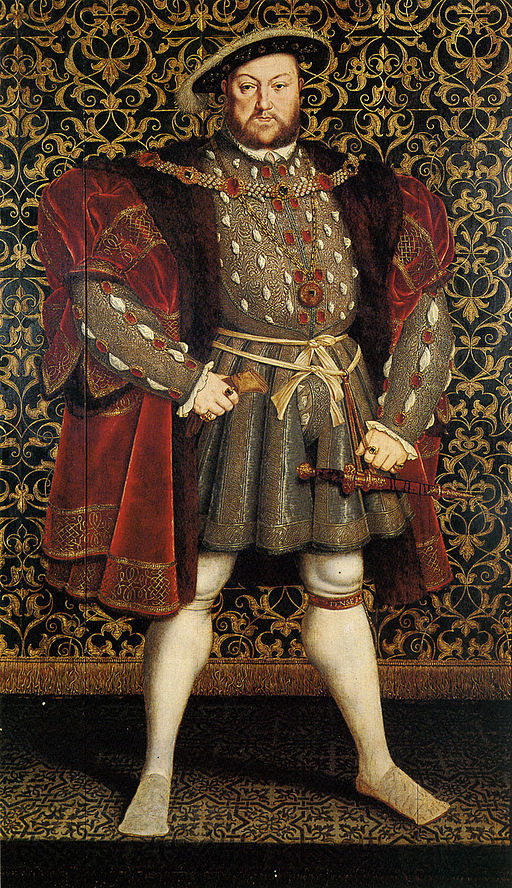
Henry VIII Holbein - Public Domain

Even after Mary returned to court and her household was reinstated and she was reunited with her lifelong friend, Susan Clarencieux her life continued to be difficult. As the dissolution of the monasteries intensified, Mary saw the church she saw as the ‘true church’ all but demolished. She had to sit quietly while monks and nuns were punished. Henry was no longer the golden king of Mary’s infancy but became increasingly ruthless, a trait that grew worse after Queen Jane died shortly after childbirth, providing Henry with Edward, the son he’d longed for.

After the execution of her fifth step-mother, Katherine Howard, Mary was invited to act as hostess at court until the king married his final wife, Katheryn Parr. For a short time the royal family were reunited and almost ‘normal’ or at least as normal as the Tudors ever managed. Encouraged by Parr, Henry welcomed all three of his children back into the fold and, although they remained illegitimate both Mary and Elizabeth were reinstated in the line of succession, after Edward. It was only a brief respite for Mary, who under her brother’s strictly Protestant rule, was to suffer further subjection and torment.

All things considered, there is little wonder that Mary grew into a troubled adult, and ultimately became as harsh a ruler as her father. Of all the women I have studied and written about in my novels, Mary strikes me as the most pitiful. She wasn’t friendless; the people loved Mary from her cradle to her deathbed but for much of the time were afraid to show it.

Edward VI Attributed William Scrots - Public Domain

From infancy she suffered trauma that would have broken most people. But Mary stood firm for as long as she could under constant pressure from her father and his councillors, her brother and his protectors and never ceased to champion her religion. Isolated and terrified, she stood for what she believed was right and, once the crown was finally within her grasp, she did not hesitate to step up to the mark and fight for it.

In a premeditated act, the Duke of Northumberland persuaded Edward to name his cousin, Lady Jane Grey, as his heir in Mary’s place. Having previously married Jane to his son, Guildford Dudley, Northumberland clearly planned to manipulate her and rule in her stead. But Mary was having none of it and rallied an army at Framlingham Castle where support for Northumberland quickly crumbled.

Mary’s reign has been largely regarded as a failure and from our perspective it is easy to see how she earned the title Bloody Mary. As queen, Mary married against the will of the people. She failed to understand the desire of the populace to worship in the manner of their choosing. She failed to provide an heir, suffering phantom pregnancies and dying before her innovative plans for England came to fruition. Yet some of those plans were promising.

She began many policies that have since been laid at Elizabeth's door: reforms to the economy, naval expansion and colonial exploration and had her reign been longer, she may have been remembered very differently. Her success is always measured against Elizabeth's yet Mary had just five years against Elizabeth's forty-four. As with her father, Mary is remembered for her very worst acts yet there was much more to her than religious persecution and brutality. I do not seek to whitewash her actions but to consider the events of her life as she saw them, and it cannot be denied that Mary flew the Tudor banner bravely. She was stalwart, stubborn and loyal. She was sometimes unwise, she was overly passionate and she could be harsh but despite everything, she was loved by her people.

Mary Tudor by Hans Eworth. National Portrait gallery - public domain

~~~~~~~~~~
Judith Arnopp is the author of twelve historical fiction novels, her latest being in The Heretic Wind: the life of Mary Tudor, Queen of England available on Kindle, in Paperback and soon on audible.

To find out more please visit her website www.judithmarnopp.com


Friday, December 14, 2012

A Resplendent Monument to Henry VIII of England


Judith Arnopp


 Most people would agree that England’s most memorable monarch is Henry VIII. The bloody years of his reign, the executions, the break with Rome, his complex sex life have all left their mark on our imagination. He is so synonymous with England that you might even assume that a magnificent memorial stands prominently in Westminster such as the one his parents share, or the superb edifice that enshrines the resting place of his daughter Elizabeth. But you’d be quite wrong to think so.  

Indeed, although buried at Windsor alongside his third wife, Jane Seymour, there is no glorious shrine, no guilded angels, just a slab set in the floor. Where once people trembled before King Henry, now many of us do not even notice when we walk over him.
Death is a great leveller.

In the sixteenth century monuments were intended to mark wealth, status and power, and the building of them was usually undertaken during the lifetime of the person for whom the tomb was intended. Always conscious of the need to emphasise his own supremacy, Henry laid down elaborate plans for a suitable edifice. You have only to consider the most famous portrait of Henry to imagine the impact he intended his memorial to have. Henry was dominant, self-obsessed and power hungry. His burial tomb was intended to reflect that.

The Tomb of Henry VII and Elizabeth of York
As early as 1518, while still married to his first queen, Katherine of Aragon, a contract was signed by a Florentine sculptor, Pietro Torrigiano, the same man who created the fabulous tomb of Henry VII and Elizabeth of York. It was to be similar in design, of black and white marble yet twenty-five per cent bigger and ‘finished in beauty, fairness, costs and adornments.’
Unfortunately, an issue arose over payment between the sculptor and Wolsey (who was in charge of the project) and the Florentine left without completing, or perhaps not even beginning the work. 

Henry and Wolsey quickly sought other craftsmen and made further plans for even more splendid designs. Robert Hutchinson in his book, The last days of Henry VIII notes that the design was based on one originally intended for Pope Leo X. ‘It was to be 28ft high, 15ft long and topped by an effigy of the king on horseback in grand Italian Renaissance style. Beneath this the high canopy were to lie the effigies of the king and queen. In its sheer megalomaniac scale, it was deliberately intended to be a monument to outshine that of any pope or monarch found within the churches and abbeys of Europe.’ Wow, splendid indeed ...and expensive.

The Tomb of Henry's Grandmother, Margaret Beaufort
At around this time Cardinal Wolsey had also began plans for his own shrine. As equally status-conscious as his king, Wolsey’s tomb was to outdo that of Henry VII’s both in ostentation and in cost. Unfortunately, his downfall preceded the completion of his monument and having fallen foul of his King, he was instead buried ignominiously at Abbey Park in Leicestershire.

Henry, never one to let a good thing go to waste, lost no time in acquiring elements of Wolsey’s tomb for his own use, and Cromwell, who was now the project manager, made several payments to Italian and English metal founders. A giant effigy of the king was produced in gilt bronze and work continued until the last decade of Henry’s reign when war with France and Scotland put pressure on the royal coffers. By this time the project was well underway. In his will Henry stated that his tomb was 'well onward and almost made therefore already with a fair grate about it, in which we will also the bones of our true and loving wife Queen Jane be put also.’ 
But with the king out of the picture the project for his grand burial was no longer of primary importance, even to his children.

Under his successor, Edward VI, work continued half-heartedly and under the new protestant regime even the chantry priests who had been asked to pray for Henry and Jane’s souls were forbidden to continue. The King's tomb was shelved and after Edward’s early demise in 1553 work on his own tomb took precedence over Henry’s.

When Mary Tudor assumed the throne she declined to continue with the work for fear she should be seen as supporting one who broke with Rome, and when Elizabeth's turn came, she showed no more filial respect than her sister. Records show that she did consider continuing with the project but rejected several designs, hampered no doubt by the reluctance to spend too much money on it. After all, her own considerable monument, taking many years to complete and requiring a fortune in white marble, was of more immediate importance.

The Tomb of King Francis I of France
Through the Commonwealth and the Restoration periods the half-finished monument, and the chapel that housed it, fell into further disrepair, its ruinous condition being recorded as late as 1749.  In 1804 when the architect, James Wyatt, began work on a huge royal catacomb on the site of the chapel, Henry’s tomb was put into storage. As his memory faded into the past, plans for  Henry VIII’s memorial faded with it. The tomb was never completed and the huge black sarcophagus intended for Henry, is now in St Paul’s housing instead the bones of England’s hero of Trafalgar, Lord Nelson - who has so many monuments.

And so Henry and Jane stayed where they were, beneath the floor of St George’s Chapel at Windsor but they were not left in peace. In 1649 the tomb was opened up to make way for Charles I. One wonders, after executing so many lesser men, what Henry makes of sharing his tomb with a defeated and executed King. You can almost hear his indignant roar, ‘It wouldn’t have happened in my day.’ 

At the end of the seventeenth century the tomb was opened again for the burial of a still-born child of Princess George of Denmark (later to become Queen Anne) and again to allow a casket  of relics appertaining to Charles I to be interred. 

At that time a light was lowered into the tomb and revealed Henry’s coffin to be ‘in a condition of great dilapidation. The King’s skull, with its very broad frontal, his thigh bones, ribs and other portions of the skeleton are exposed to view as the lead has been extensively ripped open…’
The grave remained unmarked until 1837 when in King William IV’s reign it was inscribed as follows.

IN A VAULT
BENEATH THIS MARBLE SLAB
 ARE DEPOSITED THE REMAINS
 OF
JANE SEYMOUR, QUEEN OF KING HENRY VIII
 1537
 KING HENRY VIII
 1547
KING CHARLES I
 1648
 AND AN INFANT CHILD OF QUEEN ANNE.
 THIS MEMORIAL WAS PLACED HERE
 BY COMMAND OF
 KING WILLIAM IV. 1837.

So, our great Tudor monarch lies in a modest tomb, in mixed company while many of his contemporaries, people who bowed and scraped before him, lie in splendour elsewhere in the kingdom.

The graves of his wives are more resplendent than his, even those who died disgraced. Katherine of Aragon has a black marble grave marker with her name written above it in large gilded letters. Anne Boleyn and Catherine Howard lie beneath decorative grave markers at the Chapel of St Peter ad vincula at the Tower of London where flowers are left regularly by modern day sympathisers. 

Anne of Cleves has a marked tomb at Westminster Abbey which, if a little difficult to find, still has substance.  And at Sudeley Castle an effigy of Henry’s last wife, Catherine Parr, lies upon a resplendent tomb.

Henry's son, Edward VI has a tomb fit for a monarch at Westminster Abbey, as does Elizabeth who shares her grave with her half-sister Queen Mary I. Even Henry’s bastard son, Henry Fitzroy, lies in some majesty in St Michael’s church at Framlingham in Suffolk.

Many of Henry's VIII's contemporaries have superior monuments to their king. Thomas Howard, Earl of Surrey, third Duke of Norfolk has a sumptuous memorial at Framlingham Church, and Henry’s great rival King Francis I has a huge effigy in the Basilica of St Denis in Paris with a separate, gigantic urn to house his heart. 

The Tomb of Henry's last victim, Henry Howard, Earl of Surrey
And Henry’s last victim, Henry Howard, Earl of Surrey, who was beheaded just one day before the king died, has a resplendent effigy marking the tomb he shares with his wife Frances, at Framlingham in Suffolk.


Henry’s elder brother Arthur, who was Catherine of Aragon's first husband and died before he could ascend the throne, has an ostentatious tomb in a designated chapel. I could go on, and on but I will resist.

Henry’s parents, grandparents, wives, children, cousins, siblings, friends; most of the Tudors rest in splendour and, I hope, peace.

It is only Henry, who in life was the most ostentatious of them all, that lacks the majesty of a proper monument.

Judith writes historical novels and essays. Her latest Tudor novel The Winchester Goose, is now available in paperback and on kindle. Click the link to purchase.
The Winchester Goose

More information about Judith's work can be found on her webpage: http://www.juditharnopp.com