by Catherine Curzon
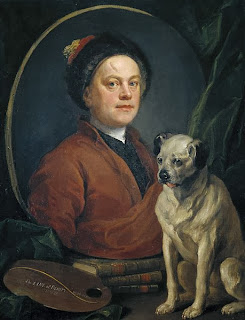 In the history of art and painting, some names have endured for centuries. The chroniclers of their times, their reputations have grown through the years and raised them to the status of icon. Of the many glorious artists who emerged from the Age on Enlightenment, one of the most respected, recognised and influential is the great William Hogarth, English painter, satirist and printmaker.
Although the work is undated, experts believe that the unfinished oil on canvas dates from the 1740s, and was most likely begun as an experiment in working with different styles of painting. If this date is correct, then Hogarth was already at the peak of the art world. He was an established, hugely successful figure with nothing left to prove and perhaps was searching, as Joshua Reynolds often did, for new styles and techniques to stimulate his own creativity. By the 1740s, Hogarth's sitters paid vast sums to commission paintings, and his works were instantly recognisable, influential and lauded by the most illustrious names in the country. Deeply embedded in contemporary culture, the public flocked to printshops to purchase prints of his works. However, Hogarth wasn't content to rest on his laurels with these successes, and when he painted The Shrimp Girl he was looking to develop a less formal style, experimenting with elements of impressionism and a light, frivolous touch.
The identity of the woman in the painting is unknown and sadly, no records exist to lend so much as a clue to who she might be. However, one thing we can be sure of is that young women like this would have been familiar sights around the fish markets of the capital where Hogarth took his inspiration. That is not a hat the young lady wears, but a basket balanced atop her head from which she sells fresh shellfish, the pewter tankard used as a half-pint measure to properly portion out the goods. Although he never finished the work, Hogarth kept the painting at home until his death. When his widow, Jane Thornhill, showed it to people after Hogarth had passed away, she told them, "They say he could not paint flesh. There is flesh and blood for you".
In The Shrimp Girl we see a joyously beaming face free of make up, fashion or guile that is at odds with the idealised formal portraits that lined the walls of galleries and fine homes. This painting illustrates a long-lost, anonymous moment of London street life, one of thousands of such moments that occurred every day yet Hogarth has captured it as clearly as a photograph might today, immortalising the unknown, cheerful young woman forever. The Shrimp Girl is not Hogarth's most dramatic work, nor his most magnificent; it tells no satirical tale, not does it present us with an illustrious figure of national importance, but it does show us the everyday face of Hogarth's London and that is why, for me, it is his one of his greatest works.
Hogarth, William (1833). Nichols, JB, (ed). Anecdotes of William Hogarth, Written by Himself. London: J. B. Nichols and Son.
~~~~~~~~~~~~~
In the history of art and painting, some names have endured for centuries. The chroniclers of their times, their reputations have grown through the years and raised them to the status of icon. Of the many glorious artists who emerged from the Age on Enlightenment, one of the most respected, recognised and influential is the great William Hogarth, English painter, satirist and printmaker.
His work is instantly recognisable and justifiably celebrated, with series such as the magnificent Marriage A-la-Mode endlessly reproduced and rightly lauded. However, my favourite work by Hogarth is not one of his satirical series nor his portraits of the great and good, but a painting of an unknown and far from illustrious young lady, The Shrimp Girl.
Although the work is undated, experts believe that the unfinished oil on canvas dates from the 1740s, and was most likely begun as an experiment in working with different styles of painting. If this date is correct, then Hogarth was already at the peak of the art world. He was an established, hugely successful figure with nothing left to prove and perhaps was searching, as Joshua Reynolds often did, for new styles and techniques to stimulate his own creativity. By the 1740s, Hogarth's sitters paid vast sums to commission paintings, and his works were instantly recognisable, influential and lauded by the most illustrious names in the country. Deeply embedded in contemporary culture, the public flocked to printshops to purchase prints of his works. However, Hogarth wasn't content to rest on his laurels with these successes, and when he painted The Shrimp Girl he was looking to develop a less formal style, experimenting with elements of impressionism and a light, frivolous touch.
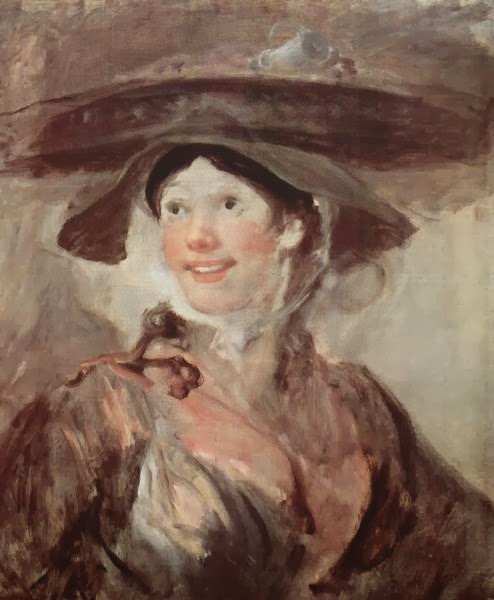 |
| The Shrimp Girl by William Hogarth, 1740-45 |
In The Shrimp Girl we see a joyously beaming face free of make up, fashion or guile that is at odds with the idealised formal portraits that lined the walls of galleries and fine homes. This painting illustrates a long-lost, anonymous moment of London street life, one of thousands of such moments that occurred every day yet Hogarth has captured it as clearly as a photograph might today, immortalising the unknown, cheerful young woman forever. The Shrimp Girl is not Hogarth's most dramatic work, nor his most magnificent; it tells no satirical tale, not does it present us with an illustrious figure of national importance, but it does show us the everyday face of Hogarth's London and that is why, for me, it is his one of his greatest works.
Hogarth, William (1833). Nichols, JB, (ed). Anecdotes of William Hogarth, Written by Himself. London: J. B. Nichols and Son.
~~~~~~~~~~~~~

Glorious Georgian ginbag, gossip and gadabout Catherine Curzon, aka Madame Gilflurt, is the author of A Covent Garden Gilflurt’s Guide to Life. When not setting quill to paper, she can usually be found gadding about the tea shops and gaming rooms of the capital or hosting intimate gatherings at her tottering abode. In addition to her blog and Facebook, Madame G is also quite the charmer on Twitter. Her first book, Life in the Georgian Court, is available now, and she is also working on An Evening with Jane Austen, starring Adrian Lukis and Caroline Langrishe.