by Lauren Gilbert
Historical hoaxes crop up from time to time. Examples ranging from the Piltdown Man in England (here) to Francis Drake’s Plate (here) in the US and others abound. Some are found to be pranks, some deliberate hoaxes. Then there are stories about people and personal relationships. They start with whispers, then printed hints and finally, hey presto! We now have full blown “history”. Gossip? Undoubtedly. True? No one really knows. Sometimes there simply aren’t enough known facts to determine the answer. A case in point is the story of Hannah Lightfoot and the very young Prince of Wales who became George III.
THE LEGEND
Young George, Prince of Wales, saw Hannah Lightfoot’s beautiful, unblemished face through a window (or maybe at a masquerade) and fell immediately in love with her sometime in 1753, and she with him. At some point, they began a passionate affair. She married Isaac Axford in December of 1753, and was snatched from the doors of the church (or maybe 6 weeks later) by the prince (or by the prince’s mother’s orders), who took her to live in one of the royal residences or another residence connected with the royal family. One particularly lurid account has the prince and Hannah in a coach pursued up the turnpike by Mr. Axford. George cleared the tolls by shouting “Royal Family”(1) at the tollkeepers, while poor Mr. Axford had to stop and pay each toll, ultimately losing the couple.
There is also an account that George was married to Hannah in the spring of 1759 by James Wilmot. They had at least one child (some accounts list 3, and the story has grown to a point where there seems to have been many children). When King George II died in October of 1760, Prince George’s mother and Lord Bute convinced him of the need to make a marriage of state to a royal princess, and he bigamously married Princess Charlotte of Mecklenburg-Strelitz. Hannah and her child(ren) left. Some accounts place her in South Africa, others in America. Some sources indicate that Charlotte found out about this previous marriage; she insisted on being married again to George III in 1765 (again by James Wilmot), supposedly after the death of Hannah in 1764.
THE FACTS
GEORGE
George was born June 4, 1738, the second child and oldest son of Frederick, Prince of Wales, and his wife Augusta, Princess of Saxe-Gotha. He was the grandson of King George II and Queen Caroline. He was born two months prematurely and tended carefully so that he became a healthy child. Prince Frederick was interested in the arts, sciences, writing and sports, and was quite involved with his children’s education. George and his younger brother Edward studied with Rev. Ayscough, learning to read and write both English and German well. It is likely that, thanks to Prince Frederick’s interests, they had exposure to literature, including Jonathon Swift and Alexander Pope, music, including the work of Bononcini and Handel, and fine art, thanks to Frederick’s personal collection, which included works by Van Dyck, Rubens and Breughel. Frederick also played with his children when he was available.
When he was age 11, a new tutor, George Lewis Scott, was assigned to George. He and his brother also were appointed a governor, Lord North. Their schedule expanded to include Latin and Greek, with a work day that started at 8:00 in the morning and continued until bedtime (between 9:00 and 10:00 at night), 6 days per week. On Sundays, they attended church multiple times and studied religion with Dr. Ayscough in the time available. (This schedule is outlined in Christopher Hibbert’s biography of George III.) This schedule was maintained, wherever they were in residence, until Prince Frederick died suddenly on March 31, 1751. George became the heir apparent at age 12.
Because of the antipathy George II had felt for Frederick, changes were made in the children’s household to get rid of those appointed by Frederick. Lord Harcourt replaced Lord North and Dr. Thomas Haytor. George’s studies continued, including Latin, mathematics, trigonometry, algebra, history, sciences, etc. He had a music master, drawing master, dancing master, fencing master, riding master, and went to outside lectures as well. He was shy, reserved and somewhat melancholy. Still living with his mother Princess Augusta, George came under the influence of Lord Bute, who had many political enemies. When George turned 18 in 1756, George II offered George his own household, but George refused, choosing to stay with his mother. His education continued, with interests expanding into agriculture, architecture and international trade. He received input from conflicting sources regarding current affairs and politics, but placed a lot of trust in Lord Bute.
Prince George turned 21 in June of 1759, at which point (according to Stella Tilyard in Aristocrats), he was still a virgin(2). In November 1759, Prince George took his seat in the House of Lords. Also in November of 1759, Sarah Lennox (one of the famous Lennox sisters) arrived at Holland House in London. She was almost 15 years old. She was presented at court in late November and met Prince George again. Sarah was known to the King and the royal family. She had participated in Protestant Irish society, so was more socially sophisticated than the Prince. Prince George apparently fell in love with Sarah immediately. Sarah was much admired at court. In addition to coping with his passion for Sarah, Prince George was also trying to convince his grandfather George II to give him something more to do politically. Somewhere around this time, he confessed to Lord Bute that he was interested in girls, Sarah in particular. Since Prince George was expected to marry for state reasons, his interest in Sarah was not encouraged.
Although Prince George yearned for Sarah, and it appears he asked her to marry him at least once, nothing came of this romance. On October 25, 1760, King George II died, making George king. Meetings with Lord Bute, William Pitt, Cabinet ministers and government business dominated the new king’s time. George III ultimately married Princess Charlotte of Mecklenburg-Strelitz on September 8, 1761. They were crowned king and queen together on September 22, 1761. In spite of his passion for Sarah Lennox, George III was devoted to his wife almost from the beginning, and to their family (they had 15 children.)
HANNAH

Hannah Lightfoot was the daughter of Matthew Lightfoot, a shoemaker by some accounts, and Mary Wheeler his wife, and was born in approximately 1730. Matthew died in 1732 or 1733. The Lightfoots and Wheelers were members of the Society of Friends. Mary’s brother Henry Wheeler, a linendraper, took Hannah and her mother into his home at some point. Accounts indicate he had a shop in St. James’s Market that was apparently not far from the Opera House and Pall Mall. Most accounts indicate Hannah was expected to work for or with her uncle in the family business. On December 11, 1753, Hannah married Isaac Axford, a grocer, in Dr. Keith’s marriage chapel in Mayfair. Isaac’s parents were Baptists (although other family members may have been members of the Society of Friends). The records of the Westminster Society of Friends indicate Hannah was expelled from the society in 1756 for being married by a priest to a non-member. Data indicates she had left and could not be contacted.
In 1757, a man named Robert Pearne of Isleworth left a will leaving Hannah (Mrs. Hannah Axford, formerly Miss Hannah Lightfoot) an annuity of 40 pounds per year. Mr. Pearne was reportedly a wealthy, single man with property in England and Antigua. He may, or may not, have been known to Hannah's family. No one really knows why he left her the annuity. (I saw nothing to indicate anyone has discovered if it were claimed.) Isaac Axford, claiming to be a widower, remarried in December of 1759. Hannah’s mother, Mary Wheeler Lightfoot, made a will in January of 1760 leaving her property to Hannah, stating she had not heard from her daughter in 2 years and did not know if she were alive or dead. Mary died in May of 1760. By all accounts that I have read indicate Hannah disappeared shortly after her marriage in December of 1753. To date, there is no indication that a date, place or cause of death has been established for her.
CONCLUSION
In 1753, George, Prince of Wales, was 15 years old and engaged with studies 6 days a week under the supervision of a governor, tutors and multiple masters, as well as his mother and Lord Bute, with Sundays equally occupied with multiple church attendances and religious studies. In 1753, Hannah would have been somewhere between approximately 23 years old, a member of a conservative and devout religious sect, and probably working in her uncle’s shop. There is no indication of any contemporary gossip of the prince being involved with any girl at this time in his life. Frankly, I don’t know when he would have had the time or the opportunity. It also does not seem likely that a young woman working for her keep in her uncle’s shop would have had much spare time to carry on a flirtation with passing royalty.
There is no contemporary record indicating a meeting between George and Hannah or of Hannah’s presence in any of the royal residences or of any gossip concerning the prince’s romance with Hannah. (One would think that someone would have noticed, given the intense supervision to which the prince was subjected.) I think that a mad flight up the turnpike would have been noted somewhere. The idea that a 15-year old Prince of Wales could organize such an event without getting caught by one or more of his many minders also seems wildly improbable.
We do know that by the end of 1759, George was madly in love with and wanted to marry Sarah Lennox. This seems completely out of character if he were in fact happily ensconced in a family relationship with Hannah and a child or children. After his grandfather’s death October 25, 1760, he was occupied with matters of state and forming a government as king, working closely with Lord Bute and his mother. He was married to Charlotte September 22, 1761. A letter was written by Lady Sophia Egerton to her uncle William Bentinck (who became the Duke of Portland) in December of 1759 that indicated that George had kept a beautiful Quaker, had a child by her, and she was dead. The Quaker in question was not named. There is nothing to indicate where she got the story, and there is no indication of similar stories in other sources. The timing is certainly odd, given the then-Prince’s known feelings for Sarah Lennox. I have not been able to find the full text of this letter, and I’ve seen no discussion regarding the existence and the validity or otherwise of this letter.
Subsequently, no rumors concerning a romance between Hannah and the Prince of Wales surfaced until the 1770’s, when an account was published that the prince had had this relationship, after which they popped up occasionally. By this time, George had been king and a contented family man for at several years. While it has been noted that George III was aware of and respected the Society of Friends, no evidence indicates this viewpoint on a personal relationship with an affair with a young woman. From 1779 until 1820, the story did not appear to be in circulation. In 1817, a woman named Olive Wilmot Serres contacted the Prince of Wales, claiming to be the daughter of the Duke of Cumberland. After the death of George III, she revised her story to say she was the legitimate daughter of the Duke of Cumberland. Such documentation of the relationship between George and Hannah that has been located include marriage certificates indicating that a marriage was performed between George and Hannah by James Wilmot in Curzon Street Chapel in either April or May of 1759 (apparently there are 2 certificates, each with a different date) and a will signed in 1762 by Hannah Regina appeared in a case filed by the illegitimate daughter of Olive Serres in a last attempt to establish that her mother was Princess Olive, daughter of the Duke of Cumberland and petitioned King George III for a pension. (For Princess Olive’s story go HERE and HERE and in THE GREAT PRETENDERS shown in Sources below). The royal family contested Olive's allegations and, after Olive's death, her daughter Lavinia took the case to court in 1866. The documents (including those related to Hannah Lightfoot and George III) were finally pronounced at best suspicious, probably forgeries. (There are indications that George III’s oldest son, George IV, spread the story, using it to tease Queen Charlotte about the legitimacy of her marriage to his father.(3)) It is worth noting that the chapel where the wedding of George and Hannah allegedly occurred in 1759 was closed in 1754.(4) The story grew throughout the Victorian era. There is also no evidence linking the portrait shown, attributed to Joshua Reynolds, to Hannah Lightfoot Axford. It is a portrait of a woman in an elegant gown, not in Quaker attire. (There is a similar portrait, painted in 1756 by Joshua Reynolds, hanging at Knole, titled "Miss Axford, "The Fair Quakeress", also in fashionable garb.) Either or both portraits could be portraits of Miss Ann Axford, who was not a Quaker but a member of a well-to-do family of grocers in Ludgate Hill.
While Hannah Lightfoot Axford did exist, and did disappear sometime after her marriage to Isaac Axford on December 11, 1753, there is nothing linking her disappearance to the then-Prince of Wales. The inheritance of an annuity in 1757 from Robert Pearne would indicate other possibilities. Is it completely impossible that, at some point, she may have met George? No. I do however, feel a relationship of any kind between the two would not have gone unnoticed and undocumented, and a passionate romance that included living together and producing a child (or several) without any contemporary record does seem impossible to me.
Footnotes
(1) Bondeson, Jan. THE GREAT PRETENDERS The True Stories behind Famous Historical Mysteries. P. 175.
(2) Tilyard, Stella. ARISTOCRATS. P. 112
(3) Hampden, John Jr. THE ARISTOCRACY OF ENGLAND A History for the People. P. 204.
(4) Bondeson, Jan. Op. Cit. P. 181
SOURCES INCLUDE
Bondeson, Jan. THE GREAT PRETENDERS The True Stories behind Famous Historical Mysteries. 2004: W. W. Norton & Co., New York.
Hibbert, Christopher. GEORGE III A Personal History. 1998: Viking of Penguin Books. Reprinted by Basic Books, a Member of the Perseus Books Group, New York.
Pendered, Mary Lucy. THE FAIR QUAKER Hannah Lightfoot and Her Relations with George III. 1911: D. Appleton and Co., New York. Kessenger Legacy Reprint. (historical book reprint including imperfections) in my possession.
Tilyard, Stella. ARISTOCRATS. 1994: Farrar, Straus and Giroux, New York.
Chest of Books. “True Love Stories of Famous People-29. King George III and Hannah Lightfoot” from EveryWoman’s Encyclopaedia, 1910-1912. HERE
GoogleBooks. Ashdown-Hill, John. ROYAL MARRIAGE SECRETS: Consorts & Concubines, Bigamists and Bastards. 2013: History Press. (Preview) HERE
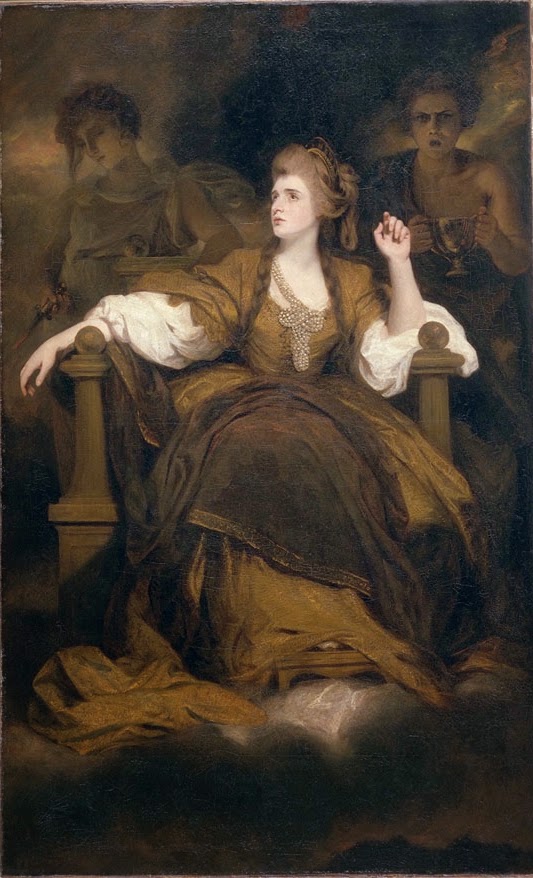
Joshua Reynolds' Portrait of Hannah: HERE
Liotard's portrait of George: HERE
Imaginary portrait of Hannah is the frontispiece from Mary Lucy Pendered's THE FAIR QUAKER Hannah Lightfoot, and Her Relations with George III (1911) as reprinted by Kessinger Legacy Reprints, p. vii. in my possession. (THE MYSTERIES OF THE COURT OF LONDON by G. W. M. Reynolds, from which she obtained this portrait, was a "penny dreadful" published in 1849 by J. Dicks.)
~~~~~~~~~~
 Lauren Gilbert lives in Florida and is a long-time member of the Jane Austen Society of North America. An obsessive reader, she has been writing since childhood, and achieved her dream of publishing a book with HEYERWOOD: A Novel in 2011. She is working on her second novel A RATIONAL ATTACHMENT. Visit her website HERE for more information.
 |
| Portrait of A Lady-Attributed to Sir Joshua Reynolds, this may be a portrait of Hannah Lightfoot. |
Historical hoaxes crop up from time to time. Examples ranging from the Piltdown Man in England (here) to Francis Drake’s Plate (here) in the US and others abound. Some are found to be pranks, some deliberate hoaxes. Then there are stories about people and personal relationships. They start with whispers, then printed hints and finally, hey presto! We now have full blown “history”. Gossip? Undoubtedly. True? No one really knows. Sometimes there simply aren’t enough known facts to determine the answer. A case in point is the story of Hannah Lightfoot and the very young Prince of Wales who became George III.
THE LEGEND
Young George, Prince of Wales, saw Hannah Lightfoot’s beautiful, unblemished face through a window (or maybe at a masquerade) and fell immediately in love with her sometime in 1753, and she with him. At some point, they began a passionate affair. She married Isaac Axford in December of 1753, and was snatched from the doors of the church (or maybe 6 weeks later) by the prince (or by the prince’s mother’s orders), who took her to live in one of the royal residences or another residence connected with the royal family. One particularly lurid account has the prince and Hannah in a coach pursued up the turnpike by Mr. Axford. George cleared the tolls by shouting “Royal Family”(1) at the tollkeepers, while poor Mr. Axford had to stop and pay each toll, ultimately losing the couple.
There is also an account that George was married to Hannah in the spring of 1759 by James Wilmot. They had at least one child (some accounts list 3, and the story has grown to a point where there seems to have been many children). When King George II died in October of 1760, Prince George’s mother and Lord Bute convinced him of the need to make a marriage of state to a royal princess, and he bigamously married Princess Charlotte of Mecklenburg-Strelitz. Hannah and her child(ren) left. Some accounts place her in South Africa, others in America. Some sources indicate that Charlotte found out about this previous marriage; she insisted on being married again to George III in 1765 (again by James Wilmot), supposedly after the death of Hannah in 1764.
THE FACTS
GEORGE
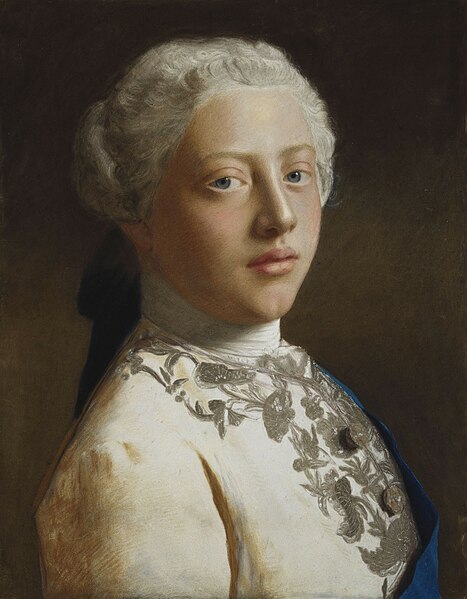 |
| George III as Prince of Wales by Jean-Etienne Liotard, painted 1754 |
George was born June 4, 1738, the second child and oldest son of Frederick, Prince of Wales, and his wife Augusta, Princess of Saxe-Gotha. He was the grandson of King George II and Queen Caroline. He was born two months prematurely and tended carefully so that he became a healthy child. Prince Frederick was interested in the arts, sciences, writing and sports, and was quite involved with his children’s education. George and his younger brother Edward studied with Rev. Ayscough, learning to read and write both English and German well. It is likely that, thanks to Prince Frederick’s interests, they had exposure to literature, including Jonathon Swift and Alexander Pope, music, including the work of Bononcini and Handel, and fine art, thanks to Frederick’s personal collection, which included works by Van Dyck, Rubens and Breughel. Frederick also played with his children when he was available.
When he was age 11, a new tutor, George Lewis Scott, was assigned to George. He and his brother also were appointed a governor, Lord North. Their schedule expanded to include Latin and Greek, with a work day that started at 8:00 in the morning and continued until bedtime (between 9:00 and 10:00 at night), 6 days per week. On Sundays, they attended church multiple times and studied religion with Dr. Ayscough in the time available. (This schedule is outlined in Christopher Hibbert’s biography of George III.) This schedule was maintained, wherever they were in residence, until Prince Frederick died suddenly on March 31, 1751. George became the heir apparent at age 12.
Because of the antipathy George II had felt for Frederick, changes were made in the children’s household to get rid of those appointed by Frederick. Lord Harcourt replaced Lord North and Dr. Thomas Haytor. George’s studies continued, including Latin, mathematics, trigonometry, algebra, history, sciences, etc. He had a music master, drawing master, dancing master, fencing master, riding master, and went to outside lectures as well. He was shy, reserved and somewhat melancholy. Still living with his mother Princess Augusta, George came under the influence of Lord Bute, who had many political enemies. When George turned 18 in 1756, George II offered George his own household, but George refused, choosing to stay with his mother. His education continued, with interests expanding into agriculture, architecture and international trade. He received input from conflicting sources regarding current affairs and politics, but placed a lot of trust in Lord Bute.
Prince George turned 21 in June of 1759, at which point (according to Stella Tilyard in Aristocrats), he was still a virgin(2). In November 1759, Prince George took his seat in the House of Lords. Also in November of 1759, Sarah Lennox (one of the famous Lennox sisters) arrived at Holland House in London. She was almost 15 years old. She was presented at court in late November and met Prince George again. Sarah was known to the King and the royal family. She had participated in Protestant Irish society, so was more socially sophisticated than the Prince. Prince George apparently fell in love with Sarah immediately. Sarah was much admired at court. In addition to coping with his passion for Sarah, Prince George was also trying to convince his grandfather George II to give him something more to do politically. Somewhere around this time, he confessed to Lord Bute that he was interested in girls, Sarah in particular. Since Prince George was expected to marry for state reasons, his interest in Sarah was not encouraged.
Although Prince George yearned for Sarah, and it appears he asked her to marry him at least once, nothing came of this romance. On October 25, 1760, King George II died, making George king. Meetings with Lord Bute, William Pitt, Cabinet ministers and government business dominated the new king’s time. George III ultimately married Princess Charlotte of Mecklenburg-Strelitz on September 8, 1761. They were crowned king and queen together on September 22, 1761. In spite of his passion for Sarah Lennox, George III was devoted to his wife almost from the beginning, and to their family (they had 15 children.)
HANNAH

Hannah Lightfoot was the daughter of Matthew Lightfoot, a shoemaker by some accounts, and Mary Wheeler his wife, and was born in approximately 1730. Matthew died in 1732 or 1733. The Lightfoots and Wheelers were members of the Society of Friends. Mary’s brother Henry Wheeler, a linendraper, took Hannah and her mother into his home at some point. Accounts indicate he had a shop in St. James’s Market that was apparently not far from the Opera House and Pall Mall. Most accounts indicate Hannah was expected to work for or with her uncle in the family business. On December 11, 1753, Hannah married Isaac Axford, a grocer, in Dr. Keith’s marriage chapel in Mayfair. Isaac’s parents were Baptists (although other family members may have been members of the Society of Friends). The records of the Westminster Society of Friends indicate Hannah was expelled from the society in 1756 for being married by a priest to a non-member. Data indicates she had left and could not be contacted.
In 1757, a man named Robert Pearne of Isleworth left a will leaving Hannah (Mrs. Hannah Axford, formerly Miss Hannah Lightfoot) an annuity of 40 pounds per year. Mr. Pearne was reportedly a wealthy, single man with property in England and Antigua. He may, or may not, have been known to Hannah's family. No one really knows why he left her the annuity. (I saw nothing to indicate anyone has discovered if it were claimed.) Isaac Axford, claiming to be a widower, remarried in December of 1759. Hannah’s mother, Mary Wheeler Lightfoot, made a will in January of 1760 leaving her property to Hannah, stating she had not heard from her daughter in 2 years and did not know if she were alive or dead. Mary died in May of 1760. By all accounts that I have read indicate Hannah disappeared shortly after her marriage in December of 1753. To date, there is no indication that a date, place or cause of death has been established for her.
CONCLUSION
In 1753, George, Prince of Wales, was 15 years old and engaged with studies 6 days a week under the supervision of a governor, tutors and multiple masters, as well as his mother and Lord Bute, with Sundays equally occupied with multiple church attendances and religious studies. In 1753, Hannah would have been somewhere between approximately 23 years old, a member of a conservative and devout religious sect, and probably working in her uncle’s shop. There is no indication of any contemporary gossip of the prince being involved with any girl at this time in his life. Frankly, I don’t know when he would have had the time or the opportunity. It also does not seem likely that a young woman working for her keep in her uncle’s shop would have had much spare time to carry on a flirtation with passing royalty.
There is no contemporary record indicating a meeting between George and Hannah or of Hannah’s presence in any of the royal residences or of any gossip concerning the prince’s romance with Hannah. (One would think that someone would have noticed, given the intense supervision to which the prince was subjected.) I think that a mad flight up the turnpike would have been noted somewhere. The idea that a 15-year old Prince of Wales could organize such an event without getting caught by one or more of his many minders also seems wildly improbable.
We do know that by the end of 1759, George was madly in love with and wanted to marry Sarah Lennox. This seems completely out of character if he were in fact happily ensconced in a family relationship with Hannah and a child or children. After his grandfather’s death October 25, 1760, he was occupied with matters of state and forming a government as king, working closely with Lord Bute and his mother. He was married to Charlotte September 22, 1761. A letter was written by Lady Sophia Egerton to her uncle William Bentinck (who became the Duke of Portland) in December of 1759 that indicated that George had kept a beautiful Quaker, had a child by her, and she was dead. The Quaker in question was not named. There is nothing to indicate where she got the story, and there is no indication of similar stories in other sources. The timing is certainly odd, given the then-Prince’s known feelings for Sarah Lennox. I have not been able to find the full text of this letter, and I’ve seen no discussion regarding the existence and the validity or otherwise of this letter.
Subsequently, no rumors concerning a romance between Hannah and the Prince of Wales surfaced until the 1770’s, when an account was published that the prince had had this relationship, after which they popped up occasionally. By this time, George had been king and a contented family man for at several years. While it has been noted that George III was aware of and respected the Society of Friends, no evidence indicates this viewpoint on a personal relationship with an affair with a young woman. From 1779 until 1820, the story did not appear to be in circulation. In 1817, a woman named Olive Wilmot Serres contacted the Prince of Wales, claiming to be the daughter of the Duke of Cumberland. After the death of George III, she revised her story to say she was the legitimate daughter of the Duke of Cumberland. Such documentation of the relationship between George and Hannah that has been located include marriage certificates indicating that a marriage was performed between George and Hannah by James Wilmot in Curzon Street Chapel in either April or May of 1759 (apparently there are 2 certificates, each with a different date) and a will signed in 1762 by Hannah Regina appeared in a case filed by the illegitimate daughter of Olive Serres in a last attempt to establish that her mother was Princess Olive, daughter of the Duke of Cumberland and petitioned King George III for a pension. (For Princess Olive’s story go HERE and HERE and in THE GREAT PRETENDERS shown in Sources below). The royal family contested Olive's allegations and, after Olive's death, her daughter Lavinia took the case to court in 1866. The documents (including those related to Hannah Lightfoot and George III) were finally pronounced at best suspicious, probably forgeries. (There are indications that George III’s oldest son, George IV, spread the story, using it to tease Queen Charlotte about the legitimacy of her marriage to his father.(3)) It is worth noting that the chapel where the wedding of George and Hannah allegedly occurred in 1759 was closed in 1754.(4) The story grew throughout the Victorian era. There is also no evidence linking the portrait shown, attributed to Joshua Reynolds, to Hannah Lightfoot Axford. It is a portrait of a woman in an elegant gown, not in Quaker attire. (There is a similar portrait, painted in 1756 by Joshua Reynolds, hanging at Knole, titled "Miss Axford, "The Fair Quakeress", also in fashionable garb.) Either or both portraits could be portraits of Miss Ann Axford, who was not a Quaker but a member of a well-to-do family of grocers in Ludgate Hill.
While Hannah Lightfoot Axford did exist, and did disappear sometime after her marriage to Isaac Axford on December 11, 1753, there is nothing linking her disappearance to the then-Prince of Wales. The inheritance of an annuity in 1757 from Robert Pearne would indicate other possibilities. Is it completely impossible that, at some point, she may have met George? No. I do however, feel a relationship of any kind between the two would not have gone unnoticed and undocumented, and a passionate romance that included living together and producing a child (or several) without any contemporary record does seem impossible to me.
Footnotes
(1) Bondeson, Jan. THE GREAT PRETENDERS The True Stories behind Famous Historical Mysteries. P. 175.
(2) Tilyard, Stella. ARISTOCRATS. P. 112
(3) Hampden, John Jr. THE ARISTOCRACY OF ENGLAND A History for the People. P. 204.
(4) Bondeson, Jan. Op. Cit. P. 181
SOURCES INCLUDE
Bondeson, Jan. THE GREAT PRETENDERS The True Stories behind Famous Historical Mysteries. 2004: W. W. Norton & Co., New York.
Hibbert, Christopher. GEORGE III A Personal History. 1998: Viking of Penguin Books. Reprinted by Basic Books, a Member of the Perseus Books Group, New York.
Pendered, Mary Lucy. THE FAIR QUAKER Hannah Lightfoot and Her Relations with George III. 1911: D. Appleton and Co., New York. Kessenger Legacy Reprint. (historical book reprint including imperfections) in my possession.
Tilyard, Stella. ARISTOCRATS. 1994: Farrar, Straus and Giroux, New York.
Archive.org. Doran, Dr. LIVES OF THE QUEENS OF ENGLAND. Second Edition in Two Volumes. Vol. II. . 1855: Richard Bentley, London. HERE
GoogleBooks. Ashdown-Hill, John. ROYAL MARRIAGE SECRETS: Consorts & Concubines, Bigamists and Bastards. 2013: History Press. (Preview) HERE
GoogleBooks. Hampden, John Junior (annotated William Howiitt). THE ARISTOCRACY OF ENGLAND A History for the People. 1856: Chapman Brothers, London. HERE
Wikipedia. "Olive Serres"(last edited 30 June 2017). No author or date provided. HERE
Illustrations:Wikipedia. "Olive Serres"(last edited 30 June 2017). No author or date provided. HERE
Joshua Reynolds' Portrait of Hannah: HERE
Liotard's portrait of George: HERE
Imaginary portrait of Hannah is the frontispiece from Mary Lucy Pendered's THE FAIR QUAKER Hannah Lightfoot, and Her Relations with George III (1911) as reprinted by Kessinger Legacy Reprints, p. vii. in my possession. (THE MYSTERIES OF THE COURT OF LONDON by G. W. M. Reynolds, from which she obtained this portrait, was a "penny dreadful" published in 1849 by J. Dicks.)
~~~~~~~~~~
 Lauren Gilbert lives in Florida and is a long-time member of the Jane Austen Society of North America. An obsessive reader, she has been writing since childhood, and achieved her dream of publishing a book with HEYERWOOD: A Novel in 2011. She is working on her second novel A RATIONAL ATTACHMENT. Visit her website HERE for more information.

_by_Sir_Joshua_Reynolds,_PRA.jpg)