Showing posts with label Channel Islands. Show all posts

Saturday, September 17, 2016

Surrealist Sisters: Artistic Resistance to Nazi Occupation

by Mark Patton

In an earlier blog-post, I introduced the topic of the German Occupation of the Channel Islands during the Second World War. Jersey, Guernsey, Alderney, Sark and Herm were the only parts of the British Isles to fall under Nazi control. Armed resistance of the sort that took place in the occupied territories of France, Belgium, and the Netherlands was really not possible on such small islands, but the residents, both native Channel Islanders and a handful of immigrants, did what they could to undermine the occupying forces and their morale. By the time the Germans arrived in 1940, most men of military age had already joined the British forces, and all but a handful of the islands' Jewish population had taken refuge on the UK mainland.

The artists, Claude Cahun and Marcel Moore, were not native islanders but Frenchwomen, and they were also Jewish. Cahun had been born Lucy Schwob; Moore as Suzanne Malherbe; they met as teenagers, became a lesbian couple, and adopted deliberately gender-ambiguous names. Their families, both from Nantes, knew each other well, and, when Cahun's father married Moore's widowed mother, they became, technically, step-sisters.

Claude Cahun, by Marcel Moore, Jersey Heritage Collections
(reproduced under fair usage protocols).

Marcel Moore, by Claude Cahun,
Jersey Heritage Collections
(reproduced under fair usage protocols). 

Before the outbreak of war, Cahun and Moore had lived in Paris, where they collaborated in the creation of art-works that combined photography, poetry and performance. Instinctively attracted to the Surrealist movement, they struggled against the misogyny and homophobia of many of its leading members, but participated in the International Surrealist Exhibition at London's New Burlington Gallery in 1936. They were also actively involved in Contre-Attaque, a group of artists and intellectuals protesting against the rise of Hitler, and the spread of fascism in France.


Flyer for the International Surrealist Exhibition (image is in the Public Domain). Organisers included Henry Moore, Paul Nash, Andre Breton and Man Ray. "Happenings" occurred all across London: Salvador Dali donned a diving suit to give a lecture, almost suffocated, and had to be rescued by the poet, David Gascoyne, who used a spanner to remove the helmet. 


In 1937, Cahun and Moore moved to Jersey, where they had enjoyed family holidays in their youth, buying a property in Saint Brelade's Bay, close to the hotel in which they had previously stayed. As war loomed, they made the brave and surprising decision, despite their Jewish ethnicity and their sexuality, to remain on the island.

Saint Brelade's Bay, Jersey. Photo: Snapshots of the past (licensed under CCA).
This is a pre-war postcard: the Germans later built a concrete tank-proof wall,
and a series of fortifications, along the top of the beach.

Bob Le Sueur, a native islander who taught me at secondary school, and who, as a young man on the island, helped to hide Russian and Spanish slave-workers escaping from the Nazis, said of the two women: "They lived as art ... everyone knew they were Jewish, but nobody turned them in." He described watching from a distance as they walked a cat on a leash along the beach, the creature squealing as the waves swept closer.

In the final year of the war, with the islands cut off from the continent, and both the German garrison and the local population on the brink of starvation, they embarked on a programme of active, but non-violent, resistance: producing leaflets and distributing them to German troops. The leaflets included excerpts from BBC broadcasts, and encouraged troops to mutiny. Karen LeRoy Harris, who curated a recent exhibition of Cahun's work in London, wrote:

"Moore spoke fluent German, a secret kept from the Nazis. The leaflets were written as if by a German officer, and signed 'The soldier without a name.' They distributed the notes themselves, on buses, in soldiers' pockets, in staff-cars ..."

In October, 1944, they were arrested and sentenced to death, but the sentence was never carried out: by this stage it was obvious that Germany was losing the war; and senior officers, fearful of prosecution as war criminals, did not want to be caught with the blood of civilians on their hands. They spent the remaining months of the war in prison, and were liberated by British troops on the 9th of May, 1945. Cahun died in 1954, her health, many believe, broken by her treatment in prison. Moore committed suicide in 1972. They are buried together in Saint Brelade's Churchyard, close to where they lived.


The grave of Lucy Schwob and Suzanne Malherbe at Saint Brelade.
Photo: Man Vyi (image is in the Public Domain).

In the aftermath of the war, Cahun's and Moore's artistic works were largely forgotten. All this changed when, in the early 1990s, a local collector on Jersey showed some of their works to my then colleague, and Curator of Art at the Jersey Museum, Lucy Marder. She organised a major exhibition: "Surrealist Sisters - An Extraordinary Story of Art and Politics;" and the museum went on to acquire a substantial body of their work, which has formed the basis of subsequent exhibitions in the UK, France, and the USA.

The cover of a book by Louise Downie (Lucy Marder's successor as Curator of Art at the Jersey Museum).
Most works by Claude Cahun will remain in copyright until 2024:
a Google search will reveal many of them, but they may not be reproduced.

In 2007, Claude Cahun received this tribute from David Bowie, who exhibited reproductions of some of her works in the United States:

"You could call her transgressive, or you could call her a cross dressing Man Ray with surrealist tendencies. I find this work really quite mad, in the nicest way. Outside of France, and now the UK, she has not had the kind of recognition that, as a founding follower, friend and worker of the original surrealist movement, she surely deserves."
~~~~~~~~~~

Mark Patton blogs regularly on aspects of history and historical fiction at http://mark-patton.blogspot.co.uk. His novels, Undreamed Shores, An Accidental King, and Omphalos, are published by Crooked Cat Publications, and can be purchased from Amazon. He is currently working on The Cheapside Tales, a London-based trilogy of historical novels.

Wednesday, June 17, 2015

The Death of a Hero - The Story Behind a Painting

by Mark Patton.

Victor Hugo once described the British Channel Islands of Jersey, Guernsey, Alderney, Sark and Herm as "little pieces of France, dropped in the sea and picked up by England." They are certainly closer to France than they are to England, although today they are mainly English-speaking. The coast of Normandy is clearly visible from the north and east coasts of Jersey, and from the eastern coast of Alderney.

In fact, the islands were not dropped by France, but retained by England when, in 1204, King John lost his other possessions in Normandy to the French King Philippe-Auguste. Ever since, the islanders have found themselves on the front line whenever England (or, later, Britain) was at war with France.

In a current exhibition on British history-painting at Tate Britain in London, the centre-piece is a painting by the American artist, John Singleton Copley, of "The Death of Major Peirson." The painting is owned by the Tate, but is, ordinarily, on display in Jersey as part of a loan agreement. From 9th June to 13th September, however, those of us who live in, or have the opportunity to visit, London have the opportunity of viewing it.

"The Death of Major Peirson," 
by John Singleton Copley. Image: Tate Britain

The events depicted took place in January 1781. On the night of 6th January, a French force led by a mercenary adventurer who styled himself "Baron de Rullecourt" (his name was Philippe Macquart, and his noble title self-adopted) landed on the south-east coast of Jersey, under cover of darkness. He had with him around two thousand troops, but his choice of landing ground was disastrous, and he had lost almost half his force by the time he came ashore.

The coast of La Rocque, Jersey, where De Rullecourt landed his force.
A labyrinth of jagged rocks is to be found beneath the shallow waters,
making it the graveyard of many ships.
Photo: Man Vyi (image is in the Public Domain).

Philippe Macquart, "Baron de Rullecourt"

He had luck on his side, however (or perhaps this really was military judgement), in that the night in question was Twelfth Night, the last evening of the Christmas festivities, and most of the British garrison were celebrating, presumably consuming large quantities of the cider for which the island was then renowned. With his remaining troops, he reached the town of Saint Helier and surprised the island's Lieutenant-Governor, Moses Corbet, in bed, placing him under arrest and forcing the "surrender" of the garrison.

Knowing that Corbet's "surrender" had been made at the point of a gun, neither the British garrison, dispersed between several barracks around the island, nor the local Militia, had any inclination to comply with it. Command was assumed by the senior officer of the regular garrison, 24 year old Major Francis Peirson. He mustered his force on a hill overlooking Saint Helier (he had available around 6000 regular troops and 3000 militia, but it is not known how many of these were actually deployed) and advanced into the town.

Major Francis Peirson
thought to be by Jean Sullivan

The actual fighting lasted for less than fifteen minutes, the French force being decisively outnumbered, but both Peirson and De Rullecourt were killed in action. Copley's painting, commissioned by a London Alderman, John Boydell, shows Peirson falling at the centre of the market-place (now the Royal Square), but it is not thought that he ever reached this position: he was taken out by a sniper in the opening moments of the battle.

The painting also shows a black man (supposedly Peirson's servant, Pompey, although it is unclear that any such man existed) taking aim at the sniper. The uniform worn by this man appears to be that of Lord Dunmore's Ethiopian Regiment (which had nothing to do with Ethiopia, but rather was raised from escaped slaves in the American Colonies): soldiers of this regiment never served outside the American colonies.

Detail of Copley's painting,
showing "Pompey" taking aim

Peirson was buried in the crypt of the Town Church nearby, and De Rullecourt in the adjacent church-yard. The context for the invasion, backed by the French King, Louis XVI, was a desire to end the activities of Channel Island privateers, which were harrying French and American shipping on both sides of the Atlantic. With its defeat, these activities were free to continue.

It is unclear whether Copley, who lived and worked in London at the time, actually visited the island, or worked from commercially available prints, but most of the topographical and architectural details are correct, even if aspects of the battle are not.

Saint Helier's Royal Square in the early 19th Century
Visible are the statue of George II and the court-house
behind it, both of which can be seen on
Copley's painting, as well as the church where
Peirson and De Rullecourt lie buried.

Copley's painting went on public display in London in 1784, with an admission charge of one shilling, and attracted lengthy queues. For a brief season, the name of Peirson was celebrated as that of Nelson would later be (it still is on the island, where Copley's painting has featured on bank-notes and stamps).


Poster advertising the public exhibition
of Copley's painting in London.
Photo: Man Vyi (Public Domain).

~~~~~~~~~~~~~

Mark Patton blogs regularly on aspects of history and historical fiction at http://mark-patton.blogspot.co.uk. His novels, Undreamed Shores, An Accidental King and Omphalos, are published by Crooked Cat Publications, and can be purchased from Amazon.


Friday, May 8, 2015

The Liberation of the Channel Islands - 9th May 1945

by Mark Patton

In an earlier Blog Post, I explored the circumstances under which, during the course of the Second World War, the Channel Islands of Jersey, Guernsey, Alderney, Herm and Sark became the only British territories in the Western Hemisphere to be occupied by the forces of Nazi Germany. German troops took control of the islands in June 1940, but the islanders suffered their greatest hardships in the final year of the war. After the D-Day landings of June 1944, the islands were effectively cut off from all external supplies. Islanders and German troops alike came close to starvation.

A German officer with a Channel Island policeman.
Photo: Imperial War Museum (non-commercial license).

Despite the very real threat of execution, many islanders kept illicit radios in their home, enabling them to listen to the broadcasts of the BBC. The news of Hitler's suicide on 30th April circulated widely, both among the islanders and within the German garrison, yet there remained uncertainty. The formal instruments of surrender were signed at Reims on 7th May, and Churchill declared VE Day on the 8th, but the islands remained in German hands. There were rumours that the German commander of the islands, Admiral Huffmeier, an ardent Nazi, would refuse to surrender them.

On the 8th May, the Bailiff of Jersey, Alexander Coutanche, raised the British and American flags from the twin flag poles of the island's parliament building, and spoke to the assembled crowd in the Royal Square. German troops, still armed, mingled with people in the streets (Huffmeier was on Guernsey, and Coutanche's action had probably been authorised by one of the senior German officers on Jersey, most of whom were not Nazis).

Later that day, two Royal Navy warships, HMS Beagle and HMS Bulldog, were dispatched from Plymouth and anchored four miles off Guernsey. Huffmeier at first threatened to fire on them, and subsequently declared that he would only surrender the islands after having detonated all the ammunition stored on them, but there were, among his own officers, several who were willing to assassinate him rather than allow this to happen. The surrender was signed at Saint-Peter-Port at 0714 on the 9th May. Shortly afterwards, an RAF force of Mosquitoes and Mustangs overflew the islands, whose people were reassured to see that they met no fire from the German batteries.

The surrender of Oberst Heine,
one of the senior German officers, to British troops.
Photo: Imperial War Museum (non-commercial license).

The Beagle continued to Jersey, where officers came ashore and raised the British flag. British troops were in control of both of the larger islands before the sun went down that day.

The crowd in Saint-Peter-Port cheering
as the British flag is raised.
Photo: Imperial War Museum (non-commercial license - D24590).

The larger infantry force of "Operation Nest-Egg" (the last military operation of the war in Europe) arrived on the 12th May in landing craft and amphibious vehicles. It took several months to evacuate all of the German troops, who were dispersed among a number of prisoner-of-war camps around the UK (many first needed medical treatment for the effects of malnutrition).

The arrival of British troops in Saint Helier.
Photo: Imperial War Museum (non-commercial license).


The evacuation of German prisoners-of-war 
from Saint Aubin's Bay, Jersey. 
Photo: Imperial War Museum (non-commercial license).

The restoration of normal life on the islands would, of course, take years. Some islanders had been deported to internment camps on the continent, and not all had survived; others had been serving with the British armed forces; those who remained on the islands had lost all contact with those who were elsewhere.

Some islanders were considered to have "collaborated" with the occupiers (acts of "collaboration" ranged from the denunciation of neighbours to the Gestapo, to romantic liaisons with German troops), whilst others took pride in their acts of resistance (hiding escaped Russian and Spanish slave-workers, for example). Divisions were opened up which certainly endured into my life-time (my mother, who moved to Jersey from England after the war, befriended a local woman who was shunned by many of the islanders as a "Jerry-Bag").

The physical reminders of the Occupation - concrete gun-batteries, bunkers and observation towers - endure to this day. Some were my childhood playgrounds, others have been put to ingenious uses, from fish hatcheries to strawberry and mushroom farms, radio stations and cafes.

German observation tower at Les Landes,
Jersey, part of Hitler's "Atlantic Wall."
Photo: Man Vyi (image is in the Public Domain).

But the 9th of May will always be remembered on the islands as "Liberation Day," commemorated with annual ceremonies and public statues as marking the end of the islanders' darkest days.

The monument to the Liberation in Saint Helier.
Photo: Man Vyi (image is in the Public Domain).

~~~~~~~~~~~~~

Mark Patton blogs regularly on aspects of history and historical fiction at http://mark-patton.blogspot.co.uk. His novels, Undreamed Shores, An Accidental King and Omphalos, are published by Crooked Cat Publications, and can be purchased from Amazon.

Sunday, May 11, 2014

The German Occupation of the Channel Islands

by Mark Patton

From June 1940 until May 1945, the Channel Islands of Jersey, Guernsey, Alderney, Sark and Herm were the only parts of the British Isles to be occupied by German military forces.

A German marching band in St Peter-Port, Guernsey.
Photo: Imperial War Museum (image is in the Public Domain).

Possessions of the English Crown since the 13th Century (and of the Duchy of Normandy prior to that), the islands are geographically much closer to France than to England. After the fall of France in the opening months of the Second World War, the British Government decided that the defence of the islands would not be possible without an unacceptable loss of life. Most men of military age had already left the islands to join the British forces, and many of the island's Jewish residents chose also to leave. The authorities in Alderney encouraged everyone to evacuate, which most people did, whilst those in Sark encouraged people to stay). Many Jersey and Guernsey families, particularly those engaged in farming, preferred, in any case, to remain on their land.


German forces took control of the islands on 30th June 1940. In the months that followed, thousands of German troops were moved to the islands, ultimately outnumbering the islanders by a ratio of 2:1. German commanders took full advantage of the propaganda value of the occupation, releasing photographs and film footage of British policemen, in their distinctive uniforms, chatting casually with German soldiers. The islands were heavily fortified, however, with bunkers, observation towers, and heavy artillery as part of the "Atlantic Wall" defence preventing any possibility of an allied invasion on the western coast of Normandy or the northern coast of Brittany. Most of these were built by slave-workers, including Spanish republicans captured during the civil war, and Russians and Ukrainians taken on the eastern front.

German observation tower at Les Landes, Jersey.
Photo: Man vyi (image is in the Public Domain).


Slave labourers of Organisation Todt laying
railway tracks in Saint Helier, Jersey.
Image is in the Public Domain.

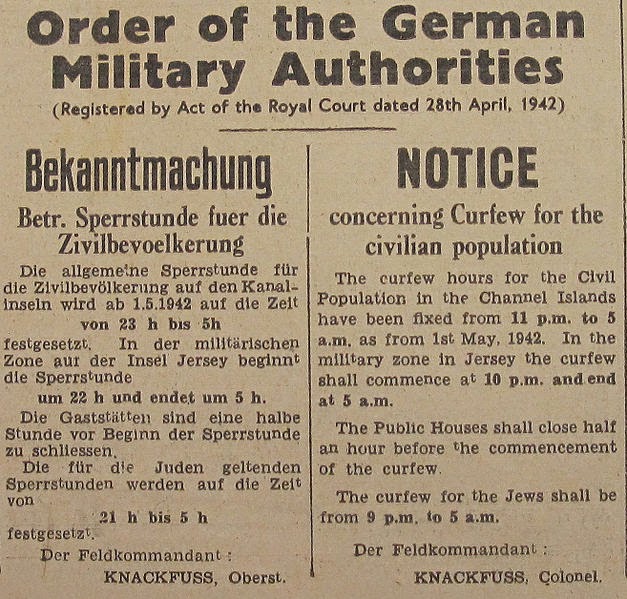
Within the civilian population, armed resistance was impossible. Many islanders did listen to BBC broadcasts on illegally held crystal wireless sets. Some risked their lives to help escaped slave-workers. One local woman, Louisa Gould, was caught sheltering a Soviet worker: she was sent to the concentration camp at Ravensbruck, where she died in the gas chamber. A further 570 people were deported to internment camps in Germany, of whom 31 died of various diseases. The islands' civilian authorities refused to cooperate with Nazi measures against Jews. 30-50 Jews remained on the islands, and they were neither forced to wear yellow stars nor sent to the concentration camps.

Curfew notice from Jersey.
Image is in the Public Domain.

Perhaps the most remarkable act of non-violent resistance was carried out by the surrealist artists, Claude Cahun and Suzanne Malherbe. They presented themselves as sisters, but were, in fact, in a lesbian relationship. Cahun also identified herself as being Jewish. They published fliers and posters, which they circulated among the German troops, translating extracts from BBC reports into German, and giving details of German defeats and war crimes. They were arrested and sentenced to death, but the sentence was never carried out: by this stage it was clear that Germany was losing the war, and senior officers feared to take any actions for which they themselves might be condemned.

The final months of the war brought great hardship both to the civilian population of the islands and to the German garrison. After D-Day, the islands were effectively cut off, and supplies of food and fuel ran very short. Almost all of the horses owned either by local farmers or by the occupying forces were slaughtered for their meat. Some islanders (around 200 in total) managed to escape in small boats and made for the French coast, where they offered their services to the British forces.

Liberation came on 9th May 1945. With Hitler dead and Berlin fallen, the German garrisons surrendered without a shot being fired. The 9th May, "Liberation Day," has been a public holiday on the islands ever since. The German troops were shipped as prisoners of war to camps on the British mainland, and were gradually repatriated over the following three years.

German and British Officers on board HMS Bulldog
prior to the signing of the surrender on 9th May 1945.


A British officer raises the union flag outside the
parliament building of Saint Peter-Port, Guernsey. 
Photo: Imperial War Museum (image is in the Public Domain).


The German occupation of the Channel Islands has provided the background to several historical novels, notable among which are The Guernsey Literary and Potato Peel Pie Society, by Mary Ann Shaffer & Annie Barrows, and The Book of Lies, by Mary Horlock. I have been researching the topic for my forthcoming novel, Omphalos.


~~~~~~~~~~~~~

Mark Patton's novels, Undreamed Shores and An Accidental King, are published by Crooked Cat Publications. E-book editions can be purchased from the Crooked Cat Bookstore, and the paperback versions from Amazon UK and Amazon USA.