Showing posts with label Anne O'Brien. Show all posts

Saturday, November 21, 2015

The Ancient tradition of the boy-bishop

by Anne O'Brien

Here is something with a festive connection today.

I find ancient historical traditions that still exist today most appealing.  Did the characters in my historical novels participate in or witness these traditions?  Did Joanna of Navarre and her husband King Henry IV of England acknowledge the tradition of appointing a Boy-Bishop during their own Christmas celebrations? history rarely tells us, but I am sure that they did.  Henry was a keen exponent of Christmas festivities both in his youth and in later life at Eltham Palace.


This is Hereford Cathedral where the custom of appointing a boy-bishop is still maintained today. In the great cathedrals of England this was a tradition widespread and going back to the first quarter of the thirteenth century, long before Henry and Joanna, when a boy was chosen to parody the role of the true bishop, becoming for a short time a 'boy-bishop.'

There were two purposes here.  One was to remind the congregation of humility, a child replacing an ecclesiastical lord and wielding his power.  The other purpose, since the ceremony took place on the Sunday nearest to the Feast of St Nicholas, the patron saint of children, usually in the first week of December, to remind the congregation that there was a place for fun and revelry and celebration  to fight off the cold dark days of midwinter.  The medieval church was not necessarily a place of doom and gloom. The ceremony was originally planned with lively choristers in mind.  The boy bishop was chosen from one of their number, to recognise their importance in the musical life of the church.


This ancient custom was abolished by Henry VIII at the Reformation, revived by Mary I, then finally abolished by Queen Elizabeth I.  In recent years it has however been revived, most notably in Hereford Cathedral, as shown above, where a boy-bishop has been appointed with great ceremony every year in the first week of December since 1982.  His term of office runs from the Feast of St Nicholas to Holy Innocents' Day on 28th December.  Definitely a time for festivity and rejoicing.

This is how it works at Hereford.  The boy-bishop, in his early teens, is chosen from the senior choristers to take office.  It is written into the service of Evensong.  During the saying of the Magnificat, on the words 'he hath put down the mighty from their seat', the bishop of Hereford steps down from the Episcopal throne.  Then on the words 'and hath exalted the humble and meek' the boy- bishop takes his place.  He is dressed in full bishop's robes with mitre and stole and is given  the bishop's crozier to hold.  The new bishop leads the prayers, accepts the collection, blesses the congregation and preaches his own sermon.  A favourite text in medieval times was Mathew 18:3 'Then He said: in truth I tell you, unless you change and become like little children you will never enter the kingdom of Heaven.'

What an experience for a young boy, to taste such magnificence and such authority.


For the rest of the festive period in Hereford, the new 'bishop' in full episcopal regalia plays an important part in all the services of the church except for Holy Communion.  Many see it as a chance to give a youthful perspective on life in a clerical community through their sermons.  One of the boy bishops, when asked which ability was most required to be boy-bishop for three weeks, confessed that it was the ability to drink so many cups of tea when meeting with members of the congregation.  Others quite simply enjoy the panoply and magnificence of it all, where they are the centre of attention.


In medieval times the boy-bishop and his retinue of choristers dressed as cathedral canons were expected to go on 'visitations' to ecclesiastical establishments and noble households.  There he would be entertained and given gifts, the whole often irreverent and unruly but much in keeping with medieval festivity.  This aspect of the tradition no longer takes place.  I am sure that many wish it did.

The boy-bishop will be installed once again this December in the magnificent setting of Hereford Cathedral with great ceremony and enjoyment for all involved.  I find it a great pleasure when the echoes of medieval life are carried on today.  Long may it continue.

My novel of Henry and Joanna which includes their celebration of Christmas at Eltham Palace, The Queen's Choice, will be published in the UK on 15th January 2016.

Please visit my website to keep up to date with all my events, signings and giveaways.


Monday, October 5, 2015

The Ill-Fated House of Lancaster


by Anne O'Brien

The House of Lancaster has become of interest to me since writing about Elizabeth of Lancaster in The King's Sister and then more recently about the marriage of King Henry IV and Joanna of Navarre in my new novel The Queen's Choice to be published in January 2016. 

What a short-lived dynasty the House of Lancaster turned out to be in spite of the promising beginnings.

In 1399 Henry Bolingbroke, Duke of Hereford, son and heir of John of Gaunt and grandson of Edward III,  usurped the Crown of England from his cousin Richard II and was himself crowned King Henry IV after acclamation by the Lords and clerics.  Thus the first King of the House of Lancaster took the throne of England.  With four healthy sons and two daughters, all grown to adulthood, all married, Henry might have expected that England was set fair for a time of regal stability with a healthy and increasing number of Lancaster children and grandchildren to occupy the throne.  Even though Henry's wife, Mary de Bohun, was dead by 1399, and Henry had no more children with his second wife Joanna of Navarre, probably due to his own ill-health, Henry had no need of more heirs.


In 1399, with a new and potent king, who would have believed that the House of Lancaster would have been so short lived, that by 1471 it should have come to an end with no more possible claimants?  Although its demise was indisputably influenced by death in battle, disease and mental frailty - all prevalent in many medieval families at this time-  it was also due to the Lancaster inability to reproduce themselves, or at least legitimately. 

Without legitimate descendents, the House of Lancaster was doomed.

Henry's four sons laid down the pattern for lack of heirs.

Henry, Prince of Wales, later Henry V:  his marriage to Katherine de Valois, of short duration, produced only one son who would become Henry VI.  Henry V died at Vincennes in France, probably from a severe form of dysentery in 1422 at the age of 35.


Thomas, Duke of Clarence: married to Margaret Holland but killed in 1421 at the Battle of Bauge in France at the age of 34 without legitimate issue.  He had one illegitimate son, Sir John Clarence, who was granted lands in Ireland and is buried in Canterbury Cathedral.

John, Duke of Bedford: married twice, first with Anne of Burgundy and then with Jacquetta of Luxemberg.  There were no children from either marriage.  In addition, out of wedlock he had a daughter named Mary, who married Pierre de Montferrand with whom she had a son, Richard.  John died in 1435 at the age of 46.

Humphrey, Duke of Gloucester: also married twice, first to Jacqueline of Hainault, a marriage that was annulled, and then to Eleanor Cobham.  There were no children from either marriage.  Humphrey had two illegitimate children:  Arthur of Gloucester who died in 1447 and Antigone of Gloucester who married Henry Grey, Earl of Tankerville, Lord of Powys.  Humphrey was the longest lived of the four sons of Henry IV.  He died in 1447 at the age of 57.

So of the four sons of Henry IV, there was only one legitimate descendent to carry on the royal claim to the throne. 

Henry IV's two daughters fared no better:

Blanche married Louis, the Elector Palatine.  She died in childbirth in 1409 at the age of 17 after the birth of a son Rupert.  This young man died in 1429 at the age of 19 years, unmarried and without issue.  Blanche's dowry included the oldest surviving royal crown known to have been in England.  It probably belonged originally to Anne of Bohemia, Queen of Richard II.

Philippa married Eric, King of Denmark, Sweden and Norway.  She gave birth to a stillborn boy in 1429, and herself died in 1430.  Philippa was the first documented princess in history to wear a white wedding dress during a royal wedding ceremony: she wore a tunic with a cloak in white silk bordered with grey squirrel and ermine.

Henry IV had an illegitimate son Edmund Lebourde who was born in 1401.  He was educated in London.  It is thought that he entered the church since in 1412 a Papal dispensation was granted to allow this, but Edmund thereafter disappeared from history as so many illegitimate children did.

The legitimate line of Lancaster after Henry V fared no better with Henry VI.  Mentally unstable, he married Margaret of Anjou with whom he had only one child, a son Edward of Lancaster.  Edward, married to Anne Neville, had no children and died in 1471 at the Battle of Tewkesbury.  Henry VI died, murdered, in the same year. 


Thus ended of the House of Lancaster.  What a sad tale of inability to produce legitimate heirs to the crown.  Battle and disease took its toll, far more than with most medieval families, yet we might have expected a much higher degree of fertility, being descended from Edward III who, with Philippa of Hainault, had thirteen children. Henry IV's family had promised so much but lasted less than a century.

~~~~~~~~~~~~~

My novel of Joanna of Navarre, The Queen's Choice, will be published in hardback in the UK on 15th January 2016.  To keep up to date with all events and promotions, visit my website.

Thursday, August 6, 2015

Keeping Up With The Medieval Joneses

by Anne O'Brien

They are of course beyond price for allowing us to step into the world of the English ruling family and aristocracy. The members of the Paston family also are well known for the range and depth of their correspondence, but fortunately for us there are others too to give insight into the lives of lesser gentry families. How gratifying that these writers, all unwittingly, build up our knowledge of medieval people and the society in which they lived. It should be no surprise to us that in some aspects we in the 21st century are little different in our goals and expectations, particularly when it comes to impressing the neighbours.

Margaret Walkerne was a member of a minor gentry family of the early 15th Century. She was daughter of Philip and Joan Redington. On being widowed, Joan became wife of Robert Armburgh, thus providing Margaret with a step father to whom she was not unwilling to turn when her own fledgling family fell into financial difficulties.


Margaret married William Walkerne in 1428 or 29, and on this occasion of her writing to her step-father, was expecting her first child. Here is her short simple letter which opens a number of interesting doors on custom and family ambition in the early 15th Century.

My dear and well beloved father,

I commend me to you ...I have but a little while to go and am like within a short time with the grace of God to be delivered of a child. And for as much as ladies and gentlewomen and other friends of my mother's and mine are like to visit me while I lie in childbed, and I am not purveyed of honest bedding, with the which my husband's honour and mine may not be saved ...

Here we see that Margaret expects her mother to be present for the birth of her child, and furthermore expects a round of visits from her own and family friends to wish her and the new child well. But clearly the quality of her bedding is an issue for Margaret.


It is very important for Margaret that she should make a good impression for herself and for her husband when the neighbours come to call. She continues, explaining their own lack of money to provide the necessary bedding ...

... and also my friends have been put to so grievous costs and importable charges through the entangling of their adversaries, and my husband in new come into his land (which) is but bare and as yet hath little profit taken thereof, and hath laid great cost on his husbandry, that he may not acquit them (the profits) to be as he would wish.


Which all goes to explain the many reasons why Margaret should be so short of money to spend on her appearance for the visiting ladies and gentlefolk. As well as the lack from their own lands, it would appear that she has already sent a plea to her friends for aid (for which they had been quick to make excuses!). So here finally she appeals to her step father for a loan:

Therefore I would beseech you of your good fatherhood that you would vouchsafe in saving of my husband's worship (honour) and mine, to lend me two marks or twenty shillings until the next term (rent) day (when) my husband's farm (rent) comes in, and then with the grace of God you shall be well and truly paid again. I can no more at this time.


Margaret's anxiety is clearly about putting on a good display when these local ladies come visiting. It is a matter of honour and family status and of great importance for her and her husband's standing in the local community. Keeping up with the Joneses is nothing new.

Did Margaret receive her loan to impress the neighbours? We do not know. What we do know is that Robert Armburgh and Margaret's mother Joan were themselves in serious financial difficulty over an ongoing legal case, as well as from the expenses for Margaret's wedding. Margaret might have had to stiffen her spine and receive her visitors with her less than the 'honest bedding' that she so desired.


What a splendid little letter, allowing us the opportunity to peek into the life and concerns of Margaret Walkerne in 1430. What a miracle that such correspondence of little apparent importance in the great scheme of things should have survived for almost six hundred years.

My novel of Joanna of Navarre, The Queen's Choice, will be released in Hardback and eBook in January 2016.

Visit my website for all up-to-date information.

Wednesday, July 8, 2015

Historical Paintings: Authenticity v. Drama

by Anne O'Brien

Is this the real Joanna of Navarre?  If so, it would be a valuable addition to the little we know of this fifteenth century Queen of England.

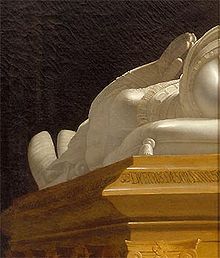
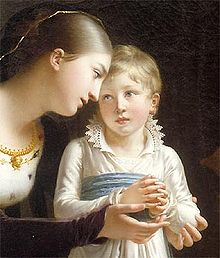
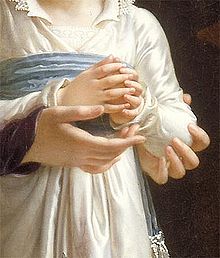
This is a painting of Duke Arthur III of Brittany, painted by the French artist Henriette Lorimier and exhibited in the Paris Salon of 1806 when Romanticism was the order of the day.


It is of interest to me because it is one of the few representations we have of Joanna of Navarre, second wife of King Henry IV of England.  It shows her, beside the tomb of her late husband Duke John V of Brittany, in the role of caring mother, instructing her young son in the need for piety, in the importance of family history, and in his duty to the role of Duke which he would inherit from his dead father, John de Montfort.  Joanna is dark-haired, attractive, every inch a Navarrese and Valois princess.

I would like to think this would be a valuable image for me in bringing Joanna to life when writing about her.  But how accurate a representation is it?  There is much to intrigue the historian in this painting, and the choice that Henriette Lorimier made when deciding to portray Arthur as the young Duke.

In colouring and appearance of Joanna, we have no historical idea.  It is not on record.  We have no contemporary portraits of her.  If she is seen kneeling at her husband's impressive tomb, it would have been after 1409, when Joanna had personally had the alabaster image sculpted in England and sent to Nantes Cathedral.  She would have been at least 40 years old.  Arthur by this time would have been 16.  Yet both mother and son look younger than this - clearly to maintain the romantic image of the young and beautiful widow and the young child with all the duty on his shoulders.  As Queen of England, Joanna never returned to Brittany to see the tomb completed, as far as the records show. 


It could be argued of course that this image was from the date of Duke John's death in November 1399, in which case Joanna was only thirty one, and Arthur was six years old, which makes the image more realistic, but still does not explain the magnificent tomb beside which she is kneeling.

Another interesting point: Arthur was not the heir to the Dukedom when John de Montfort died.  Why chose to paint this child, receiving his mother's encouragement and instruction?  The heir was another John, the eldest son, who became John VI on the death of his father in 1399.  So why paint Arthur?

The choice of costume is also highly romantic.  Joanna is wearing a fur trimmed cote-hardie, which by 1409 would have been regarded as not the height of fashion by members of the Court.  Joanna, who was known to spend extravagantly on clothes, would have worn a houppelande with its high neckline and heavy folds, and her hair would certainly have been covered with a veil or one of the fashionable rolled chaplets or a caul.  Her hair would not have been uncovered in public as it is here.  As for Arthur, he appears to be wearing something  romantically childlike for 1409.  I expect that the artist thought that a romantic, easily recognisable 'medieval' image was more important than authenticity.


And finally to return to why Henriette chose to paint Arthur.  He actually became Duke of Brittany but not until 1457 in the final year of his life, taking the title after his nephew Peter who died childless.  Arthur was 64 years old when he became Duke.  Was he chosen for the subject of this highly romantic picture because he played a notable part in French history?  He fought alongside Joan of Arc.  He was Constable of France and a notable leader of the French army, taking an important part in the negotiation to bring peace between France and Burgundy at the Treaty of Arras. This alliance led ultimately to the end of English pretensions to the French crown.  Furthermore Duke Arthur led the French army in the battle of Formigny in 1450 which resulted in the conquest of Normandy.  Thus Arthur was undoubtedly a heroic figure in French military history.  I can only presume that this was the reason for this painting in the nationalistic days of Napoleonic France.


What a sentimental portrait this is. Do the historical inaccuracies matter?

I would suggest that accuracy has no bearing on the subject.  It was not painted to make a genuine historical comment but to heighten the emotion of the relationship between the young widowed duchess and her little son, to tug at the heart-strings of the onlooker.  It makes her an appealing figure, which is what was intended.  As long as we know the intentions of the artist, then we are able to appreciate the worth of this romantic painting.

As an interesting post script; this painting gained an immense success when it was exhibited in 1806. Empress Joséphine immediately purchased it for her paintings gallery at the Malmaison.

My novel of Joanna of Navarre, The Queen's Choice, will be published in Hardback and eBook in January 2016, followed in May in Paperback.

www.anneobrienbooks.com

Sunday, February 22, 2015

What happened to Elizabeth of Lancaster after the last page of 'The King's Sister' has been turned?

by Anne O'Brien

The Final Years

For any lover of history, the final years of Elizabeth of Lancaster, younger daughter of John of Gaunt and Blanche of Lancaster, are most unsatisfactory.  Information is sketchy, and what exists is tragic.

After the emotional and physical upheaval that ended her second marriage to John Holland, Duke of Exeter, Elizabeth took a step back into the shadows of history.  We know that in the summer of 1400 she married Sir John Cornewall, a knight from the west country, son and heir of a second son so with a future and fortune to make.  One chronicler tells us that he took Elizabeth's eye at a tournament held at York where she was seduced by his prowess in the lists, thus implying that her marriage to Cornewall, a bare six months after she was widowed, was the consequence of her lustful character.


This is the lovely Georgian house that today stands on the site of the manor of Burford near Tenbury Wells, owned by John Cornewall.  Remnants of the orignal manor have been found beneath this one.  Elizabeth must have lived here for some of her later years.

What we do know about this marriage is that it was a marriage not promoted merely by Elizabeth's character, but by her brother Henry, now King Henry IV.  After the overthrow of King Richard II, Henry's position was not an easy one.  With enemies in Scotland and France and rumours rife that Richard was still alive, rebellion was always on the cards to threaten the peace of England as well as Henry's own life.  Henry needed to build alliances with English noble families and men of ability;  Elizabeth was part of this rebuilding.  And so she married John Cornewall.  She was about 36 years old, her husband much younger at 25 years.

This is a 17th Century etching of Elizabeth and John by Wenceslaus Hollar.  We have no contemporary images of her other than her tomb.


The couple were soon in royal favour, and Elizabeth was able to carry out her mission to regain control of the Holland properties, forfeited on the execution of John Holland for treason.  Henry was obviously pleased to listen to his sister and granted her and her new husband a large part of the Holland estates, particularly in Devon, and also the new house built there, Dartington Hall.  In 1404 Elizabeth received her dower: a life annuity of 1000 marks.  Thus she made Sir John Cornewall a valuable bride.  Sir John was created Baron Fanhope.

This is a Victorian stained glass window of Elizabeth in the church at Burford.


And then we know so little of her remaining life.  In 1405 she gave birth to a son John, to whom Henry stood godfather, a boy who followed in his father's footsteps as a good soldier, both of them taking part in the English offensive in France in the reign of Henry V.  Sir John made a name for himself and a fortune by capturing and ransoming valuable prisoners.

Tragically his son - and Elizabeth's - was killed at the siege of Meaux late in 1421, fighting at the side of his father.  Sir John lost his heir and the end of his legitimate line.  We can only guess at Elizabeth's grief.  It is not on record.

The couple also had a daughter, Constance, who had no issue and was dead by 1429.

Elizabeth herself died at Ampthill Castle in Bedfordshire on 24th November 1425 at the age of 61 years and was buried in the splendid tomb in the little church of St Mary in Burford in Shropshire.  Sir John lived on until 1443 and was buried, not in Burford, but in a chapel he had founded in the cemetery of the Friars Preacher near Ludgate in London.

All that remains today of the great Ampthill Castle.


Thus for the last twenty years of her life Elizabeth faded into obscurity. What did she do with her time? I cannot imagine her living in rural domesticity in Burford or Devon. Or in the magnificent Ampthill Castle that Sir John built for her out of the fortune he made at war. Sir John's absence in France would mean that she was left to her own devices. Perhaps she spent her time between her restored properties and the royal court of her brother and then her nephew, Henry V. I hope that she found some element of peace at last in what was an adventurous life, but I doubt it.

Elizabeth's magnificent tomb in the church at Burford, showing her as the epitome of a Plantagenet princess.


How I wish history allowed us a few more windows into Elizabeth's later years.
~~~~~~~~~~~~~

To mark the release of 'The King's Sister' in Paperback in the UK and Australia on 26th February, 2015.


Wednesday, December 31, 2014

Mistletoe Lore and Legend

by Anne O'Brien

Kissing under the Mistletoe?
How frivolous!
Not in Medieval Herefordshire!


 There is an awful lot of mistletoe in Herefordshire.  Many mature trees are festooned with it, the large bunches easy to see now that the leaves have fallen. Apple trees in orchards are weighed down with it.  I have some on my own apple trees in my garden. In December the mistletoe is harvested and a mistletoe market is traditionally held in Tenbury Wells on three consecutive Saturdays before Christmas.  It is an institution.  Holly is for sale too in huge piles.  Buyers come from miles around.


 But in Herefordshire, in past centuries, mistletoe was not considered a plant to encourage much kissing in this festive season.  Rather it was believed to be  a plant of magical properties, and the activities associated with it certainly go back to a pre-Christian age.


 Based on the research done by Ella Mary Leather in the 1920s, interviewing local folk (the Folklore and Witchcraft of Herefordshire), the custom all over Herefordshire, certainly until the final years of the 19th Century, was to weave a globe of hawthorn and mistletoe into a 'bush'  which was hung in the kitchen on New Year's Day.  There it would remain throughout the year until the next New Year's Day when the bush with its mistletoe would be taken outside and burned.  At the same time a new 'bush' would be woven, sometimes cider poured over it and the ends of the branches scorched in the fire, and brought back into the kitchen for the following year.  Definitely the remnant of some primitive ritual. 

New mistletoe was NEVER brought into the house at any time between one New Year's Day and the next.  It would be considered highly unlucky to do so.

The burning of the old bush on New Year's Day took place very early - sometimes as early as five o' clock in the morning - so that the evil spirits from the old year would be caught up in it and destroyed, thus giving the New Year a good start free from evil.  While the old bush was burning, the new one was woven, for the house must not be left without this protection.  Much cider was drunk and cake eaten.  Sometimes there was dancing and singing by the men-folk in a ring around the fire.  We still see this custom, particularly on 6th of January, when the Leominster Morris Men perform the traditional wassail in one of the local orchards.


 In some areas fire from the burning bush was carried across the fields and orchards to ensure a good crop.  It was believed that without this ceremony the crops and the apples would fail.  One belief was that the bush represented Our Lord's crown of thorns and when they carried the fire across the fields they were driving away the 'old un' (the Devil).


 So kissing under the mistletoe in Herefordshire?  No chance!
Is this custom of burning the bush still carried out today in rural households?
I don't know. 
But I burned my bunch of mistletoe from last year on the 1st January.  I didn't dance around the fire, or sing, but I certainly drank a glass of cider and ate cake.
Ah, but did I perhaps also kiss my husband under the mistletoe?
Now that would be telling ...


My best wishes to all for 2015.

Do visit me at:

Monday, January 30, 2012

Giveaway Queen Defiant/Devil's Consort by Anne O'Brien

This giveaway is now ended. Thank you so much to all fans of Eleanor of Aquitaine who put their names forward. It is good to see so many people who enjoy medieval history.
I decided to draw for two copies, one of UK Devil's Consort and the other the US Queen Defiant.
The two fortunate winners are Anne Goodwin (UK) and Sophia Rose (US).
Congratulations and Happy Reading.

Anne O'Brien is giving away a copy of Queen Defiant(US)/Devil's Consort(US). To see some information about the book, please click HERE.

Saturday, January 28, 2012

An All-Consuming Passion

by Anne O'Brien

An All-Consuming Passion
The love affair that changed the course of English History


Owen Tudor and Katharine de Valois

He was a servant. She was the dowager-queen of England. He was a dispossessed Welshman. She had royal Valois blood in her veins and was the widow of England’s glorious hero of Agincourt, King Henry V. She was the King’s Mother, he was the Keeper of the Queen’s Wardrobe.
Such a liaison would be unthinkable, and yet they fell victim to a passionate romance.


A Windsor Romance


It all happened at Windsor since Katharine was bound by law to live in her son’s household after her politically disastrous near-marriage to Edmund Beaufort. She was considered to be a woman ‘unable fully to curb her carnal passions’ and so she must live a carefully controlled life. So how did Katharine and Owen manage to fall in love? The record of the occasion of the romance has been described as ‘a pot pourri of myth, romanticism, tradition and anti-Tudor propaganda.’ It is certainly a gift to writers of historical fiction - although it brings its own problems.


A mixed bag of historical tradition ...


One strong tradition, written in a poem in 1361 at the time of Owen’s death, was that he first caught Katharine’s attention when he over-balanced and fell into her lap at a Court ball. Too much alcohol? Or clumsy dancing? Impossible to tell.


A mid 16th century chronicler tells a quite different story. Katharine saw Owen and his friends swimming in the river on a summer’s day. Perhaps in this very spot on the Thames near Windsor - with or without the swans.


Overcome by his sheer masculinity, Katharine changed garments with her maid and arranged to meet Owen in disguise. He was too ardent, she struggled and, escaping his embrace, received a wound to her cheek. Serving her at supper that night, Owen saw the bruise and realised who the ‘maidservant’ had been. Ashamed, he begged her forgiveness. Katharine forgave him readily, they professed their love and were duly married. Sadly, there is no historical proof for either version. But what vivid scenes these sources paint for us. The difficulty for a novelist is of course producing something half-way realistic. If Owen was Katharine’s personal servant, how could he not recognise her face, her voice, even in disguise? Unless she was mute and they met in a dark cupboard, it would seem impossible. As for the drunken mishap ... It makes writing a credible version highly entertaining.


A Private Marriage.


Whatever the truth of their meeting, their love was strong enough to encourage the unlikely pair to flout the law of the land. Katharine was forbidden to marry without the permission of the King who was not yet ten years old. Any man foolish enough to wed her without permission would find all his lands and possessions declared forfeit. Here Katharine was fortunate for Owen had no assets to lose. Penal statutes against the Welsh after Owen Glendywr’s Rising in the reign of Henry IV dispossessed many, as well as prohibiting them from carrying arms, meeting in gatherings, owning land east of the ancient border of Offa’s Dyke and holding government office. When Owen married Katharine he had nothing to forfeit.


The clandestine affair was no secret at Court: Katharine had no compunction in taking the law into her own hands and challenging the Council to do its worst. She would be wed and be damned to them! Perhaps this suggests that Katherine not the mindless beauty that she has sometimes been described as, but a woman of considerable audacity and courage. The marriage was conducted privately, and the happy couple left Windsor to live out the years of their marriage quietly in Katharine’s dower properties.


And the Tudors ...


The circumstances of the astonishing marriage between Owen and Katharine is my primary interest since I am writing a novel of Katharine de Valois, but for aficionados of the Tudors it is the descendants of this marriage who take all the attention. Their eldest son Edmund married Margaret Beaufort, the Beaufort heiress, who passed enough royal Plantagenet blood to their son to enable him to claim the crown of England as King Henry VII.


This is a bust of Henry VII based on his death mask, and can be seen in the V and A in London. We have no portrait of Owen Tudor. Did he look anything like his grandson? Would Katharine have fallen in love with this man?


Who knows ...?


Anne O’Brien:

Author of The Virgin Widow and Queen Defiant(US)/Devil’s Consort(UK)

The King’s Concubine, the story of Alice Perrers, will be released in May(UK)June(US) 2012


Thursday, November 24, 2011

Alice the Bad or Alice the Good - or Alice the Quintessential Business Woman?

by Anne O'Brien

See also Alice Perrers: A Notorious Woman

So can we say nothing good about Alice Perrers? I believe that we can at least soften the edges of her contemporary portrait. We might be hampered by lack of hard evidence (except for a barrage of hostile criticism from courtiers and clerics) but there is enough to shine a vestige of light into the dark corners of her reputation.

Alice the low-born usurper of royal power.

Did Alice know her place in society, or did she step outrageously beyond it? As far as we know Alice had neither breeding nor wealth nor significant family connections, but was she the reputed bastard of a labourer and tavern whore? Perhaps not. Recent evidence suggests that she may have had a brother with whom she did business, and that she engaged in a brief marriage to Janyn Perres, a Lombardy merchant and money lender, during which she made her first purchase of property. She could read and write and figure. Somewhere she learned this, if not with her invisible family then in a convent. And royal mistress to Edward III? Alice would not be the first low born woman to share a King's bed, nor the last.


We do not know how she came to the attention of Queen Philippa but it is unlikely that she would have done so if she had been born in the filth of the gutter. Perhaps she does not deserve her notoriety based on her stepping beyond her birth.


Alice the Ugly.

Much can be forgiven a beautiful woman but not an ill favoured one. Alice was reputed to be the inspiration for Chaucer's Wife of Bath. He gave her a bold face, a gap-toothed smile, broad hips, a wide hat and red stockings. I'm sure he enjoyed writing this description but is it true? He also gave her five 'legitimate' husbands. It may be that his physical description of her is as scurillous as the rest of it.


Alice was said to be graceful and possess a pleasing, seductive voice. Certainly she had enough attractions to please the King. Could it be that she was dark rathen than fair, the fashionable trend for the day? Perhaps she had more than mere beauty but rather a lively, striking countenance. How unfortunate that there are no representations of this famously ugly woman. We might decide that she was not ugly at all.

Alice the rapacious royal mistress

It is true that Alice became Edward’s mistress during the lifetime of the much loved Queen Philippa, and for this she was condemned. How interesting that on such occasions (even in modern royal scandals) the blame is placed very firmly on the shoulder of the non-royal woman involved. Edward was not to blame: it was Alice who seduced the King! Hard to believe that Edward, a true Plantagenet, had no part in this, even in his later years.

How did Philippa react to her damsel sleeping with her husband? Certainly she must have known, yet made no move to dismiss her. Interestingly, during Philippa’s lifetime, the scandal was kept under wraps at court as if there was a conspiracy of silence to protect the Queen from humiliation. It was only on her death that Alice’s position was widely acclaimed. Despite the liaison between Edward and Alice, there is no evidence that the King neglected his wife. To the contrary, when Philippa died, Edward was heart-broken. It was a very strange ménage-a-trois. I regret that we know so little about it – but it is a gem for a writer of historical fiction.

Alice the greedy embezzler of wealth.

It is impossible to deny Alice’s desire for wealth. She is guilty as charged. Alice dipped her hands into the royal Treasury and amassed jewels worth more than £200,000. After Queen Philippa’s death Alice demanded that Edward give the royal jewels, left by Philippa in the keeping of her senior lady-in-waiting, to her. She flaunted them at court with great enjoyment. And the most heinous crime of all? When Edward lay on his death bed, Alice stripped the rings from his fingers. Without doubt she did this. All difficult to defend? Alice was guilty, but as a writer of historical fiction I have allowed Alice to give her own reasons. Read The King’s Concubine to discover more ...


Alice the grasping land-grabber.
Alice was amazingly successful: so successful that she controlled 56 manors, castles and town houses stretching over 25 counties of England. She became the wealthiest common-born woman in the land. Did Alice rob the crown of this land? Did she persuade the King to gift it to her?
Perhaps surprisingly, out of the 56 manors, only 15 came from royal grants. All the rest - 45 of them – were gained by her own initiative and efforts, and most of them in prime locations in the counties surrounding London.
Alice made use of her clerk William Greseley and a group of male business associates to acquire and manage the manors for her. Sometimes she made the purchases herself, showing a knowledge of business and the law. When she came under legal attack from men whose toes she trod on, Alice sat in court, next to the judge, to ensure that he considered her interests first and foremost. (What a wonderful scene this would make!) If a man had shown such acumen, he might have been accused of gross self-interest, but he might equally have been admired for his achievements. He would not have been denigrated to the extent that Alice was.


Alice the arch manipulator

The government of England in the final years of Edward’s life when he was at his most vulnerable fell into the hands of Alice, in alliance with John of Gaunt, Edward’s son, and a group of royal ministers appointed by her and loyal to her. This cannot be argued against. Alice determined who should and who should not approach the King. In these years Edward suffered from increasing dementia. Perhaps it was Alice’s duty as she saw it to save the King from humiliation in the sight of his subjects. She created a facade to protect him. There is no evidence that she had any influence on the direction of royal policy during these years.

So what and who is the real Alice Perrers?

Alice was neither Bad nor Good. Certainly she was no angel. She was opportunistic and seized every opportunity that came her way to feather her nest against the bad times. But Alice was a realist. She was a survivor. She was aware, first and foremost, that when Edward died, she would be alone and vulnerable to attack. She must cushion herself against an uncertain future, both for herself and her four children. And this is what she did, acquiring land as a very permanent form of wealth. Perhaps this explains Alice’s less-than-wise clandestine marriage to William de Windsor. When Edward was sinking into dementia, as he was in 1373, she saw in Windsor some security for her future.

Alice was smart and clever and a formidable opponent. Intelligent and ruthless, she set out to make her way in life, and much of what she did would have been forgiven if she had been a man. If a man had acquired her wealth and standing with the King he would have been entitled to high praise and an earldom, a degree of respect if not outright popularity. Alice, as a woman, was condemned as a mercenary and an immoral swindler.

Alice struggled constantly against her lack of connection, making her way in the world in one of the few ways open to women without family or influence. I believe that she deserves some admiration for her strength of character under adversity. She was even accused of witchcraft in her seduction of the King - always a useful weapon to use against a powerful woman.

We never hear Alice’s voice raised in her own defence. I hope in some small way I have given her back her voice and a measure of respect.

Anne O'Brien: author of The Virgin Widow and Queen Defiant, a novel of Eleanor of Aquitaine. The King’s Concubine, a novel of Alice Perrers will be released in the US in June 2012.

www.anneobrienbooks.com