Showing posts with label William Hogarth. Show all posts

Wednesday, January 15, 2020

Opera in Early 18th Century London

by Lucy May Lennox

Today opera has an (undeserved) reputation for being stuffy and dull, with the stereotypical image of a fat woman shrieking in a horned helmet. Opera in Georgian London was very different—it was the equivalent of our big budget superhero movies today, all about spectacle and popular entertainment.

The style of opera popular throughout Europe in the first half of the eighteenth century is called opera seria. Opera seria originated in Italy, which is why operas composed and performed in England were in the Italian language, and the most celebrated singers were from Italy. Unlike later opera styles, opera seria features solos almost exclusively; there is very little choral or ensemble singing. There are only a few duets, usually performed between lovers to highlight their emotional connection. The performance was very stylized, not intended to be naturalistic, and the singers showed their skill through vocal ornamentation rather than emotional expression. The plots were heroic and/or tragic, borrowed from Greek and Roman mythology, and the stagecraft featured all kinds of spectacles such as flying horses, mythological creatures, and magic. In contrast to performances in Italy, opera seria in London was popular entertainment for high and low alike, and the performances tended to be much more raucous.

Caricature of Handel opera seria Flavio featuring castrato Senesino
on the left and soprano Francesca Cuzzoni center.

London opera in the early eighteenth century is synonymous with the composer George Frideric Handel (1685-1759). Although Handel is best remembered today for his oratorios, particularly the Messiah (1742), he made his name in London in opera seria. Born in what is now Germany, Handel studied opera in Italy before moving to London in 1712. Over the course of his career, he composed forty-two operas, most of which were produced by the Haymarket Theater and the Theater Royal, Covent Garden. His operas were dramatic spectacles including dance as well as virtuoso singing, and drove the craze in London for opera seria. Today his best known aria is “Ombra mai fu” from Serse (Xerxes, 1738), written for castrato voice.

Handel composed oratorios throughout his career as well, but the most famous of these he composed in the 1730s and 1740s. In part he turned to oratorios in reaction to changing tastes in London, as the exotic appeal of opera seria waned. In contrast to opera seria, which was performed in Italian, most of Handel’s oratorios were composed in English. While the plots of opera seria were taken from classical antiquity, the text of the oratorios came from the King James Bible. In fact, Handel first wanted to stage bible stories as operas, but the Bishop of London would not allow it. Performing scenes from the bible in Covent Garden theaters, associated with prostitution, was considered blasphemous. Bible stories should only be performed in a church. Oratorio, in which the singers did not wear costumes or act out the scenes, but stood on stage beside the orchestra, was a compromise between theatrical and church music, and allowed the religious theme to be performed in a secular setting. Several of these oratorios were conducted by John Stanley, a blind composer and organist who worked closely with Handel for many years.

Portrait of Farinelli
The most popular voice type in opera seria was the castrato, a man castrated before puberty so he maintained a soprano range into adulthood. The practice of creating and training castrati was limited to Italy, although they performed all over Europe. The most popular castrato in London was Farinelli (1705-1782). There was a film about him made in 1994, although it is not very biographically accurate. The popularity of Farinelli and other castrati in London was intense but brief, peaking in the 1720s-1730s. There was an equally intense backlash against castrati, not only because they challenged gender norms, but because they were not English. Male social clubs called beef-steak societies were one source of this backlash. In particular the Sublime Society of Beef Steaks was founded in 1735 by John Rich, the manager of the Theater Royal, Covent Garden, as a means of expressing a British masculine identity. Rich was also the producer of the Beggar’s Opera (1728), written by John Gay as a parody of opera seria and the style popularized by Handel. Some of this xenophobic sentiment can be seen in the broadside “London” penned by beefsteak society member Henry Carey:
There your English actor goes, with many a hungry belly
While heaps of gold are laid, God wot! on Signor Farinelli
What did a castrato performance sound like? There’s no way to know exactly. Castration not only affected the vocal cords, but the entire physical development. Castrati had elongated limbs and large barrel chests, which gave them tremendous lung capacity and vocal power. Musically, their high voices symbolized virtue and purity, but certainly part of the appeal for audiences was the spectacle of a man with an almost inhuman high voice. After the castrati disappeared, revivals of opera seria tended to use female singers in their place through the nineteenth and twentieth centuries, but lately there has been a trend for male countertenors to reclaim these roles.

Although men with high voices were the superstars of the era, there were women opera stars as well. One of the biggest stars in London was Anna Maria Strada del Pò (1719-1741) who was brought from Italy by Handel and performed the soprano lead in many of his operas. While she was celebrated for her fine vocal technique, she was also mocked for her appearance, particularly for inelegant facial expressions as she sang. Charles Burney noted that, “she had so little of a Venus in her appearance, that she was usually called the Pig.”

Portrait of Anna Maria Strada

Not all the prima donna were Italian. Kitty Clive (1711-1785), who was from Ireland, was another major star of the era. While Kitty Clive sang the role of Delila in Handel’s oratorio Samson (1743), she was best known for her comedic roles in David Garrick’s company. Likewise, Lavinia Fenton (1708-1760) was famous as a singer and comic actress, originating the role of Polly Peachum in The Beggar’s Opera (1728). The English singer Susannah Cibber (1714-1766), a contralto, sang many male roles in Handel’s oratorios. She was praised for her expressivity in tragic roles, although her vocal technique was not considered as polished as that of Italian singers.

Scene from The Beggar’s Opera, by William Hogarth. Lavinia Fenton as Polly Peachum is in
the center, and the Duke of Bolton is in the box to the right. Note the audience members sitting on
 the stage, talking during the performance.

Handel also innovated the inclusion of extensive dance scenes in opera seria, as another form of titillating spectacle. One of the most famous (or infamous) dancers was Marie Sallé (1707-1756), a French ballerina born to a family of circus acrobats. John Rich brought her to the Theater Royal, Covent Garden, where she appeared in several of Handel’s operas. She was known for dancing in loosely-fitting, revealing costumes, to the scandalized delight of audiences. She was also rumored to have female lovers, and was not the only performer to do so (for example, actress Elizabeth Ashe, the lover of Caroline, Countess of Harrington).

Attending a Covent Garden opera performance in the early eighteenth century was a very different experience than today. Opera performances only occurred at certain times of year, and when the season was over, there was no way to hear the same performances again. In an age of recorded music, we tend to forget how precious and rare live performance could be.

Opera performances could stretch on for four hours or more, although audiences might come and go as they pleased. Before the overture, there were usually three pieces played to entertain the crowd as they arrived at five o’clock to secure seats until the show began at six o’clock. Called the First, Second, and Third Music, these might be instrumental pieces or solos by up and coming singers, followed by a prolog or speech by the manager. Likewise, during the intermission (intermezzo or entr’acte), there would be additional performances as the sets and costumes were changed.

Audiences were loud and disruptive. A Trip Through the Town (1735) describes the theater audience thus: “They talk continually no matter of what, for they talk only to be taken notice of, for which reason they raise their voices to be taken notice of by those who pass by.”

Riot at the Theater Royal, Covent Garden, 1763
over increased ticket prices.
There was very little separation between the audience and the players. Although the interior of the theater was similar to theaters today, there was no curtain. The boxes, or balcony seats along the edge of the theater, extended alongside the stage. The wealthiest patrons were allowed to have seats right on the stage. Some Covent Garden theaters had rows of spikes along the proscenium to prevent overly amorous or critical audience members from leaping onto the stage during a performance.

Audiences might shout at the players or throw rotten fruit if they did not like a performance. Riots were not uncommon. Burford writes,
In 1738, after a riot in the Haymarket Theater in protest at the appearance of some French players, it was enacted that the public had a legal right to manifest their dislike of a play or the actors. In 1744 there was a riot at Drury Lane Theater over contemplated rises for admission. In another fracas in 1755 there was a free fight with gallants jumping from the boxes into the pit, their swords being drawn and blood being shed while the women screamed when the mob tore up scenery and smashed up the seats.
Audiences might also take sides in a rivalry between singers, booing the rival and cheering their favorite loudly, as happened with Handel’s singers Francesca Cuzzoni and Faustina Bourdoni. The two women even fought each other on stage. Handel threatened to throw Cuzzoni out a window when she refused to sing an aria during rehearsals.

All this meant that the life of an opera star was precarious indeed, especially for women. The actresses were all assumed to be prostitutes. The sad fact is that many were forced to become the mistress of a wealthy patron or engage in outright prostitution because the wages were so low. Many of the celebrated divas died alone and penniless, as happened to La Strada. Lavinia Fenton, on the other hand, married her much older lover the Duke of Bolton after the death of his first wife, and became a duchess.

Susannah Cibber’s personal life also erupted in scandal. She married actor Theophilus Cibber, son of playwright Colley Cibber, but she was far more famous and rich than her husband. As all of a wife’s assets belonged solely to the husband, she attempted to circumvent this law by placing her money in trust, but he managed to spend it all anyway. To pay the bills, they took in a tenant named William Sloper, which led to an affair that twice landed all three in court, with competing claims that Cibber forced Susannah at gunpoint to have sex with Sloper, or that she fell in love with Sloper and they slept together while a spy observed them from a closet. Nevertheless, she continued to perform through this scandal, which only increased her popularity.

Marie Sallé and Lavinia Fenton used their status to improve the working conditions and treatment of women on stage. Clive campaigned publicly for better pay for actresses, and for separating the career of actress from prostitution. She also wrote several short plays satirizing the poor treatment of actresses.

There have been some recent revivals of opera seria that attempt to capture the flavor of the era. This excerpt of a German production of Serse, with the cross-dressed singers arguing with the conductor, gives us a small taste of what it might have been like to attend the opera in the eighteenth century.

Selected sources:

Burford, E. J. Wits, Wenchers and Wantons: London’s Low Life: Covent Garden in the Eighteenth Century. Robert Hale: London, 1990.

Grove’s Dictionary of Music and Musicians

Parker, Roger, ed. The Oxford Illustrated History of Opera. Oxford University Press, 2001.

Schœlcher, Victor. The Life of Handel. Cambridge: Cambridge University Press, 2009.

~~~~~~~~~~

Lucy May Lennox is the author of The Adventures of Tom Finch, Gentleman, a novel set in the opera world of eighteenth century London.

London, 1735. Tom Finch, composer and conductor, approaches life with boundless good cheer and resilience, despite his blindness. Join Tom for a picaresque romp through high and low Georgian society among rakes, rovers, thieving whores and demi-reps, highway robbers, bigamists, and duelists, bisexual opera divas, castrati, mollies, and cross-dressers, lecherous aristocrats, and headstrong ladies. This meticulously researched, witty and lively tale overturns stereotypes about disability and revels in the spectacle and excitement of 18th century opera.


Friday, December 27, 2019

Mary Edwards, An Independent Woman

By Lauren Gilbert

Portrait of Mary Edwards by William Hogarth
Mary Edwards (or Edwardes) has already been mentioned on the EHFA blog in connection with the arts and Hogarth. She was a fascinating and strong-minded woman, not afraid to make decisions or to take her life into her own hands.

Mary was born c 1704 or 1705, daughter of Francis Edwards of Welham Grove, Leicestershire, and his wife Anna Margaretta Vernatti, who was a wealthy Dutch woman. She may have been baptised May 25 1705 at Saint Anne Soho, Westminster, London. A great heiress, Mary succeeded to the estate of her father upon his death 1728-1729. Her estates included properties in the counties of Essex, Hertford, Kent, Leicester, Middlesex and Northampton, in the city of London, and in Ireland. She had an annual income between 50,000-60,000 pounds. All were at her disposal. Data indicates she preferred being in London rather than her estate at Welham.

Mary was of age and in control of her own fortune. Mary met Lord Anne Douglas Hamilton (who was the 3rd son of the James Hamilton, 4th Duke of Hamilton, and was born Oct 12, 1709) about 1730. He was the godson of Queen Anne, and named for her. He was younger than Mary by four to five years. Accounts indicate she fell in love with him. They may have been married sometime around 1730-1731, possibly in Fleet, but the location is unclear. Their marriage appears to have been a hasty marriage, as no one’s approval was required. A certificate may exist but has not been found.

Circumstantial evidence supports that there was a marriage in 1731 or earlier: on July 8, 1731, Mary granted property to Lord Anne in Leicester and on Aug 15 1733, her arms and crest were granted to Lord Anne; he added Edwards to his name as shown on bank stock September 11, 1733 in the name of Lord Anne Edwards Hamilton; she called herself Lady Hamilton Edwards.

Mary and Lord Ann had a son, born circa 1732-1733. There are indications that the child’s birth date may have been March 4, 1733 (old calendar). (A bill, Edwards v Mitford, filed in 1743 shows Gerard Ann Edwards as the surviving son of Mary Edwards and his age as 10, which supports a 1733 birth date.) Lord Ann’s possible marriage to Mary and their son appear in Anne Hamilton’s listing in The Peerage, as well as in the Scots Peerage, which implies that the question of the marriage’s validity has been a topic of discussion.

A patron of the arts, Mary’s name is linked to that of William Hogarth, and she was one of his most loyal patrons, encouraging his satirical works. She was also a subject for him. Coincidentally, some of his works appear to support the marriage:

A portrait of Anne Edwards Hamilton was painted in the uniform of the Second Regiment of the Guards c 1731 has been attributed to William Hogarth; Hogarth painted a portrait of her son Gerard Anne Edwards Hamilton c 1732 and the entire family (The Edwards Hamilton Family) c 1733.

The marriage disintegrated between 1733 and 1734. Available data indicates that Lord Anne was an avaricious spendthrift, and Mary was concerned about preserving her fortune and her child’s inheritance. Long before the Married Women’s Property Acts, Mary had no real recourse in law as Lord Anne’s wife to prevent him from draining her funds. So she took an unusual and drastic step and repudiated the marriage.

The process appears to have begun when she had their son christened as Gerard Anne Edwards on March 28, 1733 St. Mary Abbots Church, and showed herself in the record as a single lady. There was no marriage contract, and she allegedly bribed the officials at the Fleet to delete all references to their marriage from the Fleet registers. There is an indication that a final separation was established in a deed dated in May of 1734. The Leicestershire Archives show several documents from June of 1734 filed as Hamilton v Edwards, showing Mary Edwards as “spinster” that involve the support of Gerard Anne Edwards. She subsequently referred to herself as Mary Edwards, spinster. This process had the side of effect of rendering her son illegitimate legally. Mary never remarried.

Lord Ann was married (or married again, as one prefers) in Oct 1742 to Anna Charlotte Maria Powell, an heiress, in Bath. (This was before Mary’s death in 1743.) They had two sons. If, in fact, he and Mary were legally married, this marriage would have presumably been bigamous, which would have had serious ramifications for inheritance. The matter has not arisen as no primary evidence has surfaced, and efforts to document such evidence apparently have not been successful.

Mary made her will on April 13, 1742, leaving her entire estate to her son, and she died at approximately age 38 on Aug 23, 1743. There is an indication that her death may have been precipitated by her consumption of gin. A commemorative panel appears on family tomb in the Church of St Andrew Welham.

Mary’s mother Anna Margaretta survived her. Data shows her death occurring in 1765. Leicestershire Archives holds a copy of Anna’s will, proved April 15, 1765, leaving her estate to Gerard Ann Edwards (son of Mary Edwards, decd.).

Gerard Ann Edwards was married to Jane Noel, daughter of Baptist Noel, 4th Earl of Gainsborough on October 8, 1754. He died October 29, 1773. His only son, Gerard Noel Edwards, succeeded to the estate of his uncle Henry, 6th Earl of Gainsborough, and assumed by royal license the name and arms of Noel May 5, 1798.

Sources include:
Curzon, Catherine. (2015, June 13). “A Beloved Patron: Hogarth and Miss Mary Edwards,” on English Historical Fiction Authors.

Tscherny, N. “An Un-Married Woman, Mary Edwards, William Hogarth and A Case of Eighteenth Century British Patronage”, in WOMEN AND ART IN EARLY EARLY MODERN EUROPE: Patrons, Collectors and Connoisseurs edited by Cynthia Lawrence. University Park, PA : Pennsylvania State University Press, c1997.

Paul, Sir James Balfour, ed. THE SCOTS PEERAGE Founded on Wood’s Edition of Sir Robert Douglas’s PEERAGE OF SCOTLAND. Vol. 4. Edinburgh: David Douglas, 1907. [on Mary Edwards.]

Googlebooks. Maclehouse, James, ed. THE SCOTTISH HISTORICAL REVIEW. Vol. 5. Glasgow: James Maclehose and Sons, 1908. [on Lord Anne Hamilton.]

The Peerage. “Lord Anne Hamilton,” last edited 15 June 2014; “Gerard Anne Edwards,” last edited 6 December 2009; “Mary Edwardes,” last edited 29 June 2008.

British History Online. “Welham” by J. M. Lee and R. M. McKinley in A HISTORY OF THE COUNTY OF LEICESTERSHIRE: Volume 5, Gartree Hundred. PP. 330-336. London: Victoria County History, 1964. https://www.british-history.ac.uk/vch/leics/vol5/pp330-336

Kensington Parish News, Spring 2014. St. Mary Abbots Church. “Inspiring Women” by Jane McAllen (The article refers to Mary Edwards, and shows the date of baptism of Gerard Anne Edwards on 28th March 1733.) https://www.smaw8.org/uploads/5/0/2/5/5025325/kpn_-_spring_2017.pdf

Illustration: Portrait of Mary Edwards by William Hogarth [Public domain].

~~~~~~~~~

Lauren Gilbert was introduced to English authors early in life.  Lauren has a Bachelor of Arts degree in liberal arts English with a minor in Art History.  A long time member of JASNA, she has presented several programs. She lives in Florida with her husband.  Her first book, HEYERWOOD A Novel, is available.  A RATIONAL ATTACHMENT, her second novel is in production and will be available soon.  A long-time contributor to this blog, her work is included in both volumes of CASTLES, CUSTOMS AND KINGS: True Tales by English Historical Fiction Authors. She is also researching material for a non-fiction work.  For more information, visit her on Facebook  and on Amazon.


Monday, June 29, 2015

William Hogarth and The Shrimp Girl

by Catherine Curzon

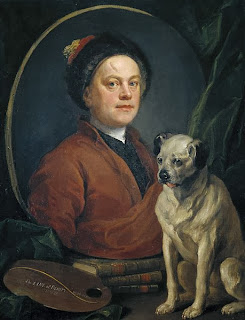
The Painter and his Pug by William Hogarth, 1745In the history of art and painting, some names have endured for centuries. The chroniclers of their times, their reputations have grown through the years and raised them to the status of icon. Of the many glorious artists who emerged from the Age on Enlightenment, one of the most respected, recognised and influential is the great William Hogarth, English painter, satirist and printmaker. 
His work is instantly recognisable and justifiably celebrated, with series such as the magnificent Marriage A-la-Mode endlessly reproduced and rightly lauded. However, my favourite work by Hogarth is not one of his satirical series nor his portraits of the great and good, but a painting of an unknown and far from illustrious young lady, The Shrimp Girl. 

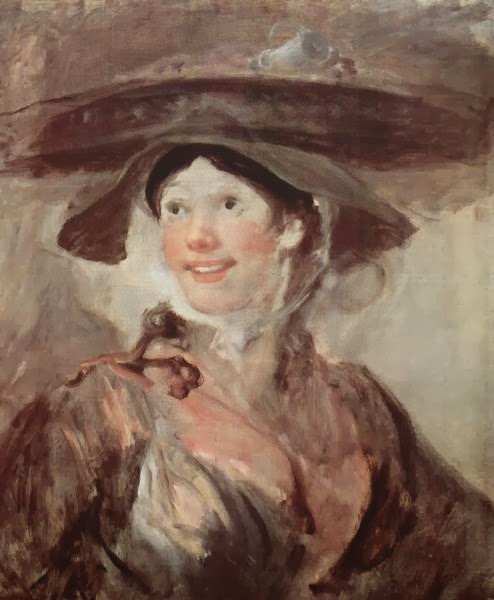
Although the work is undated, experts believe that the unfinished oil on canvas dates from the 1740s, and was most likely begun as an experiment in working with different styles of painting. If this date is correct, then Hogarth was already at the peak of the art world. He was an established, hugely successful figure with nothing left to prove and perhaps was searching, as Joshua Reynolds often did, for new styles and techniques to stimulate his own creativity. By the 1740s, Hogarth's sitters paid vast sums to commission paintings, and his works were instantly recognisable, influential and lauded by the most illustrious names in the country. Deeply embedded in contemporary culture, the public flocked to printshops to purchase prints of his works. However, Hogarth wasn't content to rest on his laurels with these successes, and when he painted The Shrimp Girl he was looking to develop a less formal style, experimenting with elements of impressionism and a light, frivolous touch.


The Shrimp Girl by William Hogarth, 174o-45
The Shrimp Girl by William Hogarth, 1740-45
The identity of the woman in the painting is unknown and sadly, no records exist to lend so much as a clue to who she might be. However, one thing we can be sure of is that young women like this would have been familiar sights around the fish markets of the capital where Hogarth took his inspiration. That is not a hat the young lady wears, but a basket balanced atop her head from which she sells fresh shellfish, the pewter tankard used as a half-pint measure to properly portion out the goods. Although he never finished the work, Hogarth kept the painting at home until his death. When his widow, Jane Thornhill, showed it to people after Hogarth had passed away, she told them, "They say he could not paint flesh. There is flesh and blood for you".

In The Shrimp Girl we see a joyously beaming face free of make up, fashion or guile that is at odds with the idealised formal portraits that lined the walls of galleries and fine homes. This painting illustrates a long-lost, anonymous moment of London street life, one of thousands of such moments that occurred every day yet Hogarth has captured it as clearly as a photograph might today, immortalising the unknown, cheerful young woman forever. The Shrimp Girl is not Hogarth's most dramatic work, nor his most magnificent; it tells no satirical tale, not does it present us with an illustrious figure of national importance, but it does show us the everyday face of Hogarth's London and that is why, for me, it is his one of his greatest works.


Hogarth, William (1833). Nichols, JB, (ed). Anecdotes of William Hogarth, Written by Himself. London: J. B. Nichols and Son.

~~~~~~~~~~~~~

Glorious Georgian ginbag, gossip and gadabout Catherine Curzon, aka Madame Gilflurt, is the author of A Covent Garden Gilflurt’s Guide to Life. When not setting quill to paper, she can usually be found gadding about the tea shops and gaming rooms of the capital or hosting intimate gatherings at her tottering abode. In addition to her blog and Facebook, Madame G is also quite the charmer on Twitter. Her first book, Life in the Georgian Court, is available now, and she is also working on An Evening with Jane Austen, starring Adrian Lukis and Caroline Langrishe.

Saturday, June 13, 2015

A Beloved Patron: Hogarth and Miss Mary Edwards

by Catherine Curzon

Beloved of court and public, William Hogarth was an icon of the Georgian art world and a man whose work endures to this day. In his time he  turned his hand to portraiture, caricature and satirical prints. His subjects ranged from the street vendor to his own beloved pug and, as we shall see today, the most noteworthy names in Georgian society.

Miss Mary Edwards of Kensington was a most singular sort. One of Hogarth's favourite portraits, the eccentric heiress inherited a fortune in her early twenties, and she and the artist enjoyed a fruitful, close friendship as she brought commissions and inspiration to his door including a portrait of her own infant son and caricatures of society types who had once mocked her somewhat unorthodox approach to life.


Miss Mary Edwards by William Hogarth, 1742

When the time came to paint Mary herself in 1742, she was thirty seven years of age and had lived an eventful life, including marrying and then casting aside a most avaricious and scheming husband, Lord Anne Hamilton, whom she believed intended to relieve her of her fortune. In this oil painting Hogarth captured his adored patron perfectly, his brush picking out a kindly, playful and undeniably appealing face, the central figure of Mary in her vibrant red dress shining out against a formal dark background.

Behind Mary a globe and bust suggest wisdom and artistry respectively and she rests her hand on the head of a loyal, adoring dog, marking her out as a most dependable sort. Her clothes are fine yet not overly extravagant, the jewellery around her neck likewise ornate but not quite dazzling. As we can see from Mary's decision to leave her marriage rather than lose her fortune and place in the world, she loved and valued freedom and independence and the scroll at her elbow bears testament to this, reading:

Remember, Englishmen, the Laws and the Rights.
The generous plan of Power delivered down
From age to age by your renown’ed Forefathers. . .
Do thou, great Liberty, inspire their Souls!

This portrait is not simply that of one more sitter in the appointment book, it is a friend captured forever on canvas, Hogarth's brush showing us how highly he thought of this most illustrious lady. One year after Hogarth completed this lovely painting the lady was dead yet she lives on even now, vibrant, happy and adored, in this remarkable painting.


~~~~~~~~~~~~~


Glorious Georgian ginbag, gossip and gadabout Catherine Curzon, aka Madame Gilflurt, is the author of A Covent Garden Gilflurt’s Guide to Life. When not setting quill to paper, she can usually be found gadding about the tea shops and gaming rooms of the capital or hosting intimate gatherings at her tottering abode. In addition to her blog and Facebook, Madame G is also quite the charmer on Twitter. Her first book, Life in the Georgian Court, is available now, and she is also working on An Evening with Jane Austen, starring Adrian Lukis and Caroline Langrishe.
SaveSave

Tuesday, March 24, 2015

Beauty and Georgian Society

by Grace Elliot

What is beauty?

In the 18th century, according to the Morning Post, a true beauty not only had good looks and a pleasing figure, but wit, grace, sensibility, elegance, good sense, expression, and principle. (Note: Modesty is absent from the list, but perhaps this falls under good sense or principles.) Indeed, in October 1776, the paper published a ‘Scale of Bon Ton’ that listed 12 of society’s most fashionable women as ranked by a point-scoring scheme.

Georgiana Cavendish, Duchess of Devonshire
1787

In case you are wondering, the Duchess of Devonshire topped the list, hotly followed by the Duchess or Gordon, then the Countess of Derby.  Ranking beauties against one another was very popular, and only the month before the London Chronicle had published its own ‘Scale of Beauties’ – again with the Duchess of Devonshire ahead of the rest.

There’s no denying that the majority of these women were indeed attractive, but more than that, it was difficult for a woman not of noble blood to be a beauty in the fullest Georgian sense of the word, because they simply didn’t have the breeding. The concept of beauty was closely tied to ideas of behaviour and manners such that someone with good looks but lacking the correct social niceties  was left sadly short of that vital ‘something’ that made her acceptable as a society beauty.

All of which is as good as any yard stick to base the concept of ‘beauty’ on, since it is such a subjective thing. Even at the time, people debated (as they have done since time immemorial) the essence of beauty. A poem, written in 1733, titled ‘Beauty and Proportion’ extolled the virtue of symmetry with ‘a roman nose, high turn’d forehead and well-set eye.’

But someone with a good appreciation of beauty, the artist William Hogarth, writing in the mid-18th century, argued that disorderly style in the form of curved lines and uneven structures was a greater delight to the eye.

From the Harlot's Progress, by William Hogarth
Hogarth was well known for his cutting observations on social manners

A little later in 1795, the Dictionary of Love catalogued beauty in 28 points or of which the foremost was ‘Youth’. Understandable then, that some women turned to cosmetics to cheat the clock and make them appear younger. But this too was frowned upon, not least because makeup could be purchased by anyone to create the illusion of beauty and thus cheat the viewer.

Part of the problem with makeup was that it was so thick that it obscured many blemishes and imperfections. Whilst a noble lady was cossetted and often protected from some of the diseases that could devastate a complexion, a lady of lower birth was not. Therefore a perfect skin was a badge, a mark of superior rank. However, the use of makeup blurred this boundary and made it less clear for all to see.

It was argued that titled women should avoid ‘paint’ because it lowered them to the level of ‘inferiors’. This is all very well, for many young women in society who needed to make a good marriage but with average looks, the clever use of makeup seemed a Godsend to make them more attractive.

Maria, Countess of Coventry
1751

At the time, much makeup contained lead, so perhaps there was wisdom (but for a different reason) behind avoiding artificial props. Perhaps one the most famous cautionary tales is that of Maria, Countess of Coventry, who rose to fame because of her stunning looks, but died because of lead poisoning from her makeup. Such was the pressure to maintain her status as a beauty that the means of maintaining an outward appearance of loveliness was ultimately her end. A salient lesson indeed.

 ~~~~~~~~~~~~~ 

Grace Elliot is a veterinarian and writer.  
To find out more, visit her blog:


Sunday, March 10, 2013

Hogarth, St Giles and Gin Lane

 By Grace Elliot


From serious historians to readers of historical romance, mention the area of St Giles, London, and images of poverty and squalor spring to mind. This area was perhaps made famous (or should that be infamous?) when the great Georgian artist, William Hogarth, used it as his setting for "Gin Lane" - a print that moralised about the evils of gin. So in this post, let's take a look at the history of the area.
Hogarth's "Gin Lane"
It was the St Giles Hospital for lepers [Giles was the patron saint of lepers] that gave its name to an area that also comprised of a monastery and chapel. The hospital was established by Queen Matilda, wife of Henry I around 1100 AD. The site was chosen because it was separated from the rest of London by fields and marshland, hence keeping the sick at a safe distance from the wealthy. With time a village grew up around the hospital to cater the brethren. The area was looked on as 'outside the law' and so criminals felt safe there, which in turn meant respectable people kept away, and social outcasts and refugees migrated in. 
    
Water-tank, St Giles. 1858
During the dissolution the monastery was broken up, by which time the parish known as St Giles in the Fields and had an established reputation for vagrancy and poverty. The houses, being built on marshland, were described as 'damp and unwholesome', and by 1606 a Parliamentary Act condemned the area as "deepe foul and dangerous".

Insanitary conditions inevitably linked St Giles to outbreaks of the plague, and after the Great Fire of London, parts were redeveloped in the late 17th century and became known as Seven Dials. As London expanded in the 18th and 19th centuries, the Rookery grew out of St Giles - a warren of desperately inadequate housing, damp, dangerous, over-crowded and squalid: open sewers ran through buildings and cesspits overflowed.
Poverty in Seven Dials.
"The Rookeries embodied the worst living conditions in all of London's history; this was the lowest point which human beings could reach"
Peter Ackroyd

 In 1860 Henry Mayhew wrote a vivid description of the slums in A Visit to the Rookery of St Giles and its Neighbourhood:

 "The parish of St. Giles, with its nests of close and narrow alleys and courts… has passed into a byword as the synonym of filth and squalor."

Amidst such conditions there was little hope of enforcing law and order, and so prostitution and crime flourished. It seems the only way to tolerate the dreadful filth was to be permanently drunk and gin-selling and gin-shops thrived, in turn leading to yet more drunken and disorderly conduct…which takes us back to the beginning and Hogarth's print of "Gin Lane".


Grace Elliot is a veterinarian by day and author of historical romance by night.
To find out about Grace and her work please visit her blog:
 "Fall in Love with History" (click banner for link)


Subscribe to Grace's quarterly newsletter here:
http://eepurl.com/r4R3v

Click for link
Coming soon!

Click for link