Tuesday, July 9, 2013

How to Become a Twelfth Century Saint: The Case of Thomas Becket

by Rosanne E. Lortz


On February 21, 1173, Thomas Becket was officially canonized as a saint by the decree of the Roman Church. This elevation to sainthood indicated three things about Thomas.

First, it showed that Thomas’s life was of such an exemplary character that the Church recommended it for emulation. The archbishop in his stand for the Church’s liberty was an example for all of his contemporaries to follow.

Second, it showed that the relics of Thomas’s body had produced genuine miracles after his death. If the chroniclers’ records are to be believed, the miracles were exceedingly numerous. A paralyzed woman was healed when she came into contact with the martyr’s blood. A baby boy was relieved from his fever when he drank water from a spring near the shrine. By contact with the martyr’s body, one young man discovered a large treasure; another man, who had stolen from a merchant, was nearly suffocated by the power of the martyr until he resolved to repent of his theft.

Because of these and other miraculous events, rich and poor alike journeyed to Thomas’s shrine at Canterbury seeking the blessing of the martyr. These pilgrimages to Canterbury were later made famous by the poet Geoffrey Chaucer.
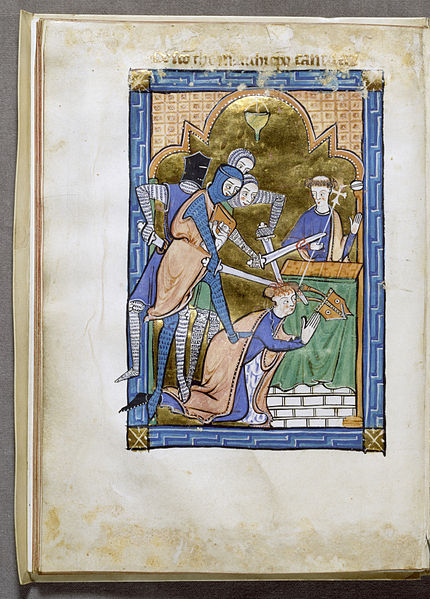
Thomas Becket's murder, from a page in a Psalter (c.1250)

Third, Thomas's canonization showed that the events of his life and the miracles subsequent to his death were well-documented enough to be considered authentic. The Church of the twelfth century was becoming more and more scrupulous about who ought to be canonized. An accurate record of the holy man’s life must be produced before he could be officially considered a saint. Canonization could not be conferred on mere hearsay.

In a treatise composed half a century before Thomas’s death, Guibert of Nogent wrote:
[The saints] "are people who are worthy of our reverence and honor in exchange for their example and protection. As regards such people, the only method for considering a person to be a saint which should be considered authoritative is one that relies not on opinion, but on timeworn tradition or on the evidence of trustworthy writers…. 
"Who would ask people, about whose merit in the eyes of God is uncertain, to intercede on their behalf? Would not the conscience of a man offer grave offense if he obtained as an intercessor with God someone who was not to be particularly trusted? Would not the sharpness of his prayer be blunted in its intention if he did not know whether the person whom he asked for help had anything in common with God?" 
This treatise warns us that the Church must prevent charlatans from being venerated as saints. Only those whose merit is unquestionable should be trusted to intercede with God on our behalf. The canonization of Thomas Becket indicates that the twelfth century Church found him a trustworthy intercessor.

Out of all the pilgrims who came to honor the new saint at his tomb, there was one that deserves especial mention. Henry, the king who had refused to kiss the archbishop in peace, did penance for that refusal in the summer of 1174.

Politically, the penance was a necessary deed. After the tumult with Thomas had subsided, Henry found himself faced by a full-scale rebellion led by his wife Eleanor and his sons Henry, Richard, and Geoffrey. His family was aided in their rebellion by King Louis of France, King William of Scotland, and several other foreign powers.  Now Henry himself knew how it felt to stand contra mundum.

Many of his subjects believed that this revolt was a fitting punishment for the king’s mistreatment of Thomas. In order to counteract this opinion and to regain the support of his subjects, Henry made a pilgrimage to Canterbury. The chronicler Edward Grim writes:
"Finally, shown through a vision that there was no other way of obtaining peace except by placating and reconciling the martyr, in whose revenge such great confusion of things now seized the whole realm, so that without much blood no one might hope for peace, the king put aside his pride for a time, and with a contrite and humble heart he came to the tomb of the precious martyr to beg pardon for his presumption."  
Barefoot and sorrowful, King Henry entered the church at Canterbury. The flagstones that had run red with Thomas’s blood were drenched again with the tears of the king. When the archbishop lived, Henry had refused to give him the kiss of peace. Now that the archbishop was dead, Henry kissed his death place over and over again, begging that the saint would give peace to him and his kingdom.

Humbling himself even further, Henry removed his outer clothing and leant against the tomb. The bishops and monks who were present came forward. Each of the bishops struck him five times; each of the eighty monks struck him three times. Following this punishment, Henry spent the entire night in prayer beside the tomb. Thus was the king’s absolution completed.

Stained glass window of Thomas Becket in Canterbury Cathedral

There are many nowadays who would question the genuineness of Henry’s sorrow. Because the action had political advantages, they assume that it could not have been from the heart. The chroniclers, however, have no doubts about the authenticity of Henry’s contrition. The events that followed the penance confirm its genuineness. Insofar as the dead can intercede on behalf of the living, Thomas interceded for Henry. On the day that Henry completed his penance,
"The count of Flanders, who with an immense army had blockaded the coast of the sea so as to invade England without warning, suddenly changed his mind and retreated.  Likewise, the next day…the king of the Scots, who was attacking and laying waste and robbing the Northumbrians, was captured in battle."  
Henry had received his own miracle from the hand of the man he had mistreated. Henry had retained his kingship, a gift from the man he had murdered. The deeds that Thomas Becket accomplished in his death vindicated everything he had sought to accomplish in his life.

The man was a saint indeed...according to all the necessary proofs required by the twelfth century.

~~~~~~~~~~~~

Rosanne E. Lortz is the author of two books: I Serve: A Novel of the Black Prince, a historical adventure/romance set during the Hundred Years' War, and Road from the West: Book I of the Chronicles of Tancred, the beginning of a trilogy which takes place during the First Crusade. The above essay was excerpted from Rosanne's New St. Andrews College thesis: The Life and Death of Saint Thomas Becket: Type of Paul, Type of Peter, Type of Christ.

You can learn more about Rosanne's books at her Official Author Website where she also blogs about writing, mothering, and things historical.
_________________

BIBLIOGRAPHY

Head, Thomas, trans. and ed. Medieval Hagiography: An Anthology. New York: Routledge, 2001.

Staunton, Michael, trans. and ed. The Lives of Thomas Becket. New York: Manchester University Press, 2001.

Monday, July 8, 2013

Wilton Abbey and The Bayeux Tapestry

by Carol McGrath


There is a strong argument that panels of The Bayeux Tapestry may have been embroidered at Wilton Abbey. The Bayeux Tapestry is generally thought to have been the product of Canterbury where Bishop Odo, who was responsible for the new Church at Bayeux, had his headquarters. One of the most mysterious vignettes on the Tapestry supports the possibility of Wilton's connection with its construction, depending on its interpretation.

A cleric and Ælfgyva - Bayeux Tapestry, 1070
A Cleric and Elfgyva (just to the side Harold is pointing)


The inscription above this particular vignette has the title 'Where a Cleric and Elfgyva...' We ask: Who was this lady? Why was she included in the Tapestry?  There is a suggestion that Elfgyva was Harold's sister (M.W. Campbell, 1984, E.A. Freeman 1867-9), and that she was alive at the time of Harold's visit to Normandy in either 1064/5 and that she was well-known to a contemporary audience. She is mentioned in The Domesday Book along with other members of the Godwin family. Elfgyva is connected with lands held by the Abbess of Wilton Abbey. Now, why might this lady depicted on  the embroidery be Harold's sister?

  • She was Abbess of Wilton from 1065-67, the time scale of the events depicted on the Tapestry.


Queen Edith is kneeling at her husband's death-bed.

  • Queen Edith was strongly connected with Wilton and, interestingly, one of the other two vignettes which feature women depicts Edith Godwin, wife of Edward the Confessor rubbing his feet in the death-bed scene. She was also at the abbey during 1065 supervising building work of a new abbey church just as her husband was responsible for the new Westminster Abbey consecrated in January 1066. The third vignette of a woman fleeing a burning house before the battle could also be a Godwin woman, Edith Swan-Neck, King Harold's hand-fasted wife with his youngest son Ulf.


A house is being burned - Bayeux Tapestry, 1070
A House Is Burned

  • Earl Godwin had his daughters educated at Wilton and Harold's youngest daughter was educated there during this period. There was a school for young noblewomen attached to the abbey.

Looking closely at the vignette--one wonders if Harold, who seems animated, is drawing attention to her and telling William something about her. The cleric draws attention to her eyes. Perhaps Harold is telling William and others present, including his brother, Wulfnoth and his nephew Hakon, hostages living at William's court about the miraculous healing of Harold's sister's eyes by St. Edith of Wilton Abbey. Now who could that priest be and why in the Tapestry border below the vignette is there naked male genitalia?  To understand how this connects with Harold's sister one can turn to Goscelin's story.

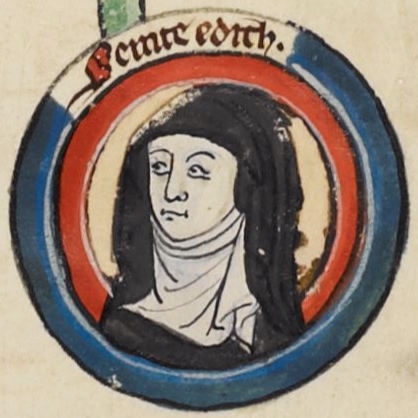
File:Edith of Wilton.jpg
Saint Edith of Wilton

Goscelin was Chaplin to Elfgyva and he tells the story in 1080 of how St Edith who was the daughter of King Edgar and a woman, Wulfrith, whom he had seduced when visiting the abbey school. Wulfrith returned to the abbey with their baby daughter Edith and became a nun. Edith remained at Wilton all her life. The next king her half brother, Athelred II, built a chapel for her.

After she was interred there prayers were answered and miracles occurred. She quickly became a saint. Elfgyva was lighting a lamp in the chapel which overturned burning her. Her right eye became badly swollen. She lost her sight. However, while she slept she had a vision of St Edith making the sign of the cross over her and telling her all would be well. When she woke the swelling went down and she regained her strength. It is just possible that Harold is telling William this story. The gateway by which she stands is another clue. Goscelin gives details as he also gives details of Westminster Abbey, details that do appear for both on the Tapestry.

Holy Trinity Church, Bosham
Holy Trinity Church Bosham, Harold's Church

The cleric is emerging down some stone steps at an entrance porch. Two double doors are depicted, with crosses set on them. The entrance to this chapel is also described in a fifteenth century poem just as it appears on the Tapestry. The cleric drawing attention to Elfgyva's eyes is surely Goscelin himself, her chaplain. She is standing in her own gateway at Wilton Abbey, just as the abbess of Wilton appears on her Anglo-Saxon seal.

As for the naked figure in the border there is a possible explanation there too, associated with St Edith's story and Wilton Abbey. She is the only woman named on the Tapestry therefore this was obviously an important scene for those making it. The embroiderers throughout convey realistically the typical Wilton chequer-board style of architecture. These are squares made of flint and stone!

It is also likely that Goscelin who was also chaplain to Queen Edith, composed the Vita Edwardii Regis. His description of Westminster Abbey is just as the abbey appears exactly half way through the Tapestry. Further reasons that the Tapestry may have been embroidered at least in part at Wilton are:

  • Praise for Queen Edith's family. Harold is depicted nobly with hawk and hounds as he rides to Bosham.
  • A team of embroiderers may have wanted to show a portion of the Tapestry showing Queen Edith's new building.
  • Queen Edith was an expert embroiderer, one of the greatest in the land, seriously educated and religious and also she was pragmatic towards the Invasion. She was at Wilton during the 1070s.
  • This adds weight to the argument--Muriel, a poetess and possibly Odo's sister, was a widow and lived as a nun at Wilton during the 1070s.
  • Could the Tapestry be seen as a memorial to the dead, Norman and Saxon?
  • Pragmatically, the Norman story takes up the second half of the work restoring the balance from it being Godwin orientated.
  • The story of Elfgyva and her miraculous cure from blindness may foreshadow the death of Harold during which scene he is struck down by an arrow and then hacked to death. Foreshadowing Roland's death in the popular Song of Roland occurs early on in the poem with Charlemagne's vision. A contemporary audience, used to miracles and visions would have understood why Elfgyva and Goscelin were there. The embroiders are denoting the place where a cleric and Elfgyva are performing a miracle.
  • So was the Tapestry embroidered at Wilton and is it, in fact, a memorial to the dead!
I would like to acknowledge Patricia Stephenson whom I heard give a paper on this topic at The British Museum. It is titled Where a Cleric and Elfgyva.

~~~~~~~~~~~~

Carol McGrath is the author of The Handfasted Wife, the story of Harold's common-law wife and a woman's perspective on the events of 1066. It is available as a paperback and for all e readers.

Giveaway of The Widow's Redeemer, by Philippa Jane Keyworth

This week's giveaway is a paperback copy of The Widow's Redeemer, by Philippa Jane Keyworth (open internationally). Go HERE to learn more about the book.

To enter, please leave a comment on this post with your contact information so that we can contact the winner.

Sunday, July 7, 2013

One of England's Hidden Treasures

by Cassandra Grafton


There is a road in England's Peak District that wends its way from the spa town of Buxton to another former watering place at Matlock. Off this road, just beyond the market town of Bakewell, where it winds and turns, cosseted by thick hawthorn hedgerows, lies a hidden treasure. The cars rattle along this road at a fair pace, their drivers set upon their destination, wherever that may be, oblivious to what is concealed behind the screen of lush greenery: a fortified manor house steeped in history.

A discreet roadside sign and the small gravelled car park on the opposite side of the road are all that indicate its presence to the passer-by, for nothing can be seen of it from here other than a break in the hedgerow and a short drive to a small gatehouse.

It is a gentle stroll under the gatehouse’s arch and along the drive, and before long a small bridge comes into view and up beyond it towers the house, perched on a limestone bluff high above the river, exuding an air of mystery and romance as it beckons you into the past. This is Haddon Hall, a building rich in history, its origins stemming from the 12th Century, a home that has passed most of its life in the hands of just two families and that retains much of its original character.

There have been various descriptions over time of this medieval manor, more recently “the most perfect English house to survive from the Middle Ages”, from Simon Jenkins in England’s Thousand Best Houses.

Back in 1836, however, S. Rayner's The History and Antiquities of Haddon Hall described the house thus:

“In the midst of romantic scenery, on a rocky eminence, at the foot of which flows the River Wye, and not far from its confluence with the Derwent, stands the castellated mansion of Haddon. Its embattled parapets and crested turrets, proudly towering above the branching woods in which it is embossed, cause it, when viewed from the vale, to assume the appearance of a formidable fortress.”


Then there is this, from Edward King's Observations on Ancient Castles (1782) regarding castellated houses (as he says in the introduction, “mansions adorned with turrets and battlements; but utterly incapable of defence, except against a rude mob, armed with clubs and staves, on whom the gates might be shut”):

“The high turrets of this mansion stand proudly towering on a rock, in the midst of thick woods, and in a most beautiful situation. It has undergone fewer alterations, and retains more curious vestiges of the residence of an old English Baron, and exhibits more manifest indications of the ancient mode of life, than any building I ever saw.”

The manor of Haddon was bestowed upon the natural son of William the Conqueror in the 12th century, passing thereafter through marriage to the Vernon family who, over the centuries that spanned the years 1180 to 1565, constructed most of the Hall as it is seen today.

The Vernons’ tenure came to an end in 1565 through lack of a male heir and the marriage of a daughter to the family who still own and manage the estate today, the Manners.

Herein lies a legend and, as with all good tales from the past, its truth and origin remain mysteries that will likely never be solved, a tale of illicit romance and an elopement.

In the mid-16th Century, the Hall was under the guardianship of Sir George Vernon, a man known as ‘The King of the Peak’, mainly down to his larger than life persona, his lavish lifestyle and his love of entertaining. He was the last male in the Vernon line, having fathered only two daughters, Margaret and Dorothy, who were joint co-heiresses to the estate.

Dorothy married Sir John Manners in 1563, and when her father died in 1565, her share of the estate, which passed to her husband, included Haddon Hall.

The legend has it that Dorothy’s father was against the match and banned the couple from seeing each other. There are several schools of thought on what the reason might have been for this. Dorothy was eighteen at the time, and it is believed that Sir John was substantially older, most likely in his thirties. This alone would probably not be an issue, but there is also speculation that, as a second son, his future was considered too uncertain despite the illustrious family name. Another line of thought suggests that religion was the cause as the Manners family was Protestant and the Vernons were Catholic.

As the story goes, Dorothy made her escape from the house under cover of a hunt or masked ball and fled into the woods where John had been waiting, dressed in disguise. They fled the neighbourhood and were wed the following day.

Charming though the story is, we only have certainty on two facts: the marriage definitely took place in 1563 (though where remains another unsolved mystery) and, whatever the circumstances at the time, if there was an estrangement with Sir George due to an elopement or for any other reason, the matter was resolved within a relatively short time, for the couple took up residence at the Hall during the last few years of the gentleman’s life and inherited their share of the estate on his passing in 1565.

Could this house, therefore, be considered one of the most romantic in the country, with its charming situation, its air of mystery and romance, the walls rich in history and wrapped in the myth of a forbidden love?

In a film-maker’s eyes, it could well be, for Haddon Hall, in the present day, has association a-plenty with some of the most romantic stories of yesteryear - a perfect 'set', it has starred in adaptations of Charlotte Bronte’s Jane Eyre (on no less than three occasions) and Jane Austen’s Pride & Prejudice, whilst this year sees the 25th anniversary of the cult classic The Princess Bride's filming at the hall, where it had the role of Humperdinck's castle. It has also taken centre-stage in the films Elizabeth I and The Other Boleyn Girl, along with several television series, including Moll Flanders and The Prince and the Pauper.

Perhaps John Leyland, in his description of Haddon Hall in Articles on Derbyshire (1891) summed it up best:

“These charms of a truly English landscape, and an old English mansion, have long had, and must continue to have, a spell of fascination for the artist and the lover of the picturesque; what other place can wake such impressions of old-time greatness touched by the witchery of bygone romance? It is here - better, perhaps, than in any other spot in England - that we can grasp the conditions of life of the mediaeval and Tudor gentleman”.


So, if you are ever driving along the A6 in Derbyshire between Buxton and Matlock, keep an eye out for that break in the hedgerows. Stop a while, leave the car behind and step through the gatehouse for a wonderful journey into the past at Haddon Hall.

~~~~~~~~~~~~

Sources: the official guide book to Haddon Hall, published by Heritage House Group.
Observations on Ancient Castles by Edward King, The History and Antiquities of Haddon Hall by S. Rayner and Articles on Derbyshire by John Leyland, all of which have been edited by David Trutt who has also written an introduction to each publication, can be found on David’s website at www.haddon-hall.com, where you can also find links to the documents and several others that relate to Haddon Hall and the legend of Dorothy Vernon.

~~~

Cassandra Grafton has always loved words, so it comes as no surprise that her favourite pastimes are to read and write. Having spent many years wishing to be a writer and many more dreaming of it, she finally took the plunge in 2002, offering short stories to online communities. A few years later, it was a natural next step to attempting a full length novel, and thus A Fair Prospect, a story inspired by Jane Austen’s Pride & Prejudice, was born.

A former college lecturer, Cassandra has two grown up children and splits her time between North Yorkshire, where she lives with her husband and two cats, and Regency England where she lives with her characters.

LINKS

You can find Cassandra on:

Website
Facebook
Twitter

A Fair Prospect is a tale of Darcy and Elizabeth. It is one story told across three volumes. The books are available in paperback in all the usual online bookstores and in eBook format in the Kindle, Nook and Kobo stores and in all eBook formats, including PDF, at Smashwords.

Kindle

Nook
Kobo
Smashwords


Saturday, July 6, 2013

A Night of Terror: January, 1809

by Jonathan Hopkins


17th January, 1809. And from French-held Northern Spain, a beleaguered army was on its way home.

Amid scenes reminiscent of a much later conflict - the evacuation of their expeditionary force at Dunkirk - the British, having marched through Spain in hope, boarded a fleet of ships in Corunna harbour under the very noses of their French antagonists.

An enemy twice as strong had been kept at bay over hundreds of miles of Iberia’s most inhospitable mountain country before a desperate rearguard action, which cost the lives of commander-of-the-forces, Sir John Moore, and hundreds of his men, gave the remaining troops enough time to embark before they were overwhelmed, and they set off in convoy across the Bay of Biscay toward the English Channel.

Relief at escaping Spain must have been immense, though most soldiers’ morale remained at a low ebb. Not realising how badly they were outnumbered at the very end, many could not understand why they had been forced to flee a campaign where, even when suffering both hunger and bitter cold, they had beaten the enemy in every engagement fought.

But whatever their thoughts, they could not escape the fact that the army was a shadow of its former self. Their transport ships, blown on increasingly strong south-westerly winds which scattered the fleet, were packed to the gunwales; holds and decks overflowing, with untended sick and wounded lying alongside their healthy but underfed comrades.

In such squalid confines it was inevitable that typhus and dysentery would run amok, so much so that when the early transports made landfall on the south coast of England, at first locals could not believe the shivering, unshaven scarecrows ferried to shore were really British soldiers.

But that was in the future.

Most of the army’s cavalry horses were shot prior to departure simply because there was not enough hold space in the returning convoy to embark them as well as the men.

Already stretched by the importance of patrolling the Channel, North Sea, Mediterranean and Americas amongst others, the navy was so desperate for ships that inexperienced or incompetent masters were among those whose vessels were leased for the expedition. Alexander Gordon (15th Hussars) reported that one vessel carrying his regiment was almost wrecked when the master mistook the glow of the Needles lighthouse for a star, until he was persuaded of his error by a landlubber, the regimental paymaster.

In fact by the 20th of January the weather had eased slightly, only for the gales to return with a vengeance the following day. Crammed into the Dispatch transport were around seventy men of the 7th Hussars, including three of their officers, together with 34 horses. In the early hours of 22nd January (between 2am and 4am, depending on the source) and running for Falmouth, she struck a chain of shoals to the south of that port known as ‘The Manacles’ - in old Cornish Maen Eglos, or 'Church Stones'.

It’s difficult to imagine the full horror of what happened next. The grinding, tearing sound of timber on rocks as the vessel came to a sudden and unexpected stop would have reverberated right through the ship. Men asleep in their hammocks were thrown out. Scrambling about inside what was in effect a pitch-black slowly-disintegrating wooden box, disoriented and terrified, who knows what went through their minds as the sea slowly smashed the transport to pieces?

Northern end of Coverack Cove on an ebb tide, showing where The Manacles come ashore. The mound visible on the promontory is apparently where the horses were buried

Once the ship foundered, the horses on board were lost. They would have been lowered into the hold using block and tackle, a laborious process which meant that even had the ship struck the coast rather than being out at sea there was no way to get the animals out.

So the wreck would have been filled with screaming men and panicked horses until, eventually, the raging sea quieted them all. Of the hundred-odd souls aboard the Dispatch, only six survived; five hussar privates and one of the regimental farriers. Officers Major Cavendish, Captain Duckenfield, and Lieutenant Waldegrave all perished.

Two hours later, and further north, a second vessel - the Royal Navy sloop Primrose - on its way to Spain with dispatches, struck The Manacles with the loss of 126 lives. The sole survivor was a boy who had lashed himself to the stump of a mast, from where he was rescued by intrepid locals, by now alerted to the disasters, who launched small boats in the hope of saving at least some lives.


Base of the tower and main doorway of St Keverne Church. Its tall spire (not visible here, sorry)
could be seen from the sea in daylight and acted as an aid to navigation.

Washed ashore at Coverack and further along the rocky coast, casualties were buried in mass graves in the churchyard at nearby St Keverne. Men of the 7th were originally commemorated by a plaque on the church wall which read:


When Britain sends at liberty's command
Her ready youth to free a stranger land,
She bears her slain in triumph to the shore,
And the proud parent shows the wounds before.
But when her sons, each form of danger past,
Strain their glad eyes to view her bills at last;

If then the tempest rolls the foaming flood,
And her own ocean 'whelms her bravest blood,
When there a Bukenfield(sic), a Cavendish here,
And youthful Waldegrave press a wat'ry bier;

Their mourning comrades feel a moisten'd cheek,
And bid the marble their dumb sorrow speak.
Tyranti the barrier of thy rage, the deep
Aids thy fierce boast, and English mothers weep.


At some point this was removed and the gravesite seems to have been forgotten until a later mass burial uncovered the bodies, whereupon a descendent of the 7th Hussars previous field commander, Lt Colonel Sir Richard Hussey Vivian, provided a permanent memorial for the grave mound.


7th Hussars memorial
The dedication reads:
In Memory of
the Officers and men of H M VIIth Hussars,
interred in this plot who were lost in the
Transport Dispatch on the
Manacle rocks Janry 22nd, 1809,
on their return from the
Peninsular War.


Interestingly, dead horses washed up on shore were also interred, but further along the coast. It seems these were covered rather than buried (probably due to the presence of granite rocks not far below the surface) and this mound is still visible.

So the British were, mostly, back on home soil, but it would not be long before another army returned to Iberia, this time without loss of life on the voyage. The parallel expedition to Walcheren in the Netherlands, however, killed more than 4000 men. Not lost at sea this time, but struck down by disease.

Mother nature always has the upper hand.


Sources:

Shipwrecks of the Revolutionary and Napoleonic Eras - Terence Grocott (2002)

Journal of a Cavalry Officer in the Corunna Campaign - Captain Alexander Gordon (facsimile reprint of original held by the RMA, Sandhurst)

Cannon Diggens’ Archive


~~~~~~~~~~~~
Jonathan Hopkins has a passionate interest in the Duke of Wellington's cavalry. The British army's embarkation at Corunna and subsequent loss of the Dispatch transport feature in his new novel, Leopardkill, due for release on 1st September, 2013.

More details on the author's website Cavalry Tales

Friday, July 5, 2013

The Wrong Type of Haircut - The Meeting at Augustine's Oak

by Richard Denning


In 597 AD Pope Gregory sent a mission to Kent under the leadership of Augustine. King Aethelberht of Kent converted and allowed the establishment of the See of Canterbury as well as offering his help with expanding the mission further inland. The missionary efforts continued into neighbouring Saxon kingdoms with varied but ongoing success.


Meanwhile, of course, the Christian church had actually never left the lands of the Celtic Britons or Welsh. It came here in Roman times and the Welsh church continued to thrive through the centuries after Rome left. Gregory had ordered that the Celtic church which had survived in isolation be brought back to the fold and should place itself under the authority of Canterbury.

By 603 Augustine was ready to make contact with the Welsh. The mission is described by Bede the great historian and chronicler of the church.

In the meantime, Augustine, with the help of King Ethelbert, drew together to a conference the bishops and doctors of the nearest province of the Britons, at a place which is to this day called, in the English language, Augustine's Ac, that is, Augustine's Oak, on the borders of the Hwiccas and West Saxons; and began by brotherly admonitions to persuade them to preserve Catholic peace with him, and undertake the common labour of preaching the Gospel to the heathen for the Lord's sake. For they did not keep Easter Sunday at the proper time, but from the fourteenth to the twentieth moon; which computation is contained in a cycle of eighty-four years. Besides, they did many other things which were opposed to the unity of the church. 

Where was the meeting?
So then a meeting was arranged at the place that later would be called Augustine's Oak. Where was this?


Traditionally the Seven valley is the area associated with the meeting. Several places have been suggested.

A) Aust Cleeve in Gloucestershire. It is on the bank of the Seven and its name could be an abbreviation of Augustine. However historians have disputed this claim.

B) Martin Hussingtree (anciently Aussuntree) again has that 'Augustine's tree' possibility in its name.

C) Mitre Oak, Hartlebury was the place specially chosen in 1575 for the Bishop and the clergy of Worcester to meet Queen Elizabeth on her historic visit to the county because of the claim to be Augustine's Oak. This site is on the east side of the Seven which would fit the tradition that the British Bishops crossed the Severn. A great Oak Tree stands today, perhaps a sapling from the original, at the side of the Worcester to Kidderminster road.

D) Rock. Of all the claimants Rock near Kidderminster has the superior claim according to historians. In Saxon days the village was called Ther Ac (The Oak) whilst in the Domesday Survey it is given as Halac (Holy Oak). There also a famous oak of great antiquity stood. Alas one winter's night in 1757 the owner of the land lit a fire inside the tree when taking shelter from the rain and it burnt down.

What were the areas of discussion?
The main areas of dispute at this meeting between Augustine and the Welsh were:
1. The dating of Easter. The Welsh calculated Easter in a different manner and based their calculations on an older method to the official Roman method.
2. The method of baptism. It is unclear how the 2 churches differed but there was some element of the way the Welsh did it that the Roman church would not accept.
3. The approach of the Welsh to evangelism. Augustine's mission was to convert the pagan English. To the Welsh though this was abhorrent. The English were the invaders who had slaughtered them and driven them west into the mountains. How could they be expected to preach to them?
4. There are other areas Bede is vague on but may well have included a dispute of the tonsure. In other words how the monks and priests cut their hair.

Despite Augustine healing a blind man - showing by this miracle that he was God's man - the Welsh were uncertain how to respond and asked leave to consult with their own people before returning for another meeting at a later date (probably some time later). Unsure how to respond to Augustine, Bede says that they took:

"themselves first to a certain holy and discreet man, who was wont to lead the life of a hermit among them, to consult with him, whether they ought, at the preaching of Augustine, to forsake their traditions. He answered, "If he is a man of God, follow him."— "How shall we know that?" said they. He replied, "Our Lord saith, Take My yoke upon you, and learn of Me, for I am meek and lowly in heart; if therefore, Augustine is meek and lowly of heart, it is to be believed that he bears the yoke of Christ himself, and offers it to you to bear. But, if he is harsh and proud, it is plain that he is not of God, nor are we to regard his words." They said again, "And how shall we discern even this?" – "Do you contrive," said the anchorite, "that he first arrive with his company at the place where the synod is to be held; and if at your approach he rises tip to you, hear him submissively, being assured that he is the servant of Christ; but if he despises you, and does not rise up to you, whereas you are more in number, let him also be despised by you."

"They did as he directed; and it happened, that as they approached, Augustine was sitting on a chair. When they perceived it, they were angry, and charging him with pride, set themselves to contradict all he said. He said to them, "Many things ye do which are contrary to our custom, or rather the custom of the universal Church, and yet, if you will comply with me in these three matters, to wit, to keep Easter at the due time; to fulfil the ministry of Baptism, by which we are born again to God, according to the custom of the holy Roman Apostolic Church; and to join with us in preaching the Word of God to the English nation, we will gladly suffer all the other things you do, though contrary to our customs." They answered that they would do none of those things, nor receive him as their archbishop; for they said among themselves, "if he would not rise up to us now, how much more will he despise us, as of no account, if we begin to be under his subjection?" Then the man of God, Augustine, is said to have threatened them, that if they would not accept peace with their brethren, they should have war from their enemies; and, if they would not preach the way of life to the English nation, they should suffer at their hands the vengeance of death. All which, through the dispensation of the Divine judgement, fell out exactly as he had predicted."

What Bede is referring to here is that some years later the Welsh of Powys and Gwynedd were destroyed at the Battle of Chester in c 612.  They were defeated by a pagan king - Aethelfrith of Bernicia. To Bede this slaughter of fellow Christians by a pagan king was basically divine Punishment for refusing to fall into line with Augustine.

This failed meeting was the only significant attempt at a meeting and agreement with the Celtic/British Church before the Council of Whitby in 664 AD. The Celtic and Roman churches went their separate ways and it does not appear that the Welsh bishops altered their approach to preaching to the English, Easter, baptism or for that matter the way they cut their hair!

~~~~~~~~~~~~

Richard Denning is the author of the Northern Crown Series of Historical novels set in the late 6th and early 7th centuries. He also visits schools and local historical societies giving lectures on the Early Anglo-Saxon Era.

Thursday, July 4, 2013

Tribal Politics in Pre-Roman Britain

by Mark Patton


In the four decades following 43 AD, the whole of England and Wales came under Roman rule. Prior to this, what we now call Britain was made up of a number of independent "nations," which were frequently at war with one another.


"The most civilised of all of these nations," wrote Julius Caesar in 54 BC (www.sacred-texts.com/cla/jcsr/dbg5.htm) "are those which inhabit Kent, which is entirely a maritime district. Most of the inland inhabitants do not sow corn, but live on milk and flesh, and are clad with skins."

The real distinction, however, was not between maritime and inland districts, but between the lowlands of the south (the territories of the Catuvellauni, Trinovantes, Iceni, Cantiaci, Regnenses, Atrebates, Belgae and Durotriges), and the lands to the north and west. The economy of the lowlands was based on cereal crops, whilst that of the northern and western lands had a far greater dependence on cattle and sheep. Between 54 BC and 43 AD, the peoples of south-eastern England traded extensively with Romanised Gaul, supplying the legions with grain, and the civilian population with slaves, in return for wine, olive oil and luxury goods.

One of these nations was larger and more powerful than the others and, in the first half of the 1st Century BC, they embarked on a campaign of territorial expansion at the expense of their neighbours. Originally from Hertfordshire (centred around Verulamium - modern St Albans), the Catuvellauni took over part of the territory of the Trinovantes of Essex, seizing their capital, Camulodunum (modern Colchester) in 55 BC. The Trinovantian king, Mandubracius, fled to Gaul and appealed for help from Caesar, prompting his brief invasions. Caesar demanded hostages and tribute from the Catuvellaunian king, Cassivelaunus, and "...forbade and commanded...that he wage not war against Mandubracius or the Trinovantes." By 10 BC, however, Cassivelaunus's successor, Tasciovanus, was again minting coins from Camulodunum.


Between 30 and 40 AD, the Catuvellauni began to threaten their southern neighbours, the Regnenses and Atrebates, seizing the town of Calleva (modern Silchester). In 42 AD the Regnensian king, Verica, the grandson of Julius Caesar's some-time ally, Commius, fled to Rome, providing the Emperor Claudius with a pretext for invasion.


The spin was that he was intervening to protect the Regnenses, just as Julius Caesar had intervened to protect the Trinovantes, from the Catuvellauni.

The king of the Catuvellauni, Cunobelinus (Shakespeare's Cymbeline), had recently died, and it was his sons, Caratacos and Togodumnus, who led the resistance to the Claudian invasion. Their forces, however, were soon overcome by the legions. Togodumnus fell in battle, opposing the crossing of a river which may have been either the Medway or the Thames, whilst Caratacos escaped to the west, with his elite warriors, to continue a guerrilla war against the Romans.

Camulodunum became the capital of the Roman province of Britannia, and the Catuvellaunian elite, having lost the war, may have prospered from the peace that followed. Cunobelinus had pursued a policy of peaceful trade with Rome, and the legacy of his long reign may have been a population that was already largely Romanised (perhaps even bilingual), well-placed to exploit commercial opportunities and occupy key positions in the new administration.


The Trinovantes, who would have regarded Camulodunum as their territory, must have watched this with deep resentment and, when the Icenian queen known to us as "Boudicca" rose up against the Romans in 60/61 AD, they were among the first to join her ill-starred revolt. The cities that were sacked (Camulodunum, Verulamium and Londinium) were all mainly or largely Catuvellaunian, so perhaps the revolt was a settling of scores between British tribes as much as an assault on the Roman invaders.

When, in the 12th Century, the Anglo-Norman poet, Wace, came to write his fictionalised history of Britain (Le Roman de Brut), tracing the ancestry of his royal patron, Henry II, back to the Trojan Brutus, he gave the name "Trinovant" to the earliest foundation of London:

"Ca cite fist desur Tamise...pour ces anceisors remembrer, la fist Troi Nove apeller...si l'apella l'om Trinovant...Trinovant est Troy nove."

(Having established his city on the Thames...in order to honour his ancestors, he named it "New Troy"...In calling it "Trinovant" he meant to indicate that it was the new Troy).

~~~~~~~~~~~~

Mark Patton's novel, An Accidental King, set in the 1st Century AD, is published today by Crooked Cat Publications. Details can be found at http://mark-patton.blogspot.com.

Illustrations relating to the pre-Roman peoples of Britain can be found at http://pinterest.com/markpatton.

Wednesday, July 3, 2013

Baking in Victorian England

by Heather Hiestand


In the Victorian period, food was expensive. A middle class family could expect to spend a little more than half their income on food. Their diet, just like with the upper classes, included a half pound of bread daily. A laborer’s diet might include two pounds of bread, with his wife and children getting something over half this amount.

This was often delivered directly to houses by bakers or pastry cooks. There were also street markets, stalls, and shops called such names as pastry shops, pie-shops and confectioners, where families could purchase a variety of baked goods. Families could prepare their own bread in their own oven or have it baked in a bakehouse, too. The family coal budget was one of the issues that led to making these different choices.

In the home, who was making the bread depended on the size of the household. Servants were relatively inexpensive and readily available during this period. Many families could afford to hire a maid-of-all-work. Next up would be families who could afford this and someone to do “heavy work.” Then, you get into larger households, where there might be cooks, kitchen maids, and scullery maids to specialize in food preparation.

Who made the bread outside of the home? According to A.N. Wilson in The Victorians, the baking life was a tough one. It only became worse during the London Season when bread orders increased. Eleven at night was the start of a baker’s day, when he made the dough. He was able to sleep on the job for a couple of hours while the bread rose, then had to do the rest of the physical tasks of preparing rolls and loaves. Kneading was sometimes done with feet, perhaps making for a less-than-clean product. The bakehouse was alarmingly hot as well, up to ninety degrees Fahrenheit. Some bakers had to deliver the bread they made, too. They only had five to ten hours off per day and all but none during the Season. Wilson says statistics show London bakers rarely lived past the age of forty-two.

Now, having said all this, it is true that in some places in England, the lifestyle of the industrial revolution was killing people even faster than that. In Glasgow, Scotland, for instance, during the middle of this period, men’s life expectancy dropped to thirty-seven and women to forty.

A baker didn’t only have to worry about the process of baking. Getting supplies was more difficult than it is now, though as always, suppliers were important to businesses. They had to choose from various grades of flour, classes of butter, and different kinds of sugar. Eggs needed to be fresh and fruit needed to be best quality.

The market for these building blocks of baked goods was international. Some sources were Ireland, Holland or New Zealand for butter, Hungary and America for flour, and France for eggs. These items affected shelf life, quality and color of the product.

Companies offered other wares such as machinery, tools such as rolling pins and rolling racks, cake boxes and boards, nuts, peels, flavorings, colorings and decorations. As the period continued, manufacturers attempted to invent machines to do some of the hard work. Some machines for sale included those for egg whisking, flour sifting, dough kneading and dough mixing.

During the Victorian period, we see the rise of consumer culture, and women with leisure time to leave the home and shop. By the 1870s, parts of London were safe for women to shop in, and soon came places for women to eat, socialize, and use the facilities. This is the time when ladies’ tea shops came into being. Meals eaten there were usually lunch or tea.


Adventure back in time to a Victorian confectioner’s shop, pastry shop or delicatessen. What would you find available for sale? You might enjoy cakes for various celebrations, gateux and petit fours, biscuits, shortbread, meringues, marzipan, trifles, pound cake, sponge cake and gingerbread, for starters. All of it was perfectly delicious (assuming it was made with the best products and no poisonous fillers) and looked not so different than it might today. Just as now, price point improved the ingredients considerably, with cakes starting at a shilling. Buyer beware, because it wasn’t until the 1870s that the government started policing the adulteration issue. Until then, some of the big issues were chalk in flour, lesser fats being sold as butter and poisonous food dyes.

Americans don’t often, if ever, choose fruit cake for wedding cakes, but it is traditional in England. Even Prince William and Kate Middleton served fruit cake for their wedding. But once again, ingredients and cake processing varied widely based on price point in the Victorian era.

The most basic cake was made from butter or lard, sugar, eggs and flour, and raisins or currants. As cakes became fancier, you see candied peels, fruit, lots of spices and alcohols being added. Food preservation was a major issue before refrigeration and alcohol helped preserve fruit cakes almost indefinitely, so the bakers said.

Cakes were cooked in closed, cast iron ranges by the 1850s. Originally ranges were all coal-based. Then gas versions were available about this time as well but were considered more dangerous.

Ranges required a great deal of maintenance and only rarely had thermometers, so bakers had to come up with methods of checking temperature, like putting paper in the oven until it was dark yellow. That meant the oven was ready to bake cake. Cakes were set on paper or in sand or bran filled trays so the bottom didn’t burn. Smaller baked goods like scones could be cooked on hot plates.

Art and commerce come together for my favorite category of cake, the special occasion cake, such as wedding, christening and birthday cake. Special occasion cakes could be decorated as fancifully as they are today. Smaller cakes were also decorated of course, just to attract the customer. Bright and pretty was important. Cakes were covered with almond paste, then royal icing, then stacked, before being piped around the sides and topped with gum-paste or marzipan decorations, flowers or fresh fruit. There were schools to teach the artistic parts of cake decorating, like modeling, sugar spinning, and fancy pastry making, as well as books. Competitions existed for decorated cakes.


While the process of making baked goods is still labor-intensive today, we can be glad so many improvements have been made to equipment and supplies. I imagine the taste of cake prepared by a conscientious confectioner was just as delicious back then though.

Bibliography:
Davies, Jennifer, The Victorian Kitchen, 1989
Flanders, Judith, Inside the Victorian Home, 2003
Lodge, Nicholas, The Victorian Book of Cakes, 1991
Picard, Liza, Victorian London, 2005
Tabraham, C.J., The Illustrated History of Scotland, 2004
Wilson, A.N.,  The Victorians, 2011

~~~~~~~~~~~~

After a couple of years of writing Victorian-set steampunk, Heather Hiestand went back to what first sold her into the romance market in the first place—Victorian-set romance. Her first novel for Kensington is the 1886-set The Marquess of Cake (July 2013) which will be followed by One Taste of Scandal (December 2013) and His Wicked Smile (2014). All the novels feature a Victorian bakery, a central setting of the Redcakes series. You can learn more about Heather at her website and blog. You can join her newsletter too.


Tuesday, July 2, 2013

The Great Famine, Irish Diaspora, and the Ripper Connection

by Ginger Myrick


As I am addressing this post to an audience of fellow Anglophiles, I am working under the assumption that the majority have seen the movies starring Cate Blanchett as Elizabeth I. Who among us can forget Clive Owen as the dashing and somewhat insolent Sir Walter Raleigh nonchalantly interrupting Elizabeth’s court to present her with gifts from the New World?

“What have you brought me?” she demands sternly.

“Patata, Majesty. You eat it. Very nourishing,” he answers with a devilish gleam in his eyes and a cheeky grin playing about his lips.

And thus, the potato came to Britain. Well … maybe it didn’t happen exactly like that, but it is generally agreed that the potato was introduced to Jolly Old England sometime in the latter part of the 16th century, and quickly became a hearty supplemental food source. Bangers and mash, bubble and squeak, shepherd’s pie, fish ‘n’ chips—where would British cuisine be without it? And not only has the spud had a large impact upon the diet, it has also exerted a widespread influence on the people and culture themselves.

Although Sir Walter Raleigh cannot claim full responsibility for importing this versatile tuber to Great Britain, he is credited with bringing potatoes to Ireland and planting the first of them in the garden at his estate near Cork. Eventually they made their way to the table, and by the early part of the 18th century, the majority of the population in Ireland had become dependent upon a single variety both as a food source and fodder for livestock.

The Irish Lumper is a hardy strain of potato that is known to adapt and thrive in any type of soil. Making this a primary crop may sound like a fantastic idea, but lack of genetic diversity in a plant species can lead to vulnerability to disease and subsequent exhaustion. During the first half of the 19th century that is exactly what happened.

In the two centuries or so leading up to the Great Famine, the potato crop in Ireland experienced several failures. Official records count a total of 24 going back to 1728. They were accepted as a matter of course, and none of them impacted the Emerald Isle with the degree of devastation that resulted in the years between 1845-1852. The increasing dependency upon the food crop, the frequency with which it failed, and the introduction of a seemingly unstoppable disease, all combined to create a disaster of epic proportions.

Although there were many social issues that paved the way for the Great Famine, the obvious cause was the blight, which attacked the crop with voracity and obliterated the food source of an entire nation. Regardless of the complex arguments over contributing factors and the assignation of blame, the grim consequence was the same. By 1848 the Irish people began to die of starvation. It is estimated that at least one million deaths resulted. This was the immediate outcome, but the effects would be felt for decades to come.


It is reported that another million Irish emigrated to Great Britain, Australia, Canada, and the U.S. The majority of people affected by the famine were poor and could hardly choose a luxurious mode of transport. They were desperate and forced to accept whatever means available of escaping the horrors of their homeland.

They piled into boats bound for more promising lands, most often with substandard to illegally dismal accommodations. With little or no access to food and water, and crowded to capacity, these ships became hotbeds for disease and most of them arrived at their destinations with only a small percentage of their cargo. Due to their high mortality rates, these vessels became known as “coffin ships”.

Of those who made the trip safely and arrived intact in America, many of them found refuge in the port cities of New England. At one time, as many as 300 Irish nationals per day disembarked in New York, seeking a better life in the New World. By 1855 a quarter of the population in Manhattan was of Irish descent, that ratio growing to over half by the turn of the century. They formed their own communities, Five Points and Hell’s Kitchen among them, two of the most notorious for gang warfare.

Also of note is the large number of Irish who participated in the U.S. Civil War. The Union Army recorded slightly less than 150,000 native Irishmen among their forces. The Confederate Army employed a lesser amount but still enough to warrant the formation of their own units. These divisions bore symbolic Irish banners and names, and upheld traditional practices such as attending mass before heading into battle.

In the early 1800s, there was already an abundance of Irish manpower on the market in the U.S. It was welcome in the face of the booming industrial period, advancing technological developments, and westward expansion. The labor was utilized in lumbering, the steel industry, and construction in the big cities building canals, roads, and railways. The large numbers of humanity affected by the famine and the mass exodus from their homeland caused another substantial surge in the workforce.

Approaching the midpoint of the century, jobs became scarce, and many advertisements for employment began to specify “No Irish.” But because of their willingness to work cheaply, often at a fraction of the cost of other laborers, wages were driven so low that eventually it became an unwise business decision not to hire them. Fortunately, the industrial revolution experienced a second wave and the economical workforce was put to good use.

Over half of the population that made its way from Ireland to America was female. Aside from the large numbers who sought jobs in factories and mills, many found positions of domestic service in hotels or private households. Although the conditions and wages were better than those offered by factory work, their employers’ attitudes toward them were often disdainful, treating them little better than the slaves they had been hired to replace.

As with many women in similarly dire situations, a large percentage who could not find a respectable way to earn a living turned to plying a more practical trade. They became prostitutes, easy prey for those with sinister intent. In such a dangerous profession, it was not uncommon for them to be assaulted, beaten, or even murdered.

At the same time their fellow countrymen were making their way to America, many dispossessed Irish looked for refuge closer to home. They found their way to the overcrowded and poverty-stricken streets of “Dickensian” London, where they suffered like prejudice and were obligated to take comparably low positions of employment. Girls placed in equally precarious situations sought similar solutions, subjecting themselves to the same perils as their counterparts in the U.S. This happened in the areas of the East End, in particular a certain district called Whitechapel, where a fellow named Jack earned a ghoulish and fitting sobriquet for himself in the months between 1888 and 1891.


~~~~~~~~~~~~

As is often the case with natural disasters, the Great Famine showed no discrimination, and the people of Ireland were affected without regard to social standing. Supremely talented people and those who would have otherwise been considered genteel were forced into positions of servitude to eke out a living in their newly adopted American homes.

Along with other aforementioned premises, this is a possibility of which I take full advantage to create a chilling and compelling tale of romance and macabre in my latest release, Work of Art. It is the story of Del Ryan, an intelligent and talented Irish clairvoyant, who finds love and murder in 19th century New York. To learn more about this and two more historical novels, El Rey and The Welsh Healer, please visit GingerMyrick.com.


Monday, July 1, 2013

The Madness of King Henry VIII?

by Nancy Bilyeau


I know more about Henry VIII than I do about psychopaths. Or at least I think I do. I'm under the impression that psychopaths don't feel guilty about the bad things they do. They're not capable of it. But psychopaths are supposed to be rare, and since I've worked with more than a few people in the media who didn't evidence an ounce of remorse after a frenzy of nastiness, it's possible I need to deepen my understanding of this mental disorder.

Perhaps I am setting the bar of misdeed too low. Psychopaths do very nasty things sans guilt, like...well....Hannibel Lecter.  The serial killer who chews his way through Thomas Harris's novels Manhunter, Silence of the Lambs and Hannibal is a bona fide psychopath. And I've seen Silence of the Lambs--twice--and shudder whenever I picture Anthony Hopkins' cannibalistic fava-beans riposte or hear him saying, "Ready when you are, Sergeant Pembry."

This is why when the news broke recently that Henry VIII was in reality a psychopath, it gave me pause. King Henry famously sent two of his six wives to the chopping block and laid waste to a long line of courtiers, ministers and relatives. Still, I was having a hard time with him gobbling an errant gentleman of the privy chamber.

But I repeat, my knowledge of the world of psychopaths is not extensive. So I decided it was time to, if you will, put Henry Tudor on the couch, starting with the latest theory.


Henry VIII: Psychopath?
This theory about Henry's mental wiring comes from Oxford researcher Kevin Dutton, who wrote The Wisdom of Psychopaths: Lessons in Life from Saints, Spies and Serial Killing, coming out in paperback later this year. That's correct--this is, among other things, a self-help book. "Psychopaths have a lot of good things going for them," declares the book's website. "They are fearless, confident, charismatic, ruthless and focused--qualities tailor-made for success in twenty-first century society." And for the mid-16th century too? Instead of feeling repulsed by Henry's psychopathic side, should I be proud of him? When he consigned devoted ministers Thomas More and Thomas Cromwell to the Tower, he wasn't cold, he was charismatic. Way to be the boss!

Byron: Dangerous to know, but no psychopath
Still, I wanted to know how Professor Dutton diagnosed Henry Tudor. It seems that there is a list of criteria ranging from emotional detachment to feelings of alienation, and 10 people considered "Britain's greatest" were put to the test. Only Henry VIII scored high enough: 174 on a spectrum that required a minimum score of 168 to make it to the Big P. The nine who did not make it: Charles Darwin, Isaac Newton, Elizabeth I, Charles Dickens, Freddie Mercury, Lord Byron, William Shakespeare, Winston Churchill and Oscar Wilde. (I love Queen, but Freddie Mercury?)

If you'd like to know more about the job requirements for being a psychopath, Professor Dutton has a quiz--or rather a "Challenge." Typical of the questions: "Cheating on your partner is OK so long as you don't get caught." Hmmmm. When I think of Henry's marital history, it seems that cheating on his partners was OK even if he was caught. Didn't the Tudor king inform his outraged second wife, "Close your eyes, as your betters have done before you"?

Perhaps Professor Dutton is on to something. But before I agree to lump Henry VIII with Ted Bundy, I thought I'd refresh my memory on what other psychologists and historians have said about Henry's psychological state. His outrageous reign has led to all sorts of speculation.

Young Henry VIII
Henry VIII:  Extreme Narcissist? A carefully argued article published in 1972 by Miles F. Shore in The Journal of Interdisciplinary History (The MIT Press) found, after examining Henry VIII's behavior with a psychoanalyst's view, that the king exhibited "distinct behavior changes, and at least one depressive episode." The author blames a childhood swinging between "extravagant adulation and brutal discipline," as "exciting ceremonials and pageantry" came and went, replaced by "boredom and loneliness." This produced an adult who seemed confident, accomplished and flamboyant but beneath the surface was insecure, dependent and anxious.

According to the journal article:
"For Henry VIII, the first seventeen years of his reign had seen the acting-out of a series of grandiose narcissistic fantasies. His crisis came when these had to be modified in the face of real events: his injuries, his military and political disappointments, and his inability to have a legitimate male heir. Biological factors and the erosive effect of real events on his grandiose fantasies were the major precipitants of his crisis....compulsive attempts to remain young with hypochondriachal concerns, sexual promiscuity and possible real character deterioration."
Such analyses have deepened since the 1970s. In her excellent new book The Creation of Anne Boleyn, author Susan Bordo probes the mind of Henry VIII to try to figure out how, after such an all-consuming and passionate love for Anne, he could callously sign her death warrant after three years of marriage. It's a question that bedeviled people in Henry's time and every century since. "In 2012, this kind of personality would probably he diagnosed as borderline or narcissistic," Bordo writes.

16th century treatment for syphilis
HENRY VIII: SYPHILITIC? Psychosis can result from untreated late-stage syphilis, which was first recorded in Europe in 1494. Ten to 30 years after infection, the sufferer experiences delusions, headaches, and impaired judgment. Because Henry VIII did exhibit these characteristics in the 1540s--and he was known to take mistresses in his 20s and 30s--syphilis was a theory tossed around for years. But recently, medical authorities have pretty much shut the door on this one. Henry did not exhibit the other physical symptoms of untreated syphilis: seizures, mania, ataxia. And he did not undergo any of the bizarre treatments used for syphilis. At least, not as far as the historical records reveal.

HENRY VIII: BRAIN DAMAGED? Henry VIII was a serious athlete when young, suffering a few falls while relishing the dangerous sport of jousting. But several years ago a theory made the rounds that his most serious fall, in January 1536, caused a two-hour loss of consciousness. Did this injury to his brain transform him from affable and charming to cruel and paranoid?

The flaw with this theory is that Henry VIII exhibited cruel behavior long before 1536. This was a young man who executed two of his father's unpopular ministers shortly after taking the throne in 1509, and pushed through the arrest and execution of his cousin, the Duke of Buckingham, on flimsy charges in 1521. He didn't need to fall off a horse to commit acts of brutality.

Henry VIII's jousting armor, at the Tower of London
In her fascinating book 1536: The Year That Changed Henry VIII, historian Suzannah Lipscomb argues that the jousting accident did have a profound effect on the king, in a number of ways. It aggravated his leg ulcers, which caused "recurrent and excruciating pain" for the rest of his life. No one in that kind of pain is in a good mood. And this fall affected him psychologically in other ways, forcing the king to face his mortality and weakening his sense of manhood at a time when, at the age of 42, he had no legitimate male heir.

HENRY VIII, UNRESTRAINED? Henry VIII might have been psychotic, or neurotic, or perpetually pain-stricken, or depressive. We have no way of knowing, five centuries after his death.

Biographer Jasper Ridley is one who vigorously refutes the idea that Henry VIII was manipulated by others, the vacillating victim of court faction. In his work, Henry VIII is willful, aggressive, selfish, ruthless. A tyrant.

It may be a "Henry Tudor" living in our time, one who is found on Twitter, who gets at something missing in all the somber, appalled analyses. And that is the undeniable glee in unfettered power, even in its dark moments.

"People are so helpful, complimentary & pleasing when they know you can have them legally killed," recently tweeted @KngHnryVIII. On June 28, the birthday of the king, he tweeted: "Today-cakes, pies, swan eating contest, heretic burning, gifts, codpiece-only dancing, strumming lute sexily w shirt off, bacon."

It was Thomas More who is thought to have said of his friend, his master and his murderer, "For if the lion knows his own strength, then no man could control him."

Henry VIII, at his coronation at the age of 17, was anointed with holy oil. The sovereign thus formed a mystical connection to God, one that Henry and all three of his children took very seriously. It was a moment and an ensuing transformation that few of us can truly grasp in the year 2013. It goes beyond modern psychiatry and biography and deep into the mind of that ever-fascinating enigma, Henry VIII.

---------------------------------------

Nancy Bilyeau is the author of the historical thrillers The Crown and The Chalice, set in the 1530s, the time of Henry VIII. For more information, go to www.nancybilyeau.com
The Chalice, U.S.


The Chalice, U.K.