Showing posts with label Rosanne E. Lortz. Show all posts

Thursday, August 6, 2020

My Kingdom for a Horse: The Cost of the Equestrian Lifestyle in the Middle Ages

By Rosanne E. Lortz

It is the prince of palfreys. His neigh is like the bidding of a monarch, and his countenance enforces homage…. I once writ a sonnet in his praise and began thus: “Wonder of nature—”
--Shakespeare's Henry V  
A horse, a horse! My kingdom for a horse!
--Shakespeare's Richard III

Very few people (unless they happen to find themselves in the same sticky situation as Richard III did) would consider trading the kingdom of England for something as inconsequential as a horse. And yet, when the medieval horse is compared to something other than the inestimable value of a kingdom, it was in fact quite a costly item, and an item that added a great deal of consequence to its owner.

A thirteenth century treatise on horses states:
No animal is more noble than the horse, since it is by horses that princes, magnates and knights are separated from lesser people, and because a lord cannot fittingly be seen among private citizens except through the mediation of a horse. 
The owning of horses, and especially warhorses, was an essential part of being a medieval nobleman precisely because it was something far out of the reach of a simple peasant.

Steven Muhlberger, in his book Jousts and Tournaments, helps us understand the value of warhorses during the thirteenth and fourteenth centuries by looking at the records of the king’s compensation to men-at-arms for horses lost during a campaign. He says that, “the lowest value assigned to a warhorse was £5 and the highest £100.”

To put this in perspective, “a well-off English peasant family at the beginning of the century might earn just a little over £3 annually.” In order to qualify to become a knight, Muhlberger says that a landowner would need to make £40 a year. They were “an elite class that included at the very most 1500 men.

With warhorses being valued all the way up to £100, some of the noblest of the beasts would be worth more than a lower-level knight’s yearly income. The loss of a horse, therefore, would be a devastating blow to all but the wealthiest of men (meaning that a man would think twice about taking his horse into battle…unless the king was willing to compensate him if his horse was lost).

Detail of a horse from a medieval bestiary

Besides war, tournaments were another place where horses might be lost…or won. In many cases, the loser of the joust had to forfeit his horse to the winner.

Geffroi de Charny, one of the premier French knights of the fourteenth century, wrote a series of questions and answers dealing with the etiquette of the joust. Unfortunately, the answers (if they were ever written down) have been lost to posterity, but the content of the questions is still revealing.
2. If it happened that…one knight knocked another to the ground with a stroke of the lance, his saddle being between his legs and the whole thing off the horse, will he who knocked the other down win the horse? What do you say in this case, will it not be judged by the laws of arms?  
3. Knights are jousting without any formal announcement, and one knight knocks another down and out of the saddle with a stroke of the lance. Will he who knocked the other down win the horse? What do you say? 
5. In the emprise it is said that anyone who kills a horse with a stroke of a lance will pay for it. So it happens that in jousting one strikes the other’s horse with his lance well advanced; but their horses collide so hard that both of them fall to the ground. Will he who struck the horse with the lance pay for it or not? What do you say? 
8. A banneret sends out from his entourage some knights to go out with him in the fields to joust with those who have set the emprise; …If there are two or three of them whose horses are dead and injured in the joust from blows or falls, will the banneret be obliged to compensate them? What do you say?
From reading just a short sampling of these questions, a common theme emerges—the theme of who deserves to win a horse and who is required to compensate for a horse’s loss. In fact, out of the twenty questions centered around jousting, nineteen of them deal with these equestrian issues. Charny’s questions, designed to standardize judicial rulings in the “law of arms” at tournaments, reinforce the idea of just how consequential the possession—and loss—of a horse could be.

A medieval warhorse might not have been worth an entire kingdom, but he was still worth a tidy chunk of change. And since the consequence of owning a horse was not something the nobler classes would willingly do without, it was essential for kings to recompense knights when horses were lost and for tournament law to clearly explain when a horse would be forfeit.

The horse was the ultimate status symbol in the later Middle Ages. Shakespeare's scene in Henry V describing "the prince of palfreys" was clearly written to poke fun at the French prince...and yet, knowing how valuable horse of this period actually were, one can almost understand why the Dauphin once “writ a sonnet” in praise of his horse, whose “neigh is like the bidding of a monarch” and whose “countenance enforces homage.”

BIBLIOGRAPHY

Muhlberger, Steven. Jousts and Tournaments: Charny and the Rules for Chivalric Sport in Fourteenth Century France. Union City, CA: Chivalry Bookshelf, 2002.

~~~~~~~~~~~~~

Rosanne E. Lortz (“Rose”) is a writer, editor, teacher, history-lover, and mom to four boys. Her first book, I Serve: A Novel of the Black Prince, released in 2009. This book explores the tumultuous landscape surrounding the Hundred Years’ War and the Black Death and is a tale of arms, of death, of love, and of honor. In 2015, Rose began her Pevensey mysteries, novels of romantic suspense set during the British Regency (with inspiration from medieval characters and events). The first three titles are: To Wed an Heiress, The Duke’s Last Hunt, and A Duel for Christmas. Rose has served on the board of the Historical Novel Society North America and works to promote interest in historical novels. Find Rose on website, and her books on Amazon.


Thursday, November 6, 2014

The Importance of Lying Toads and "Irrelevant" Information

By Rosanne E. Lortz

More than once I have heard medieval chroniclers affectionately, or not so affectionately, referred to as “lying toads.”

For some, the appearance of a few (or more than a few!) non-factual statements is reason to steer clear of these primary sources. Better to turn to the “experts”, the modern historians who have sifted the wheat from the chaff and can tell us what really happened.

This has always puzzled me. Certainly, the medieval chroniclers do tell a tall tale now and then, but there are far more important reasons to read them than to find out what actually happened. We need to find out what the medievals think happened. We need to find out why they think it happened. We need to study what they wrote as a means of studying them.

An example would be concerning the size of armies. Medieval chroniclers are notorious for inflating the size of armies when discussing a battle. But instead of throwing the book aside in disgust, it is worthwhile to contemplate why the numbers are inflated. What does this exaggeration tell us about the society in which the chronicle was penned? Is there a standard trope for describing battles that the writers are adhering to?

Because of these obvious inaccuracies, some historians are tempted to ignore the chronicles entirely and only use “official” sources for their research—purchase records of the king’s court, statutes enacted in important cities. In The Autumn of the Middle Ages, early twentieth-century historian Johan Huizinga warns against this, saying:
Medieval historians who prefer to rely as much as possible on official documents because the chronicles are unreliable fall thereby victim to an occasionally dangerous error. The [legal] documents tell us little about the difference in tone that separates us from those times; they let us forget the fervent pathos of medieval life…. This why the authors of the chronicles, no matter how superficial they may be with respect to the actual facts and no matter how often they may err in reporting them, are indispensable if we want to understand that age correctly.
Another objection to using the medieval chronicles for research is that so often they don’t tell us the history that we’re interested in knowing. Sometimes what we consider the “real history” in chronicles will be blended with something else entirely. We have to skim through reams of non-pertinent information to get to the nuggets of fact about who ruled when and who fought whom.

But this presupposes that the things that are important to us today are the same things that should have been important to them then. The reams of “non-pertinent” information are things they wrote down on expensive parchment or vellum because they wanted them preserved for posterity.


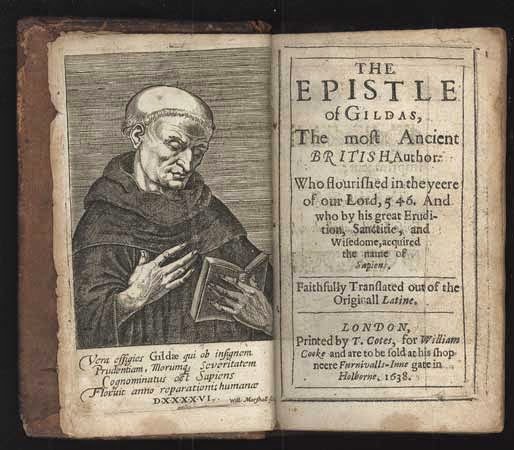
Gildas was a sixth century monk who documented the Saxon invasions of Britain. He mentions Ambrosius Aurelianus, who is a piece of Arthurian legend. Frequently, scholars will pull these Arthurian fragments out of his work De Excidio et Conquestu Britanniae and discard the rest as the crazy polemic of a bitter old monk.

But instead of skimming through all the “boring” parts where Gildas is blaming the Britons for their sins and explaining the Saxon invasion as a punishment for their iniquities, it is useful to consider why Gildas included this. What does it tell us about Gildas? Is he an anomaly in his society or is his line of reasoning shared by many?

Bede, in his Ecclesiastical History of England written a century and a half later, echoes Gildas’ sentiments, saying that the invasion of the Saxons was punishment on the Britons for not sharing the Gospel with other peoples. It seems that this subject was of prime importance to at least the monastic portion of society. Was this opinion shared by society at large?

When we accept medieval chronicles on their own terms, not blindly accepting every word as fact but also not casually dismissing everything we find wrong or irrelevant, that is when we truly begin to learn about the society in which these chronicles were written. When we extend them the same courtesy that we would to a living grandparent, sitting at their feet, learning about what was important to them in “the old days”, that is when we come across the nuggets of gold that we didn’t even know we were looking for.
____

Rosanne E. Lortz is the author of two books: I Serve: A Novel of the Black Prince, a historical adventure/romance set during the Hundred Years' War, and Road from the West: Book I of the Chronicles of Tancred, the beginning of a trilogy which takes place during the First Crusade.

____

BIBLIOGRAPHY
Huizinga, Johan. The Autumn of the Middle Ages. Translated by Rodney J. Payton and Ulrich Mammitzsch. Chicago, IL: University of Chicago Press, 1996.

Thursday, September 4, 2014

“Nor Spare Any Expense to Secure Canada…”: Marquis de la Galissoniere’s Advice for Opposing England

By Rosanne E. Lortz

A cliff notes version of history will tell you that England, later called Britain, began its rise to empire during the reign of Queen Elizabeth I. The defeat of the Spanish Armada in 1588 demonstrated that the English were not afraid to tangle with the toughest of them, and the colonies founded in the New World throughout the next few decades began to spread English influence far and wide.

England was not the only one to establish colonies in North America, however. France set up its own colonies in Canada and New Orleans. As England's longstanding enemies from the old continent, the French extended this rivalry to the new one. As luck would have it (or perhaps climate temperature), the French colonies in the New World did not thrive to the same level as the English colonies did. But although the French colonies did not send streams of gold to their home country, they did help out in at least one significant way--by being a thorn in England’s side.

Roland-Michel Barrin de la Galissoniere

The Marquis de la Galissoniere was the French governor of New France from 1747 to 1749. He was a well-liked, well-educated man who encouraged scientific pursuits in astronomy and cartography. In December of 1750, following his departure from the French Colonies in North America, he wrote a memoir explaining the significance of France’s New World holdings.

The letter focuses mostly on the colony of Canada, with only a few mentions of the large territory of Louisiana. The Marquis' assessment of Canada's amenities was not always complimentary. He called Canada “a barren frontier” that “has always been a burthen to France.” But despite this, he did not recommend that the colony should be abandoned. “By its position…it constitutes…the strongest barrier that can be opposed to the ambition of the English.

How did the Marquis know that Canada was a barrier against English opposition? “We may dispense with giving any other proofs of this," he wrote, "than the constant efforts they have made, for more than a century, against that Colony.”

La Galissoniere pointed out that Canada alone “is in a position to wage war against them [the English] in all their possessions on the Continent of America.” As a strategic base for attacking the English, Canada must be preserved.

Even though the English possessed greater numbers in America, the Marquis noted that the French soldiers from Canada were able to do quite well against the English militarily. The first reason for that was “the great number of alliances that French keep up with the Indian Nations.” The second reason was because of the large number of French Canadians who, “are accustomed to live in the woods like the Indians, and become thereby not only qualified to lead them to fight the English, but to wage war even against these same Indians when necessity obliges.

La Galissoniere encouraged the French to maintain this military superiority in the colonies since it was impossible for them to achieve naval superiority over the English. By the mid-eighteenth century, the English Navy had already become a formidable power and a danger to France. “If anything can, in fact, destroy the superiority of France in Europe, it is the Naval force of the English.”

La Galissoniere was well aware of the difficulty of defeating the English at sea. Though by no means a famous admiral, he did win one naval battle against the English a few years after his stint as governor in the New World. Étienne Taillemite calls the battle a “very modest success” which “created a stir in France out of all proportion to its real importance.” No doubt the stir surrounding the victory was due to the infrequency of such occurrences.

No other resource remains then,” said La Galissoniere, acknowledging the impossibility of French naval supremacy, “but to attack them [the English] in their possessions; that cannot be effected by forces sent from Europe except with little hope of success, and at vast expense, whilst by fortifying ourselves in America and husbanding means in the Colonies themselves, the advantages we possess can be preserved, and even increased at a very trifling expense, in comparison with the cost of expeditions fitted out in Europe.”

Financing a war in Europe was expensive, but financing a war in the colonies was cheap! La Galissoniere goes on to explain how French attacks on the English colonies would also protect Spain’s colonies in Mexico. (In the year 1750, Spain was an ally whose gold France was hoping to profit from.) Following this, he concludes his memoir with this pithy paragraph:
All that precedes sufficiently demonstrates that it is of the utmost importance and of absolute necessity not to omit any means, nor spare any expense to secure Canada, inasmuch as that is the only way to wrest America from the ambition of the English, and as the progress of their empire in that quarter of the globe is what is most capable of contributing to their superiority in Europe.
This memoir written by the Marquis de la Galissoniere is a small but clear window into the politics of the mid-eighteenth century. It shows how the interactions between various European colonies played into the power struggle on the European continent, and how the French were willing to maintain a colony that was “a burthen” if that colony would in any way thwart “the ambition of the English.”

________________________________

Rosanne E. Lortz is the author of two books: I Serve: A Novel of the Black Prince, a historical adventure/romance set during the Hundred Years' War, and Road from the West: Book I of the Chronicles of Tancred, the beginning of a trilogy which takes place during the First Crusade.

________________________________

BIBLIOGRAPHY

"Marquis de la Galissoniere Memoir on the French Colonies in North America December 1750." American History: From Revolution to Reconstruction and Beyond. http://www.let.rug.nl/usa/documents/1701-1750/marquis-de-la-galissoniere-memoir-on-the-french-colonies-in-north-america-december-1750.php (Accessed September 4, 2014).

Taillemite, Etienne. "Barrin De La Galissonière, Roland-Michel, Marquis De La Galissonière." Dictionary of Canadian Biography. http://www.biographi.ca/en/bio/barrin_de_la_galissoniere_roland_michel_3E.html (Accessed September 4, 2014).

Wednesday, July 9, 2014

A Medieval Holocaust: The Church’s Role in Jewish Persecution

By Rosanne E. Lortz

Josephus estimates that the people from all of Judea who at the time of the Passover thronged into Jerusalem, as if to a prison, numbered three million. It was indeed appropriate that in the very days on which they perpetrated the Savior’s passion they should be shut inside a prison, as it were, and receive the destruction meted out by divine justice. Omitting their disasters by sword and other means, I shall relate only their sufferings from starvation, so that readers may learn how quickly God’s punishment followed their crime against Christ…. 
When the fourth century historian Eusebius described the gruesome destruction of Jerusalem in A.D. 70, he considered it divine retribution against the Jews for the part they had played in Jesus’ death. It was a view that would continue into the Middle Ages and color the treatment that many Christians afforded the Jewish population that had dispersed across Europe. While some thought that the destruction of Jerusalem was a sufficient one-time punishment for the Jewish race, others considered all subsequent evils befalling the Jews as their “just deserts.”

The Crusades are remembered as a time of particular cruelty to the Jews. In the late eleventh century, the People’s Crusade, part of the northern branch of the First Crusade, attacked the Jews in the major cities along the Rhine River. Hundreds of Jews perished, many by their own hands so they would not be “defiled” by the swords of the Crusaders.

Crusaders killing Jews during the First Crusade (manuscript c. 1250)

Elizabeth Hallam, in Chronicles of the Crusades, notes three reasons for the Crusaders’ attacks: greed, real need for supplies, and vengeance for the Crucifixion of Christ. Interestingly, however, this desire for “vengeance” on the Jews, while it might have been the popular theology of the day, was not at all the official theology of the Church.

Two decades before the People’s Crusade, Pope Alexander II had called a crusade against the Moors in Spain. In his Case for the Crusades, Rodney Stark says:
It is worth noting that the pope was very concerned that the knights setting out to fight the Muslims not attack Jews along the way. Having directed that the Jews be protected, he subsequently wrote that he was glad to learn "that you protect the Jews who live among you, so that they may not be killed by those setting out for Spain against the Saracens...for the situation of the Jews is greatly different from that of the Saracens. One may justly fight against those [Saracens because they] persecute Christians."
In the massacres in the Rhineland, the medieval chroniclers noted that when the Crusader army drew near, the Jews turned to the Christian bishops of the cities for help. In Speyer, when the Crusaders attacked the Jews in their synagogue, Bishop John gathered a horse troop and drove off the murderers, cutting off the hands of all the burghers who had aided them.

Although the bishops in other cities did not don armor to protect the Jews as Bishop John had done, they did allow the Jews to take refuge in their churches or their homes. In Mainz, the archbishop was bold enough to give the Jews shelter, but when the walls of the city were breached by the Crusaders, his courage left him. He himself fled, and seven hundred Jews were left to their fate.

Count Emico, one of the leaders of the attacks, claimed that, “Whoever killed a Jew would receive remission of sins.” But once again, this “popular theology” was at odds with the official teachings of the Church. Hallam writes:
The massacres did not reflect any official policy of the Church. Forced conversion, for instance, was contrary to canon law, and, although the bishops of the cities involved may have been unwilling to risk their lives for the Jews, this does not mean that any of them favoured their persecution. Contemporary western sources almost invariably condemn the crusaders’ actions.
The violence against the Jews which was sparked by the crusading movement did not reach England until a century later, in the years preceding the Third Crusade. Part of the reason for this is that there were very few Jews in England when the First Crusade was called by Pope Urban in 1095.

Primary sources seem to indicate that there were no Jews residing in England during the Anglo-Saxon period. One chronicler tells us that William the Conqueror first introduced Jews to the country, bringing them over from the city of Rouen after the Conquest in 1066. Henry I, the Conqueror’s son, is recorded to have drafted a “Charter” of liberties for the Jews, and more charters were issued during the reigns of the Plantagenet kings.

In the latter part of the twelfth century, the Jewish population in England increased, and the anti-Semitism of the English population increased as well. Stories began to circulate of the Jews ritually murdering young boys. At King Richard I’s coronation on 3 September 1189, several Jews tried to attend the coronation banquet but were refused entrance. Richard Barrie Dobson, in The Jewish Communities of Medieval England, writes that: “A fracas at the gate led to a full-scale anti-Jewish riot which eventually resulted in the burning of the London Jewry and the loss of at least thirty lives.”

This was only the beginning. In the early part of the following year (1190), several Jewish communities throughout England were assaulted. Up until this time, the English had only participated marginally in the Crusades, but now, King Richard was making preparations to go on the Third Crusade. Dobson notes that in England as well as on the continent, “there was a direct correlation between crusading propaganda against the external Moslem pagan and active hostility to the internal Jewish ‘infidel’.”

Things came to a head in the city of York, and on the night of 16 March 1190, we read about what Dobson calls “the single most famous incident in the history of the medieval English Jewry.”

A riot arose against the Jews and they took refuge in the castle. Afraid that the custodian of the castle would betray them, the Jews barred his own gates against him. This only incited the mob further and convinced them that their attack on the Jews would have royal approval. Dobson writes that: “The Jews were able to defend themselves successfully for several days, a tribute not only to the courage they found in desperation but also to the impregnability of the late twelfth-century English castle.” 

When the attackers constructed siege engines and it was clear that they would soon breach the castle’s defenses, the majority of the Jews took their own lives, setting fire to the castle at the same time. The few Jews who were left appealed for mercy and agreed to be baptized as Christians, but the promises of the victors proved false, and they massacred all the Jews as soon as they exited the castle.

William of Newburgh, one of the contemporary chroniclers, roundly condemns these “cruel butchers” who had slaughtered in cold blood “men seeking Christian grace.” His manuscript makes it clear that not all medievals were as intent on this holocaust as was the mob at York.

When word reached Richard of the massacre, he was angry beyond measure. Not only had the Jews been attacked without his orders, but their deaths had resulted in a significant blow to his tax revenue. He sent his Chancellor to investigate the matter, but sorting out who was to blame in a mob action that had involved a great many of the citizens proved impossible. A fine was imposed on the citizens, weighted more heavily towards those with a greater share of wealth (not necessarily a greater share of guilt).

Interestingly, the Chancellor also took a hundred hostages from the city of York, to assure the city's future good behavior and so that they might stand trial in the court of the king concerning the death of the Jews. It seems, however, that no trial ever took place, and one can only assume that the hostages were eventually released to return to their homes.

Just as during the People’s Crusade, the mob used a religious pretext for the attack and it is recorded that several members of the lower clergy participated in the riot. But despite this, the Church at large considered the murder and mayhem in York to be utterly reprehensible. Dobson mentions that Christian attitudes toward the Jews had shifted somewhat (the Third Lateran Council in 1179 had warned Christians not to associate with Jews), but at the same time, the teaching that the life and property of Jews were to be respected had in no way been rescinded by the Church.

Bernard of Clairvaux
Although one can undoubtedly find scattered incidents where persecution of medieval Jews was encouraged by Church leaders, on the whole, we see that the Church condemned these acts of violence. On the one hand we see demagogues urging frenzied mobs to avenge the Crucifixion of Christ; on the other hand we see bishops standing against the action, holding to these words spoken by Bernard of Clairvaux:
The Jews must not be persecuted, slaughtered, nor even driven out…. They are living signs to us, representing the Lord's passion…. [T]he...Psalm, says, "Scatter them by thy power; and bring them down, O Lord, our shield." So has it been. They have been dispersed, cast down. They undergo a hard captivity under Christian princes. Yet they shall be converted at even time, and remembrance of them shall be made in due season. Finally, when the multitude of the Gentiles shall have entered in, then, "all Israel shall be saved," saith the apostle.
Just as there was a "popular theology" in the Middle Ages which diverged from the Church's actual position on Jewish persecution, so nowadays there is a "popular history" of the Crusades which does not exactly accord with actual events. As a historical novelist, it can be tempting to oversimplify and paint a lurid picture of Christians indiscriminately killing Jews, egged on by greedy bishops and power-hungry popes. But an examination of the sources will show that Church leadership not only condemned attacks on the Jews but also, in cases like Bishop John of Speyer, exercised force to halt the violence.

The medieval bishop as hero? I can't remember the last time I've seen that in a novel. Maybe it's time for that story to be written....

_________________

Rosanne E. Lortz is the author of I Serve: A Novel of the Black Prince, a historical adventure/romance set during the Hundred Years' War, and Road from the West: Book I of the Chronicles of Tancred, the beginning of a trilogy which takes place during the First Crusade.

Rosanne's latest work is The Splintered Oak: A Short Story of the First Crusade which details the difficult choice Archbishop Rothard must make when a crowd of Crusaders come clamoring to kill the Jews in Mainz.


_________________

BIBLIOGRAPHY

Bernard of Clairvaux. "Letter to Eastern France and Bavaria Promoting the Second Crusade, 1146." Council of Centers on Jewish-Christian Relations. http://www.ccjr.us/dialogika-resources/primary-texts-from-the-history-of-the-relationship/258-bernard-of-clairvaux (Accessed July 7, 2014).

Dobson, Richard Barrie. The Jewish Communities of Medieval England: The Collected Essays of R.B. Dobson. Edited by Helen Birkett. York, UK: Borthwick Publications, 2010.

Eusebius. The Church History: A New Translation with Commentary. Edited and translated by Paul L. Maier. Grand Rapids, MI: Kregel Publications, 1999.

Hallam, Elizabeth, ed. Chronicles of the Crusades: Eye-Witness Accounts of the Wars between Christianity and Islam. New York: Salamander Books/Welcome Rain, 2000.


Thursday, June 5, 2014

England and Flanders: A Love Story

By Rosanne E. Lortz

In Flanders fields the poppies blow
Between the crosses, row on row,
That mark our place; and in the sky
The larks, still bravely singing, fly
Scarce heard amid the guns below....

Nowadays, the place name “Flanders” typically evokes the World War I poem by John McCrae and the sadness and loss that war brings. But in the Middle Ages, Flanders evoked a far different image—a bustling county renowned for its clothiers and its commercial ties with England.

Medieval Flanders, when juxtaposed with a modern map, overlaps the top right corner of France and a portion of Belgium and the Netherlands. The territory was part of the Carolingian domain under Charlemagne, but interestingly enough, its foundation as a County in its own right came about because of an English princess—or rather, a Carolingian princess who had been sent to England and then returned to her homeland.

When Alfred the Great was seven years old, his father Æthelwulf formed an alliance with the French king Charles the Bald by marrying his daughter Judith, a girl of no more than fourteen years old. In his History of Flanders, Charles Vanderhaegen describes Judith's unfortunate situation:
...Judith…was married off to the Anglo-Saxon king Ethelwolf, who was over 50 years old. 18 months later she became a widow and was married off again, this time to Ethelbald, a son to Ethelwolf from a previous marriage. He also died a few years later and Judith was promptly accused of incestuous relations to her stepson and expelled from England. Just like all kings from that time, Karel de Kale [Charles the Bald] sacrificed everything, including his daughter, for his political plans. So he locked her up in the castle only to free her for a future beneficial marriage.
At this point, while still imprisoned in a castle, Judith attracted the attention of a visiting nobleman named Baldwin. Although she had already had two husbands, Judith was not more than twenty years old and was reputed to be a beauty. Baldwin and Judith fell in love. Vanderhaegen writes:
Boudewijn [Baldwin] did not really count on getting Karel De Kale's [Charles the Bald’s] approval to marry his daughter as he was a mere subordinate. He therefore decided to free Judith from her prison by abducting her. He was aided by her younger brother prince Lodewijk, later to become Louis II of France, nicknamed the Stutterer. For some unknown reason he favoured a marriage between his sister with Boudewijn. Louis informed Judith of Boudewijn's marriage plans and in a specific night, sometime in 860, Judith disguised herself and escaped her guards. She left the castle and met Boudewijn outside the gates. Together they returned to Boudewijn's home.
But the star-cross’d lovers were not to have their happily ever after quite so easily. Charles the Bald was enraged by his daughter’s disobedience, and they were forced to flee to the neighboring kingdom of Lorraine.

Judith’s father demanded that the king of Lorraine (a cousin from the Carolingian line) return his daughter and her “husband”. To apply pressure on the couple, Charles confiscated all of Baldwin’s property and convinced the Carolingian clergy to excommunicate him.

But according to Vanderhaegen, Baldwin was not so easily intimidated: “He communicated to Karel [Charles] that if he was not reinstated and if Karel did not acknowledge his marriage, he would make a treaty with the Norsemen who had invaded the Frankish empire around 800 and who pillaged northwards and took power over that area.”

Although Charles chose to ignore this threat, the local clergy did not. The Archbishop of Reims alerted the pope about this very serious matter. The lovers went to Rome to present their case and won the pope over to their side.

However much it might have galled him, Charles was not powerful enough to go against the pope. A settlement was reached. Charles acknowledged the marriage and even presented Baldwin with a dowry of land.

Institution of Baldwin I, the first count of Flanders by Charles the Bald, the Frankish king.


Baldwin proved himself to be, if not the son-in-law that Charles wanted, then at least the son-in-law that Charles needed. Instead of going over to the “dark side” as he had threatened, he earned the nickname Ferreus (“Iron Arm”) by protecting the Carolingian kingdom against Viking incursions. Through Charles' begrudging generosity and his own prowess, he became the first Count of Flanders, ruling a County that would last for hundreds of years and become an important power on the continent.

Not much is known about the couple in the succeeding years, but Judith, who had been childless in her previous two marriages, gave birth to at least three sons and one daughter. And as if Judith’s connections with the royal line in England had not been tangled enough, her son Baldwin II ended up marrying Ælfthryth, the daughter of Alfred the Great (who had been Judith’s stepson/brother-in-law).

A century and a half later, there came another English connection. William soon-to-be-the-Conqueror married Matilda of Flanders (although one story of their courtship—of William dragging Matilda by the hair after she refused to marry him—is not quite as romantic as the story of Baldwin and Judith…).

As the centuries went by, the County of Flanders became an increasingly important player in French affairs. In the latter part of the twelfth century, the Flemish Count held as much territory as the French king held directly, and Flanders enjoyed a period of great prosperity.

The bulk of this prosperity was due to the thriving commerce between Flanders and England. And the bulk of the commerce was due to English sheep and Flemish looms. Historian Elizabeth Hallam writes that beginning in the eleventh century, “wool accounted for half the wealth in England.” Some of this wool was exported to Italian weavers, but most of it went to Flanders. Hallam says:
The stimulus for the wool trade came from Flanders, whose powerful counts had in the 11th century imposed a long period of peace on the region. With peace came prosperity and a rise in population: food shortages resulted and many Flemings emigrated. Others moved to the burgeoning Flemish cities, where they worked in the region’s rising industry, cloth manufacture…. English wool production expanded to meet [this demand]. As early as 1194 England grazed around six million sheep, and produced up to 50,000 sacks of wool a year. 
This mutually beneficial relationship between Flanders and England lasted for several hundred years—until the English Edwards killed the goose that laid the golden eggs by putting too high a tariff on wool export.

As the English began to make their own cloth (and as the Black Death spread across Europe), the County of Flanders went into a decline. In 1369, the Duke of Burgundy took possession of Flanders as part of his wife’s dowry, and from that point onward the County of Flanders was no longer independent.

In terms of size, the County of Flanders was not a large piece of medieval Europe, but the part it played in England’s economy was a pivotal one. And while the symbiotic relationship that English shepherds and Flemish weavers shared across four centuries is not quite as dramatic a love story as that of Judith and Baldwin, it is still a romance worth reading about—a romance that contributed to the success of a country that had half of its money wrapped up in wool.

____________

Rosanne E. Lortz is the author of two books: I Serve: A Novel of the Black Prince, a historical adventure/romance set during the Hundred Years' War, and Road from the West: Book I of the Chronicles of Tancred, the beginning of a trilogy which takes place during the First Crusade.

You can learn more about Rosanne's books at her Official Author Website where she also blogs about writing, mothering, and things historical.

____________
BIBLIOGRAPHY

Hallam, Elizabeth, ed. Chronicles of the Age of Chivalry. London: Salamander Books, Ltd., 2002.

Vanderhaegen, Charles. The History of Flanders. Trans. Herman Boel. http://www.hermanboel.eu/en-dossiers-hist03.htm (Accessed June 4, 2014).

Thursday, May 1, 2014

The Birth of Heraldry in the Middle Ages

By Rosanne E. Lortz

It is not much of an exaggeration to say that average readers see the entire span of the Middle Ages as a homogeneous mass of history. They assume that everything from the fall of Rome up until the Battle of Bosworth is filled with highborn damsels in flowing dresses and armored knights with lions rampant on their shields.

"The Accolade" by Edmund Blair-Leighton
The King Arthur legend has not helped matters. Arthur supposedly lived in the sixth century—that beginning of the Middle Ages which is sometimes referred to as the Dark Ages—however, many of the legends and tales concerning him and his Round Table were invented during the High Middle Ages, six hundred years later.

Naturally, these tales took on the clothing and characteristics of the twelfth and thirteenth centuries, rather than the realities of the sixth, further muddling up our ideas of what part of the Middle Ages looks like what. The complex system of knightly tournaments and symbolic heraldry in the Arthur legends makes us assume that such was the case through the whole of the Middle Ages.

My first novel, I Serve: A Novel of the Black Prince, is set during the fourteenth century, in the chivalric world that many associate with the whole of the Middle Ages. But when I began researching my second novel, Road from the West, a tale of the First Crusade set at the end of the eleventh century, I found myself having to expunge many of my “stock” medieval notions in order to be more authentic to the time period.

Two hundred and fifty years can effect radical changes. The differences between the eleventh century knight and the fourteenth century knight might not be quite as dramatic as the differences between the Lexington militiaman and the modern day Navy Seal, but they are there nonetheless.

One example of the difference is in the use of heraldry. In the fourteenth century world of the Black Prince, every character had an emblem on his shield, specific colors in his banner, and a motto he had adopted—many of these devices having been passed down from father to son. In the eleventh century, these defining characteristics of knighthood had not yet developed.

Historian Elizabeth Hallam writes:
Heraldry—the systematic use of hereditary devices—attained its maturity under the later Plantagenet kings. Symbols like the Roman eagle, the dragon of Wessex and the Viking raven had been known for centuries, but these belonged to peoples, not particular people.
At the time of the Norman Conquest, a mere thirty years before my setting of the First Crusade, we begin to see knights taking up specific symbols for themselves, but, according to Hallam, these “seem to have been personal rather than inherited.” 

Francois Velde writes:
The Bayeux tapestry provides a terminus a quo: no heraldry there. Combatants have designs on their shields, but the same design is seen on different individuals' shields (even on opposite sides of the battle) and the same individual uses different designs at different times.
In other words, the symbols adopted by eleventh century knights seem rather random, and certainly not something passed from father to son. It is not until the twelfth century when we see the Plantagenets taking the golden lions for their coat-of-arms and passing them down from father to son.

The nondescript knights of the Bayeux Tapestry

So why the change? Why do my knights of the First Crusade have no family crest to deal with, whereas my knights of the Hundred Years’ War are awash in stripes, blocks, chevrons, lions, dragons, and other heraldic beasts?

Velde says the change was
 …due to the evolution of military equipment from the late 11th to the mid-12th c, with fighters unrecognizable under their helmets (there is a nice illustration from the 11th century Bayeux tapestry showing William lifting his helmet so as to be recognized by his troops in battle). This led fighters to paint emblems on their shields. The question is then to establish a proper chronology of this emergence and of the transformation of these emblems into armory, i.e., constant use of one design by the same person and application of strict rules in the design itself.
Hallam agrees with this assessment. “Protected by an enveloping helm instead of the old open-faced Norman helmet, knights were unrecognizable in battle or tournament except by the devices emblazoned on shield, surcoat (or ‘coat-of-arms’) and horse trappings.” 

The greater protection afforded by the new helmets also afforded a virtual anonymity. To be recognizable, a knight must adopt a consistent symbol which others would associate with his name.

Velde (summarizing the work of heraldry expert Pastoureau), says that we can distinguish two phases in the birth of heraldry: “the transformation of decorative motifs painted on shields into permanent and individual emblems (1100-1140) and the transformation of the latter into hereditary emblems subjected to precise rules (1140-80).”

So, that red flag that my eleventh century Duke Bohemond flies from the towers of Antioch? A mere whim. No connection to his family heritage. Probably only hung there because he liked the color red.

Those three golden lions on my fourteenth century Black Prince’s shield? The established coat-of-arms of the Plantagenets, seen in an early form on Geoffrey of Anjou’s shield, seen again as a pair of lions on Henry II’s shield, and formalized to three lions in 1198.

Just one of the many differences that two-and-a-half centuries make in the complex period known as the Middle Ages….

________________________________

Rosanne E. Lortz is the author of two books: I Serve: A Novel of the Black Prince, a historical adventure/romance set during the Hundred Years' War, and Road from the West, the beginning of a trilogy which takes place during the First Crusade.

You can learn more about Rosanne's books at her Author Website where she also blogs about writing, mothering, and things historical.

________________________________


BIBLIOGRAPHY

Hallam, Elizabeth, ed. Chronicles of the Age of Chivalry. London: Greenwich Editions, 2002.

Velde, Francois. "Origins of Armory." Heraldica. http://www.heraldica.org/topics/origins.htm

Thursday, April 3, 2014

Was Richard the Lionheart a Homosexual?

by Rosanne Lortz

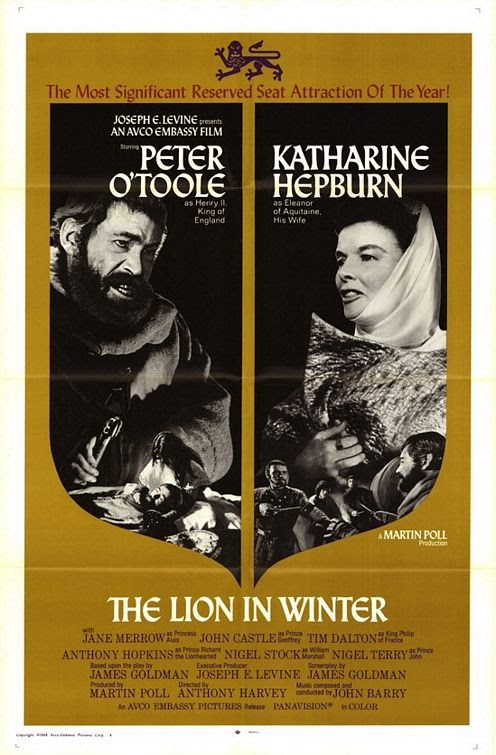
I still remember watching it for the first time. The Lion in Winter. The first historical piece that I encountered which asserted that Richard the Lionheart was a homosexual.

Naturally, I could hardly help wondering whether the portrayal was accurate. What evidence did the playwright and screenwriter James Goldman have for depicting Richard in this manner? Why had none of the history books I had read during my teenage years mentioned it?

Doing a little research, I discovered that no one had seriously mooted the idea that Richard the Lionheart was a homosexual up until the middle of the twentieth century. At this time a case for Richard's homosexuality was made based on these three points:

  1. He had no children (except for possibly one illegitimate son);
  2. He didn't seem very interested in getting married (deserting his wife Berengaria right after they tied the knot);
  3. In his early days, he had a very close relationship with Philip Augustus of France. 

When I saw these three points, I had to wonder if the case they made for Richard’s homosexuality was actually a compelling one. I researched a little more….

The first fact, that Richard had no children, is neither here nor there. It does not take a genius to think of other reasons for childlessness than being a homosexual. And in the medieval world, a homosexual king would have likely also been married (to a woman) and fathered children (the kings Edward II and James I come to mind), because no matter what one’s sexual proclivities were, producing an heir and preserving dynastic succession was paramount.

The second assertion, that Richard wasn’t very interested in marriage or in Berengaria, is, if you believe the well-respected novelist Sharon Kay Penman, surprisingly incorrect. In an interview with the Historical Novel Society, Penman said:
Another myth is that Richard was reluctant to wed Berengaria and Eleanor had to push him into it; he was actually the one who negotiated the marriage with Berengaria’s father…. I was surprised to discover that Richard went to some trouble to have her with him during their time in the Holy Land.
Although their marriage does not appear to have been one of the world’s greatest love matches, there is no evidence of “reluctance to marry” on Richard’s part, a fact which has been used to bolster the argument for his homosexuality.

Philip Augustus and Richard the Lionheart

The final piece of evidence used to prove Richard’s homosexuality is his relationship with the French king Philip Augustus. One of the most pertinent primary source excerpts says:
And after this peace, Richard the Count of Poitou remained with the king of France against the will of his father; and the king of France was honoring him in such a way that each day they would eat together at one table from one dish, and in the night their bed did not separate them. And because of this exceeding love which appeared between them, the king of England [Henry II] was struck with much astonishment and marveled at this, and being on his guard for himself in the future, sent his messengers frequently to France to recall his son Richard....
So, there you have it. “In the night their bed did not separate them.” But does this text give a homosexual connotation to Richard and Philip sharing a bed? Not really. It seems to be just another way that Philip was honoring Richard. Although my husband would probably object to sharing a bed with another man, we must remember that in the Middle Ages, men (yes, heterosexual men) shared beds all the time.

Some have read into this text that Richard's father Henry is upset about the strange relationship developing between his son Richard and Philip, the King of France. The text clearly shows that he is upset, but it does not seem to be from a fear of homosexual activity. His son Richard is befriending the longtime enemy of England, and Henry is trying to stop them from allying against him.

Judging this quote by the standards of the time it was written in, I think it is fair to say that the author is making no implications, veiled or otherwise, of homosexual relations between Richard and Philip.

So, given what we know about the evidence, was James Goldman within his rights to depict a homosexual relationship between Richard the Lionheart and Philip Augustus? Certainly. His play The Lion in Winter is, after all, a work of historical fiction. But viewers (and readers) must always keep in mind that the historical fiction writer deals with the realm of possibility, and not necessarily the realms of plausibility or probability.

____________________________

Rosanne E. Lortz is the author of two books: I Serve: A Novel of the Black Prince, a historical adventure/romance set during the Hundred Years' War, and Road from the West: Book I of the Chronicles of Tancred, the beginning of a trilogy which takes place during the First Crusade.

You can learn more about Rosanne's books at her Author Website where she also blogs about writing, mothering, and things historical.

Thursday, February 20, 2014

A Fictitious Young Lady of Fashion in the 1700's

By Rosanne E. Lortz

In the year 1926 a manuscript titled The Diary of a Young Lady of Fashion in the Year 1764-1765 was published. The book purported to be a recently unearthed diary which had been written by the witty, effervescent, and not entirely wise Cleone Knox, a young lady who had traveled around eighteenth century Europe meeting notable figures like King Louis XV and the philosopher Voltaire. The diary was a publishing success, well-received by twentieth century literary critics. The diary also happened to be a fraud.

A Gainsborough portrait of a fashionable lady
from the same era as Cleone Knox

Cynthia Crossen of The Wall Street Journal writes that:
Critics declared the diary authentic partly because it contained obsolete expressions and spelling and lots of capital letters. "Her diary must take its place beside that of Mr. Pepys," one critic wrote. Another opined, "No modern girl will ever write a diary like this. Cleone Knox breathes the very spirit of the witty, robust, patriotic, wicked, hard-drinking, hard-swearing 18th century."
It was only after the diary went through several printings both in America and England that the real author of the eighteenth century memoirs fessed up. The book had been written by Magdalen King-Hall, a nineteen-year-old with a lively imagination and a penchant for jokes. "If I had realized that so many distinguished persons would take it seriously,” said King-Hall, “I would have spent more time and pains on it."

Cleone’s visit with Voltaire is an especially memorable episode, mostly because of how irreverent it is. "The great man received us in a chintz dressing gown,” she wrote—or rather, King-Hall wrote. “To tell the truth, he reminded me of nothing so much as a chattering old magpie. We listened, silent, with the Respect which is due to Genius, however Wearisome it may be.

But it is the opening entry in the diary which is my favorite, the entry which sets the tone for the rest, and the entry in which King-Hall introduces her eighteenth-century protagonist.
March 3rd  
This morning had a vastly unpleasant interview with my Father. Last night, Mr. Ancaster, who is the indescreetest young man alive, was seized suddenly while riding home along the shore with the desire to say good night to me. He climbed the wall, the postern gate being locked at the late hour, and had the Boldness to attempt to climb the ivy below my window; while but half way up the Poor Impudent young man fell. (If he hadn’t, Lord knows what would have happened, for I am terribly catched by the Handsome Wretch.) As ill luck would have it, Papa and Ned, who were conversing in the library, looked out at the moment and saw him lying Prostrate on the ground! 
No need to describe the scene that followed. My Father it seems thinks me guilty of Indescretion and Immodesty, though why I don’t know, for I was sound asleep the whole time and never heard so much as an Oath (and I dare swear there were plenty flying round!). My father said some mighty unkind things to me this morning and I wept loudly for more than Half an Hour. 
Men are such Silly Fools. 
Although the book turned out to be more fictitious than factual, it still managed to enthrall twentieth century readers who were as “terribly catched” by the clever Cleone as she was by the “indescreet” Mr. Ancaster. In The Diary of a Young Lady of Fashion, we experience the winsomeness of a young woman who may not really have lived, but still manages to fill the pages of history as one of the eighteenth century’s most memorable heroines—historical fiction at its best.

Magdalen King-Hall went on to become a historical novelist in a more forthright fashion, writing historicals set during the Crusades, and also in sixteenth, seventeenth, and—yes—eighteenth century England. Her novel The Life and Death of the Wicked Lady Skelton, the story of a lady and a highwayman, was made into a film the same year it was published, receiving the title The Wicked Lady (1945) and starring Margaret Lockwood and James Mason.

_________________

Rosanne E. Lortz is the author of two books: I Serve: A Novel of the Black Prince, a historical adventure/romance set during the Hundred Years' War, and Road from the West: Book I of the Chronicles of Tancred, the beginning of a trilogy which takes place during the First Crusade.

You can learn more about Rosanne's books at her Official Author Website where she also blogs about writing, mothering, and things historical.


_________________

BIBLIOGRAPHY

Crossen, Cynthia. “This Column Is Real, But Not All Authors Stick to the Truth.” The Wall Street Journal (April 7, 2008). http://online.wsj.com/article/deja_vu.html.

Knox, Cleone. The Diary of a Young Lady of Fashion in the year 1764-1765. Edited by Alexander Blacker Kerr. New York: D. Appleton and Co., 1926.

Wednesday, January 8, 2014

Alfred and the Battle of Ashdown

By Rosanne E. Lortz

Before the gods that made the gods 

Had seen their sunrise pass,
The White Horse of the White Horse Vale 
Was cut out of the grass. 
Before the gods that made the gods 
Had drunk at dawn their fill, 
The White Horse of the White Horse Vale 
Was hoary on the hill. 
Age beyond age on British land, 
Aeons on aeons gone, 
Was peace and war in western hills, 
And the White Horse looked on….

Thus begins G.K. Chesterton’s epic poem The Ballad of the White Horse, the tale of King Alfred’s struggle against the Danish invaders. The poem begins in the middle of things, with the Danes having nearly conquered all of England and Alfred in hiding on the island of Athelney. The bulk of the poem deals with the Battle of Ethandun (more commonly known now as the Battle of Edington), where Alfred defeated the Danish king Guthrum and swore the Vikings to a treaty that would keep them out of the land of Wessex.

The victory at the Battle of Edington is probably the most famous moment of Alfred’s career, the story most retold in the histories of ninth century England. But seven years before Edington there was another battle, the Battle of Ashdown, that also resulted in a victory. It was the battle where Alfred won his spurs, so to speak. It was the battle where an untried leader, the youngest of five brothers, gave glimpses of the greatness that was to come. And coincidentally, it took place on January 8, one thousand one hundred forty-three years ago today.

The backstory to the Battle of Ashdown begins as any incident involving the Vikings must. Bishop Asser records that:
In the year of our Lord's incarnation 871, which was the twenty-third of king Alfred's life [i.e. he was twenty-two], the pagan army, of hateful memory, left the East-Angles, and entering the kingdom of the West- Saxons…scoured the country for plunder….
The Danes, or “pagan army” as Bishop Asser terms them, surprised and captured the town of Reading. From there, they began to send out raiding parties to loot the surrounding farms. The locals did an admirable job fending off the Danes until their king, Æthelred, arrived four days later, accompanied by his younger brother Alfred and the hastily gathered military of Wessex.

In his book The White Horse King, Benjamin Merkle notes that:
This would be the first actual combat that either Æthelred or Alfred had ever faced. The closest the two brothers had come to real fighting had been during the siege of Nottingham—a siege that had been resolved with the payment of the danegeld rather than with the sword point. Now Æthelred, twenty-five, and Alfred, twenty-two, arranged the might of Wessex for an assault on the Viking defenses, a daunting task. 
What followed was a disaster—as assaults on well-fortified towns held by skilled opponents often are. After much blood had been spilled, and after Æthelred, Alfred, and the men of Wessex had failed to breach the Danish defenses, their enemies poured through the gate and the attackers fled in a panicked retreat.

It was an inauspicious introduction to the world of warfare. But rather than giving up all hope, Æthelred, and Alfred managed to regroup the army for another attempt. The Danes sallied forth out of Reading to find more cities to pillage, and a few days later the army of Wessex “encountered the pagan army at a place called Ashdune, which,” as Bishop Asser tells us, “means the ‘Hill of the Ash.’” The exact location of the Battle of Ashdown is debated by historians, but popular tradition places it at Whitehorse Hill—where the famous stylized horse is carved into the grassy hillside, the white chalk horse that G. K. Chesterton refers to in his epic poem.


But whether or not it was on the slopes of Whitehorse Hill, it is certain that the Danes held the higher ground at Ashdown, looking down from the hill onto the West Saxons ranged below. Bishop Asser wrote:
The pagans had divided themselves into two bodies, and began to prepare defences, for they had two kings and many earls, so they gave the middle part of the army to the two kings, and the other part to all their earls. Which the Christians perceiving, divided their army also into two troops, and also began to construct defences.
Æthelred, being the king, was to engage the Danish kings. Alfred would engage the part of the Danish army led by the earls. Merkle notes that with Alfred’s lack of military experience and with the disaster at Reading fresh on everyone’s minds, “he had little to commend himself to the men of Wessex who were now expected to follow him up the soon-to-be-bloodied slope of Ashdown.”

The Danish warriors started to yell their usual taunts from the top of the hill, insulting the West Saxons’ parentage and manhood to the best of their abilities. Merkle writes:
But far more dismaying to Alfred than the taunting force on the hillside ahead was the absence on either flank of his brother and the second half of the Wessex army. The plan had been for both Alfred and Æthelred to immediately muster their forces and march to face the Danes. But Æthelred was nowhere in sight.
Where was Æthelred? Bishop Asser tells us that he was in his tent praying and hearing mass. And despite the fact that the battle was ready to be joined, he refused to put on his armor until the priest was done. His actions—or rather, his inaction—can either be seen as very pious or very cowardly. It certainly placed Alfred in a difficult position.

Returning to Bishop Asser, we read that “Alfred, though possessing a subordinate authority, could no longer support the troops of the enemy, unless he retreated or charged upon them without waiting for his brother.” Inexperienced as he was, Alfred discerned that he needed to act now, before the Danes swept down the hill like a tidal wave uprooting everything in their path. And so, despite the absence of his brother the king and despite the lack of a full half of the Saxon army, Alfred did what he had to. He charged up the hill—where the Vikings possessed both better ground and superior numbers.

The results were markedly better than the assault on Reading that the Saxons had made four days ago.
And when both armies had fought long and bravely, at last the pagans, by the divine judgment, were no longer able to bear the attacks of the Christians, and having lost a great part of their army, took to a disgraceful flight. One of their two kings, and five earls were there slain, together with many thousand pagans, who fell on all sides, covering with their bodies the whole plain of Ashdune.
In the above description of the battle, Bishop Asser does not mention the turning point of the battle which sent the “pagans” into “disgraceful flight.” When Alfred’s men charged up the hill, the Danes supposed that they were facing the whole of the Wessex army. They formed a shield wall and concentrated all their forces on Alfred.

When Æthelred finally finished his prayers and led the second half of the army against the enemy flank, the Danes were taken completely by surprise. In stark contrast to the battle at Reading, it was now the invaders’ turn to panic. Their shield wall crumbled and they fled pursued all day and all night till they reached the cover of the defenses they had erected at Reading.

In terms of significance, the Battle of Ashdown was not a great turning point militarily. The men of Wessex had lost a great deal of their number, just as the Danes had, and the weakened Wessex army was still unable to drive the Danes out of their stronghold. The Saxons suffered two more crushing defeats in the succeeding months, and Æthelred , receiving a serious wound, died not long afterward from infection.

The significance of the Battle of Ashdown lies in this—that it was a great turning point in the life of Alfred and in the confidence of the Saxons. Up until this point, Alfred had never led an army to victory. And up until this point, the Saxons had never defeated this large a company of Danes in pitched battle.

The Battle of Ashdown, on January 8, 871, showed the people of West Sussex that there was hope—that their enemies were not as invincible as they had feared, and that their soon-to-be king Alfred had the intelligence and the courage to overcome them.
___________________

Rosanne E. Lortz is the author of two books: I Serve: A Novel of the Black Prince, a historical adventure/romance set during the Hundred Years' War, and Road from the West: Book I of the Chronicles of Tancred, the beginning of a trilogy which takes place during the First Crusade.

You can learn more about Rosanne's books at her Official Author Website where she also blogs about writing, mothering, and things historical.

___________________

BIBLIOGRAPHY

Asser. The Life of King Alfred. Trans. J.A. Giles. http://omacl.org/KingAlfred/ (accessed January 6, 2014).

Chesterton, G. K. The Ballad of the White Horse.  http://www.archive.org/stream/theballadofthewh01719gut/botwh10.txt (accessed January 6, 2014)

Merkle, Benjamin. The White Horse King: The Life of Alfred the Great. Nashville, TN: Thomas Nelson, 2009.

Tuesday, December 17, 2013

English vs. French: The Hundred Years' War and Its Effect on Language

By Rosanne E. Lortz


…we few, we happy few, we band of brothers.

The St. Crispin’s Day speech, written by Shakespeare and placed in the mouth of King Henry V, contains some of the most stirring phrases in the English language. Yet, interestingly enough, that very language might not have been what spilled from Shakespeare’s pen had the Hundred Years’ War not been fought.

Before the war began in 1337, French—not English—was the language of literature and the language of the aristocracy in England. It does not take much digging around to unearth why. The Norman Conquest in 1066 established a monarchy and a ruling class who spoke French, and the later Plantagenet kings—Richard the Lionheart comes to mind—continued to spend as much (or more) time in their continental holdings as they did in England.

English, the language of the conquered Anglo-Saxons, existed of course, but only for menial, non-important purposes. Historian Elizabeth Hallam writes that:
Although in 14th century England everyone spoke some form of English, French was still the language of polite society, and used for less formal governmental business which was not transacted in Latin. The country gentry and middle class continued to use French for normal correspondence: there are almost no extant English letters before 1400. Proclamations in London were still made in French, which was also the language of the law….
So what changed? How did the language of English gain ascendancy over French? Hallam hypothesizes that, “the transformation was almost certainly a result of the surge of patriotism and nationalism associated with the Hundred Years’ War: the French language came to be associated with the enemy.”

During the same time period that the battles of Crecy and Poitiers were fought, schools began to use English in the classroom as a medium with which to teach Latin. And in 1363, a couple years after the treaty of Bretigny, “parliament was opened by a declaration of the summons in the native tongue,” something that had previously always been done in French. According to the philologist Oliver Farrar Emerson, “Soon English petitions to parliament, English wills, letters, and gild statutes appear.”

Because of the war with France, the language of English began to be used by all levels of English society for all manner of purposes. Books were the last hold out. But by the last quarter of the century, Geoffrey Chaucer showed that the vernacular could be a fitting vehicle for great literature, and English began to be used in that arena as well.

The change in language effected by the Hundred Years' War was radical. At the beginning of the fourteenth century, French was the accepted language of all formal discourse in England. By the end of the fourteenth century, Oxford University was forced to urge the learning of French “lest the Gallic tongue be utterly forgotten.”

Which leads us back to one of those interesting what-if’s in history: if not for the Hundred Years’ War and the animosity it created between French and English, would the Bard’s St. Crispin’s Day speech have been written entirely in French?

…nous frères d’armes.”

______________________

Rosanne E. Lortz is the author of I Serve: A Novel of the Black Prince, a historical adventure/romance set during the Hundred Years' War, and Road from the West: Book I of the Chronicles of Tancred, the beginning of a trilogy which takes place during the First Crusade.

You can learn more about Rosanne's books at her Author Website where she also blogs about writing, mothering, and things historical.

______________________

BIBLIOGRAPHY

Emerson, Oliver Farrar. “English or French in the Time of Edward III.” Romanic Review 7.2 (April-June 1916): 127-143.

Hallam, Elizabeth, ed. Chronicles of the Age of Chivalry. London: Salamander Books Ltd., 2002.


Tuesday, November 12, 2013

"The Pope May Be French, but Jesus Is English!": England and the Avignon Papacy

by Rosanne E. Lortz


The Pope may be French, but Jesus is English!” It’s a zinger that always brings a laugh in the 2001 film A Knight’s Tale.

While most of this “period” film is the product of the screenwriter’s fertile imagination, this particular line is culled from the pages of history itself. It was a statement the exultant English made after the Black Prince trounced the French in the early part of the Hundred Years’ War, and it was what the English bitterly believed—and not without reason—all throughout the fourteenth century.

Battle of Crecy (1346) 

England’s connection with the papacy goes back to the earliest centuries of the Middle Ages. Augustine, the first Archbishop of Canterbury, was sent to evangelize the Anglo-Saxons by Pope Gregory I. Later, King Alfred, as a young child, went on a pilgrimage to Rome, asking the pope to intercede with God in prayer for the English as they battled the invading Vikings.

In the lay investiture controversy of the high Middle Ages, the popes supported the archbishops against the kings of England as Anselm clashed with the Conqueror’s sons and Thomas Becket battled Henry II. This controversy climaxed in the early thirteenth century, with King John capitulating to Pope Innocent III and even rendering him fealty for the country of England.

England, technically, now belonged to the pope, and in return for John’s allegiance, Pope Innocent helped his “vassal” against the French king Philip Augustus.

This concord between the pope and England did not last long, however, due to the close connection that formed between the see of Saint Peter and the throne of France. In 1309, Clement V, a Frenchman who had been elected pope, refused to go to Rome and moved the papal seat to Avignon. For the next 67 years, the pope ruled from that French city.

As might be expected, the pope’s favor was now heavily weighted toward the French, and much of the papal policy during this period was directly due to the French crown’s influence. In England there was a “manifestation of popular feeling” against the prejudiced papacy. Historian Henry Dwight Sedgwick writes that, “the English people believed, and so did the Prince of Wales with a vengeance, that [the papacy] used all its influence on behalf of France.

In 1374, the Black Prince’s father, Edward III, called a council with all the bishops and lords of the realm to ask their advice on a certain matter. One contemporary chronicler describes the scene thus:
Then the Chancellor announced that the cause of the convocation was this: ‘The Pope has sent to our Lord the King a bull in which he writes that, as he is the lord of all temporalities through the vicarate of Christ, and also the spiritual and paramount lord of the Kingdom of England through the gift of King John, he commands the King to levy a tax to aid him against Florentine rebels and others, and not to delay sending it to him….
In plain and simple terms, the pope was trying to strong-arm money out of King Edward. The council had been called because the king wanted to know if he was theologically obliged to pay it.

The chronicler goes on to tell how the Archbishop and all the bishops of the realm agreed with the pope’s demand, citing the standard example of the two swords (as outlined in the papal bull “Unam Sanctam”). In a nutshell, the “two swords” doctrine used the Bible verse Luke 22:38 (“And they said, Lord, behold, here are two swords. And he said unto them, It is enough.”) as proof that all spiritual and earthly power had been given to the pope as Peter’s successor.

St. Bernard of Clairvaux, the possible author of the "two swords" doctrine

According to his churchmen, King Edward was obliged to pay the pope’s tax.  It was not the answer the king wanted. He did not want to give money to a lackey of the French king.

At this point, John Mardisle, a Franciscan friar and a master in theology whom the king had especially invited to the council (and perhaps conferred with beforehand?), stood up to challenge the prevailing opinion.
He quoted [Christ’s command to Peter]: ‘Put up thy sword unto the sheath,’ and showed that the swords did not signify such powers; for Christ did not possess temporal lordship, and did not pass it on to His disciples, but taught them to turn from it. This he proved by Holy Writ, by the Gospels, by the opinion of learned men…and by the decretals themselves he showed that the Pope admitted that he did not have universal lordship.
Such was the friar’s eloquence that he convinced all present (although, to be fair, the king and his lords were only too happy to be convinced) that the pope was overreaching his power when he demanded money.

The Archbishop, in somewhat of a huff that his opinion had been disregarded in favor of John Mardisle’s arguments, remarked snarkily that, “There has been good counsel in England without Friars.

But the Black Prince, as much averse to the papal tax as his father, responded with equal acidity: “Because of your foolishness we were obliged to call them. Had we followed your counsel, we should have lost the Kingdom.”

On the next day, when the Archbishop and prelates of the realm were again asked by the king to give their opinion on the matter, the Archbishop—who seems to have still been in quite a snit—said that he did not know what to say. The Prince, according to the chronicler, responded, “Answer, you Jackass! It is your business to instruct all of us.” (The chronicler takes pains to excuse the prince’s rude behavior, for “when he was ill, the wild Plantagenet blood unloosed the customary restraint of his gentle manners.”)

And with the Black Prince berating him thus, “the Archbishop answered: ‘My voice is that the Pope is not lord here,’ and all the prelates accordingly said the same.

With this victory, the prince, it seems, was not yet willing to let the subject alone. “What has become of the two swords?” he asked, rubbing salt in an open wound.

My Lord, I am better instructed now than I was,” replied the cleric who had voiced the doctrine the previous day.

And so, thanks to the arguments of the Franciscan friar, King Edward refused to pay the tax to the pope with a clear conscience.

Papal Palace in Avignon, France
It was not long after this incident that the Avignon papacy came to an end, and Pope Gregory XI returned the seat of the papacy to Rome in 1376. With the pope no longer under the thumb of the French king, English antipathy toward the papacy abated.

The French, however, were loath to lose their influence over the highest churchman in the West. They backed a rival claimant to the papacy, and a second pope, known as the antipope again set up rule back at Avignon. This instigated what is known as the Great Schism with two different popes both claiming to be the true successor of Saint Peter.

The schism was over a political rather than a theological matter. The kings of Europe took sides, with England, the Holy Roman Empire, and the Scandinavian countries accepting the Roman pope, and France, Scotland, and the Spanish kingdoms siding with the usurper in Avignon. The matter was not fully resolved until 1418 at the Council of Constance where the rule of the Roman pope was upheld.

Once again, England was able to be on proper terms with the acknowledged head of the Western church…for another century, at least, until Henry VIII would behave with as much belligerence as the Black Prince, berating his bishops until they agreed that, “the Pope is not lord here.

~~~~~~~~~~~~

Rosanne E. Lortz is the author of two books: I Serve: A Novel of the Black Prince, a historical adventure/romance set during the Hundred Years' War, and Road from the West: Book I of the Chronicles of Tancred, the beginning of a trilogy which takes place during the First Crusade.

You can learn more about Rosanne's books at her Official Author Website where she also blogs about writing, mothering, and things historical.
_________________


BIBLIOGRAPHY

Boniface VIII. "Unam Sanctam, 1302." Medieval Sourcebook. http://www.fordham.edu/halsall/source/b8-unam.asp

Sedgwick, Henry Dwight. The Black Prince. New York: Barnes and Noble Books, 1993.