Showing posts with label mediaeval saints. Show all posts

Sunday, March 23, 2014

Willibrord: A Saint Enmeshed in Politics

By Kim Rendfeld


Around 716, Saint Willibrord, the Northumbrian-born bishop of Frisia, faced a difficult choice as Francia was embroiled in civil war: whose side should he choose in this high-stakes family fight over an inheritance?

A 14th century image of Plectrude
Should he support Plectrude, widow of Mayor of the Palace Pepin II? Willibrord owed his monastery in Echternach to Plectrude’s mother, Irmina, who had given him the property 10 years before. Later, Plectrude and Pepin donated more land to the abbey on the condition that Willibrord’s successors remain loyal to Pepin’s sons by Plectrude and their descendants. (At this time, power rested with the mayor of the palace, who raised and led armies.)

Or should Willibrord get behind 30-year-old Charles, Pepin’s son by the concubine Alpais? Later nicknamed “Martel” or “The Hammer,” Charles was winning on the battlefield against Ragenfred, a Neustrian rebel, and more important to Willibrord, the rebel’s ally, Radbod, a pagan Frisian chieftain. (To make matters even more complicated, Radbod was the father-in-law of one of Pepin and Plectrude’s deceased sons.)

A 16th century depiction
of Charles Martel
Hostile to Christianity, Radbod had driven Willibrord out of Frisia, burned churches, and killed many missionaries. At the time, Willibrord was about 58, an old man by medieval standards. Although he had been dedicated to the Church as a young child and tonsured at age 15, perhaps his fate in the afterlife weighed more heavily on his mind. Would God hold him accountable for the souls lost in Frisia?

Willibrord had been a missionary on the Continent since 690, following a 12-year stint in Ireland, where he might have been influenced by Ecgbert, who wanted to evangelize the pagan Saxons but was prevented from doing so, and Ecgbert’s companion Wichtberct, who had tried preaching to the Frisians for two years without success.

He decided to seek Pepin’s protection soon after arriving at Utrecht. Pepin was successful on the battlefield, having won Utrecht and Vechten from Radbod.

Pepin and Willibrord’s relationship was mutually beneficial. For a medieval ruler, God’s favor was essential for victory. Another reason for a Frankish aristocrat to care about the Frisians’ religion has as much to do with politics as saving souls. Pepin had pagan enemies in the Danes and the Saxons to the north and east. If the Frisians were Christian, they would be more likely to ally themselves with the Franks.

A medieval manuscript depicting Saint Willibrord
To that end, Pepin wanted Willibrord to have the pope’s blessing for the mission in Frisia and sent Willibrord to Rome in 692. Willibrord returned to Rome three years later, was consecrated a bishop, and received a pallium, a vestment for high-ranking clergymen specially honored by the pope.

Willibrord’s mission took him into northern Francia, Frisia, and Denmark, the last of which he gave up on except for 30 boys he instructed and had baptized. He suffered a setback when the aging and ailing Pepin died on December 16, 714. Francia was torn apart as Ragenfred allied with Radbod, Plectrude, and Charles fought for control. Willibrord retreated to Echternach.

Sources don’t say if Willibrord agonized over his decision between Plectrude and Charles or prayed about it, but he decided to support Charles, despite his past with Plectrude. Perhaps he reasoned that the only way for him or his successors to get back to the mission of saving souls in Frisia was for Charles to defeat Radbod.

Apparently, Willibrord, later known as the Apostle of the Frisians, made the right decision. In 718, Charles had a decisive victory against Radbod, who died a year later of unknown causes, anything from illness to complications from his wounds to assassination by his own people. With this Frankish victory, Willibrord was again in Frisia, perhaps taking on secular responsibilities as administrator of Frisian lands in addition to spiritual duties.

His decision would have a larger impact than he originally realized. For three years, his assistant in Frisia was the much younger Boniface, a native of Wessex and later a saint called the Apostle of Germany.

Public domain images via Wikimedia Commons

Sources

Saint Willibrord website

Alcuin’s The Life of Saint Willibrord

"St. Willibrord" by Francis Mershman, The Catholic Encyclopedia Vol. 15

The Carolingians: A Family who Forged Europe, Pierre Riché, translated by Michael Idomir Allen

Early Carolingian Warfare: Prelude to Empire, Bernard S. Bachrach

Heaven's Purge: Purgatory in Late Antiquity, Isabel Moreira

Kim Rendfeld stumbled across Willibrord while researching her work-in-progress about Queen Fastrada, Charlemagne’s influential fourth wife. Kim has written two other novels set in the early years of Charlemagne’s reign: The Cross and the Dragon (2012, Fireship Press),  a tale of love amid wars and blood feuds, and The Ashes of Heaven’s Pillar (forthcoming 2014, Fireship Press), a story of the lengths a mother will go to protect her children. For more about Kim visit her blog, Outtakes of a Historical Novelist, at kimrendfeld.wordpress.com or her website, kimrendfeld.com.

Sunday, September 15, 2013

The Book of Hours

by Carol McGrath


Amongst my favourite treasures of the Middle Ages are the Books Of Hours. They really belong to the High Middle Ages but have an earlier history also. The very first Book of Hours has been attributed to one, William de Brailles, of Oxford, between 1230 and 1260. Throughout the rest of the period we know as the Middle Ages this little decorated book of prayers, A Book of Hours, was a favourite with everyone in Western Europe. In other words it was 'the' medieval bestseller. Now, they are an invaluable resource for researchers of the period 1230 until the end of the fifteenth century because they give a fabulous insight into the daily life of the Middle Ages. They are also very valuable.

Boucicant Book of Hours

They began as an addition to the end of the Psalter in the early Middle Ages. The name Book of Hours is associated with the Benedictine hours of the day. The medieval hour was actually an inexact space of time that was allocated to religious or to business duties. It derives from the notion that the monastic orders specified particular prayers and rituals which were to be observed eight times a day.

Therefore, the objective of the Book of Hours is to encourage the secular world to emulate the monastic programme of daily devotion. The Book of Hours was a book of private prayer and meditation owned by ordinary people. They were, for instance, often read in bed each morning, a notion that I find enchanting because they must have been beautiful to look upon just as you wake up-and I am not a religious person!

Book of Hours known as Bruges

The manuscript for a Book of Hours is divided into sections. The core of the Book of Hours is known as 'Hours of the Virgin'. This set of psalms and prayers is designed to be used in honour of the Virgin Mary at each of the canonical hours of the day. Matins-2 a.m., Lauds-5a.m., Prime, before daybreak, Terce, 9a.m., Sext- noon, Nones- 2p.m., Vespers- sunset, and Compline- 7p.m.

There will always be a calendar showing saints' days and four short readings from the Gospel at the front of the book. Preceding the hours of the Virgin there usually are two prayers to the Virgin.

After the Hours of the Virgin there would be the Hours of the Cross and the Holy Spirit, usually short with a hymn, an antiphon and a prayer. Then there are Seven Penitential Psalms with the Litany and the Offices of the Dead. Coming to the end of the book there might be the Fifteen Joys of the Virgin and finally the important Invocations of the Saints.


If the patron is wealthy ( the books were commissioned) the book's pages could be emblazoned with initials in gold and colours and often with miniatures and decorative borders. Miniature originally came from the Latin word, minium, the red pigment used to emphasise initial letters.

The term 'Red Letter Day' derives from the practice of writing important saints' day in red ink within the calendar section of the Book of Hours. Borders became more elaborate through time. By the end of the fifteenth century they contained fabulous naturalistic animals and flowers.

Miniatures, too, developed to contain successive episodes from Biblical stories. And of course, occasionally, the owner of the book would be painted within a miniature. The notion of a Primer as a first reading book comes from the hour of Prime and the Book of Hours. It indicates just how important and widely used these small lovely little books became!

Torture of St Apollonia circa 1400

  The Calendar
  • lists the saints days for each month
  • festivals such as Christmas, feast day of the Virgin Mary
  • local saints written in gold, red or blue
  • local events such as consecration of churches, deaths of important people in the diocese
  • each month may occupy two pages with illustrations showing the occupations of the month and the zodiac signs.
Sequences of the Gospels
  • Hours of the Virgin
  • Office of the Dead
  • secondary texts such as prayer to the Virgin
  • readings from the Gospels usually extracts from Matthew, Mark, Luke and John accompanied with pictorial attribute such as eagle for John, lion for Mark, angel for Matthew and ox for Luke. 
Penitential Psalms and office of the Dead
  • King David usually is depicted in illustrations as he had an adventurous life, thus the illustrations are varied.
  • Office of the Dead has two parts, Vespers and Matins and often miniatures show the last judgement. Later the illustrations varied and often included skeletons prancing with spears. The prayers were said over coffins!

Hell from the Du Barry Book of Hours

The most highly illustrated section after Hours of the Virgin would be the Memorials of the Saints. The section opens with prayers to the Trinity followed by prayers to the Virgin Mary, St Michael, St John the Baptist and finally a collection of local and popular saints. Like the Gospel saints, they too have their own particular emblems.  There are too many to list here, but who can ever forget St Catherine and her wheel!

~~~~~~~~~~~~


Carol McGrath is the author of The Handfasted Wife published by Accent Press, 2013, paperback and for e readers.

Tuesday, September 10, 2013

The Duties of a Dead Saint, or Thomas Becket's Busy Schedule as a Martyr

By Rosanne E. Lortz


December 29, 1170—the day that Archbishop Thomas Becket met his death at the hands of King Henry II’s knights in the cathedral at Canterbury.

Within three years of his death he had been canonized (i.e. made a “saint”) by the church. The speed with which he was canonized is telling—in a century where the church was careful only to canonize “legitimate” saints, it often took decades before a saint’s holy life and post mortem miracles were documented and accepted as legitimate.

The new saint was also exceptional in gaining a multi-national following. Historian Thomas Head writes that Becket was such a “prominent” member of the saintly set that “the date of his martyrdom…was annually commemorated all over Europe with special prayers and lessons, and often with special music as well.”

Head goes on to say that:
The standard office for Thomas’s December feast day was evidently written soon after the canonization in 1173 by Benedict of Peterborough, a monk who belonged to the community of Christ Church, Canterbury, until 1177 and served as the first recorder of miracles at the saint’s tomb. 
The readings in the Mass, interspersed between the complex antiphons, are as much a history lesson as a sermon, telling the story of Becket’s disagreement with Henry, his exile, and his martyrdom.

The text of the Mass is interesting, not just because of what it tells us about Thomas Becket, but because of what it tells us about 12th century Europe’s veneration of the saints. Here is one of the responsorial readings:
O kind Jesus, through Thomas’s merits, release us from our debts; watch over our home, city gate, and tomb; and arouse us from threefold death. Restore, by your wonted mercy, what we have lost by act, thought, or habit…. 
Through Thomas’s blood, O Christ, which he shed for thee, make us too to rise where he ascended. 
Note that the words, though they reference “Thomas’s merits,” are directed to Jesus. The medievals were entreating Christ to look upon Becket’s supererogatory merit (deeds done over and above what is required for salvation) and apply it to their own accounts. Becket had gone above and beyond the call of duty, as it were, and his good conduct was something that the pious but not-quite-so-holy could take advantage of as they sought to measure up to the mark.

The popularity of Becket’s feast day throughout Europe shows that there was a high regard for his “merits”…and for their effectiveness in being transferred to others. But besides celebrating the twenty-ninth of December, there was another even more effective way of seeking the help of the dead saint....

Every year, thousands of pilgrims congregated at Becket’s tomb at Canterbury. There they sought a physical connection with the bones and long dried up blood of the martyr, and, while touching the relics of the saint on earth, beseeched him to intercede for them in heaven.

The medieval veneration for relics—a finger bone, a vial of dried up blood, a skull—is often confusing and faintly disturbing to moderns. But rather than being based on macabre superstition, it was actually rooted in the Christian doctrine of the bodily resurrection.

Becket’s soul was in heaven with God. His body was here on earth. There was still a link between the two, for, at the end of time, Becket’s body would be resurrected and reunited with his soul.

Because of this link, the pilgrims who came into contact with Becket’s body had a connection with Becket’s soul. Since the soul was in the presence of God, it could make intercession for them with the Almighty, for whom nothing is impossible. This is why the medievals believed that relics could produce miracles. (For a fuller discussion of this idea, see Peter Brown's The Cult of the Saints: Its Rise and Function in Latin Christianity.)

Altar marking the spot of Becket's martyrdom at Canterbury

Thomas Becket spent eight long, weary years combating Henry II’s program to erode the liberty of the church. In the end, he certainly did nothing to avoid the grisly death that awaited him, refusing to let the monks bar the door against the murderers and refusing to recant any of his past pronouncements in the face of four drawn swords. Perhaps he was tired of fighting. Perhaps he was ready for death.

But rather than entering a well-deserved rest in the afterlife, it seems that Becket’s duties were only increased. Now, instead of having the cares of the see of Canterbury on his shoulders, he was inundated with the cares of Christians across Europe. When he put off this mortal flesh he put on the role of mediator between the ordinary Christian and the Christ enthroned in heaven. And if he truly was making intercession for each and every pilgrim who murmured a prayer beside his tomb, he would hardly have time for harp-strumming or taking it easy on a floating cloud.

In the 12th century conception of things, Thomas Becket, the martyr, would find himself with a busier schedule than Thomas Becket, the Archbishop of Canterbury, ever had. For a medieval saint, death was only the beginning….

~~~~~~~~~~~~

Rosanne E. Lortz is the author of two books: I Serve: A Novel of the Black Prince, a historical adventure/romance set during the Hundred Years' War, and Road from the West: Book I of the Chronicles of Tancred, the beginning of a trilogy which takes place during the First Crusade.

You can learn more about Rosanne's books at her Official Author Website where she also blogs about writing, mothering, and things historical.

_____________________________

BIBLIOGRAPHY

Brown, Peter. The Cult of the Saints: Its Rise and Function in Latin Christianity. Chicago: University of Chicago Press, 1981.

Head, Thomas, ed. and trans. Medieval Hagiography: An Anthology. New York: Routledge, 2001.

Wednesday, July 24, 2013

Tetta: Spiritual Mother of Saints

by Kim Rendfeld


1904 illustration
of a Benedictine nun
from English Monastic Life
by F.A. Gasquet.
Mother Tetta was important in her day. So important that when Saint Boniface needed nuns to assist him in his mission to strengthen the Church in today’s Germany, he wrote to her, not to a bishop. Yet little is remembered about her.

I came across Tetta while writing about Saint Lioba last month. As I researched this post, I found little information about the woman described as Lioba’s “mistress and spiritual mother.” Not even an artistic painting or statue, even though she was also a mentor to Saints Walburga and Thecla of Kitzingen.

Her biographical information is sketchy, even when she was born and died (the latter around 760). The sister of a king of Wessex, she was an abbess of the double monastery at Wimborne. Her baptismal name might have been Cuniberg.

She appears in one or two letters. A priest writing to monks in Glastonbury between 732-54 asks them to tell Mother Tetta and her nuns of his party’s safe arrival in Germany. A letter to Cuniberg from three assistants to Boniface asks her for prayers, a significant request in an age that believed in divine intervention.

Photo by Andreas Praefcke, Lioba (right)
with Saints Walburga and Michael
The importance she placed on education is seen in two of her disciples. Lioba paused from her reading only to pray, eat, or sleep. Walburga wrote her brother’s hagiography and recounted his travels to the Holy Land.

The most tantalizing clues about Tetta are in Lioba’s hagiography, written around 836. Both stories about Tetta involve the supernatural, but I have a feeling there might be some truth about her character in them. As before, I will leave it to readers to decide their accuracy.

One tale involves a set of lost keys to the chapel. The nun responsible for keeping the keys believed she was negligent and, after desperate, fruitless search, threw herself at Tetta’s feet and confessed. Tetta suspected a more sinister cause. Rather than punish the nun, Tetta led her sisters in prayer in another building. Sure enough, a dead fox (a symbol of the devil) appeared at the door with the keys in its mouth.

The other story involves a nun elevated to prioress because of her zeal for discipline and strict observance. Apparently, she was too zealous and too strict. The young nuns hated her so much that when the prioress died, they heaped curses at the grave and stomped on it. The grave sunk six inches, an indication the prioress was being punished in the afterlife. Tetta was horrified.

What she told the nuns will ring true for Christians today. Rudolf, Lioba’s hagiographer, writes, “She counselled them to lay aside their resentment, to accept the ill­ treatment they had received and to show without delay their forgiveness: if they wished their own sins to be forgiven by God they should forgive others from the bottom of their hearts.”

After three days of fasting and prayers, including Tetta prostrating herself before the altar, the grave was restored, a sign that the prioress had been absolved.

If we are to believe Saint Lioba’s hagiography, Tetta was a gentle soul who believed in education and mercy. It’s a shame we know so little about her. She deserves better.

All images via Wikimedia Commons in public domain or have permission granted under the terms of GNU Free Documentation License.

Sources

The Catholic Encyclopedia (1912) articles on Saint Walburga, Saint Thecla of Kitzingen, and Wimborne Minister
Medieval Women Monastics: Wisdom's Wellsprings edited by Miriam Schmitt, Linda Kulzer, pp. 101-103
Medieval Sourcebook: Rudolph of Fulda: Life of Leoba (Note: Leoba is an alternate spelling of Lioba)

~~~~~~~~~~~~

Kim Rendfeld is the author of two books set in Carolingian Francia: The Cross and the Dragon  and the forthcoming The Ashes of Heaven’s Pillar. Fireship Press is the publisher for both. For more about Kim and her fiction, visit kimrendfeld.com or her blog, Outtakes. You can also connect with her on Facebook and Twitter.

Tuesday, July 9, 2013

How to Become a Twelfth Century Saint: The Case of Thomas Becket

by Rosanne E. Lortz


On February 21, 1173, Thomas Becket was officially canonized as a saint by the decree of the Roman Church. This elevation to sainthood indicated three things about Thomas.

First, it showed that Thomas’s life was of such an exemplary character that the Church recommended it for emulation. The archbishop in his stand for the Church’s liberty was an example for all of his contemporaries to follow.

Second, it showed that the relics of Thomas’s body had produced genuine miracles after his death. If the chroniclers’ records are to be believed, the miracles were exceedingly numerous. A paralyzed woman was healed when she came into contact with the martyr’s blood. A baby boy was relieved from his fever when he drank water from a spring near the shrine. By contact with the martyr’s body, one young man discovered a large treasure; another man, who had stolen from a merchant, was nearly suffocated by the power of the martyr until he resolved to repent of his theft.

Because of these and other miraculous events, rich and poor alike journeyed to Thomas’s shrine at Canterbury seeking the blessing of the martyr. These pilgrimages to Canterbury were later made famous by the poet Geoffrey Chaucer.

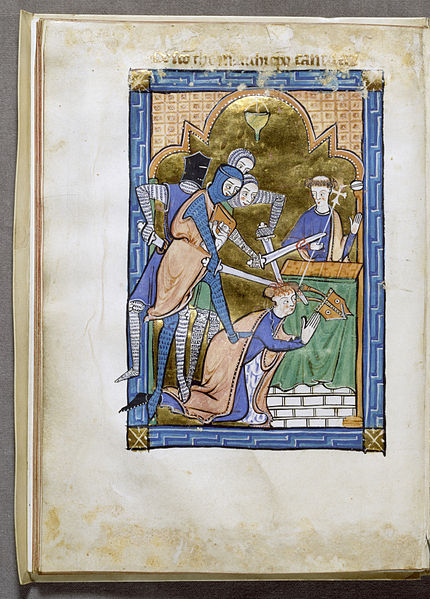
Thomas Becket's murder, from a page in a Psalter (c.1250)

Third, Thomas's canonization showed that the events of his life and the miracles subsequent to his death were well-documented enough to be considered authentic. The Church of the twelfth century was becoming more and more scrupulous about who ought to be canonized. An accurate record of the holy man’s life must be produced before he could be officially considered a saint. Canonization could not be conferred on mere hearsay.

In a treatise composed half a century before Thomas’s death, Guibert of Nogent wrote:
[The saints] "are people who are worthy of our reverence and honor in exchange for their example and protection. As regards such people, the only method for considering a person to be a saint which should be considered authoritative is one that relies not on opinion, but on timeworn tradition or on the evidence of trustworthy writers…. 
"Who would ask people, about whose merit in the eyes of God is uncertain, to intercede on their behalf? Would not the conscience of a man offer grave offense if he obtained as an intercessor with God someone who was not to be particularly trusted? Would not the sharpness of his prayer be blunted in its intention if he did not know whether the person whom he asked for help had anything in common with God?" 
This treatise warns us that the Church must prevent charlatans from being venerated as saints. Only those whose merit is unquestionable should be trusted to intercede with God on our behalf. The canonization of Thomas Becket indicates that the twelfth century Church found him a trustworthy intercessor.

Out of all the pilgrims who came to honor the new saint at his tomb, there was one that deserves especial mention. Henry, the king who had refused to kiss the archbishop in peace, did penance for that refusal in the summer of 1174.

Politically, the penance was a necessary deed. After the tumult with Thomas had subsided, Henry found himself faced by a full-scale rebellion led by his wife Eleanor and his sons Henry, Richard, and Geoffrey. His family was aided in their rebellion by King Louis of France, King William of Scotland, and several other foreign powers.  Now Henry himself knew how it felt to stand contra mundum.

Many of his subjects believed that this revolt was a fitting punishment for the king’s mistreatment of Thomas. In order to counteract this opinion and to regain the support of his subjects, Henry made a pilgrimage to Canterbury. The chronicler Edward Grim writes:
"Finally, shown through a vision that there was no other way of obtaining peace except by placating and reconciling the martyr, in whose revenge such great confusion of things now seized the whole realm, so that without much blood no one might hope for peace, the king put aside his pride for a time, and with a contrite and humble heart he came to the tomb of the precious martyr to beg pardon for his presumption."  
Barefoot and sorrowful, King Henry entered the church at Canterbury. The flagstones that had run red with Thomas’s blood were drenched again with the tears of the king. When the archbishop lived, Henry had refused to give him the kiss of peace. Now that the archbishop was dead, Henry kissed his death place over and over again, begging that the saint would give peace to him and his kingdom.

Humbling himself even further, Henry removed his outer clothing and leant against the tomb. The bishops and monks who were present came forward. Each of the bishops struck him five times; each of the eighty monks struck him three times. Following this punishment, Henry spent the entire night in prayer beside the tomb. Thus was the king’s absolution completed.

Stained glass window of Thomas Becket in Canterbury Cathedral

There are many nowadays who would question the genuineness of Henry’s sorrow. Because the action had political advantages, they assume that it could not have been from the heart. The chroniclers, however, have no doubts about the authenticity of Henry’s contrition. The events that followed the penance confirm its genuineness. Insofar as the dead can intercede on behalf of the living, Thomas interceded for Henry. On the day that Henry completed his penance,
"The count of Flanders, who with an immense army had blockaded the coast of the sea so as to invade England without warning, suddenly changed his mind and retreated.  Likewise, the next day…the king of the Scots, who was attacking and laying waste and robbing the Northumbrians, was captured in battle."  
Henry had received his own miracle from the hand of the man he had mistreated. Henry had retained his kingship, a gift from the man he had murdered. The deeds that Thomas Becket accomplished in his death vindicated everything he had sought to accomplish in his life.

The man was a saint indeed...according to all the necessary proofs required by the twelfth century.

~~~~~~~~~~~~

Rosanne E. Lortz is the author of two books: I Serve: A Novel of the Black Prince, a historical adventure/romance set during the Hundred Years' War, and Road from the West: Book I of the Chronicles of Tancred, the beginning of a trilogy which takes place during the First Crusade. The above essay was excerpted from Rosanne's New St. Andrews College thesis: The Life and Death of Saint Thomas Becket: Type of Paul, Type of Peter, Type of Christ.

You can learn more about Rosanne's books at her Official Author Website where she also blogs about writing, mothering, and things historical.
_________________

BIBLIOGRAPHY

Head, Thomas, trans. and ed. Medieval Hagiography: An Anthology. New York: Routledge, 2001.

Staunton, Michael, trans. and ed. The Lives of Thomas Becket. New York: Manchester University Press, 2001.

Tuesday, June 18, 2013

Saint Lioba: Trusted Friend of a Martyr

by Kim Rendfeld


Before he became a martyr in Frisia in 754, Saint Boniface had put his affairs at Fulda in order. Part of that was summoning his younger kinswoman Lioba, whom he had installed as abbess at Bischofsheim. He gave Lioba his cowl and instructed the monks of Fulda that they were to treat her with reverence and, when her time came, to place her remains in the same tomb as his.

Photo by Kandschwar, statue of Lioba in Schornsheim
Neither Boniface nor Lioba were young. Boniface likely was in his 70s. Lioba might have been in her mid-40s. Her hagiography gives hints of her struggles at the time, referring to “her weakness.” Boniface also “exhorted her not to abandon the country of her adoption and not to grow weary of the life she had undertaken, but rather to extend the scope of the good work she had begun.”

Those instructions must have worked. Lioba spent the rest of her days in Francia, visiting the royal court, convents, and the monastery at Fulda, where no other woman was allowed to enter.

Given how close Lioba and Boniface were in life, it might not be a surprise that his parting words to her would have such an effect. In a letter to him, she reminds her kinsman that her father died eight years before and her mother was grievously ill. "I am the only daughter of my parents, and unworthy though I be, I wish that I might regard you as a brother; for there is no other man in my kinship in whom I have such confidence as in you."

Most of what we know about the British-born Lioba comes from her hagiography written by the monk Rudolf of Fulda almost 60 years after her death. Like other hagiographies, Lioba’s story includes dreams and miracles, with parallels to biblical characters and events, the accuracy of which I will leave to the reader to decide.

“In appearance she was angelic,” Rudolf wrote, “in word pleasant, dear in mind, great in prudence, Catholic in faith, most patient in hope, universal in her charity. … No one ever heard a bad word from her lips; the sun never went down upon her anger. … So great was her zeal for reading that she discontinued it only for prayer or for the refreshment of her body with food or sleep: the Scriptures were never out of her hands.”

Childhood in the Church

Like Boniface, Lioba (also spelled Leoba) was born in the Saxon kingdom of Wessex. Her parents, Dynne and Aebbe, had given up on having a child, but then Aebbe dreamed that she bore a church bell in her bosom, which rang out merrily when withdrawn. A nurse told Aebbe that she was going to have a daughter and she must dedicate the child to the Church the way Anna offered Samuel to the temple.

Aebbe handed her daughter over to the care of Mother Tetta, abbess of Wimbourne and future saint who believed in the power of mercy and prayer. Wimbourne was a double monastery where men and women did not mix. Women who entered stayed for life unless there was a greater cause.

Growing up, Lioba proved to be serious and pious. A dream she had of an endless purple thread from her mouth, she was told, was a sign that her wise counsel would be felt in other lands.

That dream was fulfilled when Boniface sent for Lioba, who had a reputation for being learned. Boniface was founding abbeys where the practice of Christianity had slipped, and he needed people he could trust to watch over them. Tetta was not happy to let Lioba go but felt like the need was too great for her to refuse.

Life in Francia

Lioba arrived in Bischofsheim (now called Tauberbischofsheim) around 748. She trained other nuns on the principles of monastic life and many of her disciples became abbesses themselves.

Photo by Andreas Praefcke, Lioba (right)
with Saints Walburga and Michael
But Lioba and her sisters faced their own difficulties. In a story that could have come from today’s tragic headlines, a woman discovered a murdered newborn in the river and jumped to the conclusion that one of the nuns - strangers to the area - had borne and killed the child to cover up her sin. Lioba and the nuns were horrified. After a series of prayers and processions, a vision like flames appeared around the guilty party - a crippled girl the nuns had been caring for. (Her hagiography has other miracles of her healing a very sick nun, putting out a fire, and quieting a storm.)

Lioba lived for 25 years after Boniface’s martyrdom. She was often invited to the Frankish court and well received and respected for her wisdom. She was an advisor to Pepin and his sons, Charles and Carloman (who didn‘t get along). After Carloman died, she still was in Charles’s favor and became close to Hildegard. Perhaps, she was even like a second mother to the young queen, who might have been 13 when she married in 772.

But she “detested the life at court like poison,” Rudolf wrote. And so she would return to her work, mainly mentoring nuns.

At some point, her age and failing health caught up with her. Perhaps when she was in her 60s, she must have realized she had little time left. After settling her affairs at the convents under her care, she retired to Scoranesheim. But Queen Hildegard made one final request to see her.

For the sake of her friendship with the queen, Lioba visited her but soon left. Her farewell is an intimate gesture. She kissed Hildegard on the mouth, forehead, and eyes, and called her “most precious half of my soul.”

Lioba died a few days after returning home. The monks remembered Boniface’s request but they were reluctant to break into his tomb. So she was buried nearby and moved to a different location in the church several years later. (After her hagiography was written, she was moved a few more times after that, finally resting in Petersburg Abbey in Fulda.)

Miracles continued to be attributed to Lioba after her death. One involved a man cured of his twitching. When asked what happened, he said he had a vision of an old man in a bishop’s stole accompanied by a young woman in a nun’s habit who took him by the hand, lifted him up, and presented him to the bishop to be blessed.

Sources

The Letters of Saint Boniface, p. 37-38

Medieval Sourcebook: Rudolph of Fulda: Life of Leoba

"Saint Lioba of Bischofsheim" Saints.SQPN.com. 2 April 2013. Web. 8 June 2013.

All images from Wikimedia Commons, permission granted under the terms of GNU Free Documentation License.

~~~~~~~~~~~~

Kim Rendfeld is the author of two books set in Carolingian Francia: The Cross and the Dragon, published by Fireship Press, and the yet-to-be published The Ashes of Heaven’s Pillar. For more about Kim and her fiction, visit kimrendfeld.com or her blog, Outtakes. You can also connect with her on Facebook and Twitter.