Showing posts with label Thomas Becket. Show all posts

Sunday, November 15, 2020

Masters of Stone: the Medieval Stonemasons

 By E.M. Powell

In our twenty-first century urbanised world, buildings of enormous height and size are all around us and are so familiar a sight that we rarely pay them much attention. We are accustomed to living, working and shopping in them. When a new one is built, we see huge cranes and other heavy machinery employed, with elevators and lifts taking contractors up to where they need to be. 

Canterbury Cathedral
© E.M. Powell

Anybody time-travelling from the medieval world to now would be understandably astonished by what we can achieve. Yet the reverse is also true. We cannot of course travel back to medieval times. But we can stand next to a vast cathedral such as Canterbury and wonder how on earth it could be constructed by people who had only the most basic of tools.  

There has been a cathedral in Canterbury for more than 1,400 years. Saint Augustine consecrated the first cathedral there not long after his arrival in the year 597. There is no trace of the original building, as a fire in 1067 destroyed it and it had to be completely rebuilt. Archbishop Lanfranc oversaw much of the construction, but it was his successor, Archbishop – and later Saint – Anselm, who built the ‘glorious quire’ –of which more later––and the enormous crypt. 

The credit might be Anselm’s but his hands were not the ones that wielded axes, hammers and chisels, and mixed mortar that is still holding up the walls after almost a thousand years. Those people, with their remarkable skill and ingenuity, were the medieval stonemasons. 

Building- Canterbury or Anglo-Catalan Psalter 12th Century
Public Domain- British Library

The stonemasons’ guild, the Worshipful Company of Masons, is one of the ancient Livery Companies of the City of London. It was formed for the purpose of regulating the craft of stonemasonry and ensuring that standards could be properly maintained and rewarded. The earliest available records of regulation from the Court of Aldermen are from 1356.

The preceding two centuries had already seen massive growth in stone construction–royal, ecclesiastical and municipal–and alongside that came major developments in the skill of stone masonry. Stonemasons were by no means a homogenous group. Their skills ranged from the most basic to outstanding artistry, though categories of worker were fluid. Rates of pay varied from job to job too.

Before stone could be used as building material, it first had to be dug from the earth and that was the task of the quarrymen. The records use the term ‘quarrymen’ to refer to those who owned the quarries as well as those who worked in them. While the quarry owners were frequently men of means and high social standing, those who actually worked within the quarries were not. The work was back breaking, digging and breaking stone in poor conditions that led to health problems like silicosis, a lung disease induced by inhaling flinty or siliceous particles. The quarriers also partially or completely worked the stone before it was transported to its destination, as this saved on cost. In addition to providing the supply of stone, the quarries often served as schools where stoneworkers could learn the basics of the craft, before moving on to more skilled employment and better rates of pay. 

Canterbury Cathedral interior stonework
© E.M. Powell

Roughmasons and layers prepared wall stone with scappling hammers and might also hew stone with an axe into the approximate shape required. Fine carving was done with a mallet and chisel and this was the work of the freestone mason. The freestone mason did not simply step in and apply the last artistic flourishes. He would also have had to be an expert stone hewer and layer to ensure that intricate work fitted perfectly and robustly together. Building work was not solely the preserve of men either. The records show women working as masons’ servants and plasterers. 

Overseeing any project was the master mason, frequently assisted by an undermaster or a second master mason. Master masons were not just the most skilled stone workers: they were architects, designers and visionaries as well as capable administrators. They had shared responsibility with the abbey or nobleman who had embarked on the construction project for the financial accounts. These covered every aspect of expenditure: wages, materials and transport. The master masons were involved in the hiring and dismissing of their workers. 

Mason and carpenter, Bruges, 15th Century
Public Domain- British Library

In general, masons were a highly mobile group. They travelled to where the biggest and best-paying jobs were, including from country to country. Quarrymen tended to live locally to their work. 

In order for the best work to be produced, the most suitable materials had to be sourced. Huge quantities of wood went into building a structure like Canterbury Cathedral. But wood is much easier to source and transport than stone. And it could not be just any stone: it had to be soft and easy to carve. Canterbury’s cream limestone came from Caen in Normandy as it could be delivered by ship, rather than trying to move stone along medieval roads. 

Canterbury Cathedral Choir
© E.M. Powell

Such transport was not without risk. An account exists from the days of William I of a flotilla of fifteen ships that were sailing from Caen with cargoes of stone. Fourteen carried stone for the king’s new palace at Westminster and one was full of stone for Saint Augustine’s abbey in Canterbury. The ships foundered in a terrible storm and fourteen were lost. The one with the Canterbury stone was about to suffer the same fate. The master and crew prayed to Saint Augustine himself, bailed furiously and made it as far as the Sussex port of Bramber, where the ship split open and all the stone ended up on the sands. The master got hold of another ship, reloaded his cargo and delivered the stone to the abbey. A delighted abbot paid the master ‘a bonus of some shillings’. A relieved master offered half the money to God and Saint Augustine in thanks for his miraculous escape. 

Speaking of saints and miracles, Canterbury Cathedral’s most famous archbishop is another saint: Thomas Becket, who was murdered there on 29 December 1170. He was slain by four knights acting on one of King Henry II’s legendary outburst of temper. The knights’ original intention may have been to arrest Becket, who had been engaged in a monumental power struggle with the King for several years. But the situation quickly deteriorated, and Becket was hacked to death on one of the altars. The Martyrdom is still maintained in the cathedral and one can stand at the very spot. 

Sculpture of the sword's point at the Martyrdom
- site of Becket's murder in the cathedral.
© E.M. Powell

The miracles quickly began. Word quickly spread and the devotion to Becket the Martyr began, with his tomb becoming a major site for pilgrimage. 

It was a huge stroke of good fortune that the monks had chosen to place Becket’s body in a stone tomb in the crypt while they set about constructing a shrine. For on 5 September 1174, fire broke out in three cottages near the cathedral. Unknown to everybody before it was too late, the blaze spread to the roof of the cathedral. A monk, Gervase of Canterbury, wrote a vivid account of the fire, with its black smoke and scorching flames. Consumed by flames, the roof collapsed into the choir and its wooden seats. The flames rose up ‘a full fifteen cubits, scorching and burning the walls’ and causing terrible damage to the stone pillars. Anselm’s choir was destroyed. Gervase describes the reaction of those who witnessed it. He talks of people overcome with ‘grief and perplexity’ blaspheming at such an event and unable to comprehend that it had happened. 

Notre Dame Fire
Baidax, CC BY-SA 4.0 

A modern reader might dismiss this as an overreaction. But on April 15 2019, fire broke out in the roof of Notre Dame Cathedral in Paris and millions worldwide witnessed a medial cathedral burn in real time.  People’s reactions on social media and on news reports were almost identical to those reported by Gervase eight centuries ago.  

Back in twelfth century Canterbury, the monks were faced with the daunting task of reconstructing their fire-ravaged choir. They commissioned master mason William of Sens, known for his brilliance and technical expertise. Unfortunately for him and for future generations, William fell from faulty scaffolding in the choir in 1178. He was badly injured and never recovered. He was replaced and the work was finished by another mason, William the Englishman. 

Stone conservation work, Canterbury Cathedral
© E.M. Powell

The stonemasons of Canterbury Cathedral continue their work to this day, with a team of over two dozen. Their job is to conserve and to preserve the building. And they work with tools on blocks of stone brought in from a quarry near Caen- just as the masons of a millennium ago did. 

Anselm's Crypt in Canterbury Cathedral, original site of Becket's tomb.
The figure is Transport by sculptor Antony Gormley.
The work is made from nails from the repaired roof of the cathedral.
© E.M. Powell
References:

Foyle, Jonathan, Architecture of Canterbury Cathedral (London: Scala Publishers Ltd., 2013).
Gimpel, Jean, The Cathedral Builders (New York: Harper Colophon Press, 1983).
Guy, John Thomas Becket (London: Viking, 2012).
Keates, Jonathan and Hornak, Angelo, Canterbury Cathedral (London: Scala Publications Ltd., 1980).
Knoop, Douglas and Jones, G.P., The Mediaeval Mason: An Economic History of English Stone Building in the Later Middle Ages and Early Modern Times (Manchester: Manchester University Press, 1933).
Urry, William, The Normans in Canterbury: Occasional Papers No.2 (Canterbury Archaeological Society, 1959)
Urry, William, Canterbury Under the Angevin Kings (University of London, The Athlone Press, 1967).
Woodman, Francis, The Architectural History of Canterbury Cathedral (London, Boston and Henley: Routledge & Kegan Paul, 1981).
Websites:

~~~~~~~~~~~~~~

© E.M. Powell

E.M. Powell’s historical thriller and medieval mystery Fifth Knight and Stanton & Barling novels have been #1 Amazon and Bild bestsellers. The third Stanton & Barling mystery, THE CANTERBURY MURDERS, was released in November 2020. Born and raised in the Republic of Ireland into the family of Michael Collins (the legendary revolutionary and founder of the Irish Free State), she lives in northwest England with her husband, daughter and a Facebook-friendly dog. She’s represented by Josh Getzler at HG Literary. Find out more by visiting her website www.empowell.com or follow her on Twitter @empowellauthor


Wednesday, October 3, 2018

Crime and Punishment Under Henry II

By E.M. Powell

King Henry II of England is best known in the popular imagination for the murder of Archbishop Thomas Becket, a murder for which the King was blamed. Four knights broke into Canterbury Cathedral on 29 December 1170 and slew Becket in the most brutal manner.

The Murder of Thomas Becket c 1480 Public Domain- British Library

Whatever one’s view of the volatile Henry, there is one achievement from his thirty-five-year reign that stands above all others: his reform of the English legal system, which laid the foundations of the English Common Law. When he came to the throne in 1154 at the age of just twenty-one, his realm was in deep disarray following civil war. He urgently needed to re-establish royal authority and impose order and set about doing so with his customary relentless drive. The judicial system was the subject of much of his attention and he was aided in this by the talented Becket, who was his chancellor at the time.

Henry II enthroned, arguing with Thomas Becket c. 1307 - c. 1327 Public Domain- British Library

Henry addressed reform of both land law and criminal law. With land law, cases relating to an individual being dispossessed or those in which inheritance was in dispute were now settled in a trial by jury. The jury system was far quicker and more efficient than the system it replaced. Given that said system was one of trial by combat, one can see why it was not just the efficiency of the new system that made it so popular.

His reform of criminal law was even more impressive. He issued new legislation at Clarendon in 1166 and Northampton in 1176. It was at Clarendon where the procedures of criminal justice were first established, addressing how serious felonies such as murder, robbery and theft would be dealt with. Juries of presentment were established, consisting of twelve lawful men in each hundred (a subdivision of a county) and four in each vill (village). These juries were not there to decide on guilt or innocence, but to support an accusation of a serious crime.

Anyone who was accused of such crimes would be put in prison to await trial. Those trials could only be heard by the King’s justices, who travelled the country to do so. Henry first introduced his system of itinerant justices at Clarendon but refined the system at Northampton. England was divided into six circuits, with three justices, the justices of the general eyre, allocated to each.  Twelfth century chronicler Roger of Howden lists the eighteen justices itinerant and their circuits for 1176.

Detail of an historiated initial 'I'(udex) of a judge c. 1360- c. 1375 Public Domain - British Library

One of the justices listed was Ranulf de Glanville. De Glanville was one of Henry’s staunchest allies, securing key victories for the King in the rebellion of 1173-74 and rising to the position of Justiciar of England. The ‘Treatise on the Laws and Customs of the Kingdom of England’, produced in the late twelfth century, is the earliest treatise on English law and is commonly referred to as ‘Glanvill’, though it is unlikely that de Glanville was its author.

The justices provided a system of criminal investigation for the whole country. The impact of the arrival of the travelling court should not be underestimated. It could consist of several hundred people, all of whom were tasked with supporting the royal justices in administering the law in the name of the lord King. As well as being administratively impressive, it would have been a spectacle that reinforced Henry’s power over all his subjects. It would also have instilled awe and fear in all those who witnessed it, especially those who were accused of a serious crime.

The accused were brought before the justices. Proof of their guilt or innocence could be established in a number of ways, such as witness testimony, documents or the swearing of oaths. Unlike criminal trials today, the jury acted as witnesses and not an impartial panel. They would give the account of what had happened.

Five judges and three plaintiffs c. 1360- c. 1375 Public Domain - British Library

In cases that were not clear cut or in those of secret homicide where there were no witnesses, the justices used the ordeal. Ordeal could be by cold water or by hot iron. The blessing of the water and the iron served to bring the notion of God’s judgement, judicium Dei, into the proceedings.

There was great ceremony and a long build-up attached to the ordeal, which would have added to the pressure on the accused to confess. The accused would be taken to church four days before the day on which the ordeal was due to take place. They had to wear the clothes of the penitent, fast and hear several masses. If they still did not confess, the ordeal would take place.

Two judges addressing a prisoner held by a court officer c. 1360-c. 1375 Public Domain - British Library

The most innocent of hearts must have quailed. Stripped to only a loin cloth, the accused would be led to the pit, which was twenty feet wide and twelve feet deep and full of water. A priest would then bless the water. God would now be the judge: His blessed water would receive the accused if innocent, reject him if he was guilty. The accused would be bound, thumbs to toes, and lowered in from a platform.

With ordeal by hot iron, the accused had to undergo the same preparation of fasting and penitence. A length of iron would be blessed and heated in a fire until it was red hot. The accused would have to take it in one hand and carry it for three paces. The injured hand would be bandaged and then examined three days after the ordeal. If it had healed, then innocence was proclaimed. If it had not, then the accused was guilty.

Both forms of ordeal were terrifying and horrific in themselves, and the lengthy preparations would have only added to the pressure to make a confession. Once the accused made a confession, it could not be retracted. In 1215, the Church forbade priests to take part in the ordeal, bringing an end to its use.

A man hanging from gallows c. 1360-c. 1375 Public Domain - British Library

For those found guilty, the King’s punishment awaited. Hanging was reserved for the worst crimes. Thieves and robbers could lose a foot and, from 1176, their right hand. The law also had a final judgement it could impose, even if the accused was acquitted by undergoing the ordeal. If it was judged that the accused had a particularly bad reputation, as sworn to by the jury, then the accused was to leave the King’s lands as an outlaw and had to swear under oath that they would never return.

And lest anyone think that they could take the law into their own hands and administer punishments themselves, the King’s justices had a clear system of heavy fines for those who would dare to do so. Order would prevail. Henry, the consummate administrator, had thought of everything.


References:
All images are in the Public Domain and are part of the British Library's Catalogue of Illuminated Manuscripts. 
Bartlett, Robert, Trial by Fire and Water: The Medieval Judicial Ordeal (Oxford, 1986)
Bartlett, Robert, The New Oxford History of England: England under the Norman and Angevin Kings 1075–1225 (Oxford, 2003)
Hudson, John, The Formation of the English Common Law (London, 1996)
Pollock, Frederick, and Maitland, Frederic William, The History of English Law Before the Time of Edward I (Cambridge, 1898)
Warren, W. L., Henry II (Yale, 2000)

~~~~~~~~~~


E.M. Powell’s historical thriller Fifth Knight novels have been #1 Amazon and Bild bestsellers. Her new Stanton & Barling medieval murder mystery series starts with THE KING’S JUSTICE, followed by THE MONASTERY MURDERS.

As well as blogging for EHFA, she is a contributing editor to International Thriller Writers The Big Thrill magazine and is the social media manager for the Historical Novel Society.

Born and raised in the Republic of Ireland into the family of Michael Collins (the legendary revolutionary and founder of the Irish Free State), she now lives in northwest England with her husband, daughter and a Facebook-friendly dog. Find out more by visiting www.empowell.com.


Thursday, December 29, 2016

The Murder of Thomas Becket

By E.M. Powell

Midwinter in England can indeed be bleak. Iron-hard frosts, smothering snow, torrential rain and gales: all can sweep down on these short days where daylight is gone by mid-afternoon. But at day's close on the twenty-ninth of December 1170, an event occurred that stunned medieval England and all of Christendom. Archbishop Thomas Becket was brutally murdered by four knights in his own cathedral at Canterbury. The knights came to Canterbury following an outburst by Henry II, king of England and much of France. It was a tragedy that had been set in motion many years before.

Canterbury Cathedral
© Shane Broderick Photography 

The son of a London merchant, Becket cut an imposing figure. He was over six feet tall (well above average for the period), with an aquiline nose, a "large brow", and "long and handsome face". He had a quick mind and a particular capacity to absorb and retain huge amounts of information. One chronicler states that he could even detect and react to distant smells and scents! Though he had stammered in his youth, he largely overcame this and was a fluent orator.

Appointed as Henry's Chancellor in 1155, Becket did not disappoint the King. He performed brilliantly in the role and the two men, Henry thirteen years younger than Becket, became extremely close. William Fitzstephen records "Never in Christian times were there two greater friends, more of one mind."


Henry makes Becket Archbishop of Canterbury
Liturgical comb c. 1200
© 2014 E.M. Powell 

One mind, perhaps, but of course Henry was king. And he was a king who was engaged in power struggles with Rome. On the death of Archbishop Theobald in 1161, Henry appointed Becket as Archbishop of Canterbury, believing Becket would simply do his bidding and act at all times on his behalf. Henry could not have been more wrong. Becket stood firm against Henry in matters of ecclesiastical law and power. Their disputes dragged on until in 1170 Henry had his son anointed as king by the Archbishop of York, a ceremony that was witnessed by ten other bishops. Becket's response? He excommunicated the bishops from the pulpit at Canterbury Cathedral on Christmas Day. When news reached Henry, he went into one of his legendary rages.

And his rages were indeed legendary. Henry could really let rip when roused. According to John of Salisbury, Henry once became so enraged during a debate about the King of Scotland that he flung off many of his clothes and started "chewing on pieces of straw." John also has Henry describing himself as "a child of anger." One of Henry's charters states that if anyone "should attempt to quash...this grant, he will incur the disfavour, anger and indignation of Almighty God and me."

Canterbury Cathedral
© Shane Broderick Photography 

So it was when Henry was informed of the news of Becket's latest actions. He "struck his hands together and exclaimed against it vehemently", his face "white with fury." His tirade against Becket was about the man's ungratefulness, too: he had raised Becket to a high position, and the only response was treachery. He worked himself up to a frightening pitch, ending with the words: "He has...shamed my realm; the grief goes to my heart, and no-one has avenged me!" Unfortunately, a group of barons who were listening took him at his word. They set off for Canterbury to avenge their king.

And who were these knights? It is unlikely they were part of Henry's intimate circle and acted to increase their favour with the king. William of Canterbury gives us their names and their descriptions. First was Reginald Fitzurse. "Urse" means "bear", and William claims the name indicated the man's savagery. Hugh de Morville's surname translates as "a village of death." William de Tracy is acknowledged as a brave fighter, but had a "sinful way of life." Richard le Bret became the Brute "on account of the depravity of his life." It was these who headed for the cathedral in which the holy man they sought was to be found.

Canterbury Cathedral
© Shane Broderick Photography 
The accounts of events from eight hundred and forty four years ago can often be sketchy. In the case of Becket's murder, we have detail upon appalling detail, as five monks were eye-witnesses to it and wrote their version.

When the knights arrived at Canterbury Cathedral, daylight was fading. They first took off their armour and went to confront Becket who was in the Episcopal Palace. They most likely had come to arrest him but Becket simply refused to comply. That did not help the situation. The knights went back out and started to put on their armour once more. The monks and clerks who were with their Archbishop were extremely concerned by now for Becket's safety. Even if no-one expected murder, they were aware that Becket could be hideously maimed or wounded in such a tense situation. No doubt Becket himself was also aware that this was now a very real possibility. The monks hustled him through to the Cathedral, though he protested throughout.

Carrying on with the rhythm of the day, the Office of Vespers was being sung, the monks voices echoing into the cathedral's high roof with the only light from candles or lamps. Such illumination would hardly have  pierced the chill darkness and cast instead deep shadows. Once the monks saw Becket, they halted their prayers, rejoicing that he was safe. It was only a temporary reprieve. As he walked to the altar, the knights burst in, armed with hatchets and an axe, Fitzurse yelling "Where is the archbishop, the traitor of the King?"

The Murder of Thomas Becket
Public Domain

Becket kept his composure, replying: "Here I am, not a traitor of the King, but a priest. Why do you seek me?" The knights were not so calm. They surrounded Becket, in a shouting, clamouring group, their lethal weapons ready and raised. Grabbing hold of Becket, they tried to manhandle him away but he grabbed for one of the stone pillars and refused to move. Then the Archbishop delivered an insult to Fitzurse, calling him a panderer or a pimp and challenged Fitzurse to kill him. This seemed to tip Fitzurse over into murderous rage, and he roared at de Tracy to strike. Becket bent his head in submission. He knew he was going to die.

Chasse showing the Martyrdom of Saint Thomas Becket c1190
© 2014 E.M. Powell 

De Tracy's first strike took off the top of Becket's skull and glanced off, injuring Brother Edward Grim. The watching appalled monks fled in panic, as Becket took another blow to the head but still remained standing. He must have been in unspeakable agony and shock, yet managed to speak for the last time: "For the name of Jesus and the good of the Church, I am ready to embrace death." De Bret thrust his sword through Becket's head with such force that the sword shattered on the altar stone. A cleric who had accompanied the knights scattered the Archbishop's brains, declaring, "He won't get up again." It was over. The knights left the cathedral and went to the Episcopal Palace, where they ransacked Becket's possessions.

Becket's body lay cooling on the altar as the traumatized monks made their way back in. Over the next few hours, people converged on the cathedral in horrified disbelief. Those who came dipped their fingers in the blood of their martyred Archbishop, daubed their clothes with it, and collected as much as they could. Terror still filled the air, with rumours flying around that the murderers were coming back to take the body, or to slay others. It was feared that the knights would defame Becket's corpse, and pull it across the city behind a horse, or display it on a gibbet. This could not be countenanced. The monks decided to bury Becket in the crypt as quickly as possible.

Canterbury Cathedral
© Shane Broderick Photography 

The miracles began that very night. A man who dipped part of his shirt into Becket's blood went home to his paralysed wife. As he wept in his telling of the murder, she asked to be washed in water containing some of the blood. She was cured immediately. A shrine was erected to Becket in the cathedral. An astonishing 100,000 people came to pray and visit Canterbury Cathedral in 1171 alone. The attributed miracles mounted up and in ten years, there were a total of 703 recorded. Becket’s intercession was in healing, casting out demons. He was prayed to by women in childbirth. When Queen Eleanor, the wife of King Henry III was expecting her fourth child, 1,000 candles were lit around Becket’s shrine.

Reliquary casket with scenes of the martyrdom c1173-80
© 2014 E.M. Powell 

And what of Henry, the king whose supposed utterance of "who will rid me of this meddlesome priest?" set the murder in motion? Henry had to give in on the matter of church courts. He also performed a number of acts of penance for the man who had once been his dear friend. The most extreme was on the streets of Canterbury on 12 July 1174, where he was scourged by eighty monks before spending the night praying at Becket’s tomb. In death, Becket had been victorious.

Canterbury Cathedral
© Shane Broderick Photography 

Saint Thomas Becket was a venerated saint for the next four hundred years. Until the arrival of another King Henry, Henry VIII. This Henry was going to take on the church. And win. When he achieved his aim of total control of the church, Henry VIII denounced Becket as a traitor. Becket’s shrine was destroyed, his bones were burned and the mention of his name was outlawed.

Canterbury Cathedral
© Shane Broderick Photography 

But Henry didn’t manage to erase the memory of Becket. People continued in their devotion to him as a saint. Today, Canterbury Cathedral still marks the place of Becket’s martyrdom and thousands continue to visit every year. Think of him today, at day’s close.

References:
Abbott, Edwin A.: St. Thomas of Canterbury: His Death and Miracles, A & C Black (1898)
Cathedral: Murder at Canterbury, BBC TV (2005)
Gervase of Canterbury: Thomas Becket's Death, from History of the Archbishops of Canterbury, Internet Medieval Sourcebook, Fordham University
Grim, Edward: The Murder of Thomas Becket, Internet Medieval Sourcebook, Fordham University
Guy, John: Thomas Becket, Penguin Books (2012)
Jones, Dan: The Plantagenets: The Kings Who Made England, William Collins, (2013)
Staunton, Michael (ed.): The Lives of Thomas Becket, Manchester University Press (2001)
Warren, W.L., Henry II, Yale University Press (2000)
Weir, Alison: Eleanor of Aquitaine: By the Wrath of God, Queen of England, Vintage Books (2007)

Editor's Choice from the archives. Originally published December 28, 2014.
~~~~~~~~~~~~~~~~~


E.M. Powell’s medieval thrillers THE FIFTH KNIGHT and THE BLOOD OF THE FIFTH KNIGHT have been #1 Amazon bestsellers and a Bild bestseller in Germany. Book #3 in the series, THE LORD OF IRELAND, about John’s failed campaign in Ireland was published by Thomas & Mercer on April 5 2016. 

Born and raised in the Republic of Ireland into the family of Michael Collins (the legendary revolutionary and founder of the Irish Free State), she now lives in northwest England with her husband, daughter and a Facebook-friendly dog. 

As well as blogging for EHFA, she is a contributing editor to International Thriller Writers The Big Thrill magazine, reviews fiction & non-fiction for the Historical Novel Society and is part of the HNS Social Media Team. Find out more by visiting www.empowell.com.

Amazon
Barnes & Noble
Waterstones

Photographer Shane Broderick specializes in studies of castles, churches and places of pilgrimage. To view more and to see his other work, please visit his Facebook Page at Shane Broderick Photography. You can also view his video here for more on Canterbury Cathedral. His photographs on this post have been used with his generous permission.


Tuesday, July 12, 2016

Thomas Becket: The Blood of a Martyr

by E.M. Powell

On July 12 1174, King Henry II of England did public penance in Canterbury for the murder of Archbishop Thomas Becket. The infamous murder had taken place in Canterbury Cathedral in the cold and dark of a December evening in 1170.

The Murder of Thomas Becket
British Library

Yet here was Henry, ruler of England and much of France, walking barefoot along the rough cobbled streets in the heat of July, making his way to a tomb in the cathedral. It was Becket's tomb, and the slain Archbishop was now a canonised saint. Thousands of pilgrims had already made their way there but one doubts if anyone that day expected to see the king follow suit.

As if his humble progression was not astonishing enough, Henry then prostrated himself at Becket's tomb and spent many hours in prayer. He begged for forgiveness from Becket for the uttering of his words that had sent a group of knights to murder the archbishop.

12th Century Chapel at the Tower of London
© E.M. Powell

The king had good reason to do so. He was facing the loss of his crown to a rebellion led by his Queen, Eleanor of Aquitaine, their three eldest sons and King Louis of France. Henry believed that his failure to repent for Becket's death had led him to this point.

Now that he had come to make his belated penance, Henry's public display of humility reached new heights. He removed his upper clothing and was subjected to strikes from over seventy scourge-wielding monks. His royal flesh was torn and his blood flowed freely from his chastisement. While the chroniclers at the time were stunned, more modern interpretations are that the scourging of the king must have been relatively light, for otherwise he could not have survived so many blows.

Penance of Henry II
Wikimedia Commons

If only the assault on Becket had been so forgiving. There are eye-witness accounts of how he died and they are brutally graphic. It will suffice to say that the monks who converged on the dead Becket were able to collect splashed blood and and the results of his massive head wound from the stone floor of the altar.

Yet their gathering of Becket's life-force and his stained clothing were the first acts in propelling Becket along the road to sainthood. It may seem repugnant to some modern sensibilities but blood was seen as an immensely powerful force in medieval society.

This power could be seen to be evil. Necromancers (when summoning demons) followed instructions that they should write their symbols or incantations in the blood of cats, bats and even a hoopoe. There was widespread belief that a murdered corpse would bleed afresh in the presence of the murderer.

But of course blood was also seen to have the power of good. Devotion to the shedding of Christ's blood and miracles resulting from it had existed since the seventh century. One early reported miracle was the transformation of the host into a bloody finger to convince a woman who doubted her faith.

© E.M. Powell

And so it was with Becket, viewed by all as a martyr who had died for his beliefs.Within hours, a steady stream of people had arrived, looking for cures to all manner of afflictions from Becket's holy blood. Miracles were attributed to him immediately. The cloths stained with his blood brought cures to local women. There are accounts of people dabbing it on their eyes to cure their sight. Holy water containing Becket's blood started to be sold. The story of Canterbury as a place of pilgrimage had begun.

An astonishing 100,000 people came to pray and visit Canterbury Cathedral in 1171 alone. Becket was made a saint in 1173, making his a very swift canonization. His popularity as a saint grew.The attributed miracles mounted up and in ten years, there were a total of 703 recorded. Becket’s intercession was in healing, casting out demons. He was prayed to by women in childbirth. When Queen Eleanor, the wife of King Henry III was expecting her fourth child, 1,000 candles were lit around Becket’s shrine. 


The Murder of Thomas Becket
British Library

 Myths also grew up around Becket. One woman claimed she had taught a bird to pray to the saint. When the bird was hunted by a hawk, it sang out Becket’s name and was released. A story circulated that while Becket was alive, he needed a woman to mend his clothes while on his travels. The woman that did so in a convent mysteriously disappeared after completing her task. The woman was deemed to be Our Lady.


Penance of Henry II
Wikimedia Commons


And what of Henry II, one of Canterbury's most famous pilgrims and repentant sinners? The very next day, as he nursed his wounds from his penance, he received news of important victories for his troops. As far as Henry's subjects were concerned, Saint Thomas Becket had spoken: the penitent king had been granted his miracle. The rebellion was swiftly crushed. 

This post is an EHFA Editors' Choice and it/an edited version of it was first published on the blog on July 14 2014. 
References:
All Public Domain images are part of the British Library's Catalogue of Illuminated Manuscripts or via Wikimedia Commons
Guy, John: Thomas Becket, Penguin Books (2012)
Jones, Dan: The Plantagenets: The Kings Who Made England, William Collins, (2013)
Kieckhefer, Richard, Magic in the Middle Ages, Cambridge University Press (2000)
Lindhal, Carl et al., Medieval Folklore: A Guide to Myths, Legends, Tales, Beliefs & Customs, Oxford University Press (2002)
Warren, W.L., Henry II, Yale University Press (2000)
Weir, Alison: Eleanor of Aquitaine: By the Wrath of God, Queen of England, Vintage Books (2007)
~~~~~~~~~~~~~~~~~~~~~~~~~
E.M. Powell’s medieval thrillers THE FIFTH KNIGHT and THE BLOOD OF THE FIFTH KNIGHT have been #1 Amazon bestsellers and a Bild bestseller in Germany. Book #3 in the series, THE LORD OF IRELAND, about John’s failed campaign in Ireland was published by Thomas & Mercer on April 5 2016. 

Born and raised in the Republic of Ireland into the family of Michael Collins (the legendary revolutionary and founder of the Irish Free State), she now lives in northwest England with her husband, daughter and a Facebook-friendly dog. 

As well as blogging and editing for EHFA, she is a contributing editor to International Thriller Writers The Big Thrill magazine, reviews fiction & non-fiction for the Historical Novel Society and is part of the HNS Social Media Team. Find out more by visiting www.empowell.com.

Saturday, May 21, 2016

Medieval Illuminated Manuscripts.

By E.M. Powell

The word manuscript literally means ‘written by hand’ and medieval manuscripts refers to those books produced in Europe between about the fifth century and the late fifteenth century. Illuminated manuscripts are works which are decorated with a variety of pictures and ornamentation.

Psalm 27 from the Vespasian Psalter- 8th Century Kent.
It is the earliest surviving English biblical example of an initial with a narrative scene.

The word ‘illuminated’ comes from a usage of the Latin word illuminare in the sense of its meaning ‘to adorn’. Burnished gold was often used in the decorating of books from the 13th century onwards but the term ‘illuminated’ does not only apply to manuscripts where gold or silver is used. It applies more broadly to any manuscript that is more elaborately decorated than with simple coloured initials.

From the early writings of Saint Jerome (who died c.420) to around 1100, the vast majority of manuscripts were produced in the scriptoria or cloisters of abbeys and monasteries. They were primarily theological, liturgical and academic works.

The Lindisfarne Gospels- 8th Century
Written & illustrated probably by Eadfrith, bishop of Lindisfarne.

Prior to the time of Saint Jerome, manuscripts (such as those produced in Rome) were in scroll format and made of papyrus. The use of papyrus is problematic in that, as a material, it is more likely to break, especially if it is handled frequently. Early medieval scribes moved to the use of prepared animal skin, the material that we refer to as parchment or vellum. The format also underwent a significant change to that of the book or codex, with separate pages that can be turned, read in sequence and much more easily navigated by a reader.

Initial from the Howard Psalter & Hours- England,1310 -1320.
Clerics sing from a scroll, which contains musical notation. 

The codex didn’t only make life easier for readers. It also improved the lot of those who wrote and illustrated the manuscripts—our medieval scribes. It is much easier to write on the flat, stable surface of a page than on a lengthy, unrolled scroll. But it’s probably fair to say the ‘easier’ is a relative term. Even the preparation was laborious and demanded perfection. Producing fine vellum involved the soaking in lime and skilled, meticulous scraping and stretching of expensive calfskin. Inks such as oak gall and lampblack had to be produced. Guide lines had to be ruled with absolute precision.

Book of Hours- Oxford, 1240, written in & illuminated by William de Brailes.
It is the earliest surviving English Book of Hours.

Note that such precision also had to be achieved using a feather quill pen. Quill pens were introduced around the sixth century and replaced the reed pen. They were most commonly made from the flight feathers of geese but could also be made from swan, duck, crow, or even pelicans and peacocks. Most of the feather was removed and the end sharpened and slit so it could be filled with ink.  The sharpening of the nib was done at different angles, which would make pen strokes of differing thickness. Such careful nib-work didn’t last long. A scribe would have to trim it frequently with a quill-cutter to keep its sharpness.

A seated scribe from the Life of St Dunstan.
Canterbury- late 11th/early 12th Century

All that before the most challenging and skilled task of all: the writing and illustrating of the text. One can only deeply admire the concentration, dedication and sheer physical toll it must have taken, with scribes having no reading glasses, no electric light and no modern heating through freezing and damp winters.

The fruits of their labours, that are the decorations on medieval illuminated manuscripts, are of three main types. First, larger illustrations that can take up a whole page and /or miniatures or small pictures incorporated into the text. These usually illustrate or complement the content of the text.

A map of the whole known world from Ranulf Higden’s Polychronicon.
England, last quarter of the 14th century.

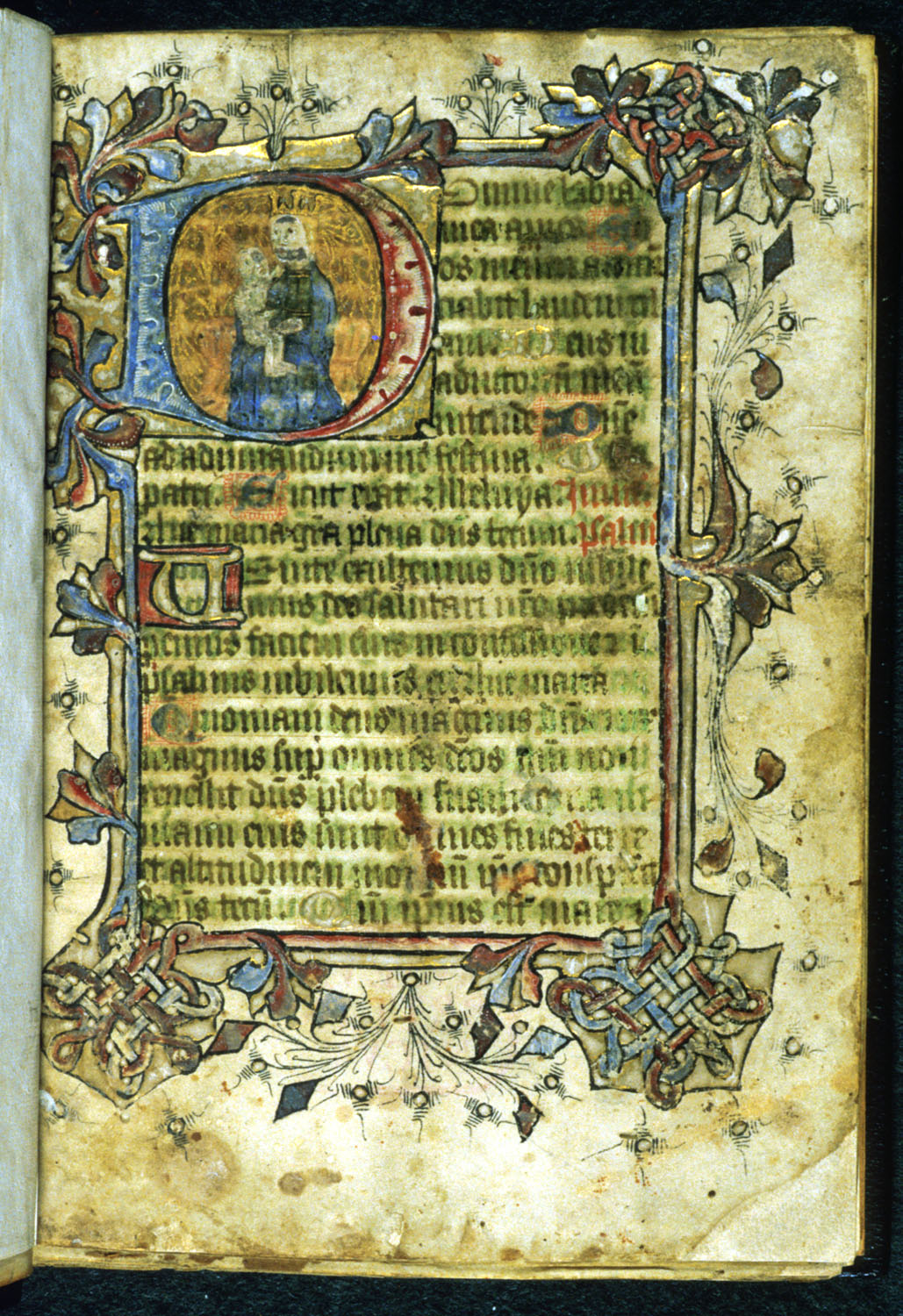
The second type are initial letters that contain scenes (known as historiated initials) or that have elaborate decoration. Again, these usually illustrate or complement the content of the text.

Historiated initial 'D'(omine) with a crowned Virgin and Child.
English Book of Hours, 1st quarter of the 15th century.

Third, we have borders and line-endings, which may have many detailed images/miniatures in them. These often do not relate directly to the text and can contain unusual figures.

Marginal illustration from the Gorleston Psalter- Norfolk, early 14th century.
How much do we love the medieval duck? 

And while the illuminations could serve to illustrate or to decorate, they also provided aids for contemplation and meditation for those reading them as part of their daily prayer and devotion. On another (very practical) level, the illustrations were useful markers for less literate readers to be able to navigate a lengthy manuscript. One does not have to be able to read to identify a picture of the Virgin Mary or one of the story of Adam and Eve.

Four scenes from the Book of Genesis, with three of Adam & Eve.
The Huth Psalter, England, late 13th century.

Although so many wonderful works were produced by men (and women) of the church, by 1100 this situation began to change. The production of manuscripts was no longer the preserve of the church, and secular scribes and illustrators rose in importance. This was in part due to the expansion of the content of manuscripts. Romances, chronicles, medical and other texts and aristocratic family trees all began to be produced. The rise of the universities and the increase in book ownership by the wealthy saw a thriving secular book trade in Paris and Bologna by the 13th century.

Guinevere questioning Lancelot about his love for her.
Lancelot du Lac, France, c.1316.

It was another university city, the city of Cologne, that was to trigger the start of the demise of the manuscript. By the 1470s Cologne had become the most important centre of printing in north-west Germany and where a certain William Caxton was perfecting his own particular art. Handwritten texts were being replaced by the printed version.

From the Arnstein Bible, a large two-volume MS, Germany c. 1172.
It was written by a single scribe, a monk named Lunandus.

But it was English Reformation that was to see the wanton destruction of the illuminated manuscript. Henry VIII decreed that the 'images and pictures' of Saint Thomas Becket shall 'through the whole realm be put down and avoided out of all churches, chapels, and other places.’ The Act against Superstitious Books and Images (1550) ordered that prayer and service books that did not comply with the reformed liturgy should be destroyed. The religious communities did their best to keep their handwritten treasures safe. Books were smuggled out of religious houses and hidden in sympathetic homes. But not all could be saved. Priceless manuscripts were torn up, burned, used to clean candlesticks, clean boots, stop up beer barrels and even deployed in the privies.

The martyrdom of Thomas Becket from the Harley collection-
a rare survival in an English context.
Netherlands, 3rd quarter of the 15th century.
           

Yet despite all of this appalling vandalism, medieval manuscripts have preserved for posterity the lion’s share of medieval painting. As Beal so beautifully puts it: ‘Books have a knack of surviving.’ It is our great good fortune that they do.


Detail of marginal images of apes with books.
France, 1318-1330.

~~~~~~~~~~~~~~~~
References:
All images are in the Public Domain and are part of the British Library's Catalogue of Illuminated Manuscripts. (This online resource is truly a treasure trove and I cannot recommend it highly enough.)
Beal, Peter, A Dictionary of English Manuscript Terminology 1450–2000: Oxford University Press, Current Online Version. (2011)
Brigstocke, Hugh, The Oxford Companion to Western Art: Oxford University Press, Current Online Version (2003)
Chilvers, Ian, The Oxford Dictionary of Art and Artists (4 ed.): Oxford University Press, Current Online Version (2014)
De Hamel, Christopher, A History of Illuminated Manuscripts (2nd ed.), London: Phaidon Press Ltd. (1994).
Kerr, Julie: Life in the Medieval Cloister, London, Continuum Publishing (2009)
Whittock, Martyn, A Brief History of Life in the Middle Ages: London, Constable & Robinson (2009)
~~~~~~~~~~~~~~~
E.M. Powell’s medieval thrillers THE FIFTH KNIGHT and THE BLOOD OF THE FIFTH KNIGHT have been #1 Amazon bestsellers and a Bild bestseller in Germany. Book #3 in the series, THE LORD OF IRELAND, about John’s failed campaign in Ireland was published by Thomas & Mercer on April 5 2016. Born and raised in the Republic of Ireland into the family of Michael Collins (the legendary revolutionary and founder of the Irish Free State), she now lives in northwest England with her husband, daughter and a Facebook-friendly dog. As well as blogging and editing for EHFA, she is a contributing editor to International Thriller Writers The Big Thrill magazine, reviews fiction & non-fiction for the Historical Novel Society and is part of the HNS Social Media Team. Find out more by visiting www.empowell.com.

Find her books on:
Amazon