Showing posts with label Newspapers. Show all posts

Tuesday, September 11, 2018

The Role of the Circulating Library

by Maria Grace

During the Georgian Era literacy rates among the ‘common man’ rose. Consequently, the demand for reading materials increased, driving the rise of two new literary forms, the newspaper and the novel. By 1720, twenty four newspapers were published in Britain. By the 19th century there were fifty four newspapers printed in London alone.

The High Cost of Reading


Unfortunately, the cost of reading material did not decrease with the increase in demand. But, where there’s a will, there’s a way. People banded together to form “newspaper societies” where groups of people, usually those in a local parish, would contribute a weekly sum. With these pooled funds, the society would purchase subscriptions to one or more newspapers. The newspapers would be shared among those in the society.

While they might not be the first to get the news, society members did manage to get their hands on what they might not be able to individually afford. By 1820, around five thousand of these societies were still going strong.

Whether booksellers took note of the idea or came upon it on their own, they realized that, as with newspapers,  there were far more readers who wanted books than could actually afford to pay for them. For some perspective, in 1815, the average (three-volume) novel cost a guinea (a pound and a shilling). Based on the current worth of a guinea's gold content, that was roughly the equivalent of $100 in modern currency.

This doesn’t tell the whole story though. In the early 1800s, a comfortable middle class salary for a family of four was in the neighborhood of £250. (A guinea was slightly more than a pound, but let’s keep the math a little easier.) At the price of a guinea, a typical novel would cost you 1/250 of your yearly income. If you consider the median US income in 2018 as $60,000 (rounding up just a smidge for the sake of the math), then that same novel carries a price tag on the order of $240. Ouch!

Enter the Circulating Library

Booksellers, particularly those in big cities like London, had already begun making changes in their business practices to reflect these economic realities. By the mid-1700s, they had started encouraging clients to linger at their shops “offering comfortable chairs, a warm fireside in cold weather, some even offering refreshments. The best of these shops soon became places where those with literary interests congregated regularly. Even if a bookseller made enough to afford to employ an assistant or two, most spent a goodly portion of their time in their shops, chatting with their customers. In the days before published book and theater reviews, it was these discussions which enabled people to keep up with the news of the literary world. By the mid-eighteenth century, the social aspects of these literary bookstores were nearly as important as the books they housed.” (Kane, 2011)

From here, it was only a short leap for booksellers to allow their best patrons to take books home with them to continue reading, for a fee of course. Trustworthy patrons were often allowed to rent books to read and return. The idea grew and by 1728, James Leake had established the first circulating library in England. (Hilden, 2018) In 1742 Reverend Samuel Fancourt, opened the first circulating library in London. He has also been credited with coining the term circulating library. (Kane, 2011) By the end of the 18th century there were 1,000 circulating libraries across England. (Hilden, 2018)

Libraries Holdings

Early library holdings varied according to the anticipated subscribers of the library. Sometimes existing social clubs or book clubs formed libraries to cater to the interests of their members. These libraries might feature books on science, arts, the classics, law, history, religion or philosophy. Other “club” libraries might feature somewhat broader topics and even some newspapers or magazines which could be made available to members in a separate reading room. These libraries were not open to the public though, available only to members of the club. (Kane, 2011)

Music libraries formed in places like Bath, specifically to allow subscribers access to sheet music. (McLeod, 2017)
Bath Chronicle and Weekly Gazette - Thursday 11 April 1816 

Since the circulating library was first and foremost a business, it behooved the library to cater to as many as could afford the price of a subscription. So, most library catalogs reflected a much wider selection of books, appealing to the tastes of both men and women since most libraries could not afford to discriminate on the basis of gender. Savvy proprietors quickly realized that the most profitable sort of book was the fashionable novel.

Novels were different than traditional nonfiction books. Where nonfiction works might be read and reread, consulted through the years as a valuable reference, this was not so with the novel. The novel was in fact a “consumable” good. Typically one read a novel once and never again. It was exactly the sort of book that made little sense to purchase (as an individual) and a tremendous amount of sense to rent.

Library catalogues reflected the (largely female reading) public’s hunger for novels. The average circulating library’s catalogue typically listed around five thousand titles. About twenty percent of those were fiction. However, many libraries boasted multiple copies of those novels, sometimes as many as twenty five copies. So that twenty percent of titles probably made up a much larger percentage of the libraries actual holdings. Research on smaller libraries, those averaging less than four hundred and fifty titles, reveals collections of up to seventy five percent fiction titles. Some research suggests that fiction was checked out three to four times as much as nonfiction, implying that for some of these smaller libraries almost all of their stock and trade was in the renting of novels. (Erickson, 1990)

Libraries as a social space


Libraries were first and foremost a business, not a public service as we think of them today. Generally, they required a town with a population of at least two thousand to be profitable. Consequently, they were almost exclusively found in larger towns and resorts.

Libraries could exist in smaller areas, but in those places, they were more of a sideline, added to an existing business. “In 1791, William Lane, famed for the Minerva Press, advertised ‘complete CIRCULATING LIBRARIES . . . from One Hundred to Ten Thousand Volumes' for sale to grocers, tobacconists, picture-framers, haberdashers, and hatters eager for a profitable side line.”(Benson, 1997) Other libraries (those small or not so small) supplemented their income with additional lines of luxury goods like haberdashery, hosiery, hats, tea, tobacco, perfume and even patent medicine. (Erickson, 1990) They might even go so far as to advertise these goods in the local paper.  (McLeod, 2017)

Taunton Courier, and Western Advertiser - Thursday 09 February 1815 

Since libraries survived on traffic from the local public, they sought to draw public attention from the local newspapers. Construction of a new library was often publicized in the newspaper as were additions to a library’s collections.

Hull Advertiser and Exchange Gazette - Saturday 10 January 1807 

La Belle Assemblee, the popular ladies' journal, carried advertisements for circulating libraries: (McLeod, 2017)
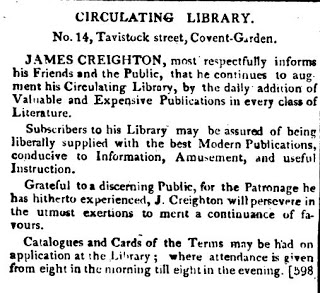


To encourage their customers to visit and to linger, libraries, especially in resort areas, often installed reading rooms and “daytime lounges where ladies could see others and be seen, where raffles were held and games were played …” (Erickson, 1990) These rooms were often gathering places for acquaintances to meet or for people to stop and rest during a long excursion into town.

“Since it was the custom to subscribe to the libraries immediately upon arrival in the watering places and resorts, their subscription books became a useful guide to who was in town. In Sanditon the subscription book is used this way. Mr. Parker and Charlotte Heywood go to Mrs. Whitby's circulating library after dinner to examine the subscription book. When they look into it, Mr. Parker ‘could not but feel that the List was not only without Distinction, but less numerous than he had hoped.’” (Erickson, 1990)

Libraries as a business


The circulating library’s profits (primarily) came from lending books to readers for a fee and later selling the used copies for a reduced price after a book (usually a novel) declined in popularity, typically about nine months after its publication.

Subscription prices varied but were generally affordable for the middling classes. Lending periods could vary depending on the kind of book borrowed—two to six days might be the period for a popular new work. Beyond the price of subscription, heavy fines, which could include purchasing the book, could be imposed for returning books late or damaging the books. (Erickson, 1990)

A catalogue of Hookham’s circulating library, 1829

Just how much did a library subscription cost? “The Nobles' brothers charged ten shillings sixpence per year, or three shillings per quarter. The subscriber was then entitled to any two books from the collection at any time. For an additional charge they would even deliver books to your London residence… Some libraries, such as Hookham's, had sliding rates according to services selected.” (Benson, 1997)

(Sanford, 2010)

Most lending libraries had a reading room with the daily newspapers and the most popular magazines available occasionally. Some had a few bookshelves with the most popular current books on them. What they did not feature were rooms of shelves where patrons could browse. In general, the books were kept in closed stacks, away from the public.

In order to borrow a book, a subscriber would peruse the library catalogue lists and select a title. Then, they would go to a clerk who would consult their lists to find the press mark which would allow them to identify what shelf and position to find the book on. The clerk would retrieve the book and allow the patron to determine whether or not they wanted to borrow said book. Clerks tended to be very knowledgeable on the latest books available and might offer recommendations as well. (Kane, 2015) While waiting for the clerk to retrieve their book, patrons might spend time in the reading room, looking over the goods for sale, or even enjoying some light refreshments.

Library failures


In The Use of Circulating Libraries, Thomas Wilson warned that not one circulating library in twenty is, by its profits enabled to give support to a family, or even pay for the trouble and expense attending it; therefore the bookselling and stationary business should always be annexed, and in country towns, some others may be added, particular small, expensive luxury items. (Erickson, 1990) Though it may seem a rather dire warning, running a circulating library required significant business savvy.

Because novels were largely a consumable good, they had a limited shelf life and depreciated quickly, rather like fruit. A substantial portion of a library’s income had to be reinvested in new stock in order to keep new, attractive titles on their shelves. At the beginning of the nineteenth century, rising book prices made this particular difficult task, with many libraries declaring bankruptcy. Mrs. Martin’s Circulating library in Basingstoke to which Jane Austen subscribed, opened in 1798, and failed in 1800. Half the library failures from 1732 to 1799 took place in the nine year period from 1790 to 1799. (Erickson, 1990)

Over the course of the 19th century, books became less expensive. Declining taxes and falling prices on paper, the rise of the paperback cover, and industrialization made books more affordable. Moreover, public libraries came on the scene and allowed individuals to borrow without a subscription fee. Together, these forces brought about the decline of the circulating library, but their influence on the reading public is still felt today.

References

“British Newspaper History”. Accessed September 6, 2018 https://www.999inks.co.uk/british-newspaper-history.html

Book Shops” Georgian Index. 2003 Accessed August 29, 2018. http://www.georgianindex.net/books/Hatchard.html

Austen, Jane. Ed. R. W. Chapman. Jane Austen's letters to her Sister Cassandra and others. 2nd ed. Oxford: Oxford University Press, 1979.

Benson, Mary Margaret. “Parasols & Gloves & Broches & Circulating Libraries.” Persuasions # 19, 1997 Jane Austen Society of North America.

Erickson, Lee. "The Economy of Novel Reading: Jane Austen and the Circulating Library." Studies in English Literature, 1500-190030, no. 4 (1990): 573-90. doi:10.2307/450560.

Feather, John. The Provincial Book Trade in Eighteenth-Century England. Cambridge: Cambridge Univ. Press, 1985.

Glover, Anne. Regency Hot Spots: Bookseller Shops and the Subscription Library. Regency Reader. November 6, 2015. Accessed August 1, 2018. http://www.regrom.com/2015/11/06/regency-hot-spots-bookseller-shops-and-the-subscription-library/

Hatch, Donna. Circulating Libraries in Regency England. Historical Hussies. Friday, November 7, 2014. Accessed July 0, 2018. http://historicalhussies.blogspot.com/2014/11/circulating-libraries-in-regency-england.html

Hilden, L. A. Circulating Libraries in Regency England. L.A. Hilden. July 23, 2018. Accessed July 31, 2018. http://www.lahilden.com/index.php?categoryid=6&p2_articleid=206

Jacobs, Edward and Antonia Forster. "'Lost Books' and Publishing History: Two Annotated Lists of Imprints for the Fiction Titles Listed in the Circulating Library Catalogs of Thomas Lowndes (1766) and M. Heavisides (1790), of Which No Known Copies Survive." The Papers of the Bibliographical Society of America 89 (1995): 260-97.

Kane, Kathryn. Before the Call Number: The Pressmark. The Regency Redingote. January 16, 2015. Accessed August 29, 2018. https://regencyredingote.wordpress.com/2015/01/16/before-the-call-number-the-pressmark/

Kane, Kathryn. Regency Circulating Libraries — Why, How and Who? The Regency Redingote. October, 211, 2011, Accessed August 12, 2018. https://regencyredingote.wordpress.com/2011/10/21/regency-circulating-libraries-why-how-and-who/.

Manley, K. A. "London Circulating Library Catalogues of the 1740s." Library History 8 (1989) 3,74-79.

Mc Leod, Lesley Anne. Who Doesn't Love a Library? Lesley Anne McLeod. Wednesday, November 8, 2017. http://lesleyannemcleod.blogspot.com/2017/11/who-doesnt-love-library.html

Sanborn, Vic. The Circulating Library in Regency Resorts. Jane Austen’s World. August 30, 2010. Accessed August 15, 2018. https://janeaustensworld.wordpress.com/2010/08/30/the-circulating-library-in-regency-times/
~~~~~~~~~~~~~~~~~~~~~~~~~~~~~~


Though Maria Grace has been writing fiction since she was ten years old, those early efforts happily reside in a file drawer and are unlikely to see the light of day again, for which many are grateful.

After penning five file-drawer novels in high school, she took a break from writing to pursue college and earn her doctorate. After 16 years of university teaching, she returned to her first love, fiction writing.

Click here to find her books on Amazon. For more on her writing and other Random Bits of Fascination, visit her website. You can also like her on Facebook, or follow on Twitter.

Monday, March 12, 2018

Newspapers, Gossip Columns, and Scandal Mongers

by Maria Grace


It seems people have always been hungry for news. Not unlike today with abounding media outlets, newspapers proliferated during the Regency era. In spite of heavy taxation, high costs, and government censorship (that could include prosecution for libel!) by 1816, thirty one national newspapers were published in Britain, including fourteen in London itself. Some published daily, some several times a week, and some even less regularly. Daily papers included: The Morning Chronicle, Morning Post, The Times, and The Morning Herald. (Bolen, 2012)

Newspapers were not cheap. Costing around seven pence apiece (over half the price being tax!), they were often shared among many readers at coffee houses and circulating libraries or passed among friends and family members around the neighborhood.

The dawn of serious journalism

What did these popular papers publish? Most of those who (could afford to) read newspapers were interested in parliamentary proceedings. Consequently, reports on those often took up at least half the print space. (Day, 2006) The rest of the space—often in relatively haphazard order—was taken up by the rest of the news. Reports on the visual and performing arts became increasingly popular during the era. News of crime and punishments including bankruptcies, duels and seductions appeared with almost monotonous regularity. (Fullerton, 2004)

Some news was difficult to report, particularly that related to the Peninsula war. Captain Rees Howell Gronow noted, “there was a very limited and imperfect amount of intelligence which the best journals were enabled to place before their readers (the progress of the Peninsular campaign was very imperfectly chronicled.)” (Summerville, 2006) To answer some of this difficulty, The Times of London sent the first war correspondent, Henry Crabb Robinson, to Spain to report on the Peninsula War. (Grum, 1975) In contrast, Adm. Nelson did not leave the job to reporters. He ensured that he received praise and public recognition by issuing press releases to the papers directly. (Summerville, 2006)

Such a wide variety of sources suggests a wide range in the reliability of various newspapers. Indeed, some had high standards, publishing what we would consider today to be important news including new of Parliament, war correspondence, current events and even the weather. (Journalism standards and ethics were also being established during this period, which considering what some papers printed, was a very necessary thing.)

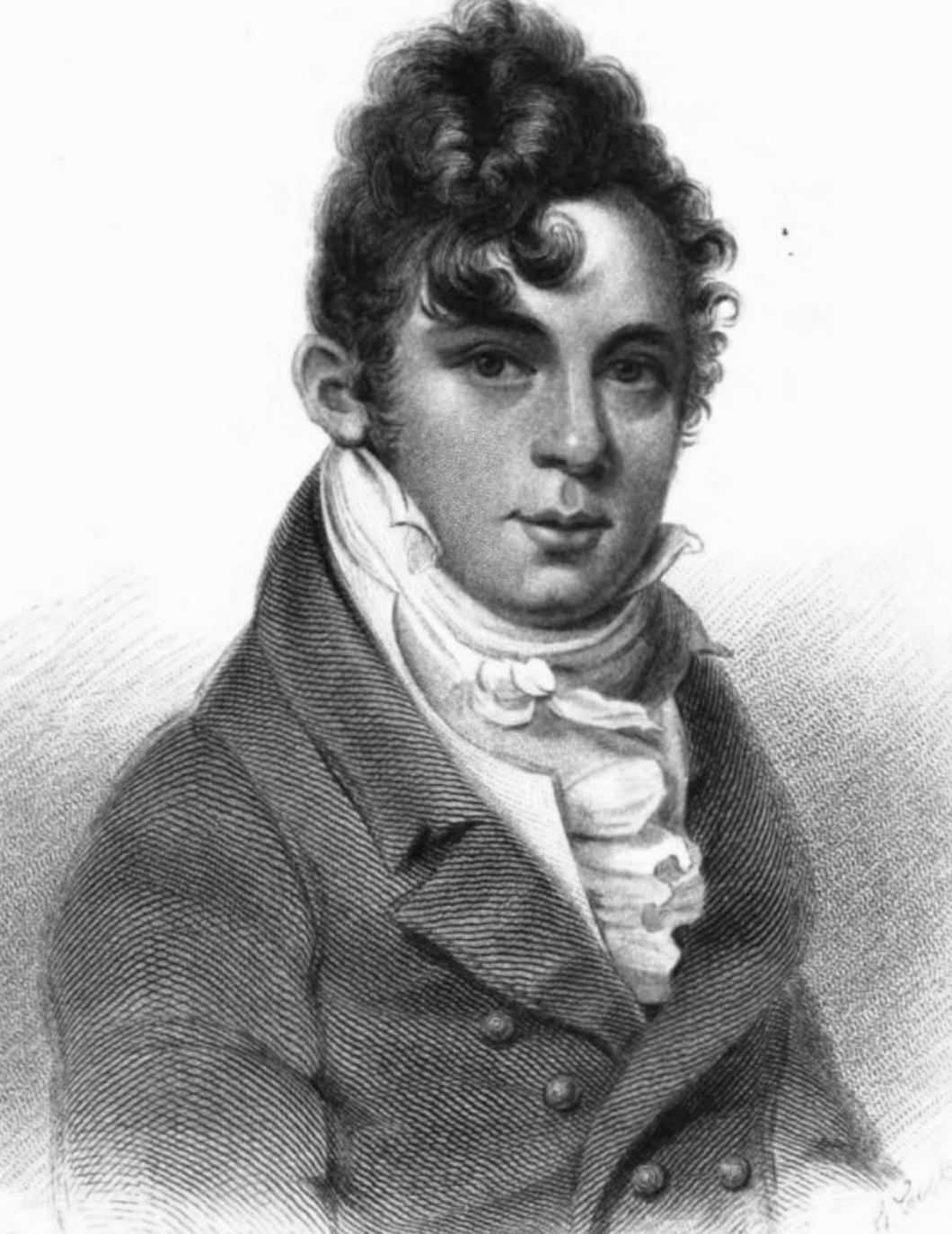
James Leigh Hunt
For example London’s The Examiner, edited by the Hunt brothers, James Leigh and John, published serious news, even though it was not always popular. Among other things, they called the government to task for the heavy taxation. In 1812, they criticized the Prince Regent for gambling and womanizing and running up huge debts while not doing anything for the citizenry. Despite the truth of what they printed, the Hunts were sued for libel and James Leigh imprisoned for two years though he continued to edit The Examiner from prison. (Gaston, 2008)

…and not so serious

Other newspapers flourished by reporting the scandals of the “the celebrities of the day. Women of the peerage, like royalty, combined the glamour of present-day Hollywood with the power and prestige of modern political and economic elites. Aristocratic comings and goings, successes and failures, travels and travails, were avidly reported in the English press.” (Lewis, 1986) Reports of elopements were frequently published under the heading 'Fashionable World.' Other missteps might find their way under columns dedicated to ‘Fashionable Faux Pas.'

Even the ordinary news of a betrothal in the Morning Post, the Gazette or The Times could be spiced up by reporting the bride’s fortune—whether the reporter knew the actual amount or not. Sometimes, the announcements did not give the name of the bride, only that of her father and any titled connections—because of course that was what really of interest to readers. (Jones, 2009)

Reporters often purchased their juicy tidbits from servants less than loyal to their masters and gentlemen and ladies willing to expose their friends. Purchasing gossip could get expensive; blackmail was much cheaper. Some newspapers were known to take money to not print some embarrassing incident—which might or might not actually even be true. (Gaston, 2008)
Theodore Hook
One of the most notorious of such journalists was Theodore Hook. He lost a great deal of money in a government job when a clerk under him embezzled money he was responsible for. To make up for lost income, Hook started the Sunday newspaper, The John Bull.

Unlike the Hunts, he sided with the Prince Regent—not a bad idea considering his situation. In his paper, he freely criticized prominent Whigs and even Queen Caroline and her attendants. Even more endearing, while not above paying for gossip, Hook gleaned most of his information by keeping his identity as editor of The John Bull a secret, and essentially spying on his friends and connections. Charming guy, huh? (Gaston, 2008)
Away from London, country newspapers reported on the doings of the local landowners—the closest thing passing for a celebrity in the remote regions. Local gentry would then include these scintillating tidbits in their letter so local news did not stay local very long. Sufficiently scandalous items managed to find their way into the national papers.

Even with the use of initials and dashes to substitute for full names (ostensibly to protected editors from legal actions) little remained private. When things were especially salacious full names were often used citing the ‘concern for public morality.’ (Jones, 2009) Crim con trials were a particular favorite scandal to report on.

Crim con trials

Crim con trials, or more properly Criminal Conversation trials, were the part of a divorce proceeding where a wife’s infidelity was proven in a court of law. Since divorce required a literal act of Parliament, only the very wealthy and well-connected were able to even consider seeking a divorce, effectively guaranteeing that crim con trials would be newsworthy.

The trials tended to be colorful, highly publicized events open to the general public—as close to modern reality TV as the Regency era could get. For those not fortunate enough to be able to attend in person, most book sellers carried newspaper, pamphlets, transcripts and ‘true’ exposés documenting all the sexual misadventures of high society.
Barristers on both sides of the case played up the drama as much for the public notoriety as for the effect on the court’s decisions. During the 1809 Clarke scandal, the Duke of York bore the humiliation of having his love letters to Mrs. Clarke read out to the entire House of Commons and published in every scandal seeking newspaper in the country.

Trial proceedings called upon servants, especially young pretty ones, to deliver testimony for both the plaintiff and the defense. While servants could be (mostly) excused for presenting sensational tales in coarse language, the barristers were gentlemen and adopted notably euphemistic and flowery language to express the necessary elements with decency and taste. Some said it became something of an art form.

With so much at stake, both in terms of finances and reputations, truth and accuracy fell to the need to convince jurors. What better fodder for sensation hungry editors to use to sell newspapers? Not surprisingly, the papers sold out as fast as they could be printed. (Murray, 1998)

Of course, all this sounds nothing like the media today, does it? Uhm, yeah, sure. Absolutely—not. One more case of the more things change, the more they stay the same.

References

Bolen, Cheryl. "The Proliferation of Newspapers in Regency England.” The Beau Monde. March 22. 2012. Nov. 27, 2017 .http://thebeaumonde.com/the-proliferation-of-newspapers-in-regency-england/

Fullerton, Susannah. Jane Austen and Crime. Sydney: Jane Austen Society of Australia, 2004.

Gaston, Diane. “Scandal! Gossip! Research.” Risky Regencies. August 25, 2008. Accessed Nov. 27, 2017 . http://www.riskyregencies.com/2008/08/25/scandal-gossip-research/

Gronow, R. H., and C. J. Summerville. Regency Recollections: Captain Gronow's Guide to Life in London and Paris. Welwyn Garden City, U.K.: Ravenhall, 2006.

Grun, Bernard. The timetables of history: a chronology of world events: based on Werner Steins "Kulturfahrplan". London: Thames and Hudson, 1975.

Harvey, A. D. Sex in Georgian England: Attitudes and Prejudices from the 1720s to the 1820s. New York: St. Martin's Press, 1994.

Jones, Hazel. Jane Austen and Marriage. London: Continuum, 2009.

Laudermilk, Sharon H., and Teresa L. Hamlin. The Regency Companion. New York: Garland, 1989.

Lewis, Judith Schneid. In the Family Way: Childbearing in the British Aristocracy, 1760-1860. New Brunswick, N.J.: Rutgers University Press, 1986.

Murray, Venetia. An Elegant Madness: High Society in Regency England. New York: Viking, 1999.

Wilkes, Roger. Scandal: a scurrilous history of gossip. London: Atlantic, 2003.

~~~~~~~~~~

Though Maria Grace has been writing fiction since she was ten years old, those early efforts happily reside in a file drawer and are unlikely to see the light of day again, for which many are grateful. 

After penning five file-drawer novels in high school, she took a break from writing to pursue college and earn her doctorate. After 16 years of university teaching, she returned to her first love, fiction writing.

Click here to find her books on Amazon. For more on her writing and other Random Bits of Fascination, visit her website. You can also like her on Facebook, or follow on Twitter.


Sunday, August 30, 2015

Read All About It! The Daily Courant Hits the Presses

by Catherine Curzon

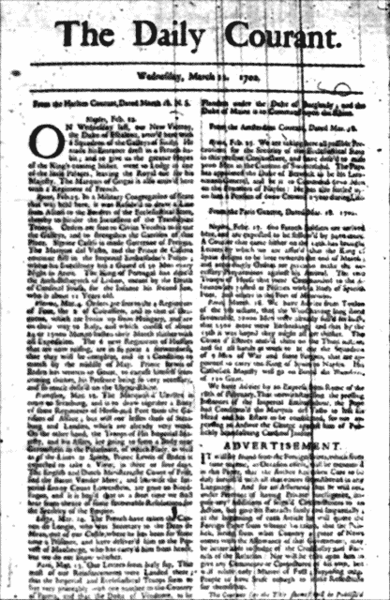
Reading through newspapers of the Georgian era  has always been a source of delight to me; long hours can be lost to browsing the dailies, and if we think our news today is scandalous and prurient, we have nothing on the 18th century. One of the first I encountered was The Daily Courant, a newspaper owned by a most estimable lady named Elizabeth Mallet. 

Mallet launched the Courant from her premises besides the Kings Arms on Fleet Bridge, London, on 11th March 1702; her adders was given as the wonderfully evocative against the Ditch at Fleet Bridge, which puts it somewhere in the vicinity of the building occupied by The Times two centuries later. As the first daily English language newspaper to be published in Britain, it was a remarkable endeavour undertaken by a remarkable woman, yet by our standards, the newspaper resembled a newsletter rather than the supplement and advertisement-stuffed behemoths that plop through our letterboxes today.


The Daily Courant

The Courant was only one page, so there were none of troublesome glossy inserts to clutter up one's home, but what it did contain was reports of the major stories of the day. When one's curiosity for current affairs was sated, one could turn over and browse advertisements on the reverse. 

Mindful of the public's thirst for news from overseas and sensing that the availability of such material was sorely lacking, the paper confined itself to reporting only on stories that came from abroad. The news was  curated from overseas gazetteers and translated into English, presented without any editorial or opinion to muddy the facts. Instead, Mallet considered her readers "had sense enough to make reflections for themselves", something that the news writers of today might do well to remember!

Sadly, Mallet did not receive recognition for her endeavours as, well aware that a female name on the byline might not endear her newspaper to the public, she published the Courant under the gender-neutral name E Mallet. In 1703 she sold the paper to Samuel Buckley and then faded from the annals of history until 1706, when reference can be found to her posthumous estate. Buckley, of course, went from strength to strength and became a famed name in the industry, eventually securing his place in news history as the printer of The Spectator, a title that exists on newsstands to this day.


Like most groundbreaking endeavours, the Courant was not without its controversies, and on 7th April 1712, the paper fell foul of government when it printed an account of business in the House of Commons translated from a Dutch source. Publishing the private business of parliament was a serious matter, and Buckley was punished with a hefty fine for his wrongdoing. Naturally, the case did no harm to sales of his newspaper! 


The Courant continued for 34 years under Buckley's stewardship, and in 1735 it merged with the Daily Gazetteer. Buckley himself passed away five years later, his place in the history of printing assured.


References
Dunton, John, The Life and Errors of John Dunton, Citizen of London. J. Nichols, 1818.
Leach, Henry Leach. Fleet Street from Within. J.W. Arrowsmith, 1905.
Wheatley, Henry Benjamin and Cunningham, Peter. London Past and Present: Its History, Associations, and Traditions. Cambridge University Press, 2011.
Williams, Kevin, Read All About It!: A History of the British Newspaper. Routledge, 2009.

~~~~~~~~~~~~~


Glorious Georgian ginbag, gossip and gadabout Catherine Curzon, aka Madame Gilflurt, is the author of A Covent Garden Gilflurt’s Guide to Life. When not setting quill to paper, she can usually be found gadding about the tea shops and gaming rooms of the capital or hosting intimate gatherings at her tottering abode. In addition to her blog and Facebook, Madame G is also quite the charmer on Twitter. Her first book, Life in the Georgian Court, is available now, and she is also working on An Evening with Jane Austen, starring Adrian Lukis and Caroline Langrishe.

Monday, September 1, 2014

The West Briton

by Jane Jackson

We are so used to 24-hour news with information arriving from all over the world minutes after events occur, it’s easy to forget that two hundred years ago news travelled at the speed of a galloping horse or a fast sailing ship. But though dispatches might take days, weeks or months to arrive, their impact on local people was no less profound.

The first edition of the West Briton was published in 1810 by John Heard from offices in Boscawen Street, Truro, heart of Cornish high society in the 1800s. This was a Whig newspaper and was established to promote an alternative view to a rival Tory paper first published in 1803.

The term Whig entered British political life during the controversy of 1678–1681 about whether or not King Charles II's brother, James, should be allowed to succeed to the throne on Charles's death. Whig was a term of abuse applied to those who believed James should be excluded from on the grounds that he was a Roman Catholic.

Evolving during the C18th, the Whig party supported the great aristocratic families, the Protestant Hanoverian succession, and toleration for nonconformist Protestants (dissenters such as Presbyterians.) It drew support from emerging industrial interests and wealthy merchants. By the first half of the C19th the Whig political programme came to encompass not only the supremacy of parliament over the monarch and support for free trade, but also Catholic emancipation, the abolition of slavery and expansion of the franchise.

The term Tory - originally applied to Irish Catholic bandits – was used in the C17th to deride those who believed in the principals of hereditary succession to the crown and non-resistance to the monarch. Despite falling into disarray in 1688, within parliament a significant block of members remained bound together by support for the established Church of England, hostility to Nonconformists, and continued insistence upon the principle of divine monarchical right.

Briefly back in power during Queen Anne's reign, in 1714 they were undone by their support for James II and the Stuart Royal family’s claim to the British throne. The Tory power base was the conservative rural gentry which violently opposed the taxation required to pay for the wars with France that the Whigs, with their belief in free trade, stood to profit from. They returned to government in 1784. But after the French Revolution the Tories were increasingly seen as a party of reaction and eventually lost power in 1830.

(Whigs with their liberal views on community and social responsibility equate to American Democrats, Tories being conservative and believing in individual rights and justice, to Republicans.)

Given such violently opposed political views, editorial battles between the rival newspapers were epic, being inflammatory and scathing.

In that first edition of the West Briton, Heard expressed concerns about the actions of Napoleon Bonaparte. What follows are abstracts from articles in his newspaper.

In April 1814 the paper reported the entrance of the Allied Army into Paris. The dethronement of Bonaparte was received in every part of Cornwall with demonstrations of joy. In Penzance and Newlyn the populace erected bonfires in several streets and wealthy neighbours donated barrels of beer to aid the celebrations.

St. Michael's Mount
Marazion and St Michael’s Mount were illuminated with the castle magnificently lighted to striking effect. The bells in the castle tower, which had not been heard for many years, rang out on this joyous occasion.

The fishermen of Mousehole showed their delight by burning an effigy of Bonaparte.

The proprietors of Crinnis Mine near St Austell celebrated the victory by entertaining all the (mine) captains, miners and work people in their employ. The captains dined together and were given twelve dozen bottles of wine. The work people were treated to a whole roast ox, a thousand loaves of bread and ten hogsheads of beer. In the evening the entire company enjoyed a grand display of fireworks.

(Bonaparte was sent to Elba, escaped, and rallied his army to fight the Allies.)

After his defeat at Waterloo in June 1815, unable to escape to America because of the blockading Bellerophon, Bonaparte stepped aboard the ship that had dogged his steps for twenty years to finally surrender to the British ending two decades of war.

The Bellerophon
In July 1815 Bellerophon, known to English sailors as Billy Ruffian, entered Plymouth Sound to take on water and provisions before carrying the ex-Emperor to exile in St Helena. Bellerophon was accompanied by the Slaney and the Myrmidon, both carrying the baggage of Bonaparte and his suite.

As soon as the ship dropped anchor, every boat in Plymouth took to the water filled with people wanting to approach. But acting on orders from the Government, guard boats stationed around Bellerophon prevented the curious from getting close.

Yet despite the losses of ships and men caused by the war, and the celebrations following his defeat, such was the aura surrounding Bonaparte that when at 6pm he appeared on deck every officer, British as well as French, instantly bared their heads as a token of respect.

~~~~~~~~~~~~~

Crosscurrents
Accent Press
Ebook & paperback
July 2014

Website
Facebook

Jane Jackson loves history, Cornwall and romance. A professional writer for over thirty years with twenty-eight books published, she also teaches the craft of novel-writing and ten of her former students are now published novelists. Happily married to a Cornishman, with children and grandchildren, when not writing she enjoys reading for pleasure and research, long walks while listening to music and playing 'what if' with characters and plot ideas. She also likes to bake - hence the need for long walks.

Wednesday, October 17, 2012

The Lady's Monthly Museum

by M.M. Bennetts


During the last years of the 18th century and well into the early 19th century, as female literacy and affluence increased, there was a growing body of publications designed to meet this burgeoning demand for feminine entertainment.

This is an age of when great poetry not only sells, it sells well--Byron's Childe Harold doesn't just sell well, it's a runaway best-seller along the lines of the Da Vinci Code.  Austen's Sense & Sensibility causes such a sensation, Lady Caroline Lamb's mother is writing about it, saying that everyone in the Spencer household is wholly taken up with it and talks of nothing else.

It is--make no doubt--a literate society and whilst the salons of English ladies may not reach the intellectual and political heights achieved by Frenchwomen of the period, that doesn't make them literary slouches.

The Lady's Monthly Museum or Polite Repository of Amusement and Instruction: Being an Assemblage of whatever can tend to please the Fancy, interest the Mind or exalt the Character of The British Fair.  Written "By a Society of Ladies", was one of the immensely popular periodicals published during this period.

(I did not make up that title, I can assure you.  I merely copied what is in the frontispiece of the volume at hand.)

It was published by Vernor and Hood in London, from 1798 until 1832 and provides a rather different window into the world of the early 19th century lady than one might imagine based on novels and histories about the age.

Volume five (being the one I possess) is a good example.  The contents include an article about one Miss Linwood (who apparently is a painter of some note), and the following articles titled:  Impostors, The Generous Host, Habit, a series of invented letters called The Old Woman, three chapters of a  serialised romance by the title of The Castle De Warrenne, the Editor's Reply to Mrs. Saveall's Letter--with some useful hints upon the government of the Temper, On Celibacy and Marriage, A Character, The Poor Sailor Boy, On a Passage in Sterne...and last, but not least, Jane of Flanders; Or, the Siege of Hennebonne, Scene III of a Drama in Two Acts which is continued from Volume IV (perfect for home dramatics).

(Later issues contain a great deal of poetry, a Pattern for a Carpet in Needlework, articles on the Manners of Parisian Ladies and under School of Arts, "To destroy Bugs".  And curiously enough, my copy does not have--with the exception of the needlework pattern--fashion plates or pictures of any kind.)

Equally, it's vital to bear in mind that each of these volumes had an enormous reach.  Though initially received by one household, once read, the volume would have been lent about the neighbourhood, and each of the articles probably read or heard by well over 50 women.

My favourite offering from this particular volume is the Romance--The Castle De Warrenne, possibly because it's so silly, but just as much because it provides an insight into what they were reading, what books and ideas were popular, how they spoke and wrote, and how the early 19th century female perceived themselves, how they perceived heroism and romance.

This is the opening:  "Slowly and heavily the bell of the great clock in the turret tolled out three: the gloomy mists of night were gradually dispersing, while a faint yellow, tinging the eastern atmosphere, already indicated the approach of day.

"Matilda started from her couch yet wet with tears, and which had that night afforded her but broken and imperfect slumbers.  Fearing that she had exceeded the appointed time, she hastily arrayed herself in her simple habit, and, bending mournfully over the bed of the yet sleeping Raymond, bestowed innumerable kisses on his dimpled mouth.

"'Sweet babe!' cried she in an agony of tears: 'perhaps I for the last time view they lovely countenance!--no longer shall I receive pleasure from thy innocent endearments!  Oh!  Why does Virtue demand this painful sacrifice!--My dear Lady, too,----all---all lost!!'

"Again she pressed her lips to those of the child, who opened his eyes, and, fixing them on Matilda, smiled sweetly.  The smile undid all her resolution; and, seating herself by his side, she soothed him with her accustomed tenderness, heedless of the passing time.  The clock again reminded her of her tardiness, and with reluctance, she replaced the child; and, casting a mournful look round her little apartment, departed.

"With trembling steps and perturbed heart she descended the great staircase.  All was yet profoundly still.  At the appointed spot she met Jaques, who waited (faithful to the trust reposed in him) to open the gate for her."

(I shall skip ahead to the description of our heroine now, because you won't want to miss this.)

"Matilda, at this period, had just completed her fourteenth year.  Her figure was elegantly formed, and though it had not yet attained its perfect stature, was nevertheless far from contemptible.  Her complexion, exquisitely fair, was admirably contrasted with a profusion of chestnut-coloured hair, which fell in careless ringlets over her forehead and bosom.  Her eyes were bright and piercing, and the contraction of the eyes at the temples gave an expression of archness highly fascinating.

"Her dress consisted of a gray camlet jacket and petticoat, neatly bound with black ribbon, which served to exhibit to advantage her fine shape.  A net fillet confined the superfluous hair, over which was tied a little black chip hat; and a pair of blue silk mittens completed her dress, at once simple and becoming."

It's great stuff!  She runs away to her parents' house, where she finds her father dying...plenty of opportunity to get lachrymose there...and on it goes.

And whilst we may laugh at the naivety of the writing and the overwrought sensibilities, this is exactly the sort of thing that Marianne Dashwood would have found appealing (and Willoughly too, no doubt) and which was being read (devoured) up and down the country by ladies of all ages.

No wonder Sense & Sensibility was such a hit!

~~~~~~~~~~~~~

M.M. Bennetts is a specialist in early 19th century European history and the Napoleonic wars, and is the author of two novels, May 1812 and Of Honest Fame, set during the period.  A third novel, Or Fear of Peace, is due out in 2014.

For further information, please visit the website and blog at www.mmbennetts.com


Tuesday, July 3, 2012

"Emma" Illustrated and Other News

by Debra Brown

Yes, Emma by Jane Austen was illustrated. I'm certain that you are blown away by the news. Just how do I know this deep dark secret?

One morning I was chatting by email with renowned author M.M. Bennetts complaining because she has the unfair advantage of living in the midst of English history while I am here, between five and six thousand miles from London, myself. I could not get maps.google.com to give me the exact mileage on that and had to get out my tape measure.

I also live a few centuries from my eras of chief interest, and that fact is continually rubbed in by modern architecture around me. The bridge over the river leading out of town was, however, built for horses and a carriage of which I am made acutely aware after every university ball game. Claim to fame: Craig Robinson, brother of First Lady Michelle Obama, is the basketball coach in my cozy and beautiful, modern little city.

While you can see an old wagon-train wagon some miles from here, and rusted pitchers that were once brought out west within it, there is no centuries-old castle, no museum protecting centuries-old parchments, no crumbling public records to research medieval England or Scotland or Wales. Well, of course, I have my computer.

After hitting Send on my complaint to M.M., the doorbell rang. Ugh. I almost did not answer it. I am, after all, an author and therefore do not get dressed- though I am grateful not to be strapped into a corset when I do.

Begrudgingly I put down the laptop and went to the door to send someone away. "I need your signature," declared the mailman. Hmmm. I signed a modern little gadget and accepted a box. Scotland? Who do I know in Scotland? Well, thanks to Twitter and FB I do know a few marvelous writers but not anyone who has my address.

I did feel better, though, since a package from Scotland had to be a good thing. It was shaped like a large book, but too light-weight. I shook it, of course, and something lightly clunked around (I'll never do that again) because it would take me at least a minute to get a knife and cut open the wrapper.

Inside the box was another box- a beautiful dusty-blue box with a silver metallic background for the words "A Day to Remember". Huh? Why do packages take so long to open? Does time slow down and hold you back? I opened the blue box and, to be sure, "it" was wrapped in tissue.

I lifted it in slow motion; I think it took forty-five minutes. I unfolded the tissue off the rather flat light-weight thing slowly, and at last there it was. Now my mind went into rapid-fire status: Oh yes! Some-weeks-ago-someone-emailed-me-via-the-blog-and-wanted-to-send-me-historical-newspapers! My jaw dropped. I fell into history!

Inside the tissue were three old papers. I mean old. The newest was from December 11,1896: The Daily Graphic, Enlarged to TWENTY PAGES. One Penny. But I needed new spectacles to read the miniscule print. That took a few weeks, and I still had to use a magnifying glass.The print is really small.


Hugh Thomson; Austenonly.com
Inside this paper I found the great news that Emma was being illustrated by Hugh Thomson. For your enlightenment it reads:


Mrs. Elton appears at church

One of the few books to which Mr. Hugh Thomson's name appears as illustrator this year is Jane Austen's 'Emma,' in Messrs. Macmillan's series of illustrated standard novels; for the rest he has left the field rather severely to his many imitators. But his hand has lost none of its cunning, and one has only to turn over the pages of this book to see how great is the distance still between the master and his followers. Mr. Austin Dobson gives the edition the additional gain of an excellent historical introduction from his pen, tracing the story of the novel in the day in January, 1816, when, like its predecessors 'Sense and Sensibility,' 'Pride and Prejudice,' and 'Mansfield Park,' it was anonymously put forth. Says Mr. Dobson: 'In writing to the Prince's librarian, Mr. J. S. Clarke, on the subject of the presentation copy which was to reach his Royal Highness three days before anyone else (it has been inscribed by invitation to that distinguished patron of Art and Letters, the Prince Regent), Miss Austen sets forth her own ideas of the new book-the last, as a matter of fact, which she was destined to behold in type. 'My greatest anxiety at present is that this fourth work should not disgrace what was good in the others. But on this point I will do myself the justice to declare that, whatever be my wishes for its success, I am strongly haunted with the idea that to those readers who have preferred "Pride and Prejudice" it will appear inferior in wit, and to those who have preferred "Mansfield Park," inferior in good sense.'" When it appeared the Quarterly aptly enough said that the merits of the author consisted in the neatness and point of the narrative and the quiet comedy of the dialogue, but the qualities of "Emma" are undoubtedly qualities which grow with acquaintance. Qualified approval may be the first verdict, later the qualifications have a tendency to withdraw from insistence. "I am going to take a heroine whom no one but myself will much like," said Jane Austen herself at the outset, but despite thus handicapping herself, so skilfully and subtly is the character of Emma Woodhouse developed that the reader is insinuatingly drawn into loving her. "Emma" shows to perfection the writer's methods, her genius, and her limitations. The quotation from a letter by Charlotte Bronte with which Mr. Dobson concludes is, as he says, unjust to Miss Austen, but it is most interesting as setting forth the view of many. The authoress of "Jane Eyre" thought Miss Austen bloodless and lacking fire: so she is to a great extent, but a catholic taste can appreciate many manners, while they are none of them superficial, and superficial, pace Charlotte Bronte, is just what Miss Austen is not. Our illustration shows the incident described by Emma, when explaining to her father how she had always intended Mr. Weston to marry Miss Taylor. "Ever since the day (about four years ago) that Miss Taylor and I met with him in Broadway Lane, when, because it began to mizzle, he dashed away with so much gallantry and borrowed two umbrellas for us from Farmer Mitchell's, I made up my mind on the subject. I planned the match from that hour." ("Emma," by Jane Austen, Illustrated by Hugh Thomson. Macmillan and Co.)


Well, that is the incredible news. 116 years ago. Almost. Wow. The news article comes complete with an illustration labeled "Two Umbrellas for Us." By the famous Mr. Thomson. (See more about him HERE.)

This newspaper is smooth, though yellowing. No problem. It is smooth because it is made of new-fangled paper made from wood. The other two papers are both from 1819, thus made of the more common and textured rag paper. The London Times. Price, 7d. Stamped, even. The front and back are want ads, birth, marriage and death announcements and the price of stocks. (I say, buy!) Inside there are lovely articles. Not a picture to be found.

I will share more earth-shaking news with you from these great newspapers soon, abandoning my series on the Monarchy for a little longer. But let me tell you where you, too, can obtain such fascinating bits of history. They are sold HERE at Historic Newspapers packaged beautifully as gifts for special occasions, and they come from all over the world. Imagine the amazing things you can read about first-hand, hot off the press. A history teaching resource pack is also available.

Many thanks to Thomas Walker of Historical Newspapers for the gift newspapers, some almost two hundred years old, I received.

Debra Brown is the author of The Companion of Lady Holmeshire- now undergoing revision and available again by August 1, 2012.