Showing posts with label Julius Caesar. Show all posts

Monday, July 8, 2019

The Foundation of Britain’s Feudal System

By Eifion Wyn Williams

It was believed during my schooldays, that the first wave of so-called ‘Celtic’ settlers to Britain arrived in the Late Bronze Age, roughly between 1500 BC and 1000 BC. These early arrivals were thought to be the precursor for what became a long-established tradition of feudal and tribal Kingship, and which then spread across the country. Recent archeological findings, and the latest DNA analysis of Britain’s inhabitants have overturned these ‘invasion’ or ‘influx’ theories. It seems we aboriginal people of Britain have little connection to the Continental ‘Celts’, and that we have been here since the end of the last ice-age, tens of thousands of years ago!

In recent years chainmail armour was found to be a British invention, and even the iconic, curving and leaf-shaped swords attributed to the Celts, have since been proved to be a British creation. These were subsequently exported to Gaul and elsewhere around the world, along with so much more. Druidry is thought to have followed the same course, and we can only guess at what other concepts, theories and inventions from this period were British/Brythonic, and then mislabeled over following generations as Celtic.

The most obvious and most recent confirmation of this ‘aboriginal’ theory came from DNA analysis of ‘Cheddar Man’, and whose remains date back to the corresponding Mesolithic period, roughly 11,000 years ago. Mitochondrial DNA samples of this stone-age hunter have found to be a close match to a man, currently living in a village not far from the cave in the Cheddar Gorge, and where this ‘oldest-of-all complete skeletons’ was found. So, those ancient, aboriginal Brythons are still here!

These ‘heroic-age’, Brythonic Kingdoms in this ancient period, almost always came to form the ancestral birthright locations of later, post-Roman Brythonic Kings. Their histories and achievements, their land boundaries and family lineages would have been fiercely protected by their Bards and passed down through the generations. The Brythonic warrior class were known to place a great deal of importance on their paternal lineage and being able to recite one's ancestors for many generations’ past would have been a given.

My Welsh history included the writing of Geoffrey of Monmouth, who in his History of the Kings of Britain tapped into this ancient and oral history carried forward by the Druids and then later by the Bards of this country. He greatly extended this earlier ‘word-of-mouth’ knowledge, attempting to list the lineage of all the kings of Britain who had reigned after the somewhat mythical arrival of one Brutus Greenshield from Rome. This long, ruling-line of Proto-Welsh Brythons ‘officially’ remained up to AD 689, when the end of Gwynedd's (Venedotia) attempts to regain Lloygr; the territory lost to the Anglo-Saxons, signaled to many that the time of the Brythons had come to an end.

The following list is far from complete, as there were many blanks and omissions in the surviving lists. It should not then be taken as being historically accurate, but it does form a framework for the known progenitors to these king’s and their descendants. Geoffrey of Monmouth championed the untraceable Brutus Greenshield as progenitor to this line (a political proposal?), but older Welsh sources offer an alternative, and the very namesake of this country; Prydein ap Aedd Mawr.

Aedd Mawr is purported by those ancient Brythonic scholars, to be the first tribal hunter-chieftain to have arrived with the melting ice and to have successfully settled here, naming these new lands he’d discovered for his son and heir; Prydein. Who knows, it may be Aedd Mawr’s remains that were discovered in Gough’s Cave Cheddar Gorge in Somerset, back in 1903, or perhaps it was his son’s; Prydein. That just boggles the mind….

The listed lineage (with exceptions and omissions); ‘ap’ = son of.
Beli ap Manogan ap Eneid ap Cerwyd ap Crydon ap Dyfnarth (285 BC) ap Cherin ap Porrex (II) ap Millus ap Elidyr ap Peredur ap Ingenius ap Archgallo ap Kinarius ap Guithelin ap Gurguit-Barbtruc ap Belenos-Hên/Belinus (387 BC) ap Dyfnwal ap Dunfallo ap Cloten ap Rudaucus ap Staterius ap Pinner ap Ferrex/Porrex ap Corodubic ap Kimarcus ap Iago ap Sisillius ap Gurgastius ap Rifallo ap Cuneglas (750 BC) ap Marganus ap Leir ap Bladud ap Rud-Hud-Hudibras ap (Brutus Geenshield) - or, Prydein ap Aedd Mawr.


They must have been an impressive line of warlords, as their offspring became the uncontested rulers of Cymbri and all Prydein. One of these Kings name’s stands out, and he was Beli Mawr. Marrying Dôn, (the mythical Math ap Mathonwy’s daughter) Beli becomes high king of Cymru and all Britain. They blessed Britain with six impressive children, and who went on to form a cornerstone of Welsh and British history. Beli and Dôn’s five remarkable sons; Lludd Llaw Ereint, Caswallawn Fawr, Rianaw, Nynniaw and Llefelys (heroes of Mabinogion fame) wrote their own glorious history in the annals of Britain, when they banded together for the first time in history to repel the invasion forces of one Julius Caesar.

Caesar’s Invasions in 55 & 54 BC.

The Tusculum portrait. The only known bust of
Gaius Julius Caesar sculpted whilst still alive
Attribution Link
The only surviving texts from of these invasions, were written by Caesar himself and are well known. In later Welsh manuscripts, the age-old oral tradition had been written down, and their contents made contentious and controversial reading to contemporary historians;

The allies’ first, major contact with Caesar following his landing was made on at a flat plain of land, and near a stronghold known as CaerCant, (Canterbury Fort, Kent suggested). During this battle, King Nynniaw was able to bring Caesar to single combat. In this swordfight, Nynniaw was struck a terrible blow to the head and by Caesar himself, part of which was stopped by his shield and his helmet, but Caesar’s legendary Gladius had stuck-fast to Nynniaw’s shield-rim. Nynniaw then threw down his own sword and claimed the Roman gladius from his split shield. This infamous son of Beli Mawr went on to slaughter many Romans with Caesar’s own blade. Rumours were rife at the time that ‘Caesar the Treacherous’ had poisoned his blade, as all who had been injured by it on the field of battle subsequently died, as did Nynniaw himself, many days later and in fevered agony. Caesar’s poisoned gladius was labelled ‘Crocea Mors’ by the Brythons, meaning yellow or ruddy-death and was eternally cursed.  

It seems Caesar just about escaped with his life on that first incursion in 55 BC, and regardless of his later personal reports written in comfort and with the benefit of hindsight, he was given a thorough trouncing on the fields and beaches of Kent by the allied Brythons.

Sadly or happily depending on your viewpoint, Caesar’s second invasion the following year was far more successful. Caswallawn, in his infinite wisdom and his hubris had decided he didn’t need the Northern Triad to help him, even though they were declared eager and ready to make the long journey south again in defence of Britain. Caswallawn in his arrogance had declared that his forces alone could repel the Romans once and for all. This ‘Northern Exclusion’ was a massive insult to the northern tribes after all they had done in the first invasion, and it must have caused uproar and eternal resentment toward the southern states. (It may have even been the ancient inspiration for Britain’s current north-south, cultural divide). Despite Caswallawn’s fortifications of LludsDun, the Thames approaches and many parts of coastal Kent, and regardless of his courage and leadership, the shambles of this second defence, and the internecine and treacherous, shameful backstabbing which ensued remains a sad and pivotal point. 

In this writer’s humble opinion, it marked the ending of the natural development of ancient Brythonic tradition, the culture and even the way-of-life in mainland Britain. Eventually, it changed the form and manner of Britons themselves. Regardless of those southern tribes’ shameful supplication to Rome, Brythonic Britain had almost a century to organise itself prior to the true Roman invasion of 43 AD, but they spent this time mostly adopting the culture, dress and attitudes of Rome, fighting each other and manoeuvring for more personal power, land and wealth. A cynical, technological age had come to replace a mythical, magical era, and nothing in Britain would ever be the same again, but hey; at least the roads got sorted out!

Again this was the prevailing history when I went to school, and which was entirely at odds with my handed-down Welsh history. Current thinking by leading archaeologists and historians on the period have also questioned the age-old and accepted wisdom of Rome’s gifts to ancient Britain. Did Rome bring us civilisation, medicine, education, roads, law and so-much more? In this writer’s humble opinion, they only brought their own versions of these things. We had all these concepts, teachings and advancements in Britain long before the arrival of Caesar. Our traditions and our laws were developed in our own way, and in our own style over countless generations. In-fact our glorious, unmatched culture stretched back tens of thousands of years uninterrupted, long-before the arrival on one Gaius Julius Caesar and centuries before Rome was even founded. The Romans only ever brought us the ‘cross of woe’ and almost four hundred years of brutal oppression, subsuming and destroying our own forms of art, education, construction and all the other things we were brilliant at before the Roman conquest. I think our Brythonic ancestors would have flourished had the Romans not invaded us so brutally and then stayed for so long. For example; an iron-age drover’s road in Britain was equal to anything the Romans built, and these superior roads would have criss-crossed ancient Britain since the onset of farming.

From: A Bronze Age road in Shropshire (Copyright © 2015 Edward Watson)

‘Excavation of ancient trackways is relatively rare but one event recently produced some interesting finds that have a significant bearing on the argument of the origin of Roman roads in Britain.

Archaeological evidence shows that well planned structures were being built from Neolithic times, through wet areas at least, such as the Sweet Track in the Somerset levels, itself laid over an earlier track. Increasingly sophisticated structures of timber and imported stone are found during the Bronze Age, as at Eton Rowing Lake (Berkshire), Fiskerton (Lincolnshire), Fengate/Flag Fen (Cambridgeshire), and several examples in the Thames estuary. Even gridded and metalled (gravelled) streets have been found in the later Iron Age tribal centres at Danebury and Silchester (Hampshire), from around 400 BC. The Romans certainly used these pre-historic trackways that followed escarpments, banks and ditches, which they straightened and engineered, combining short sections as necessary to provide direct routes as instruments of conquest. However, archaeological excavation has revealed that carefully surveyed and engineered, all-weather rural roads were not exclusive to Roman technology.’
Source; https://clasmerdin.blogspot.com/2015/06/the-ancient-highways-of-britain.html


From: The Institute for Creation Research: ‘Archaeologists uncovered the remains of a well-maintained and well-built British road beneath an ancient Roman road in 2011. This evidence contrasts what modern texts teach about primitive-pagan peoples inhabiting the land before Caesar conquered it, and even draws into question the long ages of human development suggested by evolution.

The ancient road, just south of Shrewsbury, was cobbled and even engineered with a camber for draining off water. The Daily Mail reported, "[It] even has a kerb fence system to hold the edge in place."1 Researchers used carbon-dating to determine its pre-Roman status.’


Source; https://www.icr.org/article/british-pre-roman-roads-lead-genesis


So, we are not the mongrel offspring of stone-age Caucasian or Gael invaders after all, nor are we Roman, Saxon or Norman equivalents. We are Brythonic/British aboriginal people. We always have been, and it’s high time we adopted the term Brythonic in our history teachings regarding ancient Britain and consigned the word Celt back over the channel to Gaul where it belongs, once and for all.

~~~~~~~~~~

Eifion Wyn Williams was brought-up in Snowdonia by a family of teachers, historians and poets. His Taid (Grandfather) was an orator and a storyteller of note, and the whole family would listen to his historical tales of dark Druids, and magic, glimmering warriors like Lludd Llaw Ereint (silver hand) and Lleu Llaw Gyffes (agile handed), both of whom feature in Eifion’s recent writing. A common character in one of Taid’s tales was a huge and terrifying giant called Yspaddaden Pencawr, who incidentally lived locally and actually ate naughty children! Eifion recently turned his focus to his Taid’s stories, the result of which is a historical trilogy entitled Iron Blood & Sacrifice, He hopes that they will appeal to a broad readership, as they are novels of adventure, love and bloody conquest at the end of the day, and with a large slice of romanticism throughout from a hopelessly romantic Brython.
Amazon Author’s Page; https://www.amazon.com/-/e/B077CVBL2F

Saturday, December 22, 2018

It’s your Natal Day, Regency Style

by David William Wilkin


“It is the old girl's birthday, and that is the greatest holiday and reddest-letter day in Mr. Bagnet's calendar.” Charles Dickens, Bleak House Chapter 49, 1853.

This is not the only Dickensian reference we have to celebration of a birthday. 

From Dickens the Pickwick Papers 1836-1837, we have this:

“ "Never mind that," said the old gentleman; "you're much too fond of punch, Tom."
Tom Smart was just on the point of protesting that he hadn't tasted a drop since his last birthday, “

Regency Tea Party

And then there is the practice of giving flowers on a birthday:
“For instance, the recurrence of a birthday affords a suitable occasion for paying a compliment of a more marked character than mere words express. Birthday bouquets intended as offerings to young people, are most appropriate when composed of spring flowers-wild if possible.” Cassells Household Guide, New and Revised Edition (4 Vol.) c.1880.

Happy Birthday William Powell Frith

Though Dickens writes just at the beginning of the Victorian era, we can extrapolate that things he observed when young (Charles lived from 1812 to 1870) were customs that were also in place when he was older. Especially as some customs relating to birthdays were practiced for several centuries by the time of the Regency.
As mentioned in previous posts, the time of the English Regency, when George the III was mad and his son George (who would be King George IV) oversaw the government for his father was from 1811 to 1820. The culture of the period though, fashion, art, extends from an earlier time, and does not change until Victoria has been on the throne for a little while. For simplicity, if we look at this from 1788 when George was first mad, to 1837, when his son William died, we have a fifty year period that Charles Dickens knew well.
One in which birthdays, as the character Tom Smart above found a way to celebrate with some punch, were honored.
Birthdays have been celebrated for a long time. First in ancient Egypt, 3000 BC (still celebrated in modern Egypt as well, I am willing to wager, despite the country going through regime change.) First in Egypt and then in Babylonia the birth of male royalty was what was celebrated. The practice began after Menes united the Upper and Lower Kingdoms. These were elaborate feasts in which slaves, servants, and freedmen all took part. Even prisoners could be released from the jails.

Walter Frederick Osborne The Birthday Party

Plutarch writes how Cleopatra threw an immense birthday celebration for Mark Antony. (They deserved some happiness before their tragic end.) A few Cleopatras before, though her husband Ptolemy gave her for a birthday present the dismembered body of their son. (Cleo II)
After the invitation of the celebration of Birthdays by the Egyptians, we move on to ancient Greece. Often we think that the Romans took all that was Greek, but here we have the Greeks taking that which is Egyptian and Persian, it would seem. Persians made cakes. (In the Regency Era, Marie Antoinette would tell you that the French did as well.)

Why not, our ancient Greek ancestors thought, put Cake and Birthday together. Philochorus writes that Artemis’ birthday was celebrated on the sixth day of each month with a large honey cake. That would be twelve birthday celebrations a year. The cake was even topped with lighted candles. 

It was the Gods who were fortunate to have their birthdays celebrated monthly. Mere mortal women and children, no birthday party at all (chauvinism goes back a long way.) For the man of the house, though, the annual celebration there was nothing that was too lavish, even after death.

The Romans (remember, they steal everything) put a twist harkening back to the Egyptians. Important statesmen would find their Natal Day festivities national holidays. IN 44 BC Caesar rated an annual parade, circus performance, gladiators, a banquet and a play.


Then came Christianity. And birthday observances stopped.
It was equating entering the world with Original Sin, and since that was the day of your birth, why mark it as special. (One day they might even come up with Temperance...)
What was celebrated instead was the death days (not the birthdays) of the saints. These became their feast days. A saint is born when he/she passes into heaven.
Before the fourth century, it was heresy to try and figure out when JC was born. But after, the church decided they wanted to know, and thus with much serious discussion, we have Christmas.

The Age of Augustus, the Birth of Christ
Jean-Léon Gérôme
By the 12th century, parish churches were recording the birth dates of women and children. Now families were celebrating with annual parties and the birthday cake, along with candles reemerged. (I won’t argue that this was now the end of the Dark Ages as light was reintroduced.)


John Lorimar Grandmother's Birthday

The reemergence was first called the Kinderfeste. It began at dawn. The birthday child was greeted with a cake with the candles already lit. And these candles were changed to stay lit the entire day. A full day of partying.
Making a wish and blowing out the candles also comes from the Kinderfeste tradition. There was an old tradition, now gone of the Birthday Man. An elf who brought extra gifts to the birthday child. 
Now bringing it to the Regency. Jane, for all our Janeites, does not mention Birthday celebrations I went through 17 sources on daily life in Georgian times, and again no mention of the activity. Writers up to now may not have cared. But we do have some examples as noted above in Dickens. Whether it is Tom Smart taking a nip at every birthday to acknowledge the occasion, or the old girl who made of it a great celebration each year.
That suggests to me (though as you have read, we don't have much that is definitive) that should you have the chance to celebrate, and the means to do so, why would you not want to have a lavish affair like Cleopatra and Marc Antony. Certainly the Ton of the Regency was always looking for entertainments and here was a reason for it.

Research (partial)
Charles Panati Panati’s Extraordinary Origins of Everyday Thing, 1987
Sally Mitchell Daily Life in Victorian England, 1996
Maggie Lane Jane Austen’s World, 1996
Daniel Pool, What Jane Austen Ate and Charles Dickens Knew, 1993


* * *

Editor's Choice: This post was originally posted on this blog, August 31, 2012.


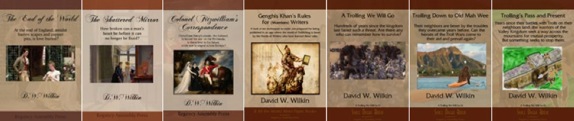
Mr. Wilkin writes Regency Historicals and Romances, Ruritanian (A great sub-genre that is fun to explore) and Edwardian Romances, Science Fiction and Fantasy works. He is the author of the very successful Pride & Prejudice continuation; Colonel Fitzwilliam’s Correspondence. He has several other novels set in Regency England including The End of the World and The Shattered Mirror. His most recent work is the humorous spoof; Jane Austen and Ghosts, story of what would happen were we to make any of these Monsters and Austen stories into a movie.

And Two Peas in a Pod, a madcap tale of identical twin brothers in Regency London who find they must impersonate each other to pursue their loves.


The links for all locations selling Mr. Wilkin's work can be found at the webpage and will point you to your favorite internet bookstore: David’s Books, and at various Internet and realworld bookstores including the iBookstoreAmazonBarnes and NobleSmashwords.


He is published by Regency Assembly Press
And he maintains his own blog called The Things That Catch My Eye where the entire Regency Lexicon has been hosted these last months as well as the current work in progress of the full Regency Timeline is being presented.


You also may follow Mr. Wilkin on Twitter at @DWWilkin
Mr. Wilkin maintains a Pinterest page with pictures and links to all the Regency Research he uncovers at Pinterest Regency-Era


Tuesday, January 30, 2018

Julius Caesar's "Invasions" of Britain: The Latest Evidence

by Mark Patton.

For almost thirty years, I have used the example of Julius Caesar's supposed "invasions" of Britain, in 55 and 54 BC, to impress upon my students just how much might have happened in the remote past, whilst leaving no apparent trace in the archaeological record. We know of these incursions from Caesar's own account of the Gaulish Wars, and, whilst it has long been understood that he was writing propaganda to advance his political career in Rome, it hardly seemed likely that he would have told an absolutely blatant lie, given that he would be returning to Rome with tens of thousands of troops, who would have a clear idea as to where they had or had not been.

Julius Caesar, Musee d'Arles.
Photo: Mcleclat (licensed under GNU).

For all of this, until very recently, I could not point to a single piece of unambiguous archaeological evidence (not a sword, a spearhead, a skeleton, or a ditch) to suggest a Roman military presence on these islands prior to the Emperor Claudius's invasion in 43 AD. I always had in mind that such evidence might come to light at any stage, and now, it seems, it has, thanks to an excavation by University of Leicester archaeologists, at Pegwell Bay, on the Isle of Thanet, Kent.

Caesar's first visit to Britain was very much an exploratory expedition, as he himself explains:

 " ... Caesar ... set out for Britain, aware as he was that our enemies in almost all our wars with the Gauls had received reinforcements from that quarter. He considered, moreover, that even if the season left no time for a campaign, none the less it would be a great advantage to him simply to land on the island and observe the kind of people who live there and its localities, harbours, and approaches ... " (from the Oxford World's Classics translation by Carolyn Hammond).

Caesar's two legions (around 12,000 men) encountered more resistance than they might have expected (presumably from warriors of the Cantiaci tribe of Kent), and his ships' captains were also surprised by the ferocity of the autumn gales in the English Channel. A disaster narrowly averted, he returned with his force to Gaul.

During Caesar's absence, it seems that tribal war broke out in Britain. A man named Mandubracius, a prince of the Trinovantes tribe of Essex, made his way to Gaul, and requested Caesar's support to recover lands that had been seized from his people by the more powerful Catuvellauni tribe of Hertfordshire. Caesar agreed, and returned to Britain with a much larger force. It is the landing site of this army that may have been discovered at Pegwell Bay. The Roman fort, probably a tented camp, may cover an area as large as twelve hectares in size, and has a ditch four to five metres wide, and two metres deep: it is securely dated to the First Century BC, and finds include a Roman spearhead closely comparable to examples found at the French site of Alesia, which Caesar is known to have besieged a few years later.


Map, showing the location of Pegwell Bay,
John Richard Green (image is in the Public Domain).

Pegwell Bay, Kent. Photo: Ron Strutt (licensed under CCA).

A reconstruction of a Roman fortification at Alesia (France).
Caesar's fort at Pegwell Bay may have had a similar design,
although it had a different purpose: the fort at Alesia were "investment" works -
intended to place an impenetrable cordon around an enemy stronghold;
that in Kent was a "beach-head" work, intended to protect Caesar's fleet,
and thus his lines of resupply and retreat.
Photo: Carole Raddatto (licensed under CCA). 


Reconstructed fortifications at Alesia.
Photo: Carole Raddatto (licensed under CCA).

Roman (left) and Gaulish (right) weapons found at Alesia.
Image: Jochen Jahnke (Public Domain).

This time, Caesar's legions fought their way through Kent, probably crossing the Medway and the Thames, and finally defeating the Catuvellaunian King, Cassivellaunus, possibly at his stronghold in Hertfordshire. It still was not Caesar's intention, however, to leave a Roman garrison in Britain: he secured a promise from Cassivellaunus to stop molesting the Trinovantes (but Cassivellaunus's successor was minting coins on Trinovantian territory only a few years later); took "hostages" from the Catuvellauni (not nearly as frightening a prospect as it might have appeared - these were aristocratic young men who would be fostered out to the wealthiest families in Rome, given an education worthy of a Consul's son, and, if circumstances allowed returned to Britain to rule as thoroughly pro-Roman client kings).


Bigbury Camp, Kent, the possible site of a battle between Caesar's 7th Legion
and the warriors of the Cantiaci tribe.
Photo: Google earth (image is in the Public Domain). 


The Devil's Dyke, near Saint Alban's, Hertfordshire,
the possible site of Caesar's defeat of King Cassivellaunus.
Photo: Colin Riegels (image is in the Public Domain).

For a further century, Rome traded peacefully with the British tribes; sent ambassadors and diplomatic gifts to them; and played one tribe off against on another to their own advantage; until, in 43 AD, renewed conflict between the Catevellauni and their neighbours to the east and south provided the pretext for the Emperor Claudius's invasion, which resulted in most of Britain being absorbed into the Roman Empire.

~~~~~~~~~~

Mark Patton blogs regularly on aspects of history and historical fiction at https://mark-patton.blogspot.co.uk. He is a published author of historical fiction and non-fiction, whose books can be purchased from Amazon.


Tuesday, November 8, 2016

Celtic Government and Society

by Annie Whitehead

In this series examining the lives of the peoples known as The Celts, I’ve looked at their origins, how they lived, the members of the community, and their occupation and leisure activities. Now, in the final post on this topic, I’m looking at their Government and Social Structure.

Boudicca

Among the Celtic tribes, the form of government was either monarchical or oligarchical. The Bretons were governed by several kings and chiefs, while the Caledonii had a democratic government. In Gaul and the British Isles, the power of the king was probably not very great, as they were almost certainly chosen by the people and could be easily deposed if the need arose.

In some tribes, there seems to have been a chief magistrate, “Summus Magistratus.” He had the power of life and death, and was elected by the priests and magistrates. He was appointed for a year only, and he could not leave the territory of the city.

At the beginning of each war, the Gauls usually convened an armed assembly. The law stated that all young adults must attend the meeting armed. The last man to arrive was tortured and put to death in public. When dealing with civic affairs, the assemblies were still attended by armed men. Anyone creating a disturbance would, according to Strabo [1] have had a chunk removed from his sagum (cloak). Approval was shown by a clanking of weapons, instead of applause. The assemblies only met in grave circumstances -  there is no evidence to suggest that they were held regularly.

A reconstructed Celtic 'La Tène' village

Caesar described the plebeians of Gaul as living in a state bordering on slavery, never being consulted about anything. There were two categories of vassals; the free vassals, “Soer-cheli”, and the non-free vassals, “doer-cheli”. These vassals were bound to their overlord by a contract based on livestock. There were five social classes: kings, nobles, free landowners, free men without property, and non-free men.

There is no firm evidence that children - of either sex - who waited on tables at banquets were slaves. It is clear, however, that the Celts brought back slaves from their expeditions.

The historian, Fustel de Coulages [2] described the structure of Celtic society thus: “A great number of peasants and a tiny urban class, many men attached to the soil and few land-owners; many servants and few masters; a plebeian class lacking utterly in status and importance, and a very powerful warrior aristocracy.”

In judicial matters, the authorities intervened only rarely, most disputes being settled privately between the parties. Certain disputes were decided by duelling. Poseidonius [3] reported that in Gaul, when hams were served at banquets, the strongest guest would seize the ham for himself. If he was challenged, the two men would fight to the death.

The Dying Gaul

In Irish law, duelling was one of the accepted means whereby parties to a legal dispute could settle their differences. If a contract had first been concluded with the consent of both parties, the family of the slain contender had no right to claim compensation for his death.

In cases of crime or murder, Caesar wrote that the Druids decided the issue and set the fine or punishment. The Celts generally prescribed a severe punishment for the killing of a stranger. The penalty for this was death, compared with the exile imposed on the murder of a fellow citizen.

An Arch Druid in His Judicial Habit -
wearing a Bronze Age gold collar

Anyone convicted of theft, highway robbery, or certain other crimes, was burnt alive. Diodorus [4] wrote that the Gauls used to keep their criminals in prison for five years, and then, in honour of the gods, they burnt them, along with numerous other offerings, on large pyres. Any Gaul caught hiding or stealing part of the booty obtained in war, or any object deposited in a sacred place, was put to death after the most cruel torture.

Fines were imposed on any young people whose waist measurement exceeded the standard, for as we saw in previous articles, much importance was placed on the perfection of the male body.

Diodorus also wrote that the Gauls had poets known as bards, and theologians known as druids. When singing their songs of praise, or reproach, the bards accompanied themselves on instruments similar to lyres. They sang of the deeds of the great, and kept alive the memory of the heroes of the past through their poems.

Druids Inciting the Britons to Oppose the Landing of the Romans

Anne Ross [5] suggests that the evidence we have about the druids in no way justifies the aura of romanticism which has surrounded them. The religious functions of the druids mainly involved attendance at ceremonies. They were responsible for the conduct of sacrifices, both public and private. Yet it appears that their presence during the ceremonies was more in response to the wishes of the people, and that they did not play a principal role in the sacrifice itself. Strabo and Diodorus agree on this point. Strabo says that the Celts made their sacrifices “with the assistance” of the druids, while Diodorus wrote that the Celts never offered a sacrifice without a philosopher present.

At the time of Pliny, magic was popular in Gaul and in the British Isles, and in his opinion the druids, whom he translated as “Magi”, were magicians and fetishists who held all kinds of magical secrets and medical remedies. The Gaulish druids believed that the mistletoe of the robur oak had special sacred powers. Sacrifices and divination were two important religious practices, but magic secrets, entrusted to druids at the time of Pliny (AD23-79) were normally left to sorcerers of lesser repute.

The druids were thought to be the most just among men, and they were made judges in public and private disputes. As we have seen, the druids were the ones to set the amount of fines and the type of punishment to be imposed in cases of crime, murder, or disputes about inheritance.

The idea that the druids were both physical and moral philosophers contrasts strongly with Pliny’s idea of their rather humble role. The explanation could be that, from the earliest times,the druids consolidated their power not merely by their knowledge, but also by the practice of certain magical arts. When Roman domination caused them to lose the judicial and political roles, all that was left for them was the equivalent of quackery.

Roman soldiers murdering druids and burning their groves
on Anglesey, as described by Tacitus

The origin for many later traditions about the druids can be found in Caesar’s writing on the subject. He described their role thus: “All the druids are under one head, whom they hold in the highest respect...The druids are exempt from military service and do not pay taxes like other citizens… It is said that their pupils have to memorise a great number of verses - so many, that some of them spend twenty years at their studies… A lesson they take particular pains to inculcate is that the soul does not perish, but after death passes from one body to another; they think that this is the best incentive to bravery, because it teaches men to disregard the terrors of death. They also hold long discussion about the heavenly bodies and their movements, the size of the universe and of the earth, the physical constitution of the world, and the power and properties of the gods; and they instruct the young men in all these subjects.” [6]

Lloyd Laing [7] agreed that the druids were powerful men, that there was an arch-druid, and that there were schools for the instruction of the young in druidic lore, but that it was unlikely that they believed in the transmigration of souls. Nor did he think it likely that they were rustic philosophers, who debated astronomy and the physical constitution of the earth, for "philosophy is was essentially the product of the civilised mind and had no real place in barbarian society."

Two Druids, as imagined by 19th c
artist  Bernard de Montfaucon

Perhaps it will always be a case of “You pays your money and you takes your choice.” Were the druids little more than ‘witch doctors’ to a primitive and undoubtedly very ancient religion, as Lloyd Laing suggested, or was their role much more significant? Caesar appears to have thought so.

Over this series, we have seen that the Celts were masters of many techniques; that they wove and used dyes, their art was advanced and they were expert miners. They were very concerned with hygiene, the women were faithful and loyal, and the men had no fear of death. On the one hand, they indulged in barbaric rituals, but enjoyed relatively sophisticated government. There are recognisable elements of what would become ‘feudalism’. They worked the land, they played games and music. A warrior society, certainly, but much more besides.

~~~~~~~~~~

[1] Strabo was a Greek geographer who lived from about 58BC-AD25
[2] Quoted from The World of Celts, G Dottin
[3] Poseidonius was a Greek Stoic philosopher who lived from 135-51BC
[4] Diodorus was a Greek historian who lived 90-30BC
[5] Pagan Celtic Britain
[6] Caesar’s The Conquest of Gaul
[7] Celtic Britain

See the other articles in this series: Who Were the Celts?, How the Celts Lived, The Celtic Community
All above images are in the public domain

~~~~~~~~~~

Annie Whitehead is a history graduate and prize-winning author. Her first novel, To Be A Queen, is the story of Aethelflaed, daughter of Alfred the Great, who came to be known as the Lady of the Mercians. It was long-listed for the Historical Novel Society’s Indie Book of the Year 2016, and it has been awarded a B.R.A.G. Gold Medallion.

Her second novel, Alvar the Kingmaker, is a tale of intrigue, deceit, politics, love, and murder in tenth-century Mercia. It charts the career of the earl who sacrificed personal happiness to secure the throne of England for King Edgar, and, later, Aethelred the Unready. It too has just been awarded a B.R.A.G. Gold Medallion.

Most recently, she has contributed to the anthology of short stories, 1066 Turned Upside Down, in which nine authors re-imagine the events of 1066, and which has just been awarded HNS Editors’ choice and long-listed for Book of the Year 2017.

Author Page
Alvar the Kingmaker
To Be A Queen
Website
Blog
1066 Turned Upside Down

Friday, August 26, 2016

The Celtic Community

by Annie Whitehead

Women
In the first of this series, Who Were the Celts*, I relied mainly on archaeological evidence. For the second, How the Celts Lived,** I relied on the Greek writers, who seem to have said little about the role of Celtic women, but are still our only real sources. Some of the information for this portion is taken from the findings of modern scholarship.

Women used to provide a dowry, but the men had to offer comparable value from their own property. Husbands had absolute power over their wives.

Among the Bretons, the women belonged to ten or twelve men at a time, particularly to brothers, fathers, or their children; however, the children born of such unions belonged to the man who had the woman while she was still a virgin. In Ireland, it was thought perfectly natural for men to have sexual relations with other men’s wives, mothers or sisters. Community of wives was the rule in Caledonia.

The status of women among the Celts seems to have been quite wretched. However, in the mid-first century AD, in what is now Great Britain, the Brigantes were in fact governed by a woman, Cartismandua (Cartimandua) and, in 61 AD, Boudicca, a woman of royal  blood, commanded the army of the ancient Britons. Yet no similar state of affairs can be found among other tribes or at earlier periods.

Queen Boudica by John Opie - public domain

The fidelity of Celtic women was famous throughout the ancient world, as can be seen from certain legends. Polybius [1] apparently spoke to a Galatian woman, Chiomara, wife of the king of Tolistobogii. She had been captured and raped by a Roman centurion around 189 BC. He was promised a large sum of money for her return. As she was being returned, she signalled to her compatriots to cut off the centurion's head. She presented the head to her husband, saying that it was finer thing even than fidelity, that only one man who had been her lover should remain alive.

Besides conjugal fidelity, Gaulish women had other qualities. Apparently they were beautiful, fertile, good nursing mothers, and they took great care of their children.

It is known that the Celtic women accompanied their menfolk into battle. The wives of the Helvetii defended entrenched positions against the Romans; the wives of the Britons encouraged them to a greater ardour in combat. Before the conquest of Cisalpine Gaul (Gaul on the Roman side of the Alps), a terrible civil war was fought, and the women strode into the midst of the armies, taking the role of arbiters to resolve the dispute.

Children
Caesar wrote that in Gaul, the father had the power of life and death over his children. This was also true of the Ancient Britons, and the Irish. Caesar also reported on a distinctive custom:
“The Gauls are unlike the other peoples in that they do not allow their children to address them in public until they have reached the age at which they are capable of performing their military service; they feel it is a disgrace for a man’s son to appear with him in public while still a child.” [2]
This could mean that sons remained with their mothers until they reached the age of military action or that children were brought up away from home.

The Family Unit
Irish Iron Age Celts had larger units consisting of four generations of descendants from a common great-grandfather; this unit was known as the derbfine and had its own identity in law, owning land collectively. The larger group, known as tuath or 'tribe', was ruled by the chief or king.

Society
Below the nobles were ordinary freemen, farmers who paid food-rent to the king and received cattle from the nobles in return for obligations. At the bottom of the social pyramid were, unsurprisingly perhaps, the slaves. There were learned men, the aes dána (men of art) whose skills gave them status above that or their birth and placed them on a similar level in society to warriors.

Homosexuality
There is some evidence to suggest that homosexuality was fairly openly practised among the Celts, and that it was not frowned upon. Diodorus [3] wrote that

“The Celtic women are not only as tall as the men but as courageous … but despite their charm the men will have nothing to do with them. They long instead for the embrace of their own sex. It is particularly surprising that they attach no value to either dignity or decency, offering their bodies to each other without further ado. This is not regarded as at all harmful; on the contrary, if they are rejected in their approaches, they feel insulted.” [4]

Strabo [5] confirms these homosexual practices with the brief mention that the young men of Gaul were “shamelessly generous with their boyish charms.”

Gerhard Herm wrote that as soon as they were old enough to bear arms, young people indeed lived away from home, living almost wholly with others of their own sex. They learned riding, swordsmanship, hunting, and drinking. They had to prove themselves in the field, and saw their like as the only suitable company. It is easy to see that this placed emphasis on male friendships, and Herm suggested that this gave rise to the cult of the male body. Certainly, according to Strabo, the Celts "tried to avoid becoming fat or pot-bellied, and they punished any boy whose waist was larger than the standard they set." Diodorus linked this to the wearing of the "armbands of all sorts" and said that the Celts "wear about their necks heavy rings of solid gold."

Death
The Celtiberians used to abandon their dead for the vultures to eat. The Gauls who took Rome used to bury their dead; and it was not until an epidemic occurred that they began to pile up corpses to burn them. Plutarch [6] remarked that the Gauls did not lament the passing of a dead man.

The Dying Gaul - public domain image

The funerals of the Celts of Gaul, who were relatively highly civilised, were quite splendid affairs. Anything thought to have been valued by a person during his lifetime was put on the pyre along with the body, even domestic animals.

At the time when bronze was the predominant metal for the manufacture of weapons, incineration was practised in various parts of Gaul, particularly in the southeast and north. When bronze swords disappeared, to be replaced by iron, burial under artificial mounds (tumuli) or in the earth itself, became more common.

Galician Celtic Stele for the deceased, called Apana, presumably an aristocrat of the tribe of Celtic Supertamáricos. Second Century of the Common Era. Image - public domain

One section of the Celtic community with which most people are familiar is the Druidic tradition. The Druids and their role will be examined in the last of this series, which will focus on government and Social Structure.

Next time: Occupations and Leisure Activities
*  ** Read the previous articles HERE and HERE

[1] Polybius, or Polybus, was a Greek historian born between 210 and 205 BC, in Arcadia. He wrote a general history of his time, and died around 125 BC
[2] Quote/translation The World of the Celts - G Dottin p40
[3] Diodorus (Sicilus) of Sicily was a Greek historian who used varied literary sources with little judgement of his own, and often without regard to exact chronology. For certain periods, though, he provides the best evidence available
[4] From Gerhard Herm's The Celts p57
[5] Strabo was a Greek geographer, who lived from about 58 BC - AD 25
[6] Plutarch was a Greek historian, biographer, and essayist, who lived from 45-120 AD

~~~~~~~~~~


Annie Whitehead is a history graduate and prize-winning author. Her novel, To Be A Queen, is the story of Aethelflaed, daughter of Alfred the Great, who came to be known as the Lady of the Mercians. It was long-listed for the Historical Novel Society’s Indie Book of the Year 2016 and has been awarded an indieBRAG medallion. Her new release, Alvar the Kingmaker, which tells the story of Aelfhere of Mercia, a nobleman in the time of King Edgar, is available now. She is also a contributor to 1066 Turned Upside Down, an anthology of short stories re-imagining the events of 1066.
Annie's Author Page
Alvar the Kingmaker
To Be A Queen
Annie's Website
Annie's Blog

Friday, July 29, 2016

How The Celts Lived

By Annie Whitehead

Last time, I introduced the Celts and who they were.*

I explained that there were three phases of Celtic settlement in Britain, beginning in around 500-450 BC (perhaps earlier in Scotland), with settlers from France and the Low countries, continuing around 250 BC, and then a third phase, in around 100 BC, of Belgic peoples settling in southern Britain.

This time I’m taking a look at how they lived, although, given the paucity of the sources, it's sometimes necessary to look at those still living in Europe, in order to build up an adequate picture.

Firstly, what kind of housing did they have?

According to Polybus [1] the people who settled in Cisalpine (the Roman side of the Alps) Gaul lived in scattered villages without walls. Their houses were probably wooden, which could easily be burned down and destroyed.

Gaulish houses were usually thatched and dome-like, and built of planks and willow supports. Some had an outer facing of mud, while others were covered with oak shingles, or straw mixed with earth. The Bretons built similar houses of reeds and wood. The Caledonii still had neither fortified walls, nor towns, as late as the second century of the Christian era.

A Pre-Roman Gaulish House

In wartime, the Gauls used to take refuge in the fortified camps known to Caesar as ‘Oppida’. The oppida of the Bretons were nothing more than retrenched camps defended by a ditch and a mound of earth with a stockade, within which they erected temporary huts. The Belgian people who inhabited the Ardennes Forest used to take special precautions in times of war by weaving the branches of thorny bushes into a mesh of thorns, so that invaders would find all paths blocked. In certain places, they would retreat with their families to small islands in swamps deep in the forest, having first driven stakes into the ground along potential paths. The oppida of Gaul were towns which could also offer shelter to the inhabitants of neighbouring areas but which also had a permanent population themselves.

Caesar described the walls of Gaulish fortifications: solid beams were laid out on the ground about two feet apart; they were joined by transverse struts, and the cavity thus formed was filled with earth. Large stones were used to face the front. A second layer was then added, and so on until the desired height was reached. These interwoven layers of stone and wood had major military advantages as the stone was a protection against fire, and the wood against the danger of the battering ram.

The Gauls described by Polybus were not familiar with the idea of furniture and their beds were apparently nothing more than grass.


Posidonius, [2] quoted by Athenus, [3] noted that at mealtimes the Celts used to sit on bales of hay around low circular tables of wood. They used neither spoons nor forks; they simply grabbed chunks of meat and tore them apart. Their dishes were made of silver, copper, or earthenware. Their goblets were of earthenware or silver.

A Belgic bronze tankard was found in Trawsfynydd in Wales, and has been dated to the mid-first century AD. Its base was made of turned wood. Two more tankards were found at Shapwick Heath in Somerset, and one was recovered from the River Thames, at Kew. Belgic wrought iron ‘fire dogs’, would have been used to spit-roast meat at feasts, and examples have been found at Great Chesterford, Essex and Capel Garmon, North Wales.

The fire dogs - pic from bbc.co.uk

Dairy products were much used among the Gauls. (The remains of vast cheese-making installations have been found at Mont Beuvray- also known as Bibracte.) [4]

The Calednoii and the Maeatae apparently made no use at all in their diet of the abundant stocks of fish in the waters of their region.

For their daily sustenance, the Bretons used to shell the oldest ears of cereal in their barns. Some of their tribes were so lacking in industry that although they had plenty of milk, they never made cheese from it. Others lived off bark and roots, and devised a type of food which was so filling that a very small amount was enough to serve as a meal. The fore-runner of the breakfast bar, perhaps? (More about farming in a later episode.)

The standard drink of the Gauls was at one time a beer made from grain. This drink was called ‘corma’. The guests all drank out of the same goblet, which was passed round by a servant.

In the first century BC, wine brought from Italy was the drink of the rich. Some Gauls would lie down on their shields, and, in exchange for wine or money, would allow their throats to be cut, as long as the wine or the money should go to their descendants after their death.

The Celts held ceremonial dinners; the guests sat in a circle, and the man who was the most distinguished in terms of military prowess, birth, or wealth, sat in the middle of the assembled company. The master of the household sat next to him, and the others sat on either side, their position depending on their rank.

So, as they sat there, what would they have been wearing?

It would seem that many of the Celtic tribes were comparatively sophisticated in their dress. Diodorus [5] described the Gauls as having worn tunics and trousers, with striped sashes over their shoulders. Pliny [6] suggested that the Gauls were the inventors of checked cloth; they extracted a purple dye from the bilberry, scarlet from the hyacinth, and colours from various other plants.

The Aedui chief Dumnorix, Museum of Celtic Civilization, Bibracte

The Celts of the La Tène culture had highly developed weaving and dyeing techniques. The men wore close-fitting trousers and pullovers, while the women wore freely-flowing cloaks of the same material.

In Ireland, the men liked to wear woollen cloaks, pinned together at the neck by a brooch. Trousers were worn only by the poor, noblemen preferring ‘Léine’, knee-length linen tunics.

The Celts wore sandals, which left much of the upper foot exposed. These sandals were tied up with leather.

Some Celtic tribes, however, seem to have been quite unaware of the use of clothes. In the second century AD, the inhabitants of Northern Brittany went completely naked. Some Gaulish tribes also were in the habit of undressing completely before battle.

When they were clothed, though, did they wear any other adornments?

Strabo [7] said of the Celts: “to the frankness and high spiritedness of their temperament must be added the traits of childish boastfulness and love of decoration. They wear ornaments of gold, torcs on their necks, and bracelets on their arms and wrists.”

These torcs were heavy rings of solid gold, richly decorated, and with a finger-sized opening at the front. Gerhard Herm points out in The Celts, that they must have been put on with great difficulty, being too small to push over the head, and yet too thick to bend open. Perhaps the most famous of the Celtic torcs were discovered at Snettisham in Norfolk between 1948 and 1968. The largest was 20cm in diameter and made of electrum. It was dated to the mid-first century BC

A more delicate (Bronze) torc

Besides jewellery, the Celts also used the tattoo as a form of personal adornment. Caesar wrote that all the Bretons used to dye their bodies with pastel, thus turning their bodies a bright blue colour, which made them look particularly horrible in battle. It is possibly from the addiction to his habit that the dark-age Picts acquired their name, ‘painted men’.

A brief note on hygiene: Personal hygiene among the Celts cannot have been overly sophisticated. They did, however, make soap from tallow or ash. This was, according to Pliny, a Gaulish invention. In order to preserve the freshness of their complexions, the Celtic women used beer foam. The cleaning of teeth, among the Celtiberians (the Celts who invaded Greece) was done with urine, stored for a long time in special tanks.

Next time: The role of Members of the Community
* Read the first in this series, Who Were the Celts?


[1] Polybus, or Polybius, was a Greek historian who was born between 210 and 205 BC, in Arcadia. He wrote a general history of his time, and died around 125 BC
[2] Posidonius, or Poseidonius, was a Syrian born historian. He was a Stoic philosopher, and emphasised the interrelation of all things in the universe.
[3] Athenus, or Athenaeus, was a Greek writer born in Egypt. He wrote in the end of the second century and the third century AD
[4] The world of the Celts - G.Dottin
[5] Diodorus (Sicilus) of Sicily was a Greek historian who used literary sources with little judgement of his own, but for certain periods he provides the best evidence available.
[6] Pliny the Elder (AD 23-79) was born in Northern Italy and wrote 37 books of natural history. The eruption of Pompeii claimed his life.
[7] Strabo was a Greek geographer, who lived from about 58 BC - AD 25. Lloyd Laing (1979) attributes this translation to S. Piggot (1970)

Further reading:
The Celts - Gerhard Herm
Pagan Celtic Britain - Anne Ross
Celtic Britain - Lloyd Laing
The World of the Celts - G Dottin

(all images are in the public domain unless otherwise attributed)

Annie Whitehead is a history graduate and prize-winning author. Her novel, To Be A Queen, is the story of Aethelflaed, daughter of Alfred the Great, who came to be known as the Lady of the Mercians. It was long-listed for the Historical Novel Society’s Indie Book of the Year 2016 and has been awarded an indieBRAG medallion. Her new release, Alvar the Kingmaker, which tells the story of Aelfhere of Mercia, a nobleman in the time of King Edgar, is available now.
Annie's Author Page
Buy Alvar the Kingmaker
Buy To Be A Queen

Annie's Website
Annie's Blog

Annie has also been involved in a collaborative e-book project re-imagining the events of 1066