Showing posts with label military. Show all posts

Friday, July 22, 2016

Military Service in Tenth-Century England

By Annie Whitehead

Last week I posted about duties and obligations in tenth-century England. This week I’m concentrating on military service.

Aethelred II (Unready)

Land granted by the king was known as ‘bookland’ and was absolved from all service with the exception of three. According to a grant by King Edgar [1] those three things were fixed military service, the restoration of bridges, and of fortresses. A grant by Aethelred II [2] calls for national military service, the construction of fortresses and the restoration of bridges. The Thegn’s law [3] tells us that:

“He be entitled to his book right, and that he shall contribute three things in respect of his land: armed service, and the repairing of fortresses and work upon bridges. Also in respect of many estates further services arise on the king’s order, … equipping a guardship, and guarding the coast, and guarding the lord, and military watch …”

The king was prepared to grant away rights privileges but not, it seems, his right to military service. The exact nature of the service is not stipulated, but it must have been important. Archbishop Wulfstan and Aelfric the Homilist divided Anglo-Saxon society into three orders: those who fight, those who labour, and those who pray. This would mean that the aristocracy was a warrior class. The nobility was required to provide military equipment [4] and there can be no doubt that a substantial part of their service was of a military nature.
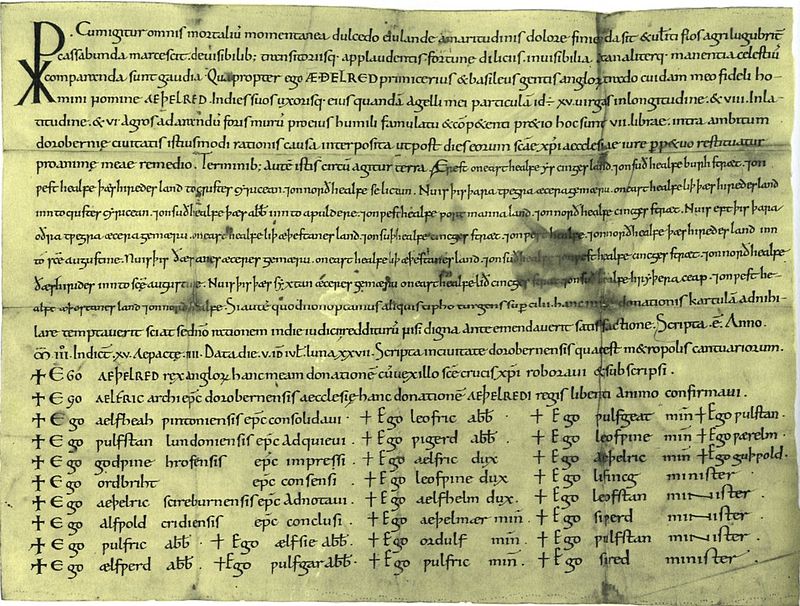

Just as the heriot (war gear) varied according to rank, so the military service requirement differed for men of varying resources. The king had at his disposal his household troops.* Mercenaries were employed, (the career of Thorkell the Tall is evidence of this) but in essence the composition of the fyrd was based on a territorial levy. The requirement was for one man from every five hides of land. Service was basically for sixty days, in a system of rotation, but only in times of war. The Anglo-Saxon Chronicle entry for 920 tells us that “when this division of the English levies went home, the other came out on military service and occupied the fortress at Huntington.” [5] A landowner with more than five hides of land would be responsible for providing the requisite number of men.

A fine was payable for neglect of military service, and this ‘fyrd-wite’ was set at around forty shillings per man. Commutation, a payment in lieu of service, was lower, at around twenty shillings per obligation. A thegn liable to service could have his lands confiscated if he defaulted. [6] This did not necessarily mean that a thegn had to fight. He could send the required number of men without going himself; he would still be fulfilling his obligation.

Mention is made of two types of fyrd (army), the select fyrd and the gelect fyrd. The distinction between the select fyrd and the great fyrd might have been thus: the select fyrd consisted of soldiers who fought in battle, and the great fyrd may have been the back-up, repairing bridges and fortresses. [7]

The expensive equipment of the ealdormen, king’s thegns and the lesser thegns would have set the aristocracy apart from the ordinary fighting ceorl. The Battle of Maldon describes the ornate trappings of a nobleman in battle:

“An armed man then went to the Earl,
Wanting to strip him of his armbands, armour,
Ring-mail and ornate sword.”

Site of the Battle of Maldon - Ken Eckert 

Clearly the nobility who fought did so with expensive war gear, but to fight was not their only obligation. As landlords, they were responsible for the organisation, summoning and assembling of the fighting forces. They were also involved in the essential organisation to ensure that competent levies turned out to perform military duties on behalf of their estates.

The military crisis precipitated by the resumption of  Danish raiding served to place emphasis on the fighting role of the thegn. But was the aristocracy a warrior class?

Their military equipment set them apart in wealth and status from the rank and file, and their bookland was held from the king immune from all except military service. Yet if this was a warrior aristocracy one would expect to see them holding their land as a reward for military service, and their status deriving from their military rank. This was clearly not the case; that land was not held as reward for military service is a major stumbling block for any historian trying to prove that pre-Conquest England was feudal.

Land was granted for many reasons. King Aethelred II granted Aethelwig land because he did not wish to sadden him. [8] Apart from his being a servant of the king there seems to be no other reason for the grant. A ceorl could amass all the weapons of a thegn and still remain a ceorl if he did not possess five hides of land. [9] Land remained the source of wealth and the indicator of status. Military service was an important part of a nobleman’s duties, but, as we have seen, it was only one of many. [10] One might also expect that in times of peace less emphasis would be placed on the thegn as a warrior than in times of war.

*During the time of Cnut, the household troops were referred to as housecarls. Cnut’s reign was not in the tenth-century, though, and Nicholas Hooper’s article [11] provides, for me, compelling argument to suggest that the housecarl differed little from the English thegn.

[1] Grant by King Edgar to his thegn Aelfwold 969 EHD (English historical Documents) 113 p519
[2] Grant by King Aethelred to his thegn Aethelwig 992-995 EHD 117 p525
[3] Origins of English Feudalism 61 p145 “The Rights and Ranks of People”
[4] For more on this, see my article on Defining the Nobility in Later Anglo-Saxon England
[5] Anglo-Saxon Chronicle (A) 921 (920)
[6] This point is discussed by DJV Fisher in the Anglo-Saxon Age Ch13
[7] See Warren hollister, Anglo-Saxon Institutions. There is also a possibility that the Select fyrd served locally, and that the Great fyrd was the national army
[8] EHD 117 p525
[9] See HR Loyn The Governance of Anglo-Saxon England p167
[10] See last week’s article on duties and responsibilities HERE
[11] The Housecarls in England in the Eleventh Century - N Hooper

Further General Reading:
The Foundation of England - HPR Finberg
The Beginnings of English Society - D Whitelock
Anglo-Saxon England - FM Stenton
From Roman Britain to Norman England - PH Sawyer

(Above illustrations - public domain unless otherwise accredited)

Annie Whitehead is a history graduate and prize-winning author. Her novel, To Be A Queen, is the story of Aethelflaed, daughter of Alfred the Great, who came to be known as the Lady of the Mercians. It was long-listed for the Historical Novel Society’s Indie Book of the Year 2016 and has been awarded an indieBRAG medallion. Her new release, Alvar the Kingmaker, which tells the story of Aelfhere of Mercia, a nobleman in the time of King Edgar, is available now. A collaborative project, re-imagining the events of 1066, is also available to pre-order. 1066 Turned Upside Down
Annie's Author Page
Buy Alvar the Kingmaker
Buy To Be A Queen

Annie's Website
Annie's Blog

Saturday, October 31, 2015

Turtle versus Eagle... A Tale of Submersible Warfare

by Catherine Curzon

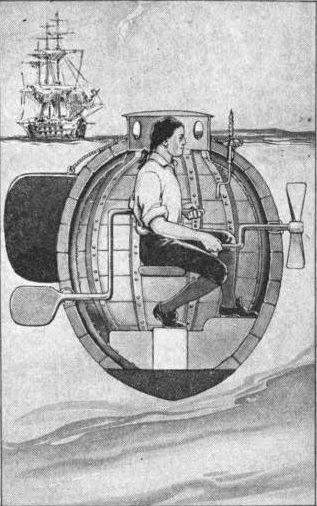
If you don't like confined spaces, look away now for today we travel back more than two hundred years to 7th September 1776 and find ourselves not so much all at sea, as all under a river as Sergeant Ezra Lee makes history with the first submersible attack, safely ensconced in the American vessel, Turtle. His mission was to approach the British HMS Eagle, attach explosives to her hull and then make good his daring escape! Needless to say, all did not go quite according to plan.


A model of the Turtle

The Turtle was built by David Bushnell in Old Saybrook, Connecticut, in 1775. Buoyed by government funding and convinced that the Turtle was the answer to vanquishing the British permanently, Bushnell handed over the completed submersible following extensive tests and waited for his invention to play its part in the destruction of the flagship vessel.


At eleven o'clock in the evening of 6th September, Lee took to the Hudson River in the Turtle, guided out by rowboats to start his journey until, finally, he began to pilot his craft towards the Eagle. In fact, the submersible barely moved at all until favourable currents caught it and propelled it towards the ship. Just as all seemed to be going to plan, Lee was faced with what would prove to be an insurmountable obstacle as, when he attempted to drill into the Eagle to attach the explosives, he had the misfortune to choose a spot directly atop the iron plates that protected the intricate rudder.


A cutaway depiction of David Bushnell's Turtle from The story of the submarine By Farnham Bishop, 1916
A cutaway depiction of David Bushnell's Turtle 
from "The Story of the Submarine", by Farnham Bishop, 1916

Not to be deterred, he continued to try to drill into the ship for some time until exhaustion forced him to stop. A somewhat cursory attempt to go directly under the hull and drill again proved futile and the thoroughly beaten Sergeant decided that the time had come to call off the operation. As he fled at a couple of miles an hour, Lee set off the explosives anyway to distract British lookouts and the Eagle lived to sail another day. Although Lee reported that the charge set off an enormous explosion and columns of water rose from the river, the British reported nothing untoward and appear to have been utterly unaware of the failed assault on their fleet.


The Turtle itself met a sticky end in October when the vessel that was carrying it was sunk at New Jersey. Submarine warfare would, of course, go on to be a major part of combat but for Lee, Bushnell and the Turtle, the underwater battle was over.


References
Compton-Hall, Richard. The Submarine Pioneers. Sutton Publishing, 1999.
Swanson, June. David Bushnell and His Turtle: The Story of America's First Submarine. Atheneum, 1991.

~~~~~~~~~~~~~


Glorious Georgian ginbag, gossip and gadabout Catherine Curzon, aka Madame Gilflurt, is the author of A Covent Garden Gilflurt’s Guide to Life. When not setting quill to paper, she can usually be found gadding about the tea shops and gaming rooms of the capital or hosting intimate gatherings at her tottering abode. In addition to her blog and Facebook, Madame G is also quite the charmer on Twitter. Her first book, Life in the Georgian Court, is available now, and she is also working on An Evening with Jane Austen, starring Adrian Lukis and Caroline Langrishe.
SaveSave

Friday, July 4, 2014

The Battle of Hattin, July 4, 1187

by Helena P. Schrader


The devastating defeat of the combined Christian army at the Battle of Hattin on July 4, 1187, was one of the most significant disasters in medieval military history. Christian casualties at the battle were so enormous that the defense of the rest of the Kingdom of Jerusalem became impossible, and so the defeat at Hattin led directly to the loss of the entire kingdom including Jerusalem itself. The loss of the Holy City, in turn, led to the Third Crusade and so to the death of the Holy Roman Emperor Friedrich I “Barbarossa” and extended absence from his domains of Richard I “the Lionheart.” Both circumstances had a profound impact on the balance of power in Western Europe.

Meanwhile the critical role played by the Pisan and Genoese fleets in supplying the only city left in Christian hands, Tyre, and in supporting Richard I’s land army resulted in trading privileges that rapidly turned into powerful trading centers in the Levant. These fostered the exchange of goods and ideas that led historian Claude Reignier Condor to write at the end of the 19th Century that: “…the result of the Crusades was the Renaissance.” (The Latin Kingdom of Jerusalem 1099 to 1291 AD, The Committee of Palestine Exploration Fund, 1897, p. 163.)

The importance of Hattin to contemporaries was not just the magnitude of the defeat, but the unexpectedness of it. In retrospect, the victory seems inevitable. Muslim states had always surrounded the crusader kingdom (as they hem in Israel today) and the Muslim rulers could always muster much larger military forces than their Christian opponents. In the early years of Latin presence in the Holy Land, the divisions among the Muslim leaders, most especially the rivalry and hatred between Shiite Caliphate of Cairo and the Sunni Caliphate of Baghdad, had played into Christian hands. However, once Saladin had managed to unite Syria and Egypt under a single, charismatic leader the balance of power clearly tipped to the Muslims.

However, that geopolitical shift was not so obvious to contemporaries. Furthermore, to suggest the defeat was inevitable ignores the fact that Christian armies under Baldwin IV of Jerusalem and Richard I of England defeated Saladin on the battlefield several times each. Saladin was a powerful, charismatic and clever commander, who knew how to deploy his forces effectively and use terrain to his advantage — but he was not invincible. Indeed, he was dealt a defeat every bit as devastating as Hattin in November 1177 at the Battle of Montgisard. His invading army was annihilated, and he himself had to flee on the back of a pack-camel. In July 1182, the Christian army under Baldwin IV stopped another full-scale invasion by Saladin, forcing him to withdraw across the Jordan with comparatively few Christian losses. In June the following year, 1183, the Christian army confronted yet another invasion on an even larger scale and again forced Saladin to withdraw — this time without even engaging in an all-out battle. Saracen victory at Hattin was not, therefore, inevitable.


Despite these apparent successes, it was clear to the King of Jerusalem that Saladin was getting stronger with each new invasion attempt. Saladin had increased his own power base from Cairo and Damascus to Aleppo, Homs and Mosul, while the Christians had no new infusions of blood, territory or income. In consequence, in 1184 Baldwin IV sent a frantic plea to the West, begging for a new crusade and offering the Western leader — whoever he might be — the keys to the kingdom. The lack of response reflected Western complacency about the threat to Jerusalem and implicit confidence in the ability of Baldwin and his barons to continue to defeat Saladin’s attempts to push the Christian kingdom into the sea.

It was because of Baldwin’s earlier successes against Saladin that the news of Hattin and the loss of Jerusalem shocked the West, allegedly causing the immediate death of Pope Urban III. How was it possible that a young and vigorous king, Guy I, could lead the same army to defeat that a youth suffering from leprosy (and only commanding his armies from a litter) had led to victory again and again?

Rarely in human history has a defeat been so wholly attributable to poor generalship on the losing side as at Hattin. To be sure, Saladin set a trap for the Christian armies. The bait was the citizens and garrison of Tiberius under the command of the Countess of Tripoli who were besieged in the citadel after the fall of the city on July 2. The Christian army was mustered at Sephorie only some 15 miles to the west. The pleas for help from the Countess and Tiberius naturally evoked a response from the Christian army, most notably her four grown sons. But the Count of Tripoli himself warned that it was a trap and opposed the decision to go to the aid of Tiberius. Tripoli’s reasoning convinced the majority of his peers and the council of war composed of the leading barons agreed to stay where they were and force Saladin to come to them. However, the Grand Master of the Temple went separately and secretly to King Guy after the council dispersed and convinced him to order the advance for the following day. In short, although warned, King Guy took the bait.

To relieve Tiberius, the Christian army had to cross territory that was at this time of year devoid of fodder for the horses and where water sources were widely dispersed. With Saladin’s forces already occupying the springs at Cafarsset, on the southern route from Sephorie to Tiberias, the Christian army had no choice but to follow the northern track, which led via the springs of Turan. Intense heat and harassment by the enemy slowed the Christian march to a crawl, and by noon on July 3, the Christian army had advanced only six miles to the springs of Turan.

 With nine miles more to go, it was clear the army could not reach Tiberius before nightfall and prudence alone should have dictated a halt at Turan, where men and horses could rest and drink. Instead, King Guy, against all reason, ordered the advance to continue. Immediately, Saladin sent his troops to occupy Turan, thereby not-only blocking the Christian retreat but harassing the Christian rear-guard and further slowing the rate of advance.

A depiction of the Christian army advancing toward
Hattin carrying the “True Cross” from the film
“The Kingdom of Heaven”

When darkness fell on July 3, the Christian army was still six miles short of its objective and forced to camp in an open field completely surrounded by enemy forces. The Christians had been marching and fighting for hours without water in the intense heat of a Palestinian summer. Men and horses were exhausted and further demoralized by the sound of Saracen drums surrounding them and the countless campfires advertising the enemy’s strength.

By morning, those fires were brush-fires intentionally set ablaze to windward of the Christian army in a maneuver that dried their already parched throats further while half-blinding them with smoke. Out of the smoke came volleys of arrows, and again “some of the Christian lords” urged King Guy to charge Saladin’s position at once, in an attempt to win the battle by killing the Sultan. King Guy instead chose to try to march the entire army toward the springs of Hattin, still some three miles away and cut off by one wing of Saladin’s army.

While the Christian cavalry tried to drive off the Saracen cavalry in a series of charges and counter-charges, the infantry stumbled forward until, half-blinded by smoke, constantly attacked by the enemy and near dying of thirst, the morale of the Christian infantry broke. As casualties mounted, some of the infantry retreated up the slopes of the “horns” of Hattin, two steep hills that flanked the plane on which the army had camped, and refused to fight any more.

Meanwhile, the Count of Tripoli with his knights and Lord Reginald of Sidon finally broke-through the surrounding enemy, charging east toward the Lake of Tiberius. The Christian infantry that had not fled up the slopes tried to follow in the wake of the cavalry, but the Saracens under the command of one of Saladin’s nephews broke before the heavy cavalry of Tripoli but regrouped in time to cut off the Christian infantry that was then slaughtered or taken captive.

By now it was late afternoon, and with the infantry either already slaughtered or refusing to come down from the hilltop, King Guy ordered his knights to retreat up the slope as well. By now, many of the knights were fighting on foot because their horses had been killed after the infantry cover was withdrawn. It was probably at this stage in the battle that the relic, believed to be a piece of the cross on which Christ was crucified, was lost. The Bishop of Acre, who had been carrying it, was killed, and the effect on Christian morale of the loss of this most precious relic — believed to have brought victory in dozens of earlier battle -- was devastating.

The final stages of the Battle of Hattin
as depicted in the film “The Kingdom of Heaven”

But still King Guy did not surrender. What few knights were still mounted made one (or according to some accounts two) last desperate charge(s) to try to kill Saladin, who was mounted and clearly identifiable among his troops. This last charge was probably lead by Balian d’Ibelin. While the charge came close enough to Saladin for him to have to shout encouragement to his men, like Tripoli before him, once Ibelin was through the enemy, he had no chance of fighting his way back up-hill through the ever thickening ranks of the enemy closing in on their prey. Within minutes, King Guy’s last position was over-run and he, along with most of his barons, was taken prisoner.

Of the roughly 20,000 Christian soldiers who had set out from Sephorie, only an estimated 3,000 infantry managed somehow to escape into the surrounding countryside and eventually take refuge in the castles and walled towns then still in Christian hands. Of the 1,200 knights and barons that mustered for the battle, only four barons, Tripoli, Sidon, Edessa and Ibelin, escaped capture along with maybe 100 - 200 knights. The remainder, including the King of Jerusalem, the Masters of the Temple and Hospital, the Constable and brother of King Guy, Aimery de Lusignan, the Lords of Oultrajourdain, Toron, Gibelet, and others — effectively the entire nobility of the Kingdom of Jerusalem — fell into enemy hands. While the majority of these lords and knights were held for ransom, the 230 Templars and Hospitallers that survived the battle were executed at Saladin’s orders.


Medieval painting of prisoners
being led away
(here by a Christian king)

As a result of these losses, both killed and captured, the kingdom was effectively denuded of defenders. King Guy had issued the equivalent of the “levee en masse” of the Napoleonic era, the arriere ban, and every able-bodied fighting man had mustered at Sephorie. Left behind in the castles, towns and cities were women, children, the old and the ill. There were no garrisons capable of offering an effective resistance. Worse, even if there had been, there was no point in resisting since there was no army capable of coming to the relief of a city under siege.

Thus when Saladin’s army appeared before the walls of one fortress and city after another, the citizens had the choice of surrender in exchange for their lives and such valuables as they could carry or hopeless resistance. Since the rules of contemporary warfare dictated that resistance justified massacre, rape and enslavement of cities that resisted, it is hardly surprising that the Christian cities and castles capitulated one after another, starting with Nazareth ca. July 6, and then Acre on July 8, followed by Haifa, Caesarea, Arsuf, Jaffa, Ramla, Ibelin, Darum, Sidon, Beirut, Gibelet, Nablus, Beirut and Ascalon.

By mid-September only isolated castles and two cities defied Saladin: Tyre which was particularly defensible and to which the barons of Tripoli and Sidon and the garrisons of the surrendered cities had withdrawn, and Jerusalem itself. But the siege of Jerusalem is material for another post….

~~~~~~~~~~~~~

Helena P. Schrader is the author of numerous books of history and historical fiction. She is currently working on a biographical novel in three parts of Balian d’Ibelin. Read more about her published works at: http://helenapschrader.com and more about her series of novels set in the age of chivalry at: http://tales-of-chivalry.com. You can also follow Helena’s blogs: her author blog: http://schradershistoricalfiction.blogspot.com and her blog about the history of the crusader kingdoms at: http://defendingcrusaderkingdoms.blogspot.com

A crusader in search of faith —

A lame lady in search of revenge —

And a king who would be saint.

St. Louis’ Knight takes you to the Holy Land in the 13th century and a world filled with nobles, knights prophet — and assassins.

Buy now!


Saturday, April 5, 2014

The Siege of Badajoz ~ 6 April 1812

by M.M. Bennetts

The Peninsular War had been raging for four years--since 1808.  But now it was early 1812, a moment of transition during which Napoleon withdrew over 15,000 troops for his intended invasion of Russia.

Not only that, but from his imperfect understanding of the situation in Spain, the emperor issued very dodgy orders to his Marechals, sending them off in different directions to take on what they were led to believe was a much smaller and disease-weakened British army.

Those orders couldn't have been more wrong or misdirected.

The Duke of Wellington, the Commander in Chief of the combined British, Spanish and Portuguese forces, sensed the tide was turning and moved from his winter quarters in Portugal to take on the two great fortresses which guarded the two main roads into Spain, Ciudad Rodrigo in the north, and Badajoz in the south--known as the keys to Spain.

Ciudad Rodrigo fell to the British on 19 January 1812.

Within days, by the 25th, Wellington was making preparations to move south to take Badajoz--the fortress they'd twice already failed to take.

But upon their arrival before the walls of Badajoz on 16 March, the British troops discovered what Wellington had known since the 6th March, when he had privately reconnoitred there.

Bordered to the north by the raging Guadiana River, the fortress's towering ochre walls and angular bastions--all of them 30 feet high, and all glowing warm and golden in the afternoon sun--were nearly impregnable now, thanks to the work of the French commander, General Armand Phillipon. The western side of the fortress had been heavily mined, the castle to the northeast had been fortified as had the outlying forts to the south (which was now attached to the main defences) and on the north side of the river. 

The eastern side was now virtually impassable due to the damming of a small stream...Not only that, but an additional outwork had been constructed in the south-eastern corner, called Fort Picurina.

It didn't look good.

Still, Wellington had had his 52 iron guns brought up from Elvas, and over 27,000 troops available--though the corps of miners and sappers which he had repeatedly requested from the Government had not been provided. Nevertheless, in the heavy rain of 17th March, at dusk, the siege began, with the British troops digging to open up the first parallel not more than 200 yards from Fort Picurina.  (The many Irish troops viewed the date a good omen.)

The howling of the wind and the heavy rain had drowned out the sounds of the digging, of the picks and shovels, and by morning, the parallel was defensible.

But not for long.

For the French opened up a ceaseless barrage of heavy artillery to pour down on their besiegers. On the 22nd, as the rain fell violently and in torrents, flooding the trenches, the rapidly rising waters of the Guadiana swept away their pontoon bridge, cutting Wellington's army in two.


Unfazed, the British carried on.  And when the weather cleared on the afternoon on the 24th, the French could look down on six batteries of artillery, armed with 28 heavy cannon. The French had nothing more than a few Portuguese-built, ancient brass pieces, used in previous sieges. At 11 a.m. on the 25th, the British guns opened fire on Fort Picurina and at nightfall, the Allies stormed it.

After a long night of fighting, and some 250 casualties (about the same number on both sides) the fort was taken.

Over the next several days, additional batteries were established, and the walls of the fortress were now under the constant fire of Wellingtons' 38 guns.  But Allied casualties were high too.

Then, on the 6th April, Easter Sunday 1812, Wellington was informed that by nightfall, three breaches would be opened up in the fortress's southern sector.  Furthermore, he received news that the French, under General Soult, were stirring in southern Spain, and to the north, Ciudad Rodrigo was in danger too.

Though he might have wished for more time, now it seemed he no longer had that luxury.  The storming was ordered for 7.30 that evening, led by the Light and 4th Divisions.  In the event, it was not launched till 10.00.

It was a launching into hell itself.

Unbeknownst to the British, the breaches had been cleared of the rubble and booby-trapped, mined, laid with trains of powder, and fitted with planks studded with spikes a foot long, and chevaux-frises (iron crows' feet).  The ditches too had been laid with fougasses (small mines) and pitted with mudholes.   The defenders were further armed with hand grenades, incendiaries, and extra muskets.  And across the breaches too were hundreds of captured sword blades--the finest of Toledo steel, sharpened and fastened down with chains. In the fraught silence of that humid night, the troops waited.

Then, a single fire-ball lit the sky, casting its bright light over the scarlet columns of the advancing British and the shadowy hunched figures awaiting them atop the fortress walls.

The first 500 of the 'forlorn hope' stormed forward with their ladders.  An instant later, they were all dead, blown to pieces by exploding mines and powder-barrels rolling down on them from the ramparts.  So too, the second 'forlorn hope'.

Over the next two hours, more than 40 assaults would be launched and driven back under murderous fire and defences, until the ditch--a space of quite literally less than 100 yards across--was filled with the bodies of dead and dying troops, some 2200 men.

As one survivor, William Lawrence wrote:  "I was one of the ladder party...On our arriving at...the wall...a shower of shot, canister and grape, together with fireballs was hurled...amongst us.  Poor Pig [Harding] received his death wound immediately...while I myself received two small...shots in my left knee, and a musket shot in my side...Still, I stuck to my ladder and got into the [ditch].

"Numbers had by this time fallen, but...we hastened to the breach.  There, to our great...discouragement, we found a cheval de frise had been fixed...Vain attempts were made to remove this fearful obstacle, during which my left hand was fearfully cut by one of the blades, but, finding no success in that quarter, we were forced to retire for a time...My wounds were still bleeding, and I began to feel very weak.


"My comrades persuaded me to go to the rear, but this proved a task of great difficulty, for on arriving at the ladders, I found them filled with the dead and wounded, hanging...just as they had fallen...so I crawled on my hands and knees till I got out of reach of the enemy's muskets."

George Simmons of the Light Division wrote:  "Our columns moved on under a most dreadful fire...that mowed down our men like grass...Eight or ten officers and men innumerable fell to rise no more.  Ladders were resting against the counter-scarp...Down these we hurried and...rushed forward to the breaches, where a most frightful scene of carnage was going on.  Fifty times they were stormed, and as often without effect, the French cannon sweeping the breaches with a most destructive fire."

Other combatants wrote of how some 21 officers of their regiment were either killed or wounded or how upon reaching the heights their fellows were pushed back to fall onto the bayonets of their comrades below. 

By midnight, the night air laden, clotted with cordite and gunpowder, the thunder and shrieking of artillery and the screaming cries of dying men, it appeared that all was lost.

Setting his face though, Wellington sent orders to General Picton to lead one final assault to storm the Castle in the north-east corner. It succeeded.  And although Picton himself was wounded, his men of the 3rd Division gained a foothold.

Furthermore, to the north-west, the 5th Division managed to scale the walls, and running through the town, attacked the French defending the breaches from the rear.

Resistance collapsed.  The French garrison were forced to lay down their arms.

The British and Portuguese troops who now flooded the streets of the city exacted a terrible revenge for the butchery of the past hours.  Maddened with drink, frenzied with rage over the hideous loss of so many of their comrades there and at Ciudad Rodrigo, wild with vengeance, they pillaged, raped and murdered in the worst atrocity committed by Wellington's troops during the whole of the Peninsular Campaign.

It was not so much a sacking--which the then 'rules of war' deemed appropriate or at least understandable after such a siege of enormous cost--but a mutiny.

As Robert Blakeney wrote:  "There was no safety for women even in the churches, and any who interfered or offered resistence were sure to get shot.  Every house presented a scene of plunder, debauchery and bloodshed committed with wanton cruelty...When the savages came to a door which had been locked or barricaded, they applied the muzzle...of a dozen firelocks...and fired them off together into the house and rooms, regardless of those inside...Men, women and children were shot..."

Officers who tried to control their men were themselves shot. On the morning after the siege, Wellington visited the dead and at the sight of so many of his men, and his friends, destroyed--nearly 5000 of them--he broke down and wept  in front of his astonished staff.

Still weeping, he returned to his tent and wrote to the Minister for War in London:  "The capture of Badajoz affords as strong an instance of the gallantry of our troops as has ever been displayed.  But I greatly hope that I shall never again be the instrument of putting them to such a test..."

He also issued a General Order that "It is full time that the plunder of Badajoz should cease..." 

Unwisely, the drunken troops ignored his order.

So on the next day, the 8th, the Bloody Provost was sent in to stop their 'enjoyment' by erecting a gallows and overseeing the flogging of many. It was a terrible aftermath--so terrible that when the reports became public in London, there were those MPs who, appalled by the ruination and damning dishonour, demanded an end to all British involvement on the Peninsula.   

Yet, through the sacrifice of so many, Spain was now open to the Allied troops.  And from this position of strength, they would defeat the French and force them out of Spain, and would eventually advance all the way to Paris and an end to the Napoleon's domination of Continental Europe.

(And yes, Jane Austen knew...)

~~~~~~~~~~~~~~~~~

M.M. Bennetts is a specialist in early 19th century British and European history and the Napoleonic wars and is the author of two novels, May 1812 and Of Honest Fame set during the period.  A third novel, Or Fear of Peace, is due out in 2014.

For further information, please visit the website and historical blog at www.mmbennetts.com

Sunday, May 5, 2013

Regency Militia--A Different Breed of Officer

by Maria Grace


In many Regency era books, companies of soldiers are encountered stationed in England. These men are members of the militia, not the regular army. While at first blush, there may seem little difference between the Regulars and the militia, the differences are striking and significant.  
 
What was the Militia?

Lord Lieutenant Flag
The militia served as a peace keeping force on home soil, embodied only in wartime to free the regulars for combat abroad. In theory, they suppressed riots, broke up seditious gatherings, and if needed, repelled invading enemy forces. Unfortunately, the militia was a dubious peacekeeper. It was not uncommon for its members to sympathize with their rioting neighbors they were sent to subdue. For this reason, militia units served outside their own counties.

Militia men were required to have weapons and to be skilled in their use. However, their lack of training made them amateurish compared to the regulars since only small numbers were selected for more serious training, the so-called trained bands.  

Joining the militia

The nation did not maintain a standing militia. The militia was embodied in wartime or in times of national emergency, to guard against invasion or rebellion and to take over various policing duties normally performed by the regular army. Popular opinion painted the citizen-soldier as a fierce defender of home and country. History had taught that a regular army could be a great threat to civil liberties, so the virtues of the militia were sometimes overstated.

Parliament controlled the size of the militia. Though considered a volunteer force, all Protestant males were required to make themselves available for service. The King required the Lord-Lieutenant, usually a local nobleman, of each county to gather a force of able-bodied men between 18 and 45 years of age to fill the quota for his area. Militia service required a five to seven year commitment to service on home soil with no chance of being sent overseas. Only clergymen were exempt from service.

If a man did not wish to serve he could pay a substitute to serve in his stead. The going rate started at £25 and could go as high as £60. (For comparison, £50 a year would be a very rough equivalent of a today’s minimum wage.)

Most militia officers were drawn from the local gentry and were led by a colonel who was a county landowner. Officer’s commissions were not purchased as they were in the regular army. Officer ranks were directly related to the amount and value of property they or their family held. For example, to qualify for the rank of captain a man needed to either own land worth £200 per year, be heir to land worth £400 per year, or the son of a father with land worth £600 per year. A lieutenant needed land worth £50 a year.

Officers drew an allowance, but this was not expected to do more than cover expenses since their primary income would be from their property. Poor families of militiamen were eligible for support from the parish whereas those of the regulars were not.

In practice it was difficult to find officers, particularly lower grade officers, for militia service. So the property qualifications for lieutenants were often ignored. While this leniency allowed many to join the ranks of officer who would not otherwise have such an opportunity, it did bring down the perceived status of the militia officer. Possibly to combat this issue, many regiments selected their recruits for their handsome appearance which would improve the look of their regiment and thus its prestige.  

Life in the militia

Brighton
Service in the militia carried little threat of front line duty. Officers had a great deal of leave and often enjoyed a busy social schedule provided by the local gentry. Since all officers were supposed to be property holders of some measure, they were all considered gentlemen and afforded the according status.

In summer the militia’s regiments went into tented camps in the open countryside to engage in training exercises. Camps were located throughout the southern and eastern coasts, the largest at Brighton.

Military reviews, held on open hillside or common land, made excellent entertainment for the local residents. Reviews included displays of all sorts of military actions: marching, drilling, firing at targets and even mock skirmishes often for the benefit of a visiting general.

Prior to 1796 when barracks were provided, the militia quartered for the winter wherever accommodation could be found for them in the nearby towns and villages. These were supposed to be paid for by the soldiers themselves but since they would only remain a short time in any one place, it was not uncommon for them to run up bills and leave town without paying them.  

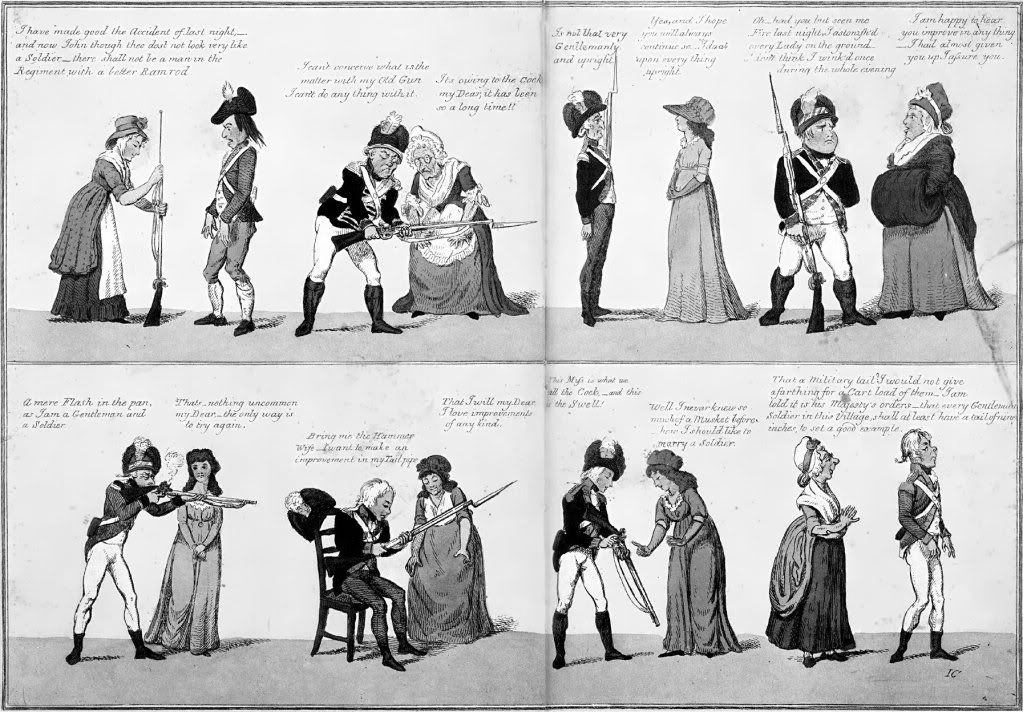
Caricature of the militia
Public attitude toward the militia

All in all the militia was not popular. Inhabitants resented assessments of equipment and money to cover the needs of the militia. Men resented being drafted to serve and were apt to do everything they could to avoid their military training. Tradesmen and innkeepers resented them leaving town without paying for services and wares.

As a peacekeeping force, they militia had little to do but drill. With so much free time on their hands, they developed a reputation for a wild lifestyle of parties and frivolity. Not surprisingly, parents often saw militia officers as a threat to their marriageable daughters since their families were unknown and they might disappear from the neighborhood very quickly.  

References

Collins, Irene. (1998) Jane Austen, The Parson's Daughter . Hambledon Press.
Day, Malcom. (2006) Voices from the World of Jane. Austen David & Charles .
Downing, Sarah Jane. (2010). Fashion in the Time of Jane Austen. Shire Publications
Holmes, Richard. (2001). Redcoat, the British Soldier in the Age of Horse and Musket W. W. Norton & Company
Le Faye, Deirdre. (2002). Jane Austen: The World of Her Novels. Harry N. Abrams  
Militia. Regency Collection
Southam, Brian (2005). Jane Austen in Context. Janet M. Todd ed Cambridge University Press
Tomalin, Claire. (1999). Jane Austen, a Life. Random House
Watkins, Susan . (1990). Jane Austen's Town and Country Style. Rizzoli

~~~~~~~~~~~~
 Maria Grace is the author of Darcy's Decision and The Future Mrs. Darcy. Click here to find her books on Amazon. For more on her writing and other Random Bits of Fascination, visit her website. You can also like her on Facebook, follow on Twitter or email her.

Wednesday, January 23, 2013

A LIttle Colorful Language--Soldiers

By Maria Grace

I am captivated by language and how it relates to a culture. With three teen aged sons living at home I get to hear a lot of the slang they encounter.  I never cease to be fascinated by the terms that come up, and how often I haven't a clue what they are referring to. Since every era has its own unique slang, I thought it would be interesting to share some Regency era slang from time to time.  Today's offering relates to soldiers.


Francis Grose, author of Dictionary of he Vulgar Tongue
Regency slang terms for soldiers:
  • Bad bargain: a worthless soldier. Usage: One of his majesty's bad bargains
  • Bloody Back: A jeering name for a soldier, for his scarlet coat.
  • Brothers of the blade: A soldier
  • Fogey or Old Fogey: A nickname for an invalid soldier.
  • Galloot: a Soldier
  • Foot wabbler: A contemptuous name for a foot soldier, commonly used by the cavalry.
  • Light bob: A soldier of the light infantry company.
  • Lobster: A nickname for a soldier, from the color of his clothes.
  • Parish soldier: A militiaman, from substitutes being frequently hired by the parish for those who do not wish to serve.
  • Rag Carrier: an ensign
  • Skulker: A soldier who by feigned sickness evades his duty; a sailor who keeps below in time of danger
  • Sons of Mars: soldiers
  • Swad or Swadkin: A soldier.
Interesting terms related to the military:  
  • Act of parliament: A military term for five pints of beer. 
    • An act of parliament had formally obliged a landlord was formerly to give to each soldier this amount free.  
  • Black Guard: A shabby, mean fellow; 
    • derived from a number of dirty, tattered roguish boys, who attended at the Horse Guards and Parade in St. James's Park, to black the boots and shoes of the soldiers, or to do any other dirty offices.    
  • Blue plumb: A bullet. 
    • Usage: Surfeited with a blue plumb—wounded with a bullet. Assortment of George R—'s blue plumbs—a volley of bullets shot from soldiers' firelocks.    
  • Brown Bess: A soldier's firelock.    
  • Camp candlestick: A bottle, or soldier's bayonet.    
  • Halbert: A weapon carried by an infantry sergeant.    
  • He carries the halbert in his face: a saying of one promoted from a sergeant to a commission officer.    
  • Lumber: Live lumber; soldiers or passengers on board a ship are so called by the sailors.    
  • Messmate: A soldier who eats at the same mess, companion or comrade.    
  • Nightingale: A soldier who sings (cries) out at the halberts. 
    • -It is a point of honour in some regiments never to cry out under the discipline of the cat of nine tails; to avoid which, they chew a bullet. 
  • Rag fair: An inspection of the linen and necessaries of a company of soldiers, commonly made by their officers on Mondays or Saturdays.    
  • Sank, Sanky, Centipees: A tailor employed by clothiers in making soldier's clothing.    
  • To be brought to the halberts: to be flogged 
    •  -soldiers of the infantry, when flogged, being commonly tied to three halberts, set up in a triangle, with a fourth fastened across them.    
  • To boil one's lobster— for a churchman to become a soldier: lobsters, which are of a bluish black, being made red by boiling.    
  • To get a halbert: to be appointed a sergeant.    
  • To hug brown Bess: to carry a firelock, or serve as a private soldier.   
  • Smart money: Money allowed to soldiers or sailors for the loss of a limb, or other hurt received in the service.   
  • Soldier's mawnd: A pretended soldier, begging with a counterfeit wound, which he claims to have received at some famous siege or battle.    
  • Tattoo: A beat of the drum, of signal for soldiers to go to their quarters and for ale to stop being served.   

Finally, in the category of not exactly slang but still pretty interesting:    
Cold burning: A punishment inflicted by private soldiers on their comrades for trifling offenses, or breach of their mess laws; it is administered in the following manner: The prisoner is set against the wall, with the arm that is to be burned tied as high above his head as possible. The executioner then ascends a stool, and having a bottle of cold water, pours it slowly down the sleeve of the delinquent, patting him, and leading the water gently down his body, till it runs out at his breeches knees: this is repeated to the other arm, if he is sentenced to be burned in both.    

Quoted from:   Grose, Captain (Francis). (2004) Dictionary of the Vulgar Tongue, 1811 ed. Ikon Classics


Maria Grace is the author of Darcy's Decision and The Future Mrs. Darcy. Click here to find her books on Amazon. For more on her writing and other Random Bits of Fascination, visit her website. You can also like her on Facebook, 
follow on Twitter or email her.