Showing posts with label King Edgar. Show all posts

Monday, April 27, 2020

Wealth, Power and Influence in Later Anglo-Saxon England

By Annie Whitehead

The great magnates of Anglo-Saxon England were not poor men. Land has always been the most recognisable sign of wealth, and these men had plenty of it. The amount of land which a pre-Conquest nobleman could amass can be seen clearly in the case of Harold Godwineson. [1] As well as their own family lands, such men could hold land from their lord as reward for service. Bookland, as it was called, was originally granted by the king to his thegns with an ecclesiastical purpose in mind. By the tenth-century, however, land was being booked without any pretence that it would go to endow a church. Many thegns and ealdormen were benefactors of religious houses though - Wulfric Spott founded Burton Abbey, Athelstan 'Half-king', ealdorman of East Anglia 932-956, used his wife's lands to form the nucleus of the large endowment of Ramsey Abbey, [2] and Aelfhere, ealdorman of Mercia 956-983, cited in the Anglo-Saxon chronicle as the destroyer of monasteries, [3] was a great friend to the religious houses at Glastonbury and Abingdon.

Dunstan - one-time abbot of Glastonbury

The nature of the land grants varied little, and each one set out the conditions under which the land was booked. King Edgar granted to his thegn, Aelfwold, land at Kineton in Warwickshire as

"an eternal inheritance ... and after the conclusion of his life (he may) leave it unburdened to whatsoever heirs he shall wish. Also the aforesaid estate is to be free from every yoke of earthly service except three, namely fixed military service and the restoration of bridges and fortresses." [4]

It was not only the king who granted land. Oswald, bishop of Worcester, sets out the conditions under which he has granted his land in his letter to King Edgar. [5]

"That they shall fulfil the whole law of riding as riding men should and that they shall pay in full ... church Scot and Toll. In addition they shall lend horses, they shall ride themselves, and, moreover, be ready to build bridges, ... they shall always be subject to the authority and will of that archiductor who presides over the bishopric..."


King Edgar

The will of Wulfric Spott [6] is a fine example of the extent of lands in the possession of an influential thegn. He had lands in Staffordshire and Derbyshire, estates in Shropshire, Leicestershire, Nottinghamshire, Warwickshire, Gloucestershire, Lincolnshire and South Yorkshire. The will also refers to lands in South Lancashire and Cheshire.

The family of Wulfric Spott was one of the most influential and powerful of its day, with branches linked to the royal family and a regular involvement in power struggles and political rivalry. Wulfric Spott's brother, Aelfhelm, ealdorman of Northumbria, was murdered in 1006, and his sons Wulfheah and Ufegeat were blinded. Wulfheah was one of the prominent ministri during the period when Aethelred II (Unready) was restoring royal favour to the Church (see below).

It is easy to believe that Eadric Streona, ealdorman of Mercia 1007-1017, was Aelfhelm's murderer. His rise to power certainly would not have been hindered by the removal of such prominent men who had surrounded the king. The rivalry does not seem to have stopped there, for Eadric is named as the murderer of the thegns Sigeferth and Morcar.

These brothers were members of this same family; Morcar was married to Wulfric Spott's niece. There is a possibility that they were related to King Aethelred through his marriage to the daughter of Thored of Northumbria.

Vacillating between the causes of Edmund Ironside and Cnut in the war of 1015-16, Eadric was playing a dangerous game. Edmund had defied his father, Aethelred II (Unready), and married Sigeferth's widow, thereby gaining the allegiance of the northern Danelaw. Cnut's English wife, Aelfgifu of Northampton, was the daughter of the murdered Aelfhelm, and the cousin of Ealdgyth, Morcar's widow. It is also possible that this family was connected to that of Leofwine, who held Eadric's ealdordom after the latter's death. His son succeeded him, and his son Aelfgar married Aelfgifu who may have been the daughter of Ealdgyth and Morcar. So far, so confusing!

Encomium Emmae Reginae 
But the Encomium Emmae Reginae shows us how important this family really was. It was written for Cnut's second wife Emma, as a propaganda exercise for the claims of her son Harthacnut, and in Book III it denies that Harald is Cnut's son. This in itself is not enough to refute Harald's claims, and the Encomium further denies that he is Aelfgifu of Northampton's son. Clearly his position as her son is important. If Emma denies that he is of this family, then she is not attacking them. The importance of Aelfgifu's kinship is clear, and Emma does not wish to offend this great family.

Cnut with his sons Harald and Harthacnut


A simple equation which has always held true is that wealth equals power. King Aethelred II was called 'Unraed' because he was badly counselled. It is certainly true that for much of his reign he was guided by councillors acting in their own interests. The 980s were a period which Aethelred came later to regret. Many churches were deprived of their lands; an Abingdon estate was acquired by a king's reeve, and Rochester was besieged. Aethelsige, one of the five most prominent men at this time, was responsible for the damage done at Rochester. The king himself admitted that this was a period when he was being manipulated by a group of men who, taking advantage of his youth, were acting in their own interests at the expense of various churches. In the next decade the prominent men were associated with the monastic cause and royal generosity to the Church was re-established.

The king needed his councillors and officials. He rarely acted without the consent of the witan (council). Royal authority could only be made to be felt throughout the kingdom through the king's representatives. Yet it was all too easy for these men to become too powerful. The king rarely strayed from the south, and to the inhabitants of England north of the Humber, royal authority was remote.

Northumbria was never free from the Scandinavian threat, and the eorls (as they were called in the north) often had to deal with this problem on their own. It must have been difficult to trust them, but many thegns were encouraged to acquire estates in areas settled by the Danes, to help break down the isolation of the north. Another policy instigated was that of appointing archbishops to York who had sees elsewhere. This pluralism was designed to ensure ecclesiastical loyalty, and would also help to bring Northumbria out of isolation. Royal control was difficult to establish in areas with separatist feeling, and Mercia was another of these areas. The ealdormen, if they wished to assert themselves, had to establish links in order to gain and retain control, and at times this must have looked suspiciously like treachery. Poor communications also did nothing to alleviate the danger of an over-concentration of power in too few aristocratic hands.

Aethelred II

During the reign of King Alfred, ealdormen usually controlled single shires, but as the West Saxon kingdom expanded the ealdormen were given greater responsibility. Athelstan of East Anglia's nickname 'Half-king' demonstrates how powerful these men could become. His ealdordom included East Anglia proper (Norfolk and Suffolk), Cambridgeshire, Huntingdonshire, north-east Northamptonshire, and he probably governed the whole of the eastern Danelaw. [7]  He kept his ealdordom under such control that Kings Edmund and Eadred were able to recover first the northern Danelaw, then Northumbria, and finally to conquer Strathclyde.

It is not surprising to discover that men like these did not always work together in complete harmony. The anti-monastic reaction which followed the death of Edgar in 975 found ealdormen Aelfhere and Aethelwine on opposing sides in the succession dispute. Doubtless Aelfhere was antagonised by the triple-hundred of Oswaldslow which had encroached upon his area of authority, but it has been suggested [8] that he had other, more personal reasons for opposing Aethelwine's and Dunstan's support of Edward; namely that Aethelwine's ealdordom was East Anglia, and this meant East Anglia proper, Essex, and the shires which had at one time been the eastern part of the old kingdom of Mercia, and were still called Mercian in the tenth-century. Aelfhere, Aethelwine and Eorl Oslac of Northumbria were the most influential ealdormen of their day. Ambition and power perhaps inevitably cause conflict.

Page from the Anglo-Saxon Chronicle

Thorkell the Tall, a Danish invader turned mercenary of Aethelred II, became the leading secular lord of Cnut's reign. He was made governor of Denmark for a time and guardian of the king's son. Cnut's letter to the people of England [9] instructs Earl Thorkell to deal with those who defy the laws. Dorothy Whitelock* suggested that this was because the letter was sent to him from Denmark by Cnut and that Thorkell was acting as regent in Cnut's absence. Power and trust indeed for a man who had earlier fought on the side of the English. Doubtless this was the kind of reward Eadric Streona had been seeking to secure himself when he changed sides during the war of 1015-16. He, of course, was not so fortunate. [10]

It is interesting to note that open conflict only occurred in times of unrest, for example during the succession dispute of 975, or the war of 1015-16. Athelstan 'Half-king' was loyal, as we have seen; Aelfhere of Mercia was invaluable to King Edgar when he was trying to assert himself as king of the Mercians. Only after Edgar's death did Aelfhere's resentment manifest itself. The king may have been ill-served upon occasion, and there is some doubt as to the effectiveness of the reeves as checks against the power of the ealdormen, but there was nothing in England to compare with the rise to power of the Capetians in France, and royal authority was never seriously challenged by the servants of the crown.

[1] Ann Williams - Harold Godwineson Battle 80
[2] CR Hart (in Anglo-Saxon England 2)- Athelstan Half-king and his Family
[3] Anglo-Saxon Chronicle (E) 975
[4] EHD (English Historical Documents) 113 page 519
[5] Origins of English Feudalism 42 p133
[6] EHD 125 p541
[7] CR Hart ibid
[8] Ann Williams - Princeps Mercorum gentis; the family, career and connections of Aelfhere, Ealdorman of  of Mercia 956-983
[9] EHD 48 p415
[10] The Encomium Emmae Reginae tells us Eadric's fate: "He (Cnut) said 'pay this man what we owe him; that is to say kill him, lest he plays us false.' He (Eric of Hlathir) indeed raised his axe without delay and cut of his (Eadric's) head with a mighty blow."
*Author of The Beginnings of English Society, & Wulfstan and the Laws of Cnut (English historical Review 62 1948)

This article is an Editor's Choice and was originally published May 30, 2016.

~~~~~~~~~~

Annie Whitehead
studied History under the eminent Medievalist Ann Williams. She is a member of the Royal Historical Society and an editor for EHFA (English Historical Fiction Authors.) She has written three award-winning novels set in Anglo-Saxon England, one of which was long-listed for the Historical Novel Society (HNS) Indie Book of the year 2016, and a full-length nonfiction book, Mercia: The Rise and Fall of a Kingdom. She has contributed to fiction and nonfiction anthologies and written for various magazines, including winning the New Writer Magazine Prose Competition. She was the winner of the inaugural Historical Writers’ Association/Dorothy Dunnett Prize 2017. She has recently been a judge for that same competition, and for the HNS Short Story Competition. Annie’s new book, Women of Power in Anglo-Saxon England, will be published on May 30 by Pen & Sword Books.

For more information, visit Annie's Website or her Author Page. Also connect with Annie through her Blog and Twitter (@AnnieWHistory).

Monday, March 30, 2020

Duties and Obligations in Tenth-Century England

By Annie Whitehead

Placing oneself under the protection of a lord was a solemn and ceremonious affair. In England it took the form of a hold-oath, or fealty oath. The physical act of bowing was accompanied by the oath:

“By the lord before whom this relic is holy, I will be to N [name of lord] faithful and true, and love all that he loves, and shun all that he shuns, according to God’s law, and according to secular custom; and never, willingly or intentionally, by word or by work, do aught of what is loathful to him, on condition that he keep me as I am willing to deserve, and all that fulfil that our agreement was, when I to him submitted and chose his will.” [1]

Essentially this is a negative commitment, a promise not to act against the lord’s interests. Nevertheless, a personal bond of this nature carried with it certain positive obligations.

For the king’s thegn, lord and king were the same person. A thegn whose lord was not the king still had a duty to the monarch. (It should be remembered that the king’s title was “Cynehlaford” or lord-king.) Thegns in turn would have men who called them lord. The role of lordship entailed a dual responsibility, that of serving one’s lord, and that of protecting one’s men.

The king with his witan
The king was ever mindful of the need to control his ealdormen. Their attendance at the royal council was one way of ensuring their co-operation, and failure to attend a summons to the witan was punished severely. The witan had the right, rather than the privilege, to advise the king, and at times it acted on its own; following the death of a king the election process for his successor was carried through in the witan. It was in the royal council that the laws were promulgated. Its members met indoors, and the Anglo-Saxon Chronicle tells how, in 978, “the leading councillors of England fell down from an upper storey at Calne, all except the holy Archbishop Dunstan, who alone remained standing on a beam.” [2] Business transacted in the witan included general, financial and judicial matters. Essentially though, its function was of a deliberative and consultative nature.

Saint Dunstan

The test of royal authority is how effectively it is felt in the localities. The law codes abound with directions to individual ealdormen to ensure that laws are enforced. King Edgar commands that:

“Earl Oslac and all the host that dwell in his aldermanry are to give their support that this may be enforced” and that “Many documents are to be written concerning this, and sent both to ealdorman Aelfhere and ealdorman Aethelwine, and that they are to send them in all directions, that this measure may be known to both the poor and the rich.” [3]

King Edgar

There is some evidence to suggest that the ealdormen disliked the king’s reeves (administrative officials.) A breach of the law by a reeve could only be dealt with by the king [4] and when Aethelred II adopted the policy of appointing reeves instead of ealdormen, the Anglo-Saxon Chronicle tells us that in 1002 Ealdorman Leofsige slew Aelfric, the king’s high-reeve. The grant of Aethelred’s explains why these men were disliked. The reeve broke the law by giving Christian burial to those who had forfeited the right. Instead of punishing him, Aethelred granted the reeve their land. To the ealdormen it must have seemed that the reeves were above the law.

Naturally the king’s officials were instrumental in the enforcement of law and order, and their duties included presiding over the shire and hundred courts. The hundred ordinance [5] directs that the hundred court is to meet every four weeks. II&III Edgar acknowledges this and states that the borough court is to be held three times a year and the shire court twice a year. It also succinctly sets out the duty of those presiding over the courts:

“And the bishop of the diocese and the ealdormen are to be present, and there to expound both the ecclesiastical and the secular law.” [6]

The shire court was unspecialised in the tenth-century, and did not develop into a full royal court until after the Norman conquest. It had a variety of functions, including procedures in outlawry. [7] It was here that arrangements were made for the collection of taxes. It was in the interests of landowners to be represented, and the shire-reeve gradually became recognised at the chief executive royal officer.

The hundred court met on an appointed day, and anyone who failed to appear had to pay thirty shillings compensation. Each man was to do justice to another. Great concern was shown over theft. Compensation had to be paid to the victim; half of the offender’s remaining property went to the hundred, and half to the lord. Aethelred II’s reign saw an emphasis placed on the importance of oath-taking, and the origins of the jury of presentment.

“The twelve leading thegns are to come forward and swear on the relics … that they will accuse no innocent man nor conceal any guilty one.” He who pronounced a wrong judgement could forfeit his thegnly status, and “A sentence where the thegns are unanimous is to be valid.”

The importance of all courts was to provide a place where good witness could be obtained. King Edgar ordered thirty-six witnesses in each borough, and twelve in each hundred. [9]

Aethelred II

By the middle of the tenth-century it was becoming customary for lords, ecclesiastical or lay, to receive grants of jurisdiction from the king. Many hundreds fell into private hands; a lord often had considerable rights here and in his own lands. The grants were usually laid down in the charters as rights of “sake and soke”, these being rights of jurisdiction and to the profits of justice.

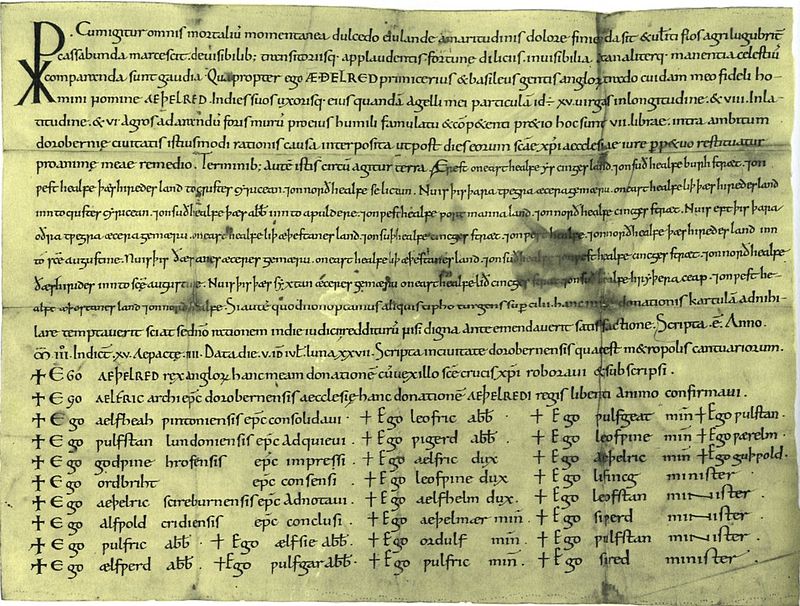
A charter of Aethelred II
This usually meant the control of a court. These rights were not granted lightly, and were really intended to emphasise royal authority rather than to weaken it. Grants of rights over a hundred court involved financial advantages, and the right to appoint hundredmen. HR Loyn suggests that the sheriffs (shire-reeves) played an important part in preventing the disintegration of royal power as private jurisdiction grew. [10] Landowners exercised other specific rights on their estates. They had a right to impose a toll on goods sold within the estate, the right (known as Team) to supervise the presentation of convincing evidence that goods for sale belonged to the vendor, and the right (infangenetheof) to hang a thief caught on the estate.

The nobility served the king, and were granted lands and privileges as a reward for that service. As lords they could expect service from their own men, and in turn they had a duty to protect those who called them ‘lord’.

To read more in this series, see Military Service in Tenth-Century England.


[1] Origins of English Feudalism 59 p145 - Of Oaths (c.1920)
[2] Anglo-Saxon Chronicle (E) 978
[3] IV Edgar 15. & 15.1
[4] EHD (English historical Documents) 117 p525
[5] This document is often called I Edgar, but was possibly written before Edgar’s reign. It was definitely in existence during Edgar’s reign.
[6] II&III Edgar 5.2
[7] HR Loyn - The Governance of Anglo-Saxon England p138
[8] III Aethelred 3.1 & 13.2
[9] IV Edgar 4. & 5.
[10] HR Loyn Op Cit p163. By 1086 approx. 130 hundreds were in private hands.

All images used above are copyright free in the Public Domain

This Editor's Choice article was originally published July 16, 2016.
~~~~~~~~~~

Annie Whitehead studied History under the eminent Medievalist Ann Williams. She is a member of the Royal Historical Society and an editor for EHFA (English Historical Fiction Authors.) She has written three award-winning novels set in Anglo-Saxon England, one of which was long-listed for the Historical Novel Society (HNS) Indie Book of the year 2016, and a full-length nonfiction book, Mercia: The Rise and Fall of a Kingdom. She has contributed to fiction and nonfiction anthologies and written for various magazines, including winning the New Writer Magazine Prose Competition. She was the winner of the inaugural Historical Writers’ Association/Dorothy Dunnett Prize 2017. She has recently been a judge for that same competition, and for the HNS Short Story Competition. Annie’s new book, Women of Power in Anglo-Saxon England, will be published on May 30 by Pen & Sword Books. 

For more information, visit Annie's Website or her Author Page. Also connect with Annie through her Blog and Twitter (@AnnieWHistory).

Monday, December 3, 2018

How Cnut Established Himself as Full King in England

By Annie Whitehead

Nearly one thousand years ago*, in November 1016, Cnut became king of England. How did he establish himself, a foreigner, with full authority?

For a contemporary account of the reign of Aethelred II, it is natural to look to the Anglo-Saxon Chronicle. In it, we find the closing years of the reign fraught with difficulties; those of fending off Danish raiders. It would be easy to agree with the Chronicler who, writing with hindsight, concludes that the slide towards Danish rule in England was inevitable. The payment of the Danegeld might at first sight seem like sheer folly, yet the policy appears in the short term to have worked.

Aethelred’s problem was that paying off one Viking force would not necessarily keep another one away from his shores. The Chronicler blames the military failure of the English on the cowardice of the military leaders. But while the squabble between Brihtric and Wulfnoth caused the loss of a hundred ships in 1009, we also know that Brihtnoth’s actions at the Battle of Maldon in 991 were those of courage and loyalty, that the army of 1009 left in 1010 without tribute, and that Aethelred was assured of the loyalty of Ulfcytel in East Anglia.

King Aethelred II

If things were not as bad before 1009 as the Chronicler would have us believe, there is little doubt that the armies of Swein Forkbeard (Cnut's father) widened any existing cracks in the morale of the English. Within a year, Swein had established himself as full king. But with his death in 1014, the Witan (king's council) sent to Normandy for Aethelred, and accepted him back as their king “if he would govern them more justly than before.” In the same year, Aethelred’s ravaging of Lindsey drove Cnut’s forces away. With further hindsight than the Chronicler had to offer, and perhaps with less bias, it is probably fair to say that it was far from inevitable that Cnut would succeed Aethelred as king of the English. We must, therefore, look elsewhere to find the reasons for his ultimate success.

It is hard to find a source which places emphasis on the military prowess of Cnut; most in fact, praise his piety and generosity to the Church. He was driven back to Denmark in 1014, and his reputation as a warrior must have suffered as a result. So his success in England must be attributed to something other than military superiority. While it might be rash to say that luck was on Cnut’s side, there is no doubt that circumstances helped him a great deal.

King Cnut

Before he left Denmark, Cnut was allowed by his brother King Harald to raise an army. He was fortunate to have the support of Eric of Hlathir, who had played a great part in the overthrow of Olaf Tryggvason, and who was to prove invaluable to Cnut in England. Before Cnut set sail, he was joined by Thorkell the Tall**. It is possible that Thorkell was seeking revenge for the death of his brother at the hands of the English, although it is possible, but not universally accepted among historians, that this revenge was sought earlier, and was, in fact, the reason for Thorkell’s invasion of England in 1009. Whatever his reason, Thorkell’s presence was a bonus for Cnut; he now had with him an accomplished warrior who knew England and the English.

The champion of English resistance was Aethelred’s son, Edmund Ironside. He had procured the support of the Danelaw by marrying the widow of Sigeferth, murdered by Eadric Streona (ealdorman of Mercia) probably at the behest of Aethelred. Cnut could not, therefore, be certain that the Danes in England would submit to him, and he landed in the south and began ravaging Wessex. Edmund and Eadric were raising forces, but they separated before they met the enemy. Eadric joined Cnut, and within four months Cnut was in firm control of Wessex and had the resources of the Mercian ealdormanry at his command.

Edmund Ironside

Cnut was aided elsewhere in England by Edmund’s troubles. His army in the Danelaw dispersed after demanding that the London militia should join them. Having lost his opportunity here, Edmund joined forces with Uhtred of Bamburgh. Cnut was quick to seize the chance he had been given and invaded the Danelaw, whence he proceeded towards Northumbria. Uhtred hurried back from the midlands and submitted to Cnut. Soon afterwards he was murdered, and Northumbria was left in the capable hands of Eric of Hlathir. Cnut was free now to turn his attention to the south east.

Edmund had joined his father in London, and when Aethelred died in 1016 the men of London chose Edmund as his successor. Within a few days of Aethelred’s death, however, a more representative assembly at Southampton swore fealty to Cnut in return for a promise of good government. Cnut was again helped by Eadric Streona’s amazing capacity to vacillate. He went over to Edmund’s side, and then took flight during the definitive Battle of Ashingdon. Cnut, as victor, came to terms with Edmund, and the result was a division of the kingdom. Edmund was given Wessex, and the rest of the country beyond the Thames Cnut took for himself. This was obviously a dangerous situation, in which conflict could easily flare up again. As Stenton pointed out, it imposed a divided allegiance on all those noblemen who held land in both Mercia and Wessex. [1] But circumstances once again favoured Cnut when, less than two months after the Battle of Ashingdon, Edmund Ironside died, and the West Saxons accepted Cnut as their king.

King of all England now, Cnut was by no means secure in his position. Good fortune and opportunity had helped him thus far; now he had to rely on his judgement and ability. He eliminated any chance that Richard of Normandy might support the claims of Aethelred’s children by Emma, by marrying the lady himself. For military rather than administrative reasons he divided the kingdom into four: Wessex he controlled himself, Eadric Streona was appointed to Mercia, East Anglia went to Thorkell, and Eric of Hlathir remained in Northumbria. In the same year, 1017, the atheling Eadwig was exiled and subsequently murdered. The Anglo-Saxon aristocracy also lost at least four of its prominent members, among them Eadric Streona. ('Streona' means 'The Grasper' or the 'Acquisitive' and the name first appeared in Hemming's Cartulary, an 11th-century manuscript, pictured below.)


Cnut set out to win the respect of the English church, and in this he was successful, being fully prepared to accept the traditional responsibility of being an agent of God with the duty to protect his people. He claimed to be occupying a throne to which he had been chosen at Gainsborough in 1014, and at Southampton in 1016. Though in reality much was changed during his reign, Cnut sought to establish himself by emphasising the importance of continuity. There was not such a large scale change in land ownership as was to occur in 1066, nor was there a great change in the personnel within the leadership of the Church. Archbishop Wulfstan drew up Cnut’s lawcodes drawing on those he’d written for Aethelred. The lawcodes themselves stressed continuity; very little in them was new.

Cnut (top centre)

Before the end of 1017, with Eadric Streona dead, and the alliance with Normandy secured, Cnut dismissed his fleet, retaining only forty ships. Its dismissal showed that henceforth he intended to rule as the chosen king of the English. At a council at Oxford it was agreed that the laws of Edgar (Aethelred's father, whose reign of 959 to 975 was already beginning to be looked upon as a golden age) should be observed.

In 1018 the military rule was relaxed. Two earldoms were re-established in Wessex, and in Mercia the earldoms of Herefordshire and Worcestershire were re-established. Stenton says that it was then that Cnut's reign began in earnest. [2] But throughout his reign the presence of the huscarls (housecarls) and the distribution of the heregeld (military tax) to them made it difficult for the English to forget that they were being ruled by a conquering alien king. There is no doubt though that by this point Cnut had established himself, for afterwards he felt sufficiently secure to leave the country in four separate expeditions to the north.

Cnut had invaded a vulnerable country in 1015, a country which was war-torn and weary. There were no clear dividing lines of loyalty; Edmund's army included Danes, Cnut’s included Englishmen. There can be no doubt that Cnut benefited considerably from the untrustworthiness of Eadric Streona, and from the dispersal of Edmund’s army in the Danelaw. For Cnut, the death of Edmund Ironside was nothing short of a blessing. Thereafter, his success rested on the fact that he did not conspicuously behave as a conqueror, stressing the importance of continuity, and keeping to the path that the pious King Edgar had trodden.

King Edgar

This emphasis must have taken attention away from the changes  his reign brought about. Keeping his military forces for less than a year Cnut reduced feeling among the English that they were a conquered people. Cnut made good use of his opportunities. By 1018 he had successfully established himself as full king of the English.

[1] Anglo-Saxon England - FM Stenton p387
[2] Op cit p 393

**Some historians, Campbell among them, argue that Thorkell did not join Cnut until 1016/17

Further reading/Bibliography:
The Anglo-Saxon Age - DJV Fisher
The Laws of Cnut & The History of Anglo-Saxon Royal Promises - P Stafford in Anglo-Saxon England 10
Encomium Emmae Reginae - Ed Campbell
The Chronicle of Thietmar of Merseberg EHD
The Sermon of the wolf to the English “ “
King Edgar and the Danelaw - Niels Lund, Med Scand 9
The Diplomas of Aethelred the Unready - Simon Keynes
Wulfstan and the Laws of Cnut - D Whitelock EHR 63

(all the above images are in the public domain)

*This article is an Editor's Choice and was originally published September 19, 2016

~~~~~~~~~~

Annie Whitehead is an author and historian, and a member of the Royal Historical Society. She has written three award-winning novels set in Anglo-Saxon Mercia. Her history of Mercia, from Penda the pagan king to the last brave stand of the earl of Mercia against the Conqueror, Mercia: The Rise and Fall of a Kingdom, is published by Amberley.

Find out more at www.anniewhiteheadauthor.co.uk

Sunday, May 14, 2017

Lordship in the Tenth-century – What was its Political and Social Function?

by Annie Whitehead

“No man can make himself king, but the people have the choice to select as king whom they please, but after he is consecrated as king, he then has dominion over the people and they cannot shake his yoke from their neck.”

So said Aelfric of Eynsham, (c955-c1010), and he tells us here of the absolute nature of kingship. The king is the lord of all the English, so if we are to discover the function of lordship, we should begin by examining the role of the king.

King Edgar

By the tenth-century ideas  about the spiritual role of kingship had developed along Carolingian lines. A well-documented example of this is Edgar’s coronation at Bath in 973. One school of thought is that Edgar delayed his coronation until he had reached the canonical age of thirty, but it is unlikely that he could have reigned successfully for so long (he succeeded his brother Eadwig in 959) without having been consecrated earlier in his reign, particularly in view of what Aelfric has to say about consecration. [1]

It is more probable that this coronation was based on the Frankish notion of ‘imperium’, stressing the king’s duty before God. Wulfstan, Archbishop of York, expanded this idea in his Institutes of Polity. His view was that a Christian king should be a just shepherd to his Christian flock, he was to help the righteous and to afflict the evil-doers, especially thieves and robbers. His true function was to purify his people before God and the world. [2]

The mutual obligation between the king and his subjects is illustrated by an incident in Aethelred the Unready’s reign. With the death of Swein Forkbeard, Aethelred was asked to return from exile in Normandy by the Witan (council), who declared that “no lord was dearer to them than their rightful lord, if only he would govern his kingdom more justly than he had done in the past."[3] The king was king, but his subjects would not allow him to neglect his duty to them.

Yet neither would they neglect to exalt a praise-worthy monarch. Florence of Worcester* summed up the virtues of King Edgar thus:-
“In the winter and spring, he used to make progress through all the provinces of England and enquire diligently whether the laws of the land and his own ordinances were obeyed, so that the poor might not suffer wrong and be oppressed by the powerful…Thus his enemies on every side were filled with awe, and the love of those who owed him allegiance was secured.”
There were, of course, more personal relationships, not only between the king and his subjects, but between the lord and his man. The argument continues among historians as to whether pre-conquest England was feudal; suffice to say that there was an English equivalent to the Frankish oath of vassalage, this being the Hold-Oath. The oath was essentially negative, a promise to do nothing to harm the lord. It included a gesture of bowing to the lord. The lord in his turn had certain obligations to his man.
“By the Lord, before whom this hallowed thing is holy, I will be steadfast and true to X, to love all he loves and shun all that he shuns, and never, by will or by thought or by deed do aught of what is loathsome to him, as long as he upholds me as I am willing to earn and fulfil all that our understanding was, when I bowed to him and took his will.” 
Naturally, the king could not rule without counsel. The witenagemot, or witan, was the royal council, and had the right, rather than the privilege, to advise the king. The king’s thegns owed their status and position to the king and were rewarded for their service (the word thegn originally meant servant.) It was usually the king’s thegns who were appointed as reeves, responsible for administration in the localities as a check on the powerful ealdormen.

The king with his witan

The most usual form of reward was that of a land grant. Many charters confirming these land grants still exist, such as King Edgar’s grant of land at Kineton to his thegn Aelfwold in 969. These grants, known as bookland, were not the same as the fief of feudal Frankia. They were granted by the king in the form of a book (charter) for services rendered. Aelfwold was granted the land at Kineton for all his life and could leave it to whomever he chose. The estate was free from all service except “fixed military service and the restoration of bridges and fortresses.”

Many grants were made to the Church, who in turn leased out land in return for service. A good example of this comes from Oswald of Worcester, who lists the service required of the beneficiaries of the land. They should fulfil the law of riding as riding men should, they should pay dues to the Church, swear to be humbly subject to the bishop and lend horses, build bridges, and send hunting spears.

Initially these endowments were made to the Church from the king, and only he could turn folkland into bookland. It soon became, however, the most common way for a lord to reward his man.

A grant by Aethelred the Unready shows how far he was prepared to support his men. His thegn, Aethelwig, gave Christian burial to men killed fighting in defence of a thief. Rather than censure Aethelwig, as Ealdorman Leofsige advised, Aethelred granted his thegn the forfeited land of the brothers who had been killed. [3]

Not all thegns were king’s thegns; many of them had another lord to whom they owed their allegiance. When these thegns died, the heriot (war gear) was surrendered to their lord and not to the king.

Aethelred the Unready

There was another aspect to lordship, an extension of the personal bond into the field of law. In the reign of Edward the Elder (899-924) a letter was written to the king explaining the history of an estate at Fonthill, Wiltshire. It describes how a thief, Helmstan, was required to give an oath to clear himself of the charges brought against him. He asked his lord Ordlaf to intercede for him, which Ordlaf did, even though his man was guilty. [4] This illustrates how a lord was bound to protect his man, whether innocent or guilty. Though the law codes might have forbidden the lord from doing this, often it was more beneficial for a man to appeal to his lord in this way than to appeal in the hundred courts.

By the middle of the tenth-century it was becoming customary for lords, ecclesiastical or lay, to receive grants of jurisdiction from the king. Usually these grants were laid down in the charters as ‘sake and soke’. The term implied jurisdiction and control of a court. It was not granted lightly, and these delegated rights were intended to emphasise rather than undermine royal authority. While the landowner enjoyed immunity from public courts, the court over which he presided was not held for his men, but was attended by men drawn from the neighbourhood.

There was also a much more specific form of private jurisdiction. All lords, be they bishops, earls, thegns or abbots, were held responsible for the behaviour of their men. “Such a responsibility involved an exercise in judgement, which would easily be formalised into the giving of judgement.” (HR Loyn) Fortunately, the monarchy was strong enough to ensure that the worst abuses were avoided.

Along with sake and soke, other judicial rights were specified. ‘Toll’ gave the lord the right to take toll on goods sold within the estate, and ‘team’ gave the right to supervise the presentation of convincing evidence that goods for sale actually belonged to the person selling them. ‘Infangenetheof’ gave the lord the right to hang a thief if he had been caught on the estate with the stolen goods still in his possession. By the end of the period, large numbers of hundred courts were in private hands.

A charter of King Aethelred's to his 'faithful man' 

Lords, of course, had always been involved with the public courts. Earls and bishops presided over the shire courts. It was here that arrangements were made for the collection of taxes. It was in the interests of landowners to be represented, as the king always was by his servant the shire-reeve. It was also important for lords to establish a presence at the hundred court, where much money could be lost and won. They were also commanded to give full support to the hundredsmen, whose job it was to supervise legal trading and to discourage cattle theft. King Edgar specifically ordered ealdormen Oslac, Aelfhere, and Aethelwine to give such support. “And they are to send them in all directions, that this measure may be known to both the poor and the rich.” [5]

Military duties were linked with the social function of lordship. From the time of King Ine (688-725) forfeiture of land and a heavy fine of 120 schillings was the penalty for a lord neglecting military service. After 899, as well as national obligations to fyrd service, and building bridges and fortifications, men were now to group themselves into tithings and hundreds to protect themselves. Ealdormen and thegns not only formed the select body of the king’s household retainers, but were, as landlords, responsible for the organisation, the summons and the assembling of the fighting forces. They were also involved in the financial and personal organisation which was essential to ensure that competent levies turned out to perform military duties on behalf of their estate. Lords, then, led their men and were responsible for them in times of peace and war and were at both times high up on the social scale, just beneath the king.

Although it was not necessarily a feudal society, a constant theme runs throughout tenth-century English society, that of mutual obligation. At the highest level, the king could demand loyalty and service from his subjects, but in return must rule them justly and protect them. The thegns, earls, and other landowners owed service to the king in judicial, military and personal capacities, for which they were rewarded. They in turn could expect loyalty and service from their men, but they were responsible for them and must protect them. Running though society in this way, the organised system which developed from the simple notion of personal loyalty was an integral part of all areas of central and local administration.


[1] DJV Fisher – The Anglo-Saxon Age Ch 12
[2] HR Loyn – The Governance of Anglo-Saxon England Ch4
[3] EHD – i 117
[4] EHD- i 102
[5] IV Edgar ‘Wihtbordesstan’ Code EHD i 41

* The authorship of the work of Florence is considered to owe more to a fellow monk, John of Worcester

~~~~~~~~~~

Annie Whitehead is an historian and novelist who writes about the Anglo-Saxon era. The author of two award-winning novels set in Anglo-Saxon Mercia, she was also a contributor to 1066 Turned Upside Down, a re-imagining of the events leading up to the Battle of Hastings. She is a member of the Royal Historical Society and an editor of the EHFA blog. Currently she is working on a contribution to a non-fiction book to be published by Pen & Sword Books in the summer of 2017. Her novel Alvar the Kingmaker is set in the tenth-century during the reigns of Eadwig, Edgar and Aethelred the Unready and contains many scenes where the above-mentioned laws and charters were put into effect.

Saturday, October 1, 2016

Government in the Reigns of Edgar and Aethelred II

by Annie Whitehead

Neither Edgar (959-975) nor his son Aethelred (978-1016) came to the throne free from controversy. Both of them succeeded their elder brothers, who reigned only briefly. King Eadwig (Edwy) succeeded his uncle in 955, while his brother Edgar was declared king in Mercia and the Danelaw. With the existence of two royal courts it seems likely that civil war was not far away when Eadwig died on this day - 1st October - in 959. He had issued so many charters that a degree of irresponsibility is probable, and he had quarrelled with Abbot, later Archbishop, Dunstan and driven him into exile.

King Edgar

Aethelred was Edgar’s younger son, and succeeded his (step) brother Edward when he was murdered at Corfe. Throughout his reign he was never entirely able to escape from the fact that the murder had been committed for his sake.

King Aethelred

The youth of these kings produced an environment where faction could arise. Powerful ealdormen could be found influencing politics and the monarch, even changing the face of war, as was the case at the end of Aethelred’s reign.

This then was the political situation over which Edgar and Aethelred had to govern.

The king normally stayed in the south, and his presence in the north was made to be felt by his appointed ealdormen. Within the royal court there was a strict hierarchy, evidence of which comes from a scrutiny of the witness lists of Aethelred’s reign, where athelings, ealdormen, thegns and bishops subscribed in strict order of seniority. This order normally changed only when one subscriber died, but the witness lists of Aethelred’s reign show how powerful particular ealdormen could become. Eadric Streona headed the lists from 1009x12 to 1016, in the lifetime of other ealdormen who had once been his seniors. The king had no choice but to rely on these men for their cooperation and support, which was to some extent ensured by their attendance at the royal council, the Witan, where laws were deliberated upon and promulgated.

The Witan

Edgar relied heavily on the bishops and abbots within the Witan. He was the great patron of the monastic revival, overseen by bishops Oswald, Dunstan and Aethelwold. Many grants of land were made to the Church, and the ecclesiastical support thus ensured gave Edgar the means to check the power of the ealdormen. Oswald was given the triple-hundred* of Oswaldslow to the exclusion of Aelfhere of Mercia, and the leases of Oswald are an indication of his power. The Anglo-Saxon Chronicle records that in 975 “Ealdorman Aelfhere had very many monasteries destroyed...” This action arose more out of political rivalry it seems, than anti-monasticism.

In contrast, the early years of Aethelred’s reign show him undoing much of Edgar’s work, with lands being taken away from religious foundations, such as Abingdon, Rochester and Winchester. Until 993 it seems that Aethelred was being led astray by ealdormen who took advantage of his youth and ignorance. Fortunately for the church, these lands were restored after 993, when, with different ealdormen emerging, Aethelred was seen to mend his ways with the restoration of the privileges of Abingdon.

A charter from Aethelred's reign

There was a long tradition of financial organisation in Anglo-Saxon England. In the tenth century traditional renders gave way to the Geld. The payment of Geld involved the handling of coinage; King Athelstan (924-939) decreed that each burh (borough/fortified town) would have a mint, and he attempted to limit the number of moneyers. Edgar reinforced this legislation in his own law codes. “There shall run one coinage throughout the realm.” [2]  Every borough was expected to issue coinage.

Edgar’s reforms set the standard and the system was continued under Aethelred. During his reign there were more than 60 mints in operation. Of course, there was a great increase in the output of the mints at this time because of the payment of the Danegeld, something with which Edgar was not confronted. It was probably at the instigation of Archbishop Sigeric after Byrhtnoth of Essex was killed at Maldon (991), that the decision was taken to pay the Danes in the hope that they would go away.

“In this year it was decided to pay tribute to the Danes … on this occasion it amounted to £10,000. This course was adopted on the advice of Archbishop Sigeric.” [3]

The payment of the Danegeld indicates two things: the amount of fluid wealth in England and the capacity of the English to tap it.

Another form of taxation (albeit strictly a military tax) was the Ship Soke. Most of the evidence we have for this comes from the reign of Aethelred. The much quoted entry for 1008 in the Anglo-Saxon Chronicle tells us that

 “In this year the king gave orders that ships should be speedily built throughout the whole England: namely one large warship was to be provided from every 300 hides, and a a cutter from every ten hides, while every eight hides were to provide a helmet and a corselet.”

Aethelred was reacting sensibly to the Danish threat, but there is evidence to suggest that this was no innovation. FE Harmer (Anglo-Saxon Writs) pointed out that in 1003/4 Archbishop Aelfric made a bequest of ships and HPR Finberg [4] credited Edgar with the invention.  He cited the Triple Hundred of Oswaldslow created by Edgar, and said that Edgar organised efficient naval patrols around the shores of Britain.

The origin of the Hundred is somewhat hazy. Most of what we know about this administrative unit is derived from a document known as the Hundred Ordinance. Dated somewhere between 939 and 960, the Ordinance is the subject of controversy among historians who are unable to agree upon its author. But the Ordinance was definitely in existence by Edgar’s reign. It decrees that the hundred court should meet every four weeks, and that each man should do justice to other men there. II&III Edgar reinforces the Ordinance, by stating that the borough court is to be held thrice a year and the shire court twice, and the hundred court is to be attended as was ‘previously established.’

My very battered student copy of the translation of the Hundred Ordinance

Aethelred’s laws make frequent reference to the hundreds, in particular the importance of oath-taking. In III Aethelred, the ‘Wantage code’, which deals mainly with the Danelaw, we find what Finberg calls the earliest known reference to the sworn jury of presentment: “and the twelve leading thegns … are to come forward and swear on the relics which are put forward into their hands that they will accuse no innocent man nor conceal any guilty one.”

Edgar’s dealings with the Danelaw can be found in IV Edgar, the Wihbordesstan Code. It had often been said that Edgar was creating something new with this code. But technically speaking this is a letter to the Danes, showing Edgar eager to respect an autonomy which was already a fact.

It is probable that Edgar became king of England in 959 with the help of a powerful group of magnates who wanted a king who would not encroach on the customary law. Niels Lund [5] says that the whole point of the letter is to notify the Danelaw that he wishes a new law to apply to all his kingdom, that he knows that this is a violation of their privileges but nevertheless he asks them to accept it. Edgar stresses five times that he has every intention of respecting the Danelaw. It is possible that although IV Edgar is a recognition of established fact, Edgar himself created the Danelaw, as there are no earlier references to it. In all probability these privileges were granted by Edgar in 957, in gratitude for the support given him in the north against his brother Eadwig.

King Eadwig, who died 1st October, 959

It has been said that Aethelred also recognised the validity of the Danelaw, but in fact his dealings with these provinces sharply contrast with those of Edgar. In IV Edgar the king is careful not to offend the Danes to whom he owes a great deal. Aethelred was not so subtle. Whitelock suggests that he appointed to office men he had himself advanced, rather than men belonging to old established families. He was quick to seize lands in the Danelaw, for example those of the murdered Sigeferth and Morcar.

In the Wihtbordesstan code, sanctions against lawbreakers are left to be decided by the Danes, while Edgar and his councillors provide the rules for the rest of England. “And it is my will that secular rights be in force among the Danes according to as good laws as they can best decide upon. Among the English, however, that is to be in force which I and my councillors have added to the decrees of my ancestors.”

A comparison of Aethelred’s Wantage and Woodstock codes, shows that Aethelred on the other hand, attempted to impose English law on the Danelaw. Known respectively as III and I Aethelred, these codes were issued at more or less the same time, Wantage being specifically for the Danelaw.

I Aethelred says, “If, however he (the accused) is of bad reputation, he shall go to the triple ordeal.”
III Aethelred says, “And each man frequently accused is to go to the triple ordeal and pay four-fold.”

Not only did Aethelred set out the sanctions he imposed in the Danelaw, but he took a portion of the fines as well. Fines in the Danelaw were heavier than elsewhere in the country. It has been said that these measures show how much Aethelred was firmly in control of the Danelaw. Lund argues that rather it shows how Aethelred was attempting to gain firm control. He had no reason to think that he could rely on the north for support. On the contrary, he feared treachery, which led to his securing hostages from Northumbria in 991, and to the notorious massacre of St Brice’s day in 1002. His relations with the Danes are highlighted by the readiness with which the north accepted the Danish conquerors. The murdered Sigeferth and Morcar belonged to a northern family so powerful that Aethelred’s son Edmund Ironside’s marriage to Sigeferth’s widow gained him enough power to become the accepted king of the Five Boroughs. [6] It was people like these whom Aethelred, in total contrast to Edgar, managed to alienate by his attempts to impose English law on them.

Edmund 'Ironside'

Edgar’s was a peaceful reign, free from invasion. All he had to do was respect the Danelaw; he had already been shown their loyalty in 957. Aethelred on the other hand was plagued by raids from the sea. He had to pay tribute to the raiders from Denmark, and was never assured of the loyalty of the Danes in his own country. It is possible that Edgar introduced the Ship Soke, but is was certainly highlighted in Aethelred’s reign, because of the wretched situation in which he found himself. In short, the differences in the administration of these two kings stems from the difference in their reigns. One was always at peace; the other seemed permanently to be fighting off invasion.

[1] EHD (English  Historical Documents) 1 113
[2] II&III Edgar 59-963 EHD 1 40
[3] The Anglo-Saxon Chronicle (E) 991
[4] The Formation of England 550-1042
[5] King Edgar and the Danelaw, Med. Scand. 9
[6] The five main towns of the Danelaw: Derby, Leicester, Lincoln, Nottingham, Derby
* Triple hundred - an area of land, three times the administrative unit of the hundred
(All above images are in the public domain)

~~~~~~~~~~

Annie Whitehead is a history graduate and prize-winning author. Her novel, To Be A Queen, is the story of Aethelflaed, daughter of Alfred the Great, who came to be known as the Lady of the Mercians. It was long-listed for the Historical Novel Society’s Indie Book of the Year 2016 and has been awarded an indieBRAG medallion. Her current release, Alvar the Kingmaker, which tells the story of politics, intrigue, deceit and murder in the time of King Edgar, has also been awarded an indieBRAG medallion. She has recently contributed to 1066 Turned Upside Down, an anthology of short stories in which nine authors re-imagine the events of 1066 and ask 'What If'.

Monday, September 26, 2016

Giveaway - Alvar the Kingmaker by Annie Whitehead

October 1st is a pivotal date in the story of Alvar the Kingmaker, and to commemorate this date, and to celebrate the fact that the book has just been awarded an indieBRAG Gold Medallion, Annie is giving away a paperback copy.

Alvar the Kingmaker is a tale of politics, intrigue, deceit and murder set in tenth-century England. Nobleman Alvar knows that securing the throne for the young and worthy King Edgar will brand him as an oath-breaker. As a fighting man, he is indispensable to the new sovereign, but his success and power gain him deadly, murderous enemies amongst those who seek favour with the king, and point the finger of suspicion when Edgar’s brother, the previous king, dies in mysterious circumstances. Alvar must fight to protect his lands, and his position, and learn the subtle art of politics. He must also, as a man of principle, keep secret his love for the wife of his trusted deputy. Civil war erupts, and Alvar once again finds himself the only man capable of setting a new king upon the throne of England, an act which comes at great personal cost. His career began with a dishonourable deed to help a good king; now he must be loyal to a new king, Aethelred, whom he knows will be weak, and whose supporters have been accused of regicide. Can he bring about peace, reconcile with his enemies, and find personal happiness, whilst all the time doing his duty to his loved ones? And what of the fragile Queen, who not only depends upon him but has fallen in love with him?

This offer is open internationally, and will run from Monday 26th September to midnight Sunday 2nd October 2016. For a chance to win, leave a comment below - don't forget to leave your contact details!


Friday, July 22, 2016

Military Service in Tenth-Century England

By Annie Whitehead

Last week I posted about duties and obligations in tenth-century England. This week I’m concentrating on military service.

Aethelred II (Unready)

Land granted by the king was known as ‘bookland’ and was absolved from all service with the exception of three. According to a grant by King Edgar [1] those three things were fixed military service, the restoration of bridges, and of fortresses. A grant by Aethelred II [2] calls for national military service, the construction of fortresses and the restoration of bridges. The Thegn’s law [3] tells us that:

“He be entitled to his book right, and that he shall contribute three things in respect of his land: armed service, and the repairing of fortresses and work upon bridges. Also in respect of many estates further services arise on the king’s order, … equipping a guardship, and guarding the coast, and guarding the lord, and military watch …”

The king was prepared to grant away rights privileges but not, it seems, his right to military service. The exact nature of the service is not stipulated, but it must have been important. Archbishop Wulfstan and Aelfric the Homilist divided Anglo-Saxon society into three orders: those who fight, those who labour, and those who pray. This would mean that the aristocracy was a warrior class. The nobility was required to provide military equipment [4] and there can be no doubt that a substantial part of their service was of a military nature.


Just as the heriot (war gear) varied according to rank, so the military service requirement differed for men of varying resources. The king had at his disposal his household troops.* Mercenaries were employed, (the career of Thorkell the Tall is evidence of this) but in essence the composition of the fyrd was based on a territorial levy. The requirement was for one man from every five hides of land. Service was basically for sixty days, in a system of rotation, but only in times of war. The Anglo-Saxon Chronicle entry for 920 tells us that “when this division of the English levies went home, the other came out on military service and occupied the fortress at Huntington.” [5] A landowner with more than five hides of land would be responsible for providing the requisite number of men.

A fine was payable for neglect of military service, and this ‘fyrd-wite’ was set at around forty shillings per man. Commutation, a payment in lieu of service, was lower, at around twenty shillings per obligation. A thegn liable to service could have his lands confiscated if he defaulted. [6] This did not necessarily mean that a thegn had to fight. He could send the required number of men without going himself; he would still be fulfilling his obligation.

Mention is made of two types of fyrd (army), the select fyrd and the gelect fyrd. The distinction between the select fyrd and the great fyrd might have been thus: the select fyrd consisted of soldiers who fought in battle, and the great fyrd may have been the back-up, repairing bridges and fortresses. [7]

The expensive equipment of the ealdormen, king’s thegns and the lesser thegns would have set the aristocracy apart from the ordinary fighting ceorl. The Battle of Maldon describes the ornate trappings of a nobleman in battle:

“An armed man then went to the Earl,
Wanting to strip him of his armbands, armour,
Ring-mail and ornate sword.”

Site of the Battle of Maldon - Ken Eckert 

Clearly the nobility who fought did so with expensive war gear, but to fight was not their only obligation. As landlords, they were responsible for the organisation, summoning and assembling of the fighting forces. They were also involved in the essential organisation to ensure that competent levies turned out to perform military duties on behalf of their estates.

The military crisis precipitated by the resumption of  Danish raiding served to place emphasis on the fighting role of the thegn. But was the aristocracy a warrior class?

Their military equipment set them apart in wealth and status from the rank and file, and their bookland was held from the king immune from all except military service. Yet if this was a warrior aristocracy one would expect to see them holding their land as a reward for military service, and their status deriving from their military rank. This was clearly not the case; that land was not held as reward for military service is a major stumbling block for any historian trying to prove that pre-Conquest England was feudal.

Land was granted for many reasons. King Aethelred II granted Aethelwig land because he did not wish to sadden him. [8] Apart from his being a servant of the king there seems to be no other reason for the grant. A ceorl could amass all the weapons of a thegn and still remain a ceorl if he did not possess five hides of land. [9] Land remained the source of wealth and the indicator of status. Military service was an important part of a nobleman’s duties, but, as we have seen, it was only one of many. [10] One might also expect that in times of peace less emphasis would be placed on the thegn as a warrior than in times of war.

*During the time of Cnut, the household troops were referred to as housecarls. Cnut’s reign was not in the tenth-century, though, and Nicholas Hooper’s article [11] provides, for me, compelling argument to suggest that the housecarl differed little from the English thegn.

[1] Grant by King Edgar to his thegn Aelfwold 969 EHD (English historical Documents) 113 p519
[2] Grant by King Aethelred to his thegn Aethelwig 992-995 EHD 117 p525
[3] Origins of English Feudalism 61 p145 “The Rights and Ranks of People”
[4] For more on this, see my article on Defining the Nobility in Later Anglo-Saxon England
[5] Anglo-Saxon Chronicle (A) 921 (920)
[6] This point is discussed by DJV Fisher in the Anglo-Saxon Age Ch13
[7] See Warren hollister, Anglo-Saxon Institutions. There is also a possibility that the Select fyrd served locally, and that the Great fyrd was the national army
[8] EHD 117 p525
[9] See HR Loyn The Governance of Anglo-Saxon England p167
[10] See last week’s article on duties and responsibilities HERE
[11] The Housecarls in England in the Eleventh Century - N Hooper

Further General Reading:
The Foundation of England - HPR Finberg
The Beginnings of English Society - D Whitelock
Anglo-Saxon England - FM Stenton
From Roman Britain to Norman England - PH Sawyer

(Above illustrations - public domain unless otherwise accredited)

Annie Whitehead is a history graduate and prize-winning author. Her novel, To Be A Queen, is the story of Aethelflaed, daughter of Alfred the Great, who came to be known as the Lady of the Mercians. It was long-listed for the Historical Novel Society’s Indie Book of the Year 2016 and has been awarded an indieBRAG medallion. Her new release, Alvar the Kingmaker, which tells the story of Aelfhere of Mercia, a nobleman in the time of King Edgar, is available now. A collaborative project, re-imagining the events of 1066, is also available to pre-order. 1066 Turned Upside Down
Annie's Author Page
Buy Alvar the Kingmaker
Buy To Be A Queen

Annie's Website
Annie's Blog