Showing posts with label Wellington. Show all posts

Wednesday, July 1, 2015

The Effect of Waterloo on Europe and England

by Tom Williams

In 1814, after almost two decades of war with France, the nations of Europe made an alliance that finally defeated Napoleon. He was exiled to the island of Elba, off the coast of Italy. In retrospect, it was foolish to allow him to keep even a token military force, but the Allied powers did and, in February 1815, he sailed from Elba with around a thousand men, landing in France on 1 March.

Although many of the French remained loyal to King Louis, who had replaced Napoleon on the throne, the army defected en masse and he had enough popular support to re-establish himself as Emperor. He even organised a referendum to demonstrate French enthusiasm for his return. At first, Napoleon hoped that the Allied powers who had deposed him would be content to see him return to France provided that he did not seem to pose any threat to the rest of Europe. It quickly became apparent, though, that the Great Powers (Britain, Russia, Prussia and Austria) had no intention of leaving him in peace. Instead they declared him an outlaw (hors la loi) and mobilised their armies to attack France. The Prussians were to join British troops stationed in Belgium so that they could attack Paris from the north, while the Austrians and the Russians moved toward the city from the east.

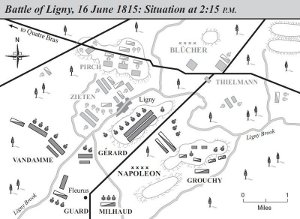
Napoleon saw his only chance as being to strike before the Allies were ready – not that much of a problem, as the armies were moving very slowly. He decided to strike north towards Brussels. His plan was to drive his own army between the British and the Prussians, who were moving to join them from the east. He reasoned that, if he could attack each army in turn, he might be able to defeat both of them although it would be impossible for him to beat them once they had combined. In those days, when battles were generally won by the larger army, (no tanks or airpower to unbalance the straightforward clash of men) this was not a foolish approach. In fact, it almost worked. On 16 June Napoleon's forces defeated the Prussians at Ligny. The Prussians retreated and Napoleon thought that he could now move on the British, who were outnumbered and outgunned and who were relying on Belgian troops of uncertain loyalty. With some justification, he looked on victory at Waterloo as a foregone conclusion. The affair, he is reported to have said, would be like eating breakfast.

In the event, of course, Napoleon lost the day and, in consequence, his throne and his freedom. But was Waterloo, as many people claim, the decisive battle that defined the future of Europe?

The importance of Waterloo to European history seems, at least, to be somewhat overstated.

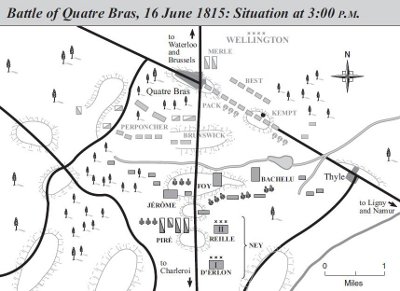
For a start, the most important battle probably took place two days earlier. While half of the French army was defeating the Prussians at Ligny, the other half was bogged down in indecisive fighting at a crossroads called Quatre Bras. Wellington had not been expecting an attack directly up that road and Quatre Bras was defended by a pathetically inadequate force of Netherlanders (made up of Dutch and Belgian regiments) under the Prince of Orange. Although many people nowadays regard the Prince as a fool and his troops as cowards, their determined defence of the crossroads against overwhelmingly superior forces allowed the British to reinforce their position and see the French army off. Napoleon had left the taking of Quatre Bras to his Marshal Ney, a heroically brave figure, but hardly a strategic genius. Ney failed to push through the Prince of Orange's defences when a determined attack would have almost inevitably succeeded. Had he done so, while British forces were still marching south to reinforce the Netherlanders, the French could have stormed north toward Brussels, brushing aside any opposition, which would not have had time to take up a proper defensive position. Brussels would have fallen by the end of the day. Indeed, many people in Brussels were fleeing toward Ghent or Antwerp, convinced that that was exactly what was going to happen. With control of Brussels – the British inevitably retreating along their lines of supply to the West – Napoleon would have succeeded in splitting the two armies and, after Ligny, the Prussians were hardly likely to take him on alone. The Battle of Waterloo, far from being won on the playing fields of Eton (something that, incidentally, Wellington almost certainly never said) was probably won at Quatre Bras.

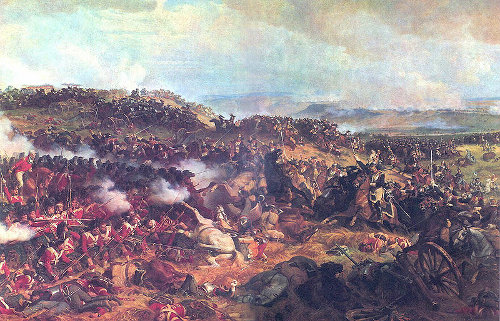
Black Watch at the Battle of Quatre-Bras, 1815
by William Barnes Wollen

The question remains, whether, if Napoleon had captured Brussels, whether by a decisive victory at Quatre Bras or by winning at Waterloo, he could have changed the history of Europe. It seems doubtful. The Prussians, though beaten, were hardly crushed. The Austrian and Russian armies were still ready to fall on Paris from the east. Britain commanded the seas and, if required, could have put another army into the field. Napoleon had united the whole of Europe against him. He was never again going to be able to threaten countries beyond his borders. What a Napoleonic victory might have achieved was to change the future of France. Talleyrand, whose diplomatic genius had served both Napoleon and the Bourbon monarchy, would quite likely have persuaded France's enemies that Napoleon, now reinforced with Belgian troops who would probably have defected back to their old imperial regiments, was best left alone in France. Austria and Russia distrusted each other and the ties between Austria and France (remember that Napoleon's wife was the daughter of the Habsburg Emperor Francis II of Austria) could have been exploited to drive a diplomatic wedge between them. There was, therefore, a small, but real, chance that Napoleon could have been left on the throne in Paris, but with conditions that prevented him from being a threat anywhere else.

Of course, a France under Napoleon might well have served as a rallying point for radical, anti-monarchist factions in other countries – one of the reasons that the Powers would have resisted the idea. The Enlightenment values of Napoleon's rule might have been sustained, his ideas conquering Europe in the same way that his armies had earlier. But this has to be doubtful. Napoleon was, by now, almost as easily identified with the sovereigns he had so affected to despise as with any revolutionary movement. He was in any case a sick man – he was to die six years later – and hardly the energetic genius that he had been at the height of his powers.

It really does seem unlikely that Waterloo changed the history of Europe. It did, however, change the history of Britain. Although Britain in the 18th century was clearly one of the Great Powers, the idea (common amongst Empire enthusiasts) that the British Empire was pre-eminent in an era of colonial expansion is by no means clear. The Napoleonic Wars saw Britain emerge as a leading (in British eyes the leading) European power. Britain was the only country to resist Napoleon throughout the period of conflict. British diplomacy was central to the formation of the many coalitions against France, and British money had financed the wars. Yet direct British military involvement had been mainly limited to the Peninsular campaign. While this had been of crucial strategic importance, it was never the primary focus of the war, and Britain was not among the Powers that fought their way into Paris in 1814. The cataclysmic battle at Waterloo, fought under Wellington as the Allied Commander-in-Chief, left the British convinced of their pre-eminence in Europe, a conviction so strong that it generated its own reality.

Britain never looked at itself in quite the same way again. Waterloo was a powerful symbol of national unity at a time of Corn Law riots and political unrest. The sight of Scots troops fighting so decisively alongside the English led to a new view of Scotland. The Scots had so recently been considered a threat to the Union that the Scots Greys were officially the North British, lest they get ideas about nationhood. Suddenly it was acceptable, even fashionable, to be a Scot. Wellington, now the greatest of British military men, went on to become Prime Minister. There were to be ups and downs in the decades ahead, but Waterloo had both strengthened the unity of the nation and allowed it to accept some of the differences within it.

Scotland Forever! by Elizabeth Thompson

Waterloo also changed the image of the Army. During most of the Napoleonic Wars, and the wars that preceded them, it was the Navy that was, in every sense, the Senior Service. It was the wooden walls that had defended England and saved us from French tyranny. Now, suddenly, the Army took centre stage. The British had long distrusted the standing army, but after Waterloo every soldier was a hero. (It was the first conflict to be commemorated with a medal awarded to all the British participants.) The modern Army has been built on the heritage of Waterloo.

Twentieth century notions of the quintessence of Britishness - coolness under fire, holding firm in the face of overwhelming opposition, even, dare it be said, making a virtue of cobbling together a solution from the limited resources available instead of properly planning ahead - all these things started with images of the Iron Duke and his men at Waterloo and in the days preceding the battle.

Waterloo was - despite its strategic inconsequence - the decisive battle of its age. It defined Britain, it enabled the development of the modern Army and it marked the start of the British Empire. It is unlikely that it had a significant impact on the future of Europe. However those seven hours in June two hundred years ago had an enormous effect on the future of Britain.

~~~~~~~~~~~~~

Tom Williams is the author of the 'His Majesty's Confidential Agent' series, which tells the story of British spy James Burke during the Napoleonic wars. His latest adventure, published by Accent press in May, sees Burke in pursuit of a Bonapartist agent who has tried to assasinate the Duke of Wellington. The story reaches its conclusion on the field of Waterloo.

James Bond meets Richard Sharpe in a thrilling tale set against a detailed historical background. Amazon

When not reading 19th-century books or going to conferences where retired officers talk about *that* battle, Tom enjoys dancing tango and street skating. He also likes to travel and has explored the locations of Burke's adventures in Argentina, Egypt, France and Belgium, which is arguably the best thing about being a writer.

Wednesday, June 24, 2015

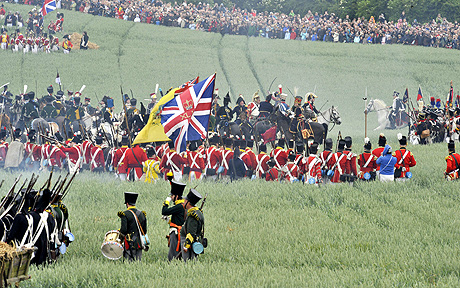
The Battle of Waterloo June 18th 1815

by Richard Denning

The Battle of Waterloo on June 18th, 1815 was the climax to over 20 years of wars that had devastated Europe. It was the moment Napoleon was finally defeated, and it is seen by many as the birth of modern Europe.


Setting the Scene


In my other article on the Battle of Quatre Bras I go into more detail on the origins of this battle. In brief, on returning from exile on Elba Napoloeon had gathered an army of veterans and marched on the combined Anglo Dutch under Wellington and Prussians under Blucher. The allies were positioned in Belgium waiting to attack France. Napoleon did not dance to their tune but attacked them first and drove into the gap between the two allies. On 16th June, at the cross roads of Quatre Bras, the French under Marshall Ney and Anglo Dutch under Wellington were locked into a stalemate battle - neither side being able to send aid to the main battlefield of the day - Ligny. At Ligny Napoleon battered the Prussians and forced them to retreat BUT because Ney had not broken through at Quatres Bras had not had enough troops to crush Blucher.

Retreat

 On the 17th June Wellington was forced to fall back to the position at Waterloo whilst waiting and hoping that the Prussians would also retreat northwards - keeping in contact and able to aid the British. Blucher did this, and as dusk fell on the 17th the scene was set for the battle of Waterloo. Napoleon was conscious that Blucher might try and rejoin Wellington and sent a third of his army under Grouchy to pursue the Prussians with strict instructions NOT to allow that to happen. Blucher left just 1 corps (a quarter of his force) to hold the French at Wavre whilst the other three set off at once towards Waterloo. Their arrival would be critical, as we shall see.

  The Battle of Waterloo

                     
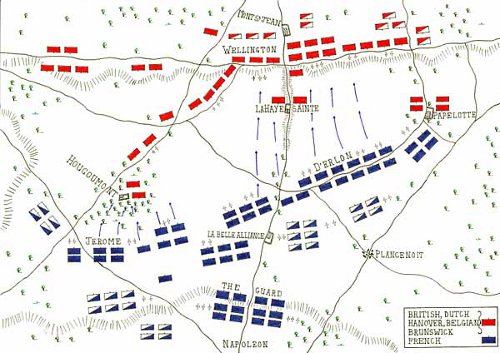
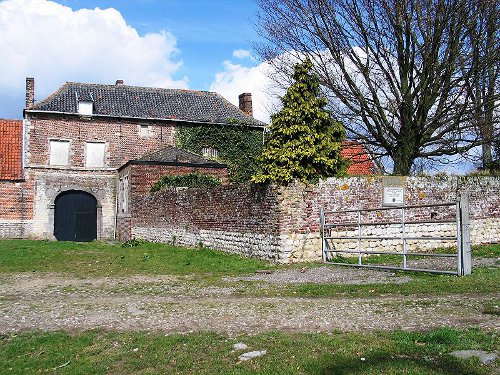
Hearing that Blucher was marching from the village of Wavre (where the Prussians had reached the night before) Wellington deployed his army on the northern side of a valley near a small Belgian village of Mount St Jean just south of the town of Waterloo. Wellington was a genius at the defensive battle and had seen that this location was perfect. The ridge itself would hide his men and forward of the slope there were three strongholds. On his right wing sat the fortress of Hougoumont. Here he deployed some of his guards companies. Covered by woods to the south (in which he placed light infantry) the Chateaux had tall stone walls and thick gates. In the centre of the position was the fortified farmhouse of La Haye Sainte.  To the left were several connected buildings at Papelotte.

11am. The French Attack Hougoumont


Napoleon opened his attacks by sending Reille's II Corps to assault Hougoumont hoping to draw the British away from their left wing where he had prepared a hammer blow. Intended as a diversion, more and more French forces were drawn into the battle around the fortress which caught fire but never fell.

1pm D'Erlon attacks

                        
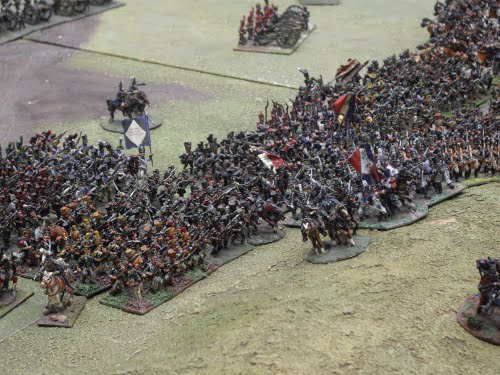
Napoleon now sent forward the 16,000 infantry of D'Erlon's I Corps to try and smash through Wellington's left wing. The French attacked in dense columns and the sight must have been terrifying. But the British had seen this before many a time in Spain and calmly stood up in line, levelled muskets and blasted the French Regiments.

  2PM: Uxbridge Charges


With the French regiments in disarray Wellington committed his heavy cavalry under Uxbridge. Thought to be the finest mounted cavalry in Europe, the Heavy cavalry of the Scots Greys and other regiments thundered through the gaps in British regiments and shattered the French. D'Erlon's men ran, and the horses pursued. BUT they now made the mistake British cavalry always did: they went too far. With cries of 'Tally-Ho' - as if they were hunting fox in Leicestershire they found themselves winded and far away from the British lines when the French lancers caught them and destroyed them.

4pm Ney leads the French Cavalry forward


Around 4pm the British, having repelled the French attack, reorganised their lines and pulled back over the ridge. Napoleon was at this moment ill (he had a stomach ulcer) and Ney who was in charge saw this movement and thought Wellington was retreating. He ordered the entire French Cavalry reserve to attack at once. The charge by the French cavalry at Waterloo would have looked terrifying and magnificent at the same time. Initially 5000 horses charged but when they crested the ridge they found the British were NOT retreating but had formed square - the best defence against cavalry. Scattered like a chess board these squares resisted no less than 12 French charges with as many at 9000 Cavalry at once. The British endured and held on.


4pm The Prussians Arrive

The Prussian's finally started to arrive from about 4pm onwards. Napoleon sent his Guard and a reserve Corps to hold them back. To begin with they defended easily, but more and more Prussians arrived, and gradually the French fell back into Plancenoit. That town fell, and the French used the Young Guard to assault it and recapture it. Things were getting desparate though. Napoleon knew he HAD to break Wellington NOW or lose the battle.


7pm The Guard Attack - final throw of the dice.

"Give me night or give me Blucher" - Wellington at Waterloo (There us a dispute about this prayer - maybe he never said it, but he certainly felt it) Napoleon gathered all his resources. He threw forward a heavy attack to take La Haye Sainte. Then vast clouds of skirmishers supported by artillery and cavalry pounded and pulverised the Anglo-Dutch lines who could do little save stand and suffer. Wellington, trusting that the Prussians would fill the hole, abandoned Papelotte and concentrated all his men in the centre of the line. He held on and endured.

Now was the time for the thunder strike.

Napoleon sent forward his Imperial Guard, veterans of many battles, to assault the British between La Haye Sainte and Hougoumont. These were the men who had conquered Europe, and he needed them to do it one more time. They stomped up the ridge towards the British.

But what was this? The ridge seemed empty.

All they could see was a few officers. Was that Wellington up there on his own?

 This was victory ...this was glory! "En Avant. Vive L'Empereur!"

And then one phrase changed everything. One phrase spoken loud and clear by Wellington: Now Maitland. Now's your time!

One authority had him adding Up Guards, ready.

As one the British Guard's Regiment under Maitland rose from where they were kneeling in the grass. They levelled their muskets and fired. The best marksmen in the world now fired devastating volley after volley. The Imperial guard - never before defeated - wavered, fell back and RAN.

Defeat

With the Middle Guard streaming back from the ridge and the Prussians surging through Plancenoit again, the French morale cracked, and the army started to run. Wellington raised his hat and waved it forward with the words: "The whole line will advance!" The Anglo Dutch and Prussians surged forward, and the French routed, and that was that. Within an area of 2 miles by 2 miles there were 48,000 bodies and the wounded desperately crying for aid.

Wellington and Blucher met at La Belle Alliance
It was Wellington's last battle. It was a bloody and costly battle, but finally Napoleon was defeated.

~~~~~~~~~~~~~

Richard Denning is a historical fiction author whose main period of interest is the Early Anglo-Saxon Era. His Northern Crown series explores the late 6th and early 7th centuries through the eyes of a young Saxon lord.

Explore the darkest years of the dark ages with Cerdic.

www.richarddenning.co.uk


Sunday, June 21, 2015

June 16th 1815 The Battle of Quatre Bras

by Richard Denning

French Lancers charge the Scots at Quatres Bras

A few days ago - The 16th June was the anniversary of the Battle of Quatre Bras. Never heard of it? Well if I mention a more famous battle that happened 2 days later - The Battle of Waterloo - you maybe now understand the campaign that I am talking about.

Waterloo was the climatic battle in the wars that started shortly after the French revolution and ran through the 1790s on as far as 1815. From around 1796 onwards they became increasing focused around the ambition of one man: Napoleon Bonaparte. Napoleon had led a series of Campaigns across Europe and at one point ruled lands from Portugal to Moscow. But of course the disaster of the Russian Invasion in 1812, the unified resistance by Austria, Russia, Prussia as well as the thorn in Napoleon's side Wellington and his campaigns in Spain led to the Emperor's defeat in 1814. He was sent to Elba in exile.

A master piece. Napoleon's grand stategy  was an echo of his brilliance that won at Austerlitz ten years before.

In 1815 he was back from exile and galvanised the French nation once more under his leadership. The Allies knew they had to do something to prevent Europe being plunged into yet more years of warfare and so began to gather in the Low countries and along the Rhine ready to invade France. This process would take weeks - especially for the more distant Russians to arrive.

Napoleon's Plan

Napoleon refused to wait for that invasion. In June 1815 he assembled an army of 100,000 veterans of his wars on the Belgium Border at the city of Charleroi and attacked. He had spotted a flaw in the allied deployment. Wellington's Anglo Dutch Army was arranged in the west of Belgium - west of the Charleroi to Brussels road. Blucher's Prussians (Wellington's ally) had his army to the east of that line. Napoleon realised that if he attacked right down that road on the line that divided the allies he could cause chaos and confusion. Then he would try and destroy the Prussian army whilst keeping the British at bay. Once Blucher was running for Germany he would turn on Wellington.

So on the 15th June Napoleon attacked up the high road. He took the bulk of the French Army with him towards Ligny where the Prussians were gathering. He sent Marshall Ney to Quatre Bras with orders to capture the poorly defended cross roads, hold off any British counter attack and send the bulk of his force along the road to Ligny to fall upon the flank of the Prussians and crush them. If everything went well Blucher's Prussians would be destroyed before Wellington could react. That night Wellington was indeed distracted. He had been invited, along with the bulk of the officers, to a ball in Brussels.

That meant that at the very moment when Napoleon was marching up the road from Charleroi the British were caught entirely off guard. When news reached the ball Wellington was already 18 hours behind the pace of the campaign. He at once sent his officers to gather the men and march on Quatre Bras.

Accompanied by much hysterics and swooning the news arrives that Napoleon has invaded Belgium


The Battle

At the beginning of the battle Marshall Ney had 18,000 men and 32 guns with 2000 cavalry and faced only 8,000 infantry and 16 guns. These allied troops were Dutch regiments, and although they fought well they were forced back towards the cross roads. Fresh British troops started to arrive two hours later as well as Wellington himself who then took command. As the day went on more and more British and allied divisions arrived until at the end of the battle; around 9 pm, Wellington with 24,000 men had a numerical superiority over Ney.

In those 6 hours the battle swung back and forth. The French launched a series of attacks, some of which reached the cross roads only to be forced back by a new allied division arriving and counter attacking. One famous moment was the arrival of the Duke of Brunswick and his black uniformed cavalry complete with death's head symbols on their shakos. Their charge repelled the French once again but at the cost of the Duke's life. Another incident of note was when the Prince of Orange (a young Dutch prince with no battle experience) ordered the British to advance in line even though there were hordes of French cavalry around who promptly charged the British and slaughtered two battalions.


Battle of Ligny

Whilst the battle was raging at Quatre Bras Napoleon had the upper hand at the nearby battle of Ligny. All he needed to complete victory was for Ney to break through at Quatre Bras and send him more troops onto the Prussian Flank. Napoleon even summoned a reserve Army corps under D'erlon to leave Quatre Bras and join him, but just as it was arriving at Ligny Ney ordered it back to Quatre Bras.

So the French missed the opportunity to use D'erlon at either battlefield as it spent most of the day marching around the Belgium country side. Wellington too was unable to help out at Ligny. Blucher had to face Napoleon alone. The French beat the Prussians at Ligny and forced them to retreat, but they had not crushed them. Never the less because the Prussian's were retreating Wellington was obliged to follow suit and spent the 17th June moving his army back northwards. However because the Prussians were able to retreat in good order, Blucher would be able to bring three Army Corps to help Wellington 2 days later at Waterloo.

So who won at Quatres Bras?

In truth both sides claimed a victory and both sides had lost about 5000 men. Ney should have broken through early in the battle, and Wellington was brilliant in defence and held him off but was unable to help Blucher himself. So it was a really a draw. Quatres Bras and Ligny left unfinished business that would only be resolved 2 days later at a battlefield just south of a small town called Waterloo.

One of my areas of interest is the Napoleonic wars. My historical fiction is set at other times, (The Saxon Period and the 17th century), but I find this period fascinating, and I have visited all the battlefield of the Hundred Days Campaign and recommend them. Waterloo in particular is ideal for tourists, but armed with a map and guide you can find much at Quatres Bras of interest.

~~~~~~~~~~~~~

Richard Denning is a historical fiction author whose main period of interest is the Early Anglo-Saxon Era. His Northern Crown series explores the late 6th and early 7th centuries through the eyes of a young Saxon lord.

Explore the darkest years of the dark ages with Cerdic.

www.richarddenning.co.uk


Saturday, April 5, 2014

The Siege of Badajoz ~ 6 April 1812

by M.M. Bennetts

The Peninsular War had been raging for four years--since 1808.  But now it was early 1812, a moment of transition during which Napoleon withdrew over 15,000 troops for his intended invasion of Russia.

Not only that, but from his imperfect understanding of the situation in Spain, the emperor issued very dodgy orders to his Marechals, sending them off in different directions to take on what they were led to believe was a much smaller and disease-weakened British army.

Those orders couldn't have been more wrong or misdirected.

The Duke of Wellington, the Commander in Chief of the combined British, Spanish and Portuguese forces, sensed the tide was turning and moved from his winter quarters in Portugal to take on the two great fortresses which guarded the two main roads into Spain, Ciudad Rodrigo in the north, and Badajoz in the south--known as the keys to Spain.

Ciudad Rodrigo fell to the British on 19 January 1812.

Within days, by the 25th, Wellington was making preparations to move south to take Badajoz--the fortress they'd twice already failed to take.

But upon their arrival before the walls of Badajoz on 16 March, the British troops discovered what Wellington had known since the 6th March, when he had privately reconnoitred there.

Bordered to the north by the raging Guadiana River, the fortress's towering ochre walls and angular bastions--all of them 30 feet high, and all glowing warm and golden in the afternoon sun--were nearly impregnable now, thanks to the work of the French commander, General Armand Phillipon. The western side of the fortress had been heavily mined, the castle to the northeast had been fortified as had the outlying forts to the south (which was now attached to the main defences) and on the north side of the river. 

The eastern side was now virtually impassable due to the damming of a small stream...Not only that, but an additional outwork had been constructed in the south-eastern corner, called Fort Picurina.

It didn't look good.

Still, Wellington had had his 52 iron guns brought up from Elvas, and over 27,000 troops available--though the corps of miners and sappers which he had repeatedly requested from the Government had not been provided. Nevertheless, in the heavy rain of 17th March, at dusk, the siege began, with the British troops digging to open up the first parallel not more than 200 yards from Fort Picurina.  (The many Irish troops viewed the date a good omen.)

The howling of the wind and the heavy rain had drowned out the sounds of the digging, of the picks and shovels, and by morning, the parallel was defensible.

But not for long.

For the French opened up a ceaseless barrage of heavy artillery to pour down on their besiegers. On the 22nd, as the rain fell violently and in torrents, flooding the trenches, the rapidly rising waters of the Guadiana swept away their pontoon bridge, cutting Wellington's army in two.


Unfazed, the British carried on.  And when the weather cleared on the afternoon on the 24th, the French could look down on six batteries of artillery, armed with 28 heavy cannon. The French had nothing more than a few Portuguese-built, ancient brass pieces, used in previous sieges. At 11 a.m. on the 25th, the British guns opened fire on Fort Picurina and at nightfall, the Allies stormed it.

After a long night of fighting, and some 250 casualties (about the same number on both sides) the fort was taken.

Over the next several days, additional batteries were established, and the walls of the fortress were now under the constant fire of Wellingtons' 38 guns.  But Allied casualties were high too.

Then, on the 6th April, Easter Sunday 1812, Wellington was informed that by nightfall, three breaches would be opened up in the fortress's southern sector.  Furthermore, he received news that the French, under General Soult, were stirring in southern Spain, and to the north, Ciudad Rodrigo was in danger too.

Though he might have wished for more time, now it seemed he no longer had that luxury.  The storming was ordered for 7.30 that evening, led by the Light and 4th Divisions.  In the event, it was not launched till 10.00.

It was a launching into hell itself.

Unbeknownst to the British, the breaches had been cleared of the rubble and booby-trapped, mined, laid with trains of powder, and fitted with planks studded with spikes a foot long, and chevaux-frises (iron crows' feet).  The ditches too had been laid with fougasses (small mines) and pitted with mudholes.   The defenders were further armed with hand grenades, incendiaries, and extra muskets.  And across the breaches too were hundreds of captured sword blades--the finest of Toledo steel, sharpened and fastened down with chains. In the fraught silence of that humid night, the troops waited.

Then, a single fire-ball lit the sky, casting its bright light over the scarlet columns of the advancing British and the shadowy hunched figures awaiting them atop the fortress walls.

The first 500 of the 'forlorn hope' stormed forward with their ladders.  An instant later, they were all dead, blown to pieces by exploding mines and powder-barrels rolling down on them from the ramparts.  So too, the second 'forlorn hope'.

Over the next two hours, more than 40 assaults would be launched and driven back under murderous fire and defences, until the ditch--a space of quite literally less than 100 yards across--was filled with the bodies of dead and dying troops, some 2200 men.

As one survivor, William Lawrence wrote:  "I was one of the ladder party...On our arriving at...the wall...a shower of shot, canister and grape, together with fireballs was hurled...amongst us.  Poor Pig [Harding] received his death wound immediately...while I myself received two small...shots in my left knee, and a musket shot in my side...Still, I stuck to my ladder and got into the [ditch].

"Numbers had by this time fallen, but...we hastened to the breach.  There, to our great...discouragement, we found a cheval de frise had been fixed...Vain attempts were made to remove this fearful obstacle, during which my left hand was fearfully cut by one of the blades, but, finding no success in that quarter, we were forced to retire for a time...My wounds were still bleeding, and I began to feel very weak.


"My comrades persuaded me to go to the rear, but this proved a task of great difficulty, for on arriving at the ladders, I found them filled with the dead and wounded, hanging...just as they had fallen...so I crawled on my hands and knees till I got out of reach of the enemy's muskets."

George Simmons of the Light Division wrote:  "Our columns moved on under a most dreadful fire...that mowed down our men like grass...Eight or ten officers and men innumerable fell to rise no more.  Ladders were resting against the counter-scarp...Down these we hurried and...rushed forward to the breaches, where a most frightful scene of carnage was going on.  Fifty times they were stormed, and as often without effect, the French cannon sweeping the breaches with a most destructive fire."

Other combatants wrote of how some 21 officers of their regiment were either killed or wounded or how upon reaching the heights their fellows were pushed back to fall onto the bayonets of their comrades below. 

By midnight, the night air laden, clotted with cordite and gunpowder, the thunder and shrieking of artillery and the screaming cries of dying men, it appeared that all was lost.

Setting his face though, Wellington sent orders to General Picton to lead one final assault to storm the Castle in the north-east corner. It succeeded.  And although Picton himself was wounded, his men of the 3rd Division gained a foothold.

Furthermore, to the north-west, the 5th Division managed to scale the walls, and running through the town, attacked the French defending the breaches from the rear.

Resistance collapsed.  The French garrison were forced to lay down their arms.

The British and Portuguese troops who now flooded the streets of the city exacted a terrible revenge for the butchery of the past hours.  Maddened with drink, frenzied with rage over the hideous loss of so many of their comrades there and at Ciudad Rodrigo, wild with vengeance, they pillaged, raped and murdered in the worst atrocity committed by Wellington's troops during the whole of the Peninsular Campaign.

It was not so much a sacking--which the then 'rules of war' deemed appropriate or at least understandable after such a siege of enormous cost--but a mutiny.

As Robert Blakeney wrote:  "There was no safety for women even in the churches, and any who interfered or offered resistence were sure to get shot.  Every house presented a scene of plunder, debauchery and bloodshed committed with wanton cruelty...When the savages came to a door which had been locked or barricaded, they applied the muzzle...of a dozen firelocks...and fired them off together into the house and rooms, regardless of those inside...Men, women and children were shot..."

Officers who tried to control their men were themselves shot. On the morning after the siege, Wellington visited the dead and at the sight of so many of his men, and his friends, destroyed--nearly 5000 of them--he broke down and wept  in front of his astonished staff.

Still weeping, he returned to his tent and wrote to the Minister for War in London:  "The capture of Badajoz affords as strong an instance of the gallantry of our troops as has ever been displayed.  But I greatly hope that I shall never again be the instrument of putting them to such a test..."

He also issued a General Order that "It is full time that the plunder of Badajoz should cease..." 

Unwisely, the drunken troops ignored his order.

So on the next day, the 8th, the Bloody Provost was sent in to stop their 'enjoyment' by erecting a gallows and overseeing the flogging of many. It was a terrible aftermath--so terrible that when the reports became public in London, there were those MPs who, appalled by the ruination and damning dishonour, demanded an end to all British involvement on the Peninsula.   

Yet, through the sacrifice of so many, Spain was now open to the Allied troops.  And from this position of strength, they would defeat the French and force them out of Spain, and would eventually advance all the way to Paris and an end to the Napoleon's domination of Continental Europe.

(And yes, Jane Austen knew...)

~~~~~~~~~~~~~~~~~

M.M. Bennetts is a specialist in early 19th century British and European history and the Napoleonic wars and is the author of two novels, May 1812 and Of Honest Fame set during the period.  A third novel, Or Fear of Peace, is due out in 2014.

For further information, please visit the website and historical blog at www.mmbennetts.com

Tuesday, March 4, 2014

Juana Smith: After Waterloo

by Lauren Gilbert

One of my favourite true romances is the love story of Harry Smith and Juana Maria de Los Dolores de Leon. Their meeting after the fall of Badajob in 1812, when Harry was 24 and already a seasoned military veteran and when Juana was 14 and only recently out of a convent school resulted in a wedding 2 weeks later, with Wellington giving the bride away.

Juana followed the drum, staying with Harry as he fought his way through the Peninsular Wars until Bonaparte’s abdication in 1814. They were separated almost immediately when Harry was sent to America during the War of 1812 (he was there from April of 1814 until March of 1815, while she waited for him in England). He returned to England just in time to be sent to the continent following Napoleon’s escape from Elba, and Juana went with him. The climax of the story would seem to have been Waterloo, with the lovers reuniting after the battle.

If you have not already read their story thus far, you can read it in detail in THE AUTOBIOGRAPHY OF LT. GENERAL SIR HARRY SMITH BARONET OF ALIWAL ON THE SUTLEJ G.C.B., edited by G. C. Moore Smith, MA. which was first published in 1901 (it is available online, in print and as an e-book). Their love story is also referenced in John Kincaid’s memoirs, and is the subject of Georgette Heyer’s novel, THE SPANISH BRIDE. Although their romantic marriage and early married life is a wonderful story, what happened to them after Waterloo? For many soldiers, the end of the Napoleonic Wars marked the end of their careers. As with so many great stories, my question was, “What happens next?”

Harry was an ambitious man, with a fierce desire to succeed and advance in his chosen career, the Army. Juana had literally grown up in the Army, with Harry as much her commanding officer as her husband. This is hardly a combination that would result in a return to a quiet life in England for them as a couple. Juana seemed to have lost contact with any surviving family members in Spain, and despite having established an affectionate relationship with Harry’s family, had no reason to want to be in England without him. Their nearest and dearest friends, including 2 of Harry’s brothers, were in the military. So their peripatetic life continued...

Then a major, Harry was appointed by General Lambert to be the Town Major in Cambrai, France after Waterloo, in 1816, with an improved pay rate. He and Juana established a busy life, maintaining their friendship with Wellington, who maintained an interest in Harry’s career. They hunted, went to balls, and were favourites at official functions, apparently enjoying an active (and expensive) social life. The occupation ended, and they returned to England in October of 1818.

Before their return, in an effort to recoup some money, Harry decided to raffle his horse Lochinvar. Tickets were sold (including one purchased by Juana) and, much to everyone’s surprise, Juana’s ticket won.

Once returned to England, Harry was assigned to Glasgow in 1819 because of mob activity in the north, and Juana accompanied him. They were in Scotland until 1825, when Harry was posted to Ireland. However, that stay was fairly brief as in September of that year, Harry was ordered to Halifax Nova Scotia, commanding 2 ½ companies of his regiment. By all accounts, Harry and Juana had fun in Nova Scotia enjoying their usual active life among the military, even though money was short.

In November of 1825, they relocated again, to Jamaica, where Harry was to assume the rank of Lieutenant Colonel and serve as Deputy Quarter Master General. Right after they landed at Kingston, Jamaica, Harry was confronted by poor management and a yellow fever epidemic. During her time with the army in the Peninsula, Juana had learned to deal with issues of illness and injury, and accompanied Harry in his efforts to combat the disease, establishing convalescent camps. After a year, the epidemic was over, and Harry and Juana were happily settled in a home in the mountains.

However, because of his success in Jamaica, Harry was ordered to be Deputy Quarter Master General at the Cape of Good Hope, in South Africa in 1829. (They did take an opportunity in route to visit Harry’s famiy before continuing on.)

Once they arrived at the Cape of Good Hope, they again settled into a comfortable home and an active life with hunting, visiting and social events with friends in a fairly peaceful fashion until 1834. However, Harry was occupied with civil as well as military responsibilities.

On January 1, 1835, because of an uprising of the Kaffir tribes, Harry had to leave for Grahamstown, 600 miles away. A serious and dangerous situation, Harry still made time to write to Juana every day of what turned into a long separation. While Harry was away, Juana was kept busy with friends, attending balls and other social affairs, teaching in a school for African girls, and other civic activities. She also joined the Church of England.

During the time of their separation, Harry suggested she write down their story and would not hear of her joining him. Largely because of Harry’s efforts and successes, peace was finally restored, and Harry was put in charge of the newly- created Adelaide province and Juana was able to rejoin him in June of 1835. Although at peace, the area was still unsettled, and Juana was able to assist Harry by trying to influence Kaffir women.

Despite his apparent successes, Harry was removed from his post in Adelaide Province in 1837, which could have been a career disaster, but the Duke of Wellington’s influence resulted in Harry’s appointment as Adjutant General in India. After a stormy voyage, in June of 1840, the Smiths arrived in Madras, and went on to Calcutta, to be greeted by old friends and acquaintances. Although Harry was not immediately comfortable with Sir Jasper Nicholls, the commander in chief, Juana made friends with Sir Jasper’s daughters. A significant advantage to India was the ability to live a comfortable life on less money; another was the possibility of advancement.

At this time, India was embroiled in conflict with Afghanistan. This as a volatile and dangerous time; hostages were taken and unrest made many things difficult. In December of 1843, the British decided to attack at Maharajpore. The army was accompanied by Juana and several other officer’s wives riding on elephants. The ladies came under fire, but apparently escaped unscathed, and Juana received a special medal for bravery from Queen Victoria. The battle won, the Governor General ordered medals made from the captured canons, one of which was awarded to Juana. Harry also had a special gold star brooch made for her.

In 1845, the Sikh wars began and Harry was given command of the 1st Infantry Division. Harry was heavily involved in the action through 1846 until final success. Juana could not be with him on this campaign, and for at least part of the time was ill with a tropical fever. Because of his valor and success, Harry was awarded a baronetcy, made a Knight of the Grand Cross of the Order of the Bath and received great acclaim.

Finally, after 18 years away, they were allowed to return to England. On arrival in Southampton in April of 1847, Harry and Juana were welcomed by crowds and taken to London in a private train. Harry was heaped with honors, and they were able to attend a dinner for veterans of the Light Division, a detailed report of which was written up in the Times. Juana also came in for her share of acclaim. At this time, Harry was 60 and Juana 49 years old. They returned to Harry’s famiy home in Whittlesey for a time.

In Glasgow, Harry was invited to become Member of Parliament (an unpaid position at that time). Despite the title and acclaim, the financial aspect of his success was less than satisfactory. Again, Wellington’s influence helped, and Harry was appointed governor of the Cape of Good Hope and awarded the rank of Lieutenant General. Between his military successes in India, and subsequent vindication of his previous policies in Africa, Harry (who had stayed current with affairs in Africa) seemed the obvious person to replace the current governor. Finances resolved, Juana, now Lady Smith, embarked with Harry on September 24 1847 for Cape Town.

Circumstances in Africa were not what they were during the Smiths’ previous stay, and Harry was no longer an impetuous youth, but a rather arrogant, bad tempered and impetuous older man without a commanding officer to keep him grounded. He managed to offend native chiefs and local people with aggressive policies and over estimated his own influence with the Boer settlers. A military action against the Boers was successful, although Harry was wounded. (Juana was awarded a pension of 500 lbs per year by the queen.)

After Harry returned to Cape Town in Oct. 1848, Juana was relieved of anxiety and ready to take part in social activities. Unfortunately, her Spanish formality and fondness for Spanish fashions and colourful fabrics was not admired. Juana and Harry also caused some concern in the conservative community as Harry was perceived as dangerously tolerant while Juana, in an effort to reach out to the Indian and Malay communities, attended some displays of local dancing that was considered unacceptable.

At the same time, they were faced with the prospect of Cape Colony receiving convicts due to a shortage of prisons. The local settlers were, of course, opposed to this, and Harry and Juana sympathized with them. In spite of everything, a ship was sent to Bermuda to pick up prisoners to take to Cape Town. Although Harry wrote repeatedly to prevent this, the ship arrived and was anchored off shore. Although the ship was ultimately sent on to Tasmania, the entire episode was a severe strain on both Harry and Juana. Subsequent unrest and disastrous policies resulted in both of them suffering ill health and a loss of popularity, as well as severe political unrest and division. Harry was dismissed from his position in March of 1852. Harry was ill when they left Cape Town, and Juana cried as they boarded ship to return to England.

Once back in England, they did not resign themselves to a quiet life, and once again, the Duke of Wellington's influence helped. Harry had subsequent appointments, including one as a delegate to Lisbon to invest Don Pedro V with the Order of the Garter when Don Pedro married Princess Stephanie. He and Juana attended the festivities at Buckingham Palace for the princess on her way to Lisbon. In September 1859, Harry left his last post, which was in Manchester, and the Smiths moved to London. Although he continued to write, offering himself for other posts, none were forthcoming and he died Oct 12, 1860 at age 73.

Juana lived on, cared for by family and friends, until her death Oct. 10, 1872. She was buried in Harry’s tomb at St. Mary’s in Whittlesey, as Harry had wanted. In spite of many ups and downs, financial worries, and political disasters, I think it can be truly said that Harry and Juana Smith truly achieved the happy-ever-after ending in spite of having no children. She experienced his life with him. They were devoted to each other their whole lives. Juana Smith travelled the world with her beloved husband, and was allowed to take part in events that most women of her time could hardly have imagined. The township of Windsor in South Africa was renamed Ladysmith for her in 1850. As a couple, they seemed to live a charmed life, surviving multiple hardships and disasters together.


Sources include:

The History Blog. “Sir Harry and Lady Smith.” By Megan Abigail white, posted March 17, 2010. http://meganabigail.blogspot.com/2010/03/sir-harry-and-lady-smith.html

Look and Learn History Picture Library. “An unlikely love story set against the backdrop of the Peninsular War.” Posted June 5, 2013 (from an article published June 3 1967). http://www.lookandlearn.com/blog/24858/an-unlikely-love-story-set-against-the-backdrop-of-the-peninsular-war

Peterborough Telegraph. “IN FOCUS: Wild about Harry-the hero of Aliwal-and Juana, his teenage Spanish bride.” Posted Aug. 26, 2004. http://www.peterboroughtoday.co.uk/news/local/in-focus-wild-about-harry-the-hero-of-aliwal-and-juana-his-teenage-spanish-bride-1-150736

Rooney, David & Scott, Michael. IN LOVE & WAR The Lives of General Sir Harry Smith and Lady Smith. 2008: Pen & Sword Military, Barnsley, South Yorkshire.

Of course, Harry Smith’s autobiography is also a must-read.

~~~~~~~~~~~~~

Lauren Gilbert lives in Florida, with her husband. Her first novel was published in 2011, and a second one is in process.