Showing posts with label King Aethelred. Show all posts

Friday, July 22, 2016

Military Service in Tenth-Century England

By Annie Whitehead

Last week I posted about duties and obligations in tenth-century England. This week I’m concentrating on military service.

Aethelred II (Unready)

Land granted by the king was known as ‘bookland’ and was absolved from all service with the exception of three. According to a grant by King Edgar [1] those three things were fixed military service, the restoration of bridges, and of fortresses. A grant by Aethelred II [2] calls for national military service, the construction of fortresses and the restoration of bridges. The Thegn’s law [3] tells us that:

“He be entitled to his book right, and that he shall contribute three things in respect of his land: armed service, and the repairing of fortresses and work upon bridges. Also in respect of many estates further services arise on the king’s order, … equipping a guardship, and guarding the coast, and guarding the lord, and military watch …”

The king was prepared to grant away rights privileges but not, it seems, his right to military service. The exact nature of the service is not stipulated, but it must have been important. Archbishop Wulfstan and Aelfric the Homilist divided Anglo-Saxon society into three orders: those who fight, those who labour, and those who pray. This would mean that the aristocracy was a warrior class. The nobility was required to provide military equipment [4] and there can be no doubt that a substantial part of their service was of a military nature.


Just as the heriot (war gear) varied according to rank, so the military service requirement differed for men of varying resources. The king had at his disposal his household troops.* Mercenaries were employed, (the career of Thorkell the Tall is evidence of this) but in essence the composition of the fyrd was based on a territorial levy. The requirement was for one man from every five hides of land. Service was basically for sixty days, in a system of rotation, but only in times of war. The Anglo-Saxon Chronicle entry for 920 tells us that “when this division of the English levies went home, the other came out on military service and occupied the fortress at Huntington.” [5] A landowner with more than five hides of land would be responsible for providing the requisite number of men.

A fine was payable for neglect of military service, and this ‘fyrd-wite’ was set at around forty shillings per man. Commutation, a payment in lieu of service, was lower, at around twenty shillings per obligation. A thegn liable to service could have his lands confiscated if he defaulted. [6] This did not necessarily mean that a thegn had to fight. He could send the required number of men without going himself; he would still be fulfilling his obligation.

Mention is made of two types of fyrd (army), the select fyrd and the gelect fyrd. The distinction between the select fyrd and the great fyrd might have been thus: the select fyrd consisted of soldiers who fought in battle, and the great fyrd may have been the back-up, repairing bridges and fortresses. [7]

The expensive equipment of the ealdormen, king’s thegns and the lesser thegns would have set the aristocracy apart from the ordinary fighting ceorl. The Battle of Maldon describes the ornate trappings of a nobleman in battle:

“An armed man then went to the Earl,
Wanting to strip him of his armbands, armour,
Ring-mail and ornate sword.”

Site of the Battle of Maldon - Ken Eckert 

Clearly the nobility who fought did so with expensive war gear, but to fight was not their only obligation. As landlords, they were responsible for the organisation, summoning and assembling of the fighting forces. They were also involved in the essential organisation to ensure that competent levies turned out to perform military duties on behalf of their estates.

The military crisis precipitated by the resumption of  Danish raiding served to place emphasis on the fighting role of the thegn. But was the aristocracy a warrior class?

Their military equipment set them apart in wealth and status from the rank and file, and their bookland was held from the king immune from all except military service. Yet if this was a warrior aristocracy one would expect to see them holding their land as a reward for military service, and their status deriving from their military rank. This was clearly not the case; that land was not held as reward for military service is a major stumbling block for any historian trying to prove that pre-Conquest England was feudal.

Land was granted for many reasons. King Aethelred II granted Aethelwig land because he did not wish to sadden him. [8] Apart from his being a servant of the king there seems to be no other reason for the grant. A ceorl could amass all the weapons of a thegn and still remain a ceorl if he did not possess five hides of land. [9] Land remained the source of wealth and the indicator of status. Military service was an important part of a nobleman’s duties, but, as we have seen, it was only one of many. [10] One might also expect that in times of peace less emphasis would be placed on the thegn as a warrior than in times of war.

*During the time of Cnut, the household troops were referred to as housecarls. Cnut’s reign was not in the tenth-century, though, and Nicholas Hooper’s article [11] provides, for me, compelling argument to suggest that the housecarl differed little from the English thegn.

[1] Grant by King Edgar to his thegn Aelfwold 969 EHD (English historical Documents) 113 p519
[2] Grant by King Aethelred to his thegn Aethelwig 992-995 EHD 117 p525
[3] Origins of English Feudalism 61 p145 “The Rights and Ranks of People”
[4] For more on this, see my article on Defining the Nobility in Later Anglo-Saxon England
[5] Anglo-Saxon Chronicle (A) 921 (920)
[6] This point is discussed by DJV Fisher in the Anglo-Saxon Age Ch13
[7] See Warren hollister, Anglo-Saxon Institutions. There is also a possibility that the Select fyrd served locally, and that the Great fyrd was the national army
[8] EHD 117 p525
[9] See HR Loyn The Governance of Anglo-Saxon England p167
[10] See last week’s article on duties and responsibilities HERE
[11] The Housecarls in England in the Eleventh Century - N Hooper

Further General Reading:
The Foundation of England - HPR Finberg
The Beginnings of English Society - D Whitelock
Anglo-Saxon England - FM Stenton
From Roman Britain to Norman England - PH Sawyer

(Above illustrations - public domain unless otherwise accredited)

Annie Whitehead is a history graduate and prize-winning author. Her novel, To Be A Queen, is the story of Aethelflaed, daughter of Alfred the Great, who came to be known as the Lady of the Mercians. It was long-listed for the Historical Novel Society’s Indie Book of the Year 2016 and has been awarded an indieBRAG medallion. Her new release, Alvar the Kingmaker, which tells the story of Aelfhere of Mercia, a nobleman in the time of King Edgar, is available now. A collaborative project, re-imagining the events of 1066, is also available to pre-order. 1066 Turned Upside Down
Annie's Author Page
Buy Alvar the Kingmaker
Buy To Be A Queen

Annie's Website
Annie's Blog

Saturday, July 16, 2016

Duties and Obligations in Tenth-Century England

By Annie Whitehead

Placing oneself under the protection of a lord was a solemn and ceremonious affair. In England it took the form of a hold-oath, or fealty oath. The physical act of bowing was accompanied by the oath:

“By the lord before whom this relic is holy, I will be to N [name of lord] faithful and true, and love all that he loves, and shun all that he shuns, according to God’s law, and according to secular custom; and never, willingly or intentionally, by word or by work, do aught of what is loathful to him, on condition that he keep me as I am willing to deserve, and all that fulfil that our agreement was, when I to him submitted and chose his will.” [1]

Essentially this is a negative commitment, a promise not to act against the lord’s interests. Nevertheless, a personal bond of this nature carried with it certain positive obligations.

For the king’s thegn, lord and king were the same person. A thegn whose lord was not the king still had a duty to the monarch. (It should be remembered that the king’s title was “Cynehlaford” or lord-king.) Thegns in turn would have men who called them lord. The role of lordship entailed a dual responsibility, that of serving one’s lord, and that of protecting one’s men.

The king with his witan
The king was ever mindful of the need to control his ealdormen. Their attendance at the royal council was one way of ensuring their co-operation, and failure to attend a summons to the witan was punished severely. The witan had the right, rather than the privilege, to advise the king, and at times it acted on its own; following the death of a king the election process for his successor was carried through in the witan. It was in the royal council that the laws were promulgated. Its members met indoors, and the Anglo-Saxon Chronicle tells how, in 978, “the leading councillors of England fell down from an upper storey at Calne, all except the holy Archbishop Dunstan, who alone remained standing on a beam.” [2] Business transacted in the witan included general, financial and judicial matters. Essentially though, its function was of a deliberative and consultative nature.

Saint Dunstan

The test of royal authority is how effectively it is felt in the localities. The law codes abound with directions to individual ealdormen to ensure that laws are enforced. King Edgar commands that:

“Earl Oslac and all the host that dwell in his aldermanry are to give their support that this may be enforced” and that “Many documents are to be written concerning this, and sent both to ealdorman Aelfhere and ealdorman Aethelwine, and that they are to send them in all directions, that this measure may be known to both the poor and the rich.” [3]

King Edgar

There is some evidence to suggest that the ealdormen disliked the king’s reeves (administrative officials.) A breach of the law by a reeve could only be dealt with by the king [4] and when Aethelred II adopted the policy of appointing reeves instead of ealdormen, the Anglo-Saxon Chronicle tells us that in 1002 Ealdorman Leofsige slew Aelfric, the king’s high-reeve. The grant of Aethelred’s explains why these men were disliked. The reeve broke the law by giving Christian burial to those who had forfeited the right. Instead of punishing him, Aethelred granted the reeve their land. To the ealdormen it must have seemed that the reeves were above the law.

Naturally the king’s officials were instrumental in the enforcement of law and order, and their duties included presiding over the shire and hundred courts. The hundred ordinance [5] directs that the hundred court is to meet every four weeks. II&III Edgar acknowledges this and states that the borough court is to be held three times a year and the shire court twice a year. It also succinctly sets out the duty of those presiding over the courts:

“And the bishop of the diocese and the ealdormen are to be present, and there to expound both the ecclesiastical and the secular law.” [6]

The shire court was unspecialised in the tenth-century, and did not develop into a full royal court until after the Norman conquest. It had a variety of functions, including procedures in outlawry. [7] It was here that arrangements were made for the collection of taxes. It was in the interests of landowners to be represented, and the shire-reeve gradually became recognised at the chief executive royal officer.

The hundred court met on an appointed day, and anyone who failed to appear had to pay thirty shillings compensation. Each man was to do justice to another. Great concern was shown over theft. Compensation had to be paid to the victim; half of the offender’s remaining property went to the hundred, and half to the lord. Aethelred II’s reign saw an emphasis placed on the importance of oath-taking, and the origins of the jury of presentment.

“The twelve leading thegns are to come forward and swear on the relics … that they will accuse no innocent man nor conceal any guilty one.” He who pronounced a wrong judgement could forfeit his thegnly status, and “A sentence where the thegns are unanimous is to be valid.”

The importance of all courts was to provide a place where good witness could be obtained. King Edgar ordered thirty-six witnesses in each borough, and twelve in each hundred. [9]

Aethelred II

By the middle of the tenth-century it was becoming customary for lords, ecclesiastical or lay, to receive grants of jurisdiction from the king. Many hundreds fell into private hands; a lord often had considerable rights here and in his own lands. The grants were usually laid down in the charters as rights of “sake and soke”, these being rights of jurisdiction and to the profits of justice.

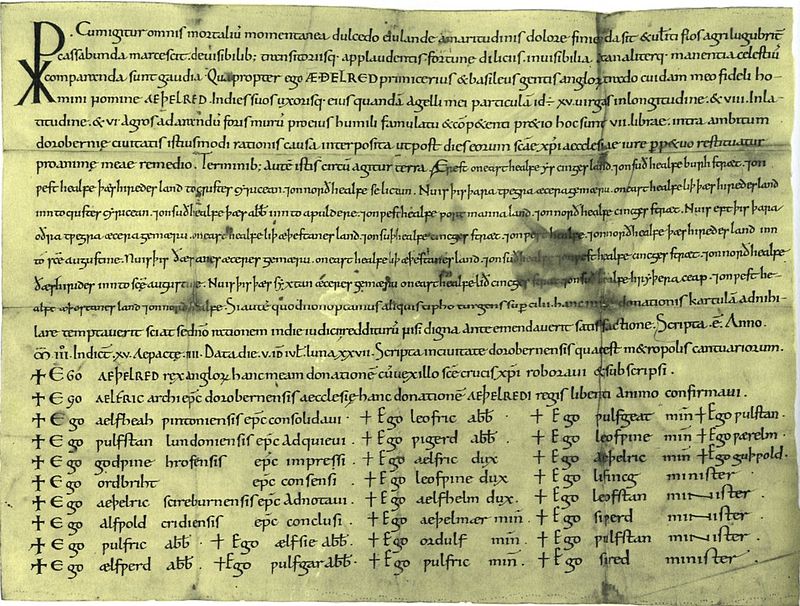
A charter of Aethelred II
This usually meant the control of a court. These rights were not granted lightly, and were really intended to emphasise royal authority rather than to weaken it. Grants of rights over a hundred court involved financial advantages, and the right to appoint hundredmen. HR Loyn suggests that the sheriffs (shire-reeves) played an important part in preventing the disintegration of royal power as private jurisdiction grew. [10] Landowners exercised other specific rights on their estates. They had a right to impose a toll on goods sold within the estate, the right (known as Team) to supervise the presentation of convincing evidence that goods for sale belonged to the vendor, and the right (infangenetheof) to hang a thief caught on the estate.

The nobility served the king, and were granted lands and privileges as a reward for that service. As lords they could expect service from their own men, and in turn they had a duty to protect those who called them ‘lord’.

(Next week - the obligations of military service)

[1] Origins of English Feudalism 59 p145 - Of Oaths (c.1920)
[2] Anglo-Saxon Chronicle (E) 978
[3] IV Edgar 15. & 15.1
[4] EHD (English historical Documents) 117 p525
[5] This document is often called I Edgar, but was possibly written before Edgar’s reign. It was definitely in existence during Edgar’s reign.
[6] II&III Edgar 5.2
[7] HR Loyn - The Governance of Anglo-Saxon England p138
[8] III Aethelred 3.1 & 13.2
[9] IV Edgar 4. & 5.
[10] HR Loyn Op Cit p163. By 1086 approx. 130 hundreds were in private hands.

All images used above are copyright free in the Public Domain


Annie Whitehead is a history graduate and prize-winning author. Her first novel, To Be A Queen, is the story of Aethelflaed, daughter of Alfred the Great, who came to be known as the Lady of the Mercians. It was long-listed for the Historical Novel Society’s Indie Book of the Year 2016. It has recently also been awarded an indieBRAG medallion. Her second novel, Alvar the Kingmaker, tells the story of Aelfhere of Mercia, a nobleman in the time of King Edgar, and his battle to keep the monarchy strong and the country at peace, when successive kings die young. It features the swearing of the hold oath and the collapse of the witan building at Calne.

Find her on her author page Here
Buy Alvar the Kingmaker
Buy To Be A Queen
Annie's Website
Annie has also been involved in a collaborative e-book project re-imagining the events of 1066

Monday, May 30, 2016

Wealth, Power and Influence in Later Anglo-Saxon England

By Annie Whitehead

The great magnates of Anglo-Saxon England were not poor men. Land has always been the most recognisable sign of wealth, and these men had plenty of it. The amount of land which a pre-Conquest nobleman could amass can be seen clearly in the case of Harold Godwineson. [1] As well as their own family lands, such men could hold land from their lord as reward for service. Bookland, as it was called, was originally granted by the king to his thegns with an ecclesiastical purpose in mind. By the tenth-century, however, land was being booked without any pretence that it would go to endow a church. Many thegns and ealdormen were benefactors of religious houses though - Wulfric Spott founded Burton Abbey, Athelstan 'Half-king', ealdorman of East Anglia 932-956, used his wife's lands to form the nucleus of the large endowment of Ramsey Abbey, [2] and Aelfhere, ealdorman of Mercia 956-983, cited in the Anglo-Saxon chronicle as the destroyer of monasteries, [3] was a great friend to the religious houses at Glastonbury and Abingdon.

Dunstan - one-time abbot of Glastonbury

The nature of the land grants varied little, and each one set out the conditions under which the land was booked. King Edgar granted to his thegn, Aelfwold, land at Kineton in Warwickshire as

"an eternal inheritance ... and after the conclusion of his life (he may) leave it unburdened to whatsoever heirs he shall wish. Also the aforesaid estate is to be free from every yoke of earthly service except three, namely fixed military service and the restoration of bridges and fortresses." [4]

It was not only the king who granted land. Oswald, bishop of Worcester, sets out the conditions under which he has granted his land in his letter to King Edgar. [5]

"That they shall fulfil the whole law of riding as riding men should and that they shall pay in full ... church Scot and Toll. In addition they shall lend horses, they shall ride themselves, and, moreover, be ready to build bridges, ... they shall always be subject to the authority and will of that archiductor who presides over the bishopric..."


King Edgar

The will of Wulfric Spott [6] is a fine example of the extent of lands in the possession of an influential thegn. He had lands in Staffordshire and Derbyshire, estates in Shropshire, Leicestershire, Nottinghamshire, Warwickshire, Gloucestershire, Lincolnshire and South Yorkshire. The will also refers to lands in South Lancashire and Cheshire.

The family of Wulfric Spott was one of the most influential and powerful of its day, with branches linked to the royal family and a regular involvement in power struggles and political rivalry. Wulfric Spott's brother, Aelfhelm, ealdorman of Northumbria, was murdered in 1006, and his sons Wulfheah and Ufegeat were blinded. Wulfheah was one of the prominent ministri during the period when Aethelred II (Unready) was restoring royal favour to the Church (see below).

It is easy to believe that Eadric Streona, ealdorman of Mercia 1007-1017, was Aelfhelm's murderer. His rise to power certainly would not have been hindered by the removal of such prominent men who had surrounded the king. The rivalry does not seem to have stopped there, for Eadric is named as the murderer of the thegns Sigeferth and Morcar.

These brothers were members of this same family; Morcar was married to Wulfric Spott's niece. There is a possibility that they were related to King Aethelred through his marriage to the daughter of Thored of Northumbria.

Vacillating between the causes of Edmund Ironside and Cnut in the war of 1015-16, Eadric was playing a dangerous game. Edmund had defied his father, Aethelred II (Unready), and married Sigeferth's widow, thereby gaining the allegiance of the northern Danelaw. Cnut's English wife, Aelfgifu of Northampton, was the daughter of the murdered Aelfhelm, and the cousin of Ealdgyth, Morcar's widow. It is also possible that this family was connected to that of Leofwine, who held Eadric's ealdordom after the latter's death. His son succeeded him, and his son Aelfgar married Aelfgifu who may have been the daughter of Ealdgyth and Morcar. So far, so confusing!

Encomium Emmae Reginae 
But the Encomium Emmae Reginae shows us how important this family really was. It was written for Cnut's second wife Emma, as a propaganda exercise for the claims of her son Harthacnut, and in Book III it denies that Harald is Cnut's son. This in itself is not enough to refute Harald's claims, and the Encomium further denies that he is Aelfgifu of Northampton's son. Clearly his position as her son is important. If Emma denies that he is of this family, then she is not attacking them. The importance of Aelfgifu's kinship is clear, and Emma does not wish to offend this great family.

Cnut with his sons Harald and Harthacnut


A simple equation which has always held true is that wealth equals power. King Aethelred II was called 'Unraed' because he was badly counselled. It is certainly true that for much of his reign he was guided by councillors acting in their own interests. The 980s were a period which Aethelred came later to regret. Many churches were deprived of their lands; an Abingdon estate was acquired by a king's reeve, and Rochester was besieged. Aethelsige, one of the five most prominent men at this time, was responsible for the damage done at Rochester. The king himself admitted that this was a period when he was being manipulated by a group of men who, taking advantage of his youth, were acting in their own interests at the expense of various churches. In the next decade the prominent men were associated with the monastic cause and royal generosity to the Church was re-established.

The king needed his councillors and officials. He rarely acted without the consent of the witan (council). Royal authority could only be made to be felt throughout the kingdom through the king's representatives. Yet it was all too easy for these men to become too powerful. The king rarely strayed from the south, and to the inhabitants of England north of the Humber, royal authority was remote.

Northumbria was never free from the Scandinavian threat, and the eorls (as they were called in the north) often had to deal with this problem on their own. It must have been difficult to trust them, but many thegns were encouraged to acquire estates in areas settled by the Danes, to help break down the isolation of the north. Another policy instigated was that of appointing archbishops to York who had sees elsewhere. This pluralism was designed to ensure ecclesiastical loyalty, and would also help to bring Northumbria out of isolation. Royal control was difficult to establish in areas with separatist feeling, and Mercia was another of these areas. The ealdormen, if they wished to assert themselves, had to establish links in order to gain and retain control, and at times this must have looked suspiciously like treachery. Poor communications also did nothing to alleviate the danger of an over-concentration of power in too few aristocratic hands.

Aethelred II

During the reign of King Alfred, ealdormen usually controlled single shires, but as the West Saxon kingdom expanded the ealdormen were given greater responsibility. Athelstan of East Anglia's nickname 'Half-king' demonstrates how powerful these men could become. His ealdordom included East Anglia proper (Norfolk and Suffolk), Cambridgeshire, Huntingdonshire, north-east Northamptonshire, and he probably governed the whole of the eastern Danelaw. [7]  He kept his ealdordom under such control that Kings Edmund and Eadred were able to recover first the northern Danelaw, then Northumbria, and finally to conquer Strathclyde.

It is not surprising to discover that men like these did not always work together in complete harmony. The anti-monastic reaction which followed the death of Edgar in 975 found ealdormen Aelfhere and Aethelwine on opposing sides in the succession dispute. Doubtless Aelfhere was antagonised by the triple-hundred of Oswaldslow which had encroached upon his area of authority, but it has been suggested [8] that he had other, more personal reasons for opposing Aethelwine's and Dunstan's support of Edward; namely that Aethelwine's ealdordom was East Anglia, and this meant East Anglia proper, Essex, and the shires which had at one time been the eastern part of the old kingdom of Mercia, and were still called Mercian in the tenth-century. Aelfhere, Aethelwine and Eorl Oslac of Northumbria were the most influential ealdormen of their day. Ambition and power perhaps inevitably cause conflict.

Page from the Anglo-Saxon Chronicle

Thorkell the Tall, a Danish invader turned mercenary of Aethelred II, became the leading secular lord of Cnut's reign. He was made governor of Denmark for a time and guardian of the king's son. Cnut's letter to the people of England [9] instructs Earl Thorkell to deal with those who defy the laws. Dorothy Whitelock* suggested that this was because the letter was sent to him from Denmark by Cnut and that Thorkell was acting as regent in Cnut's absence. Power and trust indeed for a man who had earlier fought on the side of the English. Doubtless this was the kind of reward Eadric Streona had been seeking to secure himself when he changed sides during the war of 1015-16. He, of course, was not so fortunate. [10]

It is interesting to note that open conflict only occurred in times of unrest, for example during the succession dispute of 975, or the war of 1015-16. Athelstan 'Half-king' was loyal, as we have seen; Aelfhere of Mercia was invaluable to King Edgar when he was trying to assert himself as king of the Mercians. Only after Edgar's death did Aelfhere's resentment manifest itself. The king may have been ill-served upon occasion, and there is some doubt as to the effectiveness of the reeves as checks against the power of the ealdormen, but there was nothing in England to compare with the rise to power of the Capetians in France, and royal authority was never seriously challenged by the servants of the crown.

[1] Ann Williams - Harold Godwineson Battle 80
[2] CR Hart (in Anglo-Saxon England 2)- Athelstan Half-king and his Family
[3] Anglo-Saxon Chronicle (E) 975
[4] EHD (English Historical Documents) 113 page 519
[5] Origins of English Feudalism 42 p133
[6] EHD 125 p541
[7] CR Hart ibid
[8] Ann Williams - Princeps Mercorum gentis; the family, career and connections of Aelfhere, Ealdorman of  of Mercia 956-983
[9] EHD 48 p415
[10] The Encomium Emmae Reginae tells us Eadric's fate: "He (Cnut) said 'pay this man what we owe him; that is to say kill him, lest he plays us false.' He (Eric of Hlathir) indeed raised his axe without delay and cut of his (Eadric's) head with a mighty blow."
*Author of The Beginnings of English Society, & Wulfstan and the Laws of Cnut (English historical Review 62 1948)


Annie Whitehead is a history graduate and prize-winning author. Her novel, To Be A Queen, is the story of Aethelflaed, daughter of Alfred the Great, who came to be known as the Lady of the Mercians. It was long-listed for the Historical Novel Society’s Indie Book of the Year 2016 and has been awarded an indieBRAG medallion. Her new release, Alvar the Kingmaker, which tells the story of Aelfhere of Mercia, a nobleman in the time of King Edgar, is available now.

Annie's Author Page
Buy Alvar the Kingmaker
Buy To Be A Queen
Annie's Website

Thursday, September 17, 2015

Aelfgifu of Northampton & Emma of Normandy: Strong Women in a Man’s World

by Kelly Evans

History would have us believe that very few women had a part to play in England’s story. Typically women took a back seat, relying on their fathers or brothers to make decisions on their behalf. And while this may be true (it was, after all, a patriarchal society heavily led by the male-dominated church), there have been more and more examples of women’s involvement in traditionally male-led areas of life coming to light. Recent evidence suggests that up to 50% of Viking attackers were women (McLeod, Shane 2011. Warriors and Women: The Sex Ratio of Norse Migrants to Eastern England up to 900 CE. Early Medieval Europe, 19(3)).

In my novel The Northern Queen, I focus on two powerful women who did as much to further their respective causes, and that of England, than most men. The novel’s main character, and to whom the title refers, is Aelfgifu of Northampton. Born around 990 CE to a wealthy and respected northern family, her father’s loyalty to the Danish invaders led to Aelfgifu marrying the son of the Viking leader. From the (very) little we know it was as much a love match as an astute political union.

A panel from the Bayeux Tapestry, showing the mysterious Aelfgifu.
Aelfgifu of Northampton is one of the five potential ‘Aelfgifus’ whom this panel depicts.

At the time of their marriage, Canute’s father Sweyn Forkbeard (grandson of Harald Bluetooth, whose initials comprise the Bluetooth symbol we see everyday) had decided to conquer England, partly as revenge for the death of his sister at the St Brice’s Day massacre in November 1002 (ordered by King Aethelred). Canute fought alongside his father, who eventually won, but died five weeks later.

King Aethelred the Unready,
Emma’s first husband.
Emma was Aethelred’s second wife.
Aethelred, who had fled to his wife Emma’s (our second powerful woman – more later) homeland of Normandy was invited back by the council or ‘Witan’ to rule. Canute fled to Denmark with Aelfgifu to raise money and men and a year later returned to conquer the country, defeating both Aethelred, who died, and his eldest son. But as a ruler of a mainly Christian nation (there were still small pockets of paganism left, mainly in the Danelaw) Canute’s council declared that the king must marry a Christian wife and abandon Aelfgifu, whom he had joined in a traditional pagan hand-fasting ceremony. The woman the Witan selected was Emma of Normandy, Aethelred’s widow.

Born in 985 CE in Normandy, she was sent to England when only a young girl as part of a bargain made between her brother, the Duke of Normandy, and Aethelred the Unready, the King of England. (Side note: the ‘unready’ part of his name doesn’t mean he was unprepared, it’s an Anglo-Saxon play on words meaning that he was ill-advised by his councillors: Aethelraed = well-counselled; Unraed = ill-counselled). Her marriage to a man 20 years her senior sealed a pact that would prevent Danish invaders using the ports of Normandy to prepare their attacks on England.

Emma receiving a book about her life
that she had commissioned
(Encomium Emmae Reginae).
Her sons look on.
Of course, like many political accords of the time, someone reneged and, being close to hand, much of the blame fell on Emma. She was advised to quickly provide Aethelred with sons in order to strengthen her position at court and this she did. But Aethelred had a first wife who gave him at least ten children and the odds of Emma’s boys rising to the throne were slim.

King Canute, Aelfgifu’s only
husband and Emma’s second.


Canute, despite agreeing to the marriage, did not abandon Aelfgifu. Instead he defied the council and gave her responsibility for ruling the north of England on his behalf. He even made her his regent of Norway from 1030 to 1035.

When Canute died in 1035, both Emma and Aelfgifu pushed for their children to be crowned. Emma had had her coronation oath changed to specifically exclude Aelfgifu’s sons by Canute from the throne. This meant nothing to Aelfgifu. Her first son with Canute, Sweyn, had died in 1035. But her second, Harold Harefoot, was ready, and already in England. Emma’s son Harthacanute was not; he had moved to Denmark to protect his father’s homeland from invaders.

Harold Harefoot
While Aelfgifu sent gifts of money and land to powerful men to gain their support for her son Harold’s claim to the throne, Emma sent letters begging Harthacanute to return and take the country. Harthacanute refused, choosing instead to remain in Denmark and leaving Harold the undisputed ruler of England. Harold was still relatively young when he came to the throne, a 20 year old with little military experience, and Aelfgifu effectively ran the country until Harold was able to assume full responsibility.

But Emma did not sit idly by. She invited her sons by her first husband (Aethelred) back from Normandy where they had resided since their father’s death years ago. Sadly the ploy failed, ending in the death of her son Alfred under circumstances still debated today. Emma even tried to discredit Harold Harefoot: in the book she had commissioned about her life, Encomium Emmae Reginae, she accuses Harold of being illegitimate, not in fact the son of “a certain concubine” of Canute (as she referred to Aelfgifu) but “was secretly taken from a servant who was in childbed and put in the chamber of the concubine, who was indisposed.”

The Northern Queen tells the story of these women: their lives, their families and their passion.

Edith of Wessex

My next novel, The Confessor’s Wife, continues the Anglo-Saxon tale with Edith of Wessex, wife of Edward the Confessor and member of the great Godwin family.

~~~~~~~~~~~~~

Kelly Evans was born in Canada of Scottish extraction but spent much of her life in London, England. She obtained degrees in History and English in Canada and continued her studies in London, focusing on Medieval Europe, landscape archaeology, and the Icelandic Sagas.

Kelly moved back to Canada eight years ago, shortly after which her first short stories were published. The Northern Queen is her first novel. Her work can be found on kellyaevans.com or via Nordland Publishing
Twitter: @chaucerbabe
Facebook