There is often more real manhood in the forecastle than in the ward-room; and until the common sailor is treated as a man, until every feeling of human nature is conceded to him in naval discipline--perfect, rational subordination will never be attained in ships of war, or in merchant vessels. It is needless to tell of the intellectual degradation of the mass of seamen. "A man's a man for a' that;" and it is this very system of discipline, this treating them as automatons, which keeps them degraded. When will human nature put more confidence in itself?
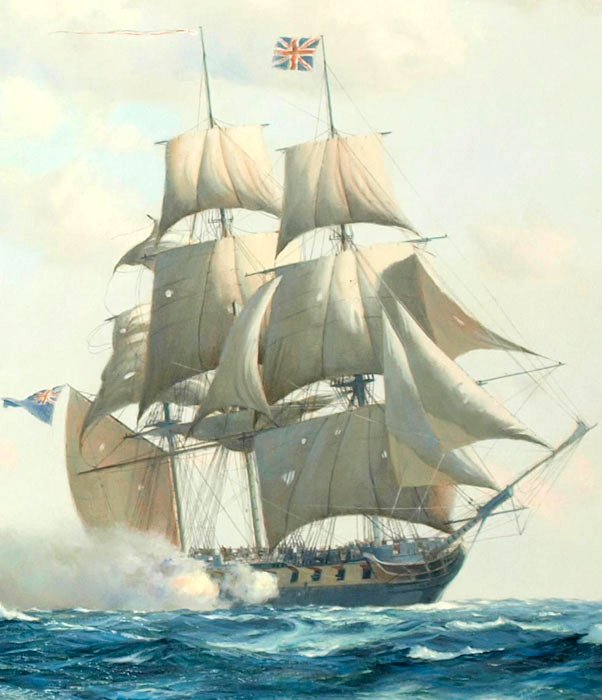
Leaving Plymouth, we next anchored, for a brief space, at Torbay, a small port in the British Channel. We were ordered thence to convoy a huge East India merchant vessel, much larger than our frigate and having five hundred troops on board, bound to the East Indies with money to pay the troops stationed there. We set sail in a tremendous gale of wind. Both ships stopped two days at Madeira to take in wine and a few other articles. After leaving this island, we kept her company two days more; and then, according to orders, having wished her success, we left her to pursue her voyage, while we returned to finish our cruise.
Though without any positive information, we now felt pretty certain that our government was at war with America. Among other things, our captain appeared more anxious than usual; he was on deck almost all the time; the "look-out" aloft was more rigidly observed; and every little while the cry of "Mast-head there!" arrested our attention.
It is customary in men of war to keep men at the fore and main mastheads, whose duty it is to give notice of every new object that may appear. They are stationed in the royal yards, if they are up, but if not, on the top-gallant yards: at night a look-out is kept on the fore yard only.
Thus we passed several days; the captain running up and down and constantly hailing the man at the mast-head: early in the morning he began his charge "to keep a good look-out," and continued to repeat it until night.
Indeed, he seemed almost crazy with some pressing anxiety. The men felt there was something anticipated, of which they were ignorant; and had the captain heard all their remarks upon his conduct, he would not have felt very highly flattered. Still, everything went on as usual; the day was spent in the ordinary duties of man-of-war life, and the evening in telling stories of things most rare and wonderful; for your genuine old tar is an adept in spinning yarns, and some of them, in respect to variety and length, might safely aspire to a place beside the great magician of the north, Sir Walter Scott, or any of those prolific heads that now bring forth such abundance of fiction to feed a greedy public, who read as eagerly as our men used to listen.
To this yarn-spinning was added the most humorous singing, sometimes dashed with a streak of the pathetic, which I assure my readers was most touching; especially one very plaintive melody, with a chorus beginning with, "Now if our ship should be cast away, It would be our lot to see old England no more," which made rather a melancholy impression on my boyish mind, and gave rise to a sort of presentiment that the Macedonian would never return home again; a presentiment which had its fulfilment in a manner totally unexpected to us all. The presence of a shark for several days, with its attendant pilot fish, tended to strengthen this prevalent idea.
The Sabbath came, and it brought with it a stiff breeze. We usually made a sort of holiday of this sacred day. After breakfast it was common to muster the entire crew on the spar deck, dressed as the fancy of the captain might dictate; sometimes in blue jackets and white trowsers, or blue jackets and blue trowsers; at other times in blue jackets, scarlet vests, and blue or white trowsers with our bright anchor buttons glancing in the sun, and our black, glossy hats, ornamented with black ribbons, and with the name of our ship painted on them. After muster, we frequently had church service read by the captain; the rest of the day was devoted to idleness. But we were destined to spend the Sabbath, just introduced to the reader, in a very different manner.
We had scarcely finished breakfast, before the man at the mast-head shouted, "Sail ho!"
The captain rushed upon deck, exclaiming, "Mast-head there!"
"Sir!"
"Where away is the sail?"
The precise answer to this question I do not recollect, but the captain proceeded to ask, "What does she look like?"
"A square-rigged vessel, sir," was the reply of the look-out.
After a few minutes, the captain shouted again, 'Mast-head there!"
"Sir!"
"What does she look like?"
"A large ship, sir, standing toward us!"
By this time, most of the crew were on deck, eagerly straining their eyes to obtain a glimpse of the approaching ship and murmuring their opinions to each other on her probable character. Then came the voice of the captain, shouting, "Keep silence, fore and aft!" Silence being secured, he hailed the look-out, who, to his question of "What does she look like?" replied, "A large frigate, bearing down upon us, sir!"
A whisper ran along the crew that the stranger ship was a Yankee frigate. The thought was confirmed by the command of "All hands clear the ship for action, ahoy!" The drum and fife beat to quarters; bulk-heads were knocked away; the guns were released from their confinement; the whole dread paraphernalia of battle was produced; and after the lapse of a few minutes of hurry and confusion, every man and boy was at his post, ready to do his best service for his country, except the band, who, claiming exemption from the affray, safely stowed themselves away in the cable tier. We had only one sick man on the list, and he, at the cry of battle, hurried from his cot, feeble as he was, to take his post of danger. A few of the junior midshipmen were stationed below, on the berth deck, with orders, given in our hearing, to shoot any man who attempted to run from his quarters.
Our men were all in good spirits; though they did not scruple to express the wish that the coming foe was a Frenchman rather than a Yankee. We had been told, by the Americans on board, that frigates in the American service carried more and heavier metal than ours. This, together with our consciousness of superiority over the French at sea, led us to a preference for a French antagonist.
The Americans among our number felt quite disconcerted at the necessity which compelled them to fight against their own countrymen. One of them, named John Card, as brave a seaman as ever trod a plank, ventured to present himself to the captain, as a prisoner, frankly declaring his objections to fight. That officer, very ungenerously, ordered him to his quarters, threatening to shoot him if he made the request again. Poor fellow! He obeyed the unjust command and was killed by a shot from his own countrymen. This fact is more disgraceful to the captain of the Macedonian than even the loss of his ship. It was a gross and a palpable violation of the rights of man.

As the approaching ship showed American colors, all doubt of her character was at an end. "We must fight her," was the conviction of every breast. Every possible arrangement that could insure success was accordingly made. The guns were shotted; the matches lighted; for, although our guns were all furnished with first-rate locks they were also provided with matches, attached by lanyards, in case the lock should miss fire. A lieutenant then passed through the ship, directing the marines and boarders, who were furnished with pikes, cutlasses, and pistols, how to proceed if it should be necessary to board the enemy. He was followed by the captain, who exhorted the men to fidelity and courage, urging upon their consideration the well-known motto of the brave Nelson, "England expects every man to do his duty."In addition to all these preparations on deck, some men were stationed in the tops with small-arms, whose duty it was to attend to trimming the sails and to use their muskets, provided we came to close action. There were others one of also below, called sail trimmers, to assist in working the ship should it be necessary to shift her position during the battle.

My station was at the fifth gun on the main deck. It was my duty to supply my gun with powder, a boy being appointed to each gun in the ship on the side we engaged, for this purpose. A woollen screen was placed before the entrance to the magazine, with a hole in it, through which the cartridges were passed to the boys; we received them there, and covering them with our jackets, hurried to our respective guns. These precautions are observed to prevent the powder taking fire before it reaches the gun.
Thus we all stood, awaiting orders, in motionless suspense. At last we fired three guns from the larboard side of the main deck; this was followed by the command, "Cease firing; you are throwing away your shot!"
Then came the order to "wear ship," and prepare to attack the enemy with our starboard guns. Soon after this I heard a firing from some other quarter, which I at first supposed to be a discharge from our quarter deck guns; though it proved to be the roar of the enemy's cannon.
A strange noise, such as I had never heard before, next arrested my attention; it sounded like the tearing of sails, just over our heads. This I soon ascertained to be the wind of the enemy's shot. The firing, after a few minutes' cessation, recommenced. The roaring of cannon could now be heard from all parts of our trembling ship, and, mingling as it did with that of our foes, it made a most hideous noise. By-and-by I heard the shot strike the sides of our ship; the whole scene grew indescribably confused and horrible; it was like some awfully tremendous thunder-storm, whose deafening roar is attended by incessant streaks of lightning, carrying death in every flash and strewing the ground with the victims of its wrath: only, in our case, the scene was rendered more horrible than that, by the presence of torrents of blood which dyed our decks.
Though the recital may be painful, yet, as it will reveal the horrors of war and show at what a fearful price a victory is won or lost, I will present the reader with things as they met my eye during the progress of this dreadful fight. I was busily supplying my gun with powder, when I saw blood suddenly fly from the arm of a man stationed at our gun. I saw nothing strike him; the effect alone was visible; in an instant, the third lieutenant tied his handkerchief round the wounded arm, and sent the groaning wretch below to the surgeon.
The cries of the wounded now rang through all parts of the ship. These were carried to the cockpit as fast as they fell, while those more fortunate men, who were killed outright, were immediately thrown overboard. As I was stationed but a short distance from the main hatchway, I could catch a glance at all who were carried below. A glance was all I could indulge in, for the boys belonging to the guns next to mine were wounded in the early part of the action, and I had to spring with all my might to keep three or four guns supplied with cartridges. I saw two of these lads fall nearly together.
One of them was struck in the leg by a large shot; he had to suffer amputation above the wound. The other had a grape or canister shot sent through his ancle. A stout Yorkshireman lifted him in his arms and hurried him to the cockpit. He had his foot cut off, and was thus made lame for life. Two of the boys stationed on the quarter deck were killed. They were both Portuguese. A man, who saw one of them killed, afterwards told me that his powder caught fire and burnt the flesh almost off his face. In this pitiable situation, the agonized boy lifted up both hands, as if imploring relief, when a passing shot instantly cut him in two.
I was an eye-witness to a sight equally revolting. A man named Aldrich had his hands cut off by a shot, and almost at the same moment he received another shot, which tore open his bowels in a terrible manner. As he fell, two or three men caught him in their arms, and, as he could not live, threw him overboard.
One of the officers in my division also fell in my sight. He was a noble-hearted fellow, named Nan Kivell. A grape or canister shot struck him near the heart: exclaiming, "Oh! my God!" he fell, and was carried below, where he shortly after died.
Mr. Hope, our first lieutenant, was also slightly wounded by a grummet, or small iron ring, probably torn from a hammock clew by a shot. He went below, shouting to the men to fight on. Having had his wound dressed, he came up again, shouting to us at the top of his voice, and bidding us fight with all our might. There was not a man in the ship but would have rejoiced had he been in the place of our master's mate, the unfortunate Nan Kivell.
The battle went on. Our men kept cheering with all their might. I cheered with them, though I confess I scarcely knew for what. Certainly there was nothing very inspiriting in the aspect of things where I was stationed. So terrible had been the work of destruction round us, it was termed the slaughter-house. Not only had we had several boys and men killed or wounded, but several of the guns were disabled.
The one I belonged to had a piece of the muzzle knocked out; and when the ship rolled, it struck a beam of the upper deck with such force as to become jammed and fixed in that position. A twenty-four-pound shot had also passed through the screen of the magazine, immediately over the orifice through which we passed our powder. The schoolmaster received a death wound. The brave boatswain, who came from the sick bay to the din of battle, was fastening a stopper on a back-stay which had been shot away, when his head was smashed to pieces by a cannon-ball; another man, going to complete the unfinished task, was also struck down. Another of our midshipmen also received a severe wound.
The unfortunate wardroom steward, who, the reader will recollect, attempted to cut his throat on a former occasion, was killed. A fellow named John, who, for some petty offence, had been sent on board as a punishment, was carried past me, wounded. I distinctly heard the large blood-drops fall pat, pat, pat, on the deck; his wounds were mortal. Even a poor goat, kept by the officers for her milk, did not escape the general carnage; her hind legs were shot off, and poor Nan was thrown overboard.
Such was the terrible scene, amid which we kept on our shouting and firing. Our men fought like tigers. Some of them pulled off their jackets, others their jackets and vests; while some, still more determined, had taken off their shirts, and, with nothing but a handkerchief tied round the waistbands of their trowsers, fought like heroes. Jack Sadler, whom the reader will recollect, was one of these. I also observed a boy, named Cooper, stationed at a gun some distance from the magazine. He came to and fro on the full run and appeared to be as "merry as a cricket." The third lieutenant cheered him along, occasionally, by saying, "Well done, my boy, you are worth your weight in gold."
I have often been asked what were my feelings during this fight. I felt pretty much as I suppose every one does at such a time. That men are without thought when they stand amid the dying and the dead is too absurd an idea to be entertained a moment. We all appeared cheerful, but I know that many a serious thought ran through my mind: still, what could we do but keep up a semblance, at least, of animation? To run from our quarters would have been certain death from the hands of our own officers; to give way to gloom, or to show fear, would do no good, and might brand us with the name of cowards, and ensure certain defeat.
Our only true philosophy, therefore, was to make the best of our situation by fighting bravely and cheerfully. I thought a great deal, however, of the other world; every groan, every falling man, told me that the next instant I might be before the judge of all the earth. For this, I felt unprepared; but being without any particular knowledge of religious truth, I satisfied myself by repeating again and again the Lord's prayer and promising that if spared I would be more attentive to religious duties than ever before. This promise I had no doubt, at the time, of keeping; but I have learned since that it is easier to make promises amidst the roar of the battle's thunder, or in the horrors of shipwreck, than to keep them when danger is absent and safety smiles upon our path.
While these thoughts secretly agitated my bosom, the din of battle continued. Grape and canister shot were pouring through our port-holes like leaden rain, carrying death in their trail. The large shot came against the ship's side like iron hail, shaking her to the very keel, or passing through her timbers and scattering terrific splinters, which did a more appalling work than even their own death-giving blows. The reader may form an idea of the effect of grape and canister, when he is told that grape shot is formed by seven or eight balls confined to an iron and tied in a cloth. These balls are scattered by the explosion of the powder. Canister shot is made by filling a powder canister with balls, each as large as two or three musket balls; these also scatter with direful effect when discharged. What then with splinters, cannon balls, grape and canister poured incessantly upon us, the reader may be assured that the work of death went on in a manner which must have been satisfactory even to the King of Terrors himself.
Suddenly, the rattling of the iron hail ceased. We were ordered to cease firing. A profound silence ensued, broken only by the stifled groans of the brave sufferers below. It was soon ascertained that the enemy had shot ahead to repair damages, for she was not so disabled but she could sail without difficulty; while we were so cut up that we lay utterly helpless. Our head braces were shot away; the fore and main top-masts were gone; the mizzen mast hung over the stern, having carried several men over in its fall: we were in the state of a complete wreck.
A council was now held among the officers on the quarter deck. Our condition was perilous in the extreme: victory or escape was alike hopeless. Our ship was disabled; many of our men were killed, and many more wounded. The enemy would without doubt bear down upon us in a few moments, and, as she could now choose her own position, would without doubt rake us fore and aft. Any further resistance was therefore folly.
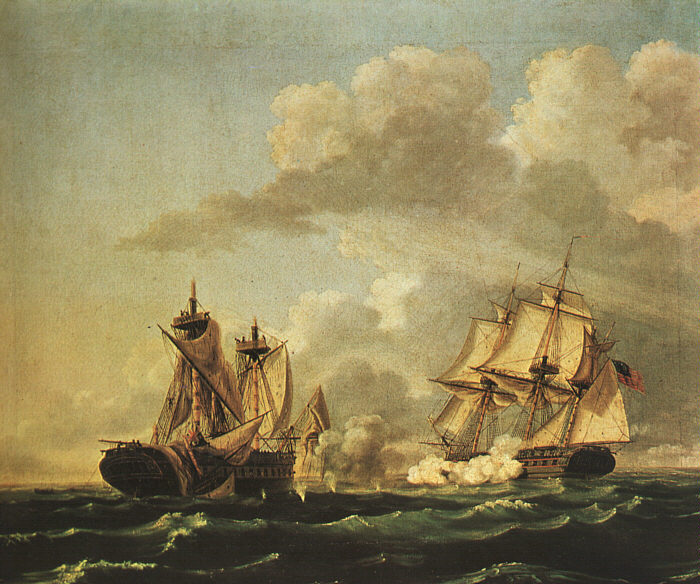
So, in spite of the hot-brained lieutenant, Mr. Hope, who advised them not to strike, but to sink alongside, it was determined to strike our bunting. This was done by the hands of a brave fellow named Watson, whose saddened brow told how severely it pained his lion heart to do it. To me it was a pleasing sight, for I had seen fighting enough for one Sabbath; more than I wished to see again on a week day. His Britannic Majesty's frigate Macedonian was now the prize of the American frigate United States.
I NOW WENT below, to see how matters appeared there. The first object I met was a man bearing a limb, which had just been detached from some suffering wretch. Pursuing my way to the ward-room, I necessarily passed through the steerage, which was strewed with the wounded: it was a sad spectacle, made more appalling by the groans and cries which rent the air. Some were groaning, others were swearing most bitterly, a few were praying, while those last arrived were begging most piteously to have their wounds dressed next. The surgeon and his mate were smeared with blood from head to foot: they looked more like butchers than doctors. Having so many patients, they had once shifted their quarters from the cockpit to the steerage; they now removed to the ward-room, and the long table, round which the officers had sat over many a merry feast, was soon covered with the bleeding forms of maimed and mutilated seamen.
While looking round the ward-room, I heard a noise above, occasioned by the arrival of the boats from the conquering frigate. Very soon a lieutenant, I think his name was Nicholson, came into the ward-room and said to the busy surgeon, "How do you do, doctor?"
"I have enough to do," replied he, shaking his head thoughtfully; "you have made wretched work for us!" These officers were not strangers to each other, for the reader will recollect that the commanders and officers of these two frigates had exchanged visits when we were lying at Norfolk some months before.
I now set to work to render all the aid in my power to the sufferers. Our carpenter, named Reed, had his leg cut off. I helped to carry him to the after ward-room; but he soon breathed out his life there, and then I assisted in throwing his mangled remains overboard. We got out the cots as fast as possible; for most of them were stretched out on the gory deck. One poor fellow, who lay with a broken thigh, begged me to give him water. I gave him some. He looked unutterable gratitude, drank, and died. It was with exceeding difficulty I moved through the steerage, it was so covered with mangled men and so slippery with streams of blood."
***
How anyone man could endure so terrible an experience is beyond my understanding. I stand in awe of anyone who came through so grotesque, so hideous an ordeal and still had their wits about them! I think I can safely say that Captain Wentworth would have been no pansy. The hero in my second book--which is not yet in print--was also a captain in the Napoleonic Wars, but he somewhat loses his moral compass as a result of his experiences. It is, of course, the heroine who inspires him to find it again.
~~~~~~~~~~~~
www.wandajuneluce.blogspot.com
lucewandarings@gmail.com