Showing posts with label officers. Show all posts

Sunday, May 5, 2013

Regency Militia--A Different Breed of Officer

by Maria Grace


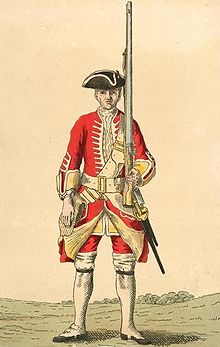
In many Regency era books, companies of soldiers are encountered stationed in England. These men are members of the militia, not the regular army. While at first blush, there may seem little difference between the Regulars and the militia, the differences are striking and significant.  
 
What was the Militia?

Lord Lieutenant Flag
The militia served as a peace keeping force on home soil, embodied only in wartime to free the regulars for combat abroad. In theory, they suppressed riots, broke up seditious gatherings, and if needed, repelled invading enemy forces. Unfortunately, the militia was a dubious peacekeeper. It was not uncommon for its members to sympathize with their rioting neighbors they were sent to subdue. For this reason, militia units served outside their own counties.

Militia men were required to have weapons and to be skilled in their use. However, their lack of training made them amateurish compared to the regulars since only small numbers were selected for more serious training, the so-called trained bands.  

Joining the militia

The nation did not maintain a standing militia. The militia was embodied in wartime or in times of national emergency, to guard against invasion or rebellion and to take over various policing duties normally performed by the regular army. Popular opinion painted the citizen-soldier as a fierce defender of home and country. History had taught that a regular army could be a great threat to civil liberties, so the virtues of the militia were sometimes overstated.

Parliament controlled the size of the militia. Though considered a volunteer force, all Protestant males were required to make themselves available for service. The King required the Lord-Lieutenant, usually a local nobleman, of each county to gather a force of able-bodied men between 18 and 45 years of age to fill the quota for his area. Militia service required a five to seven year commitment to service on home soil with no chance of being sent overseas. Only clergymen were exempt from service.

If a man did not wish to serve he could pay a substitute to serve in his stead. The going rate started at £25 and could go as high as £60. (For comparison, £50 a year would be a very rough equivalent of a today’s minimum wage.)

Most militia officers were drawn from the local gentry and were led by a colonel who was a county landowner. Officer’s commissions were not purchased as they were in the regular army. Officer ranks were directly related to the amount and value of property they or their family held. For example, to qualify for the rank of captain a man needed to either own land worth £200 per year, be heir to land worth £400 per year, or the son of a father with land worth £600 per year. A lieutenant needed land worth £50 a year.

Officers drew an allowance, but this was not expected to do more than cover expenses since their primary income would be from their property. Poor families of militiamen were eligible for support from the parish whereas those of the regulars were not.

In practice it was difficult to find officers, particularly lower grade officers, for militia service. So the property qualifications for lieutenants were often ignored. While this leniency allowed many to join the ranks of officer who would not otherwise have such an opportunity, it did bring down the perceived status of the militia officer. Possibly to combat this issue, many regiments selected their recruits for their handsome appearance which would improve the look of their regiment and thus its prestige.  

Life in the militia
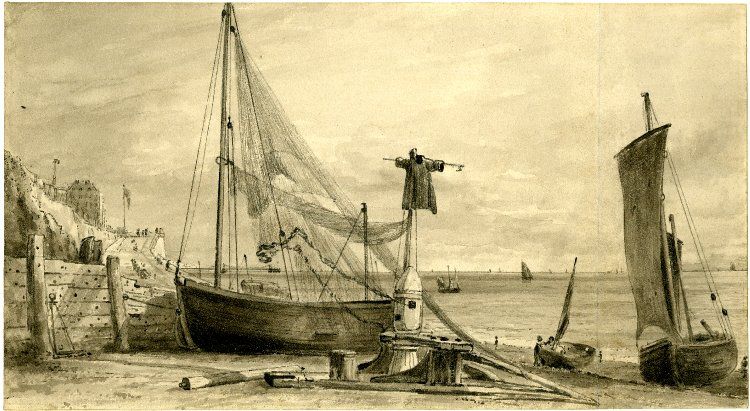
Brighton
Service in the militia carried little threat of front line duty. Officers had a great deal of leave and often enjoyed a busy social schedule provided by the local gentry. Since all officers were supposed to be property holders of some measure, they were all considered gentlemen and afforded the according status.

In summer the militia’s regiments went into tented camps in the open countryside to engage in training exercises. Camps were located throughout the southern and eastern coasts, the largest at Brighton.

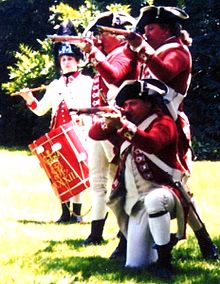
Military reviews, held on open hillside or common land, made excellent entertainment for the local residents. Reviews included displays of all sorts of military actions: marching, drilling, firing at targets and even mock skirmishes often for the benefit of a visiting general.

Prior to 1796 when barracks were provided, the militia quartered for the winter wherever accommodation could be found for them in the nearby towns and villages. These were supposed to be paid for by the soldiers themselves but since they would only remain a short time in any one place, it was not uncommon for them to run up bills and leave town without paying them.  
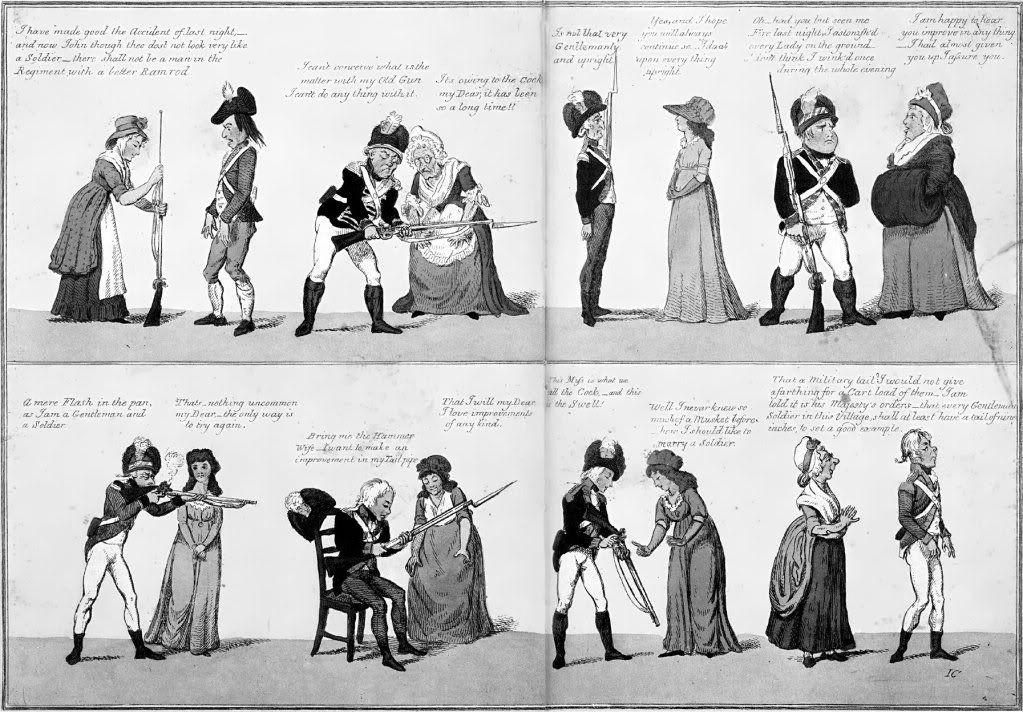
Caricature of the militia
Public attitude toward the militia

All in all the militia was not popular. Inhabitants resented assessments of equipment and money to cover the needs of the militia. Men resented being drafted to serve and were apt to do everything they could to avoid their military training. Tradesmen and innkeepers resented them leaving town without paying for services and wares.

As a peacekeeping force, they militia had little to do but drill. With so much free time on their hands, they developed a reputation for a wild lifestyle of parties and frivolity. Not surprisingly, parents often saw militia officers as a threat to their marriageable daughters since their families were unknown and they might disappear from the neighborhood very quickly.  

References

Collins, Irene. (1998) Jane Austen, The Parson's Daughter . Hambledon Press.
Day, Malcom. (2006) Voices from the World of Jane. Austen David & Charles .
Downing, Sarah Jane. (2010). Fashion in the Time of Jane Austen. Shire Publications
Holmes, Richard. (2001). Redcoat, the British Soldier in the Age of Horse and Musket W. W. Norton & Company
Le Faye, Deirdre. (2002). Jane Austen: The World of Her Novels. Harry N. Abrams  
Militia. Regency Collection
Southam, Brian (2005). Jane Austen in Context. Janet M. Todd ed Cambridge University Press
Tomalin, Claire. (1999). Jane Austen, a Life. Random House
Watkins, Susan . (1990). Jane Austen's Town and Country Style. Rizzoli

~~~~~~~~~~~~

 Maria Grace is the author of Darcy's Decision and The Future Mrs. Darcy. Click here to find her books on Amazon. For more on her writing and other Random Bits of Fascination, visit her website. You can also like her on Facebook, follow on Twitter or email her.

Thursday, January 17, 2013

On Becoming an Officer and a Gentleman

by Maria Grace

In the Regency era, social status was closely related to career and wealth. An Army or Navy officer was considered a gentleman. Thus a man could gain an element of “respectability” by purchasing a commission that they might not hold by virtue of their birth or fortune. Moreover, an officer’s status was considered higher than that of other accepted gentlemanly professions: the church, the law and medicine.

Why were commissions purchased?


Though our modern sensibilities tend to be uncomfortable with the concept of buying a commission, in the Regency era, the belief was that paying for the rank meant that only men of fortune, character, and who had a real interest in the fate of the nation would be drawn to the military, thus reducing the number of unworthies serving in the officer’s ranks. Furthermore, since officers ‘owned’ their commission, they would be more responsible with their ‘property’ than someone with nothing to lose. Private ownership of rank also implied officers would be less likely to be used by the King against the people since they did not owe their rank to the crown.

The purchase of commissions also served a practical purpose. The price paid for a commission served as a sort of nest egg for the officer, returned to him when he ‘sold out’ and retired. Thus there was no need to provide pensions for retiring officers, a definite advantage to the crown. 

These nest eggs were particularly necessary because army pay was low, enough to live on but not much more, particularly if one sought to maintain the standard of living of a wealthy family. In general, officers' honorarium (as gentlemen they did not take salaries) were just less than the amount of interest that could be earned by the cost of the commission. It was widely accepted that gentlemen should not profit from their military service. (Prize money, when it could be had, was a different thing.)  Many sons of wealthy parents who joined the army also had an allowance from their families that helped them to live in the style to which they had been accustomed. 

Purchasing a commission

Reforms set in place by the Duke of York in 1796 mandated that officer candidates had to be between the ages of 16 and 21 years of age, able to read and write, and vouched for by a superior officer. Once these were fulfilled, the required sum of money would be deposited with an authorized Regimental Agent who would submit the applicant’s documentation for approval. Depending on the regiment, officers began their careers at a ‘Subaltern’ rank of Ensign, Second Lieutenant or Coronet. Little to no training was provided for the newly fledged officer, he picked up what he would need on the job.

How much did a commission cost?

Commissions were expensive. One had to be wealthy or have wealthy friends from which to borrow in order to afford a commission. Prices varied depending on the regiment and rank. (Keep in mind a very rough reference point of £50 a year as parallel to our minimum wage.) Subaltern rank ranged in price from £400 with the Infantry to £1050 with the Horse Guards. Lieutenant Colonel ranged from £3500 to £4950.

The same logic that led to the purchase of commissions discouraged promotion by merit as it could lead to an excess of patronage, something objected to on political and professional grounds. When an officer served long enough to be eligible and wished to purchase a promotion to the next level of rank, he would pay the difference between his current commission and the next rank. After 1795, a Subaltern (Lieutenant and below) had to serve at least three years before becoming a Captain; at least seven years in service (two as Captain) to become a Major; and nine years in service to be a Lieutenant-Colonel. Advancement above the rank of Colonel was by seniority only and only possible if there were vacancies in the desired ranks. Junior officers could spend several years without advancing.

Gaining a commission without purchase

If an individual could not afford a commission, there were non-purchased ways of obtaining a commission. A man could become a “Gentlemen Volunteer.” To do so, he would apply to the Commanding Officer of a regiment to serve at their own expense in the hope of filling a non-purchase vacancy when (and if) it occurred.

It was also possible for a man to be promoted from the ranks due to valor or meritorious service. The death, disability, or retirement, of another officer might create a vacancy that needed to be filled immediately. Other openings came with the establishment of new Regiments, or the expansion of existing ones. These alternatives were much more common in times of war.

References:


Boyle, Laura.(2001) Jane Austen Centre On Line Magazine.  Advancement in the British Army  

Boyle, Laura.(2001) Jane Austen Centre On Line Magazine. Entry into the OfficerCorps

Boyle, Laura.(2001) Jane Austen Centre On Line Magazine.  Prices of Officer’s Commissions

Day, Malcom. (2006) Voices from the World of Jane. Austen David & Charles .

Holmes, Richard.  (2001).   Redcoat, the British Soldier in the Age of Horse and Musket. W. W. Norton & Company 

Southam, Brian  (2005). Jane Austen in Context.  Janet M. Todd ed. Cambridge University Press


Maria Grace is the author of Darcy's Decision and The Future Mrs. Darcy. Click here to find her books on Amazon. For more on her writing and other Random Bits of Fascination, visit her website. You can also like her on Facebook or email