Showing posts with label The Battle of Maldon. Show all posts

Saturday, October 1, 2016

Government in the Reigns of Edgar and Aethelred II

by Annie Whitehead

Neither Edgar (959-975) nor his son Aethelred (978-1016) came to the throne free from controversy. Both of them succeeded their elder brothers, who reigned only briefly. King Eadwig (Edwy) succeeded his uncle in 955, while his brother Edgar was declared king in Mercia and the Danelaw. With the existence of two royal courts it seems likely that civil war was not far away when Eadwig died on this day - 1st October - in 959. He had issued so many charters that a degree of irresponsibility is probable, and he had quarrelled with Abbot, later Archbishop, Dunstan and driven him into exile.

King Edgar

Aethelred was Edgar’s younger son, and succeeded his (step) brother Edward when he was murdered at Corfe. Throughout his reign he was never entirely able to escape from the fact that the murder had been committed for his sake.

King Aethelred

The youth of these kings produced an environment where faction could arise. Powerful ealdormen could be found influencing politics and the monarch, even changing the face of war, as was the case at the end of Aethelred’s reign.

This then was the political situation over which Edgar and Aethelred had to govern.

The king normally stayed in the south, and his presence in the north was made to be felt by his appointed ealdormen. Within the royal court there was a strict hierarchy, evidence of which comes from a scrutiny of the witness lists of Aethelred’s reign, where athelings, ealdormen, thegns and bishops subscribed in strict order of seniority. This order normally changed only when one subscriber died, but the witness lists of Aethelred’s reign show how powerful particular ealdormen could become. Eadric Streona headed the lists from 1009x12 to 1016, in the lifetime of other ealdormen who had once been his seniors. The king had no choice but to rely on these men for their cooperation and support, which was to some extent ensured by their attendance at the royal council, the Witan, where laws were deliberated upon and promulgated.

The Witan

Edgar relied heavily on the bishops and abbots within the Witan. He was the great patron of the monastic revival, overseen by bishops Oswald, Dunstan and Aethelwold. Many grants of land were made to the Church, and the ecclesiastical support thus ensured gave Edgar the means to check the power of the ealdormen. Oswald was given the triple-hundred* of Oswaldslow to the exclusion of Aelfhere of Mercia, and the leases of Oswald are an indication of his power. The Anglo-Saxon Chronicle records that in 975 “Ealdorman Aelfhere had very many monasteries destroyed...” This action arose more out of political rivalry it seems, than anti-monasticism.

In contrast, the early years of Aethelred’s reign show him undoing much of Edgar’s work, with lands being taken away from religious foundations, such as Abingdon, Rochester and Winchester. Until 993 it seems that Aethelred was being led astray by ealdormen who took advantage of his youth and ignorance. Fortunately for the church, these lands were restored after 993, when, with different ealdormen emerging, Aethelred was seen to mend his ways with the restoration of the privileges of Abingdon.

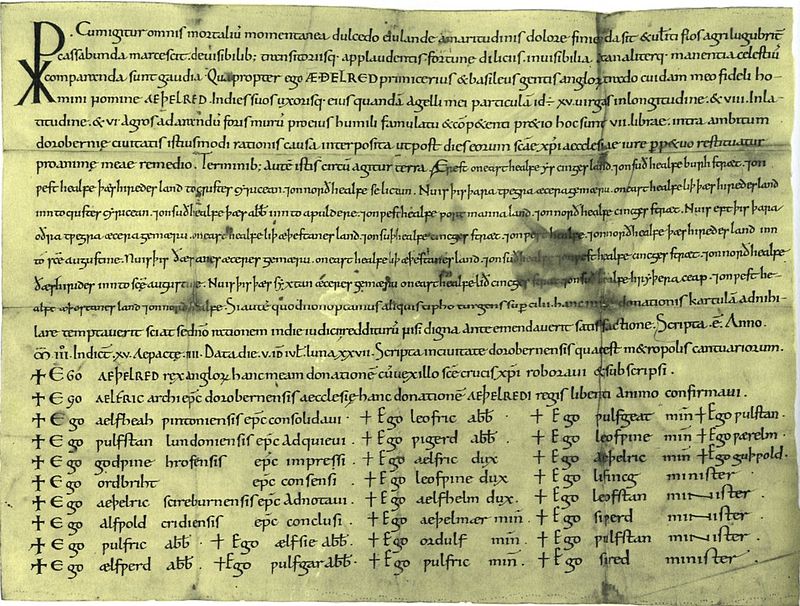
A charter from Aethelred's reign

There was a long tradition of financial organisation in Anglo-Saxon England. In the tenth century traditional renders gave way to the Geld. The payment of Geld involved the handling of coinage; King Athelstan (924-939) decreed that each burh (borough/fortified town) would have a mint, and he attempted to limit the number of moneyers. Edgar reinforced this legislation in his own law codes. “There shall run one coinage throughout the realm.” [2]  Every borough was expected to issue coinage.

Edgar’s reforms set the standard and the system was continued under Aethelred. During his reign there were more than 60 mints in operation. Of course, there was a great increase in the output of the mints at this time because of the payment of the Danegeld, something with which Edgar was not confronted. It was probably at the instigation of Archbishop Sigeric after Byrhtnoth of Essex was killed at Maldon (991), that the decision was taken to pay the Danes in the hope that they would go away.

“In this year it was decided to pay tribute to the Danes … on this occasion it amounted to £10,000. This course was adopted on the advice of Archbishop Sigeric.” [3]

The payment of the Danegeld indicates two things: the amount of fluid wealth in England and the capacity of the English to tap it.

Another form of taxation (albeit strictly a military tax) was the Ship Soke. Most of the evidence we have for this comes from the reign of Aethelred. The much quoted entry for 1008 in the Anglo-Saxon Chronicle tells us that

 “In this year the king gave orders that ships should be speedily built throughout the whole England: namely one large warship was to be provided from every 300 hides, and a a cutter from every ten hides, while every eight hides were to provide a helmet and a corselet.”

Aethelred was reacting sensibly to the Danish threat, but there is evidence to suggest that this was no innovation. FE Harmer (Anglo-Saxon Writs) pointed out that in 1003/4 Archbishop Aelfric made a bequest of ships and HPR Finberg [4] credited Edgar with the invention.  He cited the Triple Hundred of Oswaldslow created by Edgar, and said that Edgar organised efficient naval patrols around the shores of Britain.

The origin of the Hundred is somewhat hazy. Most of what we know about this administrative unit is derived from a document known as the Hundred Ordinance. Dated somewhere between 939 and 960, the Ordinance is the subject of controversy among historians who are unable to agree upon its author. But the Ordinance was definitely in existence by Edgar’s reign. It decrees that the hundred court should meet every four weeks, and that each man should do justice to other men there. II&III Edgar reinforces the Ordinance, by stating that the borough court is to be held thrice a year and the shire court twice, and the hundred court is to be attended as was ‘previously established.’

My very battered student copy of the translation of the Hundred Ordinance

Aethelred’s laws make frequent reference to the hundreds, in particular the importance of oath-taking. In III Aethelred, the ‘Wantage code’, which deals mainly with the Danelaw, we find what Finberg calls the earliest known reference to the sworn jury of presentment: “and the twelve leading thegns … are to come forward and swear on the relics which are put forward into their hands that they will accuse no innocent man nor conceal any guilty one.”

Edgar’s dealings with the Danelaw can be found in IV Edgar, the Wihbordesstan Code. It had often been said that Edgar was creating something new with this code. But technically speaking this is a letter to the Danes, showing Edgar eager to respect an autonomy which was already a fact.

It is probable that Edgar became king of England in 959 with the help of a powerful group of magnates who wanted a king who would not encroach on the customary law. Niels Lund [5] says that the whole point of the letter is to notify the Danelaw that he wishes a new law to apply to all his kingdom, that he knows that this is a violation of their privileges but nevertheless he asks them to accept it. Edgar stresses five times that he has every intention of respecting the Danelaw. It is possible that although IV Edgar is a recognition of established fact, Edgar himself created the Danelaw, as there are no earlier references to it. In all probability these privileges were granted by Edgar in 957, in gratitude for the support given him in the north against his brother Eadwig.

King Eadwig, who died 1st October, 959

It has been said that Aethelred also recognised the validity of the Danelaw, but in fact his dealings with these provinces sharply contrast with those of Edgar. In IV Edgar the king is careful not to offend the Danes to whom he owes a great deal. Aethelred was not so subtle. Whitelock suggests that he appointed to office men he had himself advanced, rather than men belonging to old established families. He was quick to seize lands in the Danelaw, for example those of the murdered Sigeferth and Morcar.

In the Wihtbordesstan code, sanctions against lawbreakers are left to be decided by the Danes, while Edgar and his councillors provide the rules for the rest of England. “And it is my will that secular rights be in force among the Danes according to as good laws as they can best decide upon. Among the English, however, that is to be in force which I and my councillors have added to the decrees of my ancestors.”

A comparison of Aethelred’s Wantage and Woodstock codes, shows that Aethelred on the other hand, attempted to impose English law on the Danelaw. Known respectively as III and I Aethelred, these codes were issued at more or less the same time, Wantage being specifically for the Danelaw.

I Aethelred says, “If, however he (the accused) is of bad reputation, he shall go to the triple ordeal.”
III Aethelred says, “And each man frequently accused is to go to the triple ordeal and pay four-fold.”

Not only did Aethelred set out the sanctions he imposed in the Danelaw, but he took a portion of the fines as well. Fines in the Danelaw were heavier than elsewhere in the country. It has been said that these measures show how much Aethelred was firmly in control of the Danelaw. Lund argues that rather it shows how Aethelred was attempting to gain firm control. He had no reason to think that he could rely on the north for support. On the contrary, he feared treachery, which led to his securing hostages from Northumbria in 991, and to the notorious massacre of St Brice’s day in 1002. His relations with the Danes are highlighted by the readiness with which the north accepted the Danish conquerors. The murdered Sigeferth and Morcar belonged to a northern family so powerful that Aethelred’s son Edmund Ironside’s marriage to Sigeferth’s widow gained him enough power to become the accepted king of the Five Boroughs. [6] It was people like these whom Aethelred, in total contrast to Edgar, managed to alienate by his attempts to impose English law on them.

Edmund 'Ironside'

Edgar’s was a peaceful reign, free from invasion. All he had to do was respect the Danelaw; he had already been shown their loyalty in 957. Aethelred on the other hand was plagued by raids from the sea. He had to pay tribute to the raiders from Denmark, and was never assured of the loyalty of the Danes in his own country. It is possible that Edgar introduced the Ship Soke, but is was certainly highlighted in Aethelred’s reign, because of the wretched situation in which he found himself. In short, the differences in the administration of these two kings stems from the difference in their reigns. One was always at peace; the other seemed permanently to be fighting off invasion.

[1] EHD (English  Historical Documents) 1 113
[2] II&III Edgar 59-963 EHD 1 40
[3] The Anglo-Saxon Chronicle (E) 991
[4] The Formation of England 550-1042
[5] King Edgar and the Danelaw, Med. Scand. 9
[6] The five main towns of the Danelaw: Derby, Leicester, Lincoln, Nottingham, Derby
* Triple hundred - an area of land, three times the administrative unit of the hundred
(All above images are in the public domain)

~~~~~~~~~~

Annie Whitehead is a history graduate and prize-winning author. Her novel, To Be A Queen, is the story of Aethelflaed, daughter of Alfred the Great, who came to be known as the Lady of the Mercians. It was long-listed for the Historical Novel Society’s Indie Book of the Year 2016 and has been awarded an indieBRAG medallion. Her current release, Alvar the Kingmaker, which tells the story of politics, intrigue, deceit and murder in the time of King Edgar, has also been awarded an indieBRAG medallion. She has recently contributed to 1066 Turned Upside Down, an anthology of short stories in which nine authors re-imagine the events of 1066 and ask 'What If'.

Friday, July 22, 2016

Military Service in Tenth-Century England

By Annie Whitehead

Last week I posted about duties and obligations in tenth-century England. This week I’m concentrating on military service.

Aethelred II (Unready)

Land granted by the king was known as ‘bookland’ and was absolved from all service with the exception of three. According to a grant by King Edgar [1] those three things were fixed military service, the restoration of bridges, and of fortresses. A grant by Aethelred II [2] calls for national military service, the construction of fortresses and the restoration of bridges. The Thegn’s law [3] tells us that:

“He be entitled to his book right, and that he shall contribute three things in respect of his land: armed service, and the repairing of fortresses and work upon bridges. Also in respect of many estates further services arise on the king’s order, … equipping a guardship, and guarding the coast, and guarding the lord, and military watch …”

The king was prepared to grant away rights privileges but not, it seems, his right to military service. The exact nature of the service is not stipulated, but it must have been important. Archbishop Wulfstan and Aelfric the Homilist divided Anglo-Saxon society into three orders: those who fight, those who labour, and those who pray. This would mean that the aristocracy was a warrior class. The nobility was required to provide military equipment [4] and there can be no doubt that a substantial part of their service was of a military nature.


Just as the heriot (war gear) varied according to rank, so the military service requirement differed for men of varying resources. The king had at his disposal his household troops.* Mercenaries were employed, (the career of Thorkell the Tall is evidence of this) but in essence the composition of the fyrd was based on a territorial levy. The requirement was for one man from every five hides of land. Service was basically for sixty days, in a system of rotation, but only in times of war. The Anglo-Saxon Chronicle entry for 920 tells us that “when this division of the English levies went home, the other came out on military service and occupied the fortress at Huntington.” [5] A landowner with more than five hides of land would be responsible for providing the requisite number of men.

A fine was payable for neglect of military service, and this ‘fyrd-wite’ was set at around forty shillings per man. Commutation, a payment in lieu of service, was lower, at around twenty shillings per obligation. A thegn liable to service could have his lands confiscated if he defaulted. [6] This did not necessarily mean that a thegn had to fight. He could send the required number of men without going himself; he would still be fulfilling his obligation.

Mention is made of two types of fyrd (army), the select fyrd and the gelect fyrd. The distinction between the select fyrd and the great fyrd might have been thus: the select fyrd consisted of soldiers who fought in battle, and the great fyrd may have been the back-up, repairing bridges and fortresses. [7]

The expensive equipment of the ealdormen, king’s thegns and the lesser thegns would have set the aristocracy apart from the ordinary fighting ceorl. The Battle of Maldon describes the ornate trappings of a nobleman in battle:

“An armed man then went to the Earl,
Wanting to strip him of his armbands, armour,
Ring-mail and ornate sword.”

Site of the Battle of Maldon - Ken Eckert 

Clearly the nobility who fought did so with expensive war gear, but to fight was not their only obligation. As landlords, they were responsible for the organisation, summoning and assembling of the fighting forces. They were also involved in the essential organisation to ensure that competent levies turned out to perform military duties on behalf of their estates.

The military crisis precipitated by the resumption of  Danish raiding served to place emphasis on the fighting role of the thegn. But was the aristocracy a warrior class?

Their military equipment set them apart in wealth and status from the rank and file, and their bookland was held from the king immune from all except military service. Yet if this was a warrior aristocracy one would expect to see them holding their land as a reward for military service, and their status deriving from their military rank. This was clearly not the case; that land was not held as reward for military service is a major stumbling block for any historian trying to prove that pre-Conquest England was feudal.

Land was granted for many reasons. King Aethelred II granted Aethelwig land because he did not wish to sadden him. [8] Apart from his being a servant of the king there seems to be no other reason for the grant. A ceorl could amass all the weapons of a thegn and still remain a ceorl if he did not possess five hides of land. [9] Land remained the source of wealth and the indicator of status. Military service was an important part of a nobleman’s duties, but, as we have seen, it was only one of many. [10] One might also expect that in times of peace less emphasis would be placed on the thegn as a warrior than in times of war.

*During the time of Cnut, the household troops were referred to as housecarls. Cnut’s reign was not in the tenth-century, though, and Nicholas Hooper’s article [11] provides, for me, compelling argument to suggest that the housecarl differed little from the English thegn.

[1] Grant by King Edgar to his thegn Aelfwold 969 EHD (English historical Documents) 113 p519
[2] Grant by King Aethelred to his thegn Aethelwig 992-995 EHD 117 p525
[3] Origins of English Feudalism 61 p145 “The Rights and Ranks of People”
[4] For more on this, see my article on Defining the Nobility in Later Anglo-Saxon England
[5] Anglo-Saxon Chronicle (A) 921 (920)
[6] This point is discussed by DJV Fisher in the Anglo-Saxon Age Ch13
[7] See Warren hollister, Anglo-Saxon Institutions. There is also a possibility that the Select fyrd served locally, and that the Great fyrd was the national army
[8] EHD 117 p525
[9] See HR Loyn The Governance of Anglo-Saxon England p167
[10] See last week’s article on duties and responsibilities HERE
[11] The Housecarls in England in the Eleventh Century - N Hooper

Further General Reading:
The Foundation of England - HPR Finberg
The Beginnings of English Society - D Whitelock
Anglo-Saxon England - FM Stenton
From Roman Britain to Norman England - PH Sawyer

(Above illustrations - public domain unless otherwise accredited)

Annie Whitehead is a history graduate and prize-winning author. Her novel, To Be A Queen, is the story of Aethelflaed, daughter of Alfred the Great, who came to be known as the Lady of the Mercians. It was long-listed for the Historical Novel Society’s Indie Book of the Year 2016 and has been awarded an indieBRAG medallion. Her new release, Alvar the Kingmaker, which tells the story of Aelfhere of Mercia, a nobleman in the time of King Edgar, is available now. A collaborative project, re-imagining the events of 1066, is also available to pre-order. 1066 Turned Upside Down
Annie's Author Page
Buy Alvar the Kingmaker
Buy To Be A Queen

Annie's Website
Annie's Blog