Showing posts with label horse racing. Show all posts

Thursday, October 16, 2014

Those Forgotten Racing Mares

by Sue Millard

Equine Mixed Marriages


The Darley Arabian

Three stallions, the Darley Arabian, Byerley Turk and Godolphin Arabian, are well known as the foundation sires of the racing Thoroughbred. It is sometimes forgotten, though, that these famous Oriental stallions could not reproduce by themselves!

In fact, 47 out of 74 foundation racehorse stock are listed on http://www.tbheritage.com as “dam unknown”. 70 have either “unknown dam” or both sire and dam “unknown”. That doesn’t prove the “unknowns” were British, of course, because they could equally be lost records of Orientals, but it does open the door to a historic tradition that is often overlooked: that some of the best British racehorses were descended purely from mares long-native to Britain, and not any imported from “the Orient.” 

The “royal mares” of King Charles II were indeed imported “Orientals” (actual country of origin seems to have been less important than the Oriental label), but the “Galloways” in the modern Thoroughbred’s pedigree surely came originally from the same source as our present native pony breeds. British mares, and very clearly mares from the North, were the mothers of modern racehorses.

The Epsom Derby, 1836, by James Pollard (1792 - 1867) (via Wikimedia Commons)

Gervase Markham wrote in “Cavalerice” (1607): “...when the best Barbaries that ever were in my remembrance were in their prime, I saw them overrunne by a black hobbie at Salesburie of Maister Carlton's and yet that hobbie was more overrunne by a horse of Maister Blackstone's called Valentine, which neither in hunting nor running was ever equalled, yet was a plaine-bred English horse by both syre and dam.” 

The Earl of Rutland’s family had been breeding “running horses” since the early 15th century. “The Rutlands were prolific breeders of ‘hobby’ horses; the origins of this breed are obscure but probably had ancestors in the Irish Hobby with Barb influences. There is an early reference to Rutland ‘hobbies’ in 1596 recording his Lordship’s racing victory in the Forest of Galtres (just north of York). Mackay-Smith differentiates between ‘hobby horses’ at Helmsley and ‘running horses’ at Sedbury.” http://www.tbheritage.com/Breeders/FoundBreeders/Helmsley/HelmsleyWilk.html

In the early years of the 18th century, the Earl of Rutland owned a mare known as “The Massey Mare”. “Most historians consider the Massey Mare descended from the Belvoir horses, long established in England, and not descended from any ‘royal’ mare belonging to any of the Stuart kings.”  A modern equine mtDNA study has matched her genetic heritage in the female line with that of a Celtic-type pony,  a horse population derived from Northern Europe and Britain. [i]  http://www.tbheritage.com/GeneticMarkers/mtdnaintbdamlines3.html  

Molly Long Legs with her Jockey, by George Stubbs (1761-62) (Walker Art Gallery, Liverpool; via Wikimedia Commons)

“The cosmopolitan maternal heritage of the Thoroughbred racehorse breed shows a significant contribution from British and Irish native mares.[ii]  … Our data demonstrate that Thoroughbred foundation mares were of cosmopolitan European heritage, with contributions from British and Irish Native and Oriental horses. The contribution from British and Irish Native horses is close to twice that of Oriental horses. … By contrast, Oriental mares made a limited contribution to Thoroughbred maternal lineages with a minimal contribution from Arabs.”

Modern Thoroughbred horses that are best suited to sprint racing carry the “C-variant” in their genetic makeup[iii]. It was rare in the infancy of the Thoroughbred, which in the 17th and 18th centuries was bred for stamina – horses capable of running up to 4 miles in their races, several times in a day. However, this gene has become widespread in modern racehorses due to selective breeding for “sprinting speed” as opposed to “stayers”.

There was a single introduction of it into the Thoroughbred: from one British-native mare. We can’t pin down which of our modern breeds deserves the honour of being its contributor, since the concept of a breed with a pedigree had only just caught on in aristocratic circles and it had certainly not reached as far down as commoners’ horses and ponies; but I’d like to think she was a Galloway mare. 


[i] E.W. Hill, et.al., "History and Integrity of Thoroughbred Dam Lines Revealed in Equine mtDNA Variation," Animal Genetics 33, 187-294. London: Blackwell Publishing.
[iii] http://www.nature.com/ncomms/journal/v3/n1/full/ncomms1644.html

~~~~~~~~~~~~~

Sue Millard maintains the Fell Pony Museum, and writes books about history and horses. Find her at Jackdaw E Books.

Friday, September 26, 2014

Horse Racing and its Organization

by Sue Millard

The Jockey Club


The Jockey Club, according to its own records, was founded in the reign of George II, in 1750. It was effectively one of the most exclusive of gentlemen’s clubs. Its first meetings were held at the Star & Garter Pub at Pall Mall, London before moving to Newmarket, which under James I, Charles II and Queen Anne had gradually become the home of racing. The Jockey Club controlled all regulations to do with racing until 2006 when, in a conscious move to decouple racing from its “patrician” roots, it set up the British Racing Authority. 


Weatherbys


Weatherbys is a privately owned English company, established 1770, which provides British horse racing with its central administration under contract to the British Horseracing Authority, acts as its bank and has maintained the Thoroughbred breed register since its inception.

Training


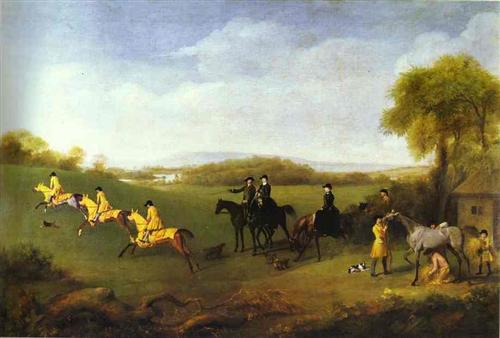
John Evelyn recorded in his Diary around 1684: “We returnd over New-market-heath...the Jockies breathing their fine Barbs & racers, & giving them their heates.” The term “breathing” meant giving a horse exercise that raised its respiration rate, while “heat” meant any exercise that raised its temperature, crudely measured as making the horse sweat. In 1761 George Stubbs portrayed the Duke of Richmond’s racehorses, being exercised in heavy rugs and hoods to achieve this.

Stubbs, The Duke of Richmond’s racehorses, painting from WikiArt


Types of races


In the early years, horse races were “matches” between two horses who competed in multiple heats, at distances from two to four miles. Only on a match day did a heat mean a stage of a race. Race heats were repeated until a horse had won the event twice or “distanced” the opponent – arriving at the finish more than 30 horse-lengths ahead, about 240 yards. These races were “stakes” in which both parties put up equal money as a sporting bet, and the winner took all.  

Horses were not raced until they were five or six years old. Carlisle racecourse, for instance, held a King's Plate – a race for 5-year-old horses in 3 mile heats – set up by George III in 1763.

Eclipse, by George Stubbs

The great horse Eclipse started racing at the age of five on 3 May 1769. Most racehorses ran only a few times in their lives, but Eclipse ran the unusually high number of 18 races in a career of about 17 months – by which time rival owners would no longer enter their horses against him because he was unbeatable: “Eclipse first, the rest nowhere”.

Originally, short races for 2 and 3 year old horses, the ones we are most familiar with today, were “futurities”, testing youngsters a couple of times on their potential for longer races.  The St Leger, first run in 1776 at Doncaster, was the first “Classic” race, though today the Derby has greater fame. The St Leger is a single contest for 3-year-olds over 1 mile 6 furlongs, so from the start it broke the tradition of races run in repeated heats and over long distances. 


Handicapping


Most races in the past were at “level weights” – all horses carrying the same weight (rider, saddle and, if necessary, lead strips carried in a saddle cloth). Weight-for-age races were a way of compensating for the relative strengths of younger and older horses and giving all a more equal chance of winning; they defined level weights for horses of equal age, with younger horses carrying less weight. 

Handicap races, in which faster or stronger horses are allotted slightly more weight to try and level the chances of winning, were not introduced until the 19th century. The name “handicap” comes from a method of making a trading agreement, Hand I(n) Cap – a bit like Scissors Paper Stone, but with the participants hiding their hands in a cap containing money. When they pulled out their hands at the word, the agreement was made if they had all picked up some money, but if one or all had not, there was no contract.

Handicapping in horseracing there’s far less chance of the “Eclipse first, the rest nowhere” scenario where the favourite is so likely to win that no-one will take your bet. In hound trailing very often the bookmakers will not give odds against two or three of the really good hounds running and you can only bet on who will be third or fourth! So the Handicap system made gambling more exciting.


Bookmaking


The first commercial bookmaker in Britain was probably Harry Ogden, who opened a business in the 1790s; then an Act of Parliament in 1845 made it illegal to gamble except at race tracks. Bookies had to be extremely good at calculating odds, so they didn’t make a loss overall. From those times onward to the present day, and with the legalisation of off-track betting in 1961, commercial interests took over racing.


A comparison with the modern day


Horseracing now has the production values of an entertainment industry, with vast sums being generated in stud fees for outstanding stallions, and total prize money exceeding the £1 million mark for some high-prestige races. 

Thoroughbred foals can only be registered if their dams are registered with Weatherby’s, and they have to be DNA sampled and microchipped before they are 4 weeks old. When they are a year old they are sold on the basis of their pedigree (which gives an idea of whether their parents or grandparents had been any good on the racecourse), their conformation (overall good physique) and their heart-score (a predictor of blood-pumping capacity, ie, racing efficiency). 

The five great British Classics are the 2,000 Guineas, the 1,000 Guineas (for fillies only), the Derby, the Oaks (for fillies only), and the St Leger. They are all for 3-year-olds, and since these runners have to be trained and prepared for the high-value contests for months beforehand, the majority of modern racing uses very young horses of two and three years old, and mature horses are now the exception rather than the rule in the thoroughbred flat-racing population. 

Training involves dietary analysis, veterinary advice and treatment, regular weighing, interval training and swimming as well as exercise with a “lad” or a “work rider” on the gallops. Yet only a third of the foals born, overall, are ever good enough mentally or physically to set foot on a racecourse, let alone to win a race.

The first Derby on 4 May 1780 had been won by Diomed, a colt owned by Sir Charles Bunbury, who collected prize money of £1,065 15s. Two hundred and thirty-three years later the first prize was £782,314.

It’s all a far cry from word-of-mouth pedigrees and gentlemen’s wagers, in racing’s amateur heyday.


~~~~~~~~~~~~~

 Sue Millard is the author of several books on horses, both fiction and non-fiction. Her web site is Jackdaw E Books, http://www.jackdawebooks.co.uk


Monday, August 25, 2014

The Horseracing Craze

by Sue Millard

Was there ever a time when men didn’t want to compete against each other to see who’d got the biggest, the fastest, whatever? As soon as men had enough horses to spare from necessary work and transport, they surely must have tested their speed against each other.

We may not know when horseracing itself began, but horses were first domesticated in Kazakhstan about 6,000 years ago http://www.bbc.co.uk/news/science-environment-17943974 so to my mind, if men had domesticated horses then, that’s probably how old horseracing is!

Britain


Horses were definitely in use here before Julius Caesar arrived – he commented on the British charioteers’ nimbleness and daring in battle – but it seems it was those pesky Romans who commercialized the idea of racing in Britain. They built at least one circus or hippodrome where chariot races could take place. The one excavated in Essex in 2011 is the first ever discovered in Britain. http://www.culture24.org.uk/history-and-heritage/time/roman/art25464

Vikings


There are still placenames that describe racecourses – “Hesket” refers back to Norse hesta-skaeth, the place where the stallions (hesta) run. It may only have been a smooth stretch of land where horses were shown off to potential buyers (what the gipsy boys at Appleby Fair would call “the flashing lane”!) but it’s unlikely such a tempting bit of grassland wouldn’t also be used as an impromptu racecourse.

Smithfield


In the middle ages the broad grassy space known as Smooth Field was just outside London Wall. William Fitzstephen described in 1171 how “every Friday there is a celebrated rendezvous of fine horses to be sold” and he listed all the different kinds he saw, but he didn’t mention any kind of horse purely for racing. Does that suggest no races were taking place? Perhaps it only means racing was impromptu, not regulated or organised.

Organised races


“Scratch” or informal races must have been common wherever men with horses got together. Trotting races and galloping races took place without any advertisement or race card in areas such as the Lake District until the middle of the 19th century. The first records of organised races, however, seem to date from the mid-16th century.

The first recorded race at Chester on the Roodee was held on 9 February 1539, in the reign of Henry VIII. There was an annual race on Shrove Tuesday – the Tuesday before the start of Lent, after which such frivolity would have been frowned upon until Easter – and from 1609 the race was held on St George's Day (23 April). The Chester Goldsmith Company supplied a silver bell and in 1744 a gold cup was awarded annually by the Grosvenor family. In keeping with the tradition of ancient races, the Gold Cup is still one for stayers, being run over 2 miles 2 ½ furlongs.

Carlisle is the home of the Carlisle Bell, one of the oldest horse races still in existence. There are two bells. The larger one, 2 ½ inches in diameter, was donated by Lady Dacre in 1559 and bears the inscription: The sweftes horse thes bel to tak for mi lade Daker sake (The swiftest horse this bell to take for my lady Dacre's sake) and the second, smaller bell is inscribed 1599 H.B.M.C. This race, however, is much shorter in modern times, being only a distance of 1 mile.

Newmarket


King James I

Newmarket already had a small reputation for horse racing when James I established himself there in 1605. The King took a lease on The Griffin inn for £100 a year. Then, in 1608, he decided to buy it for the sum of £400. Clearly he was very keen to have somewhere to hold court when he went racing! In 1609 he bought land in the High Street. http://www.newmarketracecourses.co.uk/about-the-home-of-racing/newmarket-history/james-i-discovers-newmarket/

King Charles II

Peter Tillemans - The Round Course at Newmarket,
Cambridgeshire, Preparing for the King's Plate
Google Art Project.
Charles II was also a keen horseracing fan, and was probably a very good horseman since he rode his own horses and won with them (I wonder whether anyone ever dared to beat him?) He set up the Newmarket Plate in 1665: “in the 17th year of the Reign of King Charles the Second, which Plate is to be rode for yearly the second Thursday in October, for ever, Anno Dom. 1666.” Charles won the Plate on two occasions, 1671 and 1675 when “Blew Capp” was the horse he rode. The distance was, and is, 3 miles 6 furlongs.

Royal Ascot


Queen Anne

Queen Anne, who loved horses, riding and hunting, raced her own horses at Newmarket and elsewhere. In 1711 she realised that Ascot Heath, where the royal hounds were kennelled, was an ideal location for a racecourse. The Queen and her courtiers attended the opening day, a Saturday in August, which began with a race for a purse of 50 guineas. Seven horses took part.

The Ascot Gold Cup goes back to 1807 when the race was watched by George III and Queen Charlotte.  Again, this is a race for “stayers” being run over 2 miles and a half.

It was George IV in 1825 who began the carriage procession up the course and made Royal Ascot a key event of the aristocratic social season.   http://www.historytoday.com/richard-cavendish/royal-ascot%E2%80%99s-first-day

Racing and Times of Year


Horseracing “on the flat” has retained much of the aristocratic glamour that has surrounded it in history. Partly this is because it traditionally takes place in summer, when good weather makes it easy for people to dress up without fear of being drenched.

“Jump” racing on the other hand, under National Hunt Rules, takes place from autumn to late spring, with the less formal Point-to-Point racing from December to June. More about these in another post!

~~~~~~~~~~~~~

Sue Millard is the author of “Coachman”, a historical novel set in 1838, and a modern novel about steeplechasing, “Against the Odds”, to which she is currently writing a sequel.
Sue Millard, Jackdaw E Books