Showing posts with label John Gerard. Show all posts

Tuesday, October 25, 2016

Young Love, the Gunpowder Treason and the law of Adulterine Bastardy: The Banbury Case

by Linda Fetterly Root

Fifty years ago I was working as a paralegal assistant in a San Diego law office specializing in personal injury cases and business law. Occasionally a family law case would find its way into the case log, usually as a courtesy to a business client who had wed without the benefit of a prenuptial. Our managing partner undertook the case mentioned in this post as a favor to a Superior Court Judge who had heard about it from a colleague and was outraged. The partners had larger fish to fry and assigned it to an associate, who passed the research off to me. It involved a newly married couple in which the husband sought to adopt his natural child, and to his surprise, his wife’s first husband opposed it. Hence, my introduction to the law of Adulterine Bastardy, a prominent issue in 17th Century English Common law that eventually made its way into  20th century California  Family Law as a landmark precedent known as the Banbury Case.  If you question what this has to do with English history, be patient.

The Banbury Case was first litigated in 1661, revisited in 1816 and again at the end of the 19th century on a collateral issue [1]  ratifying the presumption that a child born during a marriage is deemed legitimate. There was a public policy reason: little bastards running around were a drain on societal resources. Other than in two narrowly applied exceptions, evidence to the contrary was barred. The presumption has migrated to California where it is deemed irrebuttable.

In the case I was researching, the law gave parental rights to a cuckold husband who took his ex-wife’s daughter whom he knew wasn’t his to Balboa Park where he stood her on a soapbox and held her out to passers-by as the poster child for adulterine bastardy
[2].  An appalled judge tried to apply the legal standard used in custody disputes—i.e., the best interests of the child—to terminate his parental rights and ran into the brick wall erected in 1661. In the San Diego case, the matter was resolved when the first husband tired of paying child support and let the child’s father adopt her. Time marched on, and I forgot about Banbury, never expecting to become intimately acquainted with the original litigants during my post-retirement adventures as a historical fiction writer.

When I first encountered Lord Edward Vaux and his fiancée, Lady Elizabeth Howard while researching the Gunpowder Treason, I entertained a suspicion they may have inspired Vaux’s friend Will Shakespeare’s ill-fated adolescent lovers Romeo and Juliet, but I never cast young Elizabeth as the adulterous Countess of Banbury. She was not a child of  lesser members of the Howard dynasty. Her birthright put her closer to the center of the circle of  nobility than either of the Tudor consorts who were Howards-- namely, poor silly Catherine Howard and bold, arrogant Anne Boleyn. Lady Elizabeth Howard, the Juliet in our story, was a granddaughter of the executed Duke of Norfolk, who had been England's highest ranking peer. Her father was Thomas Howard, Earl of Suffolk. Her mother Catherine was Suffolk's second wife, the first ranked lady in waiting to the  Queen. 

Meet the Parents:  The Countess and Earl of Suffolk (PDArt)


Like his father Norfolk, Suffolk had been subtle about his religious bent, but along with the rest of the Howards, he was regarded as a Church Catholic, who tempered compulsory sermons with an occasional illegal mass.

By the time of Elizabeth Tudor's death in 1603, areas of rural England were heavily populated with recusant families, and the aristocrats among them clustered in close-knit groups. The King had been advised by his principal minister Lord Robert Cecil that aristocratic rural Catholics were like an extended family, hunting, grousing and picnicking at functions featuring a priest as guest-of-honor. It is likely that at such an event, Edward Vaux, who had inherited the Harrowden Barony from his grandfather at the age of seven, and  Elizabeth Howard, one of  her parents' sixteen children, had met and fallen desperately and interminably in love. Neither of the young lovers was involved in the Gunpowder Treason, but they certainly suffered its consequences.

An engraving showing the first meeting of Romeo and Juliet
Wikimedia Commons

If there is a female at the crux of the story, it is neither the domineering Countess of Suffolk or her love-struck daughter, but the redoubtable Eliza Roper, Edward’s mother, the self-styled Dowager Lady Vaux. Even the use of her title was over-reaching since her husband had predeceased his father and never became a baron in his own right.  There is no known portrait of her other than a carving on a tomb effigy, but men found her captivating and she was probably a beauty.

John Roper Tomb in Lynstead,
Creative Commons.
Eliza Roper and George Vaux’s marriage had problems at the start. She was the daughter of Kentish aristocrats remotely related to the son-in-law of Thomas More, and George and his father Baron William Vaux were notorious recusants.

Since the marriage united two prominent Catholic families, it required the permission of Elizabeth, who was not asked. The Queen was known to be forgiving, but not when openly defied. The marriage stood, but to appease an angry,
vindictive Queen, George was passed over as his father’s heir in favor of his younger brother Ambrose who Eliza soon beguiled.  As a daughter-in-law, she was characterized as a domineering bully.  Per her mother-in-law’s brother Thomas Tresham[3], Eliza moved them out of Harrowden Hall into a smaller house and connived to take control of their wealth. Her brother-in-law Ambrose thought Eliza was a goddess but her husband's famous sisters, the recusants Anne Vaux and Eleanore Vaux Brokesby resented her treatment of their father and step-mother.

By 1590, George had reconciled with his father, and Ambrose ceded his rights of heirship back to George. What role Eliza may have played in the maneuvering is not recorded. Ostensibly the Queen had recovered from her earlier snit and posed no objection. There is no question that while he lived, Eliza adored her husband. When he died, she went into deep mourning for the better part of a year and refused to enter the part of the house where he died.  She was devoted to the advancement of her son, but she was equally absorbed in her defense of her religion.  While her sisters-in-law Anne Vaux and Eleanore Brooksby were of equal zeal, they and Eliza were not confederates. Anne and Eleanore lived in  properties they had inherited, primarily at White Webbs, where they often gave haven to the Jesuit Superior Henry Garnet. Eliza, however,was a patron of the Jesuit aristocrat, John Gerard, Garnet's protege.

Harrowden Hall,Public Domain
In 1598, Eliza purchased her seven-year-old son’s wardship, and moved her younger children into the Vaux ancestral home at Harrowden Hall, which she remodeled to include several priest hides. Then she brought the charismatic Gerard into the household as her confessor. He used it as his principal residence for at least six years. She established a Jesuit pre-college on the grounds for Catholic boys who were too young or too poor to be smuggled to the Jesuit College at Douai.

Another of her projects was arranging a suitable marriage for her son.  Eliza was ambitious and in her judgment, there was no better match for Edward than a Howard. In 1605, Eliza’s design for Edward was going smoothly.  The two parties to the prospective marriage cooperated by actually being  in love. In spite of some accusations of recusancy based upon an ambiguous letter which had fallen into the hands of a rival Midlands socialite and passed to Robert Cecil, Lady Vaux and her son were in high favor with the crown. The king stopped at Harrowden to hunt in August, less than three months before the discovery of the Powder Treason, in spite of rumors that the mistress of the house was rumored to harbor priests. In the autumn of 1605, a wedding was on the horizon. Both the prospective bride and groom had come of age. It appeared that nothing could stand in their way.


And then came November 5, 1605.

  The politically astute Howards quickly distanced themselves from their Midland Catholic friends. The nature of the school operated at Harrowden and the presence of priests on the premises were ill-kept secrets. November of 1605 was a poor time to be negotiating a marriage with a son of Eliza Vaux.   Harrowden Hall had been on a Watch List well before November 5th, after her Papist neighbor Lady Anne Markham sold Eliza out to Cecil in hopes of having her own properties released from forfeiture and her husband returned from exile. The lady was engaged as one of Cecil’s spies, and when the Gunpowder Plot erupted, she descended upon  Harrowden with a warrant in her clutches. 

Lord Edward's engagement to Elizabeth had fallen apart in the aftermath of the Powder Plot, and it seemed the love of his life was forever out of reach, formally betrothed and soon to be wed to Sir William Knollys, later to become the Earl of Banbury, a childless widower fifty-nine years her  senior.  Knollys, incidentally, is the man credited with finding the gunpowder in the cellar beneath the House of Lords. Since Cecil had assigned spies within the Queen’s household at Denmark House to watch the Countess of Suffolk and other suspected Catholics, it was a clever match on the part of the Howards, who cleansed themselves of suspicion by marrying their daughter to the hero of the day.

Sir William Knollys, later Earl of Banbury
While the Countess of Suffolk prepared for her unhappy daughter’s hastily arranged wedding to William Knollys, the woman who was to have been the mother of the bridegroom was carted off to London to be interrogated. By then, most of the Gunpowder traitors were either dead or in the Tower awaiting execution, and Cecil’s focus shifted to the Jesuits. Lady Markham had assured him that Eliza could lead him to Gerard. But if Cecil’s henchmen hoped to wring admissions from the lady, they were sadly disappointed.

No, she’d never met anyone named John Gerard, and if she had, she had no idea he was a priest, and if she had a priest living in her house for the past six years, she had mistaken him for a country squire whose present whereabout she did not know,  but if she did, she wouldn’t tell.

The sympathetic Earl of Northampton cautioned her to  tell them what she knew of the Jesuit, since if she refused, she’d be putting her life at risk.

‘I’d sooner die first,’ she replied.

Her interrogation did not go according to the script.  It was difficult to determine who was the interrogator and who was the accused.  After being held in custody for two tedious days, the prosecution released her to detention in the home of an alderman named Swinnerton, who endured two weeks of playing manservant to his house guest before he declared her utterly reformed.  She was ordered to remain in London, but was released from custody and watched. Cecil hoped she would lead him to Gerard.  She spent her next months in London evading the pursuivants and orchestrating Gerard's escape, which is the topic of my current work in progress.

As for the thwarted lovers Edward and Elizabeth, they went their separate ways, or so it seemed, until twenty years later when William Knollys, Earl of Banbury, died, leaving behind two sons allegedly conceived during his ninth decade after twenty childless years of marriage to his countess, and which he seems to have forgotten when he made his Will. Five months later the still smitten Edward and Elizabeth wed. Vaux became the doting stepfather of two young boys who looked remarkably like him.

In spite of the tumultuous events of the reign of Charles I, the star-crossed, middle-aged couple lived happily ever after, leaving the legal quagmire surrounding the Banbury title to their heirs and generations of students of English Common Law who struggle with the principles of Adulterine Bastardy debated in the Banbury Case.   [4] 

~*~
Linda Root is a member of the State Bar of California and the United States Supreme Court, a former major crimes prosecutor and the author of seven historical novels including her work in progress, The Deliverance of the Lamb, featuring the rescue of the Jesuit John Gerard.  She is a member of the Marie Stuart Society, on the board of the M.M. Bennetts Award for Historical Fiction, a regular blogger at EHFA and a frequent reviewer and member of the Admin Team on The Review. She lives in the California hi-desert, on the edge of Joshua Tree National Park. A committed Indie, her books are available on Amazon.

Note:  All art shown is from Wikimedia Commons or other depositories of Creative Commons projects.


[1] The legal proceedings in the 17th century involved the issue of Lord Vaux’s surviving son Nicholas to use the name and title of Lord Vaux, but the subsequent case heard late in the 19th Century had to do with the entitlement to claim the peerage and the Banbury Earldom by the competing heir of William Knollys, the original Earl of Banbury. It is a very complicated litigation, and its synopsis is hundreds of pages long.
[2] The San Diego case was resolved when the legal father tired of paying child support and waging battle with Child Protective Services, the Probation Department and a hostile court, consented to a step-parent adoption of his daughter by her natural father, no doubt having found some other lives to make miserable.  It is to be noted, as in Banbury, there was little question that the child was not his.
[3] Thomas Tresham is the father of Francis Tresham, one of the persons involved in the Gunpowder Treason.  He died pending execution under suspicious circumstances. Many of the barbs directed at Eliza before were fired by Tresham’s bow, so it is hard to know if she was as abusive as he claimed. Even if they rang true he was hardly one to talk. Tresham was considered one of the most hated man in England for his bloodthirsty enforcement of the closures of his lands.  Eliza had sued him for unjust enrichment for taking funds that belonged to her son, so his low opinion of her may have been retaliation.
[4] A treatise on the Law of Adulterine Bastardy as reported in the Banbury Case,  by Sir Harris Nicholas is available as a free Google ebook, courtesy of Standford University School of Law.

Tuesday, May 24, 2016

The Markhams: A study in betrayal, treachery and infidelity. Part One: The Knight.

By Linda Root


Plots against the Scotsman who had become the King of England did not begin with Guido Fawkes and William Catesby in November of 1605, nor were they all the result of his religion.  For that matter, there was no consensus as to what exactly his religion was. In her article published in 1985 in the Journal of British Studies and entitled Gunpowder, Treason, and Scots, historian Jenny Wormald hypothesizes that there was just as much resistance to James VI stemming from his Scottishness as attributed to his Protestantism.

While the Armada threat had created more than a few Hispanophobes among the English, and the English and the Hapsburgs were hardly friends, a dislike of all things Spanish did not overshadow the English response to highly charged buzz words such as Bannockburn and Ancrum Moor. An enemy sitting tight in Madrid and Flanders was far more remote than the one entrenched on the far side of the Rivers Tweed and Clyde or along the Borders of the Middle Marches at places like Ferniehirst, where Scots a short step above barbarians had been known to play with severed English heads.

A young King James I


Sir Anthony Weldon put the sentiment to words, saying "Scotland was too guid for those that inhabit it, and too bad for others to be at the charge of conquering it. The ayre might be wholesome, but for the stinking people that inhabit it...Thair beastis be generallie small (women excepted) of which sort there are no greater in the world."  James banished him.for his anti-Scottish statements.

Those who favored the Spanish Infanta as an alternative candidate to James Charles Stuart, King of Scots had not all flocked to support Isabella Clara Eugenie because she was a Catholic. In spite of their denials, Elizabeth's First Minister William Cecil (Lord Burghley) and his son Robert, Earl of Salsbury, were among her sponsors. Nevertheless, Archduchess Isabella, who ruled the Spanish Netherlands alongside her husband, did not like the terms proposed by the Cecils, which included a pledge to work in harmony with England's protestant-dominated regime.

Archdukes Albert and Isabella (yes, she used the masculine!)

There was more to Isabella's lack of enthusiasm than her Catholicism. She and Archduke Albert had brought a Golden Age to the Netherlands and enjoyed a pleasant life, but even their luxurious salons did not explain it all.  Although her father Phillip II had willed the Southern Netherlands to her and Albert, it was a conditional grant. In effect, they served as Regents for the benefit of her brother Phillip III in the event Isabella died without issue. By the time Elizabeth Tudor was in extremis, the Infanta was thirty-six years old and probably barren. Nevertheless, she and Albert did not wish to do anything to cause a reversion prematurely. Adopting a position tolerant of Protestantism would be a dangerous move likely to alienate her brother.

Thus, in the Spring of 1603, Elizabeth lay dying and England was without a designated heir apparent. In that uncertain climate, the Queen's failing health and the fluctuating fortunes of Sir Walter Raleigh spawned two precursors to the Gunpowder Treason--the Bye Plot and the Main plot.  The target was King James, and the scapegoat was Sir Walter Raleigh.

SirWalter Raleigh


The Bye Plot and the Main Plot.


Enter stage right, Sir Griffin Markham.


In early 1603, many Catholics in England held out hopes of leniency towards Catholics on the part of James IV of Scotland. Thomas Percy, later one of the Gunpowder Conspirators, had stoked them. He was a second cousin and agent of Henry Percy, the Earl of Northumberland. Northumberland had sent him to Scotland to meet privately with James on the issue of his ascension.  Whether it was to gain status with his friends or because of a language barrier as some historians suggest (i.e., Antonia Fraser, The Gunpowder Plot), Tom  Percy had overstated the Scottish king's intentions on the issue of religion.

A widespread belief that Scottish James had grown tolerant of Catholicism did not seem so outlandish in light of evidence suggesting his consort Anne of Denmark had embraced Catholicism and both of his parents had been Catholic.  Rumors abounded in Europe that James himself intended to convert as soon as the English crown was sitting firmly on his head. In early 1603, Elizabeth died, James was tapped to succeed her, and he and a parade of ambitious Scots crossed into England in the Spring, just what many of the Protestant English feared.

Coronation of James I

But when his first Parliament was convened, the royal agenda was aimed at a union of the nations as well as the crowns.In June 1604 the national parliaments of both Scotland and England passed acts appointing commissioners to explore the possibility of "a more perfect union". James closed the final session of his first parliament with a rebuke to his opponents in the House of Commons — "Here all things suspected...He merits to be buried in the bottom of the sea that shall but think of separation, where God had made such a Union". Nothing was said about a reconciliation of religions, and during his first months in office, he took a harsh stand against the open practice of Catholicism.

The Bye Plot.


The first plot to threaten the monarchy has been referred to as the harebrained scheme of two disgruntled priests--William Watson and  William Clark. The pair planned to kidnap "the King and all his cubbes" from their lodging in Greenwich and carry them to the Tower. Next,  they would force the King 1) to pardon them; 2) to adopt a policy of  'tolleration of relligion;' and,  3) to place Catholics in 'places of credit' in the government. Since the two priests lacked the muscle to carry it off, they recruited some men who knew how to wield a sword and promised them a place in the pro-Catholic government they had conjured.

According to their plan,  Watson would be Lord Keeper (of the Privy Seal); their co-conspirator Lord Grey would be Earl Marshall;  Brooke would be Lord Treasurer (referring either to Henry Brooke, Lord Cobham, or his brother George),  and Sir Griffin Markham would be Secretary.  The plot was uncovered separately by two different Jesuit priests, one of whom promptly blew the whistle. The subtler of the two was the aristocrat-turned-Jesuit  Father John Gerard who engaged his brethren to put a stop to the foolishness. In investigating the affair, the interrogators got Cobham talking, and he exposed the Main Plot and implicated Raleigh.

The Main Plot.


The Main Plot was more ambitious and deadlier and was believed to have the financial backing of the Spanish government. Its objective was to eliminate the king and replace him with his hapless paternal cousin Arabella Stuart.

When those named by Cobham, including Raleigh, who was almost certainly innocent, were brought before the King, James was faced with a cause celebre. Raleigh was a well established English hero with no reason to fall in with the likes of the others charged.  He certainly would not have looked to Spain for money, since he had already deprived the Spanish treasuries of most of its New World gold. The likes of Raleigh and Drake had greatly relieved the English people of their tax burdens through their privateering, and not even James wished to see him hanged and gutted.  What followed is one of the most bizarre execution stories in the history of what James was referring to as Great Britain.

Raleigh's heroics  at Trinidad


The Execution Comedy.


After a series of joint and separate trials of those arrested in each of the plots, and in spite of the lack of any evidence against Sir Walter Raleigh, all of the prisoners were condemned. The two priests who designed the ridiculous Bye Plot were the first to die. They climbed the scaffold the 29th of November, 1603. Next in line were the remaining Bye conspirators, Cobham, Grey, and Sir Griffin Markham, who was a Midland Catholic from a family of known recusants. His wife Anne was a friend and neighbor to Eliza Roper, the redoubtable Dowager Lady Vaux (See my post The Undaunted Eliza Roper, Dowager Lady Vaux, supra.).

 In planning the event, King James revealed a talent for stagecraft that even the Bard could not have surpassed. Surprisingly, he kept the script very close to the chest. Not even the families of the victims or the Queen knew what James had planned. Each of the condemned men had been housed separately. They were to die one at a time. Markham was the first to mount the scaffold, to be followed at intervals by Grey and Cobham.  At the last minute, Markham, who was visibly disconcerted with good reason,  was told he did not appear ready to die, and would be given time to make his peace. He was escorted from the scaffold, unbeknownst to the remaining two, who thought him dead.

When Grey ascended the scaffold and made his peace with God,  he was told the order of executions had been changed,  and he, too, was escorted to his cell. The routine repeated itself with all three, each thinking the worst as to the fate of the others, and fearing the worst for himself, until the Sheriff offered them the Kings pardon and announced the king would do the same for Raleigh, who had been scheduled to die the following Monday. According to eyewitness accounts, the outcries of God Save the King were deafening.

In spite of overtures to the contrary to the crowd at the aborted execution, Raleigh, though spared, was not released.  He spent the rest of his life in a Tower Suite. He was executed many years later after he finally fell into the trap and committed treason. One could hardly blame him.

Sir Griffin Markham and the others were allowed to leave the scaffold with their lives, but little else. Markham was stripped of his lands and his knighthood and banished from the kingdom. From that time forward, the fortunes of the Markhams' feel into the hands of his wife, Lady Anne. While there is scarce information as to how she accomplished it, she quickly made friends with people in high places. Her name was already familiar to Cecil, who heard her mentioned by a turncoat Jesuit as someone who knew Gerard from his enthusiasm for hunting in the Midlands. In any event, the lady's circumstances did not remain dire for long.  By November 1604, her husband's attained property was ordered delivered to her care. A portion of  Markham's debts had been assumed by a cousin, John Harington, who was imprisoned when he could not pay them, but James forgave the debt and made Harington a Knight of the Bath.

Meanwhile, Markham, who was living in the Spanish Netherlands, found lucrative employment in the households of wealthy exiles there, probably as a spy.  By November 1605, his wife Anne was still living well, mixing with Midland society. Free of her husband's debts, she maintained an adequate household staff and resumed her formal lifestyle. She had been a long-time friend of the recusant Vaux of Harrowden and was a welcome visitor at Great Harrowden Hall.  By the time of the Gunpowder Conspiracy, she had made a new friend of Robert Cecil, Earl of Salisbury, the King's right-hand man.  Her absentee husband was not the only spy in the family.

Part 2 of this post, The Lady Spy, will be published on this blog on Friday, June 03 2016.

~~~~~~~~~~~~~~~~~~~~~

Additional Reading and References

Childs, Jessie, God’s Traitors: Terror and Faith in Elizabethan England, Oxford Press, N.Y. 2004.
deLisle, Leandra, After Elizabeth, The Rise of James o fScotland and the Struggle for the Throne of England, Ballantyne Books, NewYork, 2005.
Fraser, Antonia, The Gunpowder Plot: Terror and Faith in 1605, Weidenfeld & Nicolson, 1995. Also, see http://books.google.co.uk/books.
Gerard, John, S.J. The Autobiography of a Hunted Priest, Ignatius Press, San Francisco, Translated and edited by P.Carman, S.J., 195
Hogge, Alice, God’s Secret Agents, Queen Elizabeth’s Forbidden Priests and the Hatching of the Gunpowder Plot, Harper Perrenial, New York *London *Tronto*Sydney, 2005
Lovell, Mary, Bess of Hardwick, Empire Builder, W.W.Norton & Company,2007
Morris, John, S.J., Editor. The condition of Catholics Under James I, Father John Gerard’sNarrative of the Gunpowder Plot and Biography, 1871, London, a public domain book.
Morrisey, Mary, Politics and the Paul’s Cross Sermons,1558-1642
Patterson, W.B., King James VI and I and the Reunion of Christendom, Cambridge Studies in Early Modern British History, Cambridge University Press 1997.
Wormald, Jenny, Gunpowder, Treason and Scots, Journal of British Studies, Vol.24, issue 2 April 1985,pp141-168.
___________1603: The men of the Bye Plot,but not those of the Main Plot, December 9th, 2010, The Headsmen,from Executed Today, http://www.executedtoday.com/2010/12/09/1603-william-watson-bye-plot-main-plot/
Additional materials from Wikipedia.

About the Author:

Linda Root is a historical fiction author writing in the 16th and 17th Century, whose books include The First Marie and the Queen of Scots, The Last Knight and the Queen of Scots, Unknown Princess, The Knight's Daughter, 1603: The Queen's Revenge; In the Shadow of the Gallow, with Deliverance of the Lamb to follow. She is a former major crimes prosecutor who lives in the California hi-desert Town of Yucca Valley. She has written a Scottish fantasy, the Green Woman, under the name J.D.Root and is currently writing a comedic mystery tentatively called The Hurricane and the Morongo Blonds.

Tuesday, May 10, 2016

The Herbal in England: A Brief History


by Margaret Porter
'Talke of perfect happpinesse or pleasure, and what place was so fit for that as the garden place wherein Adam was set to be the Herbarist?' 
                                          John Gerard, Herball (1597)

17th century herbal

When foul weather or other matters keep the gardener from tending or admiring the garden, the next best occupation is reading about garden plants. For many centuries, plantsmen with a cataloguing mindset have produced lists, descriptions, guides, and advice. The growth of printing expanded knowledge about plants and their various uses and merits, disseminating information beyond the most learned classes to anyone who happened to be literate.

During the Middle Ages in England, religious communities compiled the sort of lists we know as herbals, detailing their medicinal uses. The composition of plants and the beauty of flowers was recorded in florilegia, books containing floral artwork. With the rise of printed books in the Renaissance period, with improvements in the printing process, metal engraving, and the skills of colourists, this category of literature and plant lore increased in availability and popularity.

In 1557, Thomas Tusser produced possibly the first advice book, A Hundred Pointes of Good Husbandrie. He offers up useful rhymes such as 'Good titlth brings seedes, ill tilture weedes.' And here we find the earliest evidence that flowers and herbs were used not only for physic, but for decorating the house. His recommendations include plants still grown today, though his spelling varies from ours:

batchlors buttons
columbines
daffadowndillies
sweet brier
flower de luce [the iris]
hollihockes
lavender
lark's foot [larkspur]
paoncies [pansies]
hartease [viola]
rosmarie
snap dragons
violets
The next important contributor to garden literature is Thomas Hyll (or Hill), who chose as his pseudonym Didymus Mountain. The Profitable Arte of Gardening: A most briefe and pleasaunte treatyse, teachynge how to dresse, sowe, and set a garden (1563) is recognised as the first guide to gardening printed in England. He followed it in 1577 with The Gardener's Labyrinth.

John Gerard

John Gerard, gardener to Lord Burghley, is responsible for the most famous horticultural volume of this period. The Great Herball, or General Historie of Plantes appeared in 1597. Its author lived in Holborn and was employed at his lordship's London house as well as at the Theobalds estate. Primarily a description of the plants' medicinal properties with advice on cultivation, he solicited--or permitted--his wife to contribute some topics of particular interest to females.  Illustrations in Gerard's first edition were not created for the book, but were reprints from a German book published several years earlier. In 1633, botanist Thomas Johnson edited and revised Gerard's Herball, correcting errors and improving the scientific content.


Varieties of thyme in the Herball

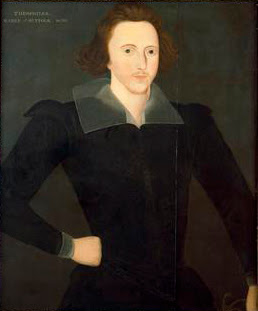
It is very likely that William Shakespeare was familiar with the Herball. Within the past year, evidence was presented that his portrait illustrates the frontispiece of of Gerard's 1597 work. 

Is this really the face of William Shakespeare?

Regardless of whether the gentleman brandishing a fritillary is the Bard, his plays and poems are crammed with plant and flower references and metaphors.
"The marigold that goes to bed with the sun
And with him rises weeping; these are flowers
Of middle summer, and I think they are give
To men of middle age." The Winter's Tale

In the tragedy Romeo and Juliet, Friar Laurence is conscious of both positive and negative powers of the herbs he gathers:

"Within the infant rind of this small flower
Poison hath residence and medicine power:
For this, being smelt, with that part cheers each part;
Being tasted, slays all senses with the heart.
Two such opposed kings encamp them still
In man as well as herbs, grace and rude will;
And where the worser is predominant,
Full soon the canker death eats up that plant."

John Parkinson

John Parkinson was very much aware of the decorative value of flowers. This author's Long Acre residence was adjacent to Covent Garden, and his proximity to the market gardens served him well. For adorning the house he suggested scented daffodils ('many are so exceeding sweet that a very few are sufficient to perfume a whole chamber'), wallflowers ('generally used in nosegays, and to deck up houses'), and iris. He was a great admirer of the newly popular tulip, introduced to England in the 1570s. The descriptive language used by Parkinson, and others, to convey the beauty can be quite poetic and evocative:
"The Anemonies likewise or Windeflowers are so full of variety and so dainty, so pleasant and so delightsome flowers, that the sight of them doth enforce an earnest longing desire in the minde of any one to be a  posessor of some of them at the least." Paradisus Terrestris (1629)
Nicholas Culpeper's The English Physican (1652) must be the best known of all the herbals.


Nicholas Culpeper

A polymath, after his apprenticeship to an apothecary he advanced to become a translator of medical texts, a physician, a botanist, and an astrologist. During England's Civil War he was under suspicion of practising witchcraft. He opposed the insular nature of the medical sciences, in particular the Society of Apothecaries. 

A firm proponent of the dissemination of medical knowledge, he published his works with the ordinary person in mind, using language and terms that could be easily understood and pricing his works cheaply. For these reasons, and because he disputed many of the accepted treatments and cures, he was unpopular with contemporary physicans.

If Culpeper had a favourite herb, it must have been rosemary:
"The oil of Rosemary. It hath all the virtues of the oil of connamon, nutmegs, carraway, and juniper berries; besides which it is much more powerful than any of them, strenghtening the brain and memory, fortifying the heart, resisting poison, and curing all sorts of agues; it is absolutely the greatest strengthener of sight, and restorer of it also, if lost: it makes the heart merry, and takes away all foolish phantasms out of the brain. It cleanseth the blood, cures tooth-ache, easeth all pains, and takes away the causes which hinder conception: it hath a very grateful taste, and hath so many virtues that I can never express them all, or give it its due commendation."
Culpeper's English Physician

Before Culpeper's day, the herbal (primarily a descriptive botanical catalogue) had inspired the publication of explicit guides to gardening practices, with recommendations for cultivation of all varieties of herbs, flowers, vines, trees, shrubs, and fruit, and instructive essays. Here is list of some publications produced during the 17th century, popular with the gentry and yeomanry, often dedicated to prominent patrons from the aristocracy:

The Countrie Farme (1600) Richard Surflet
The Fruiterers Secrets (1604) N.F.
Floraes Paradise (1608) Hugh Platt
The English Husbandman (1613) Gervase Markham
The Second Booke of the English Husbandman (1615) Gervase Markham
The Country House-wifes Garden (1617) William Lawson
A New Orchard and Garden (1618) William Lawson
Of Gardens (1625) Francis Bacon
Theatrum Botanicum (1640) John Parkinson
A Treatise of Fruit Trees (1653) Edward Hobday
Adam in Eden: or, Natures Paradise (1657) William Coles
The French Gardener: Instructing How to Cultivate all sorts of Fruit-Trees, and Herbs for the Garden (1658) John Evelyn (translation from the French)
The School of Physic (1659) Nicholas Culpeper
The Garden Book (1659) Thomas Hamner
Sylva, or a Discourse of Forest Trees and the Propagation of Timber in His Majesties Dominions... (1664) John Evelyn
The Gardener's Almanack (1683) Samuel Gilbert
The Compleat Gardeners Practice (1664) Stephen Blake
Kalendarium Rusticum (1675) John Worlidge
The Florist's Vade-Mecum (1682) Samuel Gilbert
An Improvement to the Art of Gardening (1694) Robert Sharrock
The Gardener's Almanack (1697) Leonard Meager


Throughout the 18th century, gardening guides proliferated. In that century and well into the 19th, voyages of discovery returned exotic specimens to England, hybridisers created ever more spectacular plants, botanical art flourished, and printing technology advanced. These simultaneous developments resulted in exquisitely produced and lavishly illustrated florilegia. 

Robert Furber's The Flower Garden Display'd (1732) was intended as an advertisement for his Kensington nursery business. 


Furber's flowers for March

It wasn't not merely a sensation in its own time: even now prints for each of the twelve months continue to be reproduced, framed, and placed on walls all over the world. Flora Londinensis (1777-1798), written by Richard Curtis and amply illustrated, is another fine example of botanical information combined with artistry.

Although modern science has expanded our knowledge of plants, their culture, and their habits, these wonderful books from the past contain interesting lore--and gardening advice never really goes out of style!


Illustration from Culpeper's herbal
~~~~~~~~~~~~~~

Margaret Porter is the award-winning and bestselling author of twelve period novels, whose other publication credits include nonfiction and poetry. A Pledge of Better Times, her highly acclaimed novel of 17th century courtiers Lady Diana de Vere and Charles Beauclerk, 1st Duke of St. Albans, is her latest release, available in trade paperback and ebook. Margaret studied British history in the UK and the US. As historian, her areas of speciality are social, theatrical, and garden history of the 17th and 18th centuries, royal courts, and portraiture. A former actress, she gave up the stage and screen to devote herself to fiction writing, travel, and her rose gardens.


Friday, May 29, 2015

To Catch a Priest

by Linda Root

Wikimedia Commons

A group of country folk were walking down a coastal road
north of London when they saw a stranger approaching.  Citizens in the area had been warned to be on the looked for unfamiliar faces.  Elizabeth Tudor’s spymaster Sir Francis Walsingham’s agents in Paris had sent an alarming message.  Jesuits were coming.  The farmers decided the current warnings could not possibly apply to the gentleman on the road.

And he indeed was a fine gentleman. He was a tall, swarthy man still in his youth, possessed of an aristocrat’s bearing and attitude. He was well groomed and dressed, although his cloak and boots were dusty as if he’d been on the road longer than customary. The poor man was obviously distressed.  He must be lost, the farmers thought.

"Have any of you good people seen my hawk?" he asked with a tremor in his voice. "I must have strayed too far from our usual surroundings and now my poor bird is gone missing."

It was not an unusual for members of the upper class to be as emotionally attached to their hawks as they were to their hunting dogs. In rural England, falconry was a favored sport of young aristocrats. It was rumored the Queen of Scots engaged in falconry from the balustrades while detained at Chatsworth. Much training was involved hunting with a falcon. Over time, a special bond formed between the handler and the hawk. No wonder the man was distraught. "Are ye sure ye have not heard its little bell?"

The farmers assured him they had not seen a hawk or heard the tinkling of a bell. With considerable empathy, they watched the man leave the road and wander off into the woods, desperately calling his bird. They had just encountered John Gerard, S.J., coming back to his English homeland after having been ordained. They would not be the only group to meet up with him and let him go merrily on his way.

I had never heard of John Gerard until I was adding finishing touches to my work-in-progress. The novel interjects a fictional Scottish aspect into the Gunpowder Treason. A mystery surrounding the accountability of Lord Robert Cecil, Earl of Salisbury, for allowing the plot to remain undetected until the Eleventh Hour sent me exploring the impact of the conspiracy on the  Jesuit mission to England.

Almost any historical novelist lured into that last wee bit of clarifying research before declaring a novel finished will have faced the dilemma created by a pestiferous fact challenging the novel’s premise.  Do we go on, or do we set the current work aside and begin anew, perhaps with an entirely different story?  What action should be taken when just before we type the words ‘c’est fin’, we uncloak a larger than life character whose exploits tarnish our protagonist? While we are not historians and can invoke the principle of artistic license and continue, it is often difficult to put the new character aside.  The word that comes to mind is ‘sequel.’

Questioned portrait of Father Gerard-PD Art

I was well into my  recent work In the Shadow of the Gallows, featuring Daisy Kirkcaldy and her husband, Will Hepburn, when I realized the priest I had written into the story sounded incredibly like the Jesuit John Gerard of my research, one of the few Jesuits of the English mission who survived the aftermath of November 5, 1605. The more I wrote, the larger his part in the tale became until I faced the prospect of marketing a tome. In today’s market, a historical novel the size of the Los Angeles Metropolitan telephone directory is doomed. The solution was to shave his role into something manageable and promise myself to do justice to his exploits in my next book in the series. In my case, I call it Deliverance of the Lamb.

Fortunately, in dealing with Father Gerard, there is a plethora of material on which to base a sequel. After his final flight from England in May 1606, a high-ranking Jesuit recognized the potential of using his life story as a recruitment tool.  Gerard was ordered to document his life story in writing. The original was written in Latin, but it has since been translated into English and embellished with excellent notes. Anyone who fears an autobiography written by a cleric in 1611 will be tedious drivel is in for a shock.

The Autobiography of a HUNTED PRIEST reads very much like a prize-winning well-researched historical novel.  Not being a Catholic or having much of a religious bent, I had no idea I was opening a page-turner or that Gerard was one of history’s most notable escape artists.  Research the topic of great escapes and you will find his escape from the Tower of London on the list.

No undisputed likeness of John Gerard survives.  The one shown above has recently been questioned.. However, there are three similar descriptions in his biography. Putting the accounts together, one can surmise he was exceptionally tall, very dark complected with long black hair, dark eyes and a manicured mustachio, and a stylish patch of facial hair on his chin.  Accounts of his phenomenal successes in converting aristocratic women suggests we can comfortably add the descriptors handsome and charismatic to his attributes.

A second work written by Gerard is an essay entitled The Condition of Catholics Under James I: Father Gerard’s narrative of the Gunpowder Plot. Not only is it a comprehensive critique of the Gunpowder Treason from a  Catholic point of view, and hence a bit of an apology, but it also reveals much of the author’s character. It is not as readable as the beautifully translated and edited Hunted Priest, but it is a compelling source, and its Kindle version is free of charge.

Perusing Father Gerard’s works and others writings about Early Jacobean England, a thumbnail sketch of Gerard’s colorful life emerges. Most sources place his birth in the autumn of 1564.  His father had been knighted for acts of valor and was the respected Sheriff of Lancashire. Later, however, the senior Gerard was imprisoned in the Tower for participating in one of many schemes to free the Queen of Scots.   His popularity earned him a favorable disposition of the charges.

Young John Gerard matriculated at Oxford at age eleven, but when he was asked to make a Declaration of Faith and renounce the Catholic religion to continue, he withdrew.  Surprisingly, he obtained permission from an Anglican bishop to continue his studies abroad. He headed to the Jesuit College in Douai, the institution founded by the militant activist Cardinal William Allen, the man behind the Jesuit mission to England.

When the establishment moved to Rheims in 1578, John Gerard went with it. He was still far too young to be inducted into the Society of Jesus.   Quite incidentally, the timing of his three-year stay in Rheims fits perfectly into my plotline for Deliverance of the Lamb.

He began his mission to England in 1582.

Like all Catholic priests of his day, he was aware of the risks involved if he were identified as a priest.  Early during his mission he spent a year in Marshalsea prison, which left him not the least dismayed.  He had plenty of time to study while confined. Eventually, he was bailed by none other than Anthony Babington of the infamous Babington Plot, a plan designed to place Marie Stuart on the English throne. Gerard's life story is filled with names of aristocrats associated with plots to supplant Elizabeth with her Catholic cousin Marie Stuart. Elizabeth’s fears were more than paranoid delusions.

It helps to remember that until the second quarter of the 16th Century, England had been a Catholic country led by the Pope’s Defender of the Faith, King Henry the Eighth.  The popular mid-Twentieth century adage, You Cannot Legislate Morality applied then as now.

After he was bailed out of jail by Babington, Gerard jumped parole and returned to Europe and eventually settled in Rome.  He was still young to be inducted into the Jesuit order but after a period of accelerated but rigorous study under Cardinal Allen's oversight, he was ordained and ordered to proceed to London. This is the journey north to Paris and the coast which was observed by  Walsingham's spies. He and three other priests including his good friend Father Oldecorne eventually boarded a ship headed for the English coast. They did not disembark until they were north of London, where Gerard predicted matters would be quiet.  However, the Watchers were on the lookout.  To be less obvious, the group split up.  While the incident described earlier went well, a few days later he encountered a patrol and was taken into custody.  At the time, Gerard told a convincing story to the men who detained him and charmed his way out of it.

Many of his encounters follow a similar script.  His good breeding, physical attributes and persuasive words got him out of one fix after another.  On several occasions, appearing before magistrates who had known his father helped.

Henry Garnet, S.J. (Wikimedia)
Soon he was in London hoping to meet Father Henry Garnet, the Superior Jesuit in England. First, he made friends with a Catholic aristocrat who took him into his fine house in Grimston. The man's Protestant brother was curious as to his background, but Gerard's gentlemanly habits assuaged any fears of unwittingly harboring a priest. Gerard used his good manners and his knowledge of falconry and other indicia of membership in the gentry to convince others he was a high-born Englishman touring his country. However, to those who needed his intercession with their God, he abandoned his disguise.  The services he rendered in bringing peace to the many troubled families caught up in the Reformation earned him steadfast friends who were willing to risks their lives to keep him free.  While he did not seek rewards, he accepted them graciously as a means of supporting the lifestyle that kept his true vocation a secret.  The Watchers and Pursuivants were not seeking out well-heeled aristocrats, complete with servants and fine horses. They were looking in hidey holes and secret rooms for impoverished, starving priests.

During the latter days of Elizabeth’s rule, Gerard moved from one host household to another, converting many and sending some of the young men abroad to the Jesuit College. He sent one of the executed Earl of Northumberland's daughters to his friend Father Holt in Belgium. She later became a founder of the English Benedictine convent in Brussels which figures in the plot of my novel 1603: The Queen's Revenge.


((PublicDomain,-Art-US))

Gerard's exploits included a stay in the Tower of London in 1597 where he was tortured for his refusal to lead them to his Superior Father Garnet. Even the account of his suffering has its dramatic twist. His height complicated matters for his tormenters. When they hung him from the ceiling of the torture room by chaining his hands to a pole suspended between the two highest of the hooks, his toes still reached the floor. His abusers had to use shovels to dig a pit to make the device effective.

The Salt Tower- courtesy Richard Nevell
What is more, their tactics failed. His escape from the notorious Tower is well remembered.  Different versions appear on almost every list of famous escapes and prison breaks. He did it by employing remarkable charm, an innovative flight plan, a healthy dose of personal ingenuity and a bit of derring-do. He made friends with an inmate John Arden in another tower by passing notes written in orange juice. He made fast friends with his jailor who helped them pass information to friends on the outside.  The jailor provided a rope to use to climb down the out wall and toss across the moat. Finally, the two escapees and their jailor made it to a spot on the Thames where the jailor had a dinghy hidden.  They rowed to a prearranged rendezvous with Gerard's friends. He was never taken into custody again during the remaining several years of his mission in England.

During the remainder of his mission, he did not spend his time in hidey-holes like so many of his counterparts. He played the role of an aristocrat too well to resort to secret rooms and false cabinets to keep him free.  He was a master at hiding in plain sight. At the time of the Gunpowder Treason, he had been living in the Strand.

Midway through his autobiography, a student of early Jacobean history will recognize familiar names in the footnotes. Gerard described his friends but never named them in the original Latin text.  Gerard was far too wily to kiss and tell.  The single noteworthy exception is in several references to Everhard Digby, one of the plotters who came into the conspiracy in the middle stages. For years, he had been among John Gerard’s closest friends.  The intensity of their relationship is the one point which makes Gerard's disclaimer of guilty knowledge of the conspiracy disingenuous.

In discussing the Gunpowder Treason, there is no doubt where Gerard's passions lay. He empathized with the men involved and considered their deaths acts of martyrdom.  Although he believed their grievances were legitimate, he did not endorse the violence, and he did not know the details until the plan was in motion. He did not join their conspiracy, but he was not blind to the emotions driving it.  While at least two other Jesuits knew what was planned, they had received their information under seal of the confessional. Had he been caught, he would not have the sanctity of the Confessional as a defense, for whatever good it might have done.

After the Gunpowder Plot was uncovered, Jesuits were fair game, even though they had not been active in it.  Cecil used the event to launch a purge. At least four former Catholics who knew members of the English mission offered their services to Cecil, one of whom was a woman whose husband was in exile. She was anxious to get her lands and privileges restored, and offered to deliver Gerard. When the house where he was staying came under scrutiny, she arrived with the pursuivants, waving a king’s warrant in her hand. On that occasion, Gerard’s escape was less spectacular than his Tower breakout. He withdrew into a secret room with a scant supply of water and a jar of rich preserves. He stayed there under unhealthy circumstances for nine days before the searchers moved on.

Other women--especially Ann and Elizabeth Vaux, risked their lives to help Gerard and others escape.  The celebrated recusant Elizabeth Vaux was taken to London and interrogated as to Gerard's whereabouts and remained defiant.  By then, others of Gerard’s associates including his superior Father Henry Garnet had been apprehended.


The Discovery of Father Garnet and Father Oldecorne
((PD-Art))

After her release, Elizabeth Vaux made certain Father Gerard had everything he needed to subsist until an escape could be arranged. She offered to finance his flight to the tune of five thousand florins and gifted Gerard a thousand florins in travel money.

Gerard’s last escape was brilliant, but likely he had little to do with its planning. It appears to have been arranged by people with rank and  power in the Spanish Netherlands or France.  He left the country of his birth disguised as a manservant in the entourage of the Spanish Ambassador and a diplomat sent by the Hapsburg co-rulers of the Spanish Netherlands, Albert and Isabella Clara. The Dutchman had been in London setting the ground rules for peace negotiations between England and the Hapsburgs scheduled for later in the year 1606. Shortly before they were scheduled to board ship, the Spanish Ambassador balked, but on the morning of May 3, he rethought his position and welcomed Gerard  into the group of departing dignitaries, playing the part of a footman. The ship set sail on the day of his mentor Father Henry Garnet's suffering.

 Father Gerard remained an active Jesuit engaged in the education of seminarians and the spiritual preparation of novitiates, and he was the first Rector of a Jesuit House of philosophy and theology at Liege.  Later he returned to Flanders to take a similar position in Ghent, supervising the newly ordained during their year of probation.  In the last ten years of his life,  he served as confessor to the English College in Rome. He died there in 1637, one of the few survivors of Lord Robert Cecil's purge.  Since the annexation of Rome to the Italian State, the Collegio Roma is now houses the Italian Ministry of Heritage and Culture.

Collegio Roma-Wikimedia Commons
His autobiography is a gem, filled with anecdotes and what modern readers might call 'war stories' told with a light touch that captivates and entertains. It is a small wonder he was successful as a recruiter. What I have reported is but a small sampling of a life even the best historical novelist would be hard pressed to surpass.

I plan to enjoy assisting Father John Gerard’s escape in The Deliverance of the Lamb, which, God willing, I will have ready to launch by the end of the year.  I invite his spirit to guide me in my endeavors. I can hear his ghost whispering as I write, ‘Greetings, Madame. The name’s Gerard. John Gerard.’

~~~~~~~~~~~~~

Linda Root
Amazon