Showing posts with label Wars of the Roses. Show all posts

Sunday, August 23, 2020

The Portraits of Lady Margaret Beaufort

by Judith Arnopp


Most of us are familiar with the portraits of Margaret Beaufort. Invariably she is depicted toward the end of her life, elderly, austere, and pious. It is difficult to imagine this staid, nun-like woman as a gurgling baby, or a naughty child; even less as a vigorous young woman. 

But people, even Countesses, are not born pious. Her face must once have been unlined, she may have been frivolous, perhaps even reckless. She was certainly determined; her crusade to secure her son Henry VII on the English throne involved intrigue against a reigning monarch. Against all odds, she financed her son’s campaign and in doing so, changed her life forever. 

With Henry’s accession to the throne, she became the most powerful woman in the realm, and she did not waste her new-found success but became one of Henry’s chief advisors, her charitable work extending to the foundation of universities, and championing the arts.

The portraits we see today are not contemporary. Without exception, she is depicted in her later year, clothed in a peaked white headdress, usually with a book, and always in the act of religious contemplation with an aura of chastity and charity.

Of course, portraits are not always about the subject’s appearance; sometimes a painting depicts a person’s character rather than how large the sitter’s nose may have been. Margaret, in her exalted position, would have been keen to project an authoritative, reverent persona but she evolved into a nun-like figure, as a young woman she would have suffered all the uncertainties, the passions and the flaws that we all experience. That is the Margaret made more fascinating simply because of the lack of portraiture from the uncertain days of her youth.

There are no extant portraits of Margaret from her lifetime, the ones we see today were made during the reigns of Henry VIII and Elizabeth I. Undoubtedly they are copies of a lost original so, particularly if we compare them to the effigy on her tomb at Westminster, we can be fairly sure of her appearance during the later years of her life. This portrait of Margaret is believed to have been part of a set of corridor portraits including Henry VII, Henry VIII, commissioned during the reign of Elizabeth I. Again Margaret is in a religious pose, her clothing and book of hours illustrating her religious devotion. It is the best-preserved portrait we have of Margaret, the detail of the golden arch beneath which she sits, and the ornamented cloth of state is still visible to the naked eye.

My personal favourite portrait of Lady Margaret hangs in St John’s College in Cambridge. It was painted by Rowland Lockey in the 16th century. Margaret is shown at prayer in a lavish apartment, presumably her private chamber. She kneels at a desk with a heavy embroidered cloth and before her is a prayer book, a sign of piety and learning, and beneath it the ‘chemise’ cover she wrapped it in. Above her head, a tester bears the Tudor rose. The chamber itself is sumptuous, testament to her love of comfort, the stained glass windows with the badge of the Beauforts and of England.

This portrait tells us more about her lifestyle than the others. We can see that despite her sombre attitude, she lived luxuriously, as one would expect. Her dark clothes, although quite dour to our modern eyes, were of the best quality, black being among the most expensive and difficult hues to buy. 

After her death ‘seven gowns of black velvet were found, trimmed with ermine, and a mantle of tawny.’ And, most interesting of all, was ‘a scarlet gown with a long train, ornamented with the badges of the Garter and evidently to be worn on St George’s day. In another inventory we find a crimson gown to be work with her ‘circuit’, not a diadem but a surcoat, such as she had worn at Christmas 1487.’


So, a new Margaret begins to emerge, a woman who favoured scarlet and ermine, whose ‘chariot men wore scarlet. The very buttons of the horse harness were of gold of Venice.' This speaks less of piety and very much of majesty, perhaps even a little vanity.

The National Portrait Gallery has a portrait previously thought to be Margaret but now largely dismissed. It features a younger woman, hands clasped in pious prayer, her head covered with a veil. The painting is dark but the gown appears to be dark red, the veil itself lavishly embroidered. The nose is long and heavy, the eyes heavily lidded, as Margaret is shown in other portraits, and the face is pensive. Whether the sitter is lost in religious contemplation or distracted by plots of rebellion, it is difficult to judge. 


As I said earlier, the portrait is no longer believed to represent Margaret but it is intriguing none the less and I confess I used it during my research to picture the younger Margaret, the young woman who, widowed three times and separated from her only son, had no notion of the triumphs the future held.


[1] Jones and Underwood, The King’s Mother p188
[2] Ibid p189

Portraits from Wikimedia Commons

This is an Editor’s Choice from the #EHFA archives, originally published February 25, 2019.

~~~~~~~~~~

Judith Arnopp is the author of eleven historical fiction novels including The Beaufort Chronicle: the life of Lady Margaret Beaufort. 

Connect with Judith at https://author.to/juditharnoppbooks. Judith's books are available through Amazon including The Beaufort Bride, The Beaufort Woman: Book Two of the Beaufort Chronicles, and The King's Mother: Book Three of the Beaufort Chronicles


Monday, August 21, 2017

All you thought you knew about the Wars of the Roses, but didn’t… Episode One: Henry VI: the mad king?

by Derek Birks

A few weeks ago, I had a bit of a rant on Facebook about the common myths which persist about many aspects of the Wars of the Roses period. I vowed to do something about it, so to start with, I'm looking at Henry VI himself.

There are two commonly held beliefs about Henry VI: either he was a simpleton or he was mad – not a great choice really… and of course, neither charge is actually supported by the evidence.

Myth #1: Henry VI was a simpleton; he was just plain stupid.
Like most myths of history, this claim is so often repeated that it seems to be regarded by many as truth, despite the fact that there’s no real evidence of it at all.

Henry was not a fool. There is enough evidence, however, to suggest that he was naïve.

For example, he put far too much trust in several of the powerful and ambitious men around him at court – men like Edmund Beaufort, Duke of Somerset. But let’s bear in mind that Henry spent the whole of his long royal minority surrounded by noble advisers. He had grown up accepting advice and the habit, for a young man who was not particularly assertive, was probably quite difficult to break.
Was Somerset, or his rival for influence at court, Richard, Duke of York, especially greedy or corrupt? No, not really by the standards of the time, but they did have their own personal agendas – along with every other nobleman, lord or gentleman in the land!

A strong-willed king, who understood such men, might have managed them rather better.
Henry was undoubtedly a poor manager of men.

Henry VI [courtesy of wikipedia]
Henry was more concerned with spiritual matters than political ones – but that doesn’t make him a fool. His piety and his concern for men’s souls is somehow easily dismissed in our very secular age, but such matters were very important to all in the later middle ages and certainly not a sign of folly.

Is it so hard to believe that Henry was simply a peace loving man in an age that valued more martial virtues? 

Their king was so different from his warlike father, Henry V, that his subjects felt undermined and confused by his approach. He wanted to bring to an end the long French wars with a peace agreement. In that respect, he was out of step with the majority of his subjects for whom a successful conclusion of the war meant a military victory. Jack Cade’s Rebellion in 1450 showed the anger and distrust stirred up by Henry’s government but the rebel targets were his councillors not the king himself.

Judge him by what he did: for example, Henry wrote a letter to the French king suggesting peace and offering him some English-held lands in France. That was certainly unwise since such lands were currently held by Henry’s own subjects. Giving them up was not likely to be popular. So he was naïve, but – and here’s why he was no fool – he kept the letter secret. 

Why? Because he understood how alarmed his leading subjects would be if they knew about his offer. If he understood that, then he had more about him than your average simpleton.

Naïve then maybe, but not an idiot.

Myth #2: Henry VI was 'mad'.

Now madness is a very general term and the public perception of madness is therefore quite broad and vague. Consequently, using the word at all is unhelpful in trying to describe or understand anyone.

So what basis is there for this claim? There’s no question that from 1453 – a year traumatic enough for the average king - Henry VI succumbed to bouts of mental illness. Schizophrenia has been suggested – amongst other diagnoses. The first of these rendered him incapable of speech or recognition of those around him.
This was not a ‘mad’ king flinging out commands such as “Off with his head!” or something! It was simply as if the throne was vacant.
This first occurrence was the most significant because no-one was prepared for it and it led to the emergence of the Duke of York as the de-facto political leader of the country. In 1453 York saw himself as rightly restored to a position of great influence. But even York’s closest supporters only ever saw him as a caretaker – whether for the ailing King Henry, or for his very young son, Edward, when he ultimately came of age.

When the King recovered his capacity in December 1454, York’s role as protector was once more unnecessary and his supremacy at court waned. This was not a result of 'madness' on the king’s part but further evidence of his inability to manage political factions. Thus it resulted in the victory of one faction – that of the Duke of Somerset – over another. 

In the turbulent years which followed, it suited the Yorkists to blacken Henry’s name by emphasising his incapacity to rule: either by promoting the idea of his stupidity or his madness. Either of these slurs might help to undermine public confidence.

Yet, even after the Yorkists had taken up arms against the king and seized the throne in 1461, most of the nobility still sided with Henry VI, their anointed king. A king who inspired such loyalty had clearly earned a great deal of support from many of those closest to him. If he had truly been an imbecile or a mad man, I cannot believe he would have retained such genuine goodwill.

Two key elements of Henry VI’s kingship were:
1.      he was unable to control his leading subjects
2.      he aspired to resolve problems by peaceful means.


These two factors combined to make him an ineffectual king but neither of these factors made him mad or stupid. It's high time we stopped perpetuating these myths.

...............................

Derek was born in Hampshire in England but spent his teenage years in Auckland, New Zealand, where he still has strong family ties.

For many years he taught history in a secondary school but took early retirement to concentrate on writing. Apart from his writing, he spends his time gardening, travelling, walking and taking part in archaeological digs at a Roman villa.

Derek is interested in a wide range of historical themes but his particular favourite is the late medieval period. He writes action-packed fiction which is rooted in accurate history.
His debut historical novel was Feud, which is set in the period of the Wars of the Roses. Feud is the first of a now complete four-book series, entitled Rebels & Brothers, which follows the fortunes of the fictional Elder family from 1459 to 1471.
A new series, The Craft of Kings, picks up the story of the Elders in 1481 in its first book, Scars From The Past. Later this year, the violent events of 1483 are played out in the sequel, The Blood of Princes.


Tuesday, July 5, 2016

Margaret Beaufort: The King's Mother

By Judith Arnopp

3rd July 1509, Westminster Abbey - the body of a woman lies in state in the Abbey Refectory. The light of a thousand flickering candles falls upon nun-like clothing, hands clasped as if in prayer, a lined face testament to a life of battle, a life of uncertainty, a life of unflinching duty. This woman was the King’s mother …


Literature has not been kind to Margaret Beaufort. She was not a pretty woman, but she was pious, and she was resilient. It is not easy to turn a strong, plain woman into a romantic heroine and so, in fiction at least, she has become a harridan, a half-mad zealot. Feminists today celebrate the few medieval women who stepped from beneath the thumb of masculine authority but Margaret is seldom among them.

Due to their illegitimate roots, the Beauforts were barred from succession but that did not prevent them from becoming one of the most powerful families in England. From the day of her birth Margaret was a prominent player in the story of what we now know as the wars of the roses.

In the first year of her life Margaret’s father, out of favour with the king after a failed campaign in France, took his own life and Margaret was placed in the protection of the Duke of Suffolk, William de la Pole. When she was six-years-old she was married to the Duke’s son, John, a boy of seven.

Shortly after this the Duke himself fell into trouble and was killed trying to flee the country. Margaret and John’s marriage was quickly dissolved. As the country deteriorated into civil war the king’s brothers, Edmund and Jasper Tudor, were given the wardship of Margaret. At the age of twelve she became the wife of Edmund, the Earl of Richmond. She followed him to Wales where Edmund battled on the king’s behalf against Gruffyd ap Nicolas. They made their home at Caldicot Castle and Lamphey Palace which Edmund used as a base for his military operations. It must have been an alien environment for Margaret so fresh from the nursery at her mother’s home at Bletsoe.

After winning back Carmarthen castle, Edmund fell into dispute with the Yorkist, William Herbert, who imprisoned him at Carmarthen. Edmund died there, either of wounds, or plague, or a combination of both. He left his twelve-year-old widow, Margaret, six months pregnant with his child.

Margaret, vulnerable and alone, turned to protection to her brother-in-law, Jasper, who took her to Pembroke castle. It was in his cold, lofty fortress that Margaret gave birth to her only child, a son, whom she named Henry after her cousin the king.

Within weeks of his birth Margaret had taken her life into her own hands and arranged, with Jasper’s assistance, to marry Henry Stafford, a younger son of the Duke of Buckingham. Henry remained in the care of Jasper but, when Edward IV won the throne, he was placed in the hands of William Herbert to be raised at Raglan Castle in Wales.

How Margaret must have felt at handing her beloved son into the custody of the man responsible for her husband’s death can only be surmised. Henry maintained his title of Richmond but his lands and properties went to the new king’s brother, George, Duke of Clarence. As soon as she was able Margaret began to campaign for the return of Henry’s birthright. Henry was well treated by the Herberts, and given a place almost as a family member. Margaret maintained good relations with Herbert and his wife, wrote to him often and visited Henry on several occasions.

In 1469, after the Battle of Edgecot, Herbert was executed by the rebel Warwick, and Jasper took back control of his nephew until the Lancastrian defeat at Tewkesbury when he and the boy took flight to France, ending up in Brittany. They rode away without saying goodbye, and Margaret was not to see her beloved son for fourteen years.

Margaret seems to have been happy with Henry Stafford who sought peace with Edward IV, winning positions at court. Their main residence was at Woking where they made several improvements to the palace but Henry Stafford was wounded at Barnet in 1471 fighting for York. He died shortly afterwards, never recovering from his injuries. Wasting no time, before the year of mourning was up Margaret again made a strategic match, marrying Thomas Stanley in 1472.

Stanley was a prominent member of Edward IV’s court who offered her the position she craved. She seems to have remained loyal to King Edward but, on the accession of Richard III in 1483, she began to plot against him. There is no evidence she had anything to do with the disappearance of the princes in the tower but she was behind a series of rebellions. After a failed attempt involving the young Duke of Buckingham, despite her clear involvement, Richard was merciful and placed her in the custody of her husband – where she continued to conspire against the king. Her machinations eventually paid off and with her help Henry and Jasper raised an army in France and landed at Milford Haven in 1485. The Battle at Bosworth marks the beginning of the end of the Wars of the Roses and, like it or not, on that day Margaret achieved her life’s ambition. Not only did she finally see the ultimate victory go to Lancaster but she witnessed her only son, Henry Tudor, crowned King of England.


An objective look at the Wars of the Roses reveals no saints, no sinners; each side was as much at fault as the other. It is clear to me that Henry VI and his queen, Margaret of Anjou, were ineffective and unsuitable rulers. I can understand the frustrations of the ambitious Duke of York. On the other hand it is also clear that Edward IV became a lazy king, too fond of his leisure and exasperating his most loyal brother, Richard of Gloucester. In the few short years he ruled Richard III showed promise as king, he may have made a decent job of it given the chance. It would be a different world today had the outcome at Bosworth been different.

Henry Tudor, a complete opposite of Edward IV, cared nothing for the favour of the people. He ruled as he saw fit, his decisions often dictated to by his experiences as an exile. He made tough, sensible decisions regardless of contemporary opinion. On his death the royal coffers were full, riches that were quickly depleted by his son Henry VIII who seems to have inherited the love of excess from his grandfather, Edward IV.

During his reign Henry Tudor was guided by his mother, a woman who never for one moment faltered in her support for him, and to listen to her was probably one of his best decisions. She was a woman to be reckoned with, a wise politician, and a formidable opponent. Henry owed her everything. When he died in 1509 the future of the Tudor dynasty rested with his son, Henry VIII, a virile, golden prince whom everybody loved.

Margaret died seven days after the coronation of her grandson, Henry VIII. She had taken a prominent part in the upbringing of all her grandchildren, perhaps finding some solace for only having given birth to one son. It seems that on the death of her son and the accession of her grandson, her job was done. She had lain down her life for the Tudor cause, worn herself out for her cause, and for England. It was time to go.


Margaret Beaufort was a diminutive, self-reliant, determined woman whose piety was outstanding even in the devout days of medieval England. Most historic female achievers are saluted today. We see them as early feminists, pioneers for modern women to emulate, but Margaret is seldom celebrated. In her day she was a hallowed figure (she made sure of that) but today she is tainted with ignominy. I can only think it is her lack of romance, her lack of prettiness, her lack of sexiness, yet Margaret was awesome!

During my research for The Beaufort Chronicles I have discovered a new respect for Margaret Beaufort; I salute her metamorphosis from pawn to the most powerful person in England beneath the king.

~~~~~~~~~~~~~~~
Judith Arnopp is the author of eight historical novels, her latter work concentrating on the transitional years of the wars of the roses. She is currently working on The Beaufort Chronicles, charting the life of Margaret Beaufort. Book one: The Beaufort Bride is available now in paperback and on kindle. The Beaufort Woman coming soon.

The Beaufort Bride: Book one of The Beaufort Chronicles – out now
The Beaufort Woman: Book Two of The Beaufort Chronicles – pre-order now
The King’s Mother: Book Three of The Beaufort Chronicles – to follow.


The Beaufort Bride
The Beaufort Woman
A Song of Sixpence
The Winchester Goose
The Kiss of the Concubine
Intractable Heart
The Song of Heledd
The Forest Dwellers
Peaceweaver

mybook.to/thebeaufortbride

 https://upload.wikimedia.org/wikipedia/commons/3/3f/Tudor_Rose.svg
https://upload.wikimedia.org/wikipedia/commons/3/31/Margaret_Beaufort_2.jpg
https://upload.wikimedia.org/wikipedia/commons/9/9b/Henry_Seven_England.jpg
https://upload.wikimedia.org/wikipedia/commons/b/b3/Lady_Margaret_Beaufort_from_NPG.jpg

Friday, June 17, 2016

Edmund Beaufort, a mover and shaker in the Wars of the Roses

by Derek Birks

First of all, it is important to remember that there were at least four Beaufort Dukes of Somerset populating the period and two of them were called Edmund. Get over it. This is the Wars of the Roses and it was never simple.

The Edmund Beaufort I’m writing about here was the grandson of John of Gaunt, one of the many sons of Edward III.  Both Edmund and his king, Henry VI, therefore had Lancastrian royal blood in their veins, but the Beauforts by law could not inherit the throne. Their line of descent came from an illegitimate liaison between John and Katherine Swynford. Though they were later legitimised, Henry IV barred them from the succession by letters patent.

Edmund was the younger brother of John Beaufort and became Duke of Somerset after his brother’s death.

Alright, so why do we care? What part does he play in all the carnage?

Well, if you were to regard the Wars of the Roses as a barrel of gunpowder, Edmund Beaufort was the fuse – completely harmless of course, until…

Why Did Somerset Become a Problem?

King Henry VI was well-disposed towards the Beauforts in the 1440s at a time when Henry’s government was dominated by William de la Pole, Duke of Suffolk.

Edmund was appointed to a command in France where he replaced Richard, Duke of York. York did not take it well, resenting Somerset’s rise. His annoyance was compounded by the fact that Somerset was not a very competent commander. His resentment was further fuelled by the fact that Somerset was promised £25,000 to fund his campaign whereas York had received nothing and was owed many thousands. York was then sent to rule Ireland – far from the centre of power.

Why Was the Rivalry Between York and Somerset a Problem?

Richard, Duke of York
In 1450 a wave of popular unrest caused several attacks against Suffolk’s corrupt government, culminating in the murder of several members of the king’s inner circle, including Suffolk. This left a void at the heart of the government. Whatever happened next there would be a new regime.

York was an obvious candidate for advancement since he was the most prominent nobleman and, if King Henry were to die childless, then York was the heir presumptive. York, keen to take what he saw as his rightful place, returned from Ireland unbidden and began a propaganda campaign against the king’s corrupt councillors, especially Somerset.

Undoubtedly Henry preferred Somerset and recalled him from France, where the war was going badly, to bring him back to the centre of his government. He could of course, if he wished, remove the legal impediment to Somerset inheriting the throne. If he did so then Somerset, not York, could be seen as the heir presumptive.

York feared exactly that. He posed as a seeker after justice and had notable support in the House of Commons. Henry’s response in May 1451 was to dissolve parliament. In the end, the only opinion that mattered was Henry VI’s.

Meanwhile Somerset was appointed Captain of Calais, a prestigious post reserved for trusted men. So Henry trusted Somerset where he did not seem to trust York, possibly because he feared that York wanted the throne.

Somerset’s new appointment and dominance incensed York. Once more he embarked on an extensive campaign against government corruption, hoping to rise on a tide of popular support. He raised troops and marched to London intending to remove Somerset by force if necessary.

Henry VI
The king and Somerset rallied some support too and their small army also camped outside the city.
Few nobles supported York. Most had no stomach for taking up arms, even against Somerset. So negotiations followed and the councillors agreed that if York dissolved his army, then Somerset would be imprisoned and tried for his poor conduct of the French war. It seemed that the king agreed to this but after York sent his men away, he found that Somerset was still there by the king’s side. Instead York was treated like a prisoner – after all, what he had done certainly amounted to treason.

In the end though, Henry VI let him go and York retired from London to lick his wounds for royal service had beggared him. Later in the year Somerset could not resist rubbing York’s nose in his failure when he presided over the trial of some of York’s followers at Ludlow in the very heart of York’s powerbase. Somerset now had the king in the palm of his hand.

What went wrong then for Somerset?

It started in June 1453 when the king gave Somerset some estates in south Wales. Somerset was desperate for landed income since the Beaufort family did not have much. His income came otherwise from the various royal pensions and grants he received from the king and the profits from any offices he held.

Unfortunately, the lands Henry gave him belonged to Richard Neville, Earl of Warwick. When it came to land grabbing, Warwick was up there with the best and he strongly resented losing estates in an area where he was keen to build up influence. From then on, Somerset was a legitimate target as far as Warwick was concerned, but poor Somerset carried on oblivious to his peril.

Edmund in France (Rouen)
The really bad news though was to come in July 1453 when the French war – always the elephant in Henry VI’s chamber – took a turn for the worse. A military catastrophe occurred when the heroic John Talbot, Earl of Shrewsbury, was defeated and killed at Castillon. England’s last significant army in France, apart from the Calais garrison, was destroyed.

Even worse was to follow. The king suffered a debilitating breakdown which left him immobile. Whether it was brought on by the news from France is not clear, but England now lacked a king at the helm. For the queen, soon to give birth to a male heir, and Somerset, it made government almost impossible. For a few months Somerset muddled through by putting off matters upon which only the king could decide. But by October the king’s council agreed that someone must be appointed with authority to rule for the king.

They recalled York from the political wasteland to re-join the council. There, for various reasons, not least the little matter of estates in south Wales, York found support from the powerful Neville family. Somerset suddenly found himself confined to the Tower whilst the council argued over who should rule. The queen, worried for her new son if York should take charge, tried to have herself declared regent, but the council refused and in 1454 chose York as Protector of the Realm.

How then did Somerset extricate himself from the Tower?

The start of the Wars of the Roses. York picks white
flowers, Somerset red (Henry Arthur Payne)
It was quite simple really: the king recovered – at least enough to tell the difference between York and Somerset. By February 1455, York had to step down. Somerset was released from the Tower and at once contrived to forge an alliance with all those who were rivals of the Nevilles and York. The rivalry between York and Somerset, if left to continue, would destroy the kingdom; something had to give. York and his allies left London in haste to prepare for war.

Somerset and the queen were of one mind: York had to go. A Great Council was summoned to meet at Leicester on 21st May, 1455. It was hand-picked and the hand didn’t pick York or any of his allies because, of course, the purpose of this Council was to condemn them. The Council, however, never met.

Somerset was a poor strategist – as his French exploits had proven. Thus, he was slow to react when York left London and only began to muster troops when York was already on his way south with an army.

On 21st May, Somerset and the king set off for St Albans to await the arrival of the retinues they had summoned. They spent the night of 21st at Watford. Overnight there was an exchange of messages with York. The latter stressed his loyalty and desire for a council without Somerset in it. Early on the morning of 22nd May a final message came from York. It said little new but the king summoned his council to discuss what to do.

Somerset, surprised by the speed of York’s advance, advised waiting at Watford until they had gathered more strength. A more moderate councillor, the Duke of Buckingham, proposed continuing to St Albans, arguing that York was merely exerting pressure and would not push for a fight. Henry took Buckingham’s advice not Somerset’s and continued to St Albans, arriving about 9am. York and the Neville lords were already camped in the fields on the outskirts of the town but King Henry continued into the town centre.

What happened at St Albans?

Many of those with Henry assumed that, after all the posturing, there would be negotiations and the matter would be settled peacefully. Heralds were sent to and fro to see if such a process could be started. This was normal procedure – a sort of last ditch effort to avoid actual fighting. But even whilst the heralds were still working, the skirmishing began and by 10am York was on the attack. He did not find it easy though to break through the town’s defences. His men toiled for an hour or so to no avail.

York had got nowhere but Richard Neville, Earl of Warwick, was a little more creative in his tactics. Driven on by his desire to resolve his differences with Somerset by force, he broke through some gardens and houses of the town, taking the King’s household by surprise. Many were not even wearing armour and they scattered across the town seeking refuge wherever they could. The Duke of Buckingham fled to the abbey and Somerset dived into the Castle Inn. York’s men now broke into the town and, once victory was achieved, he ensured the safety of the wounded king who was hiding in a tanner’s cottage.

The Duke of Somerset, trapped in the inn, knew very well that York and Warwick would not let him live. So, with his loyal retinue, he tried to fight his way out. It is said that Somerset killed four men before he himself was hacked to death.

The events of 22nd May 1455 are sometimes referred to as the First Battle of St. Albans. Some have argued over the term “battle” suggesting it was only a skirmish. Casualties probably amounted to less than a hundred, but York’s objective was achieved: Somerset and the northern rivals of the Neville lords, Northumberland and Clifford, were not just removed but killed.

This was a coup d’etat more than a battle and soon after a bill passed through parliament blaming Somerset for causing the affray.

What then was Somerset’s contribution to the Wars of the Roses?

Few nobles were especially enamoured with either Somerset or York as individuals. Most accepted that factions in a king’s council were inevitable. A strong king might have dealt more even-handedly with York and not showered so many honours upon Somerset. Was that Somerset’s fault? Not really for he, like York, was playing his hand in the game as all nobles did.

Somerset’s government was corrupt and he was a poor war leader but, by killing him, York changed the rules of the game. It appeared that on Henry VI’s watch, it was alright to use force of arms to gain political advantage – NB. Political advantage, not the throne, because in 1455 it was not yet a “Game of Thrones.” Not yet.

All images in the Public Domain via Wikipedia

~~~~~~~~~~~

Derek Birks was born in Hampshire in England but spent his teenage years in Auckland, New Zealand, where he still has strong family ties. For many years he taught history in a secondary school but took early retirement to concentrate on writing. Apart from his writing, he spends his time gardening, travelling, walking and taking part in archaeological digs at a Roman villa.

Derek is interested in a wide range of historical themes but his particular favourite is the late medieval period. He writes action-packed fiction which is rooted in accurate history.

His debut historical novel, Feud, is set in the period of the Wars of the Roses and is the first of a series entitled Rebels & Brothers which follows the fortunes of the fictional Elder family.
The fourth and final book of the series, The Last Shroud, was published in the summer of 2015.

Find out more about Derek on his website, on his blog, or on his Amazon page.


Monday, January 26, 2015

Elizabeth of York - Mother of a Dynasty

by Judith Arnopp

Elizabeth of York
All images rom Wikimedia*
Unlike her son Henry VIII and the granddaughter named in her honour, Elizabeth of York isn’t a household name. When viewed against the back drop of other Tudors she is far less splendid than her children; she is conventional and appears obedient, even cowed perhaps. Her portraits show a pretty, plump, and resigned looking woman who doesn’t adhere to our imagined picture of the mother of a king, the grandmother of a king and two queens. But, although her meek expression belies her harsh experiences she was in fact, the founder of a dynasty.

Elizabeth was born on February 11th 1466 into the bloody era now known as the Wars of the Roses. She was the first child of Edward IV and Elizabeth Woodville. To everyone but the couple involved, this was an unconventional and unpopular match but, unlike other queens, Elizabeth Woodville was to prove satisfactorily fertile.

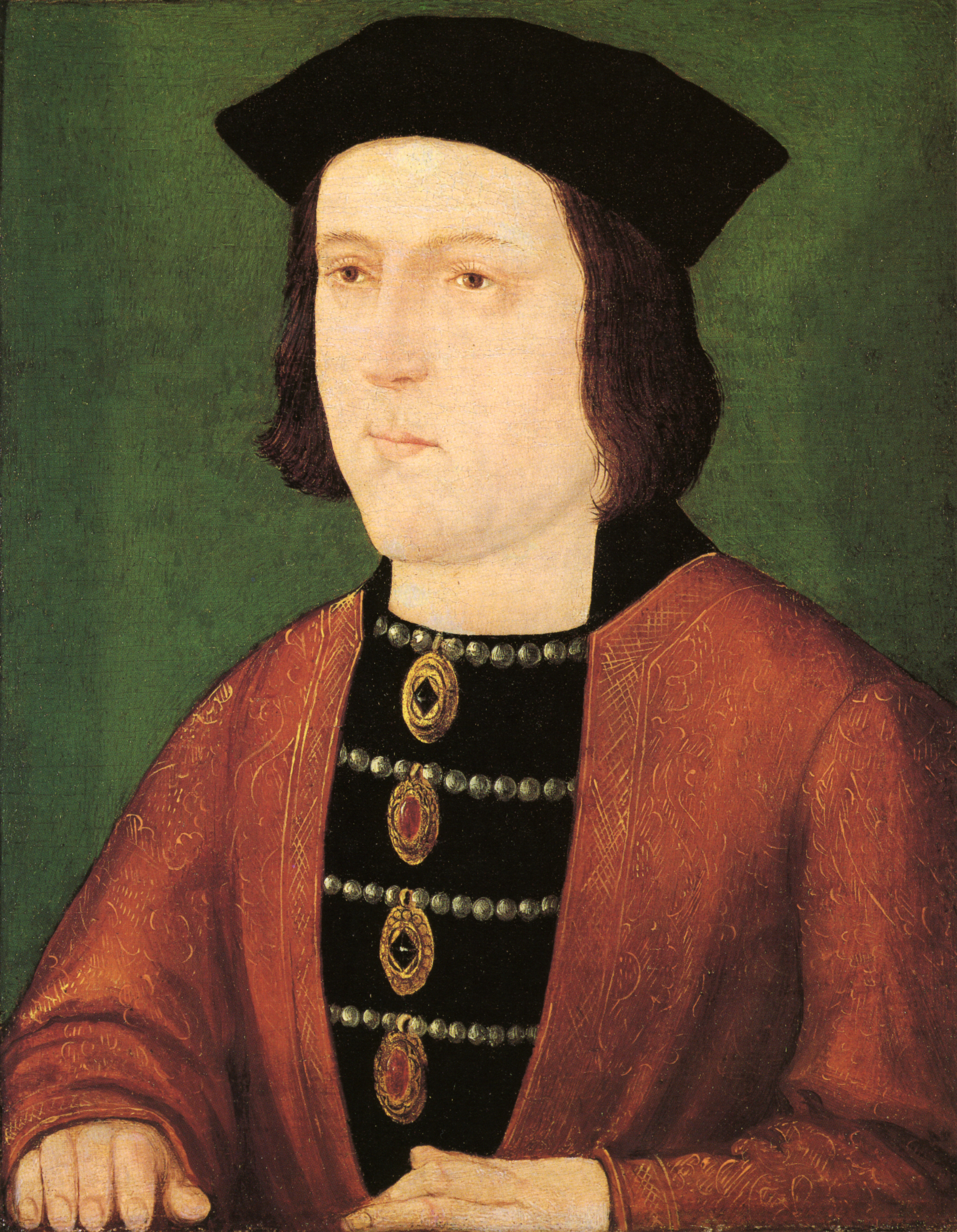
King Edward IV
It was a time of upheaval and when Edward was forced to flee into exile in Burgundy, the Queen, along with her daughters, fled into Sanctuary at Westminster Abbey.  There, safe from conflict but estranged from the exiled King, the first of the younger Elizabeth’s brothers was born. (The boy Edward would later earn his place in history by ‘disappearing’, along with his brother Richard, from the Tower of London, igniting a mystery that continues to burn today.)

Meanwhile, boosted perhaps by the good news, the exiled king gathered his forces and with the aid of his brother-in-law, Charles the Bold of Burgundy, returned to England to resume the battle for his throne, finally defeating Warwick and Margaret of Anjou and having the old King Henry VI murdered in the Tower. This initiated a time of relative peace.

For Elizabeth, now five or six years old, it was time for her education to begin. As well as the skills of running a huge household, she was also taught to read and write and given some instruction in accounting. Contemporary reports describe her as pious, obedient, and loving, and dedicated to helping the poor.

In 1475 when Edward made his peace with France, it was arranged as part of the treaty that on her twelfth birthday she would go to France to prepare for marriage to Dauphin Charles. But, before this could take place, France reneged on the deal and married his son to Margaret of Austria instead.

Elizabeth Woodville
Things ran smoothly for a while, or as smoothly as they ever do in royal circles, until, on the unexpected death of the King in 1483, Elizabeth fled once more with her mother into Sanctuary at Westminster. Richard of Gloucester took his place as Lord Protector and Elizabeth's brother, the Prince of Wales, was brought to London to await his coronation, as was tradition, in the royal apartments at the Tower. 

Shortly afterward it emerged (whether true or not is another question) that Edward IV’s marriage to Elizabeth Woodville was bigamous due to a prior contract of marriage. All children of the union between Edward IV and Elizabeth Woodville were pronounced illegitimate. As we all know, Gloucester was declared King Richard III, and at some point between 1483 and 1485, Elizabeth’s brothers disappeared from the record. (That is not proof however that they disappeared from the Earth – there are any number of possible explanations).

The Princes in the Tower
How must this have been for Elizabeth? One moment she is the Princess of the realm, Dauphine of France, and the next an illegitimate nobody living in exile from court in the squalor of sanctuary.

And what of her brothers' fate? She would have been ignorant of that, and the resulting uncertainty mixed with grief for her father can only have been hard. It is possible that her mother knew or believed the boys to be safe. Why else, after scurrying into the safety of Westminster in fear of her life, would she suddenly hand her daughters into the care of the very man suspected of injuring her sons? 

We cannot know the answer to that, but the uncertainties provide very tasty fodder for the authors of fiction.

Elizabeth and her sisters returned to court to serve Richard’s Queen, Anne Neville, where they were treated with every courtesy. Queen Anne was ailing and clearly dying. It was at this time that rumours emerged of a relationship between Richard and his niece, Elizabeth. It is now impossible to be certain of the truth behind the allegation, but at the time gossip was strong enough for Richard to publicly deny the accusation. Whether the claim was true or not, Elizabeth would have suffered some degree of shame, but she seems to have continued to be prominent at court, serving the Queen until her death in March 1485. 

In August, when invasion was looming, Elizabeth and other children from the royal nursery were sent north for safety while the King dealt with the threat from Henry Tudor.

Henry Tudor
Henry Tudor, the Lancastrian heir, was aided throughout his exile by his mother, Margaret Beaufort in England. Margaret had devoted her life to her son’s cause. She  untiringly devised methods to secure the throne she saw as rightfully her son’s. Prior to his invasion, in order to muster support from the Yorkist faction, Henry promised that, if he became king, he would marry Elizabeth of York and unite the warring houses of York and Lancaster, putting an end to the Wars of the Roses forever.

After Richard III’s defeat at Bosworth in 1485 Elizabeth was taken to Margaret Beaufort’s house at Coldharbour, but Henry was slow to marry her and slower to crown her. We should consider the logistics of arranging a royal wedding at short notice, but it not something that Henry VIII found an obstacle in the next reign. To some it is almost as if he wished to deny that Elizabeth had any influence on his claim at all. They were married in January 1486. Elizabeth gave birth to their first child, a son whom they named Arthur, in September of the same year scarcely nine months later. She had no further children until two years after her coronation which took place in November 1487.

Perkin Warbeck
Henry Tudor’s reign was fraught with rebellion. Pretenders emerged throughout, some were swiftly dealt with, but one in particular, Perkin Warbeck, claiming to be Elizabeth’s younger brother, Richard, harried the king for years. We will never know his real identity, although the King went to great lengths to provide him with a lowly one.

Elizabeth is always described as a dutiful wife and devoted mother. She took no part in ruling the country, and there are no reports of her ever having spoken out of turn or ‘disappointing’ the King. Henry appears to have been a faithful husband; his later relationship with Katherine Gordon, wife of Warbeck, was possibly no more than friendship, but Katherine did very well, both in status and financially, at Henry's court.

Although Prince Arthur was raised, as convention dictated, in his own vast household at Ludlow, Elizabeth took an active role in the upbringing of her younger children, teaching them their letters and overseeing their education.

Prince Arthur
When Arthur, the Prince of Wales, died suddenly in 1502, both Henry and Elizabeth were distraught, the King thrown into insecurity at having been left with just one male heir. Reports state that the King and Queen comforted each other and, although there are some hints of a possible estrangement between the royal couple, Elizabeth promised to give Henry another son. She fell pregnant quickly and, ten months later, gave birth to a girl, Katherine, but succumbed to puerperal fever and died on her birthday, 11th February 1503.

Elizabeth of York
Elizabeth deserves more credit. There is as much strength in resilience as in resistance, and I believe she was both strong and resolved, bound by duty to serve her country as best she could.

Her union with Henry negated the battle between York and Lancaster, and the many children she bore strengthened political unions with France, Scotland, and Spain. Ultimately, she died doing her duty to England.

When a king puts aside personal desire for the sake of his country or dies on the battlefield defending it, he becomes a hero; often, if he is on the right side, he is honoured throughout history.

Yet Elizabeth did all those things. She married dutifully; she quickly produced an heir, a spare, and several daughters to increase the king’s bargaining powers. At the tragic loss of the Prince of Wales, despite her age and the suggestion of medical problems, she took the most dangerous decision to try to give the King another son. She died a hero, in service of her King and country.

Images:
*http://upload.wikimedia.org/wikipedia/commons/9/95/Elizabeth_of_York_from_Kings_and_Queens_of_England.png
http://upload.wikimedia.org/wikipedia/commons/4/48/King_Edward_IV.jpg
http://upload.wikimedia.org/wikipedia/commons/2/2f/Elizabeth_woodville.jpg
http://upload.wikimedia.org/wikipedia/commons/c/c0/Princes.jpg
http://upload.wikimedia.org/wikipedia/commons/2/2a/Henry_Tudor_of_England_cropped.jpg
http://upload.wikimedia.org/wikipedia/commons/3/3c/Perkin_Warbeck.jpg
http://upload.wikimedia.org/wikipedia/commons/6/69/Anglo-Flemish_School%2C_Arthur%2C_Prince_of_Wales_%28Granard_portrait%29_-004.jpg
http://upload.wikimedia.org/wikipedia/commons/c/c6/Elizabeth_of_York%2C_right_facing_portrait.jpg

~~~~~~~~~~~~~

Elizabeth is the subject of my shortly to be published book A Song of Sixpence, in which I suppose that the younger of the princes was in fact rescued from the Tower in 1483 and re-emerges some years later as the man Henry names 'Perkin Warbeck'. 

The novel considers the division of loyalties a princess, born to the house of York, might have suffered in her union with the House of Lancaster. Would her support be for husband and her sons, or her long lost brother?

This is a massive issue to deal with in one blog, and I would encourage you to read more about Elizabeth in Alison Weir's book Elizabeth of York: The First Tudor Queen and Amy Licence's Elizabeth of York. 


For more information about my work please visit my webpage. 
Follow my blog.
Or find me on Facebook and Twitter.
My Amazon page is here if you are in the UK
or here if you are in the USA


Wednesday, February 22, 2012

Lancastrian Yorkists - The Pilkingtons of Pilkington in the 15th Century

by Brian Wainwright

'Pilkington' as a place name no longer exists, but it was formerly a part of what is now the Metropolitan Borough of Bury in Greater Manchester (Or Lancashire if you are a traditionalist) and included a very large park for the hunting of game. The manor house was at a place called Stand, the highest part of the lordship. It is said that the name 'Stand' originated from the one-time existence of a stand from which the ladies of the family could watch their menfolk as they chased deer around the park that spread out to the south. The Pilkingtons of Pilkington were the senior branch of their name, and had acquired considerable lands in Lancashire, where they were long established, and elsewhere in England. (There was, as usual in such families, a distinct tendency to marry heiresses, and much property was added by this method.) In the fifteenth century Sir Thomas Pilkington even obtained permission to build a small castle in the town of Bury, four or five miles to the north of Pilkington. Scanty remains of this structure survive, following excavation works some years ago.

Sir Thomas, who was born about 1425, was high in the favour of the (Yorkist) King Edward IV and was High Sheriff of Lancashire on no less than fourteen occasions between 1463 and 1484. He was created a Knight Banneret at the siege of Berwick in 1482. (To avoid confusion, this was a higher grade of knighthood, but is by no means to be confused with a Baronetcy, a title not introduced until the 17th Century.) In 1467 he was granted the right to hold two fairs and a market at Bury, and in 1483 received an annuity of 100 marks (66 and two thirds pounds) out of the revenues of Lancashire.

Unlike many other Yorkists, Sir Thomas transferred his allegiance seamlessly to Richard III. Sir Thomas was of course a northerner, and it is safe to assume that he knew Richard (as Duke of Gloucester) far more intimately than did most of the gentlemen of southern England.

Sources vary as to whether Sir Thomas fought at Bosworth or was merely on his way to the battlefield, but he was certainly treated as if he had fought, and he was attainted by Henry VII and forfeited almost all his very substantial lands. Those in Lancashire were given to Thomas Stanley (now Earl of Derby) Henry Tudor's stepfather, and were never recovered. Some of the other lands which Sir Thomas had thoughtfully transferred to his son some years before were retained in the family, though in one case at least the manor was improperly seized and King Henry had to be persuaded to give it back.

Sir Thomas remained Yorkist in sympathy, and fought at the Battle of Stoke (1487) on the side of Lambert Simnel (whoever he was). He was perhaps lucky to survive what was a very bloody battle, but the cost this time was his lands in the Midlands, an inheritance from his grandmother, Margaret Verdon, in some of which he had only a lifetime interest.

Little is known about Sir Thomas after this time. If he was not actually in prison he probably lived with his son, Roger Pilkington of Clipstone Notts and Bressingham, Norfolk. However he certainly survived, for in August 1508 Henry VII granted him a pardon, absolving him of all offences, but not restoring his lands.

Sir Thomas died about 1509, to be succeeded by his son, Roger. However when Roger died in 1525 the senior line of the Pilkingtons died with him in the male line, the remaining lands being divided between Roger's daughters.

Other branches of the Pilkington family survived, including the one that founded the famous glass making firm. It's interesting to note that in the grounds of what was the Stanley's principal home, Lathom House, destroyed in the Civil War, the present day Pilkington concern has a laboratory complex.

The main home of the Pilkingtons (known locally as Stand Old Hall) remained in place, albeit derelict and partially demolished, until relatively recent times. It is now completely demolished, and all that remains are a few pieces of timberwork that are displayed above the bookshelves of Whitefield Library.

The main source for this article was History of the Pilkington Family by Lt. Col. John Pilkington. (1912)


Brian Wainwright is the author of Within the Fetterlock a novel about the life of Constance of York, the cousin of Richard II and Henry IV and The Adventures of Alianore Audley a light-hearted novel about a Yorkist intelligence agent which is really a parody of the genre. The Open Fetterlock, published in Kindle format only, is not a novel as such but contains extracts from several abandoned or indefinitely postponed manuscripts. He is currently working (very slowly) on a number of projects.