Showing posts with label Judith Arnopp.. Show all posts

Sunday, August 23, 2020

The Portraits of Lady Margaret Beaufort

by Judith Arnopp


Most of us are familiar with the portraits of Margaret Beaufort. Invariably she is depicted toward the end of her life, elderly, austere, and pious. It is difficult to imagine this staid, nun-like woman as a gurgling baby, or a naughty child; even less as a vigorous young woman. 

But people, even Countesses, are not born pious. Her face must once have been unlined, she may have been frivolous, perhaps even reckless. She was certainly determined; her crusade to secure her son Henry VII on the English throne involved intrigue against a reigning monarch. Against all odds, she financed her son’s campaign and in doing so, changed her life forever. 

With Henry’s accession to the throne, she became the most powerful woman in the realm, and she did not waste her new-found success but became one of Henry’s chief advisors, her charitable work extending to the foundation of universities, and championing the arts.

The portraits we see today are not contemporary. Without exception, she is depicted in her later year, clothed in a peaked white headdress, usually with a book, and always in the act of religious contemplation with an aura of chastity and charity.

Of course, portraits are not always about the subject’s appearance; sometimes a painting depicts a person’s character rather than how large the sitter’s nose may have been. Margaret, in her exalted position, would have been keen to project an authoritative, reverent persona but she evolved into a nun-like figure, as a young woman she would have suffered all the uncertainties, the passions and the flaws that we all experience. That is the Margaret made more fascinating simply because of the lack of portraiture from the uncertain days of her youth.

There are no extant portraits of Margaret from her lifetime, the ones we see today were made during the reigns of Henry VIII and Elizabeth I. Undoubtedly they are copies of a lost original so, particularly if we compare them to the effigy on her tomb at Westminster, we can be fairly sure of her appearance during the later years of her life. This portrait of Margaret is believed to have been part of a set of corridor portraits including Henry VII, Henry VIII, commissioned during the reign of Elizabeth I. Again Margaret is in a religious pose, her clothing and book of hours illustrating her religious devotion. It is the best-preserved portrait we have of Margaret, the detail of the golden arch beneath which she sits, and the ornamented cloth of state is still visible to the naked eye.

My personal favourite portrait of Lady Margaret hangs in St John’s College in Cambridge. It was painted by Rowland Lockey in the 16th century. Margaret is shown at prayer in a lavish apartment, presumably her private chamber. She kneels at a desk with a heavy embroidered cloth and before her is a prayer book, a sign of piety and learning, and beneath it the ‘chemise’ cover she wrapped it in. Above her head, a tester bears the Tudor rose. The chamber itself is sumptuous, testament to her love of comfort, the stained glass windows with the badge of the Beauforts and of England.

This portrait tells us more about her lifestyle than the others. We can see that despite her sombre attitude, she lived luxuriously, as one would expect. Her dark clothes, although quite dour to our modern eyes, were of the best quality, black being among the most expensive and difficult hues to buy. 

After her death ‘seven gowns of black velvet were found, trimmed with ermine, and a mantle of tawny.’ And, most interesting of all, was ‘a scarlet gown with a long train, ornamented with the badges of the Garter and evidently to be worn on St George’s day. In another inventory we find a crimson gown to be work with her ‘circuit’, not a diadem but a surcoat, such as she had worn at Christmas 1487.’


So, a new Margaret begins to emerge, a woman who favoured scarlet and ermine, whose ‘chariot men wore scarlet. The very buttons of the horse harness were of gold of Venice.' This speaks less of piety and very much of majesty, perhaps even a little vanity.

The National Portrait Gallery has a portrait previously thought to be Margaret but now largely dismissed. It features a younger woman, hands clasped in pious prayer, her head covered with a veil. The painting is dark but the gown appears to be dark red, the veil itself lavishly embroidered. The nose is long and heavy, the eyes heavily lidded, as Margaret is shown in other portraits, and the face is pensive. Whether the sitter is lost in religious contemplation or distracted by plots of rebellion, it is difficult to judge. 


As I said earlier, the portrait is no longer believed to represent Margaret but it is intriguing none the less and I confess I used it during my research to picture the younger Margaret, the young woman who, widowed three times and separated from her only son, had no notion of the triumphs the future held.


[1] Jones and Underwood, The King’s Mother p188
[2] Ibid p189

Portraits from Wikimedia Commons

This is an Editor’s Choice from the #EHFA archives, originally published February 25, 2019.

~~~~~~~~~~

Judith Arnopp is the author of eleven historical fiction novels including The Beaufort Chronicle: the life of Lady Margaret Beaufort. 

Connect with Judith at https://author.to/juditharnoppbooks. Judith's books are available through Amazon including The Beaufort Bride, The Beaufort Woman: Book Two of the Beaufort Chronicles, and The King's Mother: Book Three of the Beaufort Chronicles


Wednesday, July 18, 2018

Sudeley Castle and the People Who Lived There

by Judith Arnopp


Set against the backdrop of the Cotswolds near Winchcombe in Gloucestershire, a little north of Cheltenham, lies Sudeley Castle. Throughout history Sudeley has been many things; today it is a family home, a beautiful garden, a historic jewel, and the last resting place of an English queen.

Sudeley remained in the hands of Goda’s family until the reign of Henry V when the castle was gifted to Thomas Boteler by way of repayment for his action in the war with France. It was Boteler who began to transform Sudeley into an enviable property, enlarging and updating the existing fabric of the building to create a place fit for royalty.

When the Lancastrians were defeated and Edward IV took the throne the Boteler family were forced out and Sudeley’s passed into the hands of a new owner, the king’s brother, Richard of Gloucester, later King Richard III.

When the tables turned again and Richard was defeated at Bosworth, Henry VII bestowed it on his loyal uncle, Jasper Tudor. After Jasper’s death Sudeley once more became crown property.


Henry VIII visited once with Anne Boleyn. They met with Thomas Cromwell there to discuss the reformation of the monasteries and took a keen interest in the Blood of Christ housed at nearby Winchcombe Abbey. After this the castle was run down and unoccupied for much of the time.


On his accession to the throne, Edward VI made his uncle, Thomas Seymour, Lord of Sudeley and after his marriage to Katheryn Parr, Seymour and his new wife made a home there.


The Seymours implemented many improvements and Katheryn took great care in choosing the décor of the nursery for their expected child. Tragically, to Thomas Seymour’s sorrow and detriment, Katheryn died scarcely a year later, having given birth to a healthy daughter, whom they named Mary. Thomas was executed for treason less than a year later and their child placed in the care of Katherine Willoughby, Duchess of Suffolk, but fades from the historical record shortly afterwards; it is likely that she died in infancy.


With Thomas’ ward, Lady Jane Grey, acting as chief mourner Katheryn was laid to rest in St Mary’s church adjacent to the castle. Today visitors to Sudeley can view a love letter and portrait gifted to the queen by her husband.


Katheryn’s step-daughter and friend, Elizabeth Tudor, later Queen Elizabeth I, visited Sudeley on three occasions during her reign. It is easy to imagine her walking in the garden, remembering her stepmother, recalling conversations and small personal details of their shared life that are now lost to history.


Sudeley’s story doesn’t end with the Tudors. During the civil war Prince Rupert made the castle his headquarters, and Charles I stayed there for a time during the campaign to take Gloucester.


During the course of the war, Sudeley passed back and forth between Royalist and Parliamentarian hands until Parliament ordered the ‘slighting’ of Sudeley making the house indefensible. The roof was removed and afterwards fell swiftly into decay. The fine worked stone was quarried by locals until the castle became nothing more than a romantic ruin. For the next two hundred years, at the mercy of the elements, it became a trysting place for lovers, or a hideaway for thieves.


In 1782, Katheryn Parr’s grave was rediscovered. The lead casket was opened and the body within reported to be 'uncorrupted'. She was reinterred in 1817 by the Rector of Sudeley and a plaque copied from the original inscription on the lead coffin was placed upon it. Today you can see a later, Victorian effigy of Katheryn on the tomb.


Sudeley remained in elegant decay until the nineteenth century when it was bought by two brothers, John and William Dent, who embarked upon a restoration project. They employed architect Sir Gilbert Scott to restore the chapel. The walls and large parts of the castle were restored and the finishing touches applied by Lady Emma Dent who spent almost fifty years restoring and filling Sudeley with fine art and historical artefacts.


The Tudor style parterre we see today is a reconstruction but it is easy to imagine Katheryn there, inhaling the scent of the flowers, the kiss of summer rain on blush pink petals.

While you move quietly between the roses, or pass through the old yew hedges you might imagine her footstep on the gravel behind you, or catch a glimpse of hanging sleeves or the flick of a scarlet kirtle as she turns a corner.


Sunday the 2nd of September 2018 Sudeley Castle is holding a Katherine Parr day! Why not visit it and see for yourself.

Photographs: Sudeley Castle property of Judith Arnopp 2018

~~~~~~~~~

Judith Arnopp is the author of ten historical novels including:

The Beaufort Chronicle: comprising of
The Beaufort Bride – also on Audible
The Beaufort Woman – also on Audible
The King’s Mother - coming soon on Audible
A Song of Sixpence: the story of Elizabeth of York and Perkin Warbeck – coming soon on Audible
The Kiss of the Concubine: A story of Anne Boleyn – also on Audible
The Winchester Goose: at the court of Henry VIII
Intractable Heart: the story of Katheryn Parr
The Song of Heledd
The Forest Dwellers
Peaceweaver

You can learn more about Katheryn Parr’s life in Judith's book Intractable Heart; the story of Katheryn Parr.


She is currently working on Sisters of Arden, set during the dissolution of the monasteries and the Pilgrimage of Grace. All books on Kindle and in Paperback.

For more information, see Judith Arnopp Books and her website, www.judithmarnopp.com.


Tuesday, June 16, 2015

Henry Fitzroy – The Almost King

by Judith Arnopp

Henry Fitzroy Duke of Richmond and Somerset (1519-36)

Kings, especially Tudor kings, could have everything they wanted. Power, property, wealth, women, it was all theirs with a click of the fingers yet, for many years, Henry VIII was denied one thing – a son and heir to follow him.

In 1519, less than forty years after Bosworth, the Tudor dynasty was still young, and it was Henry’s job to ensure it continued to flourish. The responsibility weighed heavily on his shoulders and, as Catherine of Aragon suffered more and more miscarriages, and the sons she did bear died in infancy, his need became an obsession.

With just one legitimate daughter, Mary, Henry was becoming desperate. Imagine his frustration when his mistress, Elizabeth Blount, with no trouble at all produced a healthy son. The temptation to turn his bastard into something more was irresistible. They named the child Henry.

Just to ensure that no one was mistaken, the name Fitzroy which means 'the king’s son', was often given to base-born male offspring, but although it is likely there were a good few more, Henry Fitzroy is the only illegitimate child that the king acknowledged.

Shortly after he was born, Elizabeth was married to Sir George Talboys and assigned several manors in Lincolnshire and Yorkshire. A mark of favour, or perhaps gratitude, for providing the king with what his wife could not.

While the relationship between Henry and Elizabeth ceased, he continued to show Fitzroy favour. At his christening it was Cardinal Wolsey who stood as Godfather, and by the time he was six young Henry was made Knight of the Garter, and created Earl of Nottingham and Duke of Richmond and Somerset. This double dukedom ensured that he took precedence over all other dukes in the land, barring the King’s lawful issue – should he have them.

Duke of Ricmond
He was also appointed King’s Lieutenant-general north of Trent, and Keeper of the City and Castle of Carlisle.This may seem a lot for a small boy, but it didn’t stop there, and by the time of his death in 1536 he was Lord |High Admiral of England, Wales, Ireland, Normandy, Gascony, and Aquitane, with a further commission as warden general of the Scottish marches thrown in for good measure.

Throughout his life he acquired castles, land and immense fortune, making him the richest man in England after the King. With the breakdown of Henry and Catherine’s marriage, and the advent of Anne Boleyn and the failures of that union, it soon became clear that, in the absence of a legitimate son, Fitzroy would be Henry’s heir. Nothing, bar the birth of a legitimate son, could stop it.

Henry Fitzroy received an education to match his status. Although often at court, he was resident in King’s College, Cambridge and taught by Richard Croke, a pioneer of Greek Scholarship in England, and John Palsgrave, another eminent scholar. By the time he was ten young Henry was reading Caesar, Virgil, Terence, and speaking Greek.

Arms of Henry Fitzroy

Henry VIII, proud of his son, despite the stain of his birth, lost no time in proposing matrimonial alliances beneficial to England, attempting to wed him into the family of Pope Clement VII, to a Danish princess, a French princess, and a the sister of Charles V who later became Queen of France.

In spring 1532 Fitzroy spent some time at Hatfield, accompanying Henry VIII to Calais in the autumn. He moved on to Paris, staying with his friend the Earl of Surrey until September 1533. And, later that year, at the age of fourteen, possibly at the instigation of Anne Boleyn, he married Mary Howard, daughter of Thomas, the third Duke of Norfolk by his second wife. The marriage was never consummated due to their age. Thereafter plans for him to go to Ireland were abandoned, and he remained at court in the midst of the furor surrounding the reformation and the downfall of Anne Boleyn.

He is recorded as being present at the execution of the Carthusians in May 1535 and was one of the peers at Anne Boleyn’s trial, witnessing her execution as Henry’s representative in May 1536.  Fitzroy benefited both in wealth and status from Anne’s death and those that died with her.

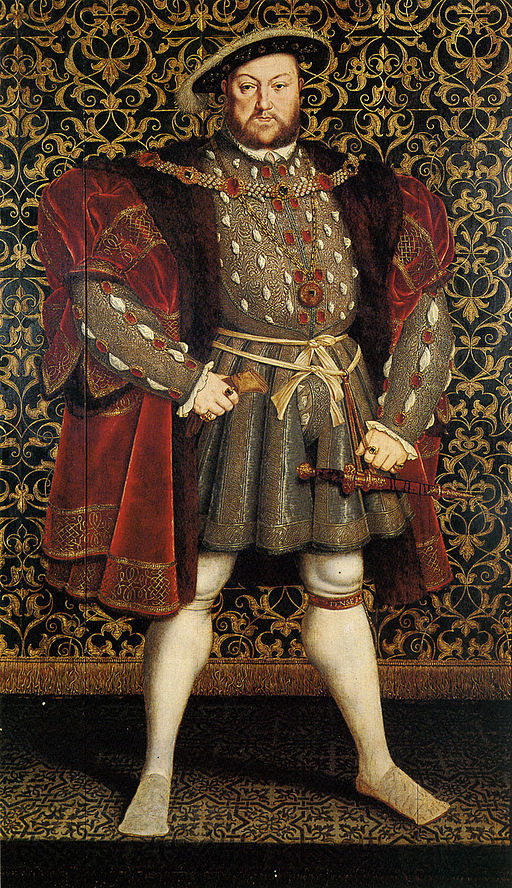
Henry VIII

Among Anne’s detractors there were rumours of jealous rivalry between Fitzroy and the Boleyns and whispers that she and her brother, Rochford, plotted to poison him. His death was more likely to have been due to consumption or possibly plague.

Fitzroy’s death in July, just two months after his stepmother, must have proved devastating for the King who, having disinherited both his daughters by this time was left temporarily heirless. But Henry VIII had a new wife and was pinning all his hopes on Jane, who was already pregnant, perhaps with a legitimate son this time. One that would live.

Henry Fitzroy was not given a state funeral as one might expect after his royal upbringing; the arrangements were left to his father in law, the Duke of Norfolk. He is believed to be interred at Thetford Priory with other members of the Howard family. After Fitzroy’s death it was decreed that, since the marriage was not consummated, the marriage was invalid, consequently stripping his widow of her benefits.

~~~~~~~~~~~~~

Judith Arnopp is the author of seven historical novels; three set in the medieval and four in the Tudor period. Details can be found here.


Illustrations

1. Henry Fitzroy http://upload.wikimedia.org/wikipedia/commons/0/02/Lucas_Horenbout_-_Henry_Fitzroy%2C_Duke_of_Richmond_and_Somerset_%281519-36%29_-_Google_Art_Project.png

2. The Duke of Richmond sometimes thought to be Edward of Middleham. http://upload.wikimedia.org/wikipedia/commons/4/44/DukeofRichmond1.gif

3. Henry VIII by Holbein  http://upload.wikimedia.org/wikipedia/commons/0/07/Workshop_of_Hans_Holbein_the_Younger_-_Portrait_of_Henry_VIII_-_Google_Art_Project.jpg

4.http://upload.wikimedia.org/wikipedia/commons/5/50/Arms_of_Henry_FitzRoy%2C_1st_Duke_of_Richmond_and_Somerset.svg

Further reading:
Elizabeth Norton: Bessie Blount: Mistress to Henry VIII
Susannah Lipscombe: 1536: The year that changed Henry VIII
Amy Licence: In Bed With the Tudors