Showing posts with label 15th century. Show all posts

Wednesday, February 15, 2023

Sir John Crosby and Crosby Place, Bishopsgate, London

by Toni Mount

In 1466, wealthy city grocer Sir John Crosby took a 99 year lease on a buildings adjacent to the Priory Church of St Helen in Bishopsgate, London, paying the prioress, Dame Alice Ashfield [or Ashfed] £11 6s 8d per year in rent. However, he demolished the old buildings and began to build his beautiful new house. Contemporaries noted that it took years before the place was finished and habitable and the unfortunate Sir John had little time to enjoy its luxuries before he died. Indeed from around 1475 Crosby Place became the London town house of Richard, Duke of Gloucester’s (later King Richard III). In my new Sebastian Foxley medieval murder mystery novel, The Colour of Bone, much is going on at Crosby Place. This grand mansion – scene of feasting, entertainment and dark deeds in my novel, was centuries later, moved stone by stone across London to Chelsea.

The Great Hall of white stone is the only remaining part of Sir John’s Crosby Place [the rest is 20th century]  

The church of St Helen's Bishopsgate still stands in what is now the heart of the financial centre of the modern day city of London. Inside St Helen’s Church, there is a superb monument tomb of Sir John Crosby and his first wife, Agnes. He is in armour with a Yorkist Suns-and-Roses collar and she wears a fashionable late fifteenth-century headdress with her lap-dogs at her feet. Agnes predeceased Sir John in 1460 and he designed their joint tomb.

Sir John was knighted by Edward IV in 1471 for taking a leading role in the defence of London against Thomas Neville, known as the Bastard of Fauconburg, who attempted to take the city on behalf of the Lancastrians while Edward was away fighting in the South-West of England. Sir John openly supported the Yorkist cause during the Wars of the Roses yet he wasn’t primarily a soldier but a wealthy merchant and member of the Grocers’ Company. He died in January or February 1476, leaving his second wife, Anne, a widow and owner of their luxurious mansion, Crosby Place, but it was far too large for her and she rented it out to the Duke of Gloucester as his town house. Most noblemen, archbishops and bishops had their own private residences in London but Gloucester didn’t, perhaps because he spent little time in the city before he became king. Once he was king, he had the Tower of London and Westminster Palace to live in but it’s thought he continued to rent Crosby Place, maybe using it as first class guest accommodation.

The tomb of Sir John and Agnes Crosby in St Helen’s Church [GRM 2022]

Sir John also bequeathed 500 marks to St Helen’s Church, money which was used to redesign the interior of the nave. A row of arches and a screen shielded the nuns from the common folk but Sir John’s bequest was used to build taller, more elegant arches and a new screen in 1480. [This rebuild is the first crime scene in The Colour of Bone.]

Sir John’s four new arches viewed from the Nuns’ Choir [GRM 2022]

Meanwhile, Crosby Place was at the centre of the action when the Duke of Gloucester became King Richard III in 1483. In his play on the subject, Shakespeare has the mansion as the setting where Gloucester is offered the crown, although this more probably occurred at Baynards Castle, the Duchess of York’s London property down on the riverside. Shakespeare certainly knew Crosby Place as he lived in St Helen’s parish for some time, appearing on a list of rate-payers. Some sources suggest that Gloucester had bought the property outright, rather than leasing it, but this seems unlikely because after his defeat at Bosworth in 1485, Henry Tudor seized all his possessions but not Crosby Place. Such a desirable residence wouldn’t have been overlooked, so it must have reverted to Crosby’s relatives after King Richard was killed.

The mansion again became the focus for royalty in 1501 when Katherine of Aragon arrived in London in November to marry her first bridegroom, Prince Arthur. Crosby Place was then the home of a wealthy goldsmith, Alderman Bartholomew Rede, who would serve as London’s Lord Mayor the following year. Katherine spent two nights in the luxurious mansion before the wedding in St Paul’s Cathedral on Sunday 14th November.
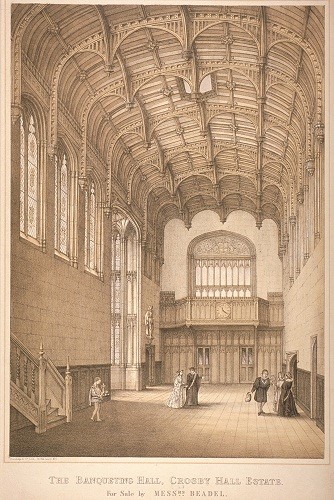
The Great Hall of Crosby Place much as Katherine of Aragon and Sir Thomas More would have seen it.[i]

A later famous occupant was Sir Thomas More although documentary evidence suggests he held the lease for a few months only and it’s uncertain whether or not he ever actually lived there. John Stow described Crosby Place in 1598, in his Survey of London as ‘of stone and timber, very large and beautiful and the highest in London’, so it was still impressive more than a century later.

If you want to know what’s going on at Crosby Place, in the Duke of Gloucester’s household in 1480, you can follow Sebastian Foxley’s new adventures in the my medieval murder mystery, The Colour of Bone. 

[Some parts of this article and photographs first appeared in Tudor Life magazine]

Toni Mount earned her Master’s Degree by completing original research into a unique 15th-century medical manuscript at the Wellcome Library in London. She is the author of several successful non-fiction books including the number one bestseller, Everyday Life in Medieval England, which reflects her detailed knowledge in the lives of ordinary people in the Middle Ages. Toni’s enthusiastic understanding of the period allows her to create accurate, atmospheric settings and realistic characters for her Sebastian Foxley medieval murder mysteries. Toni’s first career was as a scientist and this brings an extra dimension to her novels. It also led to her new biography of Sir Isaac Newton. She writes regularly for The Richard III Society Bulletin and other magazines and is a major contributor of online courses to MedievalCourses.com. 


[i] Crosby Place is known today as Crosby Moran Hall and stands on Chelsea Embankment, by coincidence just a stone’s throw from More’s Garden, once the site of Sir Thomas More’s fine house in Chelsea. The medieval hall was all that remained of Crosby Place when, in 1910, it was moved, stone by stone, from Bishopsgate in the city of London to its new site on the north bank of the River Thames. It has been sympathetically restored and greatly extended since 1988. It’s in private ownership.


Wednesday, April 15, 2020

Apothecary

By Toni Mount


Medieval apothecaries were the equivalent of our modern pharmacists. An apothecary’s shop was full of various cures, most of which he prepared himself. He was usually a trusted member of the community, but at times, apothecaries were accused of practising magic or witchcraft. In an age before folk had easy access to doctors and when hospitals were religious foundations, more interested in curing your soul than your body, the apothecary was an ordinary person’s best hope of a cure or relief from an illness. Because apothecaries saw different people with various illnesses each day, most had a huge knowledge of the human body and herbal remedies.

Early in the Middle Ages, an apothecary would have cultivated all the plants and herbs needed for his medicines himself. Later, supplies became more organised, especially in cities like London, York and Bristol, with individuals growing plants to order for the apothecaries.


The recipes for the wines, syrups, cordials and medicines were passed down through the generations, from master to apprentice. They were closely guarded secrets too, since the most successful apothecary would have the most customers. While some apothecaries worked on a casual basis from their own homes, many had their own retail premises, usually a small shop. The front of the shop would have shelves full of medicines and herbs and in the back section, the apothecary would prepare medicines as and when they were needed. Ideally, he would also have access to a garden, where he could grow some of the less exotic herbs and plants he needed to prepare his cures. Some of the most popular medicines were prepared in advance, ready for sale, just as in a modern-day pharmacy. Other cures were prepared as and when needed, and were made up precisely, with the apothecary using his knowledge of the patient and the illness to prepare what he thought would be the ideal remedy.

Apothecaries were often spicers or pepperers as well. Because their work involved weighing out small amounts of herbs and spices for use in medicine, or for direct sale to customers, their trade was regulated by the Grocers’ Guild. It was impossible to separate the two businesses completely as both were involved in importing and distributing spices from abroad, for use in cooking and in the preparation of products such as spiced wines. In addition to food and drugs, apothecaries also sold inks and pigments to the stationers, beauty products and perfumes, substances used in fumigation and pest control and even good luck charms and novelties such as serpent-stones – what we know to be ammonite fossils.


A collection of medical recipes from the fifteenth century [now MS136 at the Literary Society of London] has remedies which make use of herbs that really could have performed the cure as intended:

For the Migraine take half a dishful of barley, one handful each of betony, vervain and other herbs that are good for the head; and when they be well boiled together, take them up and wrap them in a cloth and lay them to the sick head and it shall be whole – I proved.

A sick headache might well be eased by this poultice. Betony was a favourite herb in medieval times and was taken internally for a range of ailments. It’s still used today in treatments for nervous headaches and some types of migraine. Vervain is also used in modern medicine as a nerve tonic and as a calming restorative for patients in a debilitated condition. It too is used to treat migraine and depression.

For those troubled with digestive problems, this fifteenth century remedy would have helped:

To void Wind that is the cause of Colic take cumin and anise, of each equally much, and lay it in white wine to steep, and cover it over with wine and let it stand still so three days and three nights. And then let it be taken out and laid upon an ash board for to dry nine days and be turned about. And at the nine days’ end, take and put it in an earthen pot and dry over the fire and then make powder thereof. And then eat it in pottage or drink it and it shall void the wind that is the cause of colic.

Both these spices, anise and cumin, are carminatives, so this medicine would do exactly what it said on the tin – or earthen pot. The herbs dill and fennel could be used instead to the same effect – twentieth century gripe water for colicky babies contained dill. Wind and constipation were common preoccupations in the Middle Ages because folk ate so many pulses and little roughage, apart from cabbage.


Despite such suitable treatments as these, other remedies, despite the use of some exotic ingredients, could only have worked as panaceas. These concoctions are for gout:

Take badger’s grease and swine’s grease and hare’s grease and cat’s grease, dog’s grease and capon’s grease and suet of a deer and sheep’s tallow, of each equally much and melt them in a pan. Then take the juice of herb-robert, morell, mallow and comfrey and daisy and rue, plantain and maidenhair, knapweed and dragance, of each equally much juice, and fry them in the pan with the aforesaid greases, and keep it well, for the best ointment for gout is this. Or:

Take an owl and pluck it clean, and open it clean and salt it. Put it in a new pot and cover it with a stone and put it in an oven and let it stand till it be burnt. And then stamp [pound] it with boar’s grease and anoint the gout therewith.

A cough cure was more pleasant, consisting of the juice of horehound to be mixed with diapenidion and eaten. Horehound is good for treating coughs and diapenidion is a confection made of barley water, sugar and whites of eggs, drawn out into threads, so perhaps a cross between candy floss and sugar strands. It would have tasted nice and sugar is good for the chest, still available in an over-the-counter cough mixture as linctus simplex. Another pleasant cough treatment was coltsfoot comfits, like tiny sugary sticks of pale brown rock. King Henry III had the apothecary, Philip of Gloucester, supply him with 7½ lbs of diapenidion when the king visited the West Country in May 1265, along with 5lbs of grana, all together costing 7s 6d. My source for this [The Royal Apothecaries by Leslie G Matthews, 1967, pub by the Wellcome Historical Medical Library] suggests ‘grana’ meant aromatic seeds to aid digestion, like caraway or cumin, or it could have been Grains of Paradise, a kind of pepper. But ‘grana’ was also a name given to the exotic ‘kermes’ – dried scale insects, imported as a crimson dye. Could they have been used medicinally? Or was grana to be used to dye the king’s robes?

Another medicinal possibility is that grana was for dyeing the bed linen and curtains as part of the treatment of smallpox, in which the sickroom was swathed in red. Today we know this wasn’t so daft since red cloth filters out UV light, to reduce the production of scar tissue and to protect the eyesight of patients with smallpox or measles (these two diseases were hard to tell apart in the early stages anyway) – red light works for burns victims and would have decreased the pock marking in the case of smallpox. The medieval apothecary, like Gilbert Eastleigh in ‘The Colour of Poison’, was expected to know so much about such treatments, even if the reasons why they worked – or didn’t – were beyond the medical knowledge of the time.

N.B. One fifteenth century school book gives a list of collective nouns, including ‘a poison of treaclers’ (i.e. apothecaries who sold medicinal treacle).

[This an archive Editor's Choice post. It originally appeared on EHFA on 28 April 2016]

~~~~~~~~~~

Toni Mount earned her research Masters degree from the University of Kent in 2009 through study of a medieval medical manuscript held at the Wellcome Library in London. Recently she also completed a Diploma in Literature and Creative Writing with the Open University. Toni has published many non-fiction books, but always wanted to write a medieval thriller, and her first novel “The Colour of Poison” is the
result. Toni regularly speaks at venues throughout the UK and is the author of
several online courses available at www.medievalcourses.com.


Monday, March 9, 2020

The Duchess and the Necromancers

By Nancy Bilyeau

On Monday, November 19th, 1441, the people of London lined the streets to observe an act of public penance. That morning a woman, perhaps forty years of age, bare-headed, plainly dressed, was rowed in a barge to Temple Stairs off the Thames. She stepped off the barge and proceeded to walk all the way to St. Paul's Cathedral, carrying before her a wax taper of two pounds. Once she made it to St. Paul's, she offered the taper to the High Altar.

The woman was Eleanor Cobham, mistress-turned-wife to Humphrey, Duke of Gloucester, only surviving uncle to the childless Henry VI and thus the heir to the throne. The duchess had been tried and condemned for heresy and witchcraft. This was the first of three days of ordered pilgrimages to churches, showing a "meke and a demure countenance." Afterward, she would be forced to separate from her husband and live in genteel prison for the rest of her life.

The Penance of Eleanor, painted in 1900

The downfall of Eleanor Cobham was a shocking event in the 15th century, and it's disturbing today. Certain elements of her life echo Katherine Swynford's, the longtime mistress of John of Gaunt who eventually became his third wife. A bold beauty marries a royal--it's a maneuver seen again, and much more famously, in the following century with Elizabeth Woodville and Anne Boleyn. But while rumors of witchcraft swirled around both of those queens, they are, historians now agree, not based in reality. While Eleanor Cobham most probably did traffic in what were called the black arts. And the most serious of such crimes was to seek to know--or perhaps even alter--the future, through the practice of necromancy.

Ever since the age of Homer, necromancers have flitted in the darkest shadows of society. They were believed to possess the secrets to unlocking the power of the underworld to divine the future. (See my earlier blog post, From Homer to The Hobbit: The History of the Necromancer.) No matter the results—or lack thereof—necromancers did a brisk business in the Greek and Roman world. It was only by following their secret and ornate rituals, they said, could the boundaries be dissolved between the living and the dead.

Page from the Munich Manual
After Rome fell, the early Christian popes struggled to extinguish the pagan practices of not only necromancy but witchcraft, astrology and alchemy. But these practices survived through the Middle Ages, in one form or another, and in the Renaissance, as scholars pored through ancient texts, experienced something of a rebirth. Some popes employed their own astrologers. The Munich Manual of Demonic Magic, a textbook in Latin, was compiled in the 15th century. Necromancy became, if anything, more far-reaching. After drawing a series of magic circles, saying conjurings, and making sacrifices, necromancers claim a demon would appear to assist: see the future, drive a man to love or hatred, discern where secret things were hidden, such as treasure.
During the 15th century, England was an orthodox kingdom of devout Catholics--and yet superstition ran amok. In 1456, 12 men petitioned Henry VI for permission to practice alchemy, among them two of the king's own physicians. Some courtiers owned astrological books. What was heresy and what was knowledge linked to the fashionable pursuit of ancient texts? It was not always possible to know what was forbidden--until you made a mistake.

The stage was set for Eleanor Cobham and her ambitious play for love, power and glory.

The daughter of Sir Reginald Cobham, Eleanor in her early twenties entered the service of the highborn and illustrious Jacqueline, Countess of Hanault. Jacqueline repudiated her husband, John of Brabant, and fled to England in search of champions, marrying the youngest brother of Henry V: Humphrey, duke of Gloucester.


At some point over the next five years, Eleanor herself became the mistress of the duke. After a failed war in Hainault, Humphrey abandoned his wife; the pope annulled the marriage because of legalities to do with her first husband. Later, when John of Brabant died, Humphrey could have remarried Jacqueline. But instead he married her lady in waiting, Eleanor.

His nickname of "Good Duke Humphrey" notwithstanding, Gloucester was a complex figure. Well educated, he supported learning more than most aristocrats and was a devoted patron of the arts. An enthusiastic soldier, devoted to his oldest brother, Henry V, he was a champion of the people. But Humphrey was also impulsive, vengeful, and unable to sustain a political policy. There is little doubt he was, in addition, a womanizer. After the death of his brother the king, he claimed the right to be regent for his infant nephew. His claims were supported in the dead king's will. But Cardinal Henry Beaufort and the rest of the Beauforts opposed Gloucester. The two branches of the Lancaster family fought for power for the rest of Humphrey's life.

Humphrey, youngest son of Henry IV
Eleanor did not make Humphrey more popular. She was criticized for her immoral history with Gloucester and for her ostentation. Historian Ralph Griffiths says, "One chronicler noted how she flaunted her pride and her position by riding through the streets of London, glitteringly dressed and suitably escorted by men of noble birth." She is thought to have shared her husband's sophisticated tastes in literature.

The unmarried Henry VI, passive and easily led, was fond of his aunt and uncle. He gave Eleanor beautiful presents. Historians believe a decision was made in the Beaufort camp to permanently weaken the duke of Gloucester, and the key to this was his wife.

A young Henry VI
In late June 1441, word spread through London that two men had been arrested for conspiring against the king--divining the king's future through the use of necromancy and concluding that he would soon suffer a serious illness. The accused were two clerks, Roger Bolingbroke, an Oxford priest, and Thomas Southwell, a canon. (Those who practiced necromancy were often low-level clericals, because they possessed the knowledge of Latin necessary to read forbidden books and learn the rites.) The men were sent to the Tower of London and possibly tortured. Bolingbroke told his interrogators that he had been prompted to look into the future of the king by the duchess of Gloucester.

Eleanor did not behave like someone innocent of all crime. She fled to Westminster, seeking sanctuary. Later, when she was set to appear before an ecclesiastical court, she tried to escape onto the Thames river, but was caught. The investigation went deeper. A witch was produced, Marjorie Jourdemayne, who said she procured love potions for the duchess to make Gloucester marry her. In her trial, Eleanor denied seeking to know the future of the king through necromancy, but she "did acknowledge recourse to the Black Art." It is believed she turned to the necromancers and witch to try to bear a child. Eventually, Eleanor abjured her heresies.


Eleanor's co-conspirators were condemned and executed--Margaret Jourdemayne was burned at Smithfield. One of the clerks was hanged, drawn, and quartered. Eleanor spent the rest of her life confined in various castles: Kenilworth, the Isle of Man, and in 1449, Beaumaris Castle, where she died in 1452. Her husband Humphrey, who, to the puzzlement of many, had done little publicly to free her—he "said little"—died five years before Eleanor. His wife's disgrace had finished him as an important man of the kingdom.

Did Eleanor turn to the dark arts to try to bring about the death of Henry VI so that her husband could become king and she become queen? Most historians doubt she went that far; more likely, she dabbled in the same forbidden practices that other court ladies did. But in the tense and treacherous political climate of the Lancastrian court, where rivalries were soon to explode into the War of the Roses, a mistake in judgment could cost one everything. As was learned by Eleanor Cobham.

This article is part of my series of necromancy. To read more, see From Homer to the Hobbit: The History of the Necromancer, Conversations with Angels: The Strange Life of Edward Kelley, and Henry VII and the Curse of Prophesy.

This is an Editor's Choice and was originally published January 29, 2013. 

~~~~~~~~~~

Nancy Bilyeau is a historical novelist and magazine editor based in New York. She wrote the Joanna Stafford trilogy, a trio of thrillers set in Henry VIII’s England, for Simon & Schuster. Her fourth novel is The Blue, an 18th century thriller revolving around the art & porcelain world. Her latest novel is Dreamland, set in Coney Island of 1911, is published by Endeavour Quill. A former staff editor at Rolling Stone, Entertainment Weekly, and InStyle, Nancy is currently the deputy editor at the Center on Media, Crime and Justice at John Jay College and contributes to Town & Country, CrimeReads, and Mystery Scene magazine.

For more information, visit www.nancybilyeau.com.


Wednesday, December 18, 2019

An Emperor's Christmas at Eltham in 1400

by Mark Patton

The south London suburb of Eltham today seems an improbable location for a Medieval Christmas celebration involving kings and emperors, but the area was, in the Fifteenth Century, in open countryside, just a day's ride from London, but sufficiently distant from the polluted Thames and from the frequently plague-ridden capital, for a King of England to entertain his guests in style and to enjoy, with them, the favoured pastimes of the time and season, notably hunting and jousting.

Eltham Palace: the Medieval great hall is on the right; the buildings on the left
were added in the 1930s, as the private home of Stephen and Virginia Courtauld.
Photo: Nick Blackburn (licensed under CCA).

Over the Christmas season of 1400-1401, the King in question was Henry IV, and his guests included the Byzantine Emperor, Manuel II Palaeologus. We refer today to the "Byzantine Empire," but nobody who lived in it ever thought of it as anything other than the "Roman Empire." Although his capital was Constantinople, not Rome, and his people spoke Greek, rather than Latin, Manuel regarded himself as the heir to the empires of Augustus and of Hadrian: and of Constantine, who had made the empire Christian and moved the capital eastward to a new city named after himself.

King Henry IV, UK National Archives DL 42/1
(image is in the Public Domain).

Emperor Manuel II Palaeologus,
Bibliotheque Nationale de France
(image is in the Public Domain).

Roman or Byzantine, however, the Empire, in 1400, was crumbling. The schism that had opened up in 1054, between the Eastern Orthodox and Western Catholic Churches, had never been repaired: and in 1204, the forces of the Fourth Crusade, in open defiance of the Pope, had sacked and pillaged Constantinople, dividing much of Byzantine territory up between Catholic French, German and Italian nobles. Now the Empire faced a new threat from the Muslim Ottoman Empire, which had more or less encircled Constantinople, cutting it off from its agricultural hinterland.

The Hippodrome of Constantinople, here shown on a 17th Century print,
was destroyed by the forces of the Fourth Crusade and never restored
(image is in the Public Domain).
The chariot races held here were among the city's last
tangible connections to the Rome of the Caesars.

The Mediterranean World in 1400 (image is in the Public Domain).

Manuel's journey to the west, far from being just a friendly visit, was a life-or-death diplomatic mission to secure the military and financial support that might enable his Empire to survive. One can hardly fail to admire his efforts, but the harsh truth is that it was probably already too late to save the Empire, which would ultimately fall to the Ottomans in 1453.

As a young man, Manuel had been a hostage of the Ottoman Sultan, Bayezid I at Bursa, and had escaped to Constantinople, where he was proclaimed Emperor. Bayezid besieged Constantinople from 1394 to 1402, and it was during a lull in the fighting that Manuel and his family had slipped away from the city to seek support overseas. Leaving his capital under the regency of a nephew, and his wife and children under the protection of his brother in Greece, Manuel traveled to Venice, and on to Padua, Milan, and Paris, where he met the French King, Charles VI.

The meeting of the magi, from Les Tres Riches Heures du Duc de Berry,
Musee Conde (image is in the Public Domain).
The figure on the white horse is believed by some to be styled on Manuel.
Clearly a fine horseman, the fifty year old emperor impressed the Parisian crowd
by leaping from one horse to another without touching the ground. 

His Christmas sojourn in England may, in fact, have been an accident, prompted by a recurrence of the mental illness that had dogged Charles throughout much of his reign. Henry IV, however, was a natural ally. He was more widely traveled than many English monarchs, having participated with the Teutonic Knights, in a "Crusade" against the supposedly Pagan Lithuanians, and having made a pilgrimage to Jerusalem, where he had promised to return as a Christian liberator.

Henry met the Emperor at Blackheath, and conducted him, with his forty retainers, to Eltham Palace. Manuel spoke no English, which was unsurprising, but he equally spoke no Latin (the universal language of diplomacy and scholarship in the Catholic west). His entourage must have included men who could translate between Latin and Greek, whilst Henry's court would have included many who could translate from Latin to English. Conversation cannot have been easy; already, from Paris, Manuel had complained in a letter to a Greek friend, that "the difference in language ... did not allow us to converse, as we had wished, with really good men who were extremely anxious to show us favour."

Hunting in December, from Les Tres Riches Heures du Duc de Berry,
Musee Conde (image is in the Public Domain).

The Medieval hall of Eltham Palace (extensively remodeled by Edward IV).
Photo: David Hatch (licensed under CCA). 

Manuel had brought with him Christmas gifts of religious relics: fragments of the True Cross and of garments believed to have been worn by Christ and the Virgin Mary. There was much hunting and feasting, and some of the people of London traveled down to Eltham to entertain the royal party with carols and mumming. Ultimately, however, Manuel returned to Constantinople empty-handed. Neither his English nor his French allies were able to offer any meaningful assistance, their own armies and treasuries seriously depleted by decades of war and plague.

Mark Patton is a published author of historical fiction and non-fiction, whose books can be purchased from Amazon.

[This post is an Editor's Choice article and was originally published on the blog on 16th December 2017]

Friday, December 9, 2016

Michael of Rhodes: a 15th Century Visitor to London

by Mark Patton

In an earlier blog-post, I introduced the topic of Medieval trade between London and Venice. Each year, a fleet of galleys would set sail from Venice, passing through the Straits of Gibraltar, along the Atlantic coasts of Portugal, Spain and France, and into the English Channel, half of them bound for London, the other half for Flanders. They brought with them silk thread and cloth from China and Persia; spices from India; and wine from Italy; and returned with woolen cloth, raw wool; expensive embroideries from London; and tin from the mines of Cornwall. Remarkably, we have a written record from one of the men who sailed on these ships, Michael of Rhodes.

A Flanders Galley, from the Book of Michael of Rhodes (image is in the Public Domain): these vessels were specially built to withstand the storms of the Atlantic.  


Michael was, ethnically, a Greek, and spoke Greek as his first language, although he seems only ever to have been literate in Venetian (his book includes prayers in Greek, presumably remembered from his childhood, but they are transcribed in Latin letters). He joined the Venetian navy as a humble oarsman in 1401, and, over the course of a 44-year career, which saw him sailing to Constantinople, Alexandria, Beirut, London and Bruges, rose through the ranks to be Nochiero (Midshipman), Paron (responsible for provisioning, ballasting and stowing of the ship), Comito (Sailing Master) and Armirao (effective commander of a fleet, responsible to a nobleman who did not necessarily have the skills of a master-mariner). He served on both commercial and military vessels, and was wounded in action at least once. Further details of his career can be found here.

Michael's first visit to London was in 1406, when he was a Proder (a senior oarsman, responsible for discipline on the benches). He would have had an uncomfortable journey, sleeping on his bench, exposed to the elements, and living on a diet of ship's biscuits and broth. Although the ship would have traveled under sail throughout most of her time at sea, Michael and the 180 oarsmen would have had to row her up the Thames. He would have stepped ashore, exhausted, at Galley Quay, close to the Tower of London.

The arrival of a galley signaled the beginning of an unofficial trade fair, since each member of the crew was entitled to a portata, a small package of goods that he could trade on his own account. This might have included trinkets of glass, pottery or copper made by his relatives in Venice or on Rhodes. If he was lucky, he might have been able to afford a few nights in a real bed (even if shared), and some decent meals washed down with ale.

Michael's second trip to London, in 1443, was under very different circumstances. He was now an experienced master-mariner, and a senior officer, a Homo de Conseio, selected by a panel chaired by the Doge. In London, he is likely to have been wined and dined by the Lord Mayor, and by the masters of those livery companies whose members traded with the Venetians: the Broderers, Haberdashers, Drapers, Woolmen and Vintners. He is unlikely to have spoken much English, but Venetian traders had permanent offices in London, which would have provided translators.

At sea, his responsibilities seem to have included the training of the Nochieri, men (some of them of noble birth), who were being prepared for careers as master-mariners. His book is, in large part, a training manual, encompassing ship-building; rigging; navigational and commercial mathematics; and sailing directions for voyages around the Mediterranean and Atlantic coasts. It may have played a role in securing his promotion to a senior post, and he seems to have sold it to another mariner on his retirement, an item of considerable value.

Diagram showing the construction of a ship's hull, from the Book of Michael of Rhodes (image is in the Public Domain).
A galley under construction, from the Book of Michael of Rhodes (image is in the Public Domain).
Diagram showing lateen sails, from the Book of Michael of Rhodes (image is in the Public Domain).
Mathematical calculations, from the Book of Michael of Rhodes (image is in the Public Domain).


Michael of Rhodes belonged to one of the last generation of mariners who sailed without charts. A draftsman of not inconsiderable talent, his book includes nothing that looks remotely like a map. Although he does not mention a compass, he probably did use one, but he would not have had a sextant, astrolabe or telescope. He would have followed the coastlines, using a Portolan (a list of landmarks - his book includes several of these, including one for the English Channel), making relatively frequent stops to take on fresh water, and other supplies, and using trigonometry (his book includes the relevant tables) to keep track of his position between anchorages.

A mock coat of arms gives us a rare insight into Michael's sense of humour. The turnips on either side may refer to the diet on board his ships, whilst the mouse firmly in control of a cat is an appropriate emblem for a man who has risen from humble origins to the top of his trade (image is in the Public Domain).


Written on paper (cheaper, and lighter, but less durable, than vellum), Michael's book is a remarkable survival. Although in private ownership, it has been extensively studied by academics, and a facsimile has been published, together with a full transcription and translation. It is one of the most important primary sources for anyone wishing to understand navigation, commerce, and applied mathematics in the Late Medieval Age.

~~~~~~~~~~~~~
Mark Patton blogs regularly on aspects of history and historical fiction at http://mark-patton.blogspot.co.uk. His novels, Undreamed Shores, An Accidental King, and Omphalos, are published by Crooked Cat Publications and can be purchased from Amazon.

Friday, November 25, 2016

The English Rose with the Heart of a Lion

by Anna Belfrage

Philippa of England is the first of only two English women to have been queens of Sweden.  (The second one was Louise Mountbatten who married widower and future king Gustav VI Adolf in 1923) Mind you, had Sweden been all that was on offer, Philippa’s father would not have been all that interested – at the time, Sweden was a “Here be dragons” place, in that no one really knew what might live in those impenetrable northern woods. Not even the Swedes did.

Philippa was the daughter of the future Henry IV, the last child born in his marriage to Mary de Bohun. Philippa’s birth in 1394 led to Mary’s death, and her early childhood must have been rather confusing, what with her father being exiled by Richard II in 1398, only to return in 1399, depose the king, and claim the crown himself. In one fell swoop, Philippa became a princess.

Henry’s usurpation was not welcomed everywhere, testament to which was the plot which had as its goal to murder Henry and his four sons while they were celebrating Twelfth Night at Windsor. Somehow, Henry got wind of the plot (some say due to a kind-hearted whore, some say due to the guilty conscience of one of the would-be plotters) and managed to gather up his brood and flee to the safety of London. While there was never any intention to kill Philippa or her older sister, I imagine these events would have affected a five-year-old. They certainly had a major impact on Henry, who would never feel entirely secure on his throne, not even when Richard II met his timely death some weeks later.

Henry claiming the throne
A royal princess was a valuable asset when building alliances. For Henry, negotiating splendid marriages for his daughters was also a way of legitimising himself as king – something he had to do, as there were quite a few who considered his claim to the throne secondary to that of Edmund Mortimer, fifth Earl of March, whose paternal grandmother was the daughter of Edward IIIs second son, while Henry was “only” the son of Edward IIIs third son. Fortunately for Henry, Edmund was a child at the time of the usurpation – but boys have a tendency to grow into men, which is why little Edmund and his brother Roger were to grow up very supervised, especially after their Mortimer uncle proclaimed Edmund king and rebelled against Henry.

All these political events would have coloured Philippa’s childhood, just as her future as consort to an as yet unknown prince would have impacted how she was educated and raised. By 1405, Henry IV had made his choice: his youngest daughter was to marry Erik of Pomerania, nominal king of Denmark, Norway and Sweden.  True power resided with Erik’s impressive maternal great-aunt, Margareta of Denmark, the lady responsible for unifying the Scandinavian realms under one very strong hand: hers.

Bogislav becoming Erik
Erik’s real name was Bogislav.  At the age of six he was elevated to the position of Margareta’s heir, this as a consequence of the personal tragedies that afflicted the great Margareta, culminating with the death of her only and very beloved son, Olof, in 1387. As he reached his majority, he was formally recognised as king in his various kingdoms, but Margareta had no intention of relinquishing control, and Erik had no desire to force her to, being wise enough to realise it would benefit them both is she called the shots. It was Margareta who negotiated for Erik’s bride. It was Margareta’s support and recognition, not Erik’s, that Henry wanted. The lady in question, often referred to as “the king without pants”, was an admired person, and I imagine Henry felt he was placing his daughter in safe hands.

What Philippa thought of all this, we don’t know. She was married by proxy late in 1405 – all of eleven – and come next summer she was accompanied by her father to King’s Lynn where she boarded a ship and sailed due north-east. She would never see any members of her family again.
Upon her arrival in Helsingborg, Philippa was twelve or so. Her prospective bridegroom was twelve years older – a full-grown man who was very much in the thick of things. Margareta was a firm believer in learning by doing, and so she involved Erik in all aspects of ruling his vast kingdoms. Their main concern was the Hanseatic League and what to do to curtail its power. Philippa was initially too young to understand all this – I imagine she had other challenges to overcome, such as learning the language.

Erik, as per a contemporary
caricature
In October of 1406, Philippa wed Erik. A splendid ceremony celebrated in the Lund Cathedral, and recorded as being the first time ever the bride wore white – from head to toe. Once wed, Philippa was crowned queen of Norway, Denmark and Sweden, and upon all these solemn ceremonies followed a couple of weeks of partying, with the very tall, very handsome, groom treating his little bride with much respect and affection.

Of all the kingdoms presently under Margareta’s control, Sweden was the most restless, which was probably why Erik and Philippa made Kalmar in Sweden their home.  As per tradition, Philippa’s household was managed by a granddaughter to St Birgitta, which would explain why Philippa developed such an interest in the Brigittine order and its impressive combined nunnery and monastery in Vadstena.

As she grew older, Philippa became very devout and would expend considerable energies in supporting the Brigittines, with frequent visits to Vadstena.  But she was also a regnant queen, and Erik, who had grown up with a very strong woman, seems to have trusted his wife with several complex matters, such as more or less ruling Sweden single-handedly and acting as regent when he went off on pilgrimage to Jerusalem in the 1420s. By then, formidable Margareta had been dead for a decade or so, and Erik spent most of his time travelling from one corner of his realm to another. Sometimes Philippa accompanied him. Just as often, she preferred to remain in Sweden, a tangible reminder of the absent king.

Philippa won the hearts of her subjects by her demeanour and grace, and by all accounts her marriage was happy enough, albeit that she never experienced the joy of presenting her husband with a healthy heir. There are indications that she was brought to bed of a child, but the baby was either born stillborn or died very soon after. Philippa herself remained bedridden for some time afterwards, and already in 1416 the royal couple seem to have given up on future children, as Erik drew up an Order of Succession favouring his nephew.

Erik had his hands full with his various kingdoms – and even more so with the Hanseatic League, which did everything it could to foment dissatisfaction in Erik’s realms. The League felt threatened by a unified Scandinavia, and at some point the growing hostilities exploded into war. Philippa was dispatched to Sweden to convince the Swedes it was in their interest to side with their king.
“Hmm,” the Swedish nobility said, but Philippa was good at presenting her arguments, and so she rode off with the promise of Swedish support in the ongoing conflict.

Queen Philippa came into her own during the war with the Hanseatic League. In April 1428, the German merchants brought in a huge mercenary fleet to crush the Danish-Swedish feet, presently under anchor in Copenhagen. While Erik retired to a nearby island, Philippa refused to abandon Copenhagen and its inhabitants and was a loud and constant presence among the defenders, cheering them on with, I imagine, as much verbal skill as her famous brother Henry V. Except that she probably spoke Danish.

Philippa cheering on her forces in Copenhagen
(Illustration to H.C.Andersen's story about her)
The mercenary fleet approached, more than 260 ships determined to destroy Copenhagen once and for all. But the Danish city wasn’t giving up without a fight. Cannon roared, both from land based firing platforms but also from innovative floating batteries which could get that much closer to the ships flying the distinctive red and white Hanseatic pennant. When the Danish and Swedish ships joined the melee, the Hanseatic fleet chose to flee, while a very victorious queen pumped her arm in the air and hollered “Yay!” (Well, whatever the 15th century equivalent of that would be)

Angered and humiliated, the Hanseatic League reformed and returned in force in June of 1428. This time, they emerged victorious, sinking most of the Danish and Swedish ships in Copenhagen’s harbour. But Philippa escaped, as did Erik, and soon enough they had new ships ready to go, forcing the Hanseatic League back into their own harbours.

It must therefore have been with a certain buzz of success that Philippa in 1429 decided to undertake the long journey north from Copenhagen to Vadstena, there to meet various of the Swedish nobles. While in the best of health when she rode off, by the time she reached Vadstena she was ill. She died on the eve of Twelfth Mass and was buried under the floor of the chapel she herself had added to the Brigittine Abbey church.

Philippa, stainglass window in Vadstena
(Photo: Mariusz Pazdziora)
Her husband was, by all accounts, quite distraught. Her Swedish subjects even more so. With Philippa’s death, what little loyalty they had ever felt towards Erik dissipated like mist in the sun. In 1434, Erik was deposed as king of Sweden, and over the coming years he would also lose the Norwegian and Danish crown, retiring to Gotland and the far more lucrative pursuit of piracy.

Philippa was not quite 36 years old when she died. A short life, we would think, and I suppose Philippa would have preferred not to die as she did. But for all its brevity, Philippa’s life was full of adventure, all the way from the trip she undertook in 1406 to meet her husband, to her inspired leadership during the Bombardment of Copenhagen.  She is remembered in Sweden as a good and capable queen, a Lancaster rose who thrived in the colder climates of the north, who ruled wisely and well, and had the heart of an English lion.

All pictures in public domain and/or licensed under Wikimedia Creative Commons

~~~~~~~~~~~
Had Anna been allowed to choose, she’d have become a professional time-traveller. As such a profession does not exist, she became a financial professional with two absorbing interests, namely history and writing.

Presently, Anna is hard at work with The King’s Greatest Enemy, a series set in the 1320s featuring Adam de Guirande, his wife Kit, and their adventures and misfortunes in connection with Roger Mortimer’s rise to power. The first book, In The Shadow of the Storm was published in 2015, the second, Days of Sun and Glory, was published in July 2016.

When Anna is not stuck in the 14th century, she's probably visiting in the 17th century, specifically with Alex(andra) and Matthew Graham, the protagonists of the acclaimed The Graham Saga. This is the story of two people who should never have met – not when she was born three centuries after him.

More about Anna on her website or on her blog!

Saturday, October 22, 2016

Marriage in Tudor England

by Samantha Wilcoxson

King Henry VIII & Anne Boleyn
Deer Hunting in Windsor Forest
20th Century Painting
The idea of courtship during the Tudor dynasty can inspire some widely varying portraits of love and marriage. Maybe you think of a poor young princess bartered off to be the property of an older man, as Mary Tudor was in 1514 when her brother, the man who became the poster boy for Tudor marital scandal, sent her to be the wife of King Louis XII. Her betrothed, the king of France was almost three times her age. On the heels of that image may come the idea of a handsome knight saving his beloved from a loveless marriage. Again, Princess Mary serves as a fine example with the scandalous match that she made with Charles Brandon upon the death of her first husband. However, these visions describe a small minority of Tudor marriages.

To a large extent, what a young person in Tudor England could expect from marriage depended upon their social and economic position. The rules for royalty, nobility, and commoners varied in many ways, though they did share the characteristic of matches often being planned by parents rather than being passionate ‘love matches’ discovered by the young people themselves.

It is difficult to understand from our modern point of view, but these couples did not see this as a detriment or example of parental tyranny. Despite the popular idea of a young woman running away with the man she loves in order to avoid being forced into a horrid marriage, this was not usually the case. In most instances, parents would suggest a match and then give the young couple the opportunity to get to know each other and decide whether or not they liked each other.

The modern need for butterflies, love at first sight, or undeniable passion for each other was not a necessity to the Tudor couple. It was enough that they liked and respected each other. Love was expected to grow as they experienced life together. The economic realities of the day made it necessary for couples to be paired based upon their ability to bring money or the skill to make it to their union. For the couple without that wherewithal, love simply was not enough.

The Moneylender and His Wife
by Kazerouni Guilliame
Musée du Louvre 
Since the ability to support themselves was paramount, couples that were not of noble families with expectations of great inheritance might be matched to take advantage of what assets or aptitudes each had. For example, a man who had lost his wife might marry a woman capable of managing his children and household. A man without a son might betroth his daughter to his apprentice in order to more easily leave the family business to them. These couples did not marry as young as their noble contemporaries because they were expected to support themselves and their household upon their marriage. How the couple would cope with everyday life was a great consideration that we do not typically have to consider nearly as seriously today.

Those of noble birth had the advantage of access to great estates and riches, but that did not leave them free to marry of their own free will. Allegiances, dowries, and estate planning had much to do with these marriages. Few had a greater challenge than those marrying during the reign of Tudor queen Elizabeth I. Refusing to marry and plan for the succession herself, Elizabeth was constantly wary of others who did wed and have sons who could potentially become a threat to her crown. During this difficult time, noble families had to plan for the future, but not so well that it offended their queen.

Still, these couples did not often go into marriage without knowing and having some affection for each other. The period of courtship was intended for the couple to spend chaperoned time together, give each other gifts, and begin to grow a relationship that their marriage could be built upon. Usually, each person had the option of declining the match, though there are examples of those who were compelled against their wishes, typically for the greater good of their family.

Marriage of Richard of Shrewsbury, Duke of York,
to Lady Anne Mowbray
Painting by James Northcote (19th century)
It is royal matches in which the couples had the least input. For all their riches and privileges, princes and princesses had little say in who they would share their life with. These are the matches that were often arranged at ages that seem shocking to us.

Negotiations for the marriage of the first Tudor prince began when Arthur was a toddler, and the marriage was carried out when he was the ripe old age of fifteen. Most of his siblings received similar treatment, although they did not always end up wed to those intended for them as children. Treaties could be both made and broken, creating the question of whether or not one was pre-contracted before they could be betrothed to another.

The problem of pre-contract had a hand in ending the Plantagenet dynasty and paving the way for the Tudors. With Edward IV’s children declared illegitimate after his untimely death, his son, who should have reigned as Edward V, was replaced by his uncle, Richard III. Amid the unrest caused by Richard’s usurpation, Henry Tudor seized the opportunity to invade. When he was victorious at Bosworth field, he fulfilled his vow, made almost a year earlier, to marry Elizabeth of York, the eighteen-year-old daughter of Edward IV. You can be sure that Henry and Elizabeth had their papal dispensation in hand to ensure that their new dynasty would not be questioned.

Photo Credits

King Henry VIII and Anne Boleyn Hunting in Windsor Forest: Public Domain
Marriage of Richard of Shrewsbury, Duke of York, to Lady Anne Mowbray: Public Domain
The Moneylender and His Wife: The Louvre

Additional Reading

Birth, Marriage, & Death: Ritual, Religion, & the Life Cycle in Tudor & Stuart England, by David Cressy
Courtship & Constraint: Rethinking the Making of Marriage in Tudor England, by Dana O'Hara

~~~~~~~~~~

Samantha Wilcoxson is a first generation American with British roots. She is passionate about reading, writing, and history, especially the Plantagenet dynasty. Her novel, Plantagenet Princess, Tudor Queen: The Story of Elizabeth of York has been recognized as a Historical Novel Society Editor's Choice. The Plantagenet Embers series continues with Faithful Traitor: The Story of Margaret Pole and will conclude with Queen of Martyrs: The Story of Mary I in 2017.

Samantha has also published two middle grade novels, No Such Thing as Perfect and Over the Deep: A Titanic Adventure.

When not reading or writing, Samantha enjoys traveling and spending time at the lake with her husband and three children. You can connect with Samantha on her blog, Twitter, Goodreads, Booklikes, and Amazon.