

Showing posts with label The Gilded Lily. Show all posts
Showing posts with label The Gilded Lily. Show all posts
Monday, December 9, 2013
Giveaway of The Gilded Lily


Tuesday, May 14, 2013
The Corpse Road
by Deborah Swift
That the graves all gaping wide,
Every one lets forth his sprite,
In the church-way paths to glide
Puck - A Midsummer Night's Dream
In the Middle Ages there were only a few mother churches in England that held burial rights. This meant that when someone died, the corpse had to be transported long distances, sometimes through difficult terrain. Because of the landscape, often a corpse had to be carried miles by the bearers unless the deceased was rich and had left instructions for a horse-drawn bier.
One well-known funeral way is the one that runs from Rydal to the church in Ambleside in the Lake District where you can still see a coffin stone on which the coffin was placed while the parishioners rested.
Many of the corpse roads are now long gone, but there are clues in the names of footpaths and fields. Fields crossed by church-way paths often had names like "Church-way" or "Kirk-way Field".
Where I was walking the coffin had to be carried up the side of a limestone rock face known locally as 'the Fairy Steps' because there was no burial ground in Arnside and the coffin had to be carried over the marshes to nearby Beetham.

The church was also besieged by Parliamentarians in the Civil War in 1647, where local landowners tombs were desecrated by having the heads removed from the statues.
But to return to corpse roads - There was much superstition associated with the coffin route. For example, the feet of the corpse had to be be kept pointing away from the family home on its journey to the cemetery, to prevent the deceased wanting to walk back home.
To prevent the dead returning, the route often went over bridges or stepping stones across running water which it was believed spirits would not be able to cross. Sometimes it led over stiles or through various other hazardous locations, such as The Fairy Steps. This was supposed to deter the ghosts from wandering. Ghosts and spirits were an accepted part of everyday life right up until the 20th century.
When I was out walking last week I was travelling what is known as a 'coffin route or 'corpse road.'
So what exactly is a 'corpse road'?
 |
| The Fairy Steps, Beetham, a narrow passageway where coffins were carried to the top of the hill |
Many of the corpse roads are now long gone, but there are clues in the names of footpaths and fields. Fields crossed by church-way paths often had names like "Church-way" or "Kirk-way Field".
Where I was walking the coffin had to be carried up the side of a limestone rock face known locally as 'the Fairy Steps' because there was no burial ground in Arnside and the coffin had to be carried over the marshes to nearby Beetham.
The coffins were hoisted over the limestone cliffs using metal rings embedded in the rock. In 1866, the church at Arnside was consecrated, and the walk between Arnside and Beetham was no longer necessary.
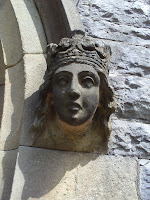
I'll digress a little to show you a few pictures of Beetham church, which is a beautiful historic building dating back to Saxon times, with these lovely medieval-style carvings above the door.
 |
| St Michael's Church, Beetham |


The church was also besieged by Parliamentarians in the Civil War in 1647, where local landowners tombs were desecrated by having the heads removed from the statues.
 |
| Desecrated tombs |
 |
| Stained glass window dedicated to Charles I Beetham Church |
But to return to corpse roads - There was much superstition associated with the coffin route. For example, the feet of the corpse had to be be kept pointing away from the family home on its journey to the cemetery, to prevent the deceased wanting to walk back home.
To prevent the dead returning, the route often went over bridges or stepping stones across running water which it was believed spirits would not be able to cross. Sometimes it led over stiles or through various other hazardous locations, such as The Fairy Steps. This was supposed to deter the ghosts from wandering. Ghosts and spirits were an accepted part of everyday life right up until the 20th century.
The corpse light, the supposed soul of the dead, was supposed to linger on these roads, and there were many accounts of people seeing them.
~~~~~~~~~~~~
Deborah Swift is the author of several historical novels. To read more about her, please visit her website www.deborahswift.blogspot.com
And to find out more about her books:
The Lady's Slipper
The Gilded Lily
A Divided Inheritance (Oct 2013)
~~~~~~~~~~~~
Deborah Swift is the author of several historical novels. To read more about her, please visit her website www.deborahswift.blogspot.com
And to find out more about her books:
The Lady's Slipper
The Gilded Lily
A Divided Inheritance (Oct 2013)
Tuesday, March 12, 2013
English historical customs of Lent - by Deborah Swift
 |
| Still life with Stag Beetle, Flegel 1635 |
In England, Lent was a season when fruit and vegetables were scarce (no supermarkets!) so the fast must have been more of a deprivation than it was in later years.
As time went by, these laws were relaxed so that by the Middle Ages fish made a return to the fast, and by the fifteenth century, milk products had been re-introduced so that effectively Lent had come to mean meals without meat, and most Lenten meals were fish and vegetables.
Fish was usually salted, dried or cured, because fish goes off quickly without refrigeration..The onset of Lent was marked by street traders who 'beare about a herringe on a staffe, and loude doe roare, Herrings, herrings, stinckinge herrings, puddings now no more...' (Neogeorgus), puddings of course, being like black pudding, made of meat.
 After the reformation James I encouraged the eating of fish so that the fish and shipping trades might benefit and Fish on a Friday became an English custom, and is still favoured by schools, hospitals and other institutions. In his diary 10th March 1661, Pepys says he 'dined at home on a poor Lenten dinner of colewarts (cabbage) and bacon.' Not sure whether he is really sticking to the letter of the law with his bacon!
In Lent entertainments of all kinds were curtailed, horse-racing, dancing and even the telling of jokes were frowned upon. Rosencrantz tells Hamlet that the players will give him 'Lenten entertainment' meaning poor or meagre, and the word Lenten came to mean anything grim or dismal, and 'lenten-chaps' a man of dour or sober countenance.
In the 17th century men would leave the powder off their wigs, and even as late as 1816 it was still the custom with some old people to wear black during Lent.
Picture from Michael Hartley's blog
But it was not all doom and gloom.
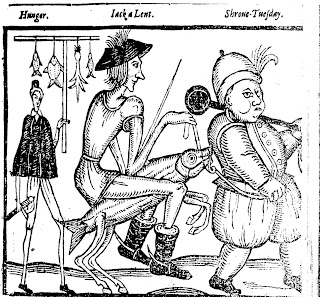
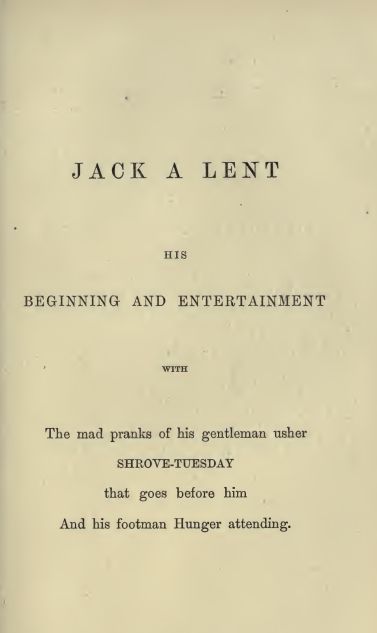
At the beginning of the season of Lent on Ash Wednesday a straw figure of Jack O'Lent would be paraded through the streets and people would throw things at it, kick it, and eventually, when Easter came, set fire to it. The image was said to represent Judas Iscariot, but common sense tells me this is probably the remnants of an earlier more pagan rite, or more likely something borrowed from the German tradition where a figure of Carnival is sentenced to death just before Lent, and burned on Ash Wednesday to mark the transition into a more reflective time of year.
 |
| The Battle between Carnival and Lent by Brueghel (the Younger) |
'that when last thou wert put out of service,
Travell'd to Hampstead Heath on an Ash Wednesday
where thou didst stand six weeks the Jack of Lent,
For boys to hurl three throws a penny at thee
To make thee a purse.'
This sounds like the equivalent of an 'Aunt Sally' and is not a job I'd like to take on if I was short of money, I have to say!
 For many poorer people in the 17th century Lent probably made little difference as they were not in a position to eat meat often anyway. This is certainly the case for Ella and Sadie Appleby, two wide-eyed country girls who seek fame and fortune and to better their lot in fashionable Restoration London.
~~~~~~~~~~~~
If you'd like to read more about Ella and Sadie, and the rich mansions and dark alleys of 17th century London, THE GILDED LILY is now on special offer in the UK for only £1.32 on Kindle, published by Pan Macmillan, and it is also available in the US in all formats published by St Martin's Press.
Read more about traditions of Lent: http://www.answers.com/topic/lent#ixzz2NEwkl9cS
Tuesday, February 12, 2013
Historical Urban Myths by Deborah Swift
As a writer of historical fiction I am fascinated by the stories we inherit about history. Quite a few of these are 'urban myths' - stories that travel orally usually via bars or other social meeting grounds. I recently came across an entertaining one which apparently went viral across the internet in the 1980's.
A Russian destroyer was on manoeuvres near Iceland when the captain spotted a strange dark shape on an iceberg floating some distance away. They went in closer for a better look and saw it was a woman, dressed in a long black dress and lying on her back. She was encased in a thin layer of ice.
A party of men including a physician went to investigate and spent almost an hour freeing her from the ice. However her outdated clothes showed she had perhaps been frozen for fifty years or more. In the pockets of the woman's coat were found a brooch, a purse with old english money, and a number of documents including one that said she was a passenger on the Titanic which had sunk off Newfoundland in 1912.
Upon being 'defrosted' the woman apparently opened her eyes, but attempts to resuscitate her failed.
Allegedly this event was hushed up and did not get the media attention it deserved because the Russian vessel should not have been in those waters and was acting illegally.
So how do I know it's a myth? Because of its unlikely nature. It is just too many unlikely coincidences. Yet this story could make a good novel with a little more detail and veracity. As a writer I am always attempting to make unlikely or dramatic events feel real to the reader.
Most literature consists of unlikely events - too much plot for the average real life - yet good novels feel real. Some of this is to do with manipulating timing, so that unlikely events are spread well apart in the novel, some of it is because what could have been 'coincidences' are given good background reasons. For example it is a wild coincidence if the detective accidentally finds himself in the same hotel in a strange town as the killer, but not a coincidence if he has spent a whole book following him there.
More detail, such as that found in old photographs like the one above of hearses waiting to carry recovered bodies away, helps to anchor the story in reality. Photo credit Of course (unsurprisingly) there is no photo of the woman found on the iceberg in the 1980's, but as a novelist I could use detail from old photographs such as this to help the reader imagine the scene.
Unlikely events feel more real if the characters act like human beings and acknowledge the strangeness and try to find a more plausible explanation.
But I think urban myths are fascinating and would love to hear your historical urban myths. (Bones of Richard III found in a city car park does not count!)
My two books are out now, click on the covers to read more about them.


 |
| image of Titanic from www.bbc.co.uk |
A party of men including a physician went to investigate and spent almost an hour freeing her from the ice. However her outdated clothes showed she had perhaps been frozen for fifty years or more. In the pockets of the woman's coat were found a brooch, a purse with old english money, and a number of documents including one that said she was a passenger on the Titanic which had sunk off Newfoundland in 1912.
Upon being 'defrosted' the woman apparently opened her eyes, but attempts to resuscitate her failed.
Allegedly this event was hushed up and did not get the media attention it deserved because the Russian vessel should not have been in those waters and was acting illegally.
 |
| Hearses lined up on Halifax wharf ready to take R.M.S. Titanic victims |
Most literature consists of unlikely events - too much plot for the average real life - yet good novels feel real. Some of this is to do with manipulating timing, so that unlikely events are spread well apart in the novel, some of it is because what could have been 'coincidences' are given good background reasons. For example it is a wild coincidence if the detective accidentally finds himself in the same hotel in a strange town as the killer, but not a coincidence if he has spent a whole book following him there.
More detail, such as that found in old photographs like the one above of hearses waiting to carry recovered bodies away, helps to anchor the story in reality. Photo credit Of course (unsurprisingly) there is no photo of the woman found on the iceberg in the 1980's, but as a novelist I could use detail from old photographs such as this to help the reader imagine the scene.
Unlikely events feel more real if the characters act like human beings and acknowledge the strangeness and try to find a more plausible explanation.
But I think urban myths are fascinating and would love to hear your historical urban myths. (Bones of Richard III found in a city car park does not count!)
My two books are out now, click on the covers to read more about them.
Friday, January 11, 2013
Let's Hear it for the Smith by Deborah Swift
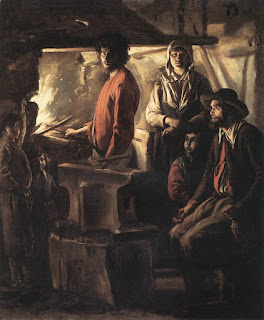 Without the smith most of life in previous centuries would be unthinkable, yet he often does not appear in historical novels. Nearly all of life was supported by the Smith. Forged tools were used by all other craftspeople such as shear hooks for thatchers or chisels for carpenters. All farmers and agricultural workers relied on him for scythes, ploughs, rakes and so forth. Women used iron cooking pots, metal spoons and knives, all hand-made by the smith.
There were several different types of smith; the traditional blacksmith who shod horses and was an expert in veterinary practice, but also the brightsmith or whitesmith who polished his work to a higher degree of finish. Cutlers and weaponry makers would come under this category. Some smiths made bells and included the business of bell-hanging in their trade, some were locksmiths manufacturing only locks and keys. Often they worked closely with wheelwrights (sometimes called wainwrights) to make the parts of wagons and coaches - a trade as complex as manufacturing a car today.In the period I enjoy writing about, the 17th century, all transport was by horse or horse and trap/carriage.
 As well as large items, the blacksmith would often have apprentices making nails, hooks, hinges and other small items for every day use. Nails were used to hold everything together - furniture, shoes, musical instruments all required hand-made nails.
As the demand for nails was so great, some parts of the country specialized in nail-making. The improvement of slitting the iron into bars came from the France early in the 17th century, and this helped create an English nail trade. Godfrey Box built the first slitting mill in England at Dartford, Kent in 1590. It used water power to slit the iron.
Many forges were close to water because of the need to 'quench' the iron between heatings, and because the wheelwright often required water to soak and bend the wood for wheels. Because their trade involved keeping a fire going all day, villages often built the bake-house with its bread-oven near the smith's. So a symbiotic relationship between all the trades developed with each using the advantages of the other. I'm sure many smiths enjoyed the benefit of a hot pie at the end of their day's work!
 |
| 18th century painting of a Forge by Wright of Derby |
Some blacksmiths specialized in making cutlery and so came to be known as “cutlers”. They had a great knowledge of the properties of iron, and how to control the heating and cooling processes to achieve a particular result. These men made knives, scissors, razors and swords.
For my next novel 'A Divided Inheritance' I researched the making of swords and weaponry, which I will explore in a later post as making a cutting edge is a very specialized skill involving the creation of steel through tempering the metal. But just to whet your appetite, here is a section of a sword discovered hidden in Cropredy Church, believed part of a cache of arms left over from the English Civil War. More about this can be found by following this link.

 |
| Quote from www.thomasironworks.com |
.JPG) For more on the history of the Blacksmith I can recommend Simon Grant-Jones'website,
For more on the history of the Blacksmith I can recommend Simon Grant-Jones'website,For more on nail-making http://www.sedgleymanor.com/
English Heritage's 'A Book of English Trades'
My book The Gilded Lily is currently this week's Giveaway, so pop over if you'd like to win a copy. You can also win a copy of The Midwife's Tale by Sam Thomas this week, just scroll down from my Giveaway.
Monday, January 7, 2013
Ruthless villains and feisty heroines - The Gilded Lily
Every week someone offers a book for nothing and this week it's my turn!
You can read about the book HERE. You will be prompted to return here to enter the drawing, and be sure to leave your contact information.
Ends at midnight, January 13th.
Good luck everyone!
Good luck everyone!
Sunday, November 25, 2012
Why the English took to Tea - Deborah Swift

Of course tea is not really English at all, it came first from China and later was introduced to India by the British as a way of suppliying the British Empire with a cheaper product .
At the end of the 17th century almost nobody in England drank tea, but by the end of the next century nearly everyone from King to commoner did. In 1699 six tons were imported, but by the turn of the eighteenth century eleven thousand tons were inported!
 The sudden enthusiasm for tea can be attributed to a number of factors - the first of which was the King's marriage to Catherine of Braganza. Her enormous dowry, suited to her position as daughter of King John IV of Portugal, included the trading posts of Tangier and Bombay, a fortune in gold bullion, and - a large chest of tea.
Catherine loved her tea and drank it from delicate thimble-sized cups. This tea-drinking caught on like wild-fire amongst the aristocracy, leading to many ladies also demanding this new elegant drink.
Because women were excluded from coffee shops drinking tea also became sociable, particularly amongst women, and in 1717 Thomas Twining of Devereux Court, who already owned a coffee shop, opened up a tea shop to furnish women with this fashionable and popular commodity.
 Tea was still so expensive that ladies could not trust their servants to buy the tea for them as it would mean entrusting them with large sums of cash. So now the ladies could take a sedan to the shop, carrying their tea caddies, which were equipped with locks to prevent pilfering. They were able to buy directly from the shop or stay a while there to meet their friends and enjoy tea freshly prepared and served in porcelain dishes.
Of course none of this would have been possible without the British East India Company, which during King Charles's reign grew to become a manifestation of British power in the East Indies. The first tea imports were from Bantam (now in Indonesia) in 1669, and it was part of a cargo of pepper, silk and other textiles. As the company grew it managed to establish trading posts in China, and despite warring with the Dutch, managed to retain control over the importation of tea.
 For the poor, tea became an essential once people realised that it improved health and productivity.It was healthy because of its natural anti-bacterial effects (of course this was not understood then) and the fact it was made with boiled water. It was also more suited to a labouring workforce as it was a stimulant and not like ale, likely to send you to sleep!
The story of tea is a fascinating one and I can highly recommend these books: The True History of Tea - Erling Hoh
A History of the World in Six Glasses - Tom Standage
For All the Tea In China - Sarah Rose
And my new book THE GILDED LILY- during the writing of which I must have drunk hundreds if not thousands of cups of tea - is released in the US tomorrow!
.JPG)
A fast-paced adventure peopled with ruthless villains and feisty heroines whose exploits grab the imagination and add suspense and excitement to a historical gem Lancashire Evening Post
Tuesday, October 16, 2012
Drinking Tobacco - A 17th Century Vice - by Deborah Swift
.JPG)
So I used the word 'smoke' even though it is technically incorrect. Cigarettes did not exist of course so all smoking was through a pipe, and the smoke was drunk, sipped or swallowed. Smoking was a word only applied to the tobacco itself when it was alight!
Tobacco was very expensive so pipe bowls were very small, allowing less than an ounce of tobacco. The stem of the pipe was very long and the hole through which you drank very small. You would have had to suck quite hard to get your hit of tobacco.
 |
| Painting by Pieter Claesz 1636 |
Clay pipes were very decorative especially those made for women, and I have an example at home which has flowers around the bowl. The pipes were cast from a mould after the original shape was carved from wood or fashioned from clay. The one below from the Museum of London shows a carved sailing ship.
For more examples you can't do better than to visit the website of Heather Coleman, an amateur archaelogist and expert on clay pipes.
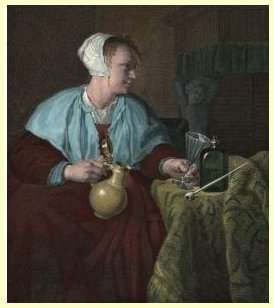 This image of a seventeenth century woman with a pipe is from an article about women and smoking by Beth Maxwell Boyle. She has a collection of pipes and smoking related memorabilia on her website
Pipes were also used by children in the age-old fashion even in the 17th century as Michaelina Woutiers' 'Boys Blowing Bubbles' from the 1640s shows us. This painting is in the Seattle Art Museum, and is a wonderful resource for costume detail. Note the shell used for holding the bubble-blowing liquid. Let's hope the boys did not 'drink' the contents!
Are there things in novels you have read that jumped you out of the story? And if you're a writer have you made decisions that were technically incorrect for the benefit of the reader?
THE GILDED LILY is already available on Kindle and will be out in paperback and in other e-formats in the US on 27th November. Read the latest review at TheLittle Reader Library
And for more about the THE GILDED LILY, a historical adventure set in rich mansions and dark alleys of 17th century London have a look at the trailer.
THE GILDED LILY is already available on Kindle and will be out in paperback and in other e-formats in the US on 27th November. Read the latest review at TheLittle Reader Library
Wednesday, September 12, 2012
Celebrating Childhood Picture Books and the stories that shape us
By Deborah Swift
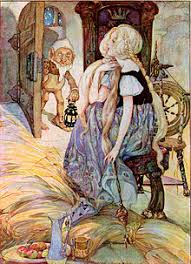
 I think it is not possible to underestimate the influence of childhood reading on later life. For me much of my childhood reading was not just about the stories, but about the pictures that went with the stories. My mother gave me a wonderful thick book called The Golden Wonder Book which was full of myths, stories and classic tales. Everything from Dickens, To Aesop, to Jane Austen - even Shakespeare. Here is one of the pictures by Anne Anderson from Rumplestiltskin.


The stories and extracts were chosen and edited by John Crossland and JM Parrish, but I can find out nothing about them. I owe these people a huge debt as they introduced me to so much classic literature. What was more, they were packaged with glorious illustrations by artists such as Anne Anderson, Margaret Tulloch and Arthur Rackham. The corseted lady on the left is by Arthur Rackham, the dandy on the right by Tulloch. It is these visual images which have stayed with me - a vague sense of a romantic golden age from times gone by. Often the myths are set in a "medieval" England that is more myth than real history, but these images have endured in my mind. Later in life these pictures persuaded me to go into costume design as a career and from there to writing historical fiction.
 Thank you for helping me celebrate - The Gilded Lily is out TODAY! published by Pan Macmillan - paperback and e-book. US edition with extras for Reading Groups coming soon.
Look out for the Giveaway of The Gilded Lily here next week.
Watch the Trailer
Ella becomes obsessed with the glitter and glamour of city life and sets her sights on flamboyant man-about-town, Jay Whitgift. But nothing is what it seems - not even Jay Whitgift.
Can Sadie survive a fugitive's life in the big city? But even more pressing, can she survive life with her older sister Ella? And when an altogether different danger threatens Ella's life, will Sadie run to the rescue, or turn the other cheek?
Set in London's atmospheric coffee houses, the rich mansions of Whitehall, and the pawnshops, slums and rookeries hidden from rich men's view, The Gilded Lily is about beauty and desire, about the stories we tell ourselves, and about how sisterhood can be both a burden and a saving grace.
"a beautifully-written blend of fast pace and atmospheric historical detail... the intense evocation of the period never falters" Gabrielle Kimm, author of His Last Duchess
I think it is not possible to underestimate the influence of childhood reading on later life. For me much of my childhood reading was not just about the stories, but about the pictures that went with the stories. My mother gave me a wonderful thick book called The Golden Wonder Book which was full of myths, stories and classic tales. Everything from Dickens, To Aesop, to Jane Austen - even Shakespeare. Here is one of the pictures by Anne Anderson from Rumplestiltskin.
The stories and extracts were chosen and edited by John Crossland and JM Parrish, but I can find out nothing about them. I owe these people a huge debt as they introduced me to so much classic literature. What was more, they were packaged with glorious illustrations by artists such as Anne Anderson, Margaret Tulloch and Arthur Rackham. The corseted lady on the left is by Arthur Rackham, the dandy on the right by Tulloch. It is these visual images which have stayed with me - a vague sense of a romantic golden age from times gone by. Often the myths are set in a "medieval" England that is more myth than real history, but these images have endured in my mind. Later in life these pictures persuaded me to go into costume design as a career and from there to writing historical fiction.
The stories themselves influenced me in so many ways. The idea of the prince who might rescue me from a tower, that we might wake from a hundred year slumber with a kiss, the fear of entering some other world and never being able to return, these all have a place in my psyche thanks to this picture book. There was a strong moral code in most of the stories, which seemed to say that good things only happened to 'good girls.' And many of the stories play with the idea of transformation from ugliness to beauty.
The idea of the influence of story on our lives was one theme I wanted to explore in The Gilded Lily - how were the sisters Ella and Sadie made different by the stories that other people told about them? Perhaps your parents called you "the clever one" (thereby implying you weren't attractive), or perhaps they told you that you were not intelligent, but a hard worker. Ella is "the pretty one" and Sadie "the skilful one". How will they each fare when they leave their village and go to seek refuge in fashionable London?
Some of the fairy stories that are mentioned in The Gilded Lily are Cinderella - called The Ash Maid in the 17th century - and Snow White and Rose Red. Of course these are stories mostly celebrated by girls. What childhood stories made a deep impression on boys? In The Gilded Lily, my character Dennis enjoys penny chapbooks of the sensational crimes of the day - tales of hangings and skulduggery.
The idea of the influence of story on our lives was one theme I wanted to explore in The Gilded Lily - how were the sisters Ella and Sadie made different by the stories that other people told about them? Perhaps your parents called you "the clever one" (thereby implying you weren't attractive), or perhaps they told you that you were not intelligent, but a hard worker. Ella is "the pretty one" and Sadie "the skilful one". How will they each fare when they leave their village and go to seek refuge in fashionable London?
Some of the fairy stories that are mentioned in The Gilded Lily are Cinderella - called The Ash Maid in the 17th century - and Snow White and Rose Red. Of course these are stories mostly celebrated by girls. What childhood stories made a deep impression on boys? In The Gilded Lily, my character Dennis enjoys penny chapbooks of the sensational crimes of the day - tales of hangings and skulduggery.
Are there books or stories from your childhood that have affected your life?
 Thank you for helping me celebrate - The Gilded Lily is out TODAY! published by Pan Macmillan - paperback and e-book. US edition with extras for Reading Groups coming soon.
Look out for the Giveaway of The Gilded Lily here next week.
Winter 1661
Timid Sadie Appleby has always lived in her small village. One night she is rudely awoken by her older and bolder sister, Ella, who has robbed her employer and is on the run. The girls flee their rural home of Westmorland to head for London, hoping to lose themselves in the teeming city. But the dead man's relatives are in hot pursuit, and soon a game of cat and mouse begins.Ella becomes obsessed with the glitter and glamour of city life and sets her sights on flamboyant man-about-town, Jay Whitgift. But nothing is what it seems - not even Jay Whitgift.
Can Sadie survive a fugitive's life in the big city? But even more pressing, can she survive life with her older sister Ella? And when an altogether different danger threatens Ella's life, will Sadie run to the rescue, or turn the other cheek?
Set in London's atmospheric coffee houses, the rich mansions of Whitehall, and the pawnshops, slums and rookeries hidden from rich men's view, The Gilded Lily is about beauty and desire, about the stories we tell ourselves, and about how sisterhood can be both a burden and a saving grace.
"a beautifully-written blend of fast pace and atmospheric historical detail... the intense evocation of the period never falters" Gabrielle Kimm, author of His Last Duchess
 |
| All illustrations from Wikicommons or Grandma's Graphics |
Monday, July 9, 2012
Miniature Cathedrals - England's Market Crosses
by Deborah Swift
There is a wonderful Market Cross at Kirkby Lonsdale, a town near to where I live, where I sometimes go to shop, or enjoy a pot of tea with friends. Seeing it made me curious to find out about other market crosses which are wonderful examples of miniature architecture, reflecting their time and the style of the day.
The primary purpose of wayside crosses was to remind the traveller that he was there but for the Grace of God
"for this reason ben Crosses by ye waye that whan folke passynge see the Crosse, they sholde thynke on Hym that deyed on the Crosse, and worsyppe Hym above all thynge" Wynken de Worde 1496
In Norman times crosses were often put up to define boundaries, particularly of a place of sanctuary. Within a mile of St Wilfrid's church in Ripon a man was safe, no matter what crime he had committed. Crosses were therefore erected on each of the five major roads leading into the town, to show the boundaries of the sanctuary.
However, as time went on, these crosses developed a more secular use as landmarks, meeting places and points of trade. They also became places where punishment was meted out under the eye of God represented by the Cross. Stocks and pillories are often to be found at their bases. In Oakham, the market cross, used to trade butter and other produce has it's stocks right up next to the cross. Can you spot something weird about these stocks?Click this link for more pictures and More info on this cross at
where you can also view its fabulous wooden roofbeams.
.jpg) |
| Kirkby Lonsdale Market Cross |
The primary purpose of wayside crosses was to remind the traveller that he was there but for the Grace of God
"for this reason ben Crosses by ye waye that whan folke passynge see the Crosse, they sholde thynke on Hym that deyed on the Crosse, and worsyppe Hym above all thynge" Wynken de Worde 1496
In Norman times crosses were often put up to define boundaries, particularly of a place of sanctuary. Within a mile of St Wilfrid's church in Ripon a man was safe, no matter what crime he had committed. Crosses were therefore erected on each of the five major roads leading into the town, to show the boundaries of the sanctuary.
 |
| Oakham Market Cross |
where you can also view its fabulous wooden roofbeams.
 |
| Amroth Market Cross |
In Wales the market cross was used to hang the heads of foxes and wolves captured in the vicinity as well as to punish thieves - foxes and wolves being considered a type of thief. A reward was offered for the capture of a wolf which was the same price as that of the reward for a robber, dog foxes were worth 2s 6d and vixens 1s 6d as late as the middle of the nineteenth century. Examples of these crosses can be seen at Eglwyscummin and Amroth.
 As time went on, the cross grew a roof, and the covered areas beneath the crosses were used for trade, particularly after the Reformation, when people were unsure whether they were still to be used as "places of worship" or whether these old monuments would be against the edicts of the King. But even as early as 1337 the market cross at Norwich was large enough to house a chapel and four shops! The early equivalent of the modern shopping mall! One of the finest of these is at Chichester. Built in 1501, it is octagonal in shape, features eight flying buttresses with matching arches, and above it the pinnacle is a lantern spire, originally lit at night. Salisbury has a similar one but hexagonal. It is known as the Poultry Cross, presumably because poultry was sold there. There are other examples at Leighton Buzzard and Shepton Mallet. (Great town names, too!)
One of the most famous "preaching crosses", ones from which open air sermons were delivered, was Paul's Cross, erected in the early 13th century near the wall of old St Paul's, London. Before it was pulled down in 1641 it was the scene of many historic events - mayors were elected under its shadow, heretics excommunicated there and in 1588 the first news of the Armada's defeat was announced from it to the public. Today few preaching crosses remain, except the Black Friar's Preaching Cross in Hereford and the one at Iron Acton Gloucestershire.
In 1643, under Puritan rule, Parliament passed an act ordering all crosses in churches, chapels and churchyards to be taken away, as "Monuments of Superstition and Idolatry". This led to the destruction of many fine crosses including Charing Cross in London. Although stones from this cross were later used to make the pavements in front of the Palace of Whitehall. Enterprising sympathisers who wanted to retain their connection with the cross also made souvenirs by cutting and polishing the stone and using it as knife handles.This is the period that interested me when writing The Gilded Lily, which features some Puritan characters alongside the libertines of London.
My explorations into these crosses led me to explore what are known as "The Eleanor Crosses", twelve crosses erected between 1291 and 1294. This became a whole separate interest, quite apart from the research I was doing for my books, so if you liked these, you can find out more about these beautiful monuments on my blog
 "Deborah Swift's THE GILDED LILY is a heart-rending story of two sisters on the run, searching for a better life. Beautifully written and meticulously researched, the novel drew me straight into the teeming streets of Restoration London. An addictive, page-turning read." Mary Sharratt, author of 'The Vanishing Point' and 'Daughters of the Witching Hill.'
The Gilded Lily will be published by Pan Macmillan in Sept 2012
 As time went on, the cross grew a roof, and the covered areas beneath the crosses were used for trade, particularly after the Reformation, when people were unsure whether they were still to be used as "places of worship" or whether these old monuments would be against the edicts of the King. But even as early as 1337 the market cross at Norwich was large enough to house a chapel and four shops! The early equivalent of the modern shopping mall! One of the finest of these is at Chichester. Built in 1501, it is octagonal in shape, features eight flying buttresses with matching arches, and above it the pinnacle is a lantern spire, originally lit at night. Salisbury has a similar one but hexagonal. It is known as the Poultry Cross, presumably because poultry was sold there. There are other examples at Leighton Buzzard and Shepton Mallet. (Great town names, too!)
.jpg) |
| Salisbury Market Cross |
 |
| The wonderful cross at Wymondham, Norfolk |
My explorations into these crosses led me to explore what are known as "The Eleanor Crosses", twelve crosses erected between 1291 and 1294. This became a whole separate interest, quite apart from the research I was doing for my books, so if you liked these, you can find out more about these beautiful monuments on my blog
The Gilded Lily will be published by Pan Macmillan in Sept 2012
Saturday, March 31, 2012
17th Century Garden Design for Women

William Lawson is credited with making gardening popular for women, with his book, A New Orchard and Garden which was printed together with the first horticultural book written solely for women, The Country Housewife's Garden. Beautifully illustrated with charming woodcuts, it tells the 17th century woman everything she needs to know to have a productive and visually attractive garden.

The concept of a "pretty" garden would have been an anathema to most women of the 17th century, as gardens were primarily about producing food and herbs, unless you were very wealthy, in which case the gardening was left to your servants. The 17-century author of The English Housewife, Gervase Markham, claimed the “complete woman” had
“skill in physic, surgery, cookery, extraction of oils, banqueting stuff, ordering of great feasts, preserving of all sorts of wines…distillations, perfumes, ordering of wool, hemp and flax: making cloth and dying; the knowledge of dairies: office of malting; of oats…of brewing, baking, and all other things belonging to a household.”
Guess that did not leave much time for planting pretty flowers!
Because kitchen gardens were about supplying the table, and as much ground as possible was covered with edible plants, every garden was different, planted according to the whims of the women of the household. William Lawson's book for the country housewife was designed to be read in conjunction with his New Orchard and Garden, thus giving women access to the idea of garden design, in print, for the very first time.
William Lawson lived from 1553 to1635 and was the vicar of Ormesby, a country parish in Yorkshire. No doubt his gardening passion led him to be so long-lived for an age where most people did not reach fifty. Gardening was a national passion in the 16th and 17th centuries, as more species came from abroad, and an interest in subjects concentrating on the useful qualities and medical virtues of plants became popular.
But the war against garden pests was just as hard then as now - he calls them the 'whole Army of mischiefs' and says that 'Good things have most enemies' . The enemies in his Yorkshire Garden were apparently deer and moles.
Lawson's garden plan included long walkways, a maze, and even a bowling alley.The illustration below depicts the overall plan.

Its rectangular shape is split into six sections over three terraces, with flights of stairs and paths to go from one to the other. Its design demonstrates the vogue in the 16th and 17th century for symmetry and patterns. In the top left square he planned to have topiary, signified by the man with the sword and a horse. A river runs at the top and bottom of the garden where he says 'you might sit in your mount and angle a peckled trout, sleighty eel or some other daintie fish'.
.JPG)

In The Lady's Slipper, Alice Ibbetson is an obsessive gardener - a pioneer if you like, testing out the knowledge handed down from her father who was a plantsman much like William Lawson. She finds relaxation in communing with nature. Her maid, Ella, featured in The Gilded Lily, would try to avoid garden work if at all possible. Her sights are set on becoming a fine lady, just like Alice Ibbetson, and leaving manual labour behind for good.
More information from my blogs
www.deborahswift.blogspot.com
www.royaltyfreefictionary.blogspot.com
Thanks for reading!
William Lawson lived from 1553 to1635 and was the vicar of Ormesby, a country parish in Yorkshire. No doubt his gardening passion led him to be so long-lived for an age where most people did not reach fifty. Gardening was a national passion in the 16th and 17th centuries, as more species came from abroad, and an interest in subjects concentrating on the useful qualities and medical virtues of plants became popular.
But the war against garden pests was just as hard then as now - he calls them the 'whole Army of mischiefs' and says that 'Good things have most enemies' . The enemies in his Yorkshire Garden were apparently deer and moles.
Lawson's garden plan included long walkways, a maze, and even a bowling alley.The illustration below depicts the overall plan.

Its rectangular shape is split into six sections over three terraces, with flights of stairs and paths to go from one to the other. Its design demonstrates the vogue in the 16th and 17th century for symmetry and patterns. In the top left square he planned to have topiary, signified by the man with the sword and a horse. A river runs at the top and bottom of the garden where he says 'you might sit in your mount and angle a peckled trout, sleighty eel or some other daintie fish'.
In The Lady's Slipper, Alice Ibbetson is an obsessive gardener - a pioneer if you like, testing out the knowledge handed down from her father who was a plantsman much like William Lawson. She finds relaxation in communing with nature. Her maid, Ella, featured in The Gilded Lily, would try to avoid garden work if at all possible. Her sights are set on becoming a fine lady, just like Alice Ibbetson, and leaving manual labour behind for good.
More information from my blogs
www.deborahswift.blogspot.com
www.royaltyfreefictionary.blogspot.com
Subscribe to:
Posts (Atom)