

Showing posts with label storytelling. Show all posts
Showing posts with label storytelling. Show all posts
Monday, December 9, 2013
Giveaway of The Gilded Lily


Tuesday, February 12, 2013
Historical Urban Myths by Deborah Swift
As a writer of historical fiction I am fascinated by the stories we inherit about history. Quite a few of these are 'urban myths' - stories that travel orally usually via bars or other social meeting grounds. I recently came across an entertaining one which apparently went viral across the internet in the 1980's.
A Russian destroyer was on manoeuvres near Iceland when the captain spotted a strange dark shape on an iceberg floating some distance away. They went in closer for a better look and saw it was a woman, dressed in a long black dress and lying on her back. She was encased in a thin layer of ice.
A party of men including a physician went to investigate and spent almost an hour freeing her from the ice. However her outdated clothes showed she had perhaps been frozen for fifty years or more. In the pockets of the woman's coat were found a brooch, a purse with old english money, and a number of documents including one that said she was a passenger on the Titanic which had sunk off Newfoundland in 1912.
Upon being 'defrosted' the woman apparently opened her eyes, but attempts to resuscitate her failed.
Allegedly this event was hushed up and did not get the media attention it deserved because the Russian vessel should not have been in those waters and was acting illegally.
So how do I know it's a myth? Because of its unlikely nature. It is just too many unlikely coincidences. Yet this story could make a good novel with a little more detail and veracity. As a writer I am always attempting to make unlikely or dramatic events feel real to the reader.
Most literature consists of unlikely events - too much plot for the average real life - yet good novels feel real. Some of this is to do with manipulating timing, so that unlikely events are spread well apart in the novel, some of it is because what could have been 'coincidences' are given good background reasons. For example it is a wild coincidence if the detective accidentally finds himself in the same hotel in a strange town as the killer, but not a coincidence if he has spent a whole book following him there.
More detail, such as that found in old photographs like the one above of hearses waiting to carry recovered bodies away, helps to anchor the story in reality. Photo credit Of course (unsurprisingly) there is no photo of the woman found on the iceberg in the 1980's, but as a novelist I could use detail from old photographs such as this to help the reader imagine the scene.
Unlikely events feel more real if the characters act like human beings and acknowledge the strangeness and try to find a more plausible explanation.
But I think urban myths are fascinating and would love to hear your historical urban myths. (Bones of Richard III found in a city car park does not count!)
My two books are out now, click on the covers to read more about them.


 |
| image of Titanic from www.bbc.co.uk |
A party of men including a physician went to investigate and spent almost an hour freeing her from the ice. However her outdated clothes showed she had perhaps been frozen for fifty years or more. In the pockets of the woman's coat were found a brooch, a purse with old english money, and a number of documents including one that said she was a passenger on the Titanic which had sunk off Newfoundland in 1912.
Upon being 'defrosted' the woman apparently opened her eyes, but attempts to resuscitate her failed.
Allegedly this event was hushed up and did not get the media attention it deserved because the Russian vessel should not have been in those waters and was acting illegally.
 |
| Hearses lined up on Halifax wharf ready to take R.M.S. Titanic victims |
Most literature consists of unlikely events - too much plot for the average real life - yet good novels feel real. Some of this is to do with manipulating timing, so that unlikely events are spread well apart in the novel, some of it is because what could have been 'coincidences' are given good background reasons. For example it is a wild coincidence if the detective accidentally finds himself in the same hotel in a strange town as the killer, but not a coincidence if he has spent a whole book following him there.
More detail, such as that found in old photographs like the one above of hearses waiting to carry recovered bodies away, helps to anchor the story in reality. Photo credit Of course (unsurprisingly) there is no photo of the woman found on the iceberg in the 1980's, but as a novelist I could use detail from old photographs such as this to help the reader imagine the scene.
Unlikely events feel more real if the characters act like human beings and acknowledge the strangeness and try to find a more plausible explanation.
But I think urban myths are fascinating and would love to hear your historical urban myths. (Bones of Richard III found in a city car park does not count!)
My two books are out now, click on the covers to read more about them.
Wednesday, September 12, 2012
Celebrating Childhood Picture Books and the stories that shape us
By Deborah Swift
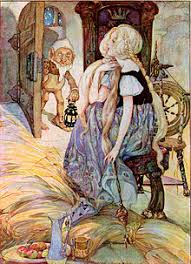
 I think it is not possible to underestimate the influence of childhood reading on later life. For me much of my childhood reading was not just about the stories, but about the pictures that went with the stories. My mother gave me a wonderful thick book called The Golden Wonder Book which was full of myths, stories and classic tales. Everything from Dickens, To Aesop, to Jane Austen - even Shakespeare. Here is one of the pictures by Anne Anderson from Rumplestiltskin.


The stories and extracts were chosen and edited by John Crossland and JM Parrish, but I can find out nothing about them. I owe these people a huge debt as they introduced me to so much classic literature. What was more, they were packaged with glorious illustrations by artists such as Anne Anderson, Margaret Tulloch and Arthur Rackham. The corseted lady on the left is by Arthur Rackham, the dandy on the right by Tulloch. It is these visual images which have stayed with me - a vague sense of a romantic golden age from times gone by. Often the myths are set in a "medieval" England that is more myth than real history, but these images have endured in my mind. Later in life these pictures persuaded me to go into costume design as a career and from there to writing historical fiction.
 Thank you for helping me celebrate - The Gilded Lily is out TODAY! published by Pan Macmillan - paperback and e-book. US edition with extras for Reading Groups coming soon.
Look out for the Giveaway of The Gilded Lily here next week.
Watch the Trailer
Ella becomes obsessed with the glitter and glamour of city life and sets her sights on flamboyant man-about-town, Jay Whitgift. But nothing is what it seems - not even Jay Whitgift.
Can Sadie survive a fugitive's life in the big city? But even more pressing, can she survive life with her older sister Ella? And when an altogether different danger threatens Ella's life, will Sadie run to the rescue, or turn the other cheek?
Set in London's atmospheric coffee houses, the rich mansions of Whitehall, and the pawnshops, slums and rookeries hidden from rich men's view, The Gilded Lily is about beauty and desire, about the stories we tell ourselves, and about how sisterhood can be both a burden and a saving grace.
"a beautifully-written blend of fast pace and atmospheric historical detail... the intense evocation of the period never falters" Gabrielle Kimm, author of His Last Duchess
I think it is not possible to underestimate the influence of childhood reading on later life. For me much of my childhood reading was not just about the stories, but about the pictures that went with the stories. My mother gave me a wonderful thick book called The Golden Wonder Book which was full of myths, stories and classic tales. Everything from Dickens, To Aesop, to Jane Austen - even Shakespeare. Here is one of the pictures by Anne Anderson from Rumplestiltskin.
The stories and extracts were chosen and edited by John Crossland and JM Parrish, but I can find out nothing about them. I owe these people a huge debt as they introduced me to so much classic literature. What was more, they were packaged with glorious illustrations by artists such as Anne Anderson, Margaret Tulloch and Arthur Rackham. The corseted lady on the left is by Arthur Rackham, the dandy on the right by Tulloch. It is these visual images which have stayed with me - a vague sense of a romantic golden age from times gone by. Often the myths are set in a "medieval" England that is more myth than real history, but these images have endured in my mind. Later in life these pictures persuaded me to go into costume design as a career and from there to writing historical fiction.
The stories themselves influenced me in so many ways. The idea of the prince who might rescue me from a tower, that we might wake from a hundred year slumber with a kiss, the fear of entering some other world and never being able to return, these all have a place in my psyche thanks to this picture book. There was a strong moral code in most of the stories, which seemed to say that good things only happened to 'good girls.' And many of the stories play with the idea of transformation from ugliness to beauty.
The idea of the influence of story on our lives was one theme I wanted to explore in The Gilded Lily - how were the sisters Ella and Sadie made different by the stories that other people told about them? Perhaps your parents called you "the clever one" (thereby implying you weren't attractive), or perhaps they told you that you were not intelligent, but a hard worker. Ella is "the pretty one" and Sadie "the skilful one". How will they each fare when they leave their village and go to seek refuge in fashionable London?
Some of the fairy stories that are mentioned in The Gilded Lily are Cinderella - called The Ash Maid in the 17th century - and Snow White and Rose Red. Of course these are stories mostly celebrated by girls. What childhood stories made a deep impression on boys? In The Gilded Lily, my character Dennis enjoys penny chapbooks of the sensational crimes of the day - tales of hangings and skulduggery.
The idea of the influence of story on our lives was one theme I wanted to explore in The Gilded Lily - how were the sisters Ella and Sadie made different by the stories that other people told about them? Perhaps your parents called you "the clever one" (thereby implying you weren't attractive), or perhaps they told you that you were not intelligent, but a hard worker. Ella is "the pretty one" and Sadie "the skilful one". How will they each fare when they leave their village and go to seek refuge in fashionable London?
Some of the fairy stories that are mentioned in The Gilded Lily are Cinderella - called The Ash Maid in the 17th century - and Snow White and Rose Red. Of course these are stories mostly celebrated by girls. What childhood stories made a deep impression on boys? In The Gilded Lily, my character Dennis enjoys penny chapbooks of the sensational crimes of the day - tales of hangings and skulduggery.
Are there books or stories from your childhood that have affected your life?
 Thank you for helping me celebrate - The Gilded Lily is out TODAY! published by Pan Macmillan - paperback and e-book. US edition with extras for Reading Groups coming soon.
Look out for the Giveaway of The Gilded Lily here next week.
Winter 1661
Timid Sadie Appleby has always lived in her small village. One night she is rudely awoken by her older and bolder sister, Ella, who has robbed her employer and is on the run. The girls flee their rural home of Westmorland to head for London, hoping to lose themselves in the teeming city. But the dead man's relatives are in hot pursuit, and soon a game of cat and mouse begins.Ella becomes obsessed with the glitter and glamour of city life and sets her sights on flamboyant man-about-town, Jay Whitgift. But nothing is what it seems - not even Jay Whitgift.
Can Sadie survive a fugitive's life in the big city? But even more pressing, can she survive life with her older sister Ella? And when an altogether different danger threatens Ella's life, will Sadie run to the rescue, or turn the other cheek?
Set in London's atmospheric coffee houses, the rich mansions of Whitehall, and the pawnshops, slums and rookeries hidden from rich men's view, The Gilded Lily is about beauty and desire, about the stories we tell ourselves, and about how sisterhood can be both a burden and a saving grace.
"a beautifully-written blend of fast pace and atmospheric historical detail... the intense evocation of the period never falters" Gabrielle Kimm, author of His Last Duchess
 |
| All illustrations from Wikicommons or Grandma's Graphics |
Subscribe to:
Posts (Atom)