Showing posts with label Third Crusade. Show all posts

Friday, July 10, 2020

The Third Crusade: an Early Mishap at Lyon, 10 July 1190

by Charlene Newcomb

King Richard I
When Richard became King of England in 1189 the pilgrimage to the Holy Land to free Jerusalem became his top priority. After his coronation, Richard set the kingdom in order and raised monies to support the undertaking. Richard’s fleet sailed towards Gibraltar intending to meet him in Marseille. His army of pilgrims – or crusaders, as we refer to them now – gathered in Tours in the spring of 1190. By early July, Richard and King Philip of France concluded discussions at Vézelay setting the conditions of their cooperation.

From Vézelay, the pilgrims marched south towards Lyon. Contemporary chroniclers describe the locals’ reactions and the grandeur of the armies, thousands strong. The discipline of the soldiers impressed them. “Who could stand against their force? What a beautiful company, what handsome youths!” Ambroise and the author of the Itinerarium claim the English and French troops numbered near 100,000 – a huge exaggeration. We can only estimate the actual numbers. Author David Miller suggests that when the army began its coastal march south from Acre in August 1191, the French and English forces numbered approximately 1,600 knights and over 14,000 foot soldiers.

On the 10th of July in 1190, Richard and Philip arrived in Lyon. The mishap here on the River Rhône – early in the crusade timeline – could have proven disastrous. In his Annals, Roger de Hoveden writes,
When they had arrived at the city of Lyons on the Rhone, after they with the greater part of their households had passed over the bridge across that river, the bridge, being thronged with men and women, broke down, not without doing injury to great numbers. Here also the two kings separated…
A second account of the incident comes from Ambroise. He describes the scene as utter chaos. Hundreds of people, animals, and wagons plummeted into the rapidly-raging river:
But those who in the morning passed?
Crowded the bridge so thick and fast?
Misfortune did them overtake.
For one span of the bridge did break
Because of the waters treacherous,
Swollen so high and perilous.
For weight of men more than an hundred
O’ertaxed the pine arch till it sundered;
The arch fell and they tumbled in,
And there were shouting, groans and din…
The Itinerarium mentions that the bridge was extremely high, the drop to the river below far enough that many could have died. Onlookers raced to pull victims from the swift current. Incredibly, the chroniclers report that only two people died. Were the numbers underreported, reflecting only those of noble birth? Many historians suggest only "important" deaths were recorded, and therefore, we will never know the true death toll.

De Hoveden has no further comment on the aftermath of the bridge collapse. None of the accounts reflect whether King Richard witnessed the incident, but the Itinerarium describes those who had not yet crossed the river as “at wit’s end.” None wanted to be left behind. The chronicler claims Richard oversaw the construction of a floating bridge built of boats lashed together. The king would have read of the idea in De Re Militari, a treatise of military principles and practices written by Publius Falvius Vegetius Renatus. Amboise does not mention the bridge of boats, but writes that small skiffs were used to ferry people to the opposite riverbank. Both accounts indicate the incident delayed the march south by three days.

What gives one pause is that one month earlier and two thousand miles away, the Holy Roman Emperor Frederick Barbarossa met his fate at the Saleph River in Turkey. His horse slipped and Frederick fell into the river and drowned. It was a devastating blow for his followers, only one-third to one-quarter of whom – perhaps 5,000 men – continued on to the Holy Land. During the siege of Acre, these troops reported to Duke Leopold of Austria, a man who would become King Richard’s bitter enemy.

What if the Lionheart had been on the bridge when it collapsed and had died at Lyon? Would Richard’s forces have been thrown into disarray as Barbarossa’s had? Would Philip of France have forsaken the pilgrimage to pursue his desires to regain French territory and to remove the Angevins from the continent? Christians besieging Acre would have been left without reinforcements. They were in dire straits, having suffered repeated attacks by Saladin’s forces. It is likely the siege of Acre would have failed. Acre, other coastal towns, and Jerusalem would remain in Muslim hands. The Third Crusade might not have been.

Sources 

Ambroise. (1976). The crusade of Richard Lion-Heart. (Trans. by M.J. Hubert.) New  York: Octagon.

De Hoveden, R. (1853).  The annals of Roger de Hoveden, comprising the history of England and of other countries of Europe from A. D. 732 to A. D. 1201. (Henry T. Riley, Trans.). London: H. G. Bohn. (Original work published 1201?)

Miller, D. (2003). Richard the Lionheart: the mighty crusader. London: Weidenfeld & Nicolson.

Nicholson, H., & Stubbs, W., trans. (1997). Chronicle of the third crusade : A translation of the itinerarium peregrinorum et gesta regis ricardi. Aldershot, Hants, England ; Brookfield, Vt.: Ashgate.

Painting of Richard I by Merry-Joseph Blondel. Licensed under Public Domain via Wikimedia Commons.

An earlier version of this post was originally published at http://charlenenewcomb.com/2014/07/10/10-july-1190-the-bridge-on-the-river-rhone/ , and published on EHFA on July 9, 2015.

~ ~ ~ ~ ~ ~ ~ ~ ~ ~


Charlene Newcomb is the author of the Battle Scars series, 12th century historical fiction filled with war, political intrigue, and a knightly romance of forbidden love set during the reign of Richard the Lionheart. She is currently working on a new medieval tale set during King John’s reign; and in summer 2020 will publish Echoes of the Storm, a sci fi/space opera filled with rebels and traitors and battles and romance in a galaxy far, far away (no, not Star Wars). Sign up for Char’s Newsletter for exclusives, including a free short story, and other special offers. Find her books on Amazon & connect with Char on Facebook, Twitter, or Instagram.

Wednesday, December 19, 2018

Richard the Lionheart's Ordeal, October - December 1192

by Charlene Newcomb

A few days before Christmas 1192, Richard the Lionheart, King of England 1189-1199, surrendered to Duke Leopold of Austria in a Vienna suburb. Perhaps best known for his role in the Third Crusade, Richard had set sail from the Holy Land in October 1192 after an unsuccessful campaign to free Jerusalem from the hands of Saladin. Richard's journey home sounds more like fiction than fact. Let me share this incredible story, looking back at events in the Fall of 1192 and other historical background leading up to Richard's capture.

Enemies – Old Rivalries, Hatred, and Politics

To the west, the quickest route to Richard’s realms was via Sicily and Marseille – the route he had sailed in 1190/1191 to the Holy Land. But word reached Richard that he would not find safe harbor in Marseille. Raymond, Count of Toulouse, an old enemy he’d engaged with in border disputes in Aquitaine, planned to seize him there.

There were ports west of Marseille, but Toulouse had conspired with the king of Aragon and Catalonia, cutting Richard’s access to Provence and northern Spain. There were also rumors that Genoese ships had been hired to watch for and intercept Richard. Skirting the north African coast to sail west and through the Straits of Gilbralter into the Atlantic would be far too dangerous. Seafaring men of the 12th century knew the hazards of winter sailing, and the best among them rarely ventured into the Mediterranean after the 1st of November.

Richard weighed his options as he approached Sicily. With the sea routes to the west cut off, his buss, a large galley called the Franche Nef, turned back and sailed into the Adriatic Sea.

Pirates, Privateers, and Shipwreck

The Lionheart abandoned his buss in Corfu and, dependent on which history you read, either: 1) had a run-in with pirates (with whom he ended up bargaining); or 2) hired two privateer galleys for 200 marks. With a small group of trusted companions and the 2 galleys, Richard sailed north from Corfu battered by one storm after another. In early December, the galleys were driven ashore by storms somewhere between Aquileia and Venice.

Overland Routes

Richard now had to consider overland routes, which presented as many hazards as the sea routes. Travel west meant traversing the Kingdom of Italy (ruled by the Holy Roman Emperor, Henry VI), treacherous passages through the Alps, and the lands of King Philip of France. The northeast route would take the returning crusaders through lands subject to Henry VI, and Leopold, Duke of Austria. In every direction, Richard was faced with enemies or inhospitable terrain.

King Philip was no doubt delighted by Toulouse’s actions. Philip – supposedly Richard’s ally in the Holy Land – had returned to France after Acre surrendered to the Crusaders in July 1191. He had invaded Richard’s lands in Normandy and stirred rebellion amongst Richard’s barons while Richard marched towards Jerusalem. Richard had also jilted Philip’s sister Alys to marry Berengaria of Navarre in 1191.

Henry VI had no love for Richard. His wife Constance had a strong claim to the throne of Sicily following the death of Richard’s brother-in-law William II. But Richard had supported Tancred’s accession there. Henry had also fought against another of Richard’s brothers-in-law, Henry of Saxony. And he was an ally of Duke Leopold of Austria, whom Richard had insulted after the siege of Acre. Highly offended when Richard ordered the removal of his banners, which had been raised above the city walls, Leopold returned to Austria.

Three hundred miles of enemy territory. Could Richard and his 20 companions make for Bohemia, a country whose ruler was no friend of Henry VI? From there, Richard could go to Saxony where his brother-in-law Henry the Lion ruled. Safe passage to an English port on the North Sea would be assured.

Recognizing the higher western range of Alps presented a formidable barrier in the winter, Richard and his companions traveled northeast through the territory of Meinhard II of Gorza, an ally of Henry VI and nephew of Conrad of Montferrat. Montferrat, also cousin to Leopold of Austria, had been a claimant to the throne of the Kingdom of Jerusalem whom Richard did not support. Richard had been accused of arranging his murder in the Holy Land.


Traveling Incognito

Richard had disguised himself as a merchant, but acting the part did not come naturally. His large retinue spent lavishly and attracted the attention of the locals. And Richard’s reputation and looks – 6'5" with reddish-gold hair – set him apart from most men. To keep Henry VI and Leopold off his scent, Richard agreed that the majority of his party would stay behind in the town of Friesach. Eight of his knights were captured, but Richard and two companions, William de l’Etang and a German-speaking boy he had hired, escaped. At one point, they raced almost 150 miles in 3 days. Fifty miles from the safety of the Moravian border, Richard stopped in the Vienna suburb of Erdburg. Ill with fever and exhausted by his ordeals, he was unable to go any further until he rested.

Captured

Unfortunately, the German boy raised suspicions when he went out for food on three successive days. His manner and his dress, which included a fine pair of Richard’s gloves, were reported to Henry VI’s secret police. The boy was questioned. Whether he led soldiers to Richard or told them his location under torture is not clear. And the circumstances of Richard’s seizure are also disputed. Most historians agree he was abed with fever, but gossip that he was caught basting a chicken in the kitchen of Erdburg inn also flourished. A chef wearing a large signet ring would have been highly unusual, but it certainly makes for great fiction!

The contemporary chronicles report that Richard refused to surrender to the soldiers who came for him, and insisted he would give himself up only to Duke Leopold. Leopold imprisoned Richard at Durnstein Castle. Though the Pope had declared safe passage for men who had taken the Cross, that did not deter Richard’s enemies. Philip of France, Henry VI, and Leopold of Austria – their hatred for the King of England must have been intense for them to risk excommunication. Leopold turned Richard over to Henry VI, and reports of machinations between Philip and Henry VI continued over the course of about 13 months. In a letter written shortly after Richard was in Henry VI's hands, Henry writes Philip:
The roads, however, being watched, and guards set on every side, our dearly-beloved cousin Leopold, duke of Austria, captured the king so often mentioned, in an humble house in the vicinity of Vienna. Inasmuch as he [i.e., Richard] is now in our power, and has always done his utmost for your annoyance and disturbance, what we now have above stated we have thought proper to notify to your nobleness, knowing that the same is well pleasing to your kindly affection for us, and will afford most abundant joy to your own feelings.
King Philip also conspired with Richard’s brother John, Count of Mortain and Lord of Ireland, offering Henry VI more silver to keep Richard imprisoned while John secured his hold on England. Eventually, in February 1194, Richard was released for the ransom of 150,000 marks.

==========
Sources
De Hoveden, R. (1853).  The annals of Roger de Hoveden, comprising the history of England and of other countries of Europe from A. D. 732 to A. D. 1201. (Henry T. Riley, Trans.). London: H. G. Bohn.

Gillingham, J. (1978). Richard the Lionheart. New York: Times Books.

McLynn, F. (2006). Lionheart and Lackland: King Richard, King John and the wars of conquest. London: Jonathan Cape.

Nicholson, H., & Stubbs, W., trans. (1997). Chronicle of the third crusade : A translation of the itinerarium peregrinorum et gesta regis ricardi. Aldershot, Hants, England ; Brookfield, Vt.: Ashgate.

Painting of Richard the Lionheart by Merry-Joseph Blondel in Wikimedia Commons. Public Domain.

Map of the Holy Roman Empire is c2014 Dennis Lukowski, commissioned by the author and used with the artist's permission.

A version of this post first appeared on Charlene Newcomb's blog on 20 December 2014. This version  is from the EHFA Archives, published December 23, 2015.
~~~~~~~~~~~~~


Charlene Newcomb published Swords of the King (Book III of her Battle Scars series) in 2018. This 12th century historical adventure series is filled with war, political intrigue, and a knightly romance of forbidden love set during the reign of Richard the Lionheart. 

Visit Charlene's website: http://charlenenewcomb.com. Find her on Facebook and Twitter.

Book links: Amazon

Wednesday, September 7, 2016

The Bloodiest Day of the Third Crusade – Richard I and Saladin at the Battle of Arsuf

by Charlene Newcomb

Richard I of England
King Richard I and his allies successfully secured the city of Acre in July 1191, and the second phase of the campaign to free Jerusalem from Saladin’s forces began. For years, scholars have debated whether Richard and his crusader army could have taken and held Jerusalem, which had been captured by their enemies in October 1187. One issue most Western scholars agree on was the need for Christian control of towns along the coastline south of Acre to Jaffa and the need for a secure supply route from Jaffa to Jerusalem—over 30 miles—to replenish the army for what was expected to be a drawn-out siege.

On the 22nd day of August, the Lionheart's army marched from Acre. Estimated to be 15,000-20,000 strong, the troops advanced slowly at first, 2 or 3 miles a day.

Marches began well before sunrise. As the men became acclimatized to the heat, they covered 10-13 miles a day, usually halting by midday and often resting a day. Between August 25 - August 30, 36 miles were covered. By September 5th, they'd advanced another 23 miles of the 80 mile trek between Acre and Jaffa.

The Holy Land in 1191-92
Saladin wasted no time: his cavalry harassed the crusader army every step of the way. The Muslim chronicler Baha' al-Din wrote that Saracen drummers and trumpeters played as their troops charged the Franks, a term they used for all European Christians. The Muslims would cry out 'Allah huwa Akbar' and fall on the crusaders in one cavalry charge after another. King Richard was wounded slightly during a skirmish on September 3rd, but he fought all the more fiercely. The author of the Itinerarium writes:

"...the wound was only a touch and actually incited him to attack the enemy as he was greedy to seek revenge for the pain of the wound."

The march was grueling. In the west, armies could live off the land, but the size of Richard’s army, the terrain, and Saladin’s scorched earth policy made this impossible. Miller suggests the typical man-at-arms carried over 30 pounds of food and his weapons. He might wear padded gambesons, hauberks, and chausses in the scorching August and September heat.

In addition to physical challenges, the men had to traverse a 12-mile stretch of the Forest of Arsuf. Rumors spread that the Saracens would set fire to the forest whilst the crusaders passed. Per Ambroise:
The unbelieving black-faced brood,
Had hid themselves in Arsur wood,
Which that day they would set on fire,
Kindling it to a blaze so dire
And fearsome that 'twould burn and roast
Our army.

Much to their relief, the army marched through the forest without incident. The way was narrow and Saladin's troops could not shadow them and had skirted further to the east. The crusaders emerged from the forest near the banks of the River Rochetaillie. Saladin's army was camped on the south side of the river. And there they rested two nights within sight of each other, each watching the other's campfires burn throughout the night.

The Battle of Arsuf, 7 Sept 1191

At sunrise on 7 September, King Richard ordered his men to move out. He had given the troops strict orders not to break rank no matter what the Saracens did. The crusaders' baggage train rumbled along the western flank nearest the sea. The infantry lined the eastern flank armed with shields, crossbows, and lances to ward off attacks and to protect the knights' horses. The knights themselves were divided into five divisions with Templars at the vanguard and Hospitallers in the rear.

Three hours into the march, the Saracens attacked the rearguard in what began the fiercest battle of the Third Crusade. An estimated 25,000 Saracens met the crusader army on a 1-2 mile wide plateau that skirted the Mediterranean Sea. (Other estimates claim the Saracens outnumbered the Crusaders two-to-one.)

Salāh al-Dīn
Saladin's strategy aimed to draw the crusaders out of their tight formation, but Richard knew that with each attack, Saladin's men and their horses would grow weaker. Had Saladin been successful and forced a gap between the crusaders' van- and rearguards, the battle would have played out much differently.

Despite Richard’s orders, the Hospitaller commander Fra' Garnier de Nablus urged the king to order a charge. At one point, the infantry had to march backwards to stave off repeated Saracen attacks. Casualties were mounting. So many horses had succumbed to enemy arrows, de Nablus said they'd not be able to charge when the order did come down. By mid afternoon, Saladin broadened his assaults along the length of the army's eastern flank. Richard still would not bend, but men in the rearguard grew desperate. They broke rank and began the charge. There was no turning back. Trumpets blared the signal and the Templars, Poitevins, French, and Bretons joined the Hospitaller charge. The Anglo-Normans held back to guard the royal standard, and as a second line of attack.

Muslim chronicler Baha' al-Dīn writes:
. . . the sultan [Saladin] was moving between the left wing and the right, urging the men on . . . Several times I encountered him, when he was attended by only two pages with two spare mounts and that was all . . . while the arrows were flying past them both.

The enemy's situation worsened still more . . . They took their lances and gave a shout as one man. The infantry opened gaps for them and they charged in unison along their whole line . . . Our men gave way before them.

Surprised by the all-out assault, Saladin's troops pulled back to avoid being encircled by the crusaders. Regrouping, the Saracens charged a second time. Attack, counter-attack. Geoffrey de Vinsauf writes:
In truth, the Turks were furious in the assault, and greatly distressed our men, whose blood poured forth in a stream beneath their blows . . . For all that, the king, mounted on a bay Cyprian steed, which had not its match, bounded forward in the direction of the mountains, and scattered those he met on all sides ; for the enemy fled from his sword and gave way. . .

By nightfall the fighting ended. Seven thousand Saracens had died. The Christian losses were a tenth of that number. A deadly day.

It was the last full assault Saladin would attempt against Richard and his Crusader army. Saladin had now lost Acre and a significant number of men. His army was tired and demoralized. This was a major victory for the Crusaders. Jerusalem lay within reach.

Sources:
Ambroise. (1976). The crusade of Richard Lion-Heart. (Trans. by M.J. Hubert.) New  York: Octagon.

Bohm, H., ed. (2004). Chronicles of the Crusades: contemporary narratives. London: Kegan Paul.

Evans, Mark L. (2001). "Battle of Arsuf: climatic clash of cross and crescent," in Military History, 18:3.

Ibn al-Athīr, 'Izz al-Din. (2007). The chronicle of ibn al-athīr for the crusading period from al-kāmil fi’l-ta’rīkh. (Trans by Richards, D. S.) Aldershot ; Burlington, VT: Ashgate.

Ibn Shaddād al-Dīn. (2001). The rare and excellent history of Saladin, or, al-Nawādir al-Sultaniyya wa’l-Mahasin al-Yusufiyya. (Trans by Richards, D. S.) Aldershot, Hants, England: Ashgate.

Latham, Andrew. (2015, Aug. 23) Analysis: Had the Crusaders Taken Jerusalem in 1192, Could They Have Held It? Retrieved from http://www.aalatham.com/#!ANALYSIS-Had-the-Crusaders-Taken-Jerusalem-in-1192-Could-They-Have-Held-it/c149s/55d9d2e90cf2083e080d4e55

Miller, David. (2003). Richard the Lionheart: the mighty crusader. London: Weidenfeld & Nicolson.

Nicholson, H. & Stubbs, W., trans. (1997). Chronicle of the third crusade : A translation of the itinerarium peregrinorum et gesta regis ricardi. Aldershot, Hants, England ; Brookfield, Vt.: Ashgate.

Images

Richard I of England by Merry-Joseph Blondel [Public domain], via Wikimedia Commons.

Map of the Holy Land, c2014 Dennis Lukowski, commissioned by the author and used with his permission.

"Schlacht von Arsuf" By Eloi Firmin Feron (1802-1876) (de:wiki) [Public domain], via Wikimedia Commons.

Saladin By Domonic Camalleri [Public domain], via Wikimedia Commons.

[this post is an Editors' choice and was originally published on September 6th 2015]
~ ~ ~ ~ ~ ~ ~ ~ ~ ~ ~


Charlene Newcomb is the author of the Battle Scars series, 12th century historical fiction filled with war, political intrigue, and a knightly romance of forbidden love set during the reign of Richard the Lionheart. She is currently working on a new medieval tale set during King John’s reign; and in summer 2020 will publish Echoes of the Storm, a sci fi/space opera filled with rebels and traitors and battles and romance in a galaxy far, far away (no, not Star Wars). Sign up for Char’s Newsletter for exclusives, including a free short story, and other special offers. Find her books on Amazon & connect with Char on Facebook, Twitter, or Instagram.
 

Saturday, August 20, 2016

War Crime or a Strategic Military Decision? The massacre at Acre, August 20, 1191

by Charlene Newcomb


Surely one of the saddest, most horrible, and notorious events of the Third Crusade occurred on August 20, 1191. When Acre surrendered to Christian forces in July 1191 after a two-year siege, negotiators from within the city agreed to terms that included the return of Christian hostages and a fragment of the True Cross - captured by Saladin at the Battle of Hattin in 1187 - and payment to secure the release of Muslim hostages. Saladin was not involved in the negotiations, and contemporary accounts provide no evidence that the Muslin leader actually agreed to the conditions set on his behalf. There is no doubt Saladin knew the terms and used delay tactics whether to better position his troops or to stall the Christians' march to Jerusalem. In the words of chronicler Geoffrey de Vinsauf, Saladin “sent constant presents and messengers to King Richard to gain delay by artful and deceptive words.” The deadline was extended in hopes Saladin would come through.

What is clear: the terms of the surrender were not met. Twenty-seven hundred hostages were executed under orders issued by Richard the Lionheart.

Richard’s decision has been a cause for debate for centuries. In today’s world, this would be a war crime of huge magnitude. In 12th century warfare, the execution of hostages was not uncommon, though in many situations, hostages were kept under house arrest – sometimes for years –  or sold as slaves.

Richard’s dilemma: where do you house 2,700 hostages? How do you keep them fed when you must feed your own army? How many guards would it take to ensure the captives would not escape? With the departure of King Philip of France, Duke Leopold of Austria, and many of their supporters that summer, Richard needed nearly every able-bodied soldier on the coming pilgrimage to secure Jerusalem.

Why didn’t Richard sell his hostages? That would take time. It was already mid-August. The army needed to begin the march to Jerusalem or else run the risk of being caught by winter storms.

Based on morals and the conduct of war in the 12th century, are these excuses or valid reasons to execute close to 3,000 prisoners?

I was surprised that contemporary observers had very little to say about the executions. It is incredible to read the accounts of wholesale slaughter generally described in such nonchalant terms.

Roger de Hoveden writes:
On the seventeenth day of the month of August, being the third day of the week and the thirteenth day before the calends of September, the king of England caused all the pagans who belonged to him from the capture of Acre to be led out before the army of Saladin, and their heads to be struck off in the presence of all . . .

De Hoveden does provide more detail than most chroniclers and further along that passage he describes what the Christians did to the bodies. It is horrific, and I won't repeat it here. He then continues:

On the twenty-first day of the month of August, after the slaughter of the pagans, the king of England delivered into the charge of Bertram de Verdun the city of Acre. . . On the twenty-second day . . . the king of England crossed the river of Acre with his army, and pitching his tents between that river and the sea, on the sea-shore between Acre and Cayphas, remained there four days.


The chronicler Geoffrey de Vinsauf writes:
. . . 2700 of the Turkish hostages [were] led forth from the city and hanged ; [King Richard's] soldiers marched forward with delight to fulfill his commands, and to retaliate, with the assent of the Divine Grace, by taking revenge upon those who had destroyed so many of the Christians with missiles and arbalests.
Ambroise writes:
Two thousand seven hundred, all

In chains, were led outside the wall,
Where they were slaughtered every one;
And thus on them was vengeance done.
For blows and bolts of arbalest.
Even Muslim contemporary writers have not provided us more than a few sentences about the event. Ibn al-Athir writes that Saladin and his emirs did not trust the Franks (the term used to denote the European Christians). Al-Athir felt that the crusaders intended 'treachery' and would not free the hostages even if Saladin met the demands. Al-Athir then notes:
On Tuesday 27 Rajab [20 August 1191] the Franks mounted up and came outside the city with horse and foot. The Muslims rode out to meet them, charged them and drove them from their position. Most of the Muslims they had been holding were found slain. They had put them to the sword and massacred them but preserved the emirs and captains and those with money. All the others, the general multitude, the rank and file and those with no money they slew.
The chronicler Baha' Al-Din writes:
Then they brought the Muslim prisoners whose martyrdom God had ordained, more than three thousand men in chains. They fell on them as one man and slaughtered them in cold blood, with sword and lance . . .
He is one of few contemporaries who comments on Richard's motives:
Many reasons were given to explain the slaughter. One was that they had killed as reprisal for their own prisoners killed before then by the Muslims. Another was that the King of England had decided to march on Ascalon and take it, and he did not want to leave behind him in the city a large number (of enemy soldiers). God knows best.
Richard justified his actions in a letter to the abbot of Clairvaux. This was war, and Saladin had not met his end of the agreement. Many of Richard's contemporaries and numerous scholars over the years have condemned the Lionheart for his decision. It was a brutal and unchivalrous act. Would Richard's reputation have suffered less if the besieged had chosen to fight to the bitter end? Those sieges did not end well for the losers: pillaging, burning, and killing. But the garrison at Acre had surrendered. Richard sought advice from his council, and seeing no alternatives if he intended to be at Jerusalem's gate before winter set in, he issued the orders.

Sources

Ambroise. The history of the holy war : Ambroise’s estoire de la guerre sainte. (Trans. by Ailes, M., & Barber, M.) Woodbridge: Boydell Press, 2003.

De Hoveden, R. (1853). The annals of Roger de Hoveden, comprising the history of England and of other countries of Europe from A. D. 732 to A. D. 1201. (Henry T. Riley, Trans.). London: H. G. Bohn. (Original work published 1201?)

"Geoffrey de Vinsauf's itinerary of Richard I and Others, to the Holy Land" in Chronicles of the Crusades: contemporary narratives, compiled and edited by Henry G. Bohm. London: Kegan Paul, 2004.

Gillingham, J. (1978). Richard the Lionheart. New York: Times Books.

Ibn al-Athīr, ʻIzz al-Din. (2007). The chronicle of ibn al-athīr for the crusading period from al-kāmil fi’l-ta’rīkh. (Trans by Richards, D. S.) Aldershot ; Burlington, VT: Ashgate.

Ibn Shaddād, Bahāʼ al-Dīn. (2001) . The rare and excellent history of Saladin, or, al-Nawādir al-Sultaniyya wa’l-Mahasin al-Yusufiyya. (Trans by Richards, D. S.) Aldershot, Hants, England: Ashgate.

Siege of Acre By Blofeld of SPECTRE at en.wikipedia (Transfered from en.wikipedia) [Public domain], from Wikimedia Commons, https://commons.wikimedia.org/wiki/File%3ASiege_of_Acre.jpg

Richard the Lionheart Merry-Joseph Blondel [Public domain], via Wikimedia Commons https://commons.wikimedia.org/wiki/File%3ARichard_coeur_de_lion.jpg

"SaracensBeheaded" by Alphonse-Marie-Adolphe de Neuville - François Guizot (1787-1874), The History of France from the Earliest Times to the Year 1789, London : S. Low, Marston, Searle &

Rivington, 1883, p. 447. Licensed under Public Domain via Wikimedia Commons - https://commons.wikimedia.org/wiki/File:SaracensBeheaded.jpg#/media/File:SaracensBeheaded.jpg

This post was originally posted on English Historical Fiction Authors on Wednesday, August 19, 2015.

~~~~~~~~~~~~~

Charlene Newcomb is the author of Men of the Cross and For King and Country, two historical adventures set during the reign of King Richard I, the Lionheart. For King and Country is an HNS Editors Choice, long listed for the 2017 HNS Indie Award. Men of the Cross was selected as an indieBRAG Medallion honoree in 2014..

Charlene is a member of the Historical Novel Society and a contributor and blog editor for English Historical Fiction Authors. She lives, works, and writes in Kansas. She is an academic librarian by trade, a former U.S. Navy veteran, and has three grown children.


Connect with Char: Website | Facebook | Twitter | Amazon


Friday, April 15, 2016

Richard the Lionheart's Noble Adversary - Saladin

By Helena Schrader


Richard the Lionheart was a man of war, and he had many adversaries in his lifetime. He fought his father more than once in his early years, with his father against the rebellious lords of the Aquitaine and against the French King even more frequently. He spent the last six years of his life in a bitter struggle against King Philip II. Yet of all his adversaries, few have captured the imagination of chroniclers, novelists or artists as much as the man he fought in the Holy Land - Sultan Salah ad-Din Yusuf ibn Ayyub, more commonly known as Saladin.

Saladin has long been viewed as the epitome of “chivalry.” His honesty and sense of honor is often compared favorably to the duplicity and dishonor of Richard's Christian foes such as the Holy Roman Emperor and Philip of France. Indeed, in the 19th century it became common to suggest that, while the crusaders (including Richard!) were treacherous barbarians, Saladin stood out as a paragon of virtue and honor, a shining light of decency and chivalry in an otherwise brutal age. This is the view of Saladin that dictated the highly sympathetic portrayal in Ridley Scott's film “The Kingdom of Heaven.”
The Hollywood Saladin - "The Kingdom of Heaven"
This positive view of Saladin in Western literature is largely attributable to a biography of Saladin published by Stanley Lane-Poole in 1898. This was arguably the first scholarly biography of the 12th century Kurdish leader in the English language, and Lane-Poole made a major contribution to Western scholarship by drawing upon Arab sources for his work. Unfortunately, he did so uncritically, adopting without scruple the purely adulatory descriptions of Saladin penned by the Sultan’s court biographers. Indeed, Lane-Poole is so completely under the spell of his Arab sources that he claims:
“...civilization, magnanimity, toleration, real chivalry, and gentle culture were all on the side of the Saracens.” 
With this statement, Lane-Poole dismisses Richard the Lionheart, the troubadour and paragon of Western chivalry, without so much as a mention.

Yet, as Andrew Ehrenkreutz meticulously documents in his biography of Saladin, far from being the embodiment of "magnanimity, real chivalry and gentle culture," Saladin used deceit, hypocrisy, propaganda, bribery, extortion, murder and, ultimately aggressive war to establish an empire in the Near East. Notably, Saladin spent much more time and many more resources fighting (and killing) fellow Muslims than he did fighting Christians, and that Saladin was responsible for the loss of many more Sunni Muslim lives than Christian ones.

Furthermore, the many instances in which Saladin treated former foes with leniency, often awarding them new lands and titles within his growing empire, demonstrates not so much his “gentleness” and “chivalry” as his cynical opportunism. If fighting men, particularly the commanders of contingents of troops that offered effective armed opposition to Saladin, could be bought with the promises of riches and titles, then why fight? After all, the alternative (killing or enslaving his opponents on capture) would only have increased the tenacity and fervor of his opponents, and Saladin had a hard enough time subduing them as it was. His mild treatment of defectors is not so much a mark of “gentleness” and “chivalry” as of opportunism that was particularly effective against the fragmented and jealous feudal lords in northern Syria.

One of the few contemporary depictions of Saladin from an Arab Manuscript
Against these documented cases of apparent “gentleness” and “chivalry” are a number of equally well documented incidents of ruthlessness, brutality, duplicity and vindictiveness that are incompatible with the image of Saladin as the paragon of chivalry. To name only a few, Saladin played a key role in eliminating the Egyptian vizier Shawar. Then, having won the confidence and trust of the Fatimid Caliph, Saladin worked systematically to undermine his regime and carried out a bloody coup d’etat against the Fatimid elite as soon as the Caliph conveniently died. While it might be argued that this was justified by repeated Fatimid conspiracies against Saladin or by Sunni orthodoxy’s hostility to Shiism, the same cannot be said of the slaughter of the unarmed women and children of the Sudanese guard that the “gentle and chivalrous” Saladin ordered burned alive in their homes. And if that weren’t enough, Saladin ended the rebellion of their men by agreeing to spare their lives if they left Cairo — only to break his word and slaughter them after they had laid down their arms.

So, yes, Saladin did break his word when it suited his purposes -- as he did to Richard the Lionheart with regard to the surrender of Acre.


Saladin next distinguished himself by waging war against the heir of his feudal overlord Nur al-Din, the eleven-year-old al-Salih -- but only after first swearing humble and abject submission to al-Salih. When the young Sultan’s legal guardians refused to acknowledge Saladin’s bogus claims to be the “true” guardian of the young Sultan, Saladin gave up his pretense of serving the interests of al-Salih, and demanded patents for his position as Sultan of Damascus from the Abbasid caliph of Baghdad. He then spent the better part of the next ten years fighting bitter campaigns against the family of Nur al-Din and their supporters based in Aleppo and Mosul and all across northern Syria.

Which is not to say that Saladin did not fight the Christians too. In fact, Saladin undertook a number of campaigns against the Christians including the invasion of 1177 that ended in Saladin’s complete humiliation at Montgisard, the invasion of 1179 that ended in the routing of the Templars and the capture of nearly 300 Christian knights and nobles on the Litani. The siege of Beirut in the same year, the campaign that ended in the draw at Le Forbelet in 1182, the equally indecisive campaign of 1183, and the sieges of Kerak in 1183 and 1184. This may sound like an impressive track record, but given Saladin’s overwhelming strategic advantages, and the fact that the Kingdom of Jerusalem was led by a youth slowing dying of leprosy, his lack of success suggests either strategic and tactical incompetence or anemic motivation.

Not that Saladin didn’t demonstrate his hatred of the Franks. When in August of 1178, less than a year after Saladin’s scalding defeat at Montgisard, Christian prisoners fell into Saladin’s hands he had them summarily executed, one by one, by members of his retinue. Aside from it being against Sharia law to kill men who had surrendered, it was hardly a demonstration of “chivalry.” Nor was it an isolated incident. When the Christians involved in the Red Sea raids were finally run-to-earth and captured, Saladin again ordered their execution. According to Bernard Hamilton in his excellent work The Leper King and His Heirs, the Christian prisoners were “taken to Mecca where, during the great annual pilgrimage, they were…slaughtered ‘like animals for sacrifice.’” Clearly these men were mercenaries and they had killed Muslim pilgrims and captured Arab shipping so perhaps they were not worthy of mercy, but the same cannot be said of the “unlucky common Christian soldier whom the sultan had slain when he noticed a minor facial scratch his son al-Afdal [by then in his late teens] sustained in the battle of Arsuf.” (Ehrenkreutz, p. 228.)

Last but not least, no discussion of Saladin would be complete without reference to the brutal execution of the Templars and Hospitallers taken captive at the Battle of Hattin. On July 6, these knights and sergeants, bound and helpless, were beheaded in public. Bartlett describes the scene in Downfall of the Crusader Kingdom as follows: “Saladin gave the task…to a group of religious Sufis, holy men largely untrained in the arts of war. Some of them took six or seven attempts to sever the heads of their victims…However justified the death of these men might have been in military terms, the cruelty and indignity of their death did Saladin no credit whatsoever. It was an act of violence, almost barbarism, which Saladin’s apologists have all too frequently glossed over.” (Bartlett, p. 204-205.)

It is important to remember that this massacre preceded — and may indeed have helped instigate — the slaughter of the Muslim hostages at Acre by Richard the Lionheart four years later. If Richard the Lionheart's reputation was sullied by the massacre at Acre, so was Saladin's by the massacre after Hattin. The 12th century was a brutal age, and empires were not built with kindness and "gentle culture" -- not in France, Aquitaine, Egypt or Syria.

~~~~~~~~~~~~~

Helena Schrader is the currently writing a three part biography of Balian d’Ibelin, who served as Richard the Lionheart’s envoy to Saladin in 1192. Saladin plays a role in all three books in the series, while Balian’s relationship with Richard and their common struggle to recapture Jerusalem 1191-1192 is the subject of the third book in her Balian series, Envoy of Jerusalem. The first two books in the series, Knight of Jerusalem and Defender of Jerusalem, were released in 2014 and 2015 respectively.

You can find out more about them and Crusader Jerusalem at defenderofjerusalem.com and more about all of Helena’s books at helenapschrader.com.


Thursday, October 15, 2015

Richard the Lionheart and the Women of Jerusalem

by Helena P. Schrader

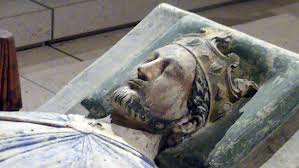
Richard's Tomb at Fontevrault

There has been a lot of speculation about Richard the Lionheart’s sexuality over the years, but whatever his personal proclivities, he cannot be accused of misogyny. He was raised by one of the most powerful women of the age, and he not only relied upon his mother for advice, he also entrusted her with delicate affairs of state. His relationship with his sister Joanna was also characterized by mutual respect. When she flatly refused to be a pawn in his negotiations with Saladin, for example, Richard meekly accepted her decision and made no attempt to coerce her. That might all have been Eleanor’s influence, or were his attitudes and reactions also colored by his family’s strong ties to the Kingdom of Jerusalem and his own sojourn there?

The crusader states set themselves apart from contemporary societies by the prominent role played by women.  This high status probably evolved out of the repeated failure of the ruling dynasty to produce male heirs and the high mortality rate among adult males generally.  A look at the succession in the Kingdom of Jerusalem illustrates this well. When Baldwin II died in 1131, he was succeeded by his daughter, Melisende, who ruled jointly with her husband Fulk of Anjou (grandfather by his first marriage of Henry II of England and great-grandfather of Richard). When Fulk died in 1143, Melisende remained Queen of Jerusalem, and ruled jointly with her eldest son, Baldwin III, (half-brother of Geoffrey d'Anjou, and hence Henry II's paternal uncle). Although her son eventually side-lined her, it was only after a struggle in which several powerful barons and most of the clergy sided with the Queen.

Medieval Illustration of a King and Queen

At Baldwin III’s death in 1163, his heir was his brother Amalric I, but Amalric’s heir was the ill-fated Baldwin IV, the Leper King, who had no children, making his sisters (and through them, their children and/or husbands) his heirs. As fate would have it, in the century between the death of Baldwin II and the ascension of Friedrich II as consort of a Queen of Jerusalem in 1225, the crown of Jerusalem passed through the female line no less than ten times!

The situation in the other crusader states and baronies thereof was similar. Due to the almost continuous fighting and the many exotic diseases for which the Westerners had no immunity, mortality rates among knights and barons in the crusader kingdoms were exceptionally high. While many men died without any heir, even more died without a male heir. The small size of the Latin elite combined with the natural desire of families to retain their lands led to the early recognition of female inheritance. By 1131, laws guaranteed the right of daughters to inherit, and primogeniture of the eldest daughter in the absence of a son was recognized.  As a result, the title to baronies repeatedly passed through heiress rather than heirs. This fact alone would have raised the importance of women, but it is significant that these queens (princesses, countesses and ladies) were not passive vessels.


Melisende was Queen in her own right and commanded loyalty and support among her vassals to such a degree that both her husband and later her son had to take her political wishes into account.  Sibylla (Richard’s 1st cousin) forced upon the kingdom a man patently unsuitable for the kingship and soon detested by her brother, the reigning King, and the majority of the barons.  When her son Baldwin V died, Sibylla – not her husband Guy de Lusignan – was crowned by the patriarch;  she then placed the crown on Guy’s head as her consort.  Furthermore, many of Guy’s vassals viewed their oaths to him absolved the moment Sibylla died – despite Richard’s determined support for Guy.

In the end, even the Lionheart gave up and recognized that without Sibylla, Guy could not be King of Jerusalem. The crown passed to Sibylla’s sister, Isabella (another of his cousins). Isabella conferred the crown on two men in succession, Henri de Champagne (Richard’s nephew) and later Aimery de Lusignan. Notably, Henri de Champagne, a nephew of both Philip II of France and Richard I of England (his mother was a daughter of Eleanor of Aquitaine by Louis VII), never even called himself King of Jerusalem; he remained Count of Champagne, while Isabella was Queen of Jerusalem.

Medieval Illustration of Isabella 
and possibly Henry of Champagne --
note her crown is more elaborate than the man's

The dynastic importance of women was both cause and effect of a uniquely high status for women in the crusader kingdoms that took many other forms. Not only did women act as regents and receive homage from vassals, they enjoyed a freedom of movement and opinion that scandalized the Muslim – and sometimes the Christian – world.  While the sexual antics of the some royal women may indeed have deserved censure, the higher status of women generally meant that widows in the crusader kingdoms exercised far more control over their property and their lives.

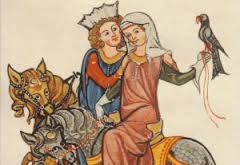
The higher status of women also impacted their daily lives. Upper class women were literate as they could not otherwise conduct their affairs, and they owned books. Some accounts stress that they rode astride for greater safety in an always precarious environment, something that gave them greater mobility. They did not have to go veiled in public, although women almost certainly covered their faces from the ravaging effects of the Palestinian summer sun when out of doors.  But perhaps most important, they were entitled to their opinions, free to voice them and often heeded by their male contemporaries. William of Tyre records multiple instances when Queen Melisende's opinion or that of her sisters was sought out. Likewise, the Count of Flanders sought the advice of Dowager Queen Maria in a dispute with Baldwin IV and the High Court. The Lady of Tiberius and of Oultrejourdain are other examples of non-royal women with documented influence.

A medieval illustration
of a woman riding astride
while engaging in the sport of hawking.

Compared to their faceless and voiceless sisters in the Muslim world, the fact that women in the crusader states were viewed as intelligent human beings with opinions worth hearing was undoubtedly the greatest privilege of all.

~~~~~~~~~~~~~

Helena P. Schrader is the author of three books set in the crusader kingdoms. St. Louis’ Knight is set in the Latin Kingdom of Cyprus in the mid-13th century and Knight of Jerusalem and Defender of Jerusalem are the first two books in a three biographical novel of Balian d’Ibelin, who defended Jerusalem against Saladin in 1187 and later played an important role during the Third Crusade. St. Louis Knight was winner of the 2014 Chaucer Award for Historical Fiction set in the High Middle Ages.

Amazon

Wednesday, January 14, 2015

England’s First Fleet

by Helena P. Schrader

For much of Britain’s history, certainly since the defeat of the Spanish Armada in the reign of Elizabeth I through the Second World War, England was considered a naval power. The Royal Navy enjoyed the prestige of the “Senior Service” and Britain was proud to “rule the waves.” But the roots of British naval traditions are largely lost in time.

The Vikings, of course, ruled much of the north of England, and William of Normandy, the last man to launch a successful invasion of the British Isles, was dependent upon an amphibious landing entailing a substantial fleet. But the longships that went “Viking” from England’s shores were not exactly serving a central English government and even the Conqueror’s ships were more transports than navy. David Miller, a retired British Army officer and journalist, argues that England’s first fleet was the fleet Richard I assembled for the Third Crusade (“Richard the Lionheart: The Mighty Crusader).


Richard’s fleet was not only commissioned by an English king to serve English policy (as opposed to personal gain), it was also largely built in England and manned by Englishmen. It was deployed for transport, in amphibious operations, as logistical support and in naval engagements. It was composed of a variety of vessels from the large “dromons,” which set lateen sails on up to three masts and could carry a thousand men, to small open ships (enescas, or snakes), descendent from the Viking longship, with a crew of sixty to man the oars and a single square sail. In between were “busses” with a thirty oars and a single mast capable of carrying 40 knights and their horses and “galleys,” propelled by oars alone. Altogether, including the ships Richard hired in his French territories and was loaned by the King of Sicily, Richard deployed a fleet to the Holy Land that numbered 216 ships, of which 125 were English.


What makes this a “fleet” is the fact that for all its diversity, it was clearly under a unified command and deployed as a single instrument in support of the King of England.  Richard commissioned the fleet from a variety of ports across England in 1189, almost immediately after he came to the throne, and he set delivery dates and assembly points which were respected. Richard even issued a naval disciplinary code which included very explicit punishments for offenses (e.g. that a murderer be tied to the body of his victim and either buried with him or tossed overboard, depending on whether the crime was committed on land or sea).  The code was evidently necessary. When the English fleet put into Lisbon on their way to rendezvous with the English king, who was travelling overland to Marseilles, the English sailors behaved so injudiciously that 700 were arrested on a single night!

Richard’s fleet assembled from various points and in varying numbers in the ports of Sicily and wintered there, as the Mediterranean was treacherous was infamous for violent storms that destroyed ships from October to March.  (Remember the fleet returning from Troy was “scattered” and Ulysses took ten years to get home, while the Romans advised against sailing between November 10 and March 10 and considered their ocean unsafe for galleys from September 14 to May 26.)  

Richard set sail from Sicily for the Holy Land on April 4, 1191, with his fleet organized into a crude formation of eight lines of ship that were supposed to maintain visual contact with their neighbors.  The entire formation was led by three dromons, one of which carried Richard’s betrothed and sister, followed by lines 13, 14, 20, 40 and 60 across.  At the rear of the fleet was a line of 36 galleys, the fastest and most maneuverable ships in the fleet, with the clear task of “herding” the entire convoy like the destroyers and corvettes of the Royal Navy in WWII.  Richard was in that last line of galleys, ready to shoot forward to put himself between his ships and pirates or to round up stranglers.


 While his formation offered protection against pirates and enabled the best navigators to lead the less adept (or those less familiar with the Mediterranean), it was no protection against wind and weather and just three days after leaving Sicily, Richard’s fleet encountered a violent storm that scattered it an sank a score.  The three largest dromons, including the one with the Richard’s sisters and finance, had been swept all the way to Cyprus. Richard meanwhile reassembled the bulk of his fleet Crete and Rhodes and then continued on to Cyprus, arriving May 6.  On discovering that the crusaders and crews of two of his dromons had been captured, mishandled and/or enslaved by the tyrant of Cyprus, while his sister and fiancé had been afraid to leave their damaged ship for fear of being held to ransom, Richard resolved upon teaching Isaac Comnenos a lesson. He deployed his galleys for the first time as amphibious landing craft.

On the next leg of his voyage to the Holy Land, Richard personally commanded a naval engagement: the attack of a three-masted dromon carrying 1,000 men and well-armed with archers and Greek fire. Richard attacked with no less than 40 galleys that, however, found it almost impossible to come alongside and board due to the overwhelming superiority of fire-power on the dromon, and the fact that the freeboard of the large sailing ship was so much greater than that of the galleys. The dromon was crippled by English sailors swimming under the dromon and tying the rudder down causing the ship to sail in circles. Taking advantage of the confusion caused, some English sailors managed to scale up the side of the ship and attempt to seize control. The Saracens, however, had such an overwhelming superiority of fighting men, however, that the English were driven back.  At this point, Richard apparently ordered his galleys to line up and ram the disabled ship simultaneously. According to English accounts this tactic succeeded, but Saracen accounts the dromon was scuttled by her own crew after they realized the situation was hopeless.

In the next stage of the Third Crusade the fleet provided vital support and protection for the army as it marched south from Acre to retain the coastal cities of Jaffa and Ascalon. A portion of the fleet moved down the coast at the same pace as the army, while other ships served as dispatch, ambulance and supply vessels that could shuttle back and forth between the army’s position and the secure base at Acre. Because of the presence of the fleet, Richard’s right flank was protected throughout the advance and that meant that the most vulnerable elements could be positioned on his right and his infantry could provide protection to landward. Even more important, the fleet insured adequate supplies of food, fodder and water, relieving the troops of the necessity to carry these on their person or to drag them in cumbersome and notoriously slow wagons. It is by no means certain that Richard would have been able to defeat Saladin — again and again — if his army had been exhausted from carrying their own supplies or weakened by inadequate food, fodder or water. In short, Richard’s successes in the Third Crusader were in part a function of his intelligent use of the fleet.


~~~~~~~~~~~~~

Helena P. Schrader is the author of numerous works of history and historical fiction.  She holds a PhD in History from the University of Hamburg.  The first book of a three-part biographical novel of Balian d’Ibelin, who defended Jerusalem against Saladin in 1187 and later took part in the Third Crusade, is now available for sale.  Read more at: http://helenapschrader.com or follow Helena’s blogs: Schrader’s Historical Fiction and Defending the Crusader Kingdoms.

A Biographical Novel of Balian d’Ibelin
Book I


A landless knight,
                A leper King
                                And the struggle for Jerusalem.


Buy now in Paperback or Kindle format!


Friday, November 14, 2014

Richard the Lionheart’s Peacemaker

by Helena P. Schrader

Richard the Lionheart's Tomb at Fontevrault, France

In an earlier entry, I wrote about Richard the Lionheart’s successes in the Holy Land, stressing his exceptional logistical planning, his battlefield bravery and his strategic competence. Not only did he transport an army 10,000 strong across vast distances in fragile wooden ships, he kept that army supplied and fed for nearly three years in the extreme weather conditions of the Holy Land. He may have alienated his fellow commanders, notably Philip II of France and the Duke of Austria, but he won the loyalty of the common soldiers and knights by his exceptional personal bravery and his willingness to build walls or dig ditches beside them. While he led from the front, he took the disheartening decision not to take Jerusalem — despite being in sight of the Holy City — not autocratically or alone but rather in council with representatives from every contingent in his motley army.

But when it was clear that all his bravery and all the sacrifices made by his soldiers was not enough to secure Jerusalem, Richard the Lionheart found himself trapped in a dilemma. News had already reached him that his own kingdom was at risk. His younger brother John was plotting with his arch-enemy, Philip II of France, to take England and the rest of the Angevin empire away from him. He knew he had to return home as soon as possible. But to just pack up and leave as Philip of France had done before him was to risk the loss of all he had achieved in the Holy Land. After all, he had not only re-captured the vital city of Acre, he had established Christian control of the entire coastline from Antioch to Ascalon. This Christian foothold in the Holy Land was vital if there was ever to be a chance of regaining Jerusalem for Christendom. While we may look back with the wisdom of hindsight and say this was a false hope, it was nevertheless a goal that Richard I clung to passionately. He left the Holy Land vowing to return and take up the fight again.

A 19th Century depiction of Richard I Embarking for the Crusades

What Richard the Lionheart needed after the second failed attempt on Jerusalem in January 1192 was a truce — a means to end the fighting while recognizing the status quo. Only this would enable him to return to the West to defend his birthright without endangering the fragile Christian states along the Levant. He had to convince Saladin, who could not defeat Richard on the battlefield but still had the vast preponderance of forces, not to take advantage of Richard’s departure to devour (for a second time) the Christian cities along the coast of the Mediterranean.  

Saladin held all the cards. He could afford to wait until Richard with his army of crusaders departed, and then defeat the remaining Christian forces. He knew both that Richard needed to return to defend his birthright and that his army was demoralized by the failure to take Jerusalem and eager to return home. It was obvious to him that the remaining Christian forces would be in a poor position to resist him. He had little incentive to negotiate at all.

Saladin as depicted in the 20th Century Fox Film "The Kingdom of Heaven"

It was at this moment that Richard turned to a man who had once before negotiated a life-saving agreement with Saladin when in an apparently hopeless situation: Balian d’Ibelin.  Balian was a native of “Outremer” — the land beyond the sea or what we know as the Holy Land. He had been born in the small and relatively insignificant barony of Ibelin around the middle of the 12th century (the date is not recorded), the third son of the First Baron of Ibelin.  His elder brother Hugh inherited the small paternal inheritance and his other elder brother, Baldwin, inherited a much larger maternal inheritance to become Baron of Ramla, Mirabel and (at Hugh's death without children) Ibelin as well. Baldwin, however, was unable to reconcile himself to Guy de Lusignan's usurpation of the throne of Jerusalem in 1186. Baldwin chose to quit the Kingdom of Jerusalem, turning over his titles and lands to his son and naming his younger brother Balian the boy's guardian. Meanwhile, Balian had made a scandalously brilliant match, marrying none other than the Dowager Queen of Jerusalem and Byzantine Princess Maria Comnena. By this marriage he also become step-father to the youngest Princess of Jerusalem, Isabella.

With the departure of his brother, Balian was suddenly one of the most powerful barons in the Kingdom of Jerusalem, and he used this power to try to reconcile the usurper, Guy de Lusignan, with the most powerful baron in the Kingdom, Raymond of Tripoli, who at that point was refusing to do homage to Guy despite the clear and present danger posed by Saladin, who had declared jihad against the Christian kingdom. His efforts were successful, and Balian and Raymond both rallied behind Guy de Lusignan when he faced Saladin’s invasion of July 1187. Unfortunately, Guy led them and the entire Christian army to a disastrous defeat on the Horns of Hattin. Balian was one of the few Christian knights to lead a successful charge against the Saracens and effect a break-out.

Thirteenth Century Manuscript Illustration of Warfare

The destruction or capture of the bulk of the Christian army, however, left the Kingdom of Jerusalem undefended and Saladin followed up his victory at Hattin by capturing one city and castle after another until, by the start of September 1187, Saladin controlled the entire Kingdom of Jerusalem except some isolated castles, the city of Tyre and the greatest prize of all: Jerusalem. In Jerusalem were concentrated somewhere between 60,000 and 100,000 Christians; roughly 20,000 inhabitants and 40,000 to 80,000 refugees from the territories Saladin had just conquered. But there were no knights in Jersualem and no commander.  Saladin called a delegation from Jerusalem to Ascalon and offered to let those trapped in the city go free in exchange for the surrender of the city. The representatives of Jerusalem refused. According to Arab sources they said that Jerusalem was sacred to their faith and that they could not surrender it; they preferred martyrdom. Infuriated by their intransigence, Saladin vowed to slaughter everyone in the city if it defied him.

Among the refugees in the city of Jerusalem were Balian d’Ibelin’s wife, the Dowager Queen of Jerusalem, and his four young children. Balian had no intention of letting his wife and children be slaughtered, and so he approached Saladin and requested permission and a safe-conduct to ride to Jerusalem and remove his wife and children from harm. Saladin agreed on the condition that he ride to Jerusalem unarmed and stay only one night.

A Medieval Family

Balian had not reckoned with the reaction of the residents and refugees in Jerusalem. The arrival of a battle-tested baron was seen as divine intervention, and the Patriarch of Jerusalem no less than the citizens begged Balian to take command of the defenses. The Patriarch demonstratively absolved him of his oath to Saladin. Balian felt he had no choice. He sent word to Saladin of his predicament and Saladin graciously agreed to send 50 of his own men to escort Balian’s family to the County of Tripoli (still in Christian hands), while Balian remained to defend Jerusalem against overwhelming odds.

And defend Jerusalem he did.  After conducting foraging sorties to collect supplies for the population from the surrounding Saracen-held territory, he held off assaults from Saladin’s army from September 21 – 25 so successfully that Saladin was forced to withdraw and re-deploy his army against a different sector of the wall. On September 29, however, Saladin’s sappers successfully undermined a portion of the wall and brought down a broad segment of it. Jerusalem was no longer defensible.

 The breach occured to the east of this gate, now known as the Damascus Gate, then St. Stephen's Gate.

It was now that Balian proved his talent as a diplomat. With Saracen forces pouring over the breech and into the city, their banners flying from one of the nearest towers, Balian went to Saladin to negotiate. Saladin initially scoffed: one doesn’t negotiate the surrender of a city that has already fallen, he answered dismissively, pointing to his banners on the walls of the city. But at that moment the banners were thrown down and replaced again by the banners of Jerusalem, and Balian played his trump. If the Sultan would not give him terms, he and his men would not only kill the Muslim prisoners they held along with all the inhabitants of the city: they would desecrate and destroy the temples of all religions in the city, including the Dome of the Rock and the Al Asqa Mosque. Saladin gave in.  The Christians were given 40 days to raise ransoms of 10 dinars per man, 5 per woman and 2 per child. Although an estimated 20,000 Christians were still marched off into slavery at the end of the forty days, forty to sixty thousand Christians survived as free men and women thanks to Balian’s skill as a negotiator.

Richard of England needed those skills now, but he had a problem. On his arrival in the Holy Land, Richard had backed the claims of his vassal Guy de Lusignan to the throne of Jerusalem, while Balian staunchly defended the claims of his step-daughter and her husband Conrad de Montferrat. As a result, during the first two years of Richard’s presence in the Holy Land, Balian had been persona non grata in Richard’s court. In fact, he had served as an envoy for Conrad de Montferrat to the Sultan’s court — something Richard’s entourage and chroniclers viewed as nothing short of outright treason to the Christian cause.


Richard the Lionheart, however, was neither a fool nor a bigot. Knowing that only the barons and knights of Outremer could defend the territories he had conquered after he went home, and recognizing that Guy de Lusignan would never be accepted as King by the barons and knights of the Kingdom he had led to disastrous defeat, Richard dropped his support of Lusignan and recognized Isabella and her husband and the rightful rulers of Jerusalem in April 1192. By doing so, he also opened the doors to cooperation with Balian d’Ibelin. Soon thereafter, Richard employed him as a negotiator with Saladin, and in August Balian had successfully talked Saladin into a three year truce (neither side wanted peace for both were unsatisfied with the status quo) that provided for free access to Jerusalem for unarmed Christian pilgrims. Like the surrender of Jerusalem this was not a triumph, but it was also better than what might have otherwise been expected given the weakness of the Christian position. Most of all, it gave Richard what he wanted: an opportunity to return to the West to defend his birthright without the immediate loss of his gains in the Holy Land. And indeed his legacy in the Holy Land was to last not just three but 99 years.

~~~~~~~~~~~~~

Helena P. Schrader is the author of numerous works of history and historical fiction.  She holds a PhD in History from the University of Hamburg.  The first book of a three-part biographical novel of Balian d’Ibelin, who defended Jerusalem against Saladin in 1187 and was later one of Richard I’s envoys to Saladin, is now available for sale.  Read more at: http://helenapschrader.com or follow Helena’s blogs: Schrader’s Historical Fiction and Defending the Crusader Kingdoms.

A Biographical Novel of Balian d’Ibelin
Book I


A landless knight,
                A leper King
                                And the struggle for Jerusalem.


 Buy now in Paperback or Kindle format!