Showing posts with label Normans. Show all posts

Monday, May 28, 2018

The Enchantment of The Bayeux Tapestry

by Carol McGrath

The Bayeux Tapestry has retained its enchantment and its vivid colour almost a thousand years after it was embroidered. It tells the story of The Norman Conquest through beautifully framed vignettes and long-shot depictions made in embroidery from Harold Godwinson's departure on a mysterious mission to Normandy in 1064 until his death at Hastings in October 1066.  I have often wondered about the fabric and the natural dyes used for the embroidery wools in the Tapestry's construction.

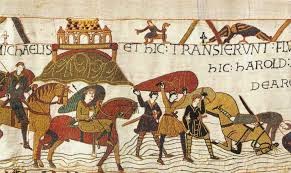
Scene from The Bayeux Tapestry

Carola Hicks wrote in her wonderful book The Bayeux Tapestry, The Life Story of a Masterpiece, "Made from the workaday fabrics of linen and wool, the Tapestry has often been described as an uncharacteristically humble artifact when compared to other works of the period, even an example of quaint folk art."

It is true that the Tapestry is not sewn with valuable gold, silver, and gems, or silk embroidery threads. It is by Anglo-Saxon standards a modest work, and yet it is a glorious feat of craftsmanship and artistry. The Tapestry is constructed in the everyday fabrics of linen and wool. Even so, its fabrics were designed and executed as the result of practice by extremely talented craftsmen.

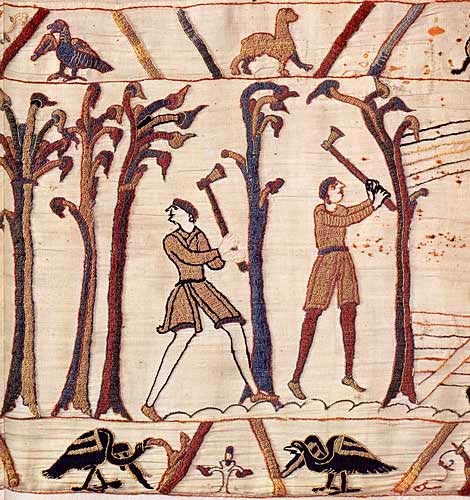
Woodland Scene from the Tapestry

Here in Tapestry the dramatic story of the Norman invasion of England is stitched out and embroidered on strips of linen. It is seventy meters in length and half a meter wide. The fact that these homely though durable fabrics, linen and wool, were used are the reason for its preservation despite its great age and fragility. Most of what we see today is original. Even where the Tapestry has been repaired we can still see the original stitch marks.

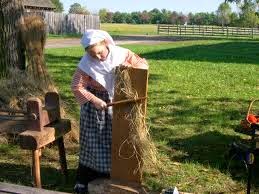
Spinning

Linen and The Tapestry

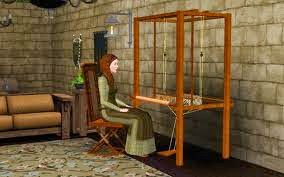
Linen has a long history. The ancient Egyptians found linen's sweat-absorbent and cooling properties divine. They attributed the invention of linen to the goddess Isis. With the advent of Christianity linen was used for priestly garments. It actually had a high status. It comes from the flax plant which was sown after Easter and harvested three months later. In the Middle-Ages the young plants were pulled by hand and never cut. Cutting might damage the stems. Plant stalks were soaked till they were decomposing, dried out, then smashed with mallets to separate the outer bark from the inner fibres. These were spun into thread on a hand spindle. Medieval women spun constantly. They attached a bundle of flax fibres to the cone-shaped top of a pole , the distaff. Then the other end was tucked under the spinner's arm. A spinner drew the fibres out from the top, twisted them onto a weighted whorl, then spun them tightly into a thread.

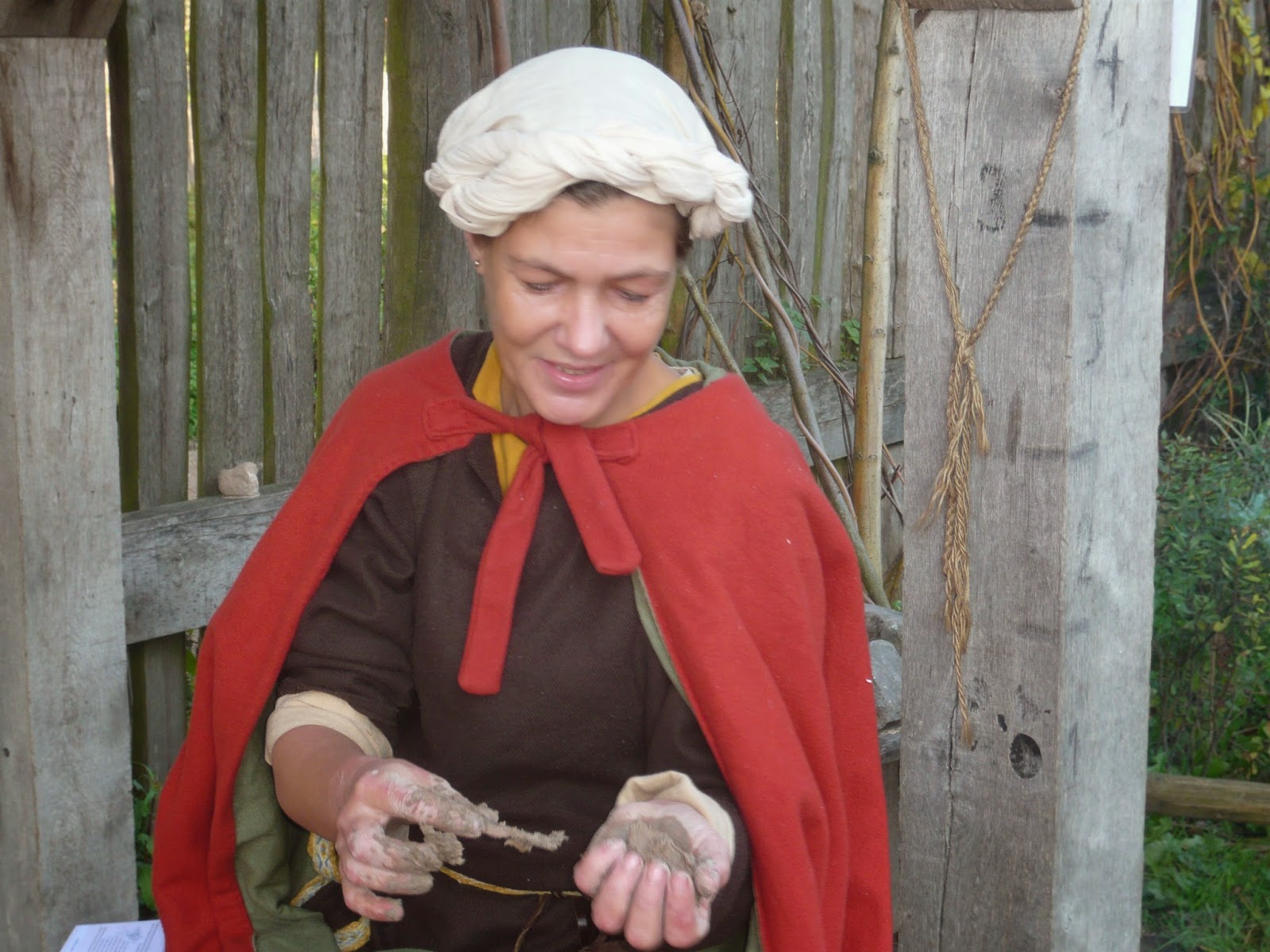
Retting (cleaning) the flax

The Bayeux Tapestry consists of nine separate panels sewn together after they were embroidered. The two longest strips measure nearly 14 meters. This suggests a long warp or length setting. Other Tapestry sections are shorter. The original lengths were woven a meter wide and then cut to make strips that would be comfortable to embroider. A loom is used to weave the threads into lengths of fabric.  Carola Hicks thought that professional weavers made the linen on a horizontal treadle loom, a more advanced machine than an upright warp-weighted loom that was used to make woollen cloth.

Upright weaving frame

When the linen was woven it was a natural brown in colour. The linen was bleached by boiling it in a solution of water alkalized by the addition of wood ash, fern or seaweed. It was stretched out on frames for exposure to the light. It was still kept damp. After a period of three weeks or so the linen was soaked in a solution of sour milk fermented by rye or bran. The fabric was pounded with a piece of marble or glass to create a smooth silky texture.

Wool Embroidery on The Tapestry

It is considered by most Tapestry historians that there was a common cartoon source  for the Tapestry design. There is a similarity between the images, especially those of figures, emblems, plants, and animals, and those depicted on Canterbury manuscripts of the period. This suggests Canterbury as the location for the Tapestry's overall design. However, between three and eight workshops are suggested for the linen's weaving. There were probably several embroidery workshops involved as well. Likely contenders were Canterbury and Wilton.

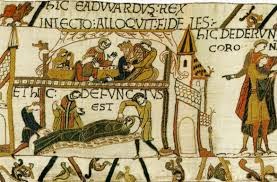
Queen Edith, the widow of Edward the Confessor, was one of the most notable embroiderers of the era, and after her husband's death she retired to Wilton Abbey which had a school for embroiderers. She may have had a hand in the execution of the Bayeux Tapestry. It is recorded in The Vita Edwardi Regis, completed around 1066-69, a few years after Edward's death, that several people were with Edward just before his death.  There were Harold Godwin and Archbishop Stigund. Edith, one of three women depicted on the Tapestry, who warmed his feet in her lap can be seen kneeling at the bottom of his bed. According to the Vita, Edward gave a prophetic vision and then said a few words to comfort Edith. Interestingly, Edward's death scene as depicted in embroidery on the Tapestry corresponds to that described in the Vita which was commissioned by Queen Edith. Wilton Abbey is, I suggest, one of the locations for the Tapestry's construction. Queen Edith may even contributed to which scenes should be included and their depiction.
 
King Edward's Death Scene

The embroidery is stitched in strands of worsted wool, the end product of an old and complicated process. An enormous amount of wool was dyed. Carola Hicks states more than 45 kilograms was used for the embroidery. The original wools remain vivid. They are also more resistant to moth than chemically dyed wools. Winchester was one of the cities that monitored the practice of dyers within its jurisdiction since dyes produced noxious waste products and hideous odours. Alum which was valuable was the favoured mordant. Dye ingredients came from animal, vegetable or mineral products acquired locally. Sometimes ingredients were imported from further afield to be smashed, boiled, and simmered, concentrated to extract the essence of a hue.

There are ten main tones on the Tapestry. They came from only three plants, woad, madder and weld. The dyes were blended into two reds, a yellow and a beige, three tones of blue and three tones of green.

Weld

Beige and yellow came from the flowers and leaves of weld.

Green also came from weld but it was mixed with the leaves of woad.

Woad produced the blues.

Woad

The reds came from madder. The roots of madder were ground into a powder, heated and simmered with added chalk or lime at a constant temperature for not more than two hours. Once a whole fleece was dyed to the required colours, a hand held spindle was used to turn the fibres into bales of worsted.

A friend of mine, Charles Jones, has had spinners and embroiderers working on a tapestry to tell the story of The Battle of Fulford September 1066. Here are a few of the dying recipes he has used to reproduce authentically the colours which his embroiderers used. Be careful if you try them out.

Weld

Chop lengths to boil for one and a half hours
Add wool and pinch of tartar
simmer for one hour
one hank of woad dyed wool added to light green will produce dark yellow.

Walnuts

5lbs of walnuts smashed and put to soak for twenty four hours
Tap water and a half cup of vinegar

Soak the wool for two days and then simmer for half an hour will produce a nut brown shade

Oak Gall Powder

20 gm of oak gall powder
boil for 30 minutes
teaspoon of salt
alum mordanted wool added
cook for twenty minutes
fix with salt and vinegar

Produces a light green-brown

These are just a few of the recipes used for dying wool used in embroidering a latter-day tapestry replica. I wonder if EHFA readers have had experience of creating dyes for wool using similar methods.

[This is an Editors' Choice archive post, originally published on this blog on 18th November 2014]

~~~~~~~~~~~~~

Carol McGrath is the author of The Handfasted Wife (2013) published by Accent Press and inspired by The Bayeux Tapestry.

The Swan-Daughter published by Accent Press (2014) is available now from Amazon.co.uk and from Amazon.com.


Sunday, January 20, 2013

The Alternate Histories of the Norman Conquest, Part 1

By Rosanne E. Lortz


One disservice that many historians do to readers is to weigh two sides of a disputed issue, form a judgment on what they think happened, and then present their judgment as if it is incontrovertible fact. The events leading up to the Norman Conquest are one such issue. School children everywhere learn that prior to Edward the Confessor’s death, Harold Godwinson, the most powerful earl in England, made a trip to Normandy and swore to support Duke William’s claim to the crown. After Edward’s death, Harold reneged on his oath, precipitating the Norman Conquest and his own death at the Battle of Hastings.

It is interesting to note, however, that most of the primary sources of the period have fairly different versions of this tale. Things are not as cut and dried as the historians would have us imagine. Did Harold actually make a journey to Normandy? And if so, did King Edward send him? Was his purpose in going to swear an oath of support to William? Or was the oath exacted under compulsion? Did Edward the Confessor, upon his deathbed, name Harold as his successor? If so, was this a change from having previously named William? 

A brief look at the primary sources of this period will show us that there are no easy answers to these questions. To tell only one version of the story is glib, at best, or deceptive, at worst. 

SOURCE 1

The first sources that we will examine are from the English side of the Channel. The Anglo-Saxon Chronicle, (a source written at a monastery and regularly updated by the record-keepers) makes no mention of Harold’s visit to Normandy. At King Edward’s death, it includes an epitaph that commends Harold as Edward’s choice for successor:
Yet did the wise king entrust his kingdom
To a man of high rank, to Harold himself,
The noble earl, who ever
Faithfully obeyed his noble lord
In words and deeds, neglecting nothing
Whereof the national king stood in need.
An argument from silence is not a strong one. It is possible that Harold’s visit to Normandy was a secret one and not common knowledge to the people of England. This source does indicate, however, that King Edward gave the crown to Harold upon his deathbed.

SOURCE 2

Another chronicle, the eleventh-century Chronicon ex Chronicis from Worcester Abbey also makes no mention of Harold’s journey to Normandy. As in the Anglo-Saxon Chronicle, we see the claim that Edward chose Harold to succeed.
When [Edward] was entombed, the underking (subregulus), Harold, son of Earl Godwine, whom the king had chosen before his demise as successor to the kingdom, was elected by the primates of all England to the dignity of kingship, and was consecrated king with due ceremony by Ealdred, archbishop of York, on the same day.
This source also gives us another important detail, that Harold “was elected by the primates of all England to the dignity of kingship.” During the later Anglo-Saxon period, the king’s heir was usually elected by a group of nobles called the Witan, adding a bit of oligarchic democracy into the monarchical succession. 

SOURCE 3

A third English source worth looking at is the Vita Aedwardi Regis (The Life of King Edward), a hagiographic work that King Edward’s wife commissioned immediately following his death. Edward’s wife Edith was the sister of Harold Godwinson—meaning she was probably very much in favor of her brother being the chosen heir to the kingdom. 

The Vita Aedwardi says that there were three people present at the deathbed of the king: Edith, Harold, and the Archbishop of Canterbury. According to this source, the dying Edward looked at Harold and said: “I entrust this woman and all the kingdom to your protection.”

Some historians have wondered about the veracity of this account. If Edward really had chosen William earlier (as we will find the Norman accounts attest), why did he change his mind at the last minute? Wouldn’t it have been very easy for Edith and Harold to fabricate a story about Edward’s last words? The only person they would have to suborn would be Archbishop Stigand, who from other sources, seems to have been quite friendly with the house of Godwin. 

But although this theory is an interesting one, it is both impossible to prove and a conspiracy theory that none of Edward’s contemporaries ever considered. The two preceding sources confirm that the entire country of England believed Edward to have bestowed the crown on Harold. 

SOURCE 4

Although Harold’s trip to Normandy is ignored in these early English sources, the Norman chroniclers are extremely eager to highlight it. William of Jumièges, a Norman monk in a monastry near Rouen, lived through the Norman Conquest and wrote an account of it in the Gesta Normannorum Ducum (Deeds of the Norman Dukes). He writes that King Edward sent Harold to Normandy in order to “swear fealty to the duke concerning his crown and, according to the Christian custom, pledge it with oaths.” After crossing the channel and landing in Ponthieu, Harold fell into the hands of Guy, count of Abbeville, who threw Harold into prison. William sent envoys to Guy to secure Harold’s freedom. Then, “after Harold had stayed with [William] for some time and had sworn fealty to him about the kingdom with many oaths he sent him back to the king with many gifts.” 

Notice the details in the above work. Harold was sent by King Edward to pledge his support to William for the crown. If this is true, and if Edward did indeed bequeath the crown to Harold on his deathbed, then something must have happened in between to change the old king’s mind. The account goes on to say that William rescued Harold from a local baron named Guy. There is no suggestion that William held Harold captive himself, only that he treated him as a guest, loading him down with presents after he swore the requisite fealty.

SOURCE 5

William of Poitiers, another Norman writing during the Conquest years, confirms the story as told by William of Jumièges. King Edward sent Harold to Normandy for the express purpose of strengthening Duke William’s right to inherit the English throne. Harold was captured by Guy in Ponthieu, rescued by William, and then….
Harold swore fealty to him according to the holy rite of Christians. And, as the most truthful and distinguished men who were there as witnesses have told, at the crucial point in the oath he clearly and of his own free will pronounced these words that as long as he lived he would be the vicar of Duke William in the court of his lord King Edward; that he would strive to the utmost with his counsel and his wealth to ensure that the English monarchy should be pledged to him after Edward’s death…. For there was no hope that Edward, already sick, could live much longer.

Notice, the emphasis that Harold swore “clearly” and “of his own free will,” indicating that there may have been claims circulating that the oath was under compulsion. While the Anglo-Saxon sources are clear that Edward promised the crown to Harold on his deathbed, the Norman sources are equally clear that Edward sent Harold to promise the crown to William just a short while earlier.

SOURCE 6

The Carmen de Hastingae Proelio (Song of the Battle of Hastings), an epic poem that was probably composed for William’s coronation, confirms the official Norman view of how events transpired. In the poem, after William lands in England, he responds to a threatening delegation sent by Harold, making clear reference to the earlier oath.
Although he threatens, unjustly, to make war, my men, trusting in the Lord, will not retreat. Is he not aware of the oath made to me and covertly forsworn? Does he not in his heart remember that he was my vassal? If his perjured hand does not yet recoil condemned, it has already been found guilty by the judgement of God. If he seeks peace and wants to confess his crimes, I will be indulgent and promptly overlook his faults. I will grant him the lands which formerly his father held if he is willing to be, as before, my vassal.

SOURCE 7

The Bayeux Tapestry, a long embroidery documenting the history of the Norman Conquest, is enigmatic in the way that pictures often are. The pictures tell us that Harold went to Normandy, was captured by Guy, and swore an oath to William, but the captions do not tell us why Harold went and what were the terms of the oath he swore. The pictures do indicate that the oath was of a serious nature, for Harold’s hands are placed on two reliquaries.


"Here Harold made an oath to Duke William"
When Harold returns to England, the picture where Edward the Confessor receives him almost looks as if the king is rebuking him—but then pictures like these are hard to use as conclusive evidence. Perhaps Edward did not want Harold to make that oath (whatever the oath was), or perhaps there is some other explanation for Harold’s obsequious posture and King Edward’s admonishing finger.


"Harold returns to Edward the King"

CONCLUSION

The seven sources we have examined thus far can all be somewhat harmonized. Perhaps the English sources simply omitted Harold’s voyage to Normandy. Perhaps the Norman version of Edward sending Harold to Normandy is correct. They do leave us with one serious gap in knowledge, however. What caused Edward the Confessor to change his mind? Why would he acknowledge William as his heir and then change the plan of succession on his deathbed to Harold?

Tomorrow we will look at more sources, histories written several decades after the event, that throw even more elements of mystery into the mix, showing that there is more than one way to tell the story of how the Norman Conquest came about….

TO BE CONTINUED

__________________________


Rosanne E. Lortz is the author of I Serve: A Novel of the Black Prince, a historical adventure/romance set during the Hundred Years' War, and Road from the West: Book I of the Chronicles of Tancred, the beginning of a trilogy which takes place during the First Crusade.

You can learn more about Rosanne's books at her Official Author Website where she also blogs about writing, mothering, and things historical.

Monday, July 9, 2012

William Before He Was the Conqueror

By Rosanne E. Lortz

He was born William the Bastard, illegitimate son of Duke Robert of Normandy, but history knows him as William the Conqueror, first Norman king of England and compiler of the Domesday Book. Many historians focus on the year 1066 and the legitimacy of William’s claim to the English crown. But how did an illegitimate boy across the Channel become powerful enough to make that claim in the first place? What did he accomplish before he invaded England? What did he win before the Battle of Hastings?

France during the eleventh century was not a unified country as it was in the earlier Carolingian period or in the later Middle Ages. It was split up into lots of little areas, which I will call counties—not because they were anything like modern day counties, but because they were typically ruled by a count. Some of Normandy’s most important neighbors were Brittany, Maine, Flanders, Anjou, Blois, and Burgundy. And let us not forget the most important neighbor of all: the Isle of France, where the Capetian king Henry I had his court. (TimeRef has an excellent map that shows where each of these counties were situated in relation to Normandy.)

The first duke of Normandy, Rollo the Viking, had sworn a reluctant fealty to the king of France (a very droll story that would take too long to tell here), but there is some question as to whether the duchy of Normandy, during William’s time, was still considered a vassal of the French king.

When William’s father Robert died in 1035, on the return trip from a pilgrimage to Jerusalem, his only son and heir was seven years old. Robert had never taken the trouble to marry Herleva, William’s mother, but he had also never taken the trouble to marry anyone else, so there were no legitimate sons to dispute William’s claim to the dukedom of Normandy.

In the age of robber barons, a seven-year-old duke was hardly able to rule his demesne with the requisite strength of arm. William’s childhood was marked at times by fighting between his various guardians and at other times by outright anarchy. But through it all, the boy was learning, and when he came of age he took steps to teach not only Normandy but also the lands around him to fear and honor his iron sword and iron will.

William as portrayed in
The Bayeux Tapestry
William of Poitiers (yes, we’re talking about a different William now) was a Norman chronicler who provides one of the most thorough pictures of Duke William’s early exploits. This chronicler was one of the duke’s biggest fans, and also proposed his own version of the just war theory: whatever Duke William did was just fine.

In 1043, when the duke was about fifteen years of age, his neighbor Geoffrey Martel, the Count of Anjou, was having a spat with another neighbor, the Count of Blois. In the process, the Count of Anjou accidentally captured Alencon, one of the Norman castles. William didn’t think it was an accident. He took back Alcenon and chased off the Count of Anjou, making a bitter enemy in the process.

Guy of Burgundy presented the next problem. Realizing that Normandy was quite a nice vacation spot, Guy began to subvert various Norman barons in an attempt to take over the dukedom. William got wise to the situation and marched out to fight Guy. This was the Battle of Val-es-Dunes in 1047. In this battle, William had the support of King Henry (who had not yet developed his later fear and hatred of the Norman duke), and with this help, William carried the day and defeated Guy.

A couple years after this, William formed a marriage alliance with the mighty Baldwin of Flanders by marrying his daughter Matilda. The county of Flanders was one of the more significant territories in France, and William’s connection with Baldwin increased both his power and his prestige.

There are many interesting legends about William and his bride. Later sources record that when William asked for Matilda’s hand in marriage, she refused on the grounds of his illegitimacy. She was too high born to marry a bastard. Undeterred, William rode to her father’s domains, grabbed her by her braids, threw her to the floor, and beat her until she changed her mind. Whether the story is true or not, it indicates how William was perceived by posterity—a man who would stop at nothing in order to get his way.

William of Arques was the next French nobleman to test William’s mettle. Unhappy with his feudal obligations to Normandy, Arques renounced his vassalship and began to pillage Norman territory. Incensed by these depredations, William drove the brigand back into his castle and besieged him until he was forced to surrender. With these actions William made it abundantly clear that vassals of Normandy were not allowed to renounce their obligations.

At this point, King Henry decided William was getting too powerful and too cocksure. The chronicler from Poitiers writes thus:
The king bore it ill and considered it an affront very greatly to be avenged, that while he had the [Holy] Roman emperor as a friend and ally…and while he presided over many powerful provinces of which lords and rulers commanded troops in his army, Count William was neither his friend nor his vassal, but his enemy; and that Normandy, which had been under the kings of the Franks from the earliest times, had now been raised almost to a kingdom. None of the more prominent counts, however great their aspirations, had dared anything of this sort. 
Henry I of France
King Henry realized that he needed to put William in his place before it was too late. What he didn’t realize was that he had already delayed too long. Supported by Theobald of Blois, William of Aquitaine, and Geoffrey Martel of Anjou, King Henry attacked William in 1054 at the Battle of Mortemer. Even these combined powers could not crush the might of Normandy. William drove their armies from the field, taking many prisoners. With victory achieved, William showed how insolent he could be. In the middle of the night, he sent a herald to King Henry’s camp, instructing him to climb the tallest tree and there declaim in full detail the sad news of Henry’s defeat. It wasn’t the happiest thing for the king to wake up to.

Because of this defeat, Henry was forced to make concessions to William. The chief concession was this: that William could do anything he wanted to Geoffrey Martel, Count of Anjou, without fear of reprisal from the king. Extremely pleased by this green light, William began to construct a castle in the region of Maine. This county was under the governance of Geoffrey of Maine, but (in the complicated web of feudal relationships) owed homage to Geoffrey Martel of Anjou. Maine sent Martel an urgent cry for help.

Martel, joined by William of Aquitaine and Eudo of Brittany, began to attack the stonemasons at the castle site. William, who had been expecting some resistance, soon arrived with his formidable army and put the counts' collective forces to flight. Then, in the words of the chronicler, William “turned his attack against Geoffrey of Mayenne [Maine]…and in a very short time he reduced him to the point of coming into the heart of Normandy, to put his conquered hands into William’s own, swearing the fealty which a vassal owes his lord.” In this way he stole the county of Maine from Anjou and extended the reach of Normandy.

With one last burst of energy, King Henry gathered another army against William. (Geoffrey Martel, who didn’t know when to cry uncle, was part of it.) This led to the Battle of Varaville in August, 1057. As you probably expected, William defeated Henry who “realized in consternation that it would be madness to attack Normandy further.”

King Henry I died three years later, in August of 1060, and was soon accompanied into the afterlife by Geoffrey Martel of Anjou. Philip I assumed the throne in France, but by this time the lesson had been well learned: don’t mess with Normandy.

When Edward the Confessor died in 1066, the Duke William of Normandy who laid claim to the throne of England was far more than some petty nobleman across the Channel. He was a man who had risen through the force of his will and his arm, maintained and increased the lands left to him by his father, and proven himself the equal (or superior?) of the King of France.

Scene from Bayeux Tapestry showing William's preparations to invade England

The character that William displayed during his rise in Normandy would continue during his reign in England. His new subjects found him a harsh master in many things, and the Anglo-Saxon Chronicle records that he was “severe beyond measure to those who withstood his will.” When he forbade hunting in the king’s forest,
The rich complained and the poor murmured, but he was so sturdy that he took no notice of them; they must will all that the king willed, if they would live, or keep their lands….
The Battle of Hastings may be the one that we remember William for, but it was all the battles before Hastings that paved the way for his victory. And while we call him the Conqueror for his exploits in England, the eleventh century counts and kings of France had good reason to call him by that name as well, a nickname born not from affection, but from the bitterness of the vanquished.

_________________

Rosanne E. Lortz is the author of I Serve: A Novel of the Black Prince, a historical adventure/romance set during the Hundred Years' War, and Road from the West: Book I of the Chronicles of Tancred, the beginning of a trilogy which takes place during the First Crusade.

You can learn more about Rosanne's books at her Official Author Website where she also blogs about writing, mothering, and things historical.

_________________

BIBLIOGRAPHY

"Medieval Sourcebook: The Anglo-Saxon Chronicle: Assessment of William I." Fordham University. From the Anglo-Saxon Chronicle, sub anno 1086, as it appears in F. A. Ogg, A Source Book of Medieval History (New York, 1907). 

William of Poitiers. The Gesta Guillelmi of William of Poitiers. Trans. Marjorie Chibnall. USA: Oxford University Press, 1998.

Saturday, April 14, 2012

Monarchy~ The Normans: Stephen and Matilda

by Debra Brown

Following the early death of the only legitimate son of Henry I, William, few of the English and Norman barons were prepared to stand by their oath to him to support his daughter's claim to the throne. Matilda was, after all, a woman, and was said to have been arrogant and unpopular. She was also married to the Count of Anjou. He was the ruler of Anjou- England and Normandy's traditional enemy.

When Henry died in 1135, the barons met to choose a king. Despite Matilda's having an infant son, they chose Count Theobald of Blois, the grandson of William the Conqueror by his daughter, Adela. Negotiations were in progress when Stephen, Theobald's younger brother, made himself King of England.

Stephen had been brought up by Henry I, who had loved him and made him one of the richest men in England. Stephen now pointed to this as evidence that Henry had been grooming him to become the next king, despite Henry's having obtained Stephen's oath to support Matilda. As soon as Henry was dead, Stephen sailed for England. He obtained the support of his brother, whom Henry had created the Bishop of Winchester, as well as the citizens of London. The Archbishop of Canterbury crowned him King on 22 December, 1135.

Stephen was charming, courageous and chivalrous. He became the first English king to allow jousting. He had humbly earned the people's affection and was generous toward the Church. Most of the barons and even Henry's favorite illegitimate son, Earl Robert of Gloucester (pronounced Gloster), swore allegiance to him.

Stephen was a brave soldier, but a failure as a king and commander. Because of it, Robert turned against him, and many followed. Matilda's uncle, David I of Scotland, invaded England, and though Stephen defeated David, Matilda could see that Stephen's support was bleeding away and that it was time for her to act. In an attempt to weaken King Henry's bureaucracy, which might support Matilda, Stephen arrested bishops and counselors, some of whom were his own family. This lost for him the vital support of the Church. He made strategic mistakes in battle defending his rule, not the least of which was to decide not to besiege Arundel, the castle where Matilda had taken up residence after arriving from France with Robert, and to allow her safe passage to join Robert in Bristol! Even I could have figured that one out.

Arundel

Chivalrous it was, but foolish, and the result was full-scale civil war. Barons built illegal castles and plundered. They sold their allegiance to the highest bidder and then changed sides at will. Anarchy existed, and no one felt safe.

Finally Stephen was a prisoner in chains at Bristol, and Matilda rode to London to claim her throne with the help of Stephen's brother, the Bishop of Winchester. She was called Lady of the English by her supporters, but she had imposed high taxes and was still a woman, and the people would not have her. They drove her out of the city.

The Water Gate of Bristol Castle

Stephen's wife, also named Matilda for the sake of confusion, was rallying his forces. Earl Robert was captured, and the Matildas made an exchange. Henry's daughter was forced to release Stephen in exchange for her main supporter. The Bishop of Winchester had by now realigned himself with Stephen.

Matilda sent Robert to Anjou to request help from her husband. The Count was, however, engaged in a successful invasion of Normandy and could not leave. Stephen had become reconciled to the clergy, and Matilda's supporters were under threat of excommunication.

Stephen laid siege to Matilda in Oxford Castle. On a frozen, snowy night, however, she and four knights dressed in white (hers was a nightgown) and climbed down from a tower. They slipped through Stephen's lines and ran to London. The war dragged on, but five years later, Robert died and Matilda was forced to give up. She left for Anjou.

Oxford Castle

Since the Count of Anjou had taken over Normandy, some of the English barons who owned Norman estates felt that their only hope of retaining their possessions across the Channel was to support Anjou in England. They threw their support to the son of Matilda, Henry, the heir to the house of Anjou. The war continued. Stephen attempted to secure the succession of his line by having his son and heir, Eustace, crowned during his own lifetime. The Archbishop of Canterbury, however, with the Pope's backing, refused to perform the coronation.

Young Henry returned to England in 1153. He was now the most powerful feudal prince in Europe. Through inheritance and marriage, he was now Duke of Normandy and Aquitaine. He landed with a small army, and barons flocked to join him. Fear of reprisals caused the barons to conclude a peace agreement, but Stephen remained adamant that his son should succeed. When Eustace died, however, in 1153, Stephen gave up interest in the succession. Peace through the Treaty of Westminster meant that Stephen would rule till his death and that Henry was acknowledged as his heir instead of his own second son, William. Stephen did not enjoy the peace for long- he died the next year.

Henry II was crowned in 1154. Matilda lived till 1167, long enough to know of her son's succession, though she did not attend his coronation in Westminster Abbey. Matilda never returned to England.


Debra Brown is the author of The Companion of Lady Holmeshire, a Victorian mystery with sweet romance.

Saturday, March 3, 2012

Monarchy~ The Normans, William Rufus and Henry I

by Debra Brown

Monarchy Part I~ The Dark Ages House of Wessex
Monarchy Part II~ William the Conqueror

The Normans that followed the Duke of Normandy, William the Conqueror, provide an interesting historical story. William left Normandy to his eldest, who he considered to be too generous and easy-going to manage England. England he left to his second son, William, called William Rufus for his red complexion. William was crowned on September 26, 1087.

Rufus came to be known as cruel, ruthless, greedy and crude. He was always looking for ways to obtain more money, and when he couldn't get it from the Norman barons or the English townsfolk, he taxed the Church heavily. When the Archbishop of Canterbury Lanfranc died, the irreligious Rufus did not replace him, but kept the revenues normally allotted to the post for himself. He did the same when other bishops and archbishops died. When fearing death, he finally replaced the Archbishop with a Benedictine monk, Anselm of Bec, but upon recovering, he exiled him to Rome and seized his assets. This was a very different rulership from his famously pious Norman predecessors as well as the English kings, Alfred the Great and Edward the Confessor.

Rufus built the Great Hall of Westminster according to his grand scale ambitions. It was the largest secular space north of the alps, used for feasting and entertainments. He would sit on an elevated plane, crowned, robed and enthroned. The choirs would sing in Latin, wishing him long life and victory. The gap between rich and poor increased, and those with money began to dress extravagantly. Men wore flamboyant, puffed up tunics and curved, pointy-toed shoes. Women wore more and more extravagant jewelry. Rufus himself, or William II, surrounded himself with "half-naked", long-haired young men according to contemporary accounts.

England's French-speaking barons often owned estates both in England and Normandy- thus, they owed some of their allegiance to William's older brother, Duke Robert. Robert was staking his claim to the English throne, and some of the barons united in his support just a year after William's coronation. William crushed the revolt, and in 1090, he invaded Normandy to subdue Robert. He also repelled attempts by Malcolm III of Scotland and an uprising by barons in Northumberland.

William, like his father, loved hunting. William I had taken over huge areas of countryside, 90,000 acres, for his own use; Rufus took 20,000 more and made the rules of the oppressive Forest Law even harsher. (You might be interested in Judith Arnopp's The Forest Dwellers, a fictional work about some of those who were expelled from their homes in the New Forest by these kings.) Killing a deer was punished by death. Men were maimed just for shooting at one. The punishment for simply disturbing a deer was blinding. These rules were considered un-English and were a constant reminder that William Rufus was a foreigner, ruling and oppressing England.

After only 13 years of rule, in a superstitious age, it appeared that Rufus received punishment for his ways. While out hunting deer in the New Forest with a party which included his younger brother, Henry, he took an arrow and died "without repentance". His body lay neglected for several hours, and it was finally carried to Winchester in a charcoal-burner's cart. He was buried there beneath the cathedral tower. Imagine the thoughts of the superstitious people who hated this king when a year later the tower came tumbling down!

Who killed William Rufus? It has never been proved. One account says that he accidentally killed himself. Others stated that a Norman lord named Walter Tirel shot him. Tirel fled the country and always maintained his innocence. Interestingly, as soon as the king was dead, Henry seized power with suspicious ease. He wasted no time in mourning his brother. He rushed to Winchester, seized the royal crown and rode off to London to have himself crowned. His claim to the throne was dubious. Rufus and his older brother Robert, still Duke of Normandy, had agreed to be heirs to each other. Robert was known to be on his way home from the Crusades with a reputation for chivalry and a young wife who could bear him sons. There was no time to waste.

Henry turned to the English people for support. He was "born in the purple", the only one of William the Conqueror's sons to be born in England and that while his father was the English king rather than just the Duke of Normandy. Unlike his father and brother, he could read, write and speak some English. Rather than just swear to rule justly, as was normal at a coronation, Henry had his promises written down and widely circulated. He promised to bring back the laws of Edward the Confessor. He would rule with consent, like an Anglo-Saxon king, and not with force and extortion. He vowed to remove the tyrannical rule of the oppressed people as his father and brother had practiced. He was crowned in Westminster Abbey on August 5th, 1100.

Henry's Charter of Liberty was followed by all the kings up until the Magna Carta, and was copied fairly closely therein. He also set up the Curia Regis, or King's Council, to settle disputes between the monarch and the people. He married a Scottish princess, Edith, who was descended directly from Alfred the Great and Edward the Confessor, which helped him to placate both the Scottish and Saxons to some degree. She did, however, adopt the Norman name Matilda, and their two children were named Matilda and William.

A problem arose. Galloping inflation set in when the silver money began to be mixed with tin. England's stable currency had been the envy of Europe for three centuries. Henry arrested the one hundred and fifty men who had worked in the mint and put them on trial. Ninety four of them were found guilty and were punished with barbaric severity. Even though these men were not Normans, but Englishmen of high status, the people were behind Henry in the matter. The coinage must be protected at any cost.

For Henry, the greatest problem of all was the death of his young heir, William, at age seventeen. William was returning to England from Normandy in a ship. It crashed against rocks because of the drinking on board, and though William was safely put into a boat, he insisted on returning to the area to save his sister. It was only his sister who survived, of the two. (My error. After comments below, I discussed this with Elizabeth. The only survivor was a butcher. William had an illegitimate sister aboard the ship who also died. His sister Matilda was, at the time, living as Empress Consort of the Holy Roman Empire in Germany.)

Henry was said to have never smiled again. He was now faced with the need to choose a new heir to the throne. His nephew Stephen had no Saxon blood, something that had been important to Henry for his heir, and he so chose instead his daughter, Matilda, a descendant of Alfred. We'll see how well that goes in the next post of the series!
~~~~~~~~~~~~~

The Monarchy of Britain by Josephine Ross

The Complete Idiot's Guide to British Royalty by Richard Buskin

The Documentary "Monarchy" with David Starkey
~~~~~~~~~~~~~

Debra Brown is the author of The Companion of Lady Holmeshire.

Website
Twitter: @kescah