Showing posts with label Domesday Book. Show all posts

Friday, January 5, 2018

Historic Woking in Surrey

by Lauren Gilbert

Woking is a vibrant modern community in Surrey, England. The buildings in the city centre are modern, and there is no real sign of great age at first glance. The modern architecture and easy commuter access to London could lead one to assume that it is a completely modern city built for convenience. However, this initial impression is quite false. Woking is a parish that consists of multiple communities, including Woking village, Horsell, Mayfield, Brookwood and others. (It can be hard for the visitor to tell when going from one to another, as building has filled in the area.) The area appears to have been settled for centuries. Burial mounds going back thousands of years and the ruins of a small Roman settlement attest to Woking’s ancient roots. Originally listed as Wochingas or Wochinges, monks settled in the area possibly as early as the 8th century, and the area was a royal property from early times. The original town, now known as Old Woking Village, was a market town that appears to have been established on or near the site of the Roman settlement. In the old village, St. Peter’s Church was established in the 11th century, with subsequent additions. For example, the nave was constructed in the 11th century while the tower was built in the 13th century. Its name has been given to the borough and to the modern city as well.

St. Peter's Church

The Domesday Book shows Woking in William the Conqueror’s hands in 1086, and a manor there was previously known to be held by Edward the Confessor. The manor was held by the Crown until King John granted it to Alan Basset for a knight’s fee in the early 13th century. It stayed in Basset’s family, eventually coming into the hands of Hugh le Despenser (his mother was the granddaughter of Alan Basset). However, Hugh was executed in1326 and the manor of Woking reverted again to the Crown. During its history, the manor changed hands many times. However, ownership by the Beaufort Duke of Somerset ultimately prevailed. Upon becoming king, Henry VII granted the property to his mother, Margaret Beaufort, who was the daughter and heiress of John Beaufort, 1st Duke of Somerset. Margaret did quite a lot of building there, converting it from manor to palace. After convincing Margaret to give it to him, Henry VII also added to the palace. It seems to have been a favoured residence of Margaret’s until her death and it remained a popular house among the Tudors, visited by Henry VIII many times, Edward VI once, and Elizabeth I on occasion in turn. Henry VIII and Elizabeth I had their own building projects on the site. In 1620, James I gave the property to Sir Edward Zouch. He built a new house, abandoning the palace, and turned the park into farmland. Sir Edward died June 7, 1634 and there is a memorial to him in St. Peter’s Church. Available data indicates the palace was never occupied again, and that material from the palace may have been used in other local building projects, including Sir Edward’s new house. The palace subsequently became a ruin. Woking Borough Council bought the site in 1988. Archaeological digs are on-going.


Woking Palace near Old Woking

Woking played an important role in cremation. As a method for disposing of dead bodies, cremation was common in the ancient world. However, with the rise of Christianity, cremation was disapproved and even became a crime under Charlemagne in 789, due to belief in the physical resurrection of the body. There were circumstances when cremation was used in spite of the disapproval of the church, such as times of epidemics, famines or following battle when there were large numbers of corpses requiring disposal. Cremation was considered illegal in England. In time, the health reasons for cremation gained support and Professor Ludovico Brunetti of Padua displayed his mechanism for cremation at the Vienna Exposition in 1873. In 1874, Sir Henry Thompson founded the Cremation Society of England as a result of seeing Professor Brunetti’s equipment. Money was raised by subscription and an acre of land purchased in Woking. A crematorium was built by 1879, but not actually used due to objections that it was unchristian, could negatively affect property values and was illegal. The issue of legality was finally resolved when, in 1884, a legal case in Wales involving a father who attempted to cremate the remains of his deceased infant son but was stopped resulted in a finding that cremation was not in fact illegal in Great Britain. The first official cremation in England took place at the crematorium built in Woking on March 26, 1885. However, cremation did not become a widely-accepted method for years. Only 1,824 cremations took place in England between 1885 and 1900. Of these, 1,340 took place in the Woking crematorium. In 1889, the crematorium was rebuilt in a more elaborate design. In 1902, an Act of Parliament formally recognized cremation as a legitimate means of disposal of the dead, and more crematoria were built. The crematorium site in Woking was expanded from the original one acre to 10 acres by 1911.

Gorini Cremator, Woking Crematorium

Because more and more people of different religious faiths were living in England in the 19th century, accommodation was needed. Woking became the home of the Shah Jahan Mosque in 1889. The oldest Mosque in England, the Shah Jahan Mosque was built by Dr. Gottlieb Leitner, a Hungarian orientalist and linguist who had established the Oriental Institute in Woking in 1881 to promote the study of oriental literature and learning. The Begum Shah Jahan, the female rule of Bhopal in India, provided some of the funds required for the building to provide a place of worship for Muslim students attending the Oriental Institute. The mosque was designed by W. L. Chambers using traditional elements including a dome, minarets, a courtyard and geometric ornamentation. The mosque closed when Dr. Leitner died in 1899. Interest in the mosque revived in 1912, thanks in part to the efforts of the Woking Muslim Mission, and the mosque reopened as a place of worship. In 1917, a burial ground was added for Indian soldiers. The Mosque remains open to this day.

Shah Jahan Mosque

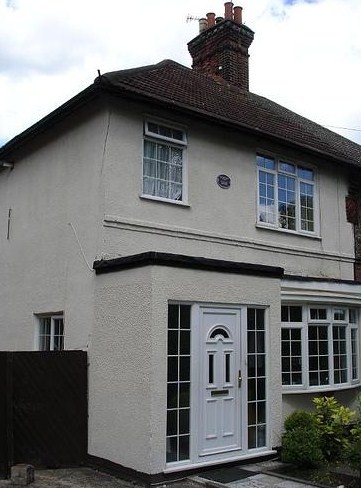
A completely different claim to fame for Woking is literary. Author H. G. Wells wanted to get out of London and moved to Horsell Common, a suburb of Woking, in May, 1895. He lived with his partner Amy Catherine Robbins (nicknamed Jane) in a semi-detached house where he wrote in the mornings and from which he took bicycle rides or long walks in the afternoons. (He had married his cousin Isabel Mary Wells in 1891, but they had separated and subsequently divorced in 1894 as a result of his falling in love with Ms. Robbins. He subsequently married Ms. Robbins in October of 1895.) During these bicycle trips and walks, he paid particular attention to the local area and topography. His time in Woking was a creative and prolific period during which he wrote several novels including The Time Machine (1895), The Island of Doctor Moreau (1896), The Wheels of Chance (published 1896), The Invisible Man (serialized in 1897, published as a novel the same year), and The War of the Worlds (serialized in 1897, published as a novel in 1898). It was in The War of the Worlds in which the local colour gleaned in his bicycle rides in the Woking area was used to greatest effect, with Martians attacking and destroying various places and people around town. He did it so well that part of the celebration of the 150th anniversary of Wells’ birth September 21, 1866 in 2016 included a tour of landmark sites destroyed in the novel. He and Jane lived in Woking for approximately 18 months, moving to Worcester Park in the latter part of 1896. However, his time in Woking made a lasting impression on the city and the world.

H. G. Wells' House


I’ve had the pleasure of travelling to Woking more than once and each time found it a delightful and interesting place. While this essay addresses some points of significance, it is by no means comprehensive. As you can see, the area is of great historical significance and well worth a visit!

Sources include:
British History Online. “Parishes: Woking” from A History of the County of Surrey Vol. 3, Pages 381-390. HERE

Exploring Surrey’s Past. “Woking: Borough”. HERE (Contains links to various topics about Woking and its environs.)

Woking History Society. “History of Woking.” HERE

A Vision of Britain Through Time. “Place: Woking, Surrey.” HERE

Friends of Woking Palace. HERE

The Guardian. “Woking pays homage to H.G. Wells, the man who brought the Martians to town” by Robin McKie, February 27, 2016. HERE

Celebrate Woking.  “H.G. Wells and Woking.”  HERE
All illustrations from Wikimedia Commons:
St. Peters Church HERE
Woking Palace HERE
Woking Crematorium HERE
Shah Jahan Mosque HERE
H. G. Wells' House HERE

~~~~~~~~~~

Lauren Gilbert lives in Florida, where she is enjoying the weather and working on her 2nd historical novel, A Rational Attachment. A long-time member of the Jane Austen Society of North America, she holds a bachelor of arts degree in English. Her first published book is Heyerwood: A Novel. Visit her website HERE.


Monday, October 17, 2016

Ossulstone - London in the Domesday Book

By Mark Patton.

"While spending the Christmas time of 1085 in Gloucester," the Anglo-Saxon Chronicler tells us, "William [the Conqueror] had deep speech with his counselors and sent men all over England to each shire to find out what or how much each landowner had in land and livestock and what it was worth ... there was no one single hide, nor a yard of land, nay, moreover (it is shameful to tell, though he thought it no shame to do it), not even an ox, nor a cow, nor a swine was there left, that was not set down in his writ. And all the recorded particulars were afterwards brought to him."

So began one of the most remarkable undertakings of record-keeping in Medieval Europe, the Domesday Survey, probably inspired by the Biblical story of a decree going out from Caesar Augustus that all the world should be taxed. In fact, the great cities of London, Winchester, and Durham (and with them, probably, a significant number of cattle and swine) were excluded from the survey, the results of which were almost certainly never brought before William, who returned to Normandy in 1086, and did not set foot in England again.

Part of the Domesday Book entry for Middlesex. Photo: National Archive (Public Domain).


Whilst the walled city of London was excluded from the survey, most of what we today consider as "Greater London" was included. England was divided into seven "Circuits," one of which included the counties of Bedfordshire, Buckinghamshire, Cambridgeshire, Hertfordshire and Middlesex. Each county, in turn, was divided into "Hundreds," and the return for each Hundred as sworn by twelve jurors, half of them English, half of them Norman (the population of England at the time was around 1.5 million, of whom 10-20 thousand were Norman settlers).

The Domesday Circuit of Buckinghamshire, Bedfordshire, Cambridgeshire, Hertfordshire and Middlesex. Image: Thomas Gun (licensed under CCA).


London north of the Thames fell within the County of Middlesex, where 25 major landowners were recorded, including the King; the Archbishop of Canterbury; the Bishop of London; Westminster Abbey; Holy Trinity Abbey, Rouen; various noblemen, and one noblewoman. Most of North London fell, more specifically, within the Middlesex Hundred of Ossulstone, where the largest settlement, by far, was Stepney.

The Middlesex Hundreds. Image: Institute for Historical Research (Public Domain).


The Bishop of London held Stepney, with 32 hides, and land for 25 ploughs. On his land were 44 villagers, each with one virgate of land; 46 cottagers, each with one hide, paying 30 shillings per year; four mills; pasture for the village livestock; and woodland for 400 pigs. The total value of the land in 1086 was £48 (it had been £50 before 1066 - land values diminished across the country in the aftermath of the conquest, but far more so in the north of England than in the south).

The Medieval system of land-holding (image is in the Public Domain). A virgate was the amount of land that was tillable by two oxen in a ploughing season, and was, typically, seen as a quarter of a hide, the latter being the area of land required to support a household.


In the same village of Stepney, Hugh of Berniers (not one of the 25 major landowners of Middlesex) held five hides of land under the Bishop. Below him were two small-holders, each with half a virgate; and two cottagers, each with two and a half acres: these land-holdings were below subsistence level, so the cottagers and small-holders would have to work on Hugh's land; or on the Bishop's; or as labourers on building projects in the City; in order to support their families.

Part of the Domesday Book entry for Middlesex. Photo: National Archive (Public Domain). 


Other settlements mentioned in Ossulstone Hundred include Hoxton (held by the Canons of Saint Paul's, with 10 villagers and 16 cottagers); Hampstead (held by the Abbot of Saint Peter's - Westminster Abbey, with one villager, five small-holders, one slave, and woodland for 100 pigs); and Haggerston (held by Robert Gernon - one of the 25 major landowners of Middlesex, with three villagers and seven small-holders).

Most conspicuous of all, however, are the place-names that are not represented: there is no Hackney; no Camden; no Islington; and no Highgate. There are twelve and a half acres of "nomansland," held by the King (presumably for hunting); and many acres of woodland, supporting a great many pigs (or hogs, or swine - these words are all Anglo-Saxon), tended by the English cottagers and small-holders, whilst most of the pork (a Norman word, derived from the Latin - porcus, a pig) would have been consumed by the Norman landowners, bishops, abbots, and their guests.

Mark Patton blogs regularly on aspects of history and historical fiction at http://mark-patton.blogspot.co.uk. His novels, Undreamed Shores, An Accidental King, and Omphalos, are published by Crooked Cat Publications, and can be purchased from Amazon. He is currently working on The Cheapside Tales, a London-based trilogy of historical novels.


Monday, August 15, 2016

Little Domesday - Norfolk

By Annie Whitehead

I’ve been spending a bit of time in my erstwhile home of Norfolk this summer and it only takes a glance to see how historic this county is. But what do we know of its origins?

Little Domesday includes Norfolk, Suffolk and Essex. It is much less of a summary and includes more detail than Domesday, although it is more untidy.

Why did it remain separate from the main Domesday Book?
One suggestion is that it was begun first, and that the rest of the survey was cut down when they saw how bulky the work was becoming. Historian Vivian Hunter Galbraith suggested it might have been a local compilation made by the commission and actually posterior to Volume I. It is, apparently, nearer to the original returns, which could mean it was never sent in and condensed and that it is therefore more accurate.

The Inquisito Eliensis
This is a subsidiary source of information, relating to lands held by the abbot of Ely in Cambs, Hertford, Essex, Norfolk, Suffolk and Huntingdon.  There is some doubt as to how it came into existence. Galbraith: “It was the return demanded by Ranulf Flambard in 1093, when Abbot Symeon died, and the possessions of the abbey were taken into the king’s hands.” JH Round argued that it was the return of the Royal Writ of 1086 instructing Lanfranc to inquire further into Ely’s losses of lands and rights.

Ely - photograph by Dave Webster

A draft of  Little Domesday may have been revised to produce the I.E. Certainly the correspondence between the two is great and the differences are such that could have resulted from errors in copying.

Norfolk Settlements and their distribution
The total number of separate places - 731 - may not be accurate; today there are many villages bearing the same place name, and it is not always clear whether more than one existed in the eleventh-century. Great and Little Massingham were dealt with as Massingham (today, ½ mile separates them.)

Great Massingham - the pond is an old clay pit

There are places about which very little information is given. Perhaps the Domesday record is incomplete, or the relevant details are included with another village, eg: Rippon Hall is included in the measurement of the neighbouring village of Hevingham, but we are not told whether its men, ploughs, woods and meadow are included in the total for these items in Hevingham. Little Domesday is silent on Bergh Apton. Were it not an Ely manor and therefore in the I.E., we would know nothing about it.

Not all the 731 names appear on the present day map. Some remain as houses or topographical features. Bawsey was recorded as a parish - all that remains today is a church and a farm.

Bawsey Church today - taken from Bawsey Farm


Some idea of the nature of the information in the Domesday folios from Norfolk and of the form in which it is presented may be obtained from the entry for Bircham Newton (Docking):

“Bircham Newton was held by Tove, a freeman, as two carucates. Then as now 4 villeins and 3 bordars.* Then 3 serfs afterwards and now 1. Then one plough on the demesne, afterwards 2 now 3. Then and afterwards 4 ploughs belonging to the men, now 2 ½. Then as now 2 rounceys** and 10 swine. Then 220 sheep, now 540. To this manor belong 11 freemen with 1 ½ carucates and 11 ½ acres. There is 1 church with 20 acres, worth 16 pence. These freemen Eudo his predecessors had; Stigand had the soke. It was then worth 60 shillings, afterwards and now 100. The whole is half a league in length and a half in breadth, and renders 15 pence out of 20 shillings in geld.”

Bircham Newton Church is now a private dwelling

Woodland
The extent of woodland on a holding is usually indicated by the number of swine it could support - the swine fed on the acorns and the beech mast -  providing a convenient measure. Thus the normal entry is ‘wood for n swine’.

The number ranges from 1 or 2 up to 100, with a few entries at over 1000. The larger entries are usually given in round figures, but the small entries are detailed, suggesting exactness.

It may not follow that the swine were actually there - they were just used as a unit of measurement.

A Deer Park is mentioned at Costessey. (Pronounced, should you ever need to know, as Cossey!)

Norfolk Deer
Meadow
The entries are uniform:- “N acres of meadow”, varying from 1-100 and even 200. Figures above 50 though, are rare. Its distribution is concentrated around the Broadlands - winter floods meaning good crops of hay along the margins of the more permanent stretches of water. There was not as much in the Fenland as might be expected, but many of the streams that drained into the Fenland were bordered by fair quantities.

Pasture
Unlike meadow, pasture is not regularly mentioned, in fact only in 11 places, and only 5 of these mention pasture for sheep. Of those it is sometimes unclear whether sheep were actually present, eg: “At Haddisloe in Clavering there was pasture capable (my italics) of supporting a total of 170 sheep.”

Marsh
It is only mentioned in connection with three places. Two lie near to the marshes of the lower Yare and Waveney rivers; the third extends into the Nar Valley which is an extension of the Fenlands. Obviously these cannot have represented all the marsh in a county which includes part of the Fenland and the Broadland.


The pasture for sheep recorded presumably refers to marshy flats on which the sheep fed. But even with these five localities the greater part of the Norfolk marshland remains unaccounted for in the Domesday text.

Fisheries
They are recorded for 1086 in connection with 61 places in Norfolk. Only the number is mentioned - no reference is made to their value, as is the case in other  counties. There is usually one fishery in a vill, but 2,3 or even  or 7 are recorded. There are ½ fisheries, usually when two adjacent villages shared a fishery and a half is recorded for each. There are some cases where the fractions are impossible to combine. Gayton Thorpe in Freebridge had ¼ but we hear nothing of the other ¾. For the most part the fisheries lay in the west - in and near the Fenland. Elsewhere the distribution is sporadic, and quite often they are not mentioned where one would expect - for example, none is mentioned in the Broadland.

There is no mention of sea-fisheries, although we can’t be certain that those in Hunstanton and Heacham (on the West coast) were not sea-fisheries.

The famous striped cliffs on the coast at Hunstanton
Salt Pans
Here again, salt pans (mentioned in connection with 62 villages) are only referred to in number - their values are not recorded. The number ranges from under 1 to over 40. Again, fractions are mentioned, some of which are impossible to combine. At Shernborne in Docking, ½ is mentioned, with no mention of the other ½. The distribution of the salt making industry is confined to the eastern and western marshlands. The big gap separating them is broken only by Burnham on the north coast.

Burnham Overy Staithe
Some villages away from these two regions are recorded as having salt pans but as it is geographically impossible that they were situated in these places it seems that the saltpans attributed to the villages were actually in the Fenland - leaving no doubt that the main salt making activity was centred on the Fenland and Broadland regions.

Domesday entry for Rudham, where my mother now lives - note the
 mention of the salt pan, and Alain of Brittany, our purported ancestor!
Mills 
In 1086, 302 settlements had mills. In 13 other places mills had existed in 1066 but had apparently disappeared by 1086. Normally only the number was stated, varying from a fraction up to 9. Of two holdings in Bayfield (Holt) one had ¼, while the other had ¾. While it seems that neighbouring villages often shared a mill, often it impossible to piece the fractions together. (Snettisham is recorded as having 7 mills - Mill Lane exists today, running near a stream.)

Snettisham Mill - the stream runs behind the building
The mills were watermills, aligned along streams. But the distribution is not what might be expected. The areas with most arable land and the most dense population, are not the areas with the largest number or the largest cluster of mills.

Churches
Churches are mentioned in connection with 217 villages, apart from Norwich, Thetford and Yarmouth. These can’t have been the only ones in the county - Holt and Dunham were important enough to have markets, and yet no church is recorded for either place.

St Mary's Old Hunstanton - 'modern' - from the 14thc!
There are some hundreds with only one church. The I.E. records 7 places with churches not recorded in Domesday. Some had two churches and form double parishes today. Again there are untraceable fractions.

Priests are recorded where there is no church. At Hevingham a priest sang ‘three masses a week’ - likely then that there was a church. Normally the value was stated with the number of acres it held, thus at Appleton, Freebridge, “one church with 12 acres, and it is worth 12 pence.”

Livestock
Horses are frequently recorded, and groups of wild or unbroken mares were found in many parishes. The most common variety of horse was the rouncey. Donkeys are only occasionally mentioned. Goats are recorded for a number of holdings, but the flocks were much smaller than those of sheep, usually under 50, sometimes less than 10.

Cows must have been kept in considerable numbers for breeding oxen for the land, but strangely they are seldom mentioned.

Sheep are associated with the salt marshes. The largest number, 1300, was at West Walton in the Fenland. It’s possible that some sheep of the northwest hundreds pastured on the salt marshes of the coast. Numbers of sheep increased and decreased between 1066 and 1086 ith no real explanation.

Markets
There are only 3. ½ at Dunham, ¼ at Litcham, one at Holt. There is nothing to indicate why there should be one at the first two, and no trace of the missing fractions. It must be a shortlist which does not cover all the markets of Norfolk.

The old market place at Holt. Only the street sign - on the building on the left- offers a clue to its origins

Beehives
Occasionally recorded along with livestock, the number is usually under 10, although 27 are recorded at Methwold. The value is never stated. Beekeeping was important for mead, wax and sugar. The entries cannot represent all the hives in Norfolk. Occasionally a render of honey is stated where no hives are mentioned.

Little at all remains to be seen of Domesday Norfolk. But the traces of this historic county are still there to be found, and Little Domesday survives as a remarkably detailed record of what was there in the eleventh-century, and gave me plenty of clues for modern locations.


Further reading:
Domesday Studies - the Eastern Counties R Welldon-Finn
The Norman Conquest and its effects on the Economy 1066-1086 R Welldon-Finn
History from the Sources - The Domesday Book ed. J Morris
The Domesday Geography of Eastern England HC Darby
English Society in the early middle Ages - DM Stenton

*bordar - A person ranking below villeins and above serfs in the social hierarchy of a manor, holding just enough land to feed a family (about 5 acres) and required to provide labour on the demesne on specified days of the week.
**The term rouncey (also spelled rouncy or rounsey) was used during the Middle Ages to refer to an ordinary, all-purpose horse. They were used for riding, but could also be trained for war. It was not unknown for them to be used as pack horses.

[All photographs apart from Ely taken by, and copyright of, the author]

Annie Whitehead is a history graduate and prize-winning author. Her novel, To Be A Queen, is the story of Aethelflaed, daughter of Alfred the Great, who came to be known as the Lady of the Mercians. It was long-listed for the Historical Novel Society’s Indie Book of the Year 2016 and has been awarded an indieBRAG medallion. Her new release, Alvar the Kingmaker, which tells the story of Aelfhere of Mercia, a nobleman in the time of King Edgar, is available now.
Annie's Blog
Annie has also participated in the collaborative project 1066 turned Upside Down which is available now as an e-book

Saturday, July 30, 2016

The Beautiful Village of Shere

by Lauren Gilbert

One’s first visit to a new place is always special. On my first visit to England, we were taken to a teashop in Shere. I was entranced. I had never been anywhere like it. So many stone and timbered buildings... It was truly the England I had always dreamed of visiting. Shere is considered to be one of the most beautiful villages in England, and I can certainly attest to that. (It was used as a setting for the movie “The Holiday.”) It is also quite old. It is in the Guildford district, between Guildford and Dorking.

A view of Shere, taken by the author, 1996

Shere appears in Domesday Book of 1086 as Essira and Essire. It was held by William the Conqueror. In 1086, when Gomshall, a village about 8 miles away, was royal demesne, the villagers of Shere were exempt from the sheriff's jurisdiction. There were four manors in the immediate vicinity of Shere: Shere Vachery, Shere Eboracum, Gomshall Netley and Towerhil.

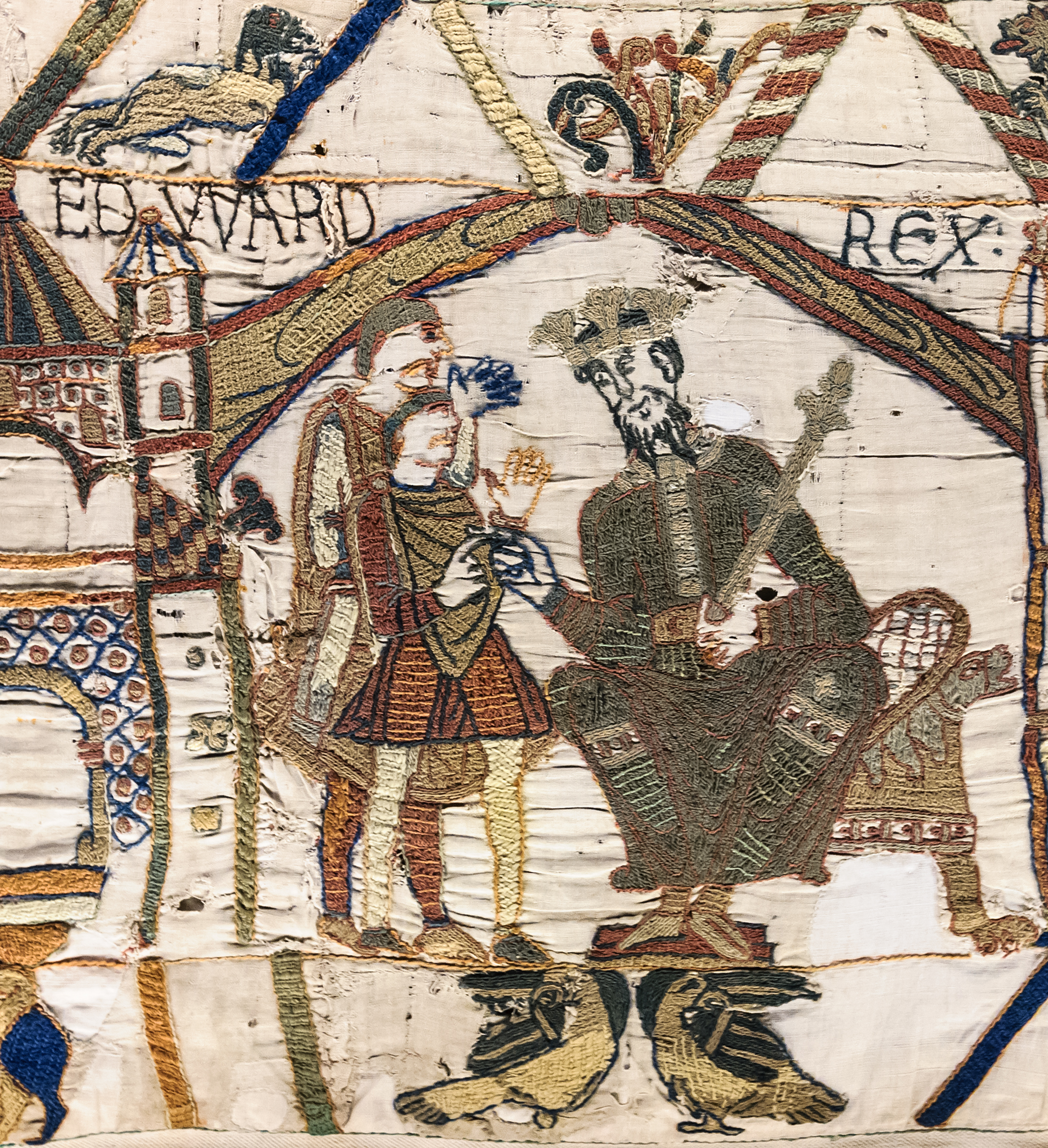
Edward the Confessor, Bayeux Tapestry

Under Edward the Confessor, his queen Edith held Shere Vachery and Shere Eboracum until her death, when they were absorbed by William the Conqueror. It became the chief English seat of the Irish Earls of Ormond. Eleanor, Countess of Ormond (wife of James Butler, the first Earl of Ormond), who owned Shere Vachery manor, had a “view of frankpledge” (a compulsive sharing of responsibility, because of kinship or an oath of fealty, to produce anyone accused of a crime) in Gomshall Towerhill.

In 1281 William Braose was granted a privilege: he was allowed to kill certain kinds of game normally off limits there (free warren). Shere Vachery was forfeited to the king when James Butler, the fifth Earl of Ormond and Earl of Wiltshire, was beheaded in 1461. (It was restored to John, Lord Audley, James’ brother in 1467. The earldom of Ormond was also restored.) Henry VII granted this manor to Sir Reginald Bray in 1486, but Lord Audley remained in possession and paid rent. Because of Audley’s activities in the Cornish Revolt in 1497, the manor was again forfeit to the crown, but was soon returned to Sir Reginald Bray, and has remained in the Bray family.

Shere Eboracum was held by William Donn de Burgh, the third Earl of Ulster. It also changed hands several times. At one point it was held by Richard, 3rd Duke of York and subsequently his widow, Cecily Neville, who held it until her death.

Because Henry VIII used it as a dower property for his first five wives, it was also known as Queen’s Hold. (Apparently, it was not a dower property for Katherine Parr.) Subsequently, for a short time, it was held by Sir Edward Bray who also owned Shere Vachery. He bequeathed it to his wife, Mary, who subsequently married Edmund Tylney, Master of the Revels to Elizabeth I. It changed hands again several times, ending up in the possession of the Bray family several times. Ultimately, the Bray family holds it today.

Gomshall Netley and Gomshall Towerhil resulted from the division of the manor of Gomshall, which was royal demesne, and had been held by King Harold. After William the Conqueror defeated Harold, it was held by William (although his brother Odo did encroach somewhat). It appears that the division of the property occurred under Henry II, who awarded part to Robert de Wendenale and part to William de Clere. Gomshall Netley was awarded to Sir Edward Bray by Henry VIII, after the suppression of Netley Abbey. It remains in the Bray family still.

Gomshall Towerhil also changed hands multiple times. In 1205 it was in the hands of William de Braose who held it until driven out by King John who awarded it to to Peter de Mauley. After the Civil War, in which Williams son the Bishop of Hereford, John, was forced to restore Towerhil to the de Braose heirs.

Rowland de Bloet held it for a time, but in 1218 Reginald de Braose (younger brother of the Bishop) had it. His widow claimed dower rights in 1230. In 1332, Edward III granted it to John Pulteney, Lord Mayor of London; after Pulteney’s death, Edward III granted Towerhil to Eleanor, Countess of Ormond for her lifetime. After her death, it changed hands a couple of times again. In 1539, it was in the hands of Sir Edward Walsingham, who conveyed it to Sir Edward Bray in 1550 (the Brays again!). Gomshall Netley and Gomshall Towerhill manors held court baron, to resolve disputes and enforce the lord’s will.


Church of St James, taken by the author, 1996

The Church of St. James is a Norman church, with the oldest part dating from possibly the late 11th century but mostly being 12th, 13th and 14th century, of various materials probably taken from Roman buildings on Farley Heath, with buttresses, which has been carefully restored. By the north chancel wall, there is a 14th-century Anchorite Cell, supposedly used by the Anchoress of Shere, Christine Carpenter, who had promised in 1329 to devote her life to God and live in a holy place. It had a quatrefoil window through which she received communion, and a “squint” (a window through which she could see the altar) belonging to Anchorite Cell. There is 14th-century glass in the east window and the chancel fittings were renewed.

Quatrefoil and Squint
This area was one of the most lawless in Surrey, with smugglers, poachers and sheep and horse-thieves hiding in the hills surrounding the village. Most of the stolen livestock ended up in London. Sheep stealing was particularly troublesome 1830-1840. Some of the cottages had (and some still have) very large cellars, considered to have been constructed to hide smuggled goods until they could be removed to London.

Iron was worked from the stone and into implements in centuries before the 18th century in Shere. Relying on the River Tillingbourne for power, gunpowder was also manufactured near Shere at Chilworth.

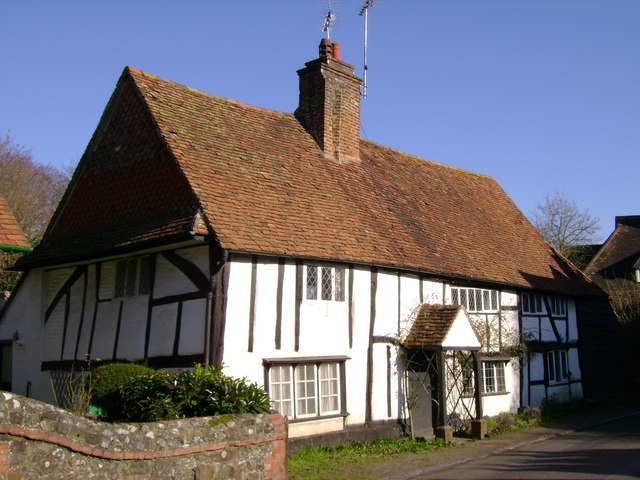
Tudor Cottage

Shere holds many old cottages and houses dating from the 15th to the 19th century. It is also home to the White Horse pub, which was originally a farmhouse built in the 15th century. After traditional beer was replaced by hopped ales in the late 18th century, the farmhouse was converted to an alehouse and brewery. It is still in operation today, and a scene from “The Holiday” with Cameron Diaz and Jude Law was shot on the premises. I had a fantastic cream tea at a beautiful tea shop there as well.

The White Horse

This is an Editor's Choice. The original article was published on November 20, 2013.

Sources:

Archive.org. Some West Surrey Villages, by E. A. Judges. 1901: Guildford (publisher’s name unclear).

Chef & Brewer. “History of the White Horse and Shere.

BritishHistory Online. Victoria County History, H. E. Malden, ed. A History of the County of Surrey, Vol. III. “Parishes: Shere.” Published 1911.

Exploring Surrey’s Past. “Shere.”

Sheredelight.com “The History of Shere.”

Wikipedia: Shere  

Edward the Confessor image from Wikimedia Commons:

Quatrefoil and Squint image from Wikimedia Commons:

Tudor Cottage image from Wikimedia Commons:

The White Horse image from Wikimedia Commons:

~~~~~~~~
Lauren Gilbert is the author of HEYERWOOD: A Novel, in 2011, and is a contributor to CASTLES, CUSTOMS, AND KINGS: True Tales by English Historical Fiction Authors. Her second novel, A RATIONAL ATTACHMENT, is in process. She lives in Florida with her husband. Visit her website at http://www.lauren-gilbert.com.

Tuesday, July 23, 2013

Uncovering Lady Godiva

by Octavia Randolph


The first of a two part article.  This month we look at the “real” Lady Godiva.

NO other early Englishwoman has been remembered as long, or as provocatively, as Lady Godiva. The name instantly conjures an image of a woman on horseback, clad only in her hair. Whether depicted in a 15th century print or gracing a modern chocolate box, Godiva lives – and rides – on in our imaginations.


Lady Godiva (1867) by P Pargetter for Minton Pottery.
 
Godiva is the latinised form of the Old English name Godgyfu or Godgifu (literally, "God's gift" or "good gift"). Godgyfu was an 11th century Anglo-Saxon aristocrat whose life spanned one of the most tumultuous periods in early English history. Despite her illustrious husband, renowned piety, and religious benefactions, without the tantalising legend of her ride through the Midlands town of Coventry she would likely be completely forgotten.

What is known of Godgyfu is found in the chronicles of various religious foundations, mentions of her or her husband in charters, and the post-Conquest compilation known as the Domesday Book. The first positive record of her is in 1035, when she was already married to Leofric, Earl of Mercia. Her birth date is unknown. Similarly, the date of her ride through Coventry cannot be known, possibly it was linked to the dedication of the Priory she and Leofric built there in 1043.

Here I must also acknowledge that despite records dating to the late 12th century concerning her ride, there are some modern scholars who doubt that it ever took place. I am persuaded that it did.

To return to fact: Like other Anglo-Saxon women of her class, Godgyfu owned property in her own right, both given to her by her parents and acquired through other means - gifts from her husband, inheritance from relatives, and purchases and exchanges from individuals and religious foundations. The modest farming village of Coventry was one of them. The Domesday Book lists it, twenty years after her death, as having sixty-nine families.

It is not known why Godgyfu and Leofric turned their attention to Coventry, which after all, was a small and seemingly unremarkable farming community. As early as 1024 Bishop Æthelnoth (later to be Archbishop of Canterbury) gave to Leofric a priceless relic, the arm of St.Augustine of Hippo, which had been purchased by the bishop in Rome and which he apparently indicated was intended – we do not know why – for Coventry.

The response of Leofric and Godgyfu was to create a suitable sanctuary to house this exceptional relic. The lavishly decorated Benedictine Priory of St.Mary, St.Osburgh, and All Saints was dedicated by Archbishop of Canterbury Eadsige in 1043, on property owned by Godgyfu. Within was a shrine to St. Osburgh (a local holy woman who had earlier founded a nunnery in Coventry) which held her head encased in copper and gold. St.Augustine's arm took its place in a special shrine, and Godgyfu and Leofric also presented to the new Priory many ornaments of gold, silver and precious stones, so that it was famed for its richness. Leofric further endowed the Priory with estates in Warwickshire, Gloucestershire, Leicestershire, Northamptonshire, and Worcestershire.

Their religious endowments were many, restoring, enriching, or founding houses in Much Wenlock, Worcester, Evesham, Chester, Leominster, and Stow in Lincolnshire. This last, the Priory Church of St. Mary's Stow-in-Lindsey, is of particular interest as a significant portion of the beautiful and impressive extant church there issued from their hands. The earliest stonework in the church dates from 955; Godgyfu and Leofric greatly endowed and enriched it from 1053-55. The lofty crossing features four soaring rounded Saxon arches (which now enclose later pointed Norman arches built within the original Saxon arches). A 10th or 11th century graffito of an oared ship is scratched into the base of one of the Saxon arches, possibly a memento from a Danish raider who sailed up the nearby Trent.

The north transept houses a narrow, deep Saxon doorway of honey-coloured stone, which would originally have been lime-washed and over-painted with decorative designs. It likely led to a chapel in Godgyfu's day, and surely she passed through this very arch. To experience St. Mary's Stow, built just ten years after the dedication of the Coventry church, is to begin to imagine what the Priory Church of St. Mary, St Osburgh, and All Saints may have been like.


St. Mary's Stow-in-Lindsey, a 10th c church endowed by Godgyfu and Leofric in the mid-11th c. Note the three windows in the transept, shown below from the interior.


St. Mary's Stow-in-Lindsey.
Three windows, three ages.
The circular window is Saxon;
the very narrow round-headed
one beneath it is Norman; the larger
pointed one later Medieval.


St. Mary's Stow-in-Lindsey.
The crossing. The later, pointed Norman
arches were actually built within
the larger rounded Saxon ones.

St. Mary's Stow-in-Lindsey.
North transept. Narrow Saxon doorway
with your author inserted for scale.
St. Mary's Stow-in-Lindsey.
Ancient stone steps to tower.
Photos by Jonathan Gilman.


Leofric was a man of considerable talent and statesmanship; no man could survive forty years as Earl without these qualities. Elevated to Earl (a title and position new to the English, replacing and expanding the Anglo-Saxon ealdorman) in 1017 by the Dane Cnut, he survived and thrived through Cnut's reign. Then followed that of Harold Harefoot (1035-1040), in whose selection as successor to Cnut Leofric was instrumental. Hardacnut, Cnut's other son, reigned next (1040-1042), and then began Edward the Confessor's rule (1042-1066).

Unsurprisingly for his age, Leofric could alternate between great rapacity and great piety, his depredations and subsequent generous benefactions upon the town of Worcester being a case in point. In 1041, when Hardacnut was king, two of his tax collectors were murdered by an angry and over-taxed group of Worcester citizens.

 An act of this nature, upon the direct representatives of the king, was seen as almost an assault upon the king’s body itself. In reprisal Hardacnut ordered Leofric to lay waste to Worcester, which Leofric did with complete and horrifying efficiency, made perhaps even more reprehensible as Worcester was the cathedral city of his own people. Afterwards (and seemingly as personal reparation) Leofric bestowed many gifts of treasure and lands upon the religious foundation there, enough to ensure that his memory would be revered and not reviled.

He seems to have been successful in this. Near the end of his life Leofric experienced four religious visions which were carefully recorded by the monks at Worcester and published after his death in 1057. The Anglo-Saxon Chronicle entry for 1057 noted, "...In this same year, on 30 October, Earl Leofric passed away. He was very wise in all matters, both religious and secular, that benefited all this nation. He was buried at Coventry, and his son Ælfgar succeeded to his authority..." (G.N. Garmonsway translation).

Following his death, Godgyfu made additional gifts to the religious foundation at Worcester to aid in the repose of Leofric's soul and for the benefit of her own. These gifts included altar frontals, wall hangings, bench covers, candlesticks, and a Bible, and joined a long list of items and estates the two had granted to Worcester in the years prior to Leofric's death.

Leofric and Godgyfu had one known child, the above-mentioned Ælfgar, who died in 1062. His daughter Ealdgyth was wed briefly first to a Welsh king and following his death, to Harold Godwineson, killed by William of Normandy's men on the field at Hastings. Thus for nine months Godgyfu was grandmother to the queen of England.

Godgyfu died in 1067, the year following Hastings. At her death she was one of the four or five richest women in England with estates valued at £160 of silver. Her lands were then forfeit to new king William.

Godgyfu was buried next to her husband in the Priory church in Coventry they had created. According to chronicler William of Malmesbury, her dying act was characteristically pious: as a final gift to the Priory, she ordered hung about the neck of a statue of the Virgin Mary her personal rosary of precious stones. (The church was alas, destroyed like so many others during the Reformation, the treasures looted and dispersed.)

Now that we have taken a look at the historical record concerning Godiva, next month we’ll examine the literary legend of her famous ride.

~~~~~~~~~~~~

My short story about Lady Godiva, Ride, was published in Narrative Magazine, and has just been translated and published in Russia in The Translator. Ride is my attempt to re-frame her act in light of the realities of 11th century Anglo-Saxon law and social and religious custom. It is also my tribute to the efforts of women everywhere who seek peace over their own personal comfort.

Octavia Randolph is also author of The Circle of Ceridwen Trilogy, and Book One is available free all day July 24th and 25th. Please claim your copy! Click here for Amazon USA and click here for Amazon UK.