Showing posts with label Edward the Confessor. Show all posts

Monday, February 3, 2020

The Man Who Broke King Harold

by Helen Johnson

The invasion, occupation and conquest of England by William of Normandy's troops in the 1060s created trauma that echoes through the centuries.

Famously, the Conquest began at the Battle of Hastings in 1066, when King Harold of England was killed.  But Normandy was a small duchy.  England was one of the wealthiest and best organised countries in Europe.  How could Duke William beat king Harold?

I believe that Harold was broken before he ever faced William - broken by his own brother, Tostig.

Tostig and Harold's father was Godwin, Earl of Wessex, who married King Cnut's kinswoman, Gytha.  In 1042, Cnut's succession failed and Edward, son of defeated King Aethelred 'the Unready', was invited to return from exile in Normandy.

Tostig's king and brother-in-law, King Edward the Confessor,
depicted in the Bayeux Tapestry. Image Credit

Under Edward, Earl Godwin rose to power.  His sons gained earldoms, and he married his daughter, Edith, to the King.

Tostig's sister Edith of Wessex,
wife of King Edward Image credit
The 'The Life of King Edward', written not long after the Conquest, describes two of Godwin's six sons, Tostig and Harold.  Both, we are told, were 'handsome and graceful persons.'  They were similarly 'strong' and 'brave'.

Harold was practiced in 'endless fatigues'.  He was mild tempered and 'of ready understanding'.  He 'could bear contradiction well'....'not readily... retaliating.'  If he thought someone loyal, he would share his plans.

It's a portrait of a self-controlled, thoughtful man, prepared to communicate and to listen to others.

Tostig, by comparison, 'occasionally was a little over-zealous in attacking evil.'  He was of 'bold and inflexible constancy of mind.'   He would 'ponder much and by himself the plans in his mind'.... 'In his word, deed or promise he was distinguished by adamantine steadfastness.'

And, in a comment that possibly tells us more about other men than of Tostig, 'He renounced desire for all women except his wife...'

Tostig's portrait is of a secretive, stubborn man, who might sometimes break into extreme behaviour.

However, Tostig was admired for his military prowess and firmness of mind, and became a  trusted servant of the King.

In 1051, King Edward's brother-in-law, Eustace of Boulogne, visited Dover. Unfortunately, his men ran amok. Townsfolk resisted, and around forty people were killed.

King Edward considered his brother-in-law to be in the right, and ordered Earl Godwin to punish the people of Dover. Godwin, believing the townsfolk to be in the right, refused.

Edward was furious.  He exiled Godwin's family, repudiated his wife, Godwin's daughter, and sent Godwin's youngest son, Wulfnoth, to Normandy as a hostage.

The incident was a flare for the Norman/English power play that simmered in England. Edward grew up in exile with his mother's people in Normandy after Danish Cnut took the throne. When Edward returned to England, he brought friends and habits gained in Normandy. But the Anglo-Scandinavian English aristocracy, including Godwin, did not like the Frenchified ways of the Normans.

A year after being exiled, Godwin returned, and supporters flocked to him. Edward was compelled to restore Godwin – and his sons and daughter.

Godwin subsequently appears to have been king in all but name.  Edward spent his time either in Church or at the hunt while his wife 'preserved the secret of the King's chastity.'  Edward developed his reputation for saintliness, while Godwin ran the kingdom.

When Godwin died in 1053, his son Harold moved into his place both as Earl of Wessex and as the King's 'Number Two.'

The Godwin plan was always for the whole family and in 1055 when Earl Siward of Northumbria died, Tostig was swiftly installed as Earl. The younger Godwins, Gyrth and Leofwine, became Earls of East Anglia and Kent.

Tostig's star was rising. He had, of all the brothers, the most illustrious wife: Judith of Flanders, half sister of Count Baldwin V of Flanders, granddaughter of Duke Richard II of Normandy, and cousin to King Edward.

A valuable gospel book, owned by Tostig's wife Judith
 and taken with her when the couple were expelled
from Northumbria Image Credit

Tostig was a favourite of King Edward, and they hunted together. Tostig was Queen Edith's favourite brother. He had a palace in York, from which to govern Northumbria.  He was wealthy, and made lavish gifts to Northumbria's patron saint, Cuthbert.

Project Godwin was going swimmingly: only one region of England, Mercia, was not ruled by a Godwin.

But in October 1065, while Tostig hunted with King Edward in Wiltshire, the Northumbrians attacked his palace in York. They slew his retainers and broke into the treasury.

The rebels rampaged south, stopping along the way to meet their allies: Edwin, Earl of Mercia, the Welsh, and their armies.

To show the King the strength of their feelings, the Northumbrians harried Northampton. Pity the unfortunate civilians of Northampton. Harrying, a standard military tactic of the time, meant burning houses and stealing cattle.

The rebels marched on to Oxford.

What had gone wrong?

Tostig's role as Earl of Northumbria was to govern, on behalf of the King, the whole of northern England. However, until 954, Northumbria was an independent kingdom, and in 1065 the Wessex-based King's power was limited to what historian W. E. Kapelle describes as 'essentially an overlord'.

Tostig was the first southerner ever appointed to rule there, and it appears either that he did not understand Northumbria, or that he aimed to govern in the same way as Wessex. However, Northumbria's laws were different to Wessex's. Northumbria had the 'Danelaw' – the laws of the Scandinavian immigrants who were the majority population in the area. Its territory and laws were defined by King Alfred in 879, and affirmed by subsequent kings including Cnut (reigned 1016 – 1035).

Many things were different in the Danelaw, but the universal complaint was that Tostig taxed too heavily. Taxes were significantly lower in the Danelaw. Did Tostig attempt to tax at southern levels?

Tostig was also accused of corruption. And there were murders – all men connected to the dynasty of hereditary Northumbrian earls, who were overlooked when Tostig got the Earldom. Might they have been a focus for rebellion?

Certainly, Tostig upset enough northerners that large numbers rebelled. They organised well. They allied with Edwin of Mercia, the only English Earl not a Godwin, keen to curb Godwin power.  Edwin allied with the Welsh, who Tostig and Harold had attacked in 1063.

The allies demanded that the king remove Tostig, renew the 'laws of Cnut' (i.e. Danelaw tax levels), and install Earl Edwin's brother, Morcar, as Earl of Northumbria.

King Edward sent Harold, his familiar 'number two', to negotiate.  Edward's orders were, essentially, to tell the Northumbrians to shut up and go home.

But when Harold saw that he had fewer soldiers than the massed Northumbrians, Mercians and Welsh, he knew that was impossible.

When Harold reported to Edward that there would be civil war unless Tostig was dismissed, Edward suffered a seizure.

Harold gave the Northumbrians all they demanded.  He averted civil war – but at cost of banishing his own brother.

Tostig went into exile in Flanders. Morcar became Earl of Northumbria. Peace settled.

Ships in the Bayeux Tapestry: Tostig travelled in ships like this,
to Flanders, Denmark and Norway.  And maybe to Normandy.
Image Credit

From this moment, King Edward descended into terminal decline. Some commentators have suggested that Edward and Tostig were homosexual lovers. From this distance, that is impossible to know. But they were certainly close companions. Edward's marriage was 'chaste'.  Tostig 'renounced desire for all women except his wife', although she did bear children.

Whatever the reasons, Edward died, childless, on 5 Jan 1066. The Witan, the country's council of wise men, overlooked Edward's teenage great-nephew, Edgar, and chose Harold to become King.

It appeared a prudent choice. The custom at the time was that the Witan chose the best candidate, and mature brothers or nephews were often chosen over younger contenders. Harold was brother-in-law to the deceased king, and had, in practice, been doing the job for years.

The news infuriated Tostig. As the king's favourite brother-in-law, and with a royal wife, I believe that Tostig had expected to become king. Instead, he was exiled, and Harold slipped into the throne.

In exile, Tostig's brother-in-law, Count Baldwin of Flanders, provided him with a home, an estate, and income of the town of St Omer. But Tostig was not satisfied: he wanted vengeance.  His 'adamantine steadfastness' cut in. Harold must pay for his betrayal.

Tostig sought support. Baldwin did not want a military adventure. Tostig surely went next to neighbouring William of Normandy, husband of Tostig's wife's niece. But I have found only writer – Peter Rex - who confirms that. Several historians record that Tostig went to his mother's cousin, King Swein of Denmark. Swein, like Baldwin and William, refused him. Tostig moved on, to Harald 'Hardrada', king of Norway.

Tostig reminded Hardrada of a treaty made in the late 1030s between Cnut's son Harthacnut and King Magnus of Norway, and persuaded Hardrada that he had a claim to England. Tostig, presumably recalling his father's return after exile, claimed that he had many supporters in England.

Hardrada was persuaded.  They raised troops, and in September 1066, they marched on York.

Was Tostig deluded when he promised Hardrada that supporters would flock to them? Or was he simply lying?

In the event, the Northumbrians defended York.  They met Tostig and the Norse at Fulford, a swampy place a couple of miles south of York.  The new Earl, Morcar, was young, not tested in battle.  Hardrada had a lifetime's military experience. The Northumbrians didn't have a chance.

After the slaughter, the Northumbrians surrendered. As usual, hostages were given as security.  Tostig began his vengeance by selecting those hostages. Promises were extracted from the Northumbrians to march with the invaders to depose King Harold – Tostig's primary aim.

Unbeknown to the invaders, however, King Harold was racing north.  Too late to save the Northumbrians, he went straight to attack the invaders.

Harold called out Tostig and offered him peace. He even offered him his place back as Earl of Northumbria – 'one third of the kingdom'.

Tostig refused – that 'adamantine steadfastness'.

So, at Stamford Bridge, on 25th September 1066, Harold's army wiped out the Norse, King Harald Hardrada, and Harold's brother, Tostig. Shortly afterwards, William of Normandy landed on the south coast.

As Harold rushed his troops back south, he paused to pray at Waltham Abbey.

A year previously, Harold and Tostig were the golden boys of England, King Edward's senior Earls.  Now, Tostig lay dead, killed if not by Harold's own hand, then certainly by his actions. What would he tell their mother?

While there, Harold received a message. The message told him that William had the Pope's blessing, and carried his banner. The message was that William had God on his side.

From this moment, Harold, the brother-killer, appeared a changed man.

His brother Gyrth volunteered to attack William, while Harold and his troops recuperated. Should Gyrth lose, the King and his troops could fight again. Gyrth also suggested they scorched the earth around William's encampment, contain them, and starve them out. They were all sensible suggestions.

But Harold – the brother-killer - did not listen. He insisted on facing William in battle at once.

Harold led his men to face God's judgement at Hastings on 14th October, 1066.

Harold, Gyrth and Leofwine were all felled by William's troops.

Their mother lost four sons in three weeks.

And England was conquered.

The death of King Harold, as depicted in the Bayeux Tapestry


Bibliography:

The Life of King Edward, anonymous, but believed to have been commissioned by Queen Edith Godwinson, and written by monk/s of St Bertin Abby at St Omer, Flanders.

The Relations between England and Flanders before the Norman Conquest, by Philip Grierson.

The Godwins, by Frank Barlow

The Saga of Harald Hardrada, in Heimskringla by Snorri Sturlesson

Queen Emma and the Vikings by Harriet O'Brien

Bloodfeud  by Richard Fletcher

The Norman Conquest of the North by William E Kapelle

William the Conqueror, the Bastard of Normandy, by Peter Rex


Finding Fulford by Charles Jones.

1066 The Year of the Conquest, by David Howarth


~~~~~~~~~~

Helen Johnson has roved around Yorkshire, England, for twenty years, writing about the history, heritage, landscape and people of the region.

She was inspired to write about the Norman Conquest after learning of William the Conqueror's 'Harrying of the North' – an act which today would qualify as genocide.

Her short story, 'God's own Country', published at Copperfield Review, imagines how two people might have felt about one of William the Conqueror's policies – his plan to blend what he described as the 'two races' of his dominions. Read the story HERE

Helen is working on two novels set in Conquest Yorkshire, one for adults and one for teenagers.

You can discover more of Helen's work and read about William the Conqueror's good intentions at her website, https://www.helenjohnsonyorkshirewriter.co.uk/ or follow her on Twitter @Yorkshirewriter.


Thursday, July 12, 2018

To Catch a Thief...

By Sarah Rayne

I’m keen on atmospheric settings and I’m very keen indeed on houses and buildings with intriguing histories.  In the early stages of drafting a new plot, looking for a hook on which to hang a building (so to speak), I came across a fragment of a very old English law.

It happened by purest chance.  One afternoon having become lost in the depths of the countryside, I drove past a field with a sign on the gate saying, ‘Infanger’s Field’. 

The English countryside is, it must be said, liberally strewn with strange and intriguing names. Quite near to where I live is a village called Coven. It’s an extremely nice place, but its name is always very deliberately pronounced ‘Coe-Ven’. Purists carefully point out that the name derives from the Anglo-Saxon, cofum¸meaning either a cove or a hut, but despite that, there are occasionally dark mutterings suggesting that the place once had witchcraft associations, and that the pronunciation was politely slurred to hide that fact. 

Then there are all those instances of Glue Works Lane and Slaughter Yard. There’s Pudding Lane where the Great Fire of London reputedly started in a baker’s shop. On the other hand, there are places whose names are open to interpretation, such as Cockshutt in Shropshire, which, despite sounding like a venue for a Carry On film, is likely to derive from fowl hunting activities. Other names are satisfyingly rooted in the past: Oxford has Brasenose College and Brasenose Lane – supposedly from the Brazen Nose door knocker of the original sixteenth century Hall. Incredibly, though, the city also once had the now-lost Shitbarn Lane, c.1290, which ran between Oriel Street and Alfred Street.

But Infanger’s Field? 

I made eager notes – I even ventured into the field itself to pace the boundaries, although it was a bit unfortunate that I dropped my notebook in the mud, (I think it was mud – I hope it was mud), and perhaps I wouldn’t have worn scarlet gloves if I had known there was a bull in the field. 

Then I dashed home to scour bookshelves and the internet.

And it seems that the word comes from the Old English infangene-þēof –  ‘Thief seized within’ or ‘in-taken-thief’.  Infangenthief or infangentheof, no matter how you spell it, was an Anglo-Saxon arrangement, supposedly from the time of Edward the Confessor – c.1003-1066, and one of the last of the royal House of Wessex. 


Infangentheof, and its sister law, outfangentheof, apparently permitted the owners of a piece of land the right to mete out justice to miscreants captured within their estates, regardless of where the poor wretches actually lived. On occasions it also allowed the culprits to be chased in other jurisdictions, and brought back for trial. The justice that was meted out was often extremely severe – there was no cheerful Gilbert & Sullivan principle of letting the punishment fit the crime in those days. People were beheaded – limbs were cut off – vagabonds were often whipped and chained in stocks. Others were forced to carry hot stones, or wear bridles over their tongues – a favoured method for troublesome wives, of course. Poisoners might be boiled alive.

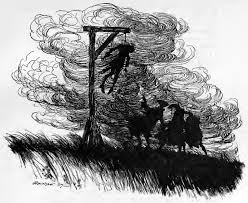
As for murderers, they risked being hung up in a cage, usually after their execution, although occasionally before it, so that people could watch their slow death. It was a day out for the ordinary people; you could take a bit of lunch with you, and it made something to tell the neighbours.
This grisly custom was sometimes useful to those unprincipled (and strong-stomached) souls who were resolved on proving the truth of the ‘Hand of Glory’ ritual – the belief that the dried hand of a hanged man had power. Writing the Ingoldsby Legends in the 1840s, the Reverend Richard Barham paints a deeply macabre image of three crones climbing up a gibbet in quest of such a gruesome fragment.
‘On the lone bleak moor, at the midnight hour,
Beneath the Gallow Tree,
Hand in hand, the Murderers stand,
By one, by two, by three!
Now mount who list, and close by the wrist,
Sever me quickly, the Dead Man’s fist.
And climb, who dare, where he swings in the air,
And pluck me five locks of the Dead Man’s hair.’
The privilege of exercising the law of infangentheof and extorting suitable punishments, was granted to feudal lords, and, inevitably, to religious houses, who generally liked to get their hands on any odds and ends of power that might be up for grabs.  When the Normans came barrelling in, they made cheerful use of most of these laws too, and they particularly liked infangentheof, which they felt helped keep the rebellious Saxons in their place.


The recipients of the privilege usually got a bit of a smorgasbord – as well as infangentheof, the king tended to throw in a few other goodies. The granting of a free borough, could be one, along with things called soke and sake, and toll and team.  Sake, despite sounding like something you’d glug down with your sushi, literally translated as ‘cause and suit’, while soke and team referred to the ‘privilege of holding court’, intended for judging people accused of wrongful possession of goods or cattle.

Toll was then, as it is today, the right granted to a landowner to impose a payment on the sale or passage of goods or cattle on his lands, or, alternatively, to be exempt from the tolls of others. So today’s motorists paying to drive along a particular stretch of motorway, and modern travellers struggling with the complexities of customs and excise (not least the present government in its wrangles with the EU), might justifiably direct their wrath towards the likes of King John. In fact, Henry III, in a Charter to the citizens of Norwich of 1229, makes ceremonious greetings to his subjects starting with bishops and archbishops and going all the way down the social scale to reeves, bailiffs, and the useful all-embracing term of ‘all faithful men’, after which, the courtesies having been observed and all Henry’s titles having been listed, (presumably in case somebody reading the edict didn’t know who he was), goes on to inform his subjects thus –
“… at the request and petition of our venerable father, John, the second [of that name], bishop of Norwich, we have granted and by this present charter confirmed to the burgesses of Lenn, that the borough of Lenn may be a free borough for ever, and they may have soke and sake, toll and team, infangenthief and outfangenthief.”
I have no idea if it was a fragment from the past I encountered with Infanger’s Field that day – perhaps a shred of some long-ago feudal baron who had named a field as a warning to miscreants.  And I’m doubtful if I could find the field again. 

The law itself fell more or less into disuse in the fourteenth century and all-but vanished from England’s history. Thankfully most of the punishments have vanished as well. But fragments of the law can still be found here and there. Such as in the name of a field that now houses only an indignant bull. 

~~~~~~~~~~

Sarah Rayne’s first novel was published in 1982, and since then she has written more than 25 books. As well as being published in America and Australia, her novels have been translated into German, Dutch, Russian, and Turkish. Much of her inspiration comes from the histories and atmospheres of old buildings, which is strongly apparent in many of her settings – Charect House in Property of a Lady, Twygrist Mill in Spider Light, and the Irish cottage,Tromloy, in Death Notes.  Music also influences a number of her plots: the music hall songs in Ghost Song, the eerie death lament ‘Thaisa’s Song’ in The Bell Tower, and the lost music in Chord of Evil that hides a devastating secret from WWII.
Connect with her at http://www.sarahrayne.co.uk/

Monday, January 2, 2017

An Englishman's Castle

by April Munday

Siege of Acre: Public Domain [Wikimedia Commons]

Castles were introduced into England in the 1040s by French supporters of Edward the Confessor. There were only four of them (one at Clavering in Essex and three in Herefordshire) and it wasn’t until after the Conquest in 1066 that the English understood what castles really meant. The Normans erected them in large numbers across the country and used them to oppress the Saxons.

Castles were a tenth-century response to Viking raids in France and were developed as a means of protecting communities. By the eleventh century, they were being used by lesser lords to resist their overlords and to dominate their own underlings. These basic castles were wooden towers sited on raised mounds of earth surrounded by a wooden palisade. The mounds were mottes and the enclosure within the outer palisade was the bailey. The effectiveness of motte and bailey castles could be improved by digging a ditch outside the palisade, making it more difficult for the enemy to enter the defended area.

In its earliest forms, the bailey was situated just inside the outer palisade or wall, and provided an area in which animals could be kept or where people from the town or nearby villages could shelter from attack. Where possible, a castle was built on a hill, but where this was not possible, a hill had to be built. Then a high tower was erected within the defensive walls.

Stone castles were rare until the twelfth century. Motte and bailey castles could be erected in a few weeks (one at York took eight days), while stone castles could take decades. The castle that is being built in the thirteenth-century style at Guédelon as an archeological experiment is planned to take 20 years. The medieval building season lasted from March to September and successive building seasons can be seen in the horizontal lines in some castle walls.

In England, at the turn of the twelfth century, there was probably a castle, however basic, every 10 miles. The vast majority of these, however, have disappeared, as they fell out of use or were destroyed in civil wars. The twelfth century Bridgnorth Castle (pictured below) was destroyed by the Parliamentarians after a successful siege in 1646.

Bridgnorth Castle © April Munday

From the thirteenth century a licence from the king was required before a castle could be built in England. By then the Plantagenets had learned that castles could just as easily be used against a king as for him.

Sometimes booty brought back by soldiers fighting abroad was invested in building castles and fortifications in England. In much the same way that the exterior of a castle was designed to impress, so was the interior. The walls would have been plastered and painted with many colourful designs or covered with tapestries. The presence of garrison soldiers would have instilled a sense of fear into a visitor, welcome or unwelcome. The visitor would be led through increasingly opulent areas until they were brought before the lord in his solar. Only lords of great houses or castles had an entire room to themselves.

Edward I was one of the greatest castle-builders of the Middle Ages. He built castles in Wales to support his conquest of and dominion over that country. They were built on the coast so that they could be supplied by sea, but they were poorly maintained and fell into disuse fairly quickly.

Castles were designed to be difficult to take by besiegers. Arrow loops were built into walls so that archers could shoot out to any area from which an attack might come. Arrow loops were narrow vertical openings in the wall. Inside they opened out into a V, which gave the archer both a good line of sight to the attackers and plenty of room to shoot, but protected him from the attackers’ arrows.

Catchcold Tower, Southampton
© April Munday

Castles were supposed to put the opposition off attacking. Their walls were high to make scaling as difficult as possible. They were also thick to provide protection against siege weapons such as trebuchets and battering rams. A garrison of soldiers would be stationed within the castle. If the besiegers misjudged the size of the garrison, or if their own number dwindled after a lengthy siege (dysentery and disaffection contributed to this) the besieged could leave the castle and see off the attackers. It did not need a large garrison to withstand a siege. Castles were not impregnable, though, and walls could be brought down by mining beneath them and then lighting fires.

Castles could be military strongholds and/or royal and aristocratic residences. After the eleventh century they were not usually large enough to provide refuge for many civilians other than those already living in the castle. Although they were built for defensive purposes, they were not, however, great defensive weapons. Unless they were of strategic importance, they could simply be bypassed by the enemy. Garrison forces were not usually sufficient to fight a full-scale battle, their primary purpose being to defend the castle once it had been attacked. Most castles were never put to the test, either because they were considered to be impregnable, or because they simply weren’t considered important enough to be worth the effort involved in an attack or siege. Despite this medieval wars were usually won or lost by sieges, not by battles. Where a castle was considered to be important enough to be worth besieging, its surrender could have consequences that lasted for generations. When the castle was taken, so was the region that it protected. They were often administrative centres, which was why their surrender was usually more important than winning or losing a battle.

Castles have been part of the English landscape for almost a thousand years. They have ranged in size from little more than a fortified house, such as Stokesay Castle, to huge structures, such as Kennilworth and Dover. In most cases even the ruins are impressive. I’m looking forward to visiting Guédelon when it’s complete to get an idea of what a functioning medieval castle really looked like.

References:

Armies and Warfare in the Middle Ages – Michael Prestwich

The Norman Conquest – Mar Morris

Inside the Medieval World – James Harpur

The Mediaeval World Complete – Robert Bartlett

Knight – Robert Jones

The Making of Europe – Robert Bartlett

The Medieval Siege – Jim Bradbury

~~~~~~~~~~

April Munday lives in Hampshire and has published six novels set in the fourteenth and early nineteenth centuries. They include The Traitor’s Daughter, His Ransom, The Winter Love and the Regency Spies Trilogy. They can be purchased from Amazon. A novel set around the sack of Limoges in 1370 will be available early in 2017.

Her blog ‘A Writer’s Perspective’ arose from her research for her novels and is a repository of things that she has found to be of interest. She can also be found on Twitter (@aprilmunday)


Friday, October 14, 2016

Did the Conqueror Build Upon Existing Foundations?

by Annie Whitehead

950 years ago today, the world changed - for those living in England, at any rate. They had a new king, and new masters, and history had a brand new reference point - 1066. But legally, administratively, and ecclesiastically, how much did William change?

Falaise, Lower Normandy; 
William was born in an earlier building here
William of Normandy was not opposing the old regime in England, he was claiming his right to carry on the government of a kingdom of which he said he was the rightful king. The England to which he came in 1066 was a soundly organised country in most respects. William abolished nothing, and introduced little new; his reign consisted of a successful attempt to fuse old and new, building upon the already existing structure.

The power of the nobility in Anglo-Saxon England was being strengthened from two levels of the social scale. The king gave grants of almost anything that was in his power to give: land, privileges, and judicial powers. From the inferior classes came men seeking the protection of a lord. Here was the beginning of a process which came to be known as feudalism. There were at this time only two aspects: a personal bond between two free men - a superior (the lord) and and inferior (the vassal) - and a method of land tenure, whereby the vassal held a benefice of his lord. The personal relationship entailed the vassal putting himself under the protection of this lord, and in a symbolic gesture of submission he would place his hands between those of his lord and swear an oath of fealty. Under this solemn contract the man was obliged to serve and obey his lord, and the lord was obliged to protect and maintain the man.

In the eleventh century the Church and most of the aristocracy held some book-land; a royal grant by book creating an estate which could be passed to heirs and which could not be lawfully resumed by the king. Leases were common, and peasants who had lost the absolute ownership of their lands became tenants of their lord, rendering rents and service in return for the use of his property.

Feudal elements then were certainly present in England before the Conquest, but the nobility were not yet vassals of the king, and it would appear that few substantial landowners held property on loan. Nevertheless, most of the characteristics of feudalism could be found in the old English kingdom.

With the Norman Conquest came the completion of the establishment of feudalism. William took land from the English earls and granted it to his followers as a reward for their military service. The new barons were enfeoffed with the scattered estates of the English, but no man was allowed to conquer for himself, except on the Welsh and Scottish borders. The land was granted by the king to be held under all the old conditions. The only changes lay in the revision of the military service required by the king, and in the closer tie of feudal vassalage. The barons in turn leased their lands to lesser barons. To curb the warlike aristocracy, William had them swear an oath of fealty to him direct. Thus the whole social structure from the king down to the poorest ceorl (churl) was brought under the control of the feudal system. William had completed the process with a natural progression, and had at the same time consolidated the royal position and organised the social system under him.

Swearing the oath of fealty
The judicial powers of the Anglo-Saxon kings were small; the king was not yet the fount of justice. A man looked to the popular courts to protect and enforce his rights under the law. This process of law was personal and local, and customs differed even from estate to estate. The Shire court, which met at least twice a year, was concerned with the traditional cases under folk law, mainly theft and violence. The townships and Hundreds sent representatives to the meetings. By Edward the Confessor’s day, the function of declaring Shire law and passing judgement had passed to the king’s thegns. The Shire Court had become an instrument of local government, receiving royal writs, and executing the king's demands. The administrative drive passing from the king via the writ to the Shire court was beginning to unite the country. Even more closely connected with the crown were the Hundred courts. Their main purpose was the administration of police schemes which the king had devised, and they met every month.

William I made few changes to the existing judicial system. Feudal law was introduced to govern the personal and tenurial relationships of the new aristocracy. But the only changes to affect the English were the introductions of Forest and Church courts. In time, the new feudal law influenced all land holding, and in the end provided England with a new land law. William made no radical changes to the existing law, and merely introduced laws out of  necessity to govern his new aristocracy.  Gradually the system filtered through to affect all the people. William therefore supplemented the existing system, which, although it made the judicial system initially more complex, meant that eventually the two peoples came under the same law, and brought more control for the king.


The Anglo-Saxon Church appeared more as a loose confederation of bishoprics under the king than as an independent hierarchical organisation. The absence of an active hierarchical principle had led to a confusion in the territorial organisation of the Church. Many bishops held more than one see, and the dioceses too were losing the character of distinct units. The general confusion brought about by an attempt to model the English Church on the Roman administration and organisation was eradicated by William’s total disregard for the papacy during his attempt to give the Church a greater structural coherence.

Lanfranc *
William replaced the English bishops with foreigners. The number and size of the dioceses remained unchanged but several of the episcopal sees were re-sited in cities in accordance with canon law. Dioceses were gradually divided into archdeaconries, which were then divided into rural deaneries. As the diocese often perpetuated the boundaries of the ancient sub-kingdoms, and the archdeaconries and rural deaneries corresponded to the Shire and Hundred, the territorial framework of the Church remained thoroughly English. However, the loose confederacy of bishoprics was reorganised on a strictly hierarchical principle and feudal ideas were incorporated into this reorganisation. The southern bishops were subordinated to Canterbury, and oaths of canonical obedience were required, which resembled the fealty of the vassal. As the Church became divorced from folklaw and traditional customs, it felt the control of the king. Church lands were treated as baronies and the bishops as vassals, bound to do homage and swear fealty.

William, working with Archbishop Lanfranc, achieved the primacy of Canterbury over York, but the situation was unstable because of the increasing power of the papacy, and a tendency for the pope to deal direct with the bishops. Primacies everywhere were being weakened by the increasing papal power. William ignored the papal attempt to deprive the laity of its traditional rights in the Church. He admitted no papal legates, and forbade any of his bishops to go to Rome, even Lanfranc. The establishment of the Archbishop of Canterbury as primate of all England provided the kingdom with a single supreme ecclesiastical court, and appeals could go no further than this without the king's’ permission. William succeeded in his ambition to restrict the already limited connection between the English Church and Rome, attaining power over the Church in the same way as he had with the laity. The English Church was unified under the primacy of Canterbury, in turn answerable to the king.

Signatures at the council of Winchester.** The large crosses are the signatures of
 William & Matilda, the one under theirs is Lanfranc's, and the other bishops' are under his.

Anglo-Saxon England, it would seem, was basically well organised and in need only of strong direction. With William I’s reign came that direction. William was no innovator; he took existing basic institutions and strengthened and co-ordinated them, added to them where necessary, and was successful in establishing a peaceful and workable fusion of the English and Norman peoples, without needing to make radical changes with revolutionary ideas, but merely by improving upon that which had had inherited.

Whether those people who now came under the yoke of new Norman masters felt the same way, is another story…

Further reading:
English Society in the Early Middle Ages - DM Stenton
The Feudal Kingdom of England 1042-1215 - F Barlow
The Norman Conquest - GH Browning

* Near contemporary picture of Lanfranc, Archbishop of Canterbury - Bodleian Library
**Accord of Winchester signed 1072 by William the Conqueror & his wife. This elevated Canterbury over York as to whose archbishop would be the highest primate in England.

(all the above images are in the public domain)

~~~~~~~~~~

Annie Whitehead is a history graduate and prize-winning author. Her first novel, To Be A Queen, is the story of Aethelflaed, daughter of Alfred the Great, who came to be known as the Lady of the Mercians. It was long-listed for the Historical Novel Society’s Indie Book of the Year 2016 and has been awarded an indieBRAG medallion. Her second novel, Alvar the Kingmaker, which tells the story of Aelfhere of Mercia, a nobleman in the time of King Edgar, has also been awarded an indieBRAG gold medallion. Most recently she has been involved in a collaborative project, a collection of stories by nine authors re-imagining the events of 1066 and asking 'What If'?
Annie's Author Page
Alvar the Kingmaker
To Be A Queen
Annie's Website
Annie's Blog
1066 Turned Upside Down

Saturday, July 30, 2016

The Beautiful Village of Shere

by Lauren Gilbert

One’s first visit to a new place is always special. On my first visit to England, we were taken to a teashop in Shere. I was entranced. I had never been anywhere like it. So many stone and timbered buildings... It was truly the England I had always dreamed of visiting. Shere is considered to be one of the most beautiful villages in England, and I can certainly attest to that. (It was used as a setting for the movie “The Holiday.”) It is also quite old. It is in the Guildford district, between Guildford and Dorking.

A view of Shere, taken by the author, 1996

Shere appears in Domesday Book of 1086 as Essira and Essire. It was held by William the Conqueror. In 1086, when Gomshall, a village about 8 miles away, was royal demesne, the villagers of Shere were exempt from the sheriff's jurisdiction. There were four manors in the immediate vicinity of Shere: Shere Vachery, Shere Eboracum, Gomshall Netley and Towerhil.

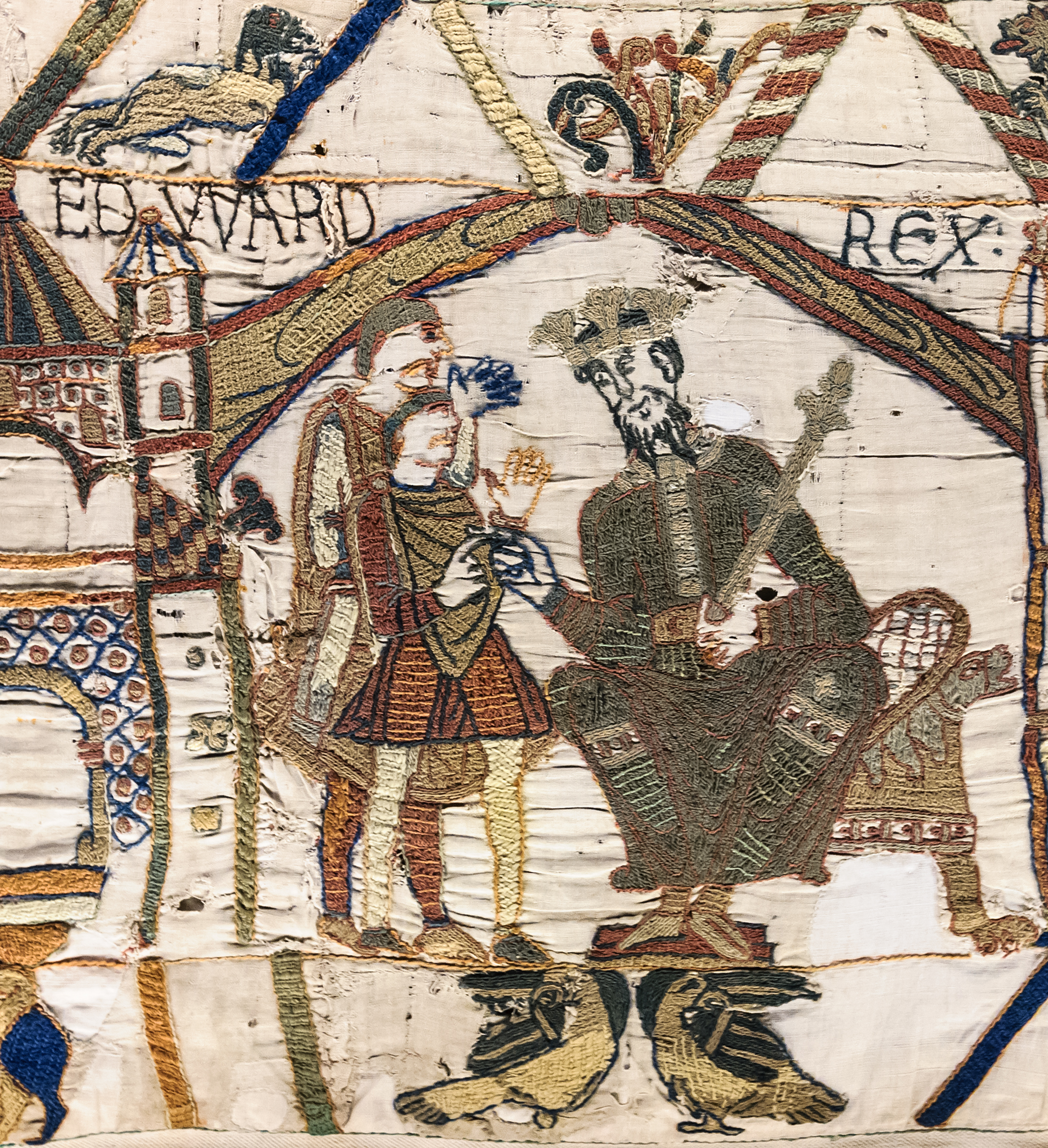
Edward the Confessor, Bayeux Tapestry

Under Edward the Confessor, his queen Edith held Shere Vachery and Shere Eboracum until her death, when they were absorbed by William the Conqueror. It became the chief English seat of the Irish Earls of Ormond. Eleanor, Countess of Ormond (wife of James Butler, the first Earl of Ormond), who owned Shere Vachery manor, had a “view of frankpledge” (a compulsive sharing of responsibility, because of kinship or an oath of fealty, to produce anyone accused of a crime) in Gomshall Towerhill.

In 1281 William Braose was granted a privilege: he was allowed to kill certain kinds of game normally off limits there (free warren). Shere Vachery was forfeited to the king when James Butler, the fifth Earl of Ormond and Earl of Wiltshire, was beheaded in 1461. (It was restored to John, Lord Audley, James’ brother in 1467. The earldom of Ormond was also restored.) Henry VII granted this manor to Sir Reginald Bray in 1486, but Lord Audley remained in possession and paid rent. Because of Audley’s activities in the Cornish Revolt in 1497, the manor was again forfeit to the crown, but was soon returned to Sir Reginald Bray, and has remained in the Bray family.

Shere Eboracum was held by William Donn de Burgh, the third Earl of Ulster. It also changed hands several times. At one point it was held by Richard, 3rd Duke of York and subsequently his widow, Cecily Neville, who held it until her death.

Because Henry VIII used it as a dower property for his first five wives, it was also known as Queen’s Hold. (Apparently, it was not a dower property for Katherine Parr.) Subsequently, for a short time, it was held by Sir Edward Bray who also owned Shere Vachery. He bequeathed it to his wife, Mary, who subsequently married Edmund Tylney, Master of the Revels to Elizabeth I. It changed hands again several times, ending up in the possession of the Bray family several times. Ultimately, the Bray family holds it today.

Gomshall Netley and Gomshall Towerhil resulted from the division of the manor of Gomshall, which was royal demesne, and had been held by King Harold. After William the Conqueror defeated Harold, it was held by William (although his brother Odo did encroach somewhat). It appears that the division of the property occurred under Henry II, who awarded part to Robert de Wendenale and part to William de Clere. Gomshall Netley was awarded to Sir Edward Bray by Henry VIII, after the suppression of Netley Abbey. It remains in the Bray family still.

Gomshall Towerhil also changed hands multiple times. In 1205 it was in the hands of William de Braose who held it until driven out by King John who awarded it to to Peter de Mauley. After the Civil War, in which Williams son the Bishop of Hereford, John, was forced to restore Towerhil to the de Braose heirs.

Rowland de Bloet held it for a time, but in 1218 Reginald de Braose (younger brother of the Bishop) had it. His widow claimed dower rights in 1230. In 1332, Edward III granted it to John Pulteney, Lord Mayor of London; after Pulteney’s death, Edward III granted Towerhil to Eleanor, Countess of Ormond for her lifetime. After her death, it changed hands a couple of times again. In 1539, it was in the hands of Sir Edward Walsingham, who conveyed it to Sir Edward Bray in 1550 (the Brays again!). Gomshall Netley and Gomshall Towerhill manors held court baron, to resolve disputes and enforce the lord’s will.


Church of St James, taken by the author, 1996

The Church of St. James is a Norman church, with the oldest part dating from possibly the late 11th century but mostly being 12th, 13th and 14th century, of various materials probably taken from Roman buildings on Farley Heath, with buttresses, which has been carefully restored. By the north chancel wall, there is a 14th-century Anchorite Cell, supposedly used by the Anchoress of Shere, Christine Carpenter, who had promised in 1329 to devote her life to God and live in a holy place. It had a quatrefoil window through which she received communion, and a “squint” (a window through which she could see the altar) belonging to Anchorite Cell. There is 14th-century glass in the east window and the chancel fittings were renewed.

Quatrefoil and Squint
This area was one of the most lawless in Surrey, with smugglers, poachers and sheep and horse-thieves hiding in the hills surrounding the village. Most of the stolen livestock ended up in London. Sheep stealing was particularly troublesome 1830-1840. Some of the cottages had (and some still have) very large cellars, considered to have been constructed to hide smuggled goods until they could be removed to London.

Iron was worked from the stone and into implements in centuries before the 18th century in Shere. Relying on the River Tillingbourne for power, gunpowder was also manufactured near Shere at Chilworth.

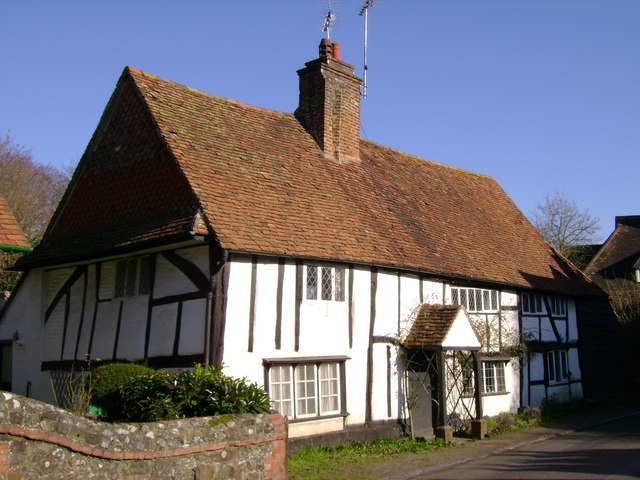
Tudor Cottage

Shere holds many old cottages and houses dating from the 15th to the 19th century. It is also home to the White Horse pub, which was originally a farmhouse built in the 15th century. After traditional beer was replaced by hopped ales in the late 18th century, the farmhouse was converted to an alehouse and brewery. It is still in operation today, and a scene from “The Holiday” with Cameron Diaz and Jude Law was shot on the premises. I had a fantastic cream tea at a beautiful tea shop there as well.

The White Horse

This is an Editor's Choice. The original article was published on November 20, 2013.

Sources:

Archive.org. Some West Surrey Villages, by E. A. Judges. 1901: Guildford (publisher’s name unclear).

Chef & Brewer. “History of the White Horse and Shere.

BritishHistory Online. Victoria County History, H. E. Malden, ed. A History of the County of Surrey, Vol. III. “Parishes: Shere.” Published 1911.

Exploring Surrey’s Past. “Shere.”

Sheredelight.com “The History of Shere.”

Wikipedia: Shere  

Edward the Confessor image from Wikimedia Commons:

Quatrefoil and Squint image from Wikimedia Commons:

Tudor Cottage image from Wikimedia Commons:

The White Horse image from Wikimedia Commons:

~~~~~~~~
Lauren Gilbert is the author of HEYERWOOD: A Novel, in 2011, and is a contributor to CASTLES, CUSTOMS, AND KINGS: True Tales by English Historical Fiction Authors. Her second novel, A RATIONAL ATTACHMENT, is in process. She lives in Florida with her husband. Visit her website at http://www.lauren-gilbert.com.

Friday, November 20, 2015

Where history brushes my cheek

by Anna Belfrage

Westminster Abbey,
Chapter house by Aiwok, 2012
There are few places in the world I am so in love with as Westminster Abbey. I recall my first visit there – ages ago – when you were still allowed to ramble around as you pleased, instead of like now, following a preordained route. But as no London visit of mine is complete without a session in the abbey, I will obediently follow the signs, stopping at my own personal highlights - like the magnificent chapter house.

Now Westminster Abbey is not first and foremost a burial site of the famous – it is a church, built in testimony of deep faith. Two English kings were to spend the equivalent of a major fortune on this their favourite church, but the origins are far older than that. In fact, we probably have the Romans to thank for the original settlement on what was then known as Thorn Ey (Island of the brambles), a small patch of solid land in the marsh that abutted the northern shore of the Thames. You see, the Romans had a logistical problem: somehow they wanted to join up Watling Street with Dover Street, and the self-evident intersection was round Thorn Ey, where the Thames was fordable at low tide.

Anyway, time came and went, the tidal waters of the Thames lapped at the shores of little Thorney Island. To the west, the Roman settlement of Londinium had evolved into Lundenvic, and Thorney Island was ideal as a further outpost of civilisation, having natural springs for drinking water and being bordered by two streams (one of which was the now subterranean Tyburn) on which to transport whatever materials might be needed to build a house, a palace, a church – well, whatever. Obviously, the then inhabitants of Lundenvic found Thorney Island too suburban, too remote, how else to account for the fact that at the time of the Norman Conquest, there were only 25 houses on the Island. Or maybe they didn’t like the marshy surroundings…

As to the abbey, its roots are lost in antiquity. As per one legend, the Romans built a temple to Apollo on the present day site of the abbey. Out went the Romans, in came the barbarous Saxons, and the temple was razed to the ground, a forgotten ruin, no more, until King Sebert of Essex (a gentleman who lived in the 7th century) saw the light and decided to build a church on top of the Roman ruins to celebrate his conversion to Christianity.

St Peter visiting the church, from La Estoire de Seint Aedward le Roi
On the eve of its dedication, or so the story goes, an anonymous traveller asked a fisherman to carry him across to the finished church. The fisherman – Edric to his friends – agreed, but chose to remain in his boat when his passenger stepped ashore. When the stranger entered the church, heavenly light poured down from above, the sky rang with the sounds of angels singing, and poor Edric was terrified. Understandably, one would think. The stranger returned to the boat, asked Edric for something to eat, but our fisherman had been so stunned by the spectacle he’d just witnessed that he’d forgotten to cast his net. “Do so now,” the stranger urged, and Edric did, bringing aboard the largest catch in his life. The traveller smiled, told him to share the fish with the bishop and revealed himself as St Peter before, I presume, stepping back into invisibility as gracefully as he’d stepped out of it.

Edric and his fish, La Estoire de Seint Aedward le Roi
Sadly, historical proof to support the above is lacking. In fact, a lot of the documents pointing to an early church on Thorney Island are 11th century forgeries produced by skilled Westminster monks eager to prove their abbey was the earliest of all Christian abbeys in England. There was a major fight ongoing between Glastonbury and Westminster, both religious houses claiming to be the oldest and therefore most important site. Of course, once Glastonbury produced the story of Joseph of Arimathea, come to England with the Holy Grail and a staff that was to take root and become the Glastonbury thorn, they sort of won that particular dog-fight…

Back to Westminster: It is believed there was a small religious community already by the 8th century, but Danish raids probably destroyed what there was. After years of unrest, the 10th century saw the re-emergence of a strong Saxon – and Christian – kingdom. Under King Edgar, religion flourished, and a certain Dunstan – bishop of Worcester and London, soon to be Archbishop and a saint – founded Westminster with monks from the Benedictine community he’d started in Glastonbury. (And in view of the previous paragraph, this would indicate Glastonbury was first, wouldn’t it? Except that the monks some centuries down the line were rather bickering about the FIRST religious settlements on their sites, the ones before dear Dunstan.)

The 11th century ushered in a Danish dynasty and so Knut (Canute), son of Sven Tveskägg (Svein Forkbeard) became king of all of England in 1016. He rather liked Westminster, despite having issues with the temperamental tides of the Thames, so he decided to build a royal palace next door to the monastery. In doing so, Knut indirectly forged the first of several links that would forever tie the future abbey to the English royals. By then, Westminster had grown into one of the more important monasteries in England. Several years of royal patronage had resulted in a wealthy monastery, and  an impressive collection of relics – among which figured parts of the True Cross – ensured a steady stream of eager pilgrims.

The Danish dynasty was to be one of the more short-lived in England. Knut died in 1035, his son Harold Harefoot became king by default as Knut’s named heir – Harold’s half-brother – Hårdeknut (Harthacnut) was stuck in Denmark due to political reasons. Eventually, Harold died of a sudden illness – some people saw this as divine justice, punishment for usurping his brother’s throne. Hårdeknut obviously agreed, as one of his first acts once he arrived in England was to exhume his half-brother’s recently buried body, decapitate it, and throw it in the Thames. Two years later, Hårdeknut was dead, and in 1043 the throne passed to Edward, known to posteriority as Edward the Confessor.

Edward as per the Litlyngton Missal
Edward was the son of Ethelred, the Saxon king deposed by Sven Tveskägg and his son. He’d grown up mostly in Normandy, and must often have despaired of ever becoming king. Tradition has it that Edward had promised to make a pilgrimage to St Peter’s grave in Rome should he regain his kingdom – and that when he was finally crowned, he found himself unable to fulfil that vow as his absence could result in him losing his crown. A compromise was found: instead of taking a very, very long walk to Rome, Edward was absolved from his vow if he instead were to build – or enlarge and restore – a monastery dedicated to St Peter. Somewhat coincidental, all this, seeing as just opposite the royal palace in Westminster was a monastery dedicated to…ta-daa…St Peter.

Other sources, such as the Vita Aedwardi, site somewhat more prosaic reasons for rebuilding the existing church at Westminster: the king wanted a grand burial place. Whatever the case, Edward immediately initiated his building project. By 1045, the work could begin in earnest, and Edward had every intention of building a permanent landmark, something that would inspire awe long after he was dead and gone. I think it is safe to say he succeeded.

The church Edward built was huge by those days’ standards. It was also built to an innovative design, the first cruciform church in England, further adorned by a huge lantern tower and turrets. It was, by all accounts, magnificent, and people gawked and exclaimed as stone by stone, the building rose towards the heavens, testament to Edward’s faith and unswerving determination to build one of the finest churches in Christendom.

Westminster Abbey - on the Bayeux tapestry
Twenty years after the building work started, the church was sufficiently finished to be consecrated. It was 1065, and while successful in his church-building endeavours, Edward had failed dismally at another royal obligation: that of producing an heir. Maybe his piety made it difficult for him to indulge in carnal relations with his wife. Or maybe the fact that Queen Edith was Godwin of Wessex’s daughter had Edward approaching her with caution – his and Godwin’s relationship was stormy at best. Whatever the case, there was no son, no daughter, and Edward was sixty – a considerable age for the times.

It was decided that the new church was to be consecrated on St Stephen’s Day in 1065. Accordingly, Edward celebrated Christmas in the nearby Westminster Palace. On Christmas Eve, Edward became ill. He managed to keep his condition secret for some days, but by the 27th he took to his bed, incapable of attending the impressive hallowing of his precious church. Two archbishops, a number of bishops and abbots went through with the consecration, at which a new list of relics were drawn up. The king himself had contributed with the Virgin Mary’s milk (and let’s not start thinking about how he got hold of that), hairs from St Peter’s beard and a broken jaw with three teeth that supposedly belonged to St Anastasia.

Neither the consecration nor the relics helped. Edward sank closer and closer to death, nominated his brother-in-law Harold as his successor, ordered that he be buried in his new church “in a place that will be shown to you”, and died on January 4th, 1066. That most momentous year in English history had, one could say, opened inauspiciously.

The day after his death, Edward was buried in front of the high altar of his new church, right under the lantern tower. That same day, Harold was crowned.

Death of Harold
Harold was destined to be a brave, tragic and unlucky king. Portents in the sky, the rumours that he’d made a binding promise to support Duke William of Normandy’s claim to the English throne, plus the treachery of baby brother Tostig, made his a very shaky throne indeed. And while he managed to defeat Tostig and his Norse companions, he lost his life in the Battle of Hastings, supposedly shot through the eye by a Norman arrow. Saxon England had cause to weep and tear their clothes. Norman William, however, decided it was time for pageantry – and where better to drive home his victory than in the church built by Edward?

William's coronation, Matthew Paris
On Christmas Day 1066, William was crowned king of England in Westminster Abbey, the coronation chair strategically placed on Edward’s tomb. Inside the church, the Saxon nobles loudly acclaimed the new king – what else could they do, what with the circle of armed men that surrounded the church? Outside the church, those same armed men feared the shouts from within was a sign of treachery, and set about burning as much of the nearby surroundings as they could. A rather odd behaviour, one thinks, as William was inside the church with the potentially rebelling Saxons…

Since that long gone December day, Westminster Abbey has seen the coronation of thirty-nine English monarchs and the burial of sixteen – plus an assortment of wives and children.  And to this day, the heart of this mighty church is the chapel to St Edward the Confessor, built two centuries after Edward’s death by Henry III, the second royal builder of Westminster Abbey.

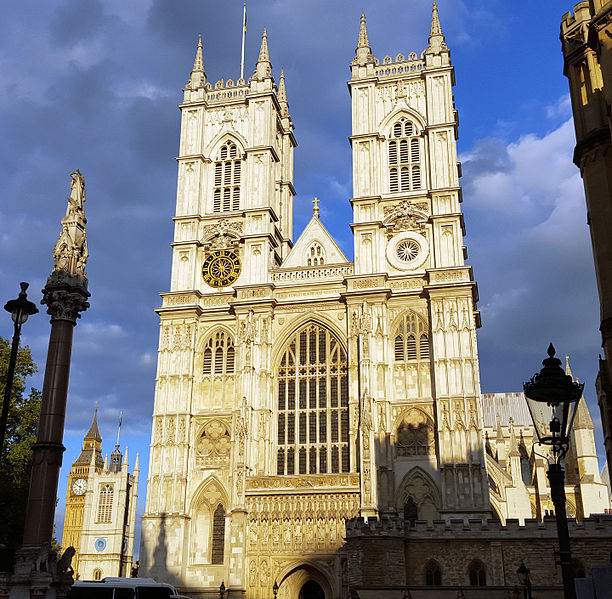
Westminster Abbey, West facade, by Bede 735
Whenever I set foot inside this ancient building. I see them all, from pious Edward through gallant Harold to the determined William. In my head, I see Henry II come striding, power and energy surging round him. There is Richard and John, the rather ineffectual if artistic Henry III, Edward Longshanks and his beloved Eleanor. There is Edward III, surrounded by his wife and many children, to the side stands handsome Richard II, and just beyond the choir I catch a glimpse of Henry Tudor, wretched and bereaved now that his wife is dead. I see them all, in this place that all of them at some point in time visited, prayed in or maybe even despaired in. I see them all, so lost in my own imagination I only notice I’m holding up the traffic when one of the wardens gently moves me aside. From the expression on his face, I am not the only one to be so overcome. In Westminster Abbey, history brushes my cheek. No wonder I always have to go back!

~~~~~~~~~~~~~

Anna Belfrage is the author of the acclaimed  The Graham Saga. Set in 17th century Scotland, Virginia and Maryland, eight books tell the story of Matthew Graham and his wife, Alex Lind - two people who should never have met, not when she was born three centuries after him.

Presently, Anna is hard at work with The King’s Greatest Enemy, a series set in the 1320s featuring Adam de Guirande, his wife Kit, and their adventures and misfortunes in connection with Roger Mortimer’s rise to power. The first instalment, In the Shadow of the Storm, was published on November 1, 2015.

For more information about Anna and her books, please visit her website. If not on her website, Anna can mostly be found on her blog.

Saturday, October 3, 2015

Queen Emma - One of the Neglected Figures in English History

by Helen Hollick

This is part of an essay I wrote in 1997 for a history degree course at Birkbeck College, University of London. Unfortunately I never found the time to complete the degree!
The full, original essay is here:

The first chapters of the Norman conquest of England began in the spring of 1002, with the marriage of Emma of Normandy to Æthelred, King of the English. She was a daughter of Richard of Normandy, great grandfather of William I of England. Although of Scandinavian (Viking) descent, these "Northmen" were, by the early eleventh century, mostly Christian, and an alliance would prevent Vikings from using Norman ports from which to harass England. Henceforth, the Counts of Normandy would have a considerable interest in the English crown, with the ambition being that a son of Emma's would succeed to the throne. Two, Harthacnut and Edward, did rule, but both were childless, thus eliminating the prospect of Norman rule by direct succession. Considering that the alliance was to bring security from Viking raiders, it is ironic that when Æthelred died in 1016, Emma then married one of the most prominent Vikings of this period, Cnut, who conquered England and became King.

Emma became a queen who carved for herself a significant position within the political estate of England. Her first son, Edward, was born circa 1005 with a second son, Alfred, a year or so later. The succession to the throne however, was disrupted in 1013 by an invasion by Svein Forkbeard of Denmark and his son, Cnut. In the autumn, Emma and her sons, at her initiative, fled to Normandy soon followed by Æthelred himself.

In the spring of 1014 Æthelred dispatched ambassadors to England, with his young son Edward accompanying them, to negotiate a return to the English throne. Shortly after Æthelred's reinstatement, his son by a first (common-law) wife, Edmund Ironside, began to act independently of his father. Emma, it seems, was also dissatisfied with her husband’s failures, for she apparently transferred her support to Edmund. In the Encomium Emma Reginae (her biography written during her lifetime) Æthelred is not merely omitted as her husband, but his existence is significantly suppressed. Emma was a strong and determined women who knew her own mind, what she wanted, and was ruthless in her ambition to obtain it. It is doubtful that she would have chosen to ‘forget’ her first husband because of infidelity; more likely she was dissatisfied with his failures and weakness as a king.

A Hollow Crown cover
depicting the frontispiece of the Encomium
showing Emma, Harthacnut and  Edward
(fourth person unknown, possibly the Encomum's author)
Æthelred died in 1016. Edmund Ironside occupied the throne and withstood Cnut, with the boy Edward, who was possibly no older than thirteen, at his side. That Emma had deliberately sent her eldest son to be with his half-brother is typical of her character. Edward would have been too young to stand against Cnut on his own; her only chance of recovering her position, wealth, and estates would have rested on Edmund's success - with Edward as his successor. Unfortunately for Emma, Edmund died in 1016, and Cnut became King of England.

Cnut turned to securing his position and took Emma as his second wife in July 1017. He had a reputation of paganism and needed to establish his Christianity. The degree of involvement that Emma herself had in the betrothal negotiations is unknown, but she was certainly shrewd and politically wise. As Queen, Emma had acquired expertise in English politics, and marriage to her diverted support away from the two royal English sons, neutralizing them as potential opponents. The master plan of the sixth or seventh century usurper had three stages: murder the king, get the gold, marry the widow. Since the widow usually sat on the gold, the two went together.

Emma achieved a position of prominence under Cnut that she had not enjoyed under Æthelred. She benefitted from her second husband's control of three kingdoms, and by Cnut she had a third son, Harthacnut, reducing Æthelred's sons who were again in exile in Normandy to little more than pawns. When Cnut died in 1035, Harthacnut was ruling in Denmark, and Emma pressed for his succession, not Edward's. Harthacnut would retain for her, as King of England and Denmark, her wealth and status and would be more likely to receive support from the Angle-Danish aristocracy who had risen to power under Cnut. Her main ally proved to be Earl Godwine of Wessex. When Edward and Alfred arrived in England in 1036 to make a claim for the throne, there was virtually no support for either brother, including none from Emma herself.

Emma was a woman of considerable wealth and because of that, she held great political power. She held three types of property which would provide her with revenue. The possession of the royal treasury was crucial. It would contain essential royal documents, such as tribute lists, gold, silver, precious stones and weapons. Possibly also, the royal insignia. By having control of the treasury, Emma was able to attract - and hold - support. Harthacnut, however, remained in Denmark and when Godwine, the crux of Emma's success, unexpectedly switched sides to support Cnut’s illegitimate eldest son, Harold Harefoot, Emma fell swiftly from power and went, once again, into exile.

Harefoot died in 1039 which gave Harthacnut opportunity to renew his claim on England. It may have been during her exile that Emma commissioned the Encomium Emmae Regina to be written; a work of praise for herself and a demonstration that Harthacnut was the right choice as King of England. It shows that Emma was literate and of distinguished learning.

Harthacnut's reign was brief; he died in 1042. After all her struggles Emma must have been devastated; the crown passed to Edward, but it was of little comfort to her. For most of his life Edward had lived in exile in Normandy. His mother had abandoned him, and there was no love between son and mother. Soon after his consecration in 1043, Edward rode to Winchester to accuse Emma of treason and to dispossess her of lands and movables, although he stopped short at exile. According to the Anglo Saxon Chronicle, "They came unexpectedly upon the lady and deprived her of all the treasures …because she had been very hard to the king, her son...”

Whether by her own strength of character or her son's remorse, she was soon reinstated into favour, although at a lower scale. He took Earl Godwine’s daughter, Edith, as wife – although the marriage produced no children, and Emma retired to Winchester, an indication that her influence had decreased. She died on 6th March 1052 and was buried in the Old Minster, Winchester near Cnut and Harthacnut.

Post 1066 queens of England are discussed at length, appreciated or condemned, depending on their worth, while those of pre-Norman history are considerably neglected - even ignored. Emma was the only woman in British history to have been Queen twice, the wife of different ruling kings. This makes her unique. She was an intriguing woman, on a par with the later Eleanor of Aquitaine, and she has a significant place in English history.

Sources:
Pauline Stafford
Queens, concubines and Dowagers: The king's wife in the early middle ages
Henrietta Leyser
Medieval Women: A social history of women in England 450- 1500
Christine Fell
Women in Anglo-Saxon England
Frank Barlow
Edward the Confessor
Translator, Anne Savage:
 The Anglo Saxon Chronicles

~~~~~~~~~~

Helen Hollick is the author of A Hollow Crown (UK edition)/The Forever Queen (US edition). 
The Forever Queen was a USA Today bestseller.
Emma's story continues in Harold the King (UK title) / I Am The Chosen King (US title)

For more information  about Queen Emma : click here 

Buy the book in paperback or on Kindle: Amazon