Showing posts with label Lucinda Brant. Show all posts

Wednesday, September 19, 2012

Gorgeous Georgian Metrosexuals — or How to strut your Metrosexual Stuff in Georgian England

by LUCINDA BRANT


The term “metrosexual” was coined by Mark Simpson to describe a man (especially one living in an urban, post-industrial, capitalist culture) who spends a lot of time and money on his appearance. Urban Dictionary definition number 5 states: “A straight guy who’s so cool, smart, attractive, stylish, and cultured, that everyone thinks he’s gay. But he’s so secure in his masculinity that he doesn’t care.” Both these definitions can be applied to wealthy men in the 18th Century who had time and money to spare.
Throughout English (and French) history there have been men such as this but it wasn’t until the 1700s when the aristocracy and the upper echelons of the wealthier merchant middle class had the time and money that the metrosexual truly came into his own. Men aspiring to be gentleman spent as much time and money fussing about their looks and what to wear as did women, and the evidence is there in their clothes, daily practices and accoutrements.
With minor modification to Urban Dictionary’s definition of what it is to be a metrosexual today, here is my list (not definitive) of what it took for a gentleman in 18th Century England to be classified a Gorgeous Georgian Metrosexual.

You were "metrosexual" if:
  1. You employ a French hair stylist instead of a barber, because barbers don't do pomade and powder
  2. You own at least 20 pairs of shoes, just as many pairs of shoe buckles— some diamond encrusted, half a dozen pairs of gloves (in every shade), and you always carry in your frockcoat pocket an enameled snuffbox and a quizzing glass
  3. You aren't afraid to use padding in your stockings, if necessary, to enhance your male attributes. Strong, large calf muscles are a must. (What were you thinking I meant?)
  4. You cultivate white hands and polished nails; so necessary when taking a pinch of snuff and standing about showing off your calf muscles in mixed company
  5. You would never, ever, be seen in public without your cravat, same goes for hair powder when attending balls and routs
  6. You know and care just as much about dress fabrics, color and weave as your wife and are not afraid to share your expert opinion with anyone
  7. You don't rise before 11AM and then you sit around in your embroidered silk banyan and matching turban half the day sipping chocolate and sorting through cards of invitation
  8. You can't imagine life without your valet
  9. Despite being flattered (even proud) that gay guys hit on you, you still find the thought of actually getting intimate with another man unappealing

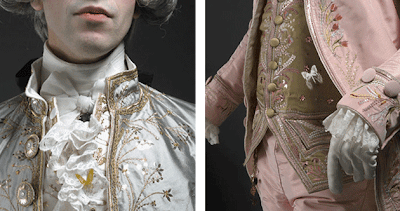
Thus for all your peacocking you are quintessentially male: You carry a sword and know how to use it, are good with your fists, love blood sports, shooting, horse racing and playing cards at your club with male chums. Dressed in a salmon pink silk embroidered frockcoat with matching silk breeches, old gold embroidered silk waistcoat, lace ruffles at your wrists to showcase your white hands, white clocked stockings to set off your massive calf muscles, an elaborately tied lace cravat, powder in your hair, a mouche at the corner of your mouth and wearing diamond buckled shoes with a heel, women swoon at the sight of you! Why? Because underneath that gorgeous metrosexual exterior is a real man just waiting to get his gear off!


Monday, July 16, 2012

The Wig Business was Big Business in 18th Century France

by LUCINDA BRANT

It is often assumed that the wig* of the 17th and 18th centuries was the preserve of the aristocracy, “an aristocratic ornament of Old Regime Europe”, a marker of high birth and status worn by the privileged few. Indeed, at the French Courts of Louis XIII and Louis XIV, wigs were very much part of the display of power and status.
[*Wig here refers to the wigs worn by men. Women’s hair is not discussed in this post.]

The full-bottom wigs worn by Louis XIV of France required ten heads of long human hair to achieve one luxuriant wig with an over-abundance of flowing locks. Cost consideration aside, how to wear such an article in every day life made it prohibitive to all but the most aristocratic fashion-conscious courtier.


Yet, by the end of Louis XIV’s reign in 1715, the wearing of wigs had spread throughout France. Surprisingly, wigs were not the exclusive preserve of noble courtiers but had “tumbled down the social hierarchy”, so far down in fact, that by the mid 1700’s wigs were upon the heads of tutors, bakers, messengers, servants, cooks and shopkeepers. All wore a wig, and often owned two—one for every day and one for Sunday best.

The Marquis of Mirabeau lamented, “Everyone [in Paris] has become a Monsieur. On Sunday, a man came up to me wearing black silk clothes and a well-powdered wig, and as I fell over myself offering him compliments, he introduced himself as the oldest son of my blacksmith or saddler; will such a seigneur deign to dance in the streets?”

The male wig became big business in the 18th century. It was no longer an aristocratic affectation, or worn only by certain non-aristocratic professional groups such as judges, lawyers and clergymen. The wig was not confined to men in the city but spread to towns and villages. As well as every town having a wigmaker or three, estimates put the number of journeymen who trudged the roads of rural France selling wigs at 10,000.


The account books of French wigmakers attest to a customer base that included not only the wealthy merchant citizens of the town but included priests, petty clerks, and shopkeepers, and in the death inventories of middle class citizens wigs figured as prominent possessions. The wig was such a universal object of consumption by mid century that it became synonymous not with luxury but with convenience. Wig advertisements stressed comfort and appeal as most important when considering the purchase of a wig. Wigmakers were keen to emphasize the free movement of the head of the 18th century wig. Unlike its predecessor, the full bottom wig, which restricted its wearer’s movements and peripheral vision, an 18th century wig permitted the wearer to carry out his daily life as if he was wearing his own head of hair, not someone else’s.

The Parisian wigmaker Neuhaus asserted that wearing a wig was far more convenient than looking after natural hair. Well, he would, wouldn’t he? He’s in the business of selling wigs! But he went to great lengths to ensure his customers felt comfortable in their wigs. He announced the invention of a new “elastic skin that grips the wig” without any irritating loops or garters, and “this skin has the softness of velvet, and does not at all inconvenience the head.”

In some respects, Neauhaus’s assertion regarding the convenience of the wig over a natural head of hair was true, given the prevalence of head lice, the lack of shampoo and intermittent bathing practices. It was far easier for a man to have his head shaved and wear a wig than to groom his own hair, particularly when, for a small fee, he could have his barber maintain his shaven head and have his wig serviced by his local wigmaker.


With wigs being the universal male consumer product of the 1700s, and everyone from shopkeeper to king wearing one, men were spoiled for choice. While a shop boy might only be able to afford one wig, and thus had to choose wisely and for durability, those of the one percent of the population, the nobleman and the wealthy cit, could afford to own dozens of wigs. If they considered themselves to be a leader of fashion, were eccentric, or merely had the money to indulge a whim, they could purchase wigs that others could only dream of owning (or not, as the case may be!).

It has often been assumed that every man wore a powdered wig, but this was not so. For everyday wear and for most occasions, men wore their wigs in their natural state, which was unpowdered natural hair. Only on the most formal of occasions, and those of the nobility attending court or a formal function, were wigs powdered. Another misconception is that because wigs looked like wigs (you could tell it was a wig!) then the wig must have been made from horsehair. Not so. All the evidence—portraits, surviving wigs, engravings, documents, letters—suggest that less than half of all wigs consisted of hair from horses, and from such animals as goats and cows. Most wigs were made from human hair. For the shop boy, however, the “horse-hair tie wig” was probably his only option.


There were a small number of wigmakers who were prepared to experiment with other materials, and often because of this found themselves ostracized by their fellow wigmakers. Yet, the experimental wig attracted the eccentric, the dandy and the jaded gentlemen. Looking for something different to make them stand out in the crowd or as a mark of their wealth, these gentlemen were not afraid to parade about society and garner the stares of amazement, incredulity and puzzlement of others about the hairpiece atop their heads.

Horace Walpole, that great 18th century letter writer and gossip, who collected fascinating tidbits about Society, wrote in a letter dated 1751, about Edward Wortley Montagu’s odd manner of dressing, commenting “that the most curious part of his dress, which he has brought from Paris, is an iron wig; you literally would not know it from hair...”.

Naturally, I just had to give one of my characters an iron wig and so the eccentric poet Hilary Wraxton in SALT BRIDE gets to wear one at a recital, causing hilarity and disruption to an afternoon’s entertainments.

Made from iron wire turned into spiral curls, such a wig could also be made of copper. While Edward Wortley Montagu may have thought he cut quite a figure in English society parading about in his iron wig, one wigmaker advertised an iron wig as being economical because it can “withstand rain, wind and hail, and all without causing discomfort to the wearer” (I wonder about that final claim).

Feathers were also used in the making of wigs, particularly sporting wigs. Wigs made from the tails of mallards or drakes were said to be not only durable but could also fight off the wet. Some parsons’ wigs employed feathers at the front and were known as “feather tops”. One can imagine the congregation doing its best to keep a straight face with a parson at the pulpit in a fine feather top wig delivering the Sunday sermon.

Most sectors of male society succumbed to the wearing of a wig in 18th century France. Testament to the wig’s universality was its necessity. Without a wig, a gentleman’s outfit was incomplete; he could not go about his daily business out in the world without his wig. Just as in the 21st century, a man’s business suit is not complete without a tie. An 18th century bewigged gentleman wished to project an air of elegance and refinement, no matter his station in life, and this is evidence in the many portraits that survive of handsome chaps in frockcoat, breeches and perfectly fitted wig, whether as part of a family group or in a singular pose, the wig helped maketh the man. As to the many styles created for the gentleman’s wig, that requires a whole other post!


Bibliography

John Woodforde, The Strange Story of False Hair, Routledge and Kegan Paul, London, 1971

Michael Kwass, Big Hair: A Wig History of Consumption in Eighteenth-Century France, American Historical Review, June 2006

The Letters of Horace Walpole, Vols. 1-4, Charles Duke Yonge (Ed), Putnam and Sons, London, 1890

Hair and Hair dos: http://www.marquise.de/en/1700/howto/frisuren/frisuren.shtml

The Hair at the Eighteenth Century: http://thehistoryofthehairsworld.com/hair_18th_century.html

The Eighteenth Century Garb Homepage: Handbook of English Costume in the Eighteenth Century by Willett & Phillis Cunnington: http://www.theweebsite.com/18cgarb/1750.html


Sunday, April 29, 2012

Political Meaning in 18th Century Nursery Rhymes (Part Two)

by LUCINDA BRANT

The relationship between nursery rhymes and actual historical events or persons is considered by many to be apocryphal but whether you believe there is a political connection or not, it is always fun to speculate! As I did in part one I examine four nursery rhymes popular in the Georgian era and the meaning behind the rhyme.


Georgie Porgie
 
Georgie Porgie pudding and pie,
Kissed the girls and made them cry
When the boys came out to play,
Georgie Porgie ran away

There are two contenders for the title of Georgie Porgie.  The first is George Villiers; Duke of Buckingham (1592-1628) the bisexual lover of James I. George was a very good-looking lad with highly suspect morals. He did not confine his sexual favors to the king but had affairs with many of the ladies at court, as well as the wives and daughters of powerful nobles. It is also believed he used his privileged position with the King to force his attentions on unwilling ladies. He “ kissed the girls and made them cry” and managed to avoid prosecution or retaliation “when the boys came out to play, Georgie Porgie ran away”. Villiers notorious affair with Anne of Austria, Queen of France, injured both their reputations and was written into Alexander Dumas’ novel The Three Musketeers. Villiers liaisons and political scheming were questioned in the English Parliament who finally put a stop to James I intervening on his young lover’s behalf.

Caricature of George IV as the Prince of Wales 

 The second contender for the title of Georgie Porgie, and the one I prefer, is none other than the last of the Hanoverian Georges, “I’m the Fat One” (to quote Horrible Histories), the Prince Regent and subsequently George IV (1820-1830).

In later life, George was not just fat he was grossly obese. He gave huge banquets and drank to excess. Although he was described as the “First Gentleman of England”, is credited with championing the Regency style of clothing and manners, was considered clever and knowledgeable, Georgie Porgie highlights his worst traits. His laziness and gluttony led him to squander his abilities.

He spent whole days in bed and his extreme weight made him the target of ridicule hence the reference to “pudding and pie”. By 1797 he weighed in at 245 pounds (111kg) and by 1824 the waist of his corset was 50 inches (127cm).

George had a notorious roving eye. His checkered love life included several mistresses, illegitimate children and bigamy. Beautiful women invited to dine with the King were warned not to find themselves alone for George was not above taking liberties with his female guests. He “Kissed the girls and made them cry”. He was also considered a coward by those who knew him well, thus “When the boys came out to play, Georgie Porgie ran away”. A senior aide to the king recorded in his diary that, "A more contemptible, cowardly, selfish, unfeeling dog does not exist... There have been good and wise kings but not many of them... and this I believe to be one of the worst." The Times once wrote, George preferred "a girl and a bottle to politics and a sermon."


Jack and Jill

Jack and Jill went up the hill
To fetch a pail of water;
Jack fell down and broke his crown,
And Jill came tumbling after.


Kilmersdon, a village in Somerset has claimed the rhyme as their own and there is a set of stone tablets along a path up to a well at the top of the notorious hill. The village claims that during 1697, a young unmarried couple courted up on a hill, away from the prying eyes of the village. Fetching a pail of water was a ruse. Jill became pregnant, and just before she gave birth, Jack “fell down and broke his crown”; he was killed by a hit to the head from a rock. Days later, “Jill came tumbling after”, dying in childbirth.


This could well be true, and could only help boost tourist numbers to Kilmersdon. However, the rhyme was not published until the 1700s. While 1760 is touted as the year of publication, there are those who contend the actual date was closer to 1795. The latter date would tie in nicely with the theory that the protagonists Jack and Jill are in fact the ill-fated French royal couple Louis XVI and his Queen Marie Antoinette who were both guillotined in 1793.

 “Up the hill” is said to represent Louis XVI’s ascension to the French throne in 1774. Jack falling down is reference to the French Revolution and Louis being arrested and charged with treason. He “broke his crown” when he was guillotined in January 1793, and Marie Antoinette (Jill) soon followed when she “came tumbling after” and was guillotined in October of the same year.

 
Execution of Louis XVI


There Was an Old Woman Who Lived in a Shoe
 
There was an old woman who lived in a shoe
She had so many children, she didn't know what to do;
She gave them some broth without any bread;
Then whipped them all soundly and put them to bed.


 The old woman is said to refer to the English Parliament and the shoe itself is England. It is said that if you look at a map of Great Britain and turn it 90 degrees clockwise it resembles a shoe (!). By the mid 1700s England is considered an “old woman” by its colonies, particularly the American colonies, set in her ways and intractable. Her many children are said to represent the English colonies, young, growing and inquisitive. “Some broth without any bread” and then a whipping before bed, refers to the piecemeal and violent way the English Parliament dealt with colonials and their problems; in the same way a harsh parent treats a child considered wayward and naughty. The dismissal, and subsequent harsh treatment, of the very real problems faced by the American colonists eventually led to the American Revolutionary War.


Jack be Nimble

Jack be nimble,
Jack be quick,
Jack jump over
The candlestick.


There is consensus amongst historians as to the identity of Jack being the notorious pirate Black Jack Smatt who lived at Port Royal, Jamaica during the latter half of the 17th Century. Port Royal was known as “The Wickedest City on Earth”, until razed by an earthquake in 1692, at which time Jack and his fellow pirates were heard of no more. Yet, his legend lived on well into the Eighteenth Century and the printing of the first Mother Goose nursery rhymes. Jack Smatt was nimble and quick—he evaded capture by the British authorities, and he was never tried for piracy because he had the knack of getting himself out of a “hot spot” (represented by Jack jumping over a candlestick). Black Jack Smatt lives on in the 21st century consciousness as the Eighteenth Century pirate Captain Jack Sparrow of the Pirates of the Caribbean movies, fabulously portrayed by the wonderfully talented Johnny Depp.


Bibliography

Baker, K (2005), "George IV: a Sketch." History Today, 2005 55(10): 30–36.

Clarke, John (1975). "George IV". The Lives of the Kings and Queens of England (Knopf): 225

Collcutt, D. (2008) Why does the Weasel go Pop, the secret meaning of our best-loved nursery rhymes

George IV of he United Kingdom

Miss Cellania, (2011) Who Was the Real “Georgie Porgie”?

Nursery Rhymes—Lyrics, Origins & History

Nursery Rhymes as Mother Goose Knows Them


Saturday, March 31, 2012

Child’s Play ...or is it?

Political meaning in 18th Century nursery rhymes (part one)

by LUCINDA BRANT


Nursery Rhymes are the first poems and songs children learn, generally before they go to school. They help broaden vocabulary, with learning to count, and to sharpen memory. They are nonsense and hold no more meaning than what is intended within the rhyme. Nonsense? That’s all well and good for children to believe, but we adults know better, don’t we? Or do you?

Of course they are not meaningless, nor are they nonsense (not if you are the intended target). In this post I’ll focus on three nursery rhymes from the Georgian era: Humpty Dumpty, The Grand Old Duke of York, and my all-time favorite Who Killed Cock Robin?


Humpty Dumpty

Humpty Dumpty sat on a wall,
Humpty Dumpty had a great fall.
All the King's horses, And all the King's men
Couldn't put Humpty together again!


There are several theories as to the origin of Humpty Dumpty and from my research the most popular is that Humpty Dumpty was a large canon used during the Civil War to defend the town of Colchester. A walled town with a castle and several churches, it was a Royalist stronghold. The Parliamentarians (Roundheads) aimed at the wall on which Humpty Dumpty sat and caused the Royalist cannon to fall and eventually the Royalists were beaten. The Siege of Colchester lasted for 11 weeks 13 Jun 1648–27 Aug 1648.

However, the rhyme wasn’t published until 1810 in Gammar Gurton’s Garland, where there is no mention of the King’s men or his horses:

Humpty Dumpty sate [sic] on a wall,
Humpti Dumpti [sic] had a great fall;
Threescore men and threescore more,
Cannot place Humpty dumpty as he was before.


This first published version leads to the more obscure theory (I can’t find a reference anywhere, and I would like to claim it as my own but alas I think one of my history teachers told me) that Humpty Dumpty is not a canon at all but a specific person. I believe it refers to King George the Third and that the rhyme is about his mental illness.


Humpty Dumpty sits on a wall—this makes him higher than anyone else, alluding to his kingly status. There was no one higher in England’s Georgian society than the King. He has a great fall—George the Third had several bouts of mental illness. Threescore men and threescore more —that’s 120 men! This suggests that it made no difference to the King’s condition how many men were called to attend on him, they cannot place Humpty as he was before—the King’s mental illness cannot be cured and thus he can no longer rule as king.

Life will never be the same again, for King George or his subjects. As a consequence of the King’s mental illness, the Prince of Wales becomes Prince Regent. The date of the rhyme’s first publication, 1810, is significant, and perhaps no mere coincidence, because this was the year the Regency was established and the Prince of Wales became Prince Regent.

George the Third was not the only one in his family to be represented in a Nursery Rhyme. His second son, Prince Frederick, the Duke of York and Albany was also the subject of a rhyme that satirized his abilities as a military field commander.


The Grand old Duke of York

The Grand old Duke of York
He had ten thousand men
He marched them up to the top of the hill
And he marched them down again.
When they were up, they were up
And when they were down, they were down
And when they were only halfway up
They were neither up nor down.


Of course there are those who contend that it is not Frederick the Nursery Rhyme is about but another old Duke of York, Richard, claimant to the English throne and Protector of England during the Wars of the Roses, and the battle of Wakefield on 30 December 1460. Richard marched his army to his castle at Sandal, built on top of the site of an old Norman motte and bailey fortress. Its massive earthworks stood 33 feet (10m) above the original ground level, and so he marched them [his soldiers] up to the top of the hill. Then, in what many scholars believe to be a moment of madness, he left his stronghold in the castle and went down to make a direct attack on the Lancastrians and so he marched them [his soldiers] down again. Richard’s army was overwhelmed and he was killed.


The theory I prefer involves Prince Frederick, Duke of York and Albany, the second and favorite son of King George III and Commander-in-Chief of the British Military throughout the Napoleonic Wars. The Grand old Duke of York is said to refer to his fighting in Flanders in 1793. The Duke won a cavalry conquest at Beaumont in the April of 1794 and then was roundly defeated at Turcoing in May and recalled to England. The "hill" in the rhyme is the township of Cassel, built on a mount that rises 176 meters (about 570 feet) over the otherwise level lands of Flanders in northern France. Though he was a bad field commander, Frederick was a competent military organizer who raised the professional level of the army, playing a significant behind-the-scenes role in the Duke of Wellington's victories in the Peninsular War. The Grand old Duke of York also founded Sandhurst College.


Who killed Cock Robin?


And finally there is my all-time favorite nursery rhyme: Who Killed Cock Robin? There is no mystery here, no rhyming for the sake of it as with other children’s rhymes we would recite without really knowing what they were about. The sparrow confesses at once, and those animals gathered around poor dead Robin, offer in one way or another to help with his burial. There are versions of Who Killed Cock Robin? in German and Norwegian, and some scholars suggest that the poem is a parody on the death of William Rufus, who was killed by an arrow in the New Forest (Hampshire) in 1100. (4)

The earliest written record for this rhyme is in Tommy Thumb's Pretty Song Book, which was published c.1744, with only the first four verses being printed. Speculation is that 'Cock Robin' refers to the political downfall of Sir Robert Walpole, Robin being a diminutive of Robert. Walpole was First Lord of the Treasury and England’s first Prime Minister and his government was toppled in 1742. Walpole had many enemies and Who Killed Cock Robin? was a taunt to his downfall.


The extended edition wasn’t printed until 1770 and it’s this extension of the poem that has lead to speculation that Who Killed Cock Robin? in its entirety was written to inform the eighteenth century child as to what occurs after someone dies, so that they are familiar with the burial process. After all, at this time, most burials occurred at night when most people, particularly children, were in their beds so that there was no fear of the spread of disease as the body was transported to the graveyard.

"Who killed Cock Robin?"
"I," said the Sparrow, "With my bow and arrow, I killed Cock Robin."
"Who saw him die?"
"I," said the Fly, "With my little eye, I saw him die."
"Who caught his blood?"
"I," said the Fish, "With my little dish, I caught his blood."
"Who'll make the shroud?"
"I," said the Beetle, "With my thread and needle, I'll make the shroud."
"Who'll dig his grave?"
"I," said the Owl, "With my little trowel, I'll dig his grave."
"Who'll be the parson?"
"I," said the Rook, "With my little book, I'll be the parson."
"Who'll be the clerk?"
"I," said the Lark, "If it's not in the dark, I'll be the clerk."
"Who'll carry the link?"
"I," said the Linnet, "I'll fetch it in a minute, I'll carry the link."
"Who'll be chief mourner?"
"I," said the Dove, "I mourn for my love, I'll be chief mourner."
"Who'll carry the coffin?"
"I," said the Kite, "If it's not through the night, I'll carry the coffin."
"Who'll bear the pall?
"We," said the Wren, "Both the cock and the hen, we'll bear the pall."
"Who'll sing a psalm?"
"I," said the Thrush, "As she sat on a bush, I'll sing a psalm."
"Who'll toll the bell?"
"I," said the bull, "Because I can pull, I'll toll the bell."
All the birds of the air fell a-sighing and a-sobbing,
When they heard the bell toll for poor Cock Robin.

And on that cheerful note, I’ll be uncovering the meaning behind a few more favorite Nursery Rhymes in my next post but until then, next time you recite a Nursery Rhyme, look for the hidden meaning!


Bibliography

Alchin, L.K. Rhymes.org.uk (Nursery Rhymes lyrics and Origins) Retrieved March 2012 from www.rhymes.org.uk Harrowven, J. The origins of rhymes, songs and sayings (Kaye & Ward, 1977), p. 92.

Cock Robin

The Grand Old Duke of York

The Real Meaning of Nursery Rhymes

Smith, A. Grand Old Duke: The greatest scandal never told, The Independent


Tuesday, January 31, 2012

Madness in their Method: Water therapy in Georgian and Regency times


by Lucinda Brant

Using water to treat illness, known today as Hydrotherapy, is a practice dating back to Ancient Egypt. Greek and Roman historians also mention the use of water in the treatment of muscle fatigue, hydrophobia and fever. Using water therapy as a psychiatric tool is attributed to Jean Baptiste Van Helmont’s massive medical tome the Ortus Medicinae published in 1643 and translated into English by John Chandler in 1662. [1]

Van Helmont advocated water immersion therapy in the treatment of mental illness. The patient was fully immersed in cold water until the point of unconsciousness, and thus at the point at which the patient could drown, because he believed near death immersion in cold water could “kill the mad idea” which caused mental derangement. [3]


Naturally, this was a very dangerous technique and never became widespread. However, Van Helmont’s staunch belief in using water as a treatment for mental illness was taken up by various medical institutions and practitioners across Europe so that by the 18th Century the “water-cure” in its various forms became one of a number of standard treatments used by physicians and insane asylums when dealing with all manner of psychiatric conditions.


The two main types of water cure were the douche or cold shower and the balneum or bath. The douche required cold water be poured over the patient’s head or sprayed at the patient’s body to cool the heat of madness if insane, or rouse the depressed if suffering from melancholia. The bath was used to calm overwrought nerves and to encourage sleep. In the early years of this type of therapy, most cures were performed out of doors near a source of water—the sea or a pond. This allowed for public viewing. However, as asylums, both public and private, became more widespread in the 18th Century, water cures were moved indoors. Inside and away from the public eye and an immediate source of water, so institutions and their practitioners developed inventive ways and a wide variety of apparatuses to deliver water therapy to the mad and melancholic. [1]

There were cold shower rooms, bath boxes that shut patients in, shower contraptions that delivered water at intervals via a system of pulleys and levers, dunking devices that immersed patients at regular intervals into small ponds as the device rotated and turned on a giant cogs, and there was the simple ladder and bucket method that involved the patient sitting in a wooden barrel while behind a screen attendants ran up and down ladders with buckets of water that they poured onto the patient’s head from a great height. And then there was “the chair”:

"I have contrived a chair and introduced it to our [Pennsylvania] Hospital to assist in curing madness. It binds and confines every part of the body. By keeping the trunk erect, it lessens the impetus of blood toward the brain. By preventing the muscles from acting, it reduces the force and frequency of the pulse, and by the position of the head and feet favors the easy application of cold water or ice to the former and warm water to the latter. Its effects have been truly delightful to me. It acts as a sedative to the tongue and temper as well as to the blood vessels. In 24, 12, six, and in some cases in four hours, the most refractory patients have been composed. I have called it a Tranquillizer"
(Rush to James Rush, The Letters of Benjamin Rush, Princeton University Press, 1951) [1,3]


By the mid 18th Century water therapy had become a standard treatment in the “mad doctor”’ medical bag. Yet, in this Age of Enlightenment, when many people came to view the shackling of the mad as inhumane, there were those physicians who advocated the use of water therapy not only as a cure but as a more humane means of coercion, thus doing away with the need for physical restraints. Thus water therapy was not only used on the mad and those suffering from depression, it was used by some physicians in the good-natured belief that it would persuade patients who had veered from the path of what society viewed as “normal” behavior to “get back on track”. [2, 3]

Thus water therapy was used by some physicians as a means of treating married women who had become “mildly distracted” and had opted out of their marital responsibilities (i.e. didn’t want to have sex with their husband). One such practitioner who used the method to sadistic effect was Patrick Blair, a physician who is the model for Sir Titus Foley in my novel AUTUMN DUCHESS, a dandified and well-respected physician whose medical forte is treating females for melancholia. When Antonia Dowager Duchess of Roxton is seen to be excessively melancholy and is still wearing mourning three years after the death of the Duke, her loving son is at his wits end and he instructs Sir Titus to treat his mother, little realizing that part of his treatment is the use of water therapy.


Patrick Blair had his female patients blindfolded, stripped and strapped to a bathing chair. The woman was then subjected to 30 minutes of water being sprayed directly into her face. When the woman refused to agree to return to the marital bed, Blair went one step further and repeated the treatment for 60 minutes, then 90 minutes and when she promised obedience Blair allowed her to sleep. Yet, the next day, sensing the woman was “sullen” and probably had only agreed because of the treatment, he again had her strapped to the chair and subjected to the treatment at intervals over the next two days. Finally, exhausted after such physical and mental torture, the woman succumbed and agreed to become a “loving and obedient and dutiful wife forever thereafter”. To make certain she did, Blair visited her at her home a month later and was happy to report “everything was in good order”. [4]

Thankfully Blair’s sadistic treatment of his female patients was not the norm. Yet, most physicians, indeed most people in the 18th and early 19th Centuries viewed water therapy in its various forms as an acceptable means of coercing, treating, and hopefully curing patients with various mental, melancholic and recalcitrant afflictions.


SOURCES
  1. Annual Report to the Friends (July 2005 – June 2006) The Institute for the History of Psychiatry, Cornell University, New York.

  2. Porter, Roy. Blood and Guts, A Short History of Medicine, Allen Lane, London 2002.

  3. Scull, Andrew. Social Order/Mental Disorder; Anglo-American Psychiatry in Historical Perspective. Berkeley. University of California Press 1989.

  4. Porter, Dorothy and Porter, Roy. Patient’s Progress: Doctors and Doctoring in Eighteenth-century England. Stanford University Press, Stanford California 1989.
Note: Water treatment images sourced and adapted from [1].

Saturday, November 19, 2011

Tutti-Fruitti Georgian Beauty

by LUCINDA BRANT

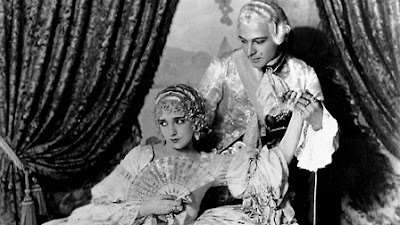
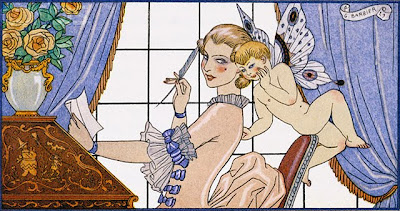
The great French illustrator George Barbier is best known for his wonderful haute couture fashion illustrations of the 1920s through his collaboration with such ‘20s luminaries as Ertè, with whom he designed sets and costumes for the Folies Bergère. Barbier was born in the French seaport city of Nantes in 1882, and it is supposed that the city’s baroque and rococo architecture and its art museums housing works by that archetypal Eighteenth Century painter Antoine Watteau influenced young George’s aesthetic sensibilities. He rose to prominence at age 29 with his first exhibition and was thereafter given commissions to design ballet and theater costumes, illustrate books, and provide fashion illustrations for various magazines and journals. Barbier even designed sumptuous movie costumes, possibly his most famous being for the silent film with an Eighteenth Century French setting (but very much filtered through the lens of a 1920s sensibility) Monsieur Beaucair starring acting legend and heartthrob Rudolph Valentino in the lead role.


It is Barbier’s whimsical and tutti-fruitti (think tri-pastel colored ice cream) vignettes of pre- revolutionary Eighteenth Century French high society, in drawings and costume design, to which I am drawn and to which I turn for inspiration when creating particularly flamboyant characters such as the self-important Versailles courtier the Comte de Salvan in NOBLE SATYR or the vainly beautiful but thoroughly repellant Diana Lady St. John in SALT BRIDE. These characters have the outward appearance and rich trappings of their class in dress, style and mannerisms. To the outside world and to the members of their own order they display themselves to perfection while beneath the froth of lace, powdered beribboned hair and exquisite silks and velvets there is a thoroughly self-centered and unprincipled individual who will do whatever it takes to win, even murder.

Looking at Barbier’s tutti-fruitti illustrations you are immediately struck by their flamboyance and theatricality. Historical accuracy is not the point. Mood and atmosphere is everything. And Barbier does a wonderful job at evoking the sense of extravagance, pleasure-seeking and strike-a-pose mentality of the French aristocracy before the French Revolution. We are drawn to the billowing soft silk gowns, pretty feminine faces under outrageous hairdos, the wide skirts and intricate patterns of the male frockcoat, and of course the quintessential accoutrements of the fop and the hostess, clocked stockings, powdered hair and fluttering fan.


Think of Eighteenth Century French society as akin to a good beer (or cappuccino!) with a nice head of froth; the Aristocracy was that froth, the light-as-air top layer lacking substance and when gently prodded reveals a darker and much murkier depth and the reality of life for the majority of society at that time: hard, short and despotic, with poverty so ingrained that a life of choice and opportunity was the stuff of wildest fantasy. Okay, forget the beer analogy—not a very satisfying drink after all. But...

We do love the froth! Eighteenth Century French society just isn’t the same without the frolicking foibles and frothy fashions of its elite.

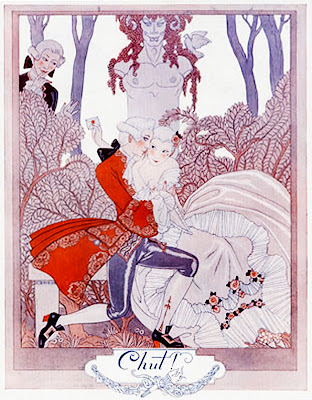
And they don’t come much frothier than Barbier’s stylized illustrations of the French aristocracy. Yet, if you linger over these whimsical drawings, look beyond the exuberant playfulness, and dare to peel away an embroidered frockcoat or two, you discover the unprincipled individual! Often, Barbier does not even hide what he wants you to discover, such as in the illustration entitled Chut! (Adultery). A young married couple embraces on a stone bench in a park and there in the foliage awaits the wife’s lover to whom she is passing a note, unbeknownst to her husband, under the watchful eye of a grinning goat-horned Bacchanalian male statue—surely a reference to the fact the young husband is being cuckolded.


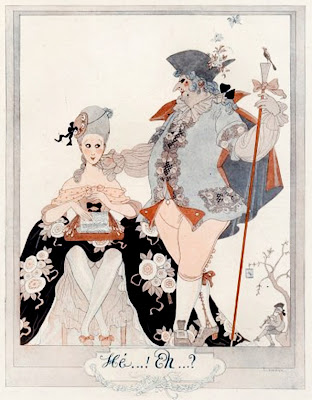
What about the illustration Hé...! Eh...? (The Lace Maker). A pretty young thing is admired by a pompous gentleman, fat fingers under her chin, his cane, corpulence and rouge proclaiming the old roué. That she has her petticoats up to her knees showing off her stockinged legs is scandalous—not so much as a calf was glimpsed of a virtuous female’s leg—which perhaps suggests the mercenary and practical nature of the young lace maker. Taking the old roué as a lover would surely free her from the drudgery and mundanity of her existence and propel her to a life of luxury and idleness those not belonging to the aristocracy could only dream about.


Perhaps it is no surprise then that George Barbier was commissioned to illustrate an early (and now extremely valuable) 1930s two-volume edition of Choderlos de Laclos’ Les Liaisons Dangereuses: The story of two aristocratic rivals, ex-lovers locked in a game of sexual one-upmanship who use sex as a means to humiliate and ruin others. Viewed individually and without the epistolary novel’s commentary Barbier’s illustrations are titillating pieces of eighteenth century theatrical fluff but put in context, the drawings become intriguing, the tutti-fruitti evocation slightly sinister knowing the fates of the Marquise de Merteuil, Madame de Tourvel and the Vicomte de Valmont.


So next time you stop to admire one of George Barbier’s Eighteenth Century flights of fancy, take a minute longer to look beyond the obvious. You may be surprised by what you discover!


SOURCES
  1. George Barbier in Wikipedia
  2. George Barbier Rediscovered by Roderick Conway Morris, International Herald Tribune
  3. Clothing and Fashion Encyclopedia
  4. The Fashion Historian