Showing posts with label Frederick Duke of York. Show all posts

Tuesday, July 17, 2012

The Notter-in-Laws of George III

George III
When we research the Regency Era we have to take in account the monarchs and royals. The Regency itself is of course the ten years during the worst madness of George III, from 1811 to 1820 in which his son reigned in his place. After which George IV ruled for ten more years, till 1830, in his own name. He was followed by his brother William, for seven years.

And then Victoria came to the throne. The daughter of the fourth son of George III.

George III had 9 sons, though, two dying in infancy, Octavius and Alfred. Of the other seven, four had mistresses that were of very long duration. These mistresses and the marriages are worth examining.

Queen Charlotte
Only four though are we concerned with, of the seven which grew to adulthood.

Of those seven, four maintained long relationships with women whom they so cherished and with whom they consorted that the ladies were as wives to them. George, Frederick, William, and Edward had relationships that were of such strength, or in fact were marriages, that the women cannot be ignored.

And if by example, or by coincidence so many of the first circle of the Ton also carried on affairs, these royals' relationships need to be examined. We can’t ignore it in our Regencies. To forget that one of the Princes was really shacked up with one of these ladies would put our tales out of the context of the times.

So we need take a look at our Princes and their mistresses.

George IV
George IV
His mistress/wife Maria Fitzherbert from 1785 to 1794, and then from 1798 to the 1820’s, though he was married to Princess Caroline of Brunswick-Wolfenbüttel.

We all should know that Geroge did not like the bride he took to secure the payments of his debts (600,000 pounds or about 1.2 billion in todays reckoning) and achieve the allowance he desired, a woman to whom he was only dedicated for a few short years until the birth of his beloved Charlotte. Three days after which he wrote a new will giving all to Mrs. Fitzherbert.

For over 30 years Mrs Fitzherbert and the Prince were together, and when asked directly if she had ever had children of the Prince and King, she coyly changed the topic of conversation to something else. And never would she sign a statement saying she had not had children.

Maria Fitzherbert
Maria had been married twice before she met and married George. It is fairly well documented that now she had proof that the two did get married secretly. She was the granddaughter of a Baronet and niece of an Earl. Her first husband was Edward Weld who died 3 months after the marriage and left her with nothing. Then she married Thomas Fitzherbert who died in 1781, but left her with 1000 pounds (about 2 million dollars) and a town house in Park Street, in Mayfair.

She married George, Prince of Wales at the time, on December 15, 1785. George paid the debts of Reverend Robert Burt to get him out of the Fleet Prison to perform the ceremony. It was not a legal marriage for the marriages act of 1772 forbade George to marry without the approval of the King and his Privy Council. If it had been legal, George would never have become king. So an interesting conundrum. But it did mean that the two acted as if they were married for a number of years.

Princess Caroline of Brunswick-Wolfenbütte
Thirty of more years, with the minor interruption of Princess Caroline. An interruption that began with a letter on June 23rd 1794 and then ended with a reconciliation during the summer of 1798. Their final separation came in the early years when he began to reign as George IV. At his death though, it was discovered that George had kept all her letters.

William IV, finding the truth in the assertions of the marriage, offered to make Mrs. Fitzherbert a Duchess, but instead she just asked to wear widows’s weeds and dress the servants in royal livery. She died in 1837.


Frederick, Duke of York and Albany
His mistress was Mary Anne Clarke from 1803 to sometime between 1809 and 1811; he then married Princess Frederica of Prussia.

Mary Anne Clarke
Of the four major mistresses that the princes had, Mary Anne is my least favorite and she should have been so much better able to have held onto her position than the others. She was first wed before she was eighteen to a stonemason. She was the daughter of a tradesman. Her husband went bankrupt and she left the man. She had several liaisons so that when she met the Duke, in 1803, she was well established as a courtesan.

Princess Frederica of Prussia
Frederick set her up in a fashionable residence. He was the Commander-in-Chief of the army, the ultimate reason for her downfall. She could not resist selling commissions in the army to support their lavish lifestyle. After she admitted this to the House of Commons, the Duke was forced to resign his post. Later it was found that he had no knowledge of the sales. Yet he surely knew that he spent money and allowed her to do so and that they were living beyond his allowance.

But then the money must have grown on trees. The Duke cut all ties to the woman, though he paid her a large sum of money so she would not publish letters he had written her. Then, when he was exonerated, he was reinstated as Commander-in-Chief of the army by the Prince Regent, his elder brother.

Mary Anne was later tried for libel and imprisoned. Her daughter by the Stonemason would marry Louis-Mathurin Busson du Maurier. Her grandson was the caricaturist George du Maruier and great-granddaughter was Daphne du Maurier.

William IV, also Duke of Clarence
His mistress, Dorothea Jordan who he lived with for twenty years and gave him ten children.  He then married Adelaide of Saxe-Meiningen.

This is my favorite of the mistresses for with ten children, this was a true marriage between successful people. Dorothea Bland was the daughter of stagehand and an actress, theater people, and when thirteen, her father left her mother and four other siblings for another actress.

Dorothea Jordan
Dorothea thus went into the family business and became famous, known to have the most beautiful legs on stage of the day. There was no Mister Jordan, as the other ladies of the royals were married prior to catching a Prince. She did have an affair with the manager of the Theater Royal, Cork, Richard Daly and had a daughter when she was twenty, named Frances.

Then in England, she had an affair with an army Lieutenant named Charles Doyne. He proposed but she went to work for the theater company operated by Tate Wilkinson. This is when she took the name Mrs. Jordan. After Wilkinson, she had an affair with George Inchbald. She would have married Inchbald, but he did not ask. In 1786, she began an affair with Sir Richard Ford, who promised to marry her. They had three children together. When she realized that Ford was never going to wed her, she traded up to William.

She began her affair with William in 1791 and moved in with him at Bushy House.
Bushy House

Adelaide of Saxe-Meiningen
They raised their ten children there for the next twenty years. Sounds like a marriage to me. After twenty years they separated and William gave her a yearly stipend. She raised the girls and he took custody of his sons. For his dignity, he asked that she not return to the stage to continue to receive her stipend. When one of her son-in-laws came into debt and needed funds, she did return to the stage to raise the necessary monies. William then cut her off and took back care of their daughters.

Now broke, she fled to France in 1815 and died a year later in poverty. Her descendants include many of the famous. One is David Cameron, Prime Minister of the United Kingdom as of this posting.


Edward, Duke of Kent and Strathearn

His mistress for twenty-eight years was Julie de St. Laurent, until he then married 1818, Princess Victoria of Saxe-Coburg-Saalfeld, who became the mother of Queen Victoria.

Julie de St. Laurent
Princess Victoria of Saxe-Coburg-Saalfeld
The Duke had several mistresses but for twenty-eight years he was enamored of Thérèse-Bernardine Montgenet or Julie de St. Laurent. It is suggested that the two met in Geneva in 1791. She then joined the Duke in Gibraltar. When King George learned of this, he sent Edward to Canada, and Julie followed again to Quebec City. In 1803, the Duke moved back to London and she took up in a small house in Knightsbridge. There are several rumors about sons born to the Duke who would obviously have been older than Victoria.  There were also rumors that a wedding occurred that was morganatic, though any marriage would be contrary to the Marriages Act of 1772.

The circumstances of the Duke of Kent and his mistress provide perhaps the best material should a writer wish to turn the Regency on its head with a fantasy. Their first son is rumored to have been born in 1793 and the second in 1794. When Prinny assumed the throne as Regent in 1811, the boys would have been eighteen and seventeen. Or when he came to the throne in his own right in 1820, twenty-seven and twenty-six. Young men!


While doing research I came across paintings of the other sons and their wives:

 Ernest Augustus

 Augustus Frederick


Adolphus

And then there are the princes who died in infancy:


* * *

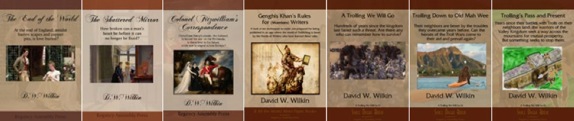
Mr. Wilkin writes Regency Historicals and Romances, Ruritanian (A great sub-genre that is fun to explore) and Edwardian Romances, Science Fiction and Fantasy works. He is the author of the very successful Pride & Prejudice continuation; Colonel Fitzwilliam’s Correspondence. He has several other novels set in Regency England including The End of the World and The Shattered Mirror. His most recent work is the humorous spoof; Jane Austen and Ghosts.

The links for all locations selling Mr. Wilkin's work can be found at the webpage and will point you to your favorite internet bookstore: David’s Books, and at various Internet and realworld bookstores including the iBookstore, Amazon, Barnes and Noble, Smashwords.


He is published by Regency Assembly Press
And he maintains his own blog called The Things That Catch My Eye


You also may follow Mr. Wilkin on Twitter at @DWWilkin
Mr. Wilkin maintains a Pinterest page with pictures and links to all the Regency Research he uncovers at Pinterest Regency-Era

Saturday, March 31, 2012

Child’s Play ...or is it?

Political meaning in 18th Century nursery rhymes (part one)

by LUCINDA BRANT


Nursery Rhymes are the first poems and songs children learn, generally before they go to school. They help broaden vocabulary, with learning to count, and to sharpen memory. They are nonsense and hold no more meaning than what is intended within the rhyme. Nonsense? That’s all well and good for children to believe, but we adults know better, don’t we? Or do you?

Of course they are not meaningless, nor are they nonsense (not if you are the intended target). In this post I’ll focus on three nursery rhymes from the Georgian era: Humpty Dumpty, The Grand Old Duke of York, and my all-time favorite Who Killed Cock Robin?


Humpty Dumpty

Humpty Dumpty sat on a wall,
Humpty Dumpty had a great fall.
All the King's horses, And all the King's men
Couldn't put Humpty together again!


There are several theories as to the origin of Humpty Dumpty and from my research the most popular is that Humpty Dumpty was a large canon used during the Civil War to defend the town of Colchester. A walled town with a castle and several churches, it was a Royalist stronghold. The Parliamentarians (Roundheads) aimed at the wall on which Humpty Dumpty sat and caused the Royalist cannon to fall and eventually the Royalists were beaten. The Siege of Colchester lasted for 11 weeks 13 Jun 1648–27 Aug 1648.

However, the rhyme wasn’t published until 1810 in Gammar Gurton’s Garland, where there is no mention of the King’s men or his horses:

Humpty Dumpty sate [sic] on a wall,
Humpti Dumpti [sic] had a great fall;
Threescore men and threescore more,
Cannot place Humpty dumpty as he was before.


This first published version leads to the more obscure theory (I can’t find a reference anywhere, and I would like to claim it as my own but alas I think one of my history teachers told me) that Humpty Dumpty is not a canon at all but a specific person. I believe it refers to King George the Third and that the rhyme is about his mental illness.


Humpty Dumpty sits on a wall—this makes him higher than anyone else, alluding to his kingly status. There was no one higher in England’s Georgian society than the King. He has a great fall—George the Third had several bouts of mental illness. Threescore men and threescore more —that’s 120 men! This suggests that it made no difference to the King’s condition how many men were called to attend on him, they cannot place Humpty as he was before—the King’s mental illness cannot be cured and thus he can no longer rule as king.

Life will never be the same again, for King George or his subjects. As a consequence of the King’s mental illness, the Prince of Wales becomes Prince Regent. The date of the rhyme’s first publication, 1810, is significant, and perhaps no mere coincidence, because this was the year the Regency was established and the Prince of Wales became Prince Regent.

George the Third was not the only one in his family to be represented in a Nursery Rhyme. His second son, Prince Frederick, the Duke of York and Albany was also the subject of a rhyme that satirized his abilities as a military field commander.


The Grand old Duke of York

The Grand old Duke of York
He had ten thousand men
He marched them up to the top of the hill
And he marched them down again.
When they were up, they were up
And when they were down, they were down
And when they were only halfway up
They were neither up nor down.


Of course there are those who contend that it is not Frederick the Nursery Rhyme is about but another old Duke of York, Richard, claimant to the English throne and Protector of England during the Wars of the Roses, and the battle of Wakefield on 30 December 1460. Richard marched his army to his castle at Sandal, built on top of the site of an old Norman motte and bailey fortress. Its massive earthworks stood 33 feet (10m) above the original ground level, and so he marched them [his soldiers] up to the top of the hill. Then, in what many scholars believe to be a moment of madness, he left his stronghold in the castle and went down to make a direct attack on the Lancastrians and so he marched them [his soldiers] down again. Richard’s army was overwhelmed and he was killed.


The theory I prefer involves Prince Frederick, Duke of York and Albany, the second and favorite son of King George III and Commander-in-Chief of the British Military throughout the Napoleonic Wars. The Grand old Duke of York is said to refer to his fighting in Flanders in 1793. The Duke won a cavalry conquest at Beaumont in the April of 1794 and then was roundly defeated at Turcoing in May and recalled to England. The "hill" in the rhyme is the township of Cassel, built on a mount that rises 176 meters (about 570 feet) over the otherwise level lands of Flanders in northern France. Though he was a bad field commander, Frederick was a competent military organizer who raised the professional level of the army, playing a significant behind-the-scenes role in the Duke of Wellington's victories in the Peninsular War. The Grand old Duke of York also founded Sandhurst College.


Who killed Cock Robin?


And finally there is my all-time favorite nursery rhyme: Who Killed Cock Robin? There is no mystery here, no rhyming for the sake of it as with other children’s rhymes we would recite without really knowing what they were about. The sparrow confesses at once, and those animals gathered around poor dead Robin, offer in one way or another to help with his burial. There are versions of Who Killed Cock Robin? in German and Norwegian, and some scholars suggest that the poem is a parody on the death of William Rufus, who was killed by an arrow in the New Forest (Hampshire) in 1100. (4)

The earliest written record for this rhyme is in Tommy Thumb's Pretty Song Book, which was published c.1744, with only the first four verses being printed. Speculation is that 'Cock Robin' refers to the political downfall of Sir Robert Walpole, Robin being a diminutive of Robert. Walpole was First Lord of the Treasury and England’s first Prime Minister and his government was toppled in 1742. Walpole had many enemies and Who Killed Cock Robin? was a taunt to his downfall.


The extended edition wasn’t printed until 1770 and it’s this extension of the poem that has lead to speculation that Who Killed Cock Robin? in its entirety was written to inform the eighteenth century child as to what occurs after someone dies, so that they are familiar with the burial process. After all, at this time, most burials occurred at night when most people, particularly children, were in their beds so that there was no fear of the spread of disease as the body was transported to the graveyard.

"Who killed Cock Robin?"
"I," said the Sparrow, "With my bow and arrow, I killed Cock Robin."
"Who saw him die?"
"I," said the Fly, "With my little eye, I saw him die."
"Who caught his blood?"
"I," said the Fish, "With my little dish, I caught his blood."
"Who'll make the shroud?"
"I," said the Beetle, "With my thread and needle, I'll make the shroud."
"Who'll dig his grave?"
"I," said the Owl, "With my little trowel, I'll dig his grave."
"Who'll be the parson?"
"I," said the Rook, "With my little book, I'll be the parson."
"Who'll be the clerk?"
"I," said the Lark, "If it's not in the dark, I'll be the clerk."
"Who'll carry the link?"
"I," said the Linnet, "I'll fetch it in a minute, I'll carry the link."
"Who'll be chief mourner?"
"I," said the Dove, "I mourn for my love, I'll be chief mourner."
"Who'll carry the coffin?"
"I," said the Kite, "If it's not through the night, I'll carry the coffin."
"Who'll bear the pall?
"We," said the Wren, "Both the cock and the hen, we'll bear the pall."
"Who'll sing a psalm?"
"I," said the Thrush, "As she sat on a bush, I'll sing a psalm."
"Who'll toll the bell?"
"I," said the bull, "Because I can pull, I'll toll the bell."
All the birds of the air fell a-sighing and a-sobbing,
When they heard the bell toll for poor Cock Robin.

And on that cheerful note, I’ll be uncovering the meaning behind a few more favorite Nursery Rhymes in my next post but until then, next time you recite a Nursery Rhyme, look for the hidden meaning!


Bibliography

Alchin, L.K. Rhymes.org.uk (Nursery Rhymes lyrics and Origins) Retrieved March 2012 from www.rhymes.org.uk Harrowven, J. The origins of rhymes, songs and sayings (Kaye & Ward, 1977), p. 92.

Cock Robin

The Grand Old Duke of York

The Real Meaning of Nursery Rhymes

Smith, A. Grand Old Duke: The greatest scandal never told, The Independent