Showing posts with label Athelstan. Show all posts

Wednesday, May 20, 2020

The Making of a Nation: England

By Annette Burkitt

The pre-conquest period in England is a largely unknown and misunderstood period for the general reader. It hardly figures in educational settings below the undergraduate. It is associated with generalised themes of horned helmets, blood and gore; its kings with unpronounceable names and unknown characters. Can a writer put this right? It takes significant research and an academic approach to unlock the surprisingly large amount of surviving information to reach the treasure trove that is Anglo-Saxon history.

Mercia and Wessex became the dominant later kingdoms of the established Saxons. Their political interplay shaped the development of the nation. By the mid-10th century Wessex kings were calling themselves kings of all Britain, ‘rex totius Britanniae’. How did this come about? And what became of the British inhabitants of Dumnonia, the kingdom of the ‘Celtic’ south-west? Looking in detail at the local landscape can help to answer this puzzle of hidden history.

Our understanding of the early years of the development of England suffers from the survival of few contemporary documentary sources, but settlement and events can be recognised and surmised through the archaeological record and from some well-known writings, notably by Gildas (6th century), Bede (8th century) and Nennius (9th century). The Anglo-Saxon Chronicle and the Welsh Annals provide a framework for these and later years. A synthesis of research involving, in addition to original and secondary sources and archaeology, landscape studies, folklore, beliefs and place-names can give meat on the bones of this otherwise poorly recorded period of English history. Thankfully, later medieval writers, such as William of Malmesbury (12th century) were able to refer to or make copies of records of earlier times, which have fed the modern historian’s understanding.

By the 10th century, Wessex, the last surviving Saxon kingdom after the Viking assaults of the late 9th century, stood out as the pre-eminent Saxon kingdom, with Winchester in Hampshire as its capital. The ancestor of King Alfred, Ecgberht, set the stage in the 9th century for the rise of the Wessex dynasty. By Athelstan’s reign in the second quarter of the 10th century, Alfred’s bloodline and his vision of a united England had become a reality. Wessex stretched across the whole of the south of Britain. Mercia, in the midlands, acquiesced to its dominance, somewhat unwillingly. Northumbria fluctuated in its loyalty to Wessex, disturbed by insurrection from the Scots, Irish Norse and Cumbrians. The mid-10th century inheritors of Alfred’s vision, Edmund, Eadred, Eadwig and Edgar enjoyed the fruit of the earlier battles against Wessex’s enemies by Edward, Alfred’s son and his grandson Athelstan.

Author's drawing of a coin of Athelstan

They gathered troops, held witans (parliaments), hunted and practised diplomacy at star-studded palaces throughout southern and midland England, travelling from palace to palace, requiring the presence of archbishops, bishops and ministers, as well their individual retinues. The English were known on the continent for their rich apparel, their willingness to entertain foreigners, diplomatic or learned, their ordered and well controlled civic life, their system of justice and particularly their wealth, in treasure as well as enviable relics. The Church was well connected with the most notable monasteries in Europe and encouraged by Popes and kings in its bold attempts to sustain a balance between civic and religious life, to the benefit of all. Naturally, the royal family of Wessex had close involvement with its chief protagonists, Dunstan, Aethelwold and Oswald.

One of the many palaces to which the Wessex kings travelled was Frome on the eastern border of Somerset, UK, from which a charter was published in December 934 AD. We know from this charter that King Athelstan attended a witan, in what would have been a palace building in Frome, for the Christmas court. He had led a campaign in Scotland in the previous summer which attempted to unite all English and British kingdoms under his rule. He is considered by many to be the first Saxon king to rule a united state of England.

Author's drawing of 1st-2nd century brooch, a
souvenir for visitors to a local Romano-British Shrine
The Frome area, now on the border between the counties of Somerset and Wiltshire, had been on the eastern frontier of Dumnonia with Wessex. The barrier forest of Selwood had assisted the British kingdom to remain independent for 200 years after the significant battle of Badon (c.517 AD), identified by some as Bath, not far from Frome, which the British won. The Saxons, newly Christianised, swept westwards in the late 7th century. The Celtic Christian British of Dumnonia were allowed to live on, as second-class citizens, as shown by Alfred’s laws. After 720 AD, when Taunton in the west of Somerset was captured and the last Dumnonian king, Geraint, was killed (probably at Langport), the Britons gradually disappear from historical view, absorbed by inter-marriage, slavery or becoming peasantry. Their language, however, remains, fossilised, in some place-names, for instance in Bath (Bathon). The hilly landscape around Frome, dotted with prehistoric and later burials, forts and temples, on the Wiltshire and Somerset border, retains traces of their long-established presence in place-names associated with pre-Christian belief systems and Christian saints. Somerset retains many town names associated with the post-Roman wave of Welsh Celtic Christian missionaries of the 5th and 6th centuries, for instance Lantocai, in Street near Glastonbury, Lan referring to the church of a Welsh saint.

Author's drawing of one of the carvings from the Saxon cross shaft sculptures, St John's, Frome

In 934 AD Frome was already a place of significance in Wessex. As a religious missionary centre with church (St John’s) and monastery, it had been established more than two centuries before by Aldhelm, a close contact of King Ine. In addition to Athelstan’s visit, King Eadred died in Frome in 955 AD, probably being nursed for his long-standing stomach ailment by monks. The palace and monastery buildings are long gone and the only trace of Saxon archaeology to be seen in Frome today is two stone cross shaft sculptures which have been incorporated into an inner wall of the restored parish church.

Author's drawing of another of the carvings from the Saxon cross shaft sculptures

The town was, with Amesbury and Cheddar, one of the favourite places of Athelstan, who relished hunting. The forest of Selwood would have been ideal for his needs. In 934 AD, 15 bishops, as well as both Archbishops, the kings Athelstan and Hywel Dda (the Good) of Wales, plus 25 ministers stayed here. By the early 11th century Frome was important enough to have its own mint and was still owned by the Saxon kings at Domesday in 1086, but by then the monastery was no longer in existence, perhaps destroyed in the early 11th century by the invasion of Sweyn Forkbeard and his son, Canute, who were active in the south-central England.

Author's drawing of St John's, Frome, as it is today

The physical layout of the land and the doings of kings and bishops can be seen, but what about women and ordinary people and their thoughts?

The bare skeleton of the Anglo-Saxon Chronicle, together with the hagiographies, contemporary accounts and accounts by later historians give a flavour of the early medieval period in England, especially of the delicate balancing act of Church and State. During the tenth century, a massive religious movement, a reformation, was underway. This was a successful, organised attempt to enforce the stricter forms of Roman Catholicism, led by powerful bishops, notably Dunstan and Aethelwold, a process which was brought to an end in the 16th century by Henry VIII and his chief minister, Thomas Cromwell. How and why the growing tenth century mindset of pilgrimage, relics, miracles, saints and their related monetary indulgences, along with the concept of Purgatory, came to be preeminent in the lives of all social strata of the tenth and later centuries are fruitful areas for the interested writer. We can follow the birth of the Benedictine reform movement in the Lives of Saint Dunstan and Aethelwold, who determinedly navigated their way, at many times thwarted by kings, through many years and many reigns. They both enjoyed long, active lives. They were often assisted by the women of the Wessex court, particularly Eadgifu, the wife of Edward, mother to kings Eadmund and Eadred and grandmother to two more kings, Eadwig and Edgar.

Public Domain image of Eadgifu in Canterbury Cathedral

Historians and writers may guess at the struggles of power between the tough-minded Church leaders and their equally hard-nosed secular rivals in the Wessex dynasty. As in any age, jealousy, espionage, murder, bigotry, bribery, greed and a contradictory wish to be seen to be altruistic and to save one’s soul must have been rampant then, as now. A deeply-held belief by the lower orders in the efficacy of relics to maintain health, win wars and quell devils, threads through the imaginative mind of the age like the serpents on stone cross-shafts. Thegns, freemen and slaves would all have been subject to the delights and terrors of the 10th century vision of Heaven and Hell.

The palaces of the Saxon kings are long gone, like the homes and habitations of the Britons before them. The early English kings hardly figure in history books. Their names are forgotten, too difficult to say, their achievements unheeded. The Church, through its two reformations, won the battle of longevity. The everyday struggle for power and dominance, the survival of the fittest, peeps through in the landscape and historical record. Look at the detail nearby and one can find clues to a nation’s progression – and demise. The cultural palimpsest of peoples of the south-west, the landscape’s hidden history, lies waiting to be unlocked, by the imaginative and informed writer, as well as the academic. There is a key to the British and English pre-conquest past with its rich potential, if you know where and how to look.

~~~~~~~~~~

Annette Burkitt grew up and lives in Frome, Somerset, UK. She has a degree in archaeology and geography. It has been her life’s interest to understand the landscape around her and to consider the palimpsest of history and archaeology of the people living here in the past. She also paints and has illustrated her first  book, ‘Flesh and Bones of Frome Selwood and Wessex’, published in December 2017 by local history publisher, Hobnob Press, which tells the story of King Athelstan and the landscape features of eastern Dumnonia. Sequels are underway, flowing events and characters of the tenth century, set largely in Wessex.

You can find her on Twitter (@annetteburkitt), Instagram and Facebook.


Thursday, July 6, 2017

Barnstaple and John Delbridge

by Lauren Gilbert

A view of Barnstaple and its setting at low tide
Some years ago, I surprised my husband with a fishing trip in northwest Devon. We got off the train in Umberleigh, checked into a delightful hotel (with an equally delightful pub), and discovered...there was no fishing due to an unprecedented heat wave. Nothing daunted, we proceeded to explore the area. At dusk one evening, we witnessed the water rushing into a river at high tide, followed by a family of wild swans. The next day, we hopped back on the train and went on to Barnstaple. It was a fascinating town which we enjoyed exploring. My current work in process includes a gentleman who inherits a small estate in the vicinity of Barnstaple, so I decided to read up on its history.

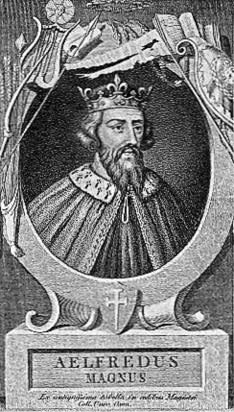
Afred the Great
Barnstaple is what may be the oldest borough in England. The town was known in the 900’s, a typical Saxon stronghold. Known to the Romans as “Tunge abertawe” and to the Saxons as “Beardenstaple,” it was referred to as “Barum”, the Latin contraction, in documents of the era. It was created a burg (borough) by King Alfred. A mint was established, possibly by King Athelstan who also supposedly granted a charter with rights to hold a market and fair (If there were a charter, it has been lost-a charter dated 930 was proven a forgery and no other has ever been found). The earliest known coin was minted during King Eadwig’s reign (between 955-59). The mint was not a particularly active and ceased production in the 13th century.

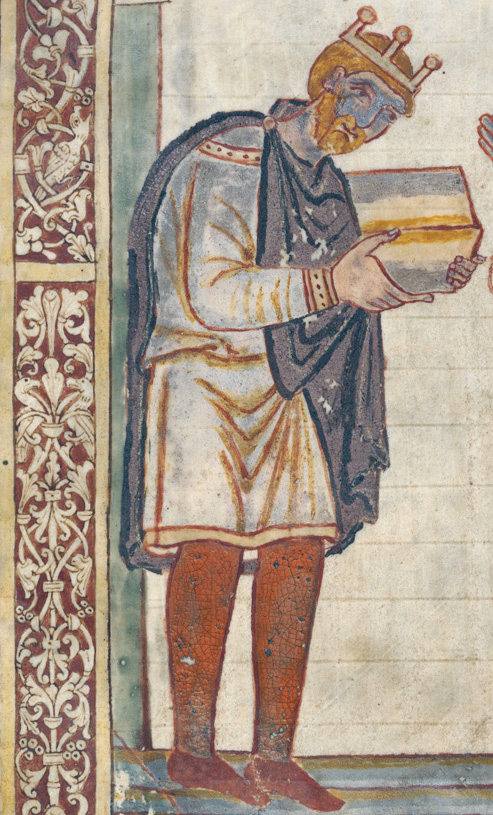
King Athelstan I
It fell to the Normans about 1068, and the fall is discussed in the Domesday Book. It is believed that an original castle was built by King Athelstan, and strengthened after the Conquest. This may be the site of the known castle, built in wood in the 11th century by Geoffrey de Mowbray, Bishop of Coutances. Stone walls were erected subsequently, probably by Henry de Tracey. By 1326, castle was a ruin; only the motte remains as a mound. It was the only port in the southwest of England, and by 1290, an important trade center located on River Taw; trading with Europe, Ireland and New World. Imports included tobacco, wine, spices. Barnstaple was licensed to export wool from the 14th century and was a member of the early merchant Guild of St Nicholas. Exports included woolen material and pottery.

Other industries included lace making, fishing, and ship building. Barnstaple was the 3rd richest town in Devon in the 14th century (behind Exeter and Plymouth). Its importance as a port grew during the 14th to 16th centuries, and the city was represented in the Naval Council. There was a petition to Mary I to build a quay and merchants' exchange on the river in 1555. Barnstaple was a “privileged port” as a member of the Spanish Company (authorized to trade in Spain and Portugal) in 1577. There were 12 merchants in Barnstaple listed in the charter.

Trade with America was also very important in the 16th and 17th centuries. Barnstaple had a rather exciting military past as well. In 1588, 3-5 outfitted ships, manned by locals, sailed to join Sir Francis Drake to help defend against Spanish Armada. In 1642, when the English Civil War erupted, Barnstaple was originally pro-Parliamentarian, but changed sides four times. Seriously damaged after the war, the city eventually resumed its normal business and trading activities.

Queen Anne's Walk
Queen Anne’s Walk was built in 1708 (a rebuilding of the original Merchants' Walk built in Tudor times) and completed in 1713, as a merchant exchange on the river with its own quay for loading and unloading ships. A statue of Queen Anne was placed on the colonnade. In the 18th Century, the wool trade ended and Barnstaple began to import Irish wool which was sent on for manufacture. The harbour silted up (a process which began as early as the 17th century) and trade gradually moved to Bideford although there was local shipping (agricultural) until the 20th century. However, the town still maintained its importance as a market town. It has been represented in Parliament continuously since 1295 (it had 2 representatives until 1885 when representation was reduced to one member). It remains an important business and shopping site and the main town in North Devon.

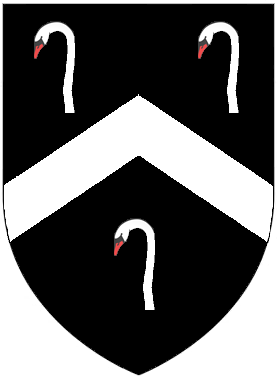
Delbridge Arms

A name that recurred in the history of the town during the 16th century was John Delbridge. Who was John Delbridge? He was born in Barnstaple. His exact date of birth is unknown; however, he was baptized July 9, 1564. John was the 2nd son of Richard Delbridge, a merchant of Barnstaple, and his wife Alice. 

John was a Puritan, and was educated at Emmanuel College Cambridge (he enrolled July 3, 1604 as a paying student or commoner, not as a scholar), and later entered the Middle Temple in London May 10, 1606. He was married to Agnes Downe of Barnstable on January 10th, 1585. Agnes was the niece of Bishop Jewel, Bishop of Salisbury. They had five sons and three daughters, but only one son and daughter survived John. He became a successful cloth merchant, importing and exporting goods by 1591. He was involved in the Newfoundland fishing trade and was a member of the East India Company (1611-21), the French Company (1611), the Virginia. Company (from 1612 to at least 1623), the North West Passage Company (1612), and the Somers Island Company (from 1615 to at least 1622). He was also a member of the Council for Virginia (1621). Clearly, he was a man of great influence with fingers in many pies.

John was involved in the American colonies, including providing passage for colonists to Virginia and Bermuda. His ship The Swan took 70 new settlers to Virginia in 1620 and all survived the voyage (he was apparently known for well supplied ships, and few deaths). He was an active trader particularly in imported tobacco. Clearly successful, John acquired property in Virginia as well as in England. He owned a house in Barnstaple and by 1632 had an estate at West Buckland (a manor which included an advowson (right to appoint a clergyman to serve that area)) about eight miles from Barnstaple. He also had an estate at Bishop’s Tawton. John became active in politics. His political career includes: working under Robert Cecil (Elizabeth I’s chief minister) in 1602-1606 (dates approximate); serving as Mayor of Barnstaple three times (1600-1, 1615-16, 1633-4). He was elected Member of Parliament for Barnstaple six times (elections in 1614, 1621, 1624, 1625, 1626 and 1628), in which capacity he served on various committees (with his known expertise in trade matters) and was very vocal on a wide range of bills at least occasionally in open defiance of the king’s wishes. (He served with Pentecost Dodderidge, a fellow merchant, at least three times, and Alexander St. John, Knight as well).

Agnes died in May of 1639, and was buried May 15th of 1639. John made his will on May 27th and died June 24, 1639 at his home at Bishop's Tawton, leaving the bulk of his estate to his surviving son Richard, with bequests to other relatives and to the poor. 

Unrest was brewing, leading to the Civil War which erupted in 1642. The events involving the war and its aftermath left John Delbridge in obscurity. I couldn't help but wonder if his Puritan faith and service in Parliament steered the loyalty of his city to the Parliamentary side of the conflict, at least at the start.

This is not by any means a comprehensive history of Barnstaple or of John Delbridge; it does, however, serve to tickle one's fancy to look further into that fascinating town and its people.

Sources:

Holton, Denise and Hammett, Elizabeth. BARNSTAPLE THROUGH TIME. Stroud: Amberley Publishing, 2013. (Kindle Version); SECRET BARNSTAPLE. Stroud: Amberley Publishing, 2015. (Kindle Version)

The History of Parliament on-line. “Delbridge, John (1564-1639) of Barnstaple and Bishop’s Tawton, Devon.” HERE

GoogleBooks. Willis, Browne. NOTITIA PARLIAMENTARIA: Or A History of the Counties, Cities and Boroughs in England and Wales. 2nd Edition with Annotations. London: Robert Gosling, 1730. HERE ; Tudor and Stuart Devon: The Common Estate and Government : Essays Presented to Joyce Youngs. Edited by Todd Gray, Margery M. Rowe, and Audrey M. Erskine. Exeter: University of Exeter Press, 1992. HERE

Barnstaple Town Centre on-line. “History.” HERE

A Vision of Britain. “Descriptive Gazetteer Entry for Barnstaple” by John Marious Wilson in IMPERIAL GAZETTEER OF ENGLAND AND WALES (1870-72). HERE

Cambridge Alumni Database. “Delbridge, John.” HERE

View of Barnstaple taken by Lauren Gilbert (c) Lauren Gilbert


Images from Wikimedia Commons

Alfred the Great HERE

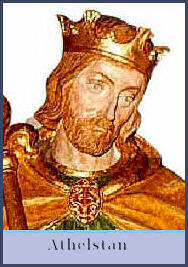
Athelstan HERE

Queen Anne's Walk HERE

Delbridge Arms HERE

~~~~~~~~~~
Lauren Gilbert, author of HEYERWOOD: A Novel, is working on her second novel set in Regency England, A RATIONAL ATTACHMENT. She lives in Florida with her husband. Please visit her website HERE.


Wednesday, December 28, 2011

The Secrets of a Saxon King


 By Nancy Bilyeau


“Holy King Athelstan, renowned through the whole world, whose esteem flourishes and whose honour endures everywhere,” said a 10th century Latin poem.

In his own lifetime, Athelstan, the grandson of Alfred of Great, was praised as  “the English Charlemagne.” By defeating the combined armies of Danes, Scots and Welsh in the Battle of Brunanburh in 937 AD, Athelstan could rightly claim the title of “King of all Britain.” In his 15-year reign, he also established laws, financed Catholic monasteries, and made key alliances with European royalty.


Yet today, Athelstan is mostly forgotten.

While researching this Anglo-Saxon king, who plays a crucial role in my historical thriller The Crown, I puzzled over why Athelstan dissolved into obscurity. It’s not all attributable to the time in which he lived—those ill-documented, striving, brutish yet sporadically dazzling centuries between the Roman Occupation and the Norman Conquest. Everyone has heard of Alfred the Great. Why not Athelstan, who arguably accomplished just as much?

I concluded that it was the mysteries surrounding Athelstan—ones that the most determined historians have not been able to solve—that made him too blurry for easy familiarity. His secrets make him tantalizing. But they also prevent his life from hardening into the simple outlines that propel a legend through time.

1.)   Was Athelstan’s mother a concubine?
This is hotly disputed, with biographer Sarah Foot convinced that Athelstan’s mother was an obscure but highly born young woman who had a child or two and died. Sort of a Dark Ages version of a starter wife.  Yet the story persists that Athelstan’s father, Prince Edward, fell in love with a beautiful young shepherdess while visiting his former wet nurse and conceived Athelstan that very night. It’s quite the erotic tale, putting to rest that stereotype of10th century men only caring for their swords. More practically, if there were any truth to Athelstan being illegitimate, it would explain why he did not have strong support when he succeeded his father to the throne at age 30—and it would also explain a serious problem he had with one of his half-brothers…

2.)   Did Athelstan have a half-brother killed?
The story goes that Athelstan suspected young Edwin, the son of his father’s undoubted queen, of conspiring against him with disaffected nobles. As punishment, Edwin was put in an oarless boat without food or water and set out to sea. He threw himself overboard rather than continue to suffer. Later Athelstan is said to have expressed remorse and performed penance. This whole story is far from confirmed but it’s persistent—and historians believe that it flung a shadow across the character of Athelstan.

3.)   Why did Athelstan never marry or have any children?
Thanks to chronicler William of Malmesbury, we know what Athelstan looked like: handsome, slim and blond. He was well educated. He was personally brave—Athelstan “won by the sword’s edge undying glory in battle.” In short, the man is King Arthur material. So why wasn’t there a Guinevere? Historians struggle to explain it: “Athelstan’s decision to remain unmarried seems more readily explicable as a religiously motivated determination on chastity as a way of life.” Still, the concept of celibate warrior monks—such as the Knights Templar—did not come along for another two centuries. A king was expected to marry and beget heirs, in Athelstan’s time and throughout the succeeding dynasties (see Henry the Eighth).  Lacking a Dark Ages Dr. Phil--which is perhaps for the best--we’ll never get to the truth of this one.

4.)   Where did the Battle of Brunanburh take place?
Athelstan’s enemies, determined to put an end to Wessex domination, drew him north for a cataclysmic encounter. Winston Churchill, as only he could, summed up the odds against Athelstan in The Birth of Britain: “The whole of North Britain—Celtic, Danish and Norwegian, pagan and Christian—together presented a hostile front under Constantine, king of the Scots, and Olaf of Dublin, with Viking reinforcements from Norway.” And yet…Athelstan won. Where this battle was fought, no one knows, though Yorkshire is a solid guess. Most of our information about Brunanburh comes from a rapturous Anglo-Saxon poem. There is a great deal of “they hewed the battle shafts with hammered weapons,” but no identifiable landmarks.


5.)   Why did Athelstan request burial at Malmesbury Abbey?
Almost every king of the House of Wessex was laid to rest in Winchester, the family’s seat of power. But Athelstan arranged to be buried at Malmesbury Abbey in Wilstshire. The king had "such a veneration for the place that he thought nowhere more desirable or more sacred." Whatever his reasons, Malmesbury rose to the occasion, and dedicated itself to the memory of the great king. Today you can visit Athelstan's tomb and glimpse his effigy, though his corpse is long gone. Some say it disappeared a few decades after his death, others that it was removed shortly before the Dissolution of the Monasteries.
Malmesbury Abbey today

6.)   Did Athelstan possess the most sacred religious relics of his time?
This was the age of relic collecting, and no one pursued them with greater passion than Athelstan. He was so famous for his love of relics than when Hugh Capet, descendant of Charlemagne, was interested in marrying Athelstan’s most beautiful sister, he is said to have delivered an amazing amount of treasure to England—as well as relics that date back to Golgotha. The most famous one was the Spear of Destiny, also known as the Lance of Longinus, that pierced Jesus’s side. 

But Athelstan is said to have possessed other objects of mystical value, too, and that is what I delve into in my novel, The Crown


"The Crown" is the first in a trilogy of historical thrillers, published by Simon & Schuster in North America and Orion in the UK. To learn more, go to www.nancybilyeau.com