Showing posts with label Medieval Clothing. Show all posts

Friday, September 25, 2015

Sumptuous Dressing in the Late Medieval Era

by Carol McGrath

I am fascinated by clothing and fabrics sold by drapers and merchants during the late medieval and early Tudor period. Wool was England's most valuable export. It was sold in quantity all over Europe.

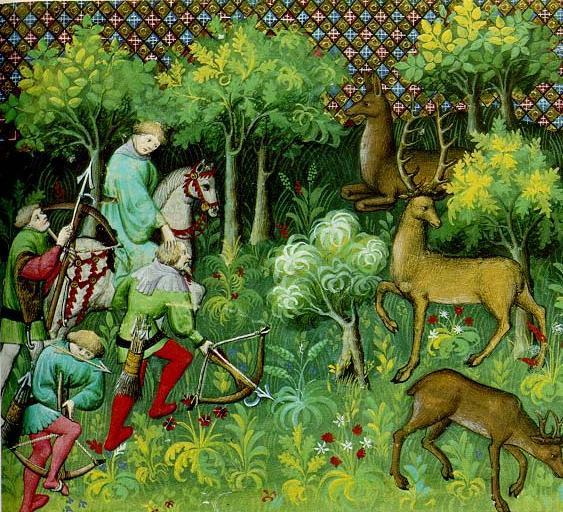
I have been studying pictures of clothing that appear on illuminated manuscript work- those fabulous tiny figures dressed in gorgeous bright colours and in exotic fabrics other than wool. Velvet, silk and damask were the most expensive fabrics that were popular among society's elite.

Beautiful fabrics and colours for the elite

However, by the end of this period there was a market for what was known as the new draperies. They were made from wool that was combed out rather than felted and which at the weaving stage was mixed with silk, linen and even cotton. These new fabrics were often light and had a variety of interesting names such as serges, bayes, sayes, perpetuanas, frisadoes, minikins, bombasines, grosgraines, buffins, russells, sagathies, mockadoes, shalloons and tammies. They actually varied little from each other except in firmness, weight and size.

Notice the pattern woven into this new fabric

The woolen industry proper involved the manufacture of broadcloth, dozens, penistones and medley cloth. These names may seem complicated to our minds, and I have only mentioned a selection of them. Yet, I have no doubt that the medieval merchant knew what he or she was looking at when they purchased fabric in the great cloth fairs such as the September fair of St Bartholomew in London or The Northampton Cloth Fair in November.

One of the most fascinating aspects of the clothing and fashion industry are the Sumptuary laws.  In 1513 such laws were passed in England to define what different classes of people were allowed to wear. They should not just know their station, but they should look it as well. I often think as John Ball, the hedge-priest said at the time of the Peasant's Revolt,  'When Adam delved, and Eve spun, who was then a gentleman?' Equality was idealism. It could not exist within a society ruled by a feudal system.
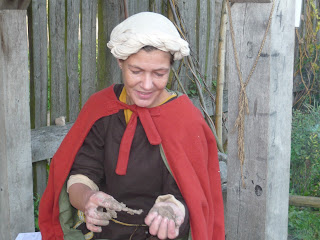

Fashion was an important way in which identity, values and status could be displayed within society. Before the 14th century status was simply indicated by the quality of clothing worn. After this there were concerns about style and tailoring. Buttons were used from circa 1350. This meant that tight fitting garments were easier to wear. There was also an increased range of imported dyes and fabrics for the elite which could afford the latest trends. There was also a greater use of fur and embroidery. Head-dresses became more complex. The higher the rank, the more choice there was of materials and colour. The upper classes could wear taffeta, velvets, silks, furs and lace. Poor Tudors wore wool and linen.

The poor throughout the seasons
Thus, in England sumptuary rules dictated the colour and types of clothing allowed to persons of various ranks and incomes. An extremely long list of items specifying colour and materials existed well into the 17th century. Only royalty could wear purple. Gold, silver, crimson, scarlet, deep blue were for the nobility and royalty only. Poor Tudors wore browns, beige,yellow, orange, russet, green, grey and paler blues.

So, you see, the beautifully clothed figures we see in illuminated manuscripts did not represent the unfashionable poorer majority in society. Rather, they show societal elite.

~~~~~~~~~~~~~

Carol McGrath lives near Oxford. She is the author of The Daughters of Hastings Trilogy. Her latest novel is The Betrothed Sister. Her WIP is set in the early Tudor period. She can be found at:

https://www.facebook.com/daughtersofhastings
Follow me on Twitter @carolmcgrath
www.carolcmcgrath.co.uk
 

Saturday, September 13, 2014

The Joy of Reenactment: Medieval Clothing

By E.M. Powell

As a historical fiction writer, so much research is done through written materials or inanimate objects stored in museums. Such resources are of course marvellous but there is one type of research that is very special in bringing history to life. I am talking of course about reenactment.

Earlier this summer, I was very fortunate in meeting a group of medieval reencators, Historia Normannis. Historia Normannis is a 12th century reenactment group, focusing primarily on the events between the reign of Henry I and King John and they bring history to life in a historically accurate, engaging and exciting way. And not only that, they were unfailingly patient and generous in giving me lots of time and answering innumerable questions.

One of the topics we discussed was the clothing of the period. They had so much valuable information and were very happy to share it via this blog.

Medieval Society

To give an indication of how clothing differed across the classes, the reenactors provided this striking line-up. As we pan from left to right, we first see the peasants with plain or non-dyed clothing. The colours and materials of the clothing become ever more sumptuous and expensive as we rise up the ranks to the right. We end the line with an Earl, the most richly-dressed of all.

Earl in full robes
The fabrics are linen and silk, and his long belt is dyed red. Originally, this would have been genuine ox-blood leather, taking its name from the dye used.

He is bare-headed with no coif or head-covering, as that helps to show his status.


The detail of the embroidery on his mantle shows a lion. But it's a twelfth century lion. Norman lions were depicted with no manes as most people had only ever seen lionesses.
Norman lion

Next we have lesser nobles, still dressed expensively.


To modern eyes, a black cloak may look unremarkable but black dye was costly, coming as it did from the iris root. It would take a whole field of irises to yield enough dye for one cloak. The black favoured by monks was actually more a dark brown, coming from the natural black wool of Welsh sheep.

The length of the cloaks may look impractical but were designed to shield the wearer from the weather. Worn when riding a horse, only the head got wet. The lanolin in the wool would have acted as a water repellent.

I also got to try one on (no, no pictures!) and they are incredibly heavy.

Again, the details are so beautifully done.


And  noblewomen of course also displayed their high status through their clothing.

Noblewomen's dress

The woman on the left wears a linen and not a wool dress. The colour is lighter as linen takes up dye less than wool. Blues and purples (from woad and clam shell dye/murex) were among the most expensive, with murex costing more than gold. Both women are wearing clothes that use colour contrast to add to their striking appearance. Necklines are high, with dresses laced tight at either side to follow the curves of a woman's body.

Their dresses have pendulum sleeves, which were a favourite fashion of noblewomen. The design was a way of demonstrating wealth (as the sleeves used extra fabric) as well as demonstrating that the wearer did not engage in any kind of manual work.


Again we see that she has a thick, beautifully decorated cloak. Her wimple, secured with a decorated pin, is white. All wimples were white as it demonstrated purity.She also has a hefty set of keys on her belt along with her Pater Noster beads.The keys suggest she has been left in charge of the estate by her husband, which occurred frequently.

Historia Normannis's sweetest reenactor!

One of the most junior reenactors was willing to be included too!

She a little bemused by the woman in hiking boots and raincoat asking her lots of questions. But she was so charming and polite, and I think she wins a special prize for utterly looking the part.

Still charming and polite (but perhaps not quite so sweet!), came our knights.

Mercenary knights

These  two would be considered mercenaries. They would own their chain mail, a horse, a shield and a sword and their ambition would be to try and serve in a household, thus guaranteeing them a living.

Set of armour and weapons
Chain mail of course gives protection against a blade and is flexible when fighting in. Well, I say flexible. I tried to pick up the mail coat in the picture and could hardly get it off the ground!

With full armour weighing in at about four stone, I guess flexibility is subjective. I was assured by the reenactors that one develops muscles to cope with wearing it. Mail of course didn't protect against blows, and men could suffer massive bruising in battle.

Mail also picked up all sorts of unmentionable debris in battle, ground into the small metal links. It was the unenviable task of a squire to clean it using only a barrel of sand.

And last, but not least, for he was doing an awful lot of the actual work, we have our peasant.

Peasant

He is dressed in his rough, plain-dyed wool, with his coif or hood to protect him against all weathers. One suspects he was probably a bit muddier in real life, but even so, his contrast to the wealth of the nobles could not be more stark.

It was a fascinating day and such an opportunity to get up close and personal with history. Historia Normannis are such a welcoming and enthusiastic group. You can find out more about them and see many more fascinating pictures of them in action at http://www.normannis.co.uk/wp/

~~~~~~~~~~~~~

E.M. Powell is the author of The Fifth Knight, a medieval thriller based on the murder of Thomas Becket in Canterbury Cathedral in 1170.

The sequel, The Blood of The Fifth Knight, will be released by Thomas & Mercer on January 1st 2015.

Amazon.com
Amazon.co.uk
Amazon.ca

Visit her website at www.empowell.com

Monday, January 20, 2014

Clothing as a Map to the Past

By Philippa Jane Keyworth

Medieval Clothing - Clothing as a Map to the Past by Philippa Jane Keyworth
Richard Grassby wrote in his article ‘Material Culture and Cultural History’ in the Journal of Interdisciplinary History, that ‘Clothes in a draw have no meaning, but when worn they become a uniform with social and moral implications.’

I am a woman, and I love clothes. What a stereotype – except that if you continued to talk to me about them, you would see that I have an obsession with clothes of bygone ages rather than what’s in high-street stores right now.

As an amateur historian, I am coming to the firm conclusion that to assume people just wore certain clothes because they liked them is missing a much broader range of motivations. There were many reasons individuals in the past chose to wear what they wore.

Many previous historians have given the main motivation, when people were choosing what to wear, as ‘social emulation’. The basic meaning of this being to dress like your betters and hope to rise through society’s ranks. Of course that is a just consideration. It is clear from eighteenth century accounts of working and middle class people that they would dress like their betters in order to enhance their job prospects and to feed their social aspirations. How many people have bought Ugg boots in the last few years because everyone else has a pair?

The idea I would like to present to you is one that sees a host of other motivations as well, and that these motivations often reflected the contemporary social, economic and political events of the day. ‘I’m confused!’ you say – but have no fear, I wish to give some examples to better explain my theory!

Whilst studying the medieval period, I was astonished to find that there were such things as sumptuary laws. These laws were designed to govern the wearing of sumptuous dress, restricting certain clothing to the rich and certain clothing to the poor. This way, if someone were to look at someone else on the street, they would be able to determine their rank within society immediately. This is much like a football player wearing his team colours.

The clearest example of these laws is in furs. Rich people were allowed to wear furs such as ermine, whilst poor people were confined to furs such as squirrel. If the poor were to don ermine they would be breaking the law. So, in this case, the type of clothing worn gives a map of the social hierarchy in society at the time which can be viewed in documents and through art.

Elizabeth I's Clothing - Clothing as a Map to the Past by Philippa Jane Keyworth
Jumping forward, Elizabeth I’s motivations when choosing the clothing she was portrayed wearing in her portraits reflects the political and gender mindsets of her time. Roy Strong’s book Gloriana explains her use of ermine was a signifier of purity, establishing her as the Virgin Queen and reinforcing her claim of marriage to her country. Equally, the fact that she chose to dress in similar clothes to her father with the masculine broad shoulders and puffy sleeves shows her legitimising her claim to the throne both by associating herself with her father Henry VIII and asserting her authority to rule in spite of her sex. Elizabeth’s choice of clothing reflected her political tools and from it you can deduce the challenges to her rule i.e. not marrying, the questioning of her claim to the throne and her sex.

Georgian Clothing - Clothing as a Map to the Past by Philippa Jane Keyworth

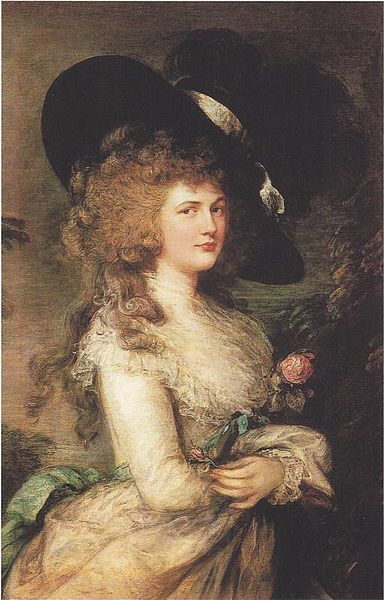
And what can the eighteenth century tell us? Oh, the wide-pannier court dresses and the lavish wigs! It was all pomp and splendour and what for? The obvious answer is to display wealth. When materials were expensive and there was no mass production available, dresses using yards and yards of the stuff were the perfect way to display wealth, importance and power. The same goes for those astronomical wigs. The larger the wig, the more expensive – I hear that’s where the term ‘big-wigs’ comes from, the wearing of big wigs by the rich and powerful.

Then on to the Regency, that most elegant of ages, what were the motivations for dressing in tight buckskin breeches and flimsy muslin dresses, (not at the same time I hasten to add)? I agree with Christopher Breward in his book The Culture of Fashion, that after the violence of 1789, the English aristocracy wanted to distance themselves from the indulgences of their French equivalents. They discarded embroidered frock coats in favour of plain jackets reminiscent of the middling classes. Then there was also the harking back to neo-classical philosophies in the previous century. The Enlightenment had brought with it ideas of equality and appreciation of antiquity. Surely that had something to do with those muslin dresses that looked so much like the clothing of caryatids? Not to mention influencing the wearing of tight buckskin breeches that Ian Kelly in Beau Brummel, said were to show the nudity of ancient statues in the everyday dress of men.

Grace Kelly - Clothing as a Map to the Past by Philippa Jane Keyworth
Finally, a friend pointed out something to me I did not know about the large 1950s skirts that women wore. We were watching Grace Kelly in Rear Window (a great film if you’ve never seen it), and were admiring Kelly’s beautiful dresses. My friend remarked upon the fact that the reason pencil skirts were so popular in the 1940s was because of fabric rationing due to the war, and when this rationing was lifted, full-bodied skirts came into fashion. Right there, a little passing comment made me realise that from two different designs of skirt the international relations and economy of countries was alluded to.

I hope that by touching upon a few highlights of bygone fashions you are starting to see clothes as I do. They can provide a map to view beliefs and attitudes in the past. They can echo the current economy, social situation, governmental changes and individual’s desires. They really do provide us amateur historians with a map to the past.

In writing all this, I do not want people to think I am completely discarding the idea of people choosing a dress or jacket simply because they like the design. I am sure they did, but along with that desire, there were lots of underlying motivations, either conscious or subconscious, that can be discovered and unpacked when looking at clothing. Next time you are looking at historical attire, why not see what it can tell you about the past?

References:

Gloriana: The Portraits of Queen Elizabeth I by Roy Strong

The Culture of Fashion: A history of Fashionable Dress by Christopher Breward

‘Material Culture and Cultural History’ by Richard Grassby in Journal of Interdisciplinary History

~~~~~~~~~~~~~

Philippa Jane Keyworth, known to her friends as Pip, has been writing since she was twelve in every notebook she could find. Whilst she dabbles in a variety of genres, it was the encouragement of a friend to watch a film adaptation of Jane Austen's Pride and Prejudice that would start the beginning of her love affair with the British Regency. Her debut novel, The Widow's Redeemer (Madison Street Publishing, 2012), is a traditional Regency romance bringing to life the romance between a young widow with an indomitable spirit and a wealthy viscount with an unsavory reputation.

The Widow's Redeemer - Regency Romance - Philippa Jane Keyworth