Showing posts with label Twelfth Night. Show all posts

Friday, January 5, 2018

Lift Your Mug of Wassail and Raise Your Voice in Song: a Brief Look at Twelfth Night

by Linda Fetterly Root


Here's to a slice of Cake and a cup of mulled wine or Wassail in honor of Twelfth Night.

The origin of Twelfth Night is sometimes traced to the ancient Roman festival of Saturnalia because of the appearance in many of its versions of a mock king. Adaptations of Roman festivals in medieval European courts often featured the appearance of a false sovereign sometimes called the Lord of Misrule, but the title of the bogus monarch common to the Twelfth Night holiday on the eve of the Feast of Epiphany was most often known as the King of the Bean. The tradition was also adopted in Spain, the Low Countries and the German principalities, although in Germany and the Netherlands, the item in the winning slice was a coin. It has been speculated as inevitable that the French would combine their love of the culinary arts with their passion for spectacle, in a celebration conferring temporary kingship on a courtier who found a bean hidden in his marzipan or honey cake. The French phrase meaning, ‘he had good luck’ –il a trove lafeve au gateau—literally translated to ‘he found a bean in his cake.'

Twelfth Night entertainments at British Courts did not begin with Shakespeare
The comedic flavor attributed to the festival of Twelfth Night did not begin with the mishaps of William Shakespeare’s star-crossed lovers, nor was it exclusively a British holiday. Shakespeare wrote his play at the turn of the 17th century, and it was first performed in 1602. The plot centers around fraternal twins who were separated in their youth by a shipwreck. One of them, Viola, resurfaces in adulthood as a trickster who often disguises herself as a man. She falls in love with Count Orsini, who is in love with Countess Olivia, who meets Viola while she is wearing her disguise and falls in love with her. The predictable series of misadventures follow.

The Masque of Blackness, script by Ben Johnson, Costumes and Set design by Inigo Jones, Starring Queen Anne of Denmark and sixteen ladies of the Court
Blackness costume design
by Inigo Jones

At least one Twelfth Night celebration, this one at the Stuart Court in 1605, was controversial in its time and certainly would not pass political correctness tests of current times. The production was sponsored by Queen Anne of Denmark, the first English Stuart consort, and entitled The Masque of Blackness. The play was written by Ben Jonson, and the set designs and costumes and props were the work of Inigo Jones. Queen Anne was a great fan of masques and often performed in them. In Blackness, she played the part of Euphorus and appeared in black face. Even then, a theme centering on skin color was considered improprietous by some of the Queen’s critics. The plot involves a group of African women who had regarded themselves as the most beautiful women in the world until learning black skin was considered ugly outside of Africa. The story advances as the women explore the known world seeking a way to make themselves white. It ends with a promise that the next year’s masque will involve Beauty, in which the black-faced women are likely to discover themselves in Britannia, where pale skin was the norm. However, performance of the second installment of the story, entitled Beauty, was postponed to 1608, to permit the 1607 Twelfth Night reveries to focus on a Wedding Masque of Robert Devereaux, Earl of Essex and Lady Francis Howard, who proved to be a couple more mismatched than any pair either Shakespeare or Ben Jonson could have conjured.

Queen for a Day: Twelfth Night at the Court of the Queen of Scots
My favorite Twelfth Night story comes in two installments of a love story I uncovered when I researched my debut novel, The First Marie and the Queen of Scots, and it involves Twelfth Night reveries which occurred in Scotland during Marie Stuart’s brief personal rule. The story begins in France during Queen Marie Stuart's youth. At the mid-sixteenth century French court at which King Henry Valois’s elegant mistress Diane de Poitiers set the tone, it is not surprising to find the selection of a Queen of the Bean incorporated into the festivities. Traditionally, a white bean was placed into a honey cake in the royal kitchens and served to female members of the royal household, the first piece given to the oldest. Like most things associated with Diane, the tradition caught the fancy of Marie Stuart, Queen of Scots, when she was Dauphine, and later, Queen Consort, and she brought the tradition home with her to Scotland in 1561.

The version she introduced commemorated her own sovereignty by making the featured attraction the selection of a Queen of the Bean. No King of the Bean appears in the histories of her reign, which the consort Henry Stuart, Lord Darnley, should have heeded. There is no record as to precisely when the Queen introduced the lottery of the honey cake, but there is some indication that Lady Marie Beaton may have been the winner in 1563. However, the Twelfth Night celebrations of 1564 have survived in some details and were vividly commemorated by descriptions reported to the Crowned Heads of Europe. It was the year when the bean was found in the honey cake of Marie Fleming, the Queen’s first cousin and leader of the Queen's ladies called The Four Maries. The petite blond woman who had been lauded by French poets as one of the most beautiful women in the world appeared dressed in a gown of silver and covered from head to toe in jewels. Even Beaton’s paramour, the English ambassador Thomas Randolph sent reports to Queen Elizabeth and to the Queen Mother Catherine d' Medici at the French Court comparing Fleming to three goddesses from classical mythology and describing her presence as eclipsing the Queen. Even stiff-necked George Buchanan praised her demeanor and her beauty. It is fitting to note that the last Twelfth Night celebration of Marie Stuart's six-year personal rule was held at Court in 1567, when the former Queen of the Bean, Marie Fleming, married the celebrated Scottish diplomat and foreign minister Sir William Maitland of Lethington who had fallen in love with her presumably at her appearance on Twelfth Night, 1564. Through their daughter, Margaret Maitland (Kerr), Lady Roxburghe, the bride and groom are remote ancestors of the late Diana, Princess of Wales, and hence, her sons, William, Duke of Cambridge and Prince Harry of Wales. The Twelfth Night Celebration of 1564 is commemorated annually in Biggar, Scotland, the Fleming ancestral home.

Twelfth Night in the New Millennium
The popularity of Twelfth Night festivities caught on in 18th century America and were very popular with George and Martha Washington, who chose it as the date of their wedding. Nevertheless, the nature of the holiday changed with time. By the 19th century, the tradition involving the election of a King or Queen for a Day had all but disappeared. Such, perhaps, is the fate of monarchy. However, its vestiges are seen in Provence and to some degree, in Germany. By the early 19th century, the festival had taken on a carnival mood and was a favorite holiday of the great Jane Austen. However, late in the 19th century, Queen Victoria outlawed its celebration as having become too raucous. Its popularity survived longer in the Americas, but by the 20th century, it had become an occasion for the taking down of decorations and the extinguishing of the Yule Log. In current times, especially in traditional households where Epiphany is celebrated, Twelfth Night is commemorated with cake and a punch bowl of wassail, which is happily consumed and put away until the next Christmas season. Thank you for celebrating it with me.

~~~~~~~~~~
Linda Root is a retired career prosecutor, armchair historian and historical novelist who lives in the Morongo Basin area of the California high desert within a quarter mile of the Joshua Tree National Park. Her books take place in Marie Stuart’s Scotland and Stuart England, and can be found at Amazon.com, Amazon.uk.com and Amazon Kindle. Her eight book and current work in progress, The Deliverance of the Lamb, will be published in the late Spring, 2018.

Wednesday, January 4, 2017

Christmastide: It's not over yet!

by Emily Murdoch

By this time, many of us may have found that our New Year’s resolutions have already fallen by the wayside, and there will be few of us who still have our Christmas decorations up – and yet in the medieval world, Christmas’ peak had not even happened and New Year was over two months away. 

Adoration of the Magi
by Bartolomé Esteban Murillo 
Epiphany, Twelfth Night, or Twelvetide, celebrated on January 6th as the day on which the Magi visited the baby Jesus in Bethlehem and presented him with gold, frankincense, and myrrh, was considered during the Middle Ages as the true end and climax of Christmas, and to many the most important part. All efforts were made to peak at Epiphany, and the biggest and most impressive displays of wealth and grandeur were reserved for this day by those who had the gold and silver to spend. Why do you think the traditional Christmas carol Twelve Days of Christmas, published in 1780, increases the gifts with every day that passes and is most extraordinary at day twelve?

And speaking of gifts, Epiphany was the day on which gifts were distributed, alms to the poor were given, and all debts repaid. This was a time to celebrate the goodness of the season past and the hopes and expectations of the season to come. There are records in Turkey from the year 400 AD of children going door to door offering small gifts (usually fruit), covered with silver paper, and then receiving from the households gifts in return often double the value – an early ancestor, perhaps of trick or treating. Then, as today, many in the Church disapproved of this ‘greedy’ practice.

Epiphany was also the last day of feasting before a return to fasting, and many of the rich and noble would ensure that this was the most striking of the Christmas celebrations. If a lord received permission from his King, his table would be allowed to serve swan, whereas at the other end of the social scale, goose was more typical – although the bird itself would still cost a whole day’s wages. The scraps from the local lord’s table would often find their way to the tables of the poor, but it would not be pleasant eating from a modern perspective: tongue, brain, and sometimes ears, all of which would be known as umbles (from the Norman French, nomble, meaning ‘innards’) – where we get our ‘humble pie’ from.

Some of the treats on the table at Epiphany we would recognise instantly: candied fruit and sugared almonds were popular yet expensive puddings that the wealthy enjoyed. The poor would make do with salted fish, or garlic and salt if they were particularly lucky, as these flavourings were costly and often only consumed during these festivities. Gingerbread was a delicacy, and so was apple pudding, known as pommesmoile, as apples had to be stored for months. And if you really wanted to amaze people at Epiphany, there was only one thing that you needed to have: peacock. Although arguably much less delicious than other fowl alternatives, the cooked flesh of the peacock would be placed back inside the skin, and sewn up, so that it looked alive with full plumage as it sat on the table!

Banquet du paon

In some places a Lord of Misrule was elected on All Hallow’s Eve, November 1st, who would rule until Candlemas which falls on February 2nd, an individual who would encourage festivities, nonsense, large amounts of eating, and practical jokes. During this time it was expected for lords and masters to serve their own servants. Turning the world on its head was considered a beneficial way to let off steam, to allow people to test out their own desires, and then to return to the natural order of life for the rest of the year – an inspiration, perhaps for the popular modern film series called The Purge.

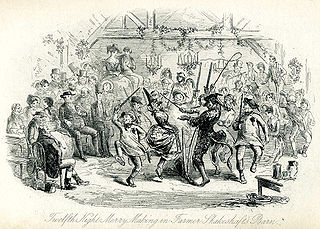
Twelfth Night by Hablot Knight Browne

All of this occurred on or near Epiphany which was always January 6th – but New Year, on the other hand, was not to be celebrated on January 1st in England until the 17th century. The Anglo-Saxons considered the New Year to begin on December 25th, Christmas Day, but after the Norman Conquest this was changed to March 25th, the Annunciation. This makes logical sense: the Christian festival marks the day that Mary is told by an angel that she is bear the Christ child, and this natural beginning, understood and appreciated by generations whose lives were ruled by the natural seasons, feels like an obvious choice for the New Year.

This English practice continued past the time of Shakespeare, who would have celebrated the New Year with his friends and family in March, but it was not a globally accepted method of dating the year. Frances and Joseph Giles write a fascinating passage in their book Life in a Medieval City, which includes the following:
"A traveller setting out from Venice on March 1, 1245, the first day of the Venetian year; finding himself in 1244 when he reached Florence; and after a short stay going on to Pisa, where he would enter the year 1246. Continuing westward, he would return to 1245 when he entered Provence, and upon arriving in France before Easter (April 16) he would be once more in 1244."
It was not until almost the 1600s that the calendar was moved back to the way that the Romans organised it, with January 1st becoming the beginning of the year once more. It was Pope Gregory XIII who officially changed it in 1582, but it took decades for the change to filter through Europe – then as now, old habits die hard. So how did medieval people celebrate New Year, whenever it happened to occur for them?

One tradition that was loved by the people and hated by the Church was the Feast of Fools, celebrated in France and more recently appearing in the Disney film The Hunchback of Notre Dame. Similar to the English custom of the Lord of Misrule, everything was turned upside down, with the poor able to mock the rich, men dressed as women, gambling was permitted (even encouraged!), and undoubtedly, lives were changed in the chaos that ensued. Unsurprisingly, the Church had quelled the Feast of Fools entirely by the 1700s.

A little further afield, New Year’s Eve was better known as Sylvester in Poland, after Saint Sylvester who slayed a dragon on December 31st in 1000. The Irish would remember those who had died that year by lighting candles and setting an empty place at the table. In England, gifts were given just as there are today at Christmas, with the expectation that giving now meant receiving yourself throughout the year. This was taken very seriously by medieval people; without a benefits system or social safety net, there was only the good feeling between neighbours and family to prevent a family from falling to ruin if they met with bad luck, and so social ties had to be continuously developed.

Christmas and New Year have been celebrated by people of all nationalities since records have begun, and yet in many ways the celebrations of the medieval era would be completely unrecognisable to us today.


References

Life in a Medieval City. Frances Gies and Joseph Gies, Harper Collins, 2010.
“On the Festival of the Calends”, Asterius, AD 400.
Umble Pie – from The Foods of England project, \
http://www.foodsofengland.co.uk/umbleornumblepie.htm

History of Christmases Past: History Events. Suzi Love, Suzi Love, 2013.


Media Attributions

Adoration of the Magi: By Bartolomé Esteban Murillo - JAFwsBSXui7rdg at Google Cultural Institute maximum zoom level, Public Domain, Wikimedia Commons 

Banquet du paon: By Anonymous 15th century painter [Public domain], via Wikimedia Commons

Twelfth Night: By Hablot Knight Browne: scanned by Steven J Plunkett - 19th century printing of the above work, Public Domain, Wikimedia Commons

~~~~~~~~~~
Emily Murdoch is a medieval historian and writer. Throughout her career so far she has examined a codex and transcribed medieval sermons at the Bodleian Library in Oxford, designed part of an exhibition for the Yorkshire Museum, worked as a researcher for a BBC documentary presented by Ian Hislop, and worked at Polesden Lacey with the National Trust. She has a degree in History and English, and a Masters in Medieval Studies, both from the University of York. Emily has a medieval series and a Regency novella series published, and is currently working on several new projects.

Buy her books from Amazon UK and Amazon US.

You can follow her on Twitter, Instagram, and Facebook.


Tuesday, December 30, 2014

Medieval Dishes fit for a Monarch

by Carol McGrath

Keeping nutmeg in your  pocket during New Year's Eve will protect you throughout the next year- so says one old medieval belief. I discovered this nugget whilst browsing www.moonsmuses.com , a blog devoted to medieval recipes, herbs and plant lore. Nutmeg would protect you if you happened to fall from a roof, cliff, ladders or other high places.  It was, of course, a highly expensive spice during the middle ages. Reading about spices has sent me on a search for medieval Christmastide recipes fit for a monarch which I thought might also interest historical fiction readers as we approach the New Year.

Medieval Feasts, a cook book

In most medieval households cooking was done on an open hearth in the middle of the main living area. For most of the medieval period, for most households, the kitchen was connected with the dining hall. It was towards the end of this period that the kitchen generally became separated, though change is a slow process. Often, separate kitchens did exist in castle baileys as they could be a fire risk. By the late middle ages, however, a separate building or wing that contained a kitchen area was created from the main building by a covered walkway. Here, one would find frying pans, pots, kettles, waffle irons, spits skewers of all sizes, pots and cauldrons, ladles and graters, just to name but a few of the utensils they had then and which we use to this day.

Importantly, there would also be mortars, pestles and sieve cloths because fine textured food was deemed good for you. The body could more easily absorb nourishment. Skilled cooks could shape the results. Farcing, for instance, was to skin and dress an animal, grind up the meat, mix with spices and other ingredients and return it to its own skin or mould it into the shape of a completely different animal.

Pies were ever popular and called coffins

During the Christmas period the kitchen staff of royal courts were extremely busy. The staff consisted of pantlers, bakers, waferers, sauciers, larderers, butchers, page boys, milkmaids, butlers and scullions who were kept incredibly busy preparing at least two meals a day for several hundred people. Importantly the chief cook would need at least a thousand cartloads of dry wood and a barnful of coal to hand for  the preparation of the two day long banquet. ( Du fait Cuisuine 1420, written by Maister Chiquart for the then Duke of Savoy). Here are a few recipes that would have been cooked in the royal kitchens over the festive season. These are adapted for the modern cook.

An ordered medieval kitchen

Medieval Roast Chicken ( from foodnetwork.com)

Ingredients
1 roasting chicken
2 cups of water
a half cup of paprika
2 cups of lemon juice
a half cup of lemon pepper
a quarter cup of Italian spice
2 teaspoons of salt

Preheat the oven to 325 f. Combine all the ingredients to prepare the marinade. Dip the whole chicken into it. Let it sit for 4 to 5 minutes. Place the chicken on a sheet pan and cook for 50 minutes uncovered, or until the chicken juices run clear.

Or why not try this easy medieval inspired recipe (from coquinaria.nl) for Medieval Apple fritters, traditional fare on New Year's Eve in the Low Countries.

Apples and quinces were regarded as a similar fruit during the period. They were originally small and sour. By the end of the medieval period there were several apple varieties. The Costard was a large kitchen variety and the Pearmain Green, which was green and red coloured, were both known by the thirteenth century. Other medieval apples were Nonpareil, White Joaneting and the Royal Russet. Fritters appeared frequently on the medieval banquet table. There were sweet and savoury fritters.

Time for Feasting

Fritters

Take wheat flour. Take ale yeast, saffron and salt. Beat all together as thick as you would make other batter on meat days. Then take good apples and cut them in the manner of fritters. Dip in batter up and down and bake them in good oil. Lay them on a dish, sprinkle with sugar and serve them.

To make these nowadays you would have to use yeast. English ale was originally the same as medieval beer. It was top fermenting and instead of hop gruit was used, a mixture of sweet gale and other herbs such as rosemary and sage. Ale could be sweet or sour depending on the composition of gruit and the brewing. Medieval beers were never bubbly because the carbon dioxide escaped during the fermenting.

On the Medieval New Year's Day everybody celebrated The Feast of Fools. For that celebration class distinctions were abolished. Most Europeans elected a Lord of Misrule or a king of fools. In England he went as King of the Bean or in Scotland, the Abbot of Misrule. They had the power to call everybody to disorder with cross-dressing, bawdy songs and drinking to excess. The end came when the Protestant Reformation condemned all politically incorrect excesses claiming their roots in paganism. The Feast of Fools has since been celebrated on the twelfth night after Christmas.

Other recipes you might be interested in investigating which were popular over the twelve days of Christmas included:

Venison in a Sack
Goose in Sawse Madame
Wild Boar Stew
Leavened Bread
Extraordinary Spiced Wine
Ancient Fruit Dumplings

Just taste the ale before bringing it to table

Finally I leave you with a medieval caudle recipe.

Medieval Caudle

Beat up egg yolks with wine, sugar and saffron. Heat the mixture over a medium flame. Stir continually until the caudle is hot and thick and fluffy. Beat well together; set it on the fire on clean coals. Stir well the bottom and sides until just scalding hot; you will be able to tell when it becomes fluffy. Then take it and stir fast & if you need add more wine; or if it rises too quickly, put it in cold water to the middle of the outside of the pot, stir it away fast, and serve.

Thanks for this recipe to godecookery.com.

~~~~~~~~~~~~~

Carol McGrath is the author of The Handfasted Wife published 2013 by Accent Press
The Swan-Daughter published 2014 by Accent Press. Both available as paperbacks and for all e readers.


Monday, January 6, 2014

Twelfth Night Revels

by Maria Grace

Epiphany or Twelfth Night was the exciting climax of the Christmastide season, a time for putting away social norms. It was a feast day to mark the coming of the Magi, and as such was the traditional day to exchange gifts. 

Decorations were to be taken down and burned by midnight on this day or the family would face bad luck for the rest of the year. Some believed that for every branch that remained a goblin would appear.

Revels, masks and balls were the order of the day and night. Often each guest would randomly select a character to play by drawing a slip of paper from a hat or bag. Guests had to remain in character for the entire evening. 

Besides the King and Queen, a variety of characters, often pulled from popular literature and plays, were available. Common characters included Sir Gregory Goose, Sir Tumbelly Clumsy, Miss Fanny Fanciful and Mrs. Candour. Sets of pre-made characters could be purchased from stationers, or a family might copy them from books on games and merry-making.

Twelfth001Servants were often included in the revelries. This could become particularly interesting when one became the king or queen for the evening.

Mince Meat Pie and Twelfth Night Cake

Though many dishes graced the tables for Twelfth Night revelry, two particular dishes were known for their connection to Twelfth Night.

Most considered mince meat pies, also known as Christmas or Twelfth Night pies staples of the season. Recipes varied by region, but usually included beef, poultry and other meats, suet, sugar, raisins or currants, spices, orange and lemon peel, eggs, apples and brandy. Leftovers from the Christmas feast would be used to make pies for the twelve days until Epiphany. Eating minced pie every day of the twelve days of Christmas was said to bring twelve months of happiness in the new year. To strengthen the charm, the pies must be baked by the dozen and offered by friends.

A special Twelfth Cake would be the centerpiece of the party. By the early 19th century, the cakes were elaborate creations with sugar frosting, gilded paper trimmings, and sometimes delicate plaster of Paris or sugar paste figures. In towns, confectioners would display these cakes in their shop windows that were illuminated by small lamps so the displays could be admired during winter evenings.

Parlor Games 

Parlor games were played by all classes of society and often involved overstepping the strict bound of propriety. Losers often paid a forfeit, which could be an elaborate penalty or dare, but more often were a thinly disguised machination for getting a kiss. Often, forfeits were accumulated all evening, until he hostess would ‘cry the forfeits’ and they would all be redeemed.

Blind Man’s Bluff and variations thereof

Blind man's bluff
Playing Blind man's bluff
Many variations of this game existed, including Hot Cockles, Are you there Moriarty, and Buffy Gruffy. All the variations include one player being blindfolded and trying to guess the identity of another player who had tapped them or who they have caught. A great deal of cheating was generally involved, which only added to the sport.


Snapdragon 

SnapDragon
A Dragon playing Snapdragon
 Raisins were piled in a bowl, topped with brandy and lit on fire. Players would try to snatch raisins out of the blue brandy-flames and eat them without getting burned—or lighting anything else aflame. The guest with the most raisins is destined to find true love in the upcoming year. 

While brandy burns with a relatively cool flame, I’m not sure I would suggest this for the next family Christmas party. Though not nearly so dramatic charades is probably much safer!

The Courtiers 

 The king or queen occupied a chair in the center of the room. The courtiers would then copy the monarch’s movements with losing their decorum. Any number of simple or vulgar actions might be attempted to cause laughter among the courtiers, thus resulting in a forfeit.


Steal the White Loaf 

 A chosen player, ‘it’, stood with their back to the others and a ‘treasure’ on the floor behind him/her. Another player would try to sneak up and steal the treasure. If ‘it’ turned around and saw them moving, then they would be ‘caught’ and become ‘it’.


Bullet pudding 

Flour was piled into a high mound and a bullet placed on the top. Players cut slices out of the flour pile with a knife without dislodging the bullet. If the bullet fell, the player had to retrieve the bullet from the flour with their teeth.

Playing Cards 7564
Post and pair 

This was a quick card game. Each player is dealt three cards. The winning hand was a pair of kings, queens or jacks, or otherwise highest ranking pair.


Tableaux Vivants 

Players took on the positions of a famous painting, nursery rhyme, or play and remained still and on display for those not participating in the scene.


Charades 

The game could be played two different ways. In one, each player in turn would recite their riddle, and the rest had to guess at their word. In the second, the party would divide into two or more groups, would create short one minute acts to describe the syllables, the last describing the whole word for the rest of the party to guess.

The End of Twelfth Night Revels 

Although Twelfth Night revelry could be peaceable and even family-friendly, it often became quite riotous thanks to large quantities of highly alcoholic punch served during the evening. In the 1870′s, Queen Victoria outlawed the celebration of Twelfth Night in fear the celebrations had become out of control.

References
A Regency Christmas. Kieran Hazzard ©2013 2nd Bn. 95th Rifles
Christmas in the Regency Jo Beverley
Celebrating a Regency Christmas.Regina Jeffers
Christmas Traditions in Regency England. Regan Walker
Christmas Frivolity. Joanna Waugh. 2008.
Revel,Rachel.Winter Evening Pastimes or The Merry Maker’s Companion. 1825
Jane Austen and Christmas: Celebrating Twelfth Night 
Jane Austen and Christmas: Parlour Games for the Season and Twelfth Night Twelfth Night
~~~~~~~~~~~~

 Maria Grace is the author of Darcy's Decision,  The Future Mrs. Darcy and All the Appearance of GoodnessClick here to find her books on Amazon. For more on her writing and other Random Bits of Fascination, visit her website. You can also like her on Facebook, follow on Twitter or email her.

Saturday, December 10, 2011

Twelfth Night

by Lauren Gilbert


Twelfth Night celebrations have taken place since medieval times. A religious holiday initially, it celebrated the coming of Epiphany, the arrival of the Magi at Jesus’ birthplace. It is the culminating festival of Christmastide, the twelve days of Christmas. The English traditions of Twelfth Night are what most of us think of when the name “Twelfth Night” is referenced: food, especially an ornate cake and great feasting, drinking, games, plays, dances and masked balls and other fun times. Shakespeare's play, Twelfth Night, is supposed to have been written to perform on Twelth Night. Although the Christmas tree was a Victorian modification, decorating with greenery, such as rosemary, ivy, mistletoe, holly, bay and laurel was very popular over centuries, from pagan times. Christmas fires, Yule logs and candles were also part of the celebration. Even Oliver Cromwell was not able to completely stamp out all vestiges of Christmastide and Twelfth Night during his Puritan rule, and the festivities rose again under Charles II.

Traditionally, Twelfth Night is celebrated on either the 5th or the 6th of January (depending on how the 12 days are counted, which varies somewhat from one tradition to another). The Twelfth Night tradition still seems strong in Great Britain (witness the many pictures of the mummers’ parades, the Holly Man, and other festivities found with the simplest Google search), Hispanic cultures still celebrate Three Kings Night, and there are surviving traditions in the other western European countries. However, in the United States, Twelfth Night is no longer celebrated commonly in the traditional sense. Twelfth Night was once widely celebrated in the colonies, especially those settled by the English. The colonists brought their traditions with them, and adapted them to their new environment. George and Martha Washington were married on Twelfth Night in 1759, and entertained on Twelfth Night throughout the day each year; Martha’s papers include a receipt for an enormous Twelfth Night Cake. Christmas wreaths, decorated with fruit (apples, oranges, etc. which were considered delicacies) were hung on doors, as can still be seen in Colonial Williamsburg.

The Twelfth Night Cake is customarily a ring-shaped cake with currants, candied fruits, nuts (or any combination) baked into it. Also baked into the cake was a coin, a carved or cast-metal baby (representing the Christ Child), or a bean and a pea. Whoever got the coin or baby was the king; in the case of the bean or pea, the man who got the bean was king, the woman who got the pea was queen. The king and queen ruled the festivities. Later, the king’s privileges included providing the next year’s cake. This cake may be elaborately iced and decorated, often with one or two crowns, or may be light and decorated with colored sugars. (This tradition still lives in the United States in some of the Mardi Gras customs; some Twelfth Night cakes are decorated with the colors now associated with Mardi Gras: purple, green and gold or yellow.)

Wassailing was also a tradition during Christmastide, and on Twelfth Night. Wassail (your health) involved toasting with a hot mulled cider and/or ale, and was very popular in southern England from about the 14th century on. One custom was wassailing the apple trees, which involved pouring a little wassail on the trees to ensure a good harvest and good cider the next year.

One important footnote: it was essential to remove the greenery before midnight. If left up, the greenery could attract goblins or cause bad luck in the new year, so it was traditionally taken down and burned. In America, the fruits used to decorate the wreaths were eaten as part of the celebratory feasts.

Sources:
Beckford, Martin, “Christmas Ends In Confusion Over When Twelfth Night Falls,” THE TELEGRAPH, 1/6/2009, http://www.telegraph.co.uk/news/religion/4126725/Christmas-ends-in-confusion-over-when-Twelfth-Night-falls.html viewed 12/2/2011

Boyle, Laura, “Twelfth Night,” http://www.janeausten.co.uk/twelfth-night/ viewed 11-18-2011.

Doe, Martha, “The Puritan Ban on Christmas,” http://www.timetravel-britain.com/articles/christmas/ban.shtml viewed 11/18/2011.

Lewis, Sandy, “UNDERSTANDING TWELFTH NIGHT The Holiday That Time Forgot,” 1/3/2005, http://historiccamdencounty.com/ccnews93.shtml viewed 12/2/2011.

Miller, Amy, “What Is The Twelfth Night Season?” Sharefaith Media for a Modern Church
http://www.faithclipart.com/guide/Christian-Holidays/twelfth-night.html

By Lauren Gilbert
Author of HEYERWOOD: A Novel