Saturday, June 10, 2017

Did Behavior make a Gentleman?

by Maria Grace

The concept of a gentleman runs back to medieval times, but its meaning has changed over the centuries.  Today, most regard a gentleman to be a cultured, courteous, well-educated man with a code of honor and high standards of behavior. Those ideas though, came into vogue during the Victorian era. Prior to that, being a gentleman reflected birth and wealth as much as it did one’s behavior.

The Georgian era gentleman, the precursor to the Victorian gentleman, established a code of conduct based on the three R’s considered fundamental to gentlemanly conduct: Restraint, Refinement and Religion. After the French Revolution (and quite possibly because of it), in the reign of George III, the British began to distinguish themselves with their restraint and reserve from the more hot-headed peoples of southern Europe. The move also increased the social distance between the English aristocracy (and eventually the upper class in general) and the lower and serving classes. The shift happened slowly, though, over decades, as the British Empire expanded. (Mason, 1982) This is where the change to defining the gentleman by his manners rather than his birth or fortune began. (Cornick, 2015)

The regency era gentlemen were caught in this shift, still interacting cordially with those not of their class, including their servants and professionals under their employ, but at the same time becoming a bit more reserved in their dealing with them. (Kane, March 2009) So, if a man of this era was haughty and dismissive of his servants, it was more a matter of his personality than of a social expectation of arrogance toward the lower classes. This suggests Mrs. Reynold’s praise of Mr. Darcy as a considerate and caring master in Austen’s Pride and Prejudice is more a statement meant to correct Elizabeth Bennet’s opinion of Darcy than it is to suggest that Darcy is an aberration amongst his class.

A young gentleman’s behavior would have been dramatically shaped by his schooling. Most young gentlemen would begin their schooling under a governess. By the age of six, he would often have a private tutor or be sent to study a few days a week with the local curate, vicar or resident scholar. (Kane, August, 2012) Some families would send boys this young to boarding school, others waited until closer to ten years old. During these years of primary, secondary and university education spent with other young men of their social class, gentlemanly behavior would be both caught and taught.

Gentlemanly behavior 

So then, what did this ‘gentlemanly behavior’ (sometimes referred to as ‘good breeding’) entail? Through the centuries, numerous writers attempted to describe it.
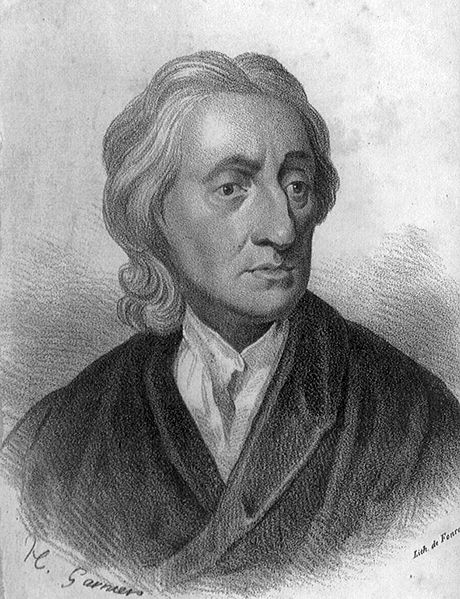
Philosopher John Locke (1693) suggested a young man of good breeding:
• was decent and graceful in his looks, voice, words, gestures and general demeanor.
• was pleasing in company, taking care not to offend others or demonstrating “sheepish bashfulness”
• showed no excess of ceremony; did not flatter or dissimulate; was not mean.
• In conversation displayed respect, esteem, good manners and goodwill to everyone.

Philip Dormer Stanhope, 4th Earl of Chesterfield by William HoareIn the mid-1700’s Philip Dormer Stanhope, 4th Earl of Chesterfield wrote to his illegitimate son on the issue of that which would make a man “welcome and agreeable in conversation and common life.” (Chesterfield, 1984) His advice echoed Locke’s including:
• “One of the most important points in life is decency; which is to do what is proper and where it is proper.”  (Chesterfield, 1984) Do not be ashamed of doing what is right.
• Do not be distracted, rude or thoughtless during a conversation.
• You should always endeavor to procure all the conveniences you can to the people you are with.” (Chesterfield, 1984) (In other words, think of others first and make them comfortable when they are with you.

Mason (1982) helps to sum up the overall English notion of a gentleman suggesting that the true English gentleman was a combination of both good birth and a sterling character. In addition to coming from a good family:
• A gentleman knew his place in society and the world
• While it was convenient for the gentleman to have money, he should never be one to be seen to count pennies
• A gentleman was a man of principle, careful of his reputation, fulfilling his obligations, and behaving with integrity and honor in every situation
• Gentlemen weren’t awkwardly bashful or formal; they didn’t put themselves forward in social settings, but rather stylish and elegant and considerate of others
• Gentlemen show consideration for women and would never insult those below them be they servant or beggar.

The limits of Gentlemanly Behavior

As interesting as is it is to consider what made a gentleman in the regency era, it is perhaps more interesting to examine what behaviors seemed to have little impact on one’s status as a gentleman.
Gentlemen of the regency were not particularly religious as a group, many were not regular church-goers. Mason (1982) suggests that many of these substituted the gentlemanly behavior Christian tenets since the former were easier to uphold. (Mason, 1982) These men included much of the clergy who were younger sons of the aristocracy who went into the church only because it was expected of them. Often these vicars hired a curate to minister to the parish whilst they continued in the social life of the season, hunting, gambling, and dallying with women all without particular scandal. They could not be faulted for living the life of an aristocratic gentlemen.

Perhaps this preference for easier to follow guidelines of behavior explains why there are a few principles that are noticeably absent in the behavioral rules for gentlemen. Sexual morals are nowhere addressed. Faithfulness to one’s marriage is not related to being a gentleman. Nor does being a gentleman preclude visiting prostitutes. Many, if not most, high society gentlemen supported mistresses and frequented brothels.

Issues of gaming, debt and financial management are not directly addressed by any ‘gentlemanly code’, only tangentially in matters of reputation and principles. Similarly any sort of reference to a ‘work ethic’ is absent from tenets of gentlemanly behavior. Remember, a gentleman was first defined as one who did not actually dirty his hands with work for his income.

In short, being a proper Regency era gentleman did not mean many of the things we assume of the term today. That is not to say there were no gentlemen who were faithful to their wives, hardworking and conscientious with their money, only that those traits were not actually considered a necessary part of gentlemanly behavior.


 References

Cornick, Nicola. "What Makes a Gentleman? - A historical post." Historical and Regency Romance UK. August, 2015. Accessed May 22, 2017. http://historicalromanceuk.blogspot.com/2015/08/what-makes-gentleman-historical-post.html.
Kane, Kathryn. "Boy to Man:   The Breeching Ceremony." The Regency Redingote. August 31, 2012. Accessed May 22, 2017. https://regencyredingote.wordpress.com/2012/08/31/boy-to-man-the-breeching-ceremony/ .
Kane, Kathryn. "The Regency Gentleman." The Regency Redingote. March 20, 2009. Accessed May 22, 2017. http://regencyredingote.wordpress.com/2009/03/20/the-regency-gentleman/.
Locke, John. Some thoughts concerning education. London: A. and J. Churchill, 1693.
Mason, Philip. The english gentleman: the rise and fall of an ideal. London: André Deutsch, 1982.
Morris, Diane H.  “A True Regency Gentleman Had Good Breeding” Moorgate Books. Thursday, October 22nd, 2015. Accessed May 22, 2017. http://www.moorgatebooks.com/10/a-true-regency-gentleman-had-good-breeding/.
Morris, Diane H.  “Good Breeding: The Regency Principle of Decency.” Moorgate Books. November 10th, 2016 Accessed May 22, 2017. http://www.moorgatebooks.com/11/good-breeding-the-regency-principle-of-decency/
 Morris, Diane H. "Is Mr. Darcy the Ideal Regency Gentleman?" Moorgate Books. September 24, 2015. Accessed May 22, 2017. http://www.moorgatebooks.com/09/is-mr-darcy-the-ideal-regency-gentleman/ .
Morris, Diane H. “Mr. Darcy’s Breeding Problem” Moorgate Books. November 5th, 2015 Accessed May 22, 2017. http://www.moorgatebooks.com/11/mr-darcys-breeding-problem/
Stanhope, Philip Dormer. Lord Chesterfield letters to his son and others. London and Melburne: Dent, 1984.


~~~~~~~~~~

Though Maria Grace has been writing fiction since she was ten years old, those early efforts happily reside in a file drawer and are unlikely to see the light of day again, for which many are grateful. 

After penning five file-drawer novels in high school, she took a break from writing to pursue college and earn her doctorate. After 16 years of university teaching, she returned to her first love, fiction writing.

Click here to find her books on Amazon. For more on her writing and other Random Bits of Fascination, visit her website. You can also like her on Facebook, or follow on Twitter.


Wednesday, June 7, 2017

Full Steam Ahead: the Overland Route Home from India

by Caroline Warfield

Before 1830, travelers between England and India and the rest of East Asia had two choices. One way, the overland route known as long ago as ancient Rome, consisted of travel overland across the Ottoman Empire, through Persia and the Kingdom of Kabul (known today as Afghanistan), over mountains or through the Khyber Pass, and across the Punjab. Of limited use for trade in the 19th century, it appealed only to the most adventurous travelers.

But, of course, Britain ruled the sea. The primary route to India involved a four and a half to six month sail around Africa via the Cape of Good Hope. That journey usually took closer to six months than four, depending as it did on prevailing winds, weather, ship design, tides, port conditions, time of year, and even skill. There were few, if any, dedicated passenger companies, and travelers booked passage on crowded merchant or East India Company ships. Conditions could be harrowing, and they didn't always make it!

Steam power came into use early in the century. Early efforts were impractical for ocean travel, however. Navies and merchants were reluctant to use steam engines for fear of fire, engine failure, and issues with fuel. In 1819 the Savannah, a hybrid vessel, crossed the Atlantic but only 1/8 of the voyage involved steam. In 1838 a ship of the British and American Navigation Company managed to cross the Atlantic in only eighteen days with forty passengers, but it ran out of coal part way and had to burn furniture. Still, by 1830 sufficient progress made the dream of a faster route between India and England possible.

Thomas Waghorn by Sir George Hayter, 1847. NPG 974,
National Portrait Gallery, London. (CC BY-NC-ND 3.0)

Thomas Waghorn, a former navy lieutenant employed as a river pilot in Calcutta, failed to persuade the government to support steamer service around the Cape in 1825. The Bengal Steam Fund had sent him to London for that purpose. Two years later, still in London, he obtained an interview with Lord Ellenborough, Chairman of the East India Company, in which Waghorn supposedly told the man he could set up a passenger and mail service that would take just 90 days. He envisioned steamers in the Red Sea and an overland route through Egypt to Alexandria. Ellenborough told him about the planned inaugural run of the steamship Enterprise through the Red Sea from Suez to Bombay and commissioned him to deliver a packet of dispatches to the Governor of Bengal. Ellenborough failed to mention that at least one other competing entity planned to make the run. The race to create overland service was on.

Waghorn left London in October 1829 determined to prove his point. He actually went by coach to Trieste, setting a record when he arrived in nine days. He delivered the London Times to the British Counsel, who soon was demanding to know why the mail typically took fourteen days. Speed had become a central issue. He then begged, borrowed, and patched together transport to Suez via Alexandria, the Nile, and Cairo, but arrived in Suez to find that the Enterprise had not arrived. It had broken down. He persisted, embarking down the Red Sea in an open boat. He arrived in Bombay four months and twenty-one days after he left London. It was a record, but not 90 days. He would not give up.

Waghorn lobbied for steam service in Bombay, Madras, and Calcutta, but both the government and the EIC were content to sit on the sidelines and watch private enterprise put together such a service. Neither wanted to deal with the political complications involving the Ottoman Emperor and Muhammad Ali Pasha, the governor of Egypt. There was concern about Ali, an ambitious Ottoman official originally from Albania, and fear that he could destabilize the Ottoman Empire, something the government very much wanted to avoid. The Eastern Question, concern about Russia's ambitions in the Middle East and India, dominated foreign affairs. The collapse of the Ottomans would cause a vacuum and chaos. When the chairman of the East India Company sent Waghorn a formal letter telling him to return to his position with the Pilot Service in Calcutta, he sent his resignation in reply.

 Mohammud Ali Pasha, 1805 artist unknown

Waghorn proceeded to form a partnership with the Pasha and lived with Arabs for three years, convincing all and sundry of the benefits of his scheme. Waghorn shipped coal for steamships from England to Alexandria, down the Mahmudieh canal to the Nile on native vessels and from there to Cairo where it went by caravan to Suez. It drove the cost of coal at Suez down from £20 to just over £4 per ton. He sent the mail—and eventually passengers—back the same way. His friendship with the Pasha benefited the local economy and enabled him to resolve myriad issues, from how to store and ship mail in that environment to how to feed and house passengers in the 84-mile journey from Suez to Cairo.

By 1835 the Company sent its mail via the overland route through Egypt. Waghorn's 90 days was a reality. The overland portion, involving as it did an 84-mile journey across the desert and tiny paddle steamers and barges from Cairo to Alexandria, wasn't particularly comfortable at first. Passengers needed rest stops. The mail didn't.

Care of Mr. Waghorn, May 2, 1839. via Wiki commons

In 1837 the company initiated steam packet service from Bombay to Suez and passenger travel became more of a reality. In 1840 the Peninsular and Oriental Steam Company won the Bombay contract and three years later began service from Calcutta as well. Passenger amenities improved. The storied Hotel des Anglais, later called Shepheard's Hotel opened in 1841, providing an oasis of England in the midst of Cairo.

Bivouac in the Desert, from Mrs. G.L. Dawson Damer. "Diary of A Tour in Greece, Turkey, Egypt, and The Holy Land, Volume 2." (Henry Colburn, London: 1841). p f05

In the 1840s ads for passenger travel, parcel delivery, agents, and services "with regularity," via "The Overland Route" filled the journal Allen's India Mail. By the 1850s the P&O had 170 coal ships servicing the route and a herd of 3500 camels carried coal across the desert. In 1858 rail service from Alexandria to Suez superseded the beasts.

Other schemes abounded; one dominated. The Company tried service along the Euphrates. It failed. While Waghorn was working out details of his overland route, Muhammad Ali Pasha hired the Frenchman Linant de Bellefonds as chief engineer of public works. He almost immediately began a survey to create a canal at Suez. Concession to build such a canal took until 1854, but in 1869 the Suez Canal opened, effectively eliminating the overland route, and driving the Age of Steam forward. Speed indeed.

SS Farforshire, 1835

~~~~~~~~~~

Caroline Warfield writes historical romance and contributes regularly to History Imagined, a blog at the intersection of history and fiction, and to The Teatime Tattler, a fictional Regency gossip news sheet.

The characters in her latest novel, The Reluctant Wife take The Overland Route, or as Meghal Wheatly age six called it "the way with camels" for their return to England. Sometimes doing the right thing results in failure in the eyes of others. Forced to take two daughters home and start over, Fred Wheatly, the hero of the book, knows failure is not an option this time. The book is part of Caroline's series, Children of Empire, stories of two brothers and their cousin torn apart by lies and deception, who struggle to find their way home from the far reaches of the Empire.


Sunday, June 4, 2017

John Ker, 3rd Duke of Roxburghe and the Roxburghe Club

by Lauren Gilbert

In doing some research regarding gentlemen’s clubs, I ran across a reference to the Roxburghe Club, a club for bibliophiles established at the time of the sale of the Duke of Roxburghe’s library. Who were the Dukes of Roxburghe? The Dukedom was a Scottish title awarded to John Ker, 5th Earl of Roxburghe who became a Secretary of State of Scotland in 1704 and helped bring about the union with England. This dukedom was the last creation in the Scottish peerage. John remained loyal to George I during the Jacobite rebellion. The first Duke of Roxburghe’s only son, Robert also was created Earl Ker of Wakefield, York and Baron Ker of Wakefield in York. John Ker was born April 23, 1740 to Robert Ker, the 2nd Duke of Roxburghe, and his wife Essex Mostyn in Hanover Square, London. He was the oldest of four children (he had 2 sisters and a younger brother). John was educated at Eton College. He succeeded to his father’s and grandfather’s titles August 20, 1755.  

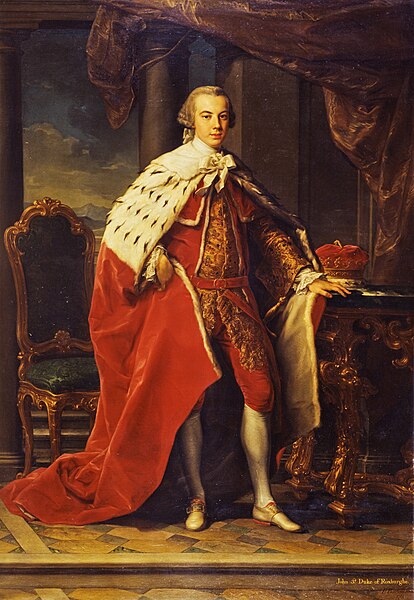
John Ker, 3rd Duke of Roxburghe,
by Pompeo Batoni 1761


While on his Grand Tour in Europe in 1761, John fell in love with Christiana Sophia Albertina (her first name was also spelled Christiane, or Christina), the oldest daughter of Charles Louis Frederick, Duke of Mecklenburg- Strelitz. His love was requited and the couple became betrothed. This was an imminently suitable match in every respect, equals in rank and intelligence. Unfortunately, not long afterwards, Christiana’s younger sister Charlotte became betrothed and then married to King George III of England. Because protocol did not allow an elder sister to marry a man of lower rank than a younger sister’s spouse (Christiana would have become Charlotte’s subject), the couple had to separate. Neither ever married.

Princess Christina of Mecklenburg-Strelitz,
German School c 1766

John found another grand passion, in his family’s library. The first and second Dukes had acquired various volumes, including some of great value. In his turn, John became a passionate collector of books. His collection included the 1st edition of Boccaccio’s Decameron, known as the Valdarfers edition. This was a legendary volume, which many had believed did not actually exist. It seems that that John’s father Robert Ker (the second Duke) found it in Italy and purchased it for 100 guineas, then brought it home and showed it to his friends at dinner for great acclaim. This dinner included Lord Oxford and the Earl of Sunderland, and young John was present. This event supposedly precipitated John’s urge to collect. However the Valdarfers edition was acquired, this volume became a centrepiece of John’s collection. He went on to become a dedicated bibliophile who collected ancient and unusual incunabula and books, and who was especially fascinated with Shakespeare. He was assisted in his purchases by a man named George Nicol (bookseller and publisher), who also assisted George III with his library acquisitions. Roxburghe’s library collection included numerous editions of Shakespeare’s works and books that mentioned Shakespeare as well as volumes printed by Caxton and other rare books. It also included pamphlets and broadside sheets of ballads. The collection was bound in green leather.

Itinerario di Ludouicode Barthema 

Bolognese nello Egypto from John Ker, 

3rd Duke of Roxburghe's collection


John died March 19, 1804. Because he had outlived his younger brother (who died March 20, 1781) and had never married or had children, the dukedom was inherited by his 2nd cousin twice removed William Bellenden, who became known at William Bellenden-Ker. The other titles John had inherited or acquired became extinct. At the time of his death, he reputedly had 10,000 items in his collection. Sadly, William, the 4th duke, died childless in October of 1805. The titles went dormant until Sir James Innes, baronet, a descendant of the 1st Earl of Roxburghe and one of multiple contenders, established his claim, changed his name to Innes-Ker, and became the 5th Duke of Roxburghe. Subsequently, in 1812, it was decided to put the collection up for sale. 9353 items were listed in the catalogue which was written by George Nicol HERE.  George Nicol also organized the auction, which was conducted by him and Robert Harding Evans, also a bookseller.  The sale began May 18, 1812, lasted over a month and was extremely successful, thanks to the competitive efforts of the Duke of Devonshire, Lord Morpeth, Lord Spencer and other wealthy collectors.  The Valdarfers Decameron was sold on June 17, 1812 for 2260 pounds to the Marquess of Blandford.  (The entire sale generated 23,341 pounds, breaking all records.)  Reverend Thomas Frognall Dibdin, a bibliographer associated with Lord Spencer, had invited a group of fellow book enthusiasts to dine at the St. Alban’s Tavern on the evening of the sale of the Decameron.  This dinner was the beginning of the Roxburghe Club.

A club for bibliophiles, its membership was made up of nobility, academics and professionals, who were united in their passion for books. They met every year on the same date as the original dinner to commemorate the sale of the Valdarfars edition of the Decameron. The club still exists, and its members (membership limited to 40) still dine together on the date of (or a date near the date of) June 17. The club has been known for producing facsimiles of rare books which the members gave to each other, as well as for publishing previously-unknown medieval texts. Their books were published in a particular, elegant style which became known as the Roxburghe style. The club continues to publish a diverse selection of works, and one can contact the club if one desires to purchase a club book. The history, list of members since its founding in 1812, and more about their books can be found at their website HERE.  Although the 3rd Duke’s library was sold, it was one of the great libraries of the Georgian eras. That library and John himself are remembered still today.

Sources include:

Google Books.  DeRicci, Seymour.  English Collectors of Books and Manuscripts and Their Marks of Ownership (1530-1930.) Cambridge: Cambridge University Press, 1930.  HERE;

Roberts, William.  The Book Hunter in London, Historical and Other Studies of Collectors and Collecting.  London: Elliot Stock, 1895.  HERE

The Encyclopedia Brittanica.  A Dictionary of Arts, Sciences, Literature and General Information, 11th edition, Volume 23. New York: Enclyclopedia Brittanica Co, 1911.  HERE

The Peerage.com.  Person Page 40279.  John Ker, 3rd Duke of Roxburghe.  (last edited 15 May, 2017)  HERE 

All images from Wikimedia Commons (public domain)

~~~~~~~~~

Lauren Gilbert, a member of the Jane Austen Society of North America, has a bachelor's degree in English, and is a long-time resident of Florida.  Her first published book, Heyerwood A Novel was released in 2011; her second novel, A Rational Attachment, is in process.  Please visit her website for more information HERE.


Editors Weekly Round-up, June 4, 2017

by the EHFA Editors

We hope you enjoy this week's round-up of articles from the blog:

by Kim Rendfeld


by Ruadh Butler


by Matthew Harffy


Saturday, June 3, 2017

A little-known saint from the Dark Ages: the tale of Bishop Birinus and Dorchester-on-Thames

by Matthew Harffy

When I first read that Dorchester had been an important town in the Anglo-Saxon kingdom of Wessex I had thought that it referred to the town that is in the modern-day county of Dorset. After all, Dorset is part of the West Country and would have been part of Alfred the Great’s Wessex. However, the research I was doing was about the seventh century, long before Alfred’s time and centuries before Wessex had become the pre-eminent power in Britain. It turned out that the Dorchester I had read about was not in Dorset, but in modern-day Oxfordshire and just thirteen miles southeast of Oxford. The Dorchester in question is Dorchester on Thames (or Dorchester-on-Thames).


It is a sleepy village now, picturesque and quintessentially English, with its timber-framed Tudor houses and the medieval abbey that dominates the settlement. It nestles in a bend of the River Thame just before it joins the Thames (or Isis, to use the alternative name for the river upstream of Dorchester), as it flows towards London and eventually the Thames Estuary and the North Sea. The modern name of the River Thames has often been thought to be derived from its two main tributaries, The Thame and The Isis. However, the ancient name of the river was Tamesis, which it seems was erroneously assumed to be made up of Thame and Isis in the middle ages.

Dorchester on Thames is picturesque and very English
The village of Dorchester is quaint and quiet and clearly well-to-do, but is hardly what one would consider a place of power. So what makes Dorchester on Thames so important in seventh century history?

The answer, as is so often the case with early medieval history, is linked to the rise of Christianity. In the early seventh century most of the tribes of northern Europeans who had settled in Britain, who we now call by the generic name of Anglo-Saxons were pagans. Incidentally, it was the Angles who gave England its name: Angleland. These Germanic tribes worshipped the gods that we all know as the pantheon made famous by the Vikings. The all-father Woden, Thunor, Tiw and Frige were the Anglo-Saxon equivalents of Odin, Thor, Tyr and Freya. But of course, Christianity is an evangelising faith, and from the north and west of Britain in the form of Irish missionaries, the word of the gospel was being brought to the pagans. And from the south of Britain, by way of the continent, came Christian missionaries sent by a series of popes from Rome.

These men of faith and learning must have been brave indeed to travel to unknown lands, having to learn the language and the culture of the warlike people and attempt to convert them to what they saw as the one true faith. These must have been formidable men, with passion and zeal and the patience to convince the Anglo-Saxons to convert. In most cases they did this through targeting the kings and the royal families. It seems that when a king decided to become a Christian, so did all his people. This certainly makes proselytising more efficient than if you had to convince every individual, but it still must have taken a great amount of courage and perseverance to get the warlike kings to turn away from the gods they had worshipped for generations and to whom they were said to be direct descendants!

Saint Birinus
One such European missionary was Birinus, now known as Saint Birinus. Before doing my research I had never heard of Birinus and I imagine that many of you reading this blog post will never have heard of him either. Not a great deal is known about him, save that he came from France at the order of Pope Honorius and set about converting the West Saxons. He landed on British shores at Southampton (Hamwic) where he founded the church of St Mary’s. Birinus had been made a bishop in Genoa and was obviously a man of great persuasion for, in 635, he had convinced Cynegils, King of the West Saxons, to allow him to preach the word of God to his people. Cynegils was in the process of negotiating an alliance with King Oswald of Northumbria. He hoped for Oswald’s aid against the rising star of the Anglo-Saxon warlords, Penda of Mercia. But the Christian Oswald baulked at joining forces with the pagan Cynegils and so it was that Cynegils was eventually baptised as a Christian by Bishop Birinus. Oswald became his godfather and also married Cynegils’ daughter. And the King of Wessex gave Dorchester on Thames to Bishop Birinus as his episcopal see.

For the next few years Birinus founded churches throughout the lands of the West Saxons before dying in 640. Shortly after his death, the bishop’s see shifted to Winchester, but it was Dorchester on Thames where the Christianisation of the West Saxons truly began.

Dorchester on Thames Abbey
There’s not a lot to remind us of the time when Dorchester on Thames was the centre of the episcopal see of Bishop Birinus. Nowadays, the village with a population of less than 1000 people, has a couple of pubs, the 12th century Abbey and also a Roman Catholic Church, a small convenience store, some allotments, and a primary school.

One of the pubs of Dorchester on Thames - The Fleur de Lys

I was pleased to see when I visited the village recently that the name of St Birinus is yet remembered in the name of the Roman Catholic Church and the primary school.


I wonder how many of the local inhabitants know who he was or why he is important, but I am sure the man who travelled from France to preach to the barbaric West Saxons would be pleased to know that his name was yet linked to both the church and the teaching of children in the village where he resided nearly 1,400 years ago.

A reminder of the past. An old milestone in Dorchester on Thames

It is interesting to note that the name of Cynegils, the king who gifted the village to Birinus, has not lived on in the same way, and I saw no mention of him in the village. Perhaps this is a reminder of how ephemeral earthly power is. Or perhaps it is more a testament to the fact that written records were kept by the church for many centuries before secular administrations caught up.


All photos copyright Matthew Harffy.

~~~~~~~~~~

Matthew Harffy is the author of the Bernicia Chronicles, a series of novels set in seventh century Britain. The first of the series, The Serpent Sword, was published by Aria/Head of Zeus on 1st June 2016, followed by the sequel, The Cross and The Curse in August and book three, Blood and Blade, in December. The fourth book in the series, Killer of Kings, was released on 1st June 2017.

Friday, June 2, 2017

Baginbun: Ireland’s Hastings?

by Ruadh Butler

When most people speak of ‘The Norman Conquest’ they are of course referring to the events that followed one of history’s most famous battles – Hastings.

Even though it was not the only Norman Conquest it is difficult to get away from 1066. The year has quite understandably become one of the most renowned; the cast are famous, the stakes never higher. And the incentive for the leaders was nothing less than the control of the kingdom of England. The outcome remained on a knife edge right to the end of the day. The Hastings campaign is simply chocked full of melodrama and even amongst the many battle honours of the Normans it still stands proudest.

So it is perhaps understandable that attempts have been made to compare the conquest of Ireland to that of England a hundred years before – that one great battle added unconquered Ireland to the Norman realm.

According to the famous medieval couplet: “At the creek of Baginbun, Ireland was lost and won.”

A Baginbun - image of modern Baginbun Point in County Wexford. 
You can still see the Norman earthworks running east-west between 
the two beaches at the headland's narrowest point.

It seems like a rather grand statement for such a little-known battle yet the rhyme has echoed down through the ages. But where is Baginbun? Who won Ireland? And who lost? Was Baginbun, like the Battle of Hastings, indeed a momentous turning point in history as the verse stated?

Baginbun Point from above the eastern beach.
The Martello tower is a Napoleonic era fortification.
It was from the fighting frontier of Wales that the men who took part in the Norman invasion of Ireland hailed. While the independent Kingdoms of Gwent, Glamorgan, Brecknock and Deheubarth had fallen to Norman freebooters within thirty years of Hastings, they had been unable to extend their web of motte and bailey castles very far from the southern coast. Their hold over this territory was severely tested several times but in 1164 it was shaken to its very core through the efforts of Rhys ap Gruffydd. Many Normans lost their lands to the resurgent Welsh. This change in fortune created a generation of desperate men, shorn of their lands and trained from youth to kill. Some would’ve travelled to the Holy Land where the victories of Nur ad-Din threatened the Kingdom of Jerusalem, but others would not have had that opportunity. It is unsurprising that when an exiled king from Ireland arrived in Wales appealing for mercenaries to help him reclaim his throne that he found many willing to follow in return for plunder.

Maurice Fitzgerald
Promised an estate of 200,000 acres by King Dermot MacMurrough (Diarmait Mac Murchada in Irish) in return for their help, the first Normans to venture to Ireland were led by Robert FitzStephen and his half-brother Maurice FitzGerald. Both were sons of the famous Princess Nest of Deheubarth and they commanded a multi-national and mongrel army of Normans, Flemings, Welshmen and Bretons comprising of forty knights, eighty esquires and around four hundred infantry and archers. It was a small force which nonetheless quickly forced Dermot’s many enemies into submission and allowed him to rise again as King of Leinster.

Taken by Ruadh Butler standing between the two massive Norman earthworks at Baginbun. When crowned with a timber palisade they would've been incredibly intimidating.
But this lofty position was no longer enough for Dermot. His mercenaries’ success had ignited a fierce ambition in him and one that would not be sated merely by sovereignty over one of the five major kingdoms of Ireland. He now set his sights upon the High Kingship. And for that aim to be realised he required an ally far greater than either FitzStephen or FitzGerald.

He needed the help of Richard de Clare. A Welsh baron from a powerful East Anglican dynasty, he became better known to history as Strongbow. His price for providing warriors for Dermot’s wars was steep. Similar to William the Conqueror, Strongbow wished to win a kingdom, although in his case he agreed to do this through marriage to Dermot’s daughter rather than bumping off the incumbent. Determined to see his own ambitions realised, Dermot agreed to the Norman’s terms and journeyed back to Ireland to await his new ally’s arrival.

But Strongbow did nothing. For three long years. The contents of one of Dermot’s letters survive through the writings of Giraldus Cambrensis and his frustration is obvious:

“Neither winds from the east or from the west have brought us your much desired and long expected presence. Let your present activity make up for this delay and prove by your deeds that you have not forgotten your engagements.”

Signpost to Baginbun Point.
Dermot’s rebuke finally forced Strongbow into action and in the summer of 1170 he despatched one of his chief warriors, the comically named Raymond the Fat, to Ireland to force a beachhead in advance of his own invasion of Ireland.

Raymond was a younger son of the Lord of Carew Castle and a nephew of both Robert FitzStephen and Maurice FitzGerald. Having little hope of inheritance from his father’s estate he had become a knight under Strongbow in Chepstow. Like his master he was desperate to win renown and wealth in Ireland. He could not have foreseen that his task in 1170, with only a small army of 120 at his side, would give him the opportunity to show his talent for war.

Giraldus Cambrensis describes Raymond as: “…very stout and slightly above the middle height, his hair was yellow and curly, and he had large, grey, round eyes. His nose was rather prominent, his countenance high-coloured, cheerful and pleasant. Although he was somewhat corpulent he was so active and lively that the encumbrance was not a blemish or inconvenience.”

Unlike the dominating and impressive Duke William who led the Normans at Hastings, it would be the largely unremarkable frontiersman Raymond the Fat who would lead the Normans at Baginbun.

The date on which he landed in southern County Wexford was probably around the first week of May. Then called Dun Domhnall (‘Donal’s Fort’), it now bears the name of Baginbun Point. The name itself – Bheag an Bun in Irish – is probably taken from the river inlet a little way south of the village of Fethard-on-Sea on the Hook Peninsula for it means ‘mouth of the small river’. Beaching their ship on the beach to the eastern side of the promontory, the Norman-Welsh army under Raymond – as had William at Pevensey – immediately began constructing an earth and timber fortification to defend the small headland. Behind their wall Raymond’s men corralled as many cattle as they could steal from local families in an area of about two acres. It was these activities that got the attention of Waterford.

Waterford had been occupied by Norse and Danes on and off since 853. Throughout its turbulent three hundred year history the inhabitants of the town had married into local native families and had taken on many of their customs including Christianity and the Irish language. They called themselves Ostmen – the men from the east. Like the other cities such as Dublin and Limerick, Waterford had become an economic centre for trade and had quickly attracted the greedy eyes of local magnates. On a number of occasions the sovereignty of the city had been lost to the most powerful families in Munster. By 1170, Waterford seems to have been vassal to the O’Brien dynasty, but their troubles with both the McCarthy and O’Connor families probably allowed the Ostmen to re-establish their independence to some extent.

What is certain is that they identified Raymond de Carew’s presence at Baginbun as a threat and under Ragnall Mac Giolla Mhuire they assembled an army of some 3,000 warriors to destroy his fort. The Normans found themselves outnumbered by at least twenty to one.

“Their small band of soldiers was unable to resist the attack of the multitudes to which they were opposed. Retreating to their camp, they were so hotly pursued by the enemy that some of them entered pell-mell with the fugitives before the barricade could be closed,” Giraldus wrote of the battle by the creek.

“Raymond, perceiving the strait to which his party was reduced, and that the peril was imminent, faced about bravely and cut down with his sword on the very threshold the foremost of the enemy who were forcing an entrance.

“Thus nobly retracing his steps while he dealt a terrible blow and shouted his war cry, he encouraged his followers to stand on their defence and struck terror into his enemy’s ranks. The enemy took to flight and, dispersing themselves over the country, were pursued and slaughtered in such numbers that upwards of five hundred quickly fell by the sword.”

Metal plate noting the significance
of the site at Baginbun.
Giraldus had visited Ireland some fifteen years after the events at Baginbun and would have heard the story perhaps from some of those who had fought there. He did not mention part of the story which appeared in ‘The Song of Dermot and the Earl’, a later narrative from the early thirteenth century, which described how a herd of cattle was driven into the Waterford army by the Normans. Stunned by the impact of the stampeding mass of animals, it was this that allowed Raymond to set the enemy to flight.

At the creek of Baginbun, Ireland was lost and won.

While it was an incredible victory against all the odds I don’t believe that the Normans’ triumph at Baginbun was the significant moment that the couplet insists. Unlike Hastings (or even Bannockburn), the victory did not decide the future of a nation. Ireland could not be won be simply beating one city-state – there were over a hundred more petty-kingdoms in addition to Waterford and five provincial kings fighting to be recognised as High King.

When he finally did arrive in Ireland on August 23rd 1170, Strongbow – the man most closely identified with the conquest – did not even land at Baginbun. Instead he made straight for Waterford, alighting at Passage East on the far side of the River Barrow. From there he marched to the walls of the city and put it under siege. Raymond’s victory had weakened Waterford, but little else had been accomplished on a strategic level.

What the Battle of Baginbun did do was to give Raymond the Fat a victory. From that victory grew confidence in his skills and soon he would earn great renown amongst the desperate men who had crossed the sea to conduct the Norman invasion of Ireland. By 1174, Raymond had become an almost mythical warrior amongst the colonists thanks to his audacious victories in Strongbow’s name. There would come a time when armies would refuse to march unless it was under his command. He had gone from a minor knight under a disgraced frontier baron to a lord of war. Ireland was not lost or won at Baginbun, but the glory from its victory gave Raymond the Fat the opportunity to lead the campaign for the future of that nation.

~~~~~~~~~~~~~

Ruadh Butler is the author of Swordland and Lord of the Sea Castle which is published by Accent Press on June 1st. The series tells the story of the Norman knights from Wales and their part in the first Norman invasion of Ireland. Catch up with Ruadh at www.ruadhbutler.com or on Facebook at www.facebook.com/ruadhbutler.

Swordland
Lord of the Sea Castle


Tuesday, May 30, 2017

Did the Saints Part over Medieval Politics?

By Kim Rendfeld


The official reason Saints Gall and Columbanus parted in the early seventh century is that Gall was too ill to accompany his longtime friend to Italy. But was that the real cause? Did they instead have a falling out over politics?

The pair went back decades. Gall and Columbanus got their education at Bangor, Ireland. Columbanus was born around 543. Gall was younger, born in Ireland in the latter half of the sixth century. His wealthy parents dedicated him to the Church as an infant, which probably means he was not their first child. At Bangor, Gall learned grammar, poetry, and Scripture, and was ordained a priest.

You might remember Columbanus as the young man who stepped over his weeping mother to leave home and pursue a life in the Church. He had forsaken all women, including her. That should be enough of a clue that he wasn’t the easiest guy to be around.

Still, he had followers. When Columbanus felt called to be a missionary to the Continent, Gall was one of his 12 companions. In early medieval times, travel was expensive, hazardous, and miserable, and the missionaries had no idea how the folk at their destination would receive them.


They landed in Gaul in 585, where they would have stood out. They spoke a different language, and even their tonsures varied from the Roman ones. Urged by the king of Austrasia to stay in his realm where he could protect them, Columbanus founded a monastery in castle ruins at Anegray.

The brothers lived an austere lifestyle. They mortified their flesh and practiced what a 7th-century monk called “extreme fasting,” eating only bark and herbs and the occasional food brought to them as charity. If we are to believe Columbanus’s hagiography, they received visitors seeking miraculous healing.

After a while, more monks joined the order, and Columbanus sought better place for his monastery. He chose Luxeuil, a site formerly sacred to pagans, a common practice. The abbey flourished for many years, but Columbanus got in trouble with Theoderic, the king of Burgundy, and Brunhilda, the monarch’s grandmother who ruled with him. Theoderic had sons born out of wedlock, and Columbanus refused Brunhilda’s request to bless them as heirs to the throne. He thought the king should get married and have children with a wife, but a queen meant less power for Brunhilda.

Theoderic was smart enough not to make Columbus a martyr, so he settled for the next best thing: exiling the troublesome missionary. Gall accompanied his leader on the heartbreaking journey in 610. They traveled along the Rhine to Lake Constance and settled in a wilderness near Bregenz.

And they began preaching again. They weren’t always popular. Apparently, people don’t take kindly to strangers breaking their sacred statues and throwing them in the lake. They also attracted the enmity of the governor, Gunzo.

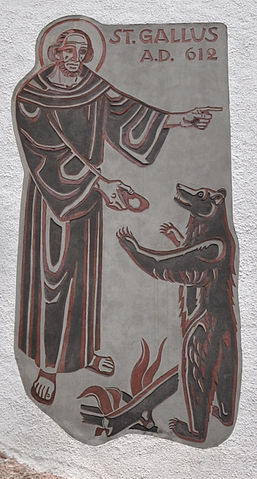
Still, Gall adjusted to life in the area. He enjoyed fishing on the lake and knew the local language. Legend has Gall, like Columbanus, able to command bears. The stories for Gall vary. One has him rebuking the beast in the forest. Awestruck, the bear brought firewood for Gall and his companions, and everyone warmed themselves by the fire.


A year later, Columbanus left for Italy. Gall stayed behind, apparently too ill for a journey. But even when he got better, he did not follow Columbanus. As arduous as travel was, it seems like Gall could have found a way to join his friend. They had faced danger and hardship before.

Perhaps, they did have a falling out, and it had something to do with Gall’s assistance to Gunzo’s ailing daughter Fridiburga. Betrothed to Sigibert, one of Theoderic’s illegitimate sons, the young woman was believed to be sickened by a demon. Sigibert sent two bishops to Überlingen to heal her, to no avail. Gall succeeded where they had failed and cured her. As a reward, Sigibert gave the Irishman royal land near Arbon for him to pursue a religious life.

Was Columbanus angry Gall had helped the enemy? Was Gall tempted by the offer of land? Or was he moved by compassion, believing a young woman’s soul was at stake? After all, why had he ventured to the Continent if not to save souls?

Regardless of Gall’s motivation, the gift of land made him a leader. The monastery had humble beginnings. He built a small, windowless stone hut—a cell for prayer—and an oratory. Soon 12 monks joined him, and they, too, wanted cells.

Gall preached, continuing his missionary work, and kept to his simple life. Apparently, he didn’t want power. When the see of Constance became vacant, the clergy—impressed with his learning and piety—unanimously chose him. Gall refused, saying that electing a stranger to lead the bishopric went against Church law.

His decision was a sacrifice, considering that an early medieval bishop or abbot could live an aristocratic lifestyle, form alliances with the nobility, and wield influence. Perhaps, Gall wanted nothing to do with politics. Or maybe he feared that luxury would corrupt him and endanger his soul.

In 625, Columbanus’s successor at the abbey at Luxeuil died, and Gall was asked to be its abbot. He again had a chance to hold power and again rejected it. At that point he might have been in his 70s. Did old age deter him? Or did he prize his humble life above everything?

Gall would live on for a while. He died Oct. 16, 646, and left behind a legacy. The abbey that bears his name went on to become a center for scholarship in Europe.

Images are public domain, via Wikimedia Commons.

Sources

"St. Gall" by Albert Poncelot, The Catholic Encyclopedia

The Lives of the Saints, Rev. Alban Butler (1711–73). Volume X: October

“Who Was St Gall” St. Gall’s Church, Carnalea, in Bangor County Down in Northern Ireland

Columbanus: Poet, Preacher, Statesman, Saint by Carol Richards

Medieval Sourcebook: The Life of St. Columban, by the Monk Jonas

Columba Edmonds, "St. Columbanus," The Catholic Encyclopedia

"Silverware in Early Medieval Gift Exchange: Imitatio Imperii and Object of Memory," by Matthias Hardt, Franks and Alamanni in the Merovingian Period: An Ethnographic Perspective edited by Ian Wood

~~~~~~~~~~

Kim Rendfeld has written two novels set in early medieval times and is working on a third.

You can order The Ashes of Heaven's Pillar, about a Saxon peasant who will fight for her children after losing everything else, at Amazon, Kobo, Barnes & Noble, and iTunes. Kim's first novel, The Cross and the Dragon, in which a Frankish noblewoman must contend with a jilted suitor and the fear of losing her husband, is available at Amazon, Kobo, iTunes, Barnes & Noble, Smashwords, CreateSpace, and other vendors.

Connect with Kim at on her website kimrendfeld.com, her blog, Outtakes of a Historical Novelist at kimrendfeld.wordpress.com, on Facebook at facebook.com/authorkimrendfeld, or follow her on Twitter at @kimrendfeld.