Showing posts with label cooking. Show all posts

Tuesday, November 20, 2018

Lady Elinor Fettiplace and Her Receipt Book

by Lauren Gilbert

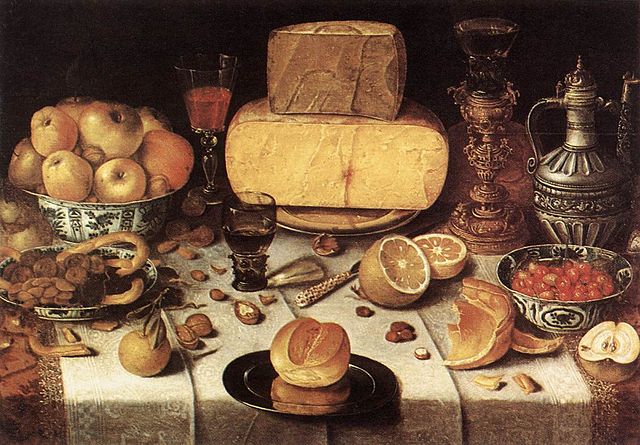
Laid Table by Nicholas Gillis, 1611

Old cookbooks and women’s household books or receipt books from times past are fascinating to me. So much “real people” information is to be found there: what they ate and when they ate it, how they celebrated, how they treated sickness or injury and which of those concerned them most, and other personal details of daily life can be found in these books. Women were responsible for the health, welfare, and feeding of their families, which at the wealthier end of the spectrum, included employees and visitors (uninvited as well as invited). Recipes were collected from friends and relatives and added to personal collections. The mistress of the household had to know what ingredients should be used and how dishes should be prepared (even if she did not do the cooking), make sure that medicinals and home remedies were properly prepared and available for use when needed, and that the supplies needed were available and techniques for completing tasks were known for household chores like laundry. Initially, these books were compiled by and for wealthy women (education being limited), but can still provide a view of their times that can illuminate the lives of people in general. One of the earliest of these books is the receipt book of Lady Elinor Fettiplace, of 1604.

Borne Elinor Poole c1570-1574, probably in Gloucestershire, to Sir Henry Poole of Gloucestershire and his wife Anne Wroughton (daughter of Sir William Wroughton of Wiltshire), Elinor was born into a family of “new men” making their fortune in the Tudor era by judicious marriages, holding positions with benefits and making themselves agreeable to important people. (The wool trade also helped.) Her paternal grandmother was a descendant of Sir Richard Whittington, a wealthy merchant who was Lord Mayor of London four times (and the inspiration for the story about Dick Whittington and his cat). Her paternal grandfather Sir Giles Poole was one of Henry VIII’s gentleman pensioners and prospered under all three of Henry’s children. (There was a family connection with the Earl of Leicester.) Her mother’s family prospered in a similar fashion. Other marriage connections included the Thynne family as well as Sir Walter Raleigh.

The Fettiplace family was an ancient line, which supposedly served William the Conqueror. Fettiplaces held various positions at court in the 13th, 14th and 15th century. They too made advantageous marriages and acquired large land holdings (at one point rumoured to hold 13 counties). At the time Elinor Poole married Richard Fettiplace in 1589, the Fettiplace name and land holdings were still impressive, but the family fortune was more uncertain. In February of 1589, her grandfather Sir Giles Poole died and left her a marriage portion of 400 pounds. It appears that, in their part of the marriage agreements, the Fettiplaces had to settle debts, which involved selling a certain amount of property. However, after the wedding of Elinor to Richard (later in 1589 after her grandfather’s death), influence by both sides got Richard invited to an important wedding at which Queen Elizabeth I was present in June of 1600. He was knighted during the celebrations. In 1604, Elinor wrote her name in her book of receipts with that year. The basic recording of the recipes themselves was apparently the work of a scribe, but she made notes herself. It’s important to realize that literacy among women was not particularly prized during this time; her ability to read and write (including knowledge of Latin) argues a more extensive education than was common even among upper-class women of this time.

The couple lived at Appleton Manor, near Oxford, where she would eventually have been responsible for the normal duties of the mistress of the house and prepared to manage the rest of the estate in her husband’s absence. The family in residence appears to have included Richard’s father Sir Bessell Fettiplace and mother (called Elinor or Helen) and his younger brothers and sisters. Elinor and Richard had 2 sons, John (the heir) born about 1589 and a younger son Henry born in 1602 about whom nothing else is known, as well as a daughter Anne born about 1594 who died in 1609. In between, there were 2 other daughters who did not survive infancy. It seems likely that Henry died in infancy or as a very small child, but his fate is not known. In 1603, Richard attended the coronation of King James, which indicated his holding a position of some influence. Son John was married in 1606 to his cousin Margaret Fettiplace. The young couple also lived at Appleton and had a son the next year.

Sir Bessells died in 1609 at which point Sir Richard came into his own, making Elinor the mistress of the household. (It appears that Richard’s mother retired on her jointure, making way for Elinor.) At this point, there was a multi-generational family living together (whether at Appleton Manor or at another family property) plus servants. Normally this would include a steward, a butler, a cook, a gardener, personal servants, and assistants to the others; similar households numbered as many as 100 or more persons. In addition to that, such households were responsible for providing hospitality to travelers and others, and assistance to local poor. Being an age of conspicuous consumption, Sir Richard and Lady Elinor Fettiplace would have been expected to “keep up with the Joneses” and maintain a similar standard of hospitality as that of their relatives and peers, many of whom were in high places indeed. Plague and other illnesses would also have to be dealt with. Elinor’s receipts included a plague remedy going back to Henry VIII and a herbal poultice from Dr. Thomas Muffet, scientist (whose daughter was the inspiration of Little Miss Muffet), as well as receipts for elegant cuisine (including a sweet potato dish attributed to Sir Walter Raleigh), and instructions for proper laundering of silk, whitening clothes and to prepare leather to be perfumed (perfumed gloves being a popular gift during the Elizabethan era).

Sir Richard Fettiplace died in 1615, leaving Elinor a widow. It appears she left Appleton Manor, retiring to her dower property (apparently near her family), leaving Appleton to her son and his wife and 4 children. She also spent considerable time at her father’s seat, Sapperton House. Her father Sir Henry Poole died in 1616 and left Elinor another 500 pounds and his coach. Sadly, Elinor’s son John died in 1619. At some point, Elinor married Edward Rogers, apparently a commoner known only as a citizen of Gloucestershire. This marriage appeared to be of fairly short duration. He died in 1623 and was buried at Sapperton church, leaving his entire estate to Elinor except for some bequests. After his death, Elinor lived on as a widow until her own death in 1647, which also appeared to have occurred in Sapperton. At her death, Lady Fettiplace left her book to her niece Anne, daughter of Sir Henry Poole the younger (her brother). The book was written in by other hands as it was passed on through the family and back to Fettiplace descendants until that branch of the family became extinct in the 18th century. It came into the hands of Hilary Spurling (author and theatre critic), as it was in the possession of one of her husband’s great-aunts. Ms. Spurling was fascinated by the book as a historical document. She put together a wonderful volume containing family information, historical context and the recipes themselves, as they were recorded (with Elinor’s notes where made) and then explains how to make these dishes today. This book gives an eye-opening view of Tudor and Elizabethan cuisine.


The original book itself (which I have not seen, unfortunately) is bound in leather and written on fine paper, with the Poole coat of arms stamped in gold on the cover. I do have Ms. Spurling’s book. The recipes are by month in her work, which illustrates the seasonality of food at that time. The recipes included some that appear to have been accumulated from times past (it was not unusual for a mother’s book to be copied and given to her daughter or daughter’s at the time of her marriage, then added to) as well as contemporary recipes. Spices were used differently than in medieval tradition, with a lighter hand. Citrus fruits were used, and lemon juice appeared. More vegetables were used, including imports such as the sweet potato. (I always envisioned lots of bread and meat, but not so many vegetables.) The recipes also indicated a level of knowledge of techniques that surprised me. Lady Fettiplace’s recipe “To Make White Bisket Bread” involves sugar, a small amount of flour, beaten whites of eggs and some crushed aniseed, combined together, formed into “coffins” (crusts) and baked; this is a recipe for meringues, which were not supposed to have been known (at least in England) in 1604. Clearly, Elizabethan cuisine was more sophisticated than many people believed. Ms. Spurling included suggestions for modern cooks and tried many of them successfully, as have others. Some of the more exotic ingredients such as rose water and ambergris are available (although not necessarily at the grocery store) and make it possible at least have an idea of what these foods might have tasted like. I plan to have a go myself. (The sweet potatoes sound especially nice, especially for Thanksgiving!)

Sources include:

Spurling, Hilary. ELINOR FETTIPLACES’S RECEIPT BOOK English Country House Cooking. 1987: Penguin Books, Middlesex.

Dickson Wright, Clarissa. A HISTORY OF ENGLISH FOOD. 2011: Random House, London.

David Nash Ford’s Royal Berkshire History. “Elinor Poole, Lady Fettiplace.” 2008. HERE

Epicurean Piranha. “The Magic of Meringue!” Posted September 10, 2012. HERE

Lost Past Remembered. “Elinor Fettiplace, Walter Raleigh’s Rose Sweet Potatoes, and an Excellent Negus,” posted by Deana Sidney on November 24, 2010. HERE

Image: Wikimedia Commons. "Laid Table" by Nicholas Gillis, 1611 (Public Domain). HERE

Image: Cover of ELINOR FETTIPLACE'S RECEIPT BOOK by Hilary Spurling-picture taken by Lauren Gilbert of her copy of the book.


~~~~~~~~~~~~~

Lauren Gilbert, author of HEYERWOOD: A Novel, lives in Florida and loves old cookbooks. She is working on A RATIONAL ATTACHMENT, due out soon.

Visit her website at http://www.lauren-gilbert.com for more information about her.

Friday, August 10, 2018

The Real Origins of the Ice Cream Cone

by Maria Grace

It is suggested that ice cream cones were an invention of an ice cream vendor at a fair (possibly the 1904 World’s Fair in St. Louis) in need of a way of serving their frozen treats. Who that ice cream vendor actually was and at what fair were they selling ice cream is a matter of some debate.

It does not take very long to fell that myth though. We know Italo Marchiony was granted a patent for a multiple cone mold on December 15, 1903 so ice cream cones were clearly around before the 1904 fair.

But just how far back do ice cream cones go? That’s where it all becomes rather interesting.

Wafers


Wafers, the stuff of which ice cream cones are made, date to the medieval era where they were an important part of a meal’s end. Over the next few hundred years, they came to be regarded as “stomach settlers,” served at the end to the meal to calm digestion.

Eventually—because creative cooks just can’t leave well enough alone don’t you know—wafers transformed into luxurious treats, making up an important element of the dessert course.  Rolled into three-dimensional shapes called funnels, cornucopias, horns or cornets they could be filled with all sort of fruit pastes, creams, and iced puddings—and chocolate, we must not forget the possibility of chocolate!

The first printed recipe for wafer cones is found Cleremont’s The Professed Cook from 1769.

Of Wafers and other Pastes

What is here meant by Cornets (Horn), is the thin Dutch Wafers twisted like a Horn.
Des Gaufres. 
Of Wafers. 
THE most fashionable are those made with cream. Mix as much powder-sugar as good flour, with a little orangeflower water-; put this into a proper vessel, and pour some good cream to it by little and little, stirring it very well with a spoon to hinder it from forming into lumps, and add as much cream as will make the paste or batter pour out pretty thick from the spoon. This is also made with Spanish, or sweet wine: mix an equal weight of sugar-powder and flour as before, and work it with one or two new-laid eggs, and sweet wine sufficient to make the batter of the same consistence as the first. They are also done with butter: use the flour and sugar as usual, add a little rasped lemon-peel, and a few drops of orange-flower water; mix as before by degrees, with very good butter melted in a little milk until it comes to the same consistence as others: the paste being prepared after this manner, of either kind, warm the waferiron on both sides, and rub it over with some butter tied in a linen bag, or a bit of virgin-wax; pour a spoonful of the batter, and bake over a smart fire, turning the iron once or twice until the wafer is done on both sides of a fine brown colour; if you would have them twisted, put them upon a mould ready at hand for that purpose; put it up directly as you take it out, and press it to the shape of whatever form you please, and so continue; always keep them in a warm place.
 .

From Wafers to Ice Cream Cones


One might note that Clermont does not actually talk about what to do with those cones once they are made. That was left entirely to the cook’s imagination. It was not until Francatelli’s The Modern Cook (1846) more than seventy five years later, that we see a specific recommendation that these wafer shapes be used to hold ice cream.  He recommended filling the wafer cornets with ice cream and using them to garnish ice cream puddings, including the rather spectacular creation Iced Pudding à la Chesterfield.

1342. ICED PUDDING, A LA CHESTERFIELD. 
GRATE one pound of pine-apple into a basin, add this to eight yolks of eggs, one pint and a half of boiled cream, one pound of sugar, and a very little salt; stir the whole together in a stewpan over a stove-fire until the custard begins to thicken; then pass it through a tammy, by rubbing with two wooden spoons, in the same manner as for a purée, in order to force the pine-apple through the tammy. This custard must now be iced in the usual manner, and put into a mould of the shape represented in the annexed wood cut; and in the centre of the iced cream, some macédoine ice of red fruits, consisting of cherries, currants, strawberries and raspberries in a cherry-water ice, must be introduced; cover the whole in with the lid, then immerse the pudding in rough ice in the usual way, and keep it in a cool place until wanted. When about to send the pudding to table, turn it out of the mould on to its dish, ornament the top with a kind of drooping feather, formed with green angelica cut in strips, and arranged as represented in the wood-cut; garnish the base with small gauffres, filled with some of the iced cream reserved for the purpose, place a strawberry on the top of each, and serve. (Emphasis added)

Were there Ice Cream Cones in the Regency?


But I’m pretty sure that someone made the leap to use wafer coronets for ice cream in that seventy-five year gap between Cleremont’s book and Francatelli’s. In fact, near the end of the Regency era, in The Italian Confectioner (1820), G. A. Jarrin “wrote, that his almond wafers should be rolled ‘on pieces of wood like hollow pillars, or give them any other form you may prefer.  These wafers may be made of pistachios, covered with currants and powdered with coarse sifted sugar; they are used to garnish creams; when in season, a strawberry may be put into each end, but it must be a fine’ . . . He suggested turning another of his wafers into ‘little horns; they are excellent to ornament a cream.” (Quinzio, 2000) Sounds like an ice cream filled cone to me!

Of course, that is only supposition, not concrete evidence. But fear not, we do have some tangible indication that ice cream cones might have been publicly consumed as early as 1807.

A colored engraving, titled Frascati, by Parisian Louis-Philibert Debucourt (1755-1832) published in 1807, depicted a Parisian café where at a “small table in the right hand corner of the engraving with two ladies and a gentleman. On the table is a carafe and a glass, and the buxom lady facing us appears to be eating out of a cone which she is holding in her right hand. The gesture is modern and familiar to all of us ice cream cone consumers in the 2lst century: cone slightly tipped, mouth open for a lick. Anyone would recognize this as an ice cream cone.” (Weir, 2004) (I can’t post the image here for copyright reasons, but you can find it HERE )

For more on Ice Cream in Jane Austen's World, click HERE.

Click Here for References


~~~~~~~~~~~~~~~~~~~~~~~~~~~~~~


Though Maria Grace has been writing fiction since she was ten years old, those early efforts happily reside in a file drawer and are unlikely to see the light of day again, for which many are grateful. 

After penning five file-drawer novels in high school, she took a break from writing to pursue college and earn her doctorate. After 16 years of university teaching, she returned to her first love, fiction writing.

Click here to find her books on Amazon. For more on her writing and other Random Bits of Fascination, visit her website. You can also like her on Facebook, or follow on Twitter.

Friday, February 9, 2018

Coffee, Tea and Chocolate: A cup for every purpose

by Maria Grace

During the regency era, there were three particular luxury drinks: tea, coffee and chocolate. They were in high demand, but expensive to acquire and, in the case of chocolate, difficult to make. Now of course luxury drinks needed accessories to go with them, just like our iphones need fancy cases—gotta show off the bling, right?  
Proper hostesses would do exactly that with specialized cups and pots for each beverage. The differences between the pieces were not random though, they were based on the way the drinks were created and enjoyed. Rather scientific, if you think about it. 

Drinking chocolate was often prepared in a large saucepan and then poured into special pots, known in France as a chocolatière, designed just for serving it. At first, when chocolate was a luxury limited to only the most elite, chocolate pots were made exclusively of silver with fine hardwoods or ivory used for the finials. In the early 1700’s, porcelain chocolate pots were made in China for export to Europe. Later, sturdier (and less expensive) pots were made of pewter or earthenware. Chocolate pots tended to be tall and relatively slender, looking a lot like coffee pots, but with a few significant differences in the lid, the spout and the handle. 

Drinking chocolate was very thick and tended to settle, so it was essential to continue whipping it with the molinet. To accommodate the molinet, a chocolate pot had a very distinct lid. The top of a chocolate pot had a hole for the molinet handle to extend from, allowing the hostess to stir the chocolate without splashing herself or her guests. The hole might remain uncovered, but in many cases a special hinged or swiveling finial would cap the hole and help preserve the heat in the chocolate. Sometimes the finial might be attached by a chain to the pot so it would not get lost.

Spouts on chocolate pots were wide and set high on the pot. Both qualities relate to the froth on the top of the chocolate. Since the froth floats on top of the chocolate, locating the spout high helps to capture the foam. Similarly, a wide spout facilitates getting it into a serving cup. A high spout also helps to keep the undesirable sediments that settled to the bottom out of the serving cups. 

The earliest chocolate pots had handles set at right angles to the pot. Usually these were made of wood, with a bit of a knob at the end. After the later part of the 1730’s, chocolate pots with looping handles in line with the pouring spout were produced. 

Drinking chocolate was thick, even syrupy, very different from tea or coffee. Its thickness, and the need to preserve the froth on top meant that special cups were required to properly enjoy sipping the chocolate through the milky froth. Here's where it gets particularly interesting--to me at least.

Chocolate cups were taller and narrower than coffee or tea cups. This would force the foam into a thick layer on the top and keep it from dispersing so quickly. Their unique shape also gave them a high center of gravity, which in English means it made them more likely to spill, especially if one's hands were less than steady.

That problem gave rise to a whole new style of china. 

The trembleuse or tasse trembleuse originated in Paris in the 1690's and was designed to allow those with trembling hands to drink with greater ease. It consisted of a cup, often with a lid and two handles, and a saucer with ether a deep well or a raised rim that steadied the cup and kept it from tipping. 
In contrast, teapots tend to be short and stout (remember the kids’ song?)  The round shape allows room for the tea to move in the pot, allowing it to steep more effectively. Their short spouts come from the center of the pot and sometimes have a grate behind to keep the tea leaves from clogging the spout.  The short length makes them easier to clean if leaves get trapped inside the spout. 

Because tea steeps near boiling, it must be slightly cooled before drinking. A tea cup has a wide open rim that tapers down to a smaller base and a handle designed to hook a single finger, all purposed to help cool the tea and prevent burns.

In many ways, coffee serving pieces do the opposite. Coffee pots are designed to help maintain the heat of the beverage, which preserves its flavor. The taller, narrow shape helps minimize heat loss. The longer, low-mounted spout helps keep cool air from circulating into the pot.


Coffee tastes best when served hot. Since it brews at around 180F, burns are not as much a concern as keeping the beverage hot. So coffee cups have a more vertical, cylindrical shape and bigger handles to accommodate two or three fingers which helps them conserve the beverage's temperature.

A proper regency hostess would have had all three sorts of china in her collection and been able to identify these pots at just a glance. In all likelihood, she would not have considered serving chocolate from anything but a chocolate pot. For the rest of us though, chocolate served from another sort of pot would still be chocolate, right? And that has to be a very good thing indeed.

References

Deitz, Paula. "Chocolate Pots Brewed Ingenuity." The New York Times. February 18, 1989. Accessed May 24, 2017. http://www.nytimes.com/1989/02/19/arts/antiques-chocolate-pots-brewed-ingenuity.html.
Kane, Kathryn. "Regency Chocolate:   The Correct Accoutrements." The Regency Redingote. August 02, 2011. Accessed May 24, 2017. https://regencyredingote.wordpress.com/2011/05/20/regency-chocolate-the-correct-accoutrements/. 
Righthand, Jess. "A Brief History of the Chocolate Pot." Smithsonian.com. February 13, 2015. Accessed May 24, 2017. http://www.smithsonianmag.com/smithsonian-institution/brief-history-chocolate-pot-180954241/.


~~~~~~~~~~

Though Maria Grace has been writing fiction since she was ten years old, those early efforts happily reside in a file drawer and are unlikely to see the light of day again, for which many are grateful. 

After penning five file-drawer novels in high school, she took a break from writing to pursue college and earn her doctorate. After 16 years of university teaching, she returned to her first love, fiction writing.

Click here to find her books on Amazon. For more on her writing and other Random Bits of Fascination, visit her website. You can also like her on Facebook, or follow on Twitter.


Friday, September 29, 2017

The Comfort of Soup

by Lauren Gilbert

Dinner at Haddo House, 1884 by Edward Emslie

It’s officially autumn (even though the temperatures do not reflect it where I live), and my menu planning is making a seasonal shift. As temperatures cool and winter approaches, a richer and more sustaining menu appeals. Soup is a favourite of mine for this time of year. An ancient dish, I suspect it evolved as soon as man figured out how to put edible things in a pot of water over heat. Soup is featured in virtually all culinary traditions and, of course, is a significant part of food history in Great Britain. As a history enthusiast, I enjoy reading details of normal life, including food, whether I’m reading fiction or non-fiction, as it gives an immediacy and life to the material.

The Forme of Cury

Peasant fare, elegant fare, or invalid fare, soup was a staple of the British diet. Early cookery books don’t show as many recipes for soup as for other dishes. I suspect this is because it was assumed that individuals already knew how to make the standard daily dish for the household, made from local ingredients to personal taste. The Forme of Cury, a cookbook from c. 1390 (originally a scroll showing authorship by “the Chief Master Cooks of King Richard II”), contained some soup recipes designed to be served to the nobility. The names frequently included “soppes” or sowp” as the dish was served over bread. One was “Fenkel in Soppes” which was shredded fennel, cooked in water and oil with onions, seasoned with saffron, salt and a spice mixture (“powder douce” which was a sweet spice mixture, left to the cook’s taste, that would contain some combination of cinnamon, galangal (related to ginger), nutmeg, sugar, etc.). It was served over toasted bread. Another similar recipe was “Slete Soppes”, which called for sliced leeks (white part only) to be cooked in wine, oil and salt, also served over toasted bread. A rather different matter is a “Cold Brewet”, which combines ground almonds cooked in wine and vinegar, seasoned with aniseed, sugar, green fennel shoots with ginger and cloves and mace. Cooked chopped kid and chicken meat is transferred to a clean dish, seasoned with salt and pepper, and boiled with the almond mixture. This soup was served cold.


Soup also had a medicinal function. Lady Elinor Fettiplace, during the Elizabethan era, put together a household book which included a recipe for almond soup designed for “a weake Back” in her recipes for October. For this soup, a rack of mutton and a chicken were boiled in water with raisins, prunes, and the roots and leaves of ditch fern until the meat was tender. The meat was removed and the broth strained. (Additional broth should be crushed out of the meat.) The broth was then thickened with ground almonds. The recommended dosage was 12 spoonfuls in the morning (fasting, i.e. before eating anything), and 12 spoonfuls before dinner.


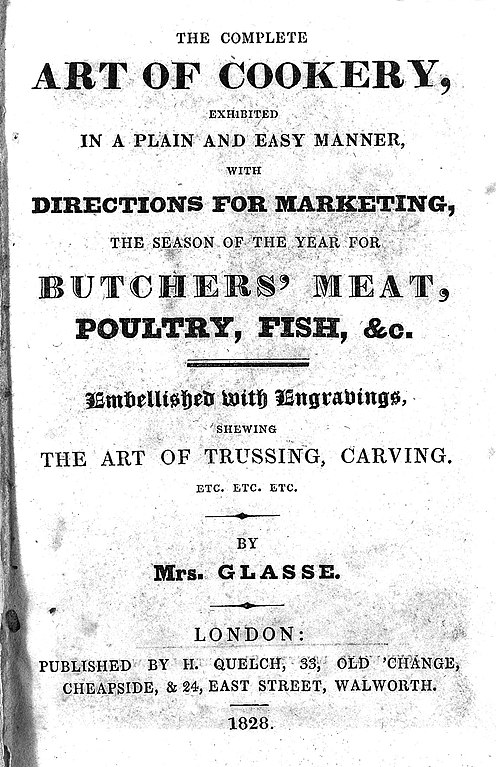
There were also soups designed for particular religious periods. Hannah Glasse’s The Art of Cookery Made Plain and Easy         included a section of a Variety of Dishes for Lent, which included eel soup. This recipe harked back to the medieval recipes as it was served over toasted bread. For every pound of eels used, the cook used a quart of water, a crust of bread, 2 or 3 blades of mace, pepper, an onion and a bundle of sweet herbs. (One pound of eels made a pint of soup, so the cook could control the quantity accordingly.) The pot was covered tightly and boiled until half the liquid was gone. The broth was then strained. Bread was toasted, cut into small pieces and placed in a dish; the broth was then poured over it.


During the Georgian era, turtle soup was considered the ultimate in elegant fare. Live sea turtles were captured and kept for fresh meat by sailors. Any left were brought in by sailors returning to port in the 1740’s-1750’s and sold for very high prices to the nobility. The popularity of the turtle was assured. At one point, as many as 15,000 live turtles were brought into England in a year. Different cuts of turtle meat had flavours reminiscent of fish, veal, beef or pork. The Compleat Housewife by Eliza Smith contains instructions for cleaning and preparing turtle soup. Once the meat from the body and fins are cleaned, cut them in pieces and stew together until tender, then strain off the liquid. Thicken the liquid and put the meat back in with kyon butter (possibly a compound butter of some kind), spices, pepper, salt, shallots, sweet herbs and Madeira wine to taste. The dish is put into the deep shell of the turtle, and baked in the oven. The extreme cost of a live turtle and the flavours of the meat resulted in recipes for Mock Turtle Soup, which used a variety of substitutions for the turtle, including beef, veal, oysters, tongue and calves’ heads. Hanna Glasse’s recipe includes a calf’s head (including the tongue and brains), veal broth, force-meat balls and eggs. The 67th edition of Mrs. Rundell’s A New System of Domestic Cookery published in 1844 contains 3 recipes for Mock Turtle Soup. Mock Turtle Soup maintained its popularity into the 20th century. (One could even find canned varieties.) Lewis Carroll based his character, the Mock Turtle, in Alice in Wonderland on this soup (a turtle with the head and back feet of a cow).

The Mock Turtle from ALICE IN WONDERLAND by John Tenniel

Soup recipes evolved over time as new ingredients became available and tastes changed. A classic example of this was Mulligatawny Soup. This soup was a chicken soup flavoured with curry. Rea Tannahill in Food in History indicated this soup appeared in England in the 18th century. British trade in India had been established since the 17th century and curry became a popular seasoning during the Georgian era. By the Victorian era, this soup was very popular. The edition of Mrs. Rundell’s A New System of Domestic Cookery mentioned previously has 4 recipes. The word “mulligatawny” (also spelled Multaanee and Malagatanee) was a corruption of the Tamil for pepper water. (The Tamil are an ethic group found in India and Sri Lanka.) The basic recipe called for onions and shallots, 2 chickens (or rabbits) pepper, butter, curry powder and turmeric, 2 quarts of strong broth, lemon juice and, if desired, a little curry powder to make it hotter. Keep in mind that curry powder was a spice mix made at home, to personal taste. (See English Historical Fiction Authors blog HERE.) One variation included cloves, and some garlic; another was made with veal, and the fourth included peas. This was a good way to use up leftover meat or vegetables. Subsequent versions included chopped apples. Cream could also be added; coconut milk may have been included. This soup is also still popular today.

Over the centuries, soup has been a common thread in culinary history. As we look back at some of the older recipes, the variety of seasonings and ingredients that are used today may seem surprising. We may not combine ingredients in exactly the same way, but it is easy to imagine how some of these soups may taste and the pleasure felt by the diners as they enjoyed them, whether elegantly spooning turtle soup at a formal dinner or enjoying the warmth of mulligatawny soup on a cold fall evening.

"Fall In For Soup", engraving by Edwin Forbes 1876

Sources include:

Dickson Wright, Clarissa. A History of English Food. 2011: Random House Books, London.

Glasse, The Art of Cookery Made Plain and Easy. A new Edition, with modern Improvements. Introduction by Karen Hess. 1805: Cottom & Stewart, Alexandria, VA. (Facsimile by Applewood Books, Bedford, MA)

Rundell, Maria Eliza Kettelby. A New System of Domestic Cookery: Founded Upon Principles of Economy and Adapted to the Use of Private Families. From the Sixty-Seventh London Edition. 1844: Carey and Hart, Philadelphia, PA. (Nabu Public Domain Reprint)

Smith, Eliza. The Compleat Housewife. 16th edition, with Additions. 1858: London. (Reprint edition published 1944: Studio Editions Ltd., London)

Spurling, Hilary. Elinor Fettiplace's Receipt Book. 1986: Penguiin Books Ltd. Hammmondsworth, England.

Tannahill, Reay. Food in History. 1988: Three Rivers Press, New York, NY.

Websites:

THE FORME OF CURY. HERE

History.com. “A Spot of Curry: Anglo-Indian Cuisine” by Stephanie Butler, April 26, 2013. HERE

GoogleBooks.com. Rumble, Victoria R. SOUP THROUGH THE AGES: A Culinary History with Period Recipes. 2009: McFarland & Company, Ind. Jefferson, NC and London. HERE

All illustrations from Wikimedia Commons Images, except for the cover of Elinor Fettiplace's Receipt Book, which is a scan of my personal copy.

About the author:

Lauren Gilbert holds a BA in English and is a long-time member of JASNA. She lives in Florida with her husband, and is the author of Heyerwood; a Novel. Another book, A Rational Attachment, is in process and will be coming soon. Please visit her website HERE for more information.


Tuesday, June 2, 2015

Spit and Grease - Food and the Hearth

by Deborah Swift

When we lived outdoors, the fire was essential for warmth and for cooking, and the earliest 'oven' was in fact a cauldron, covered in a lid, which itself was covered in burning embers, and then was suspended above the fire.

Norwegian early cauldron

Once we built houses and moved indoors, the focal point of any room, up until the invention of electricity, remained the hearth. This was the natural gathering place and should be in any historical novel. Because of this, I pay close attention to the correct type of hearth, mantelpiece, and fire tools when I'm planning my novels. For example, poorer houses might not light a fire every day but would send food out to the baker to be cooked in his big ovens for a fee. These characters would be colder and probably a lot less cheerful than their wealthier counterparts who would have many servants managing the whole paraphernalia of fire and cookery!

Up until the invention of matches, keeping the fire going was a priority because striking a light with a tinder and flint was very much a hit and miss affair. (For more information on Tinderboxes check Wikipedia ) Nobody wanted to wake to the chore of lighting a fire, so in the evenings the fire was banked up to keep it in, and smothered by a couvrefeu (fire cover) to stop it burning too hot. (I discuss these more in this article) So characters before they retire for bed, would ensure this task was done.

Tudor fireplace with firebasket and bread oven

Here is a Tudor fireplace where you can see wooden pegs on the mantel for hanging an upright spit, or for drying cloth or herbs, and also the essential  bread oven next to the main fire. Bread was a staple food, so most houses had a bread oven if they could afford it. Fireplaces were built to be wide and deep to enable cooking to take place there. When the fireplace moved to the wall of the room in medieval times, the back of the fire was lined with a metal fire-back. The fire was raised on bricks or sometimes on a fire-basket or brazier to provide for an up-draught under the fire.

18th/19thC firebasket with 17thC back plate

Bread and Meat

Bread ovens were built into the walls next to the fire to take advantage of the heat. In addition brushwood which burns fast and hot would be burnt inside with the door closed. The ashes would be raked out and then the bread put into the still hot oven to cook. Bread was inserted and removed on a peel - a long paddle. It had to be carefully watched in case it burned. No shoving it in and then coming back a few hours later!

Woman using a peel from a painting by Millet

This method was used right up until the 20th century in the countryside in England. (see this BBC link) Meat was cooked by rotating the joint on a spit before the fire, which had to be burning bright. Until the 18th century, a horizontal spit rested on hooks or notches in front of the blaze. For smaller joints, such as fowl, fish or rabbit, a cradle spit or basket spit, in which the joint was enclosed in a cage, were used. Fenders were devised in the 17th century to stop stray embers rolling out into the room. In books set before that, your characters would be likely to have to kick the embers back in using their boot.


The spit was turned by hand, using a cog and pulley system, or by dog power. (See the 17th century engraving below!) But by the 18th century an ingenious mechanical jack that ran by clockwork had been invented. At this time too, burnished metal hasteners (mirrors to reflect the heat) were clipped to the mantelpiece.


Medical use of Fat

Fat was collected in a 'dripping tray' and the dripping served many uses - in the 17th century it was used for candles, soap, and to waterproof shoes, as well as to grease cart axles and mill gears. Fat was also used in medicine mixed with herbs to make salves, but the type of fat was important, because the fat conveyed the quality of the animal to the person. For example the fat from a lively and lithe hare was used as an ointment for rheumatism.


Obviously in smaller households, the cooking would be done over the same fire that was used to heat the living space, whereas in wealthier households the cooking would be kept away from the owners of the house in a specially designated kitchen.

When I am researching my books I always investigate how the characters were fed - who did the preparing and cooking, and where it happened in the house. Each particular period has its new invention for the preparation of food, particularly the cooking of meat on the fire. By paying attention to these I can get to know intimate details of my characters' lives.

Links:
I  recommend 'Food in England - Dorothy Hartley'
Cooking with Fire
Roasting Christmas Beef
Tudor fireplace

~~~~~~~~~~~~~

Deborah Swift ~ Word addict, book addict. Nature, art and poetry fan, and writer of thought-provoking historical fiction, published by Macmillan/St Martin's Press/Endeavour Press. Creative writing tutor and writing mentor.
www.deborahswift.com 

@swiftstory
Amazon

Wednesday, May 27, 2015

A Taste for Offal-Tongue and Udder

by Lauren Gilbert


I have a great fondness for old cookbooks, and have a couple of facsimile copies of cookbooks in use during the Georgian era that I use for reference, as I can find bills of fare for every month of the year, and the proper courses for serving. Needing to check on dishes that would have been in season during the months of November and December, I pulled out my copy of The Compleat Housewife: or, Accomplish’d Gentlewoman’s Companion by Eliza Smith. As I leafed through, I paused at the May entry and spotted “Roasted Tongues and Udders.” After visualizing for a moment, I went on to December, and there I found “Roasted Tongue and Udder, and Hare.”

While I am no stranger to unusual dishes, I must confess that these menu items gave me pause. I wrote about the pupton on my own blog, which included a description of a “Pulpatoon of Pigeon”. I ventured into the area of offal in a discussion of “Ragooed Palates” which sounded surprisingly tasty. I am no stranger to the concept of tongue, with beef tongue as a main dish and in sandwiches being popular well into the 20th century, and fairly easy to find in my grocery store today. However, the idea of eating udders was something I had not previously considered.

In Mrs. Smith’s book, the following recipe appears: To roast a Tongue, or Udder. Take your Tongue or udder and parboil it, then stick into it ten or twelve cloves, and while it is roasting baste it with butter. When it is ready take it up, and send it t0 table with some gravy and sweet sauce.” (1) Apparently, since this method applied to both items, one could cook them together.


However, another recipe I found called for salting the tongue, letting it sit a few days, boiling with “a fine young udder” (2) until tender, then roasting them together with a basting of red wine and finishing with butter. After sticking the udder with cloves, this dish was served with gravy and a current jelly sauce. Hannah Glasse’s THE ART OF COOKERY MADE PLAIN AND EASY had a recipe that boils the tongue and udder together, calls for the insertion of cloves and basting with butter. However, her recipe calls for gravy and “gallintine-sauce” (her gallintine-sauce was made with bread crumbs, water, red wine and some sugar; there is a link below with a medieval recipe). I did not find a recipe that detailed the cooking of the tongue and udder with the hare all together. All of the recipes have sweetness in common, which seems odd to my modern taste.

Since this dish appears to have been fairly common over centuries, with recipes readily available, and served in the spring as well as the winter, it would be easy to assume it was popular fare. However, in my mind, offal in general is a very specific taste: one either likes it or does not. Samuel Pepys, the 17th century diarist, apparently relished it.(3) However, Parson James Woodforde commented in 1763 after a meal which included this dish, “...I shall not dine on a roasted tongue and udder again soon”....(4) Although I am open to trying new flavours, I suspect I might have more in common with Parson Woodforde than with Mr. Pepys. However, a roasted tongue and udder would certainly make an interesting addition to a winter dinner table in Georgian England.

Sources include:
Foodreference.com. “Roast Tongue and Udder.” (c) James T. Ehler, 1990-2015. (Footnote 2.) http://www.foodreference.com/html/r-tongue-udder-1209.html
HistoryNeedsYou. .“Recipe for Gallantine Sauce.” Posted 9/12/2012. http://www.historyneedsyou.com/blog/recipe-for-galantine-a-spicy-sauce-for-meat-c1390
Glasse, Hannah. THE ART OF COOKERY Made PLAIN AND EASY. A new EDITION, with modern Improvements. This edition first published 1805. Reprint published Bedford, MA: Applewood Books, 1997.
Smith, Eliza. The Compleat HOUSEWIFE: or Accomplished Gentlewoman’s COMPANION. First published 1758. Facsimile published London: Studio Editions Ltd., 1994. (Footnote 1 found on page 20)
TheOldFoodie.com “The Parson’s Tongue and Other Parts.” Posted 2/19/2006 by The Old Foodie. (Footnotes 3 and 4) http://www.theoldfoodie.com/2006/02/parsons-tongue-and-other-parts.html

Image “The Canon’s Dinner” from Wikimedia Commons.
Image “Frontispiece and Title Page of The Compleat Housewife: or Accomplished Gentlewoman’s Companion by Eliza Smith” from Wikimedia Commons

You can read in my blog The World of Heyerwood about puptons here https://laurengilbertheyerwood.wordpress.com/2012/04/29/food-in-history-what-is-a-pupton and a
bout ragooed palates here https://laurengilbertheyerwood.wordpress.com/2012/12/20/christmas-dinner-now-and-then 

~~~~~~~~~~~~~~

Lauren Gilbert lives in Florida with her husband and is working on a new novel, tentatively titled A Rational Attachment.  At least one interesting Georgian dish will be featured!  Her first published book, HEYERWOOD: A Novel, is available through Amazon.com and other outlets.  Visit her website at www.lauren-gilbert.com for more information. 


Friday, May 30, 2014

Jellies: Dessert, Medicine, Art Pieces and More!

by Lauren Gilbert

Growing up, when I thought of jelly, I thought of jelly as the apple-grape jelly my mother spread on toast and on my peanut butter and jelly sandwiches. I never thought of Jell-O as “jelly.” However, jellies have been popular since medieval times, and are so much more than a spread or a 9” x 13” dish of rubbery fruit-flavored treat adored by 20th and 21st century children. Expensive ingredients and elaborate moulds turned jelly into something extraordinary. They are a flexible dish that can take on certain aspects of many ingredients. They can be clear; they can be opaque. The addition of cream can add a creamy flavour and a silkier texture. Obviously powdered gelatin was not available. Hart’s horn, calves’ feet and isinglass (an expensive ingredient imported from Russia, made from the stomachs of sturgeon) were used to obtain the desired “jell”. Clear jellies required additional work, having to be filtered through the “jelly bag” to remove any pulp or fibers that might cloud the jelly.

Savory jellies, or aspics, have been a standby for centuries. Le Viandier, a 14th century French cookbook contains a recipe for aspic. The fact that a meat broth could become a jelly with cooling (thanks to the collagen in bones and cartilage) made all kinds of things possible. A wide variety of meat, poultry,eggs and fish have been served in this way. A very popular dish was jellied eel, which became popular in English cuisine in the 18th century. Eels produced a broth that jelled easily. In the Regency era, Careme, a famous French chef who at one point was employed by the Prince Regent, invented a dish called Chaud Froid (hot cold) which was prepared hot but eaten cold, which apparently included aspic.

Sweet jellies have always been favourites. These included fruit-flavoured jellies, wine jellies, sweetened cream jellies, and flummery, among others. They could be all one flavour or combinations of flavours and textures. The clear jellies were served in glasses, frequently in pyramids, which would have created a lovely effect with the light shining through. One example of a special jelly was “Oranges en Ruben”, which were orange skins filled with alternating layers of red wine jelly and creamy flummery in stripes, which must have been a lovely presentation. (The Petworth House and Park website has a recipe called “Stripey Orange Jellies” that seems very close to this special treat.)

It was considered that invalids were best nourished with dainty portions of foods that were easy to eat. Jellies would slip down easily, not aggravating a sore throat, or requiring much effort in chewing or swallowing. Calves’ foot jelly and pork jelly were considered especially strengthening. Pork jelly, such as Dr. Ratcliffe’s (or Ratteliff’s) Restorative Pork Jelly, was highly recommended for loss of appetite or any sort of consumptive complaint. There are multiple recipes for jellies recommended for varying complaints, most based on calves’ feet or hart’s horn. (I ran across one that included snails and citrus juice.)

There were establishments dedicated to the jelly. Just as there were coffee houses in the Georgian era, there were jelly houses that served jelly in special glasses. (According to Clarissa Dickson Wright, they were popular with prostitutes and their customers, so acquired a bad reputation.) In THE EPICURE’S ALMANACK, John Rylance specifically listed Tomlinson’s Jelly House in St James’s, that specialized in jellies only, and had been in business for over a century.

One of the aspects of jelly that maintained its popularity was the shape. Jelly moulds came in all kinds of shapes and sizes, from architectural forms (such as Solomon’s Temple) to fruit garlands, fish shapes and even multipart moulds that allowed for colour and textural contrasts. Moulded jellies maintained their popularity through the Victorian era, but gradually lost their appeal in the 20th century. Do visit the Petworth House and Park website; there are some wonderful photographs of jellies made in Georgian moulds. Take a look!

Sources include:

Brears, Peter. JELLIES AND THEIR MOULDS. 2010: Prospect Books, Totnes, Devon England. On-line at https://prospectbooks.co.uk/samples/Jellies.pdf

Dickson Wright, Clarissa. A HISTORY OF ENGLSH FOOD. 2011: Random House, London.

Rylance, Ralph. THE EPICURE’S ALMANACK Eating and Drinking in Regency London. Edited by Janet Ing Feeman. 2013: British Library, London.

Historic Food blog. “Jelly, Flummery and Creams.” http://www.historicfood.com/Jellies.htm

Petworth House and Park website. “Jellies, Jellies Everywhere!” http://petworthhouse.blogspot.com/2013/09/jellies-jellies-everywhere.html


Lauren Gilbert published her first book, HEYERWOOD A Novel, in 2011. She is currently working on another novel, in which Tomlinson's Jelly House will make an appearance, and has notes for a non-fiction work as well. She lives in Florida with her husband.

Thursday, January 31, 2013

SOME LIKED IT HOT! Cooking Curry in Jane Austen's Time

by Lauren Gilbert


On my first trip to England, one of the first things I wanted to try was Indian food, particularly curry.  I used to think that trying spicy food from other places was a modern taste, and it was not a concept that I associated with typical English cuisine of Jane Austen’s time.  However, history proves me wrong.  Cookbooks and recipes from the 18th and 19th centuries show that flavorful food was important, and herbs and seasonings were as important to cooks then as they are today.  Trade and colonies yielded new seasonings and tastes.   Travellers and immigrants had brought different seasonings and dishes into England, as did returning soldiers, sailors and traders.  Spices, especially pepper, at different times were an exchange item, valued as money.  Clearly, strong, distinct, spicy flavors had been incorporated into the culinary landscape, and hot seasoning was a part of that.  I had intended to present a broad overview of the use of herbs and spices in cooking during Jane Austen’s day.  However, I was distracted by Martha Lloyd’s curry recipes, so today our focus will be curry in Jane Austen’s time.
           There is a perception that the popularity of spices in earlier times was based at least in part on their value as preservatives, which is actually not correct.  It was driven by flavor and medicinal values.  Lack of refrigeration resulted in the “high” (tainted) flavor of meat, fish and poultries, so seasonings were used to disguise the taste.  (Spices were not effective as preservatives, and were too expensive to use in a quantity required for preserving, the way salt is used).  Cubeb and cayenne are both hot and spicy, and are listed in Culpeper (which indicates they could be grown in England). Uses of sauces and strong tastes, such as nutmeg, cloves, cinnamon etc. produced complex, sophisticated flavors that appealed to the wealthy.  When combined with the supposed medicinal values (hot spicy seasoning balanced cool moist humours of meat and fish), we can see how the desire for spices grew.
            Before 13th century, the taste for spice came back with the crusaders. Originally, the spice trade was controlled by the Arabs in the Middle East, but the Dutch and Portuguese became competitors, with the Dutch ultimately assuming control.   In order to participate in (and to try to ultimately control) the spice trade, the British East India Company was formed in 1600 to compete with the Dutch.  In 1608, the British East India Company established its first base in India, and, for the first time, Britain had access to spices that were not controlled by the Dutch.  Spice trade was driven by the craving for varied and exotic tastes as well as the medicinal values of various spices (spice was the first globally-traded commodity, one of the first pushes to globalization).  It is interesting to note that hot peppers (capsicum-cayenne peppers) were introduced into Asia by European traders after they were found in the New World (the name “Indian peppers” relates to the New World, not India).  English traders began to settle in India in the early 1600’s. 
           Indian seasonings gained increasing popularity in England as their flavors were brought with returnees from India who desired to recreate flavors they had come to enjoy, and shared them.  The cost of spices remained high in spite of English control of spice trade-almost constant warfare disrupted trade and consequently affected cost and availability.  There is disagreement on the origin of the word “curry”, but it was applied to Indian dishes with spiced sauces by the English in the 17th century.  The Hindostanee Coffee House was opened by Dean Mahomed in London in 1809, advertising Indian dishes better than any curries made in England before. (Hookah pipes could also be smoked there.)  Although Mr. Mahomed went bankrupt in 3 years (people did not dine out then as commonly as now), this restaurant remained open for some years under various owners.  Popularity spread to middle classes, in spite of cost.  (Note that the cachet of spices lessened somewhat as their perceived medicinal value declined due to improved modern medical knowledge, a loss of status which may have resulted in a slightly reduced monetary value that may have allowed them to be a bit more easily purchased by other than the wealthy classes. However the cost did not reflect any significant decline during the Georgian era, thanks to war, blockades and piracy.)  
          Curry was an established element of English cooking in the Georgian era.  In the 1st edition of of Hannah Glasse’s THE ART OF COOKERY MADE PLAIN AND EASY, she included a recipe for “Fowle Rabbit Currey” in which rabbit is stewed with rice flour (thickener), coriander seeds and black peppercorns, which would have been very mild (in the 4th edition, ginger and turmeric are included).  Hannah Glasse’s original recipe may have been one of the earliest examples of changing a recipe to suit a different population’s taste.  The 1774 new edition contains a recipe for “To make a currey the Indian way” (chicken with turmeric, ginger, salt and pepper) and for “A Pellew the Indian Way” (rice pilau with pepper, mace and cloves) on page 101.  
           John Mollard’s THE ART OF COOKERY Made Easy and Refined, 2nd edition had a recipe for “currie” (curried chicken) on page 81, referring to 2 T of “currie powder”, and cayenne pepper to taste, which seems to indicate an increasing fondness for the Indian spices and for heat.  There is also a “Currie of lobster” on page 83 and “A Peloe of rice” (pilau of rice) on page 95, while on page 254 there is a recipe for Currie (Pepper Water) which is apparently a version of what became known as Mulligatawny Soup.  Available information indicates that curry powders were widely known and subject to individual tastes; recipes for curry powder were highly variable.
           Curry is mentioned in Martha Lloyd’s household book: curry powder, curry soup, curried chicken. Martha was Jane Austen's friend, and lived with Jane, her mother and sister, before she finally married Jane's brother Francis.  It is safe to assume Jane Austen would have had curry dishes.  Note that Martha mentions use of cayenne and black pepper “to your taste...” so it seems evident that the heat level was a personal matter even then.  Martha’s recipe for curry powder contains turmeric, galangal (a ginger relative), cayenne pepper and rice flour.  (The use of few spices could be a matter of taste or a matter of cost, or elements of both.)   I made it up and used it in a dish similar to “A Receipt to Curry after the Indian Manner” from THE JANE AUSTEN COOKBOOK.  It is very mild, and has a nice flavor, perfect for someone who has never tried curry or for someone who doesn’t care for a strong or pungent curry.  The flavor could be deepened by increasing the turmeric and/or galangal, or by adding other Indian spices, such as cumin, coriander, or other spices.  One source indicated the rice powder would be a thickener of the sauce but I noticed very little thickening effect.  
           Curry maintained its popularity through the 19th century, coming to a peak in Victoria’s reign.  It declined in the early 20th century, but has become a staple of British cuisine again.  While the flavors may be somewhat different than those with which Jane Austen and her family may have been familiar, the concept and the spices combined to make curry would not be foreign to her.
Sources:  

Black,Maggie & Le Faye, Deirdre.  THE JANE AUSTEN COOKBOOK.  1995 : McClelland & Stewart Ltd., Toronto, Canada. 
Hickman, Peggy.  A JANE AUSTEN HOUSEHOLD BOOK with Martha Lloyd’s recipes.  1977: David & Charles Inc., North Pomfret, Vermont.
Tannahill, Reay.  Food in History.  1988, 1973: Three Rivers Press, New York, New York.
GoogleBooks.com. THE ART OF COOKERY Made Easy and Refined.  By John Mollard.  2nd edition, 1802.  https://play.google.com/books/reader?id=3nEEAAAAYAAJ&printsec=frontcover&output=reader&authuser=0&hl=en
GoogleBooks.com.  THE ART OF COOKERY MADE PLAIN AND EASY.  By Hannah Glasse.  A new edition, 1784.  https://play.google.com/books/reader?id=xJdAAAAAIAAJ&printsec=frontcover&output=reader&authuser=0&hl=en
A History of Curry.  (Undated, no author shown.) http://www.indepthinfo.com/curry/history.shtml
BBC News Magazine.  “How Britain got the hots for curry”, by Rumeana Jahangir.  (Page last updated 11/26/2009)  http://news.bbc.co.uk/2/hi/8370054.stm 
National Bureau of Economic Research website.   “The Worldwide economic impact of the Revolutionary and Napoleonic Wars”  by Kevin H. O’Rourke.  May 2005.  Dept. of Economics and IIIS, Trinity College, Dublin, and CPER and NBER.  http://www.nber.org/papers/w11344
The Curry House Online.  “A History of Curry” by David W. Smith, 2012.  http://www.curryhouse.co.uk
The East India Company website.  “East India Company Timeline”. Undated and no author shown.  http://www.theeastindiacompany.com/24/timeline
 YaleGlobal Online.  “SPICES: How the Search for Flavors Influenced Our World” by Paul Freedman, posted March 11, 2003.  http://yaleglobal.yale.edu/print/396

Lauren Gilbert lives in Florida with her husband, who has actually eaten and survived vindaloo curry.  She is the author of HEYERWOOD: A Novel, her first published book.  Her second novel is due out later this year.  Visit http://www.heyerwood.com!