Showing posts with label 18thc. England. Show all posts

Friday, September 29, 2017

The Comfort of Soup

by Lauren Gilbert

Dinner at Haddo House, 1884 by Edward Emslie

It’s officially autumn (even though the temperatures do not reflect it where I live), and my menu planning is making a seasonal shift. As temperatures cool and winter approaches, a richer and more sustaining menu appeals. Soup is a favourite of mine for this time of year. An ancient dish, I suspect it evolved as soon as man figured out how to put edible things in a pot of water over heat. Soup is featured in virtually all culinary traditions and, of course, is a significant part of food history in Great Britain. As a history enthusiast, I enjoy reading details of normal life, including food, whether I’m reading fiction or non-fiction, as it gives an immediacy and life to the material.
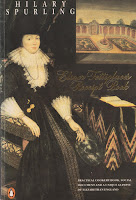
The Forme of Cury

Peasant fare, elegant fare, or invalid fare, soup was a staple of the British diet. Early cookery books don’t show as many recipes for soup as for other dishes. I suspect this is because it was assumed that individuals already knew how to make the standard daily dish for the household, made from local ingredients to personal taste. The Forme of Cury, a cookbook from c. 1390 (originally a scroll showing authorship by “the Chief Master Cooks of King Richard II”), contained some soup recipes designed to be served to the nobility. The names frequently included “soppes” or sowp” as the dish was served over bread. One was “Fenkel in Soppes” which was shredded fennel, cooked in water and oil with onions, seasoned with saffron, salt and a spice mixture (“powder douce” which was a sweet spice mixture, left to the cook’s taste, that would contain some combination of cinnamon, galangal (related to ginger), nutmeg, sugar, etc.). It was served over toasted bread. Another similar recipe was “Slete Soppes”, which called for sliced leeks (white part only) to be cooked in wine, oil and salt, also served over toasted bread. A rather different matter is a “Cold Brewet”, which combines ground almonds cooked in wine and vinegar, seasoned with aniseed, sugar, green fennel shoots with ginger and cloves and mace. Cooked chopped kid and chicken meat is transferred to a clean dish, seasoned with salt and pepper, and boiled with the almond mixture. This soup was served cold.


Soup also had a medicinal function. Lady Elinor Fettiplace, during the Elizabethan era, put together a household book which included a recipe for almond soup designed for “a weake Back” in her recipes for October. For this soup, a rack of mutton and a chicken were boiled in water with raisins, prunes, and the roots and leaves of ditch fern until the meat was tender. The meat was removed and the broth strained. (Additional broth should be crushed out of the meat.) The broth was then thickened with ground almonds. The recommended dosage was 12 spoonfuls in the morning (fasting, i.e. before eating anything), and 12 spoonfuls before dinner.
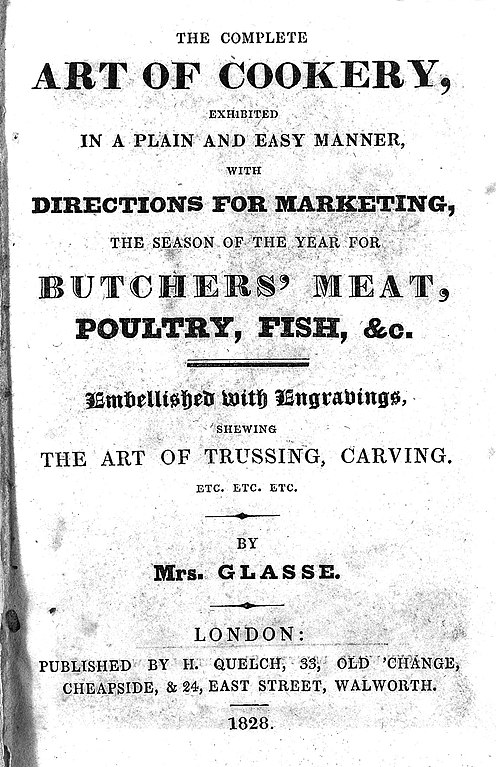

There were also soups designed for particular religious periods. Hannah Glasse’s The Art of Cookery Made Plain and Easy         included a section of a Variety of Dishes for Lent, which included eel soup. This recipe harked back to the medieval recipes as it was served over toasted bread. For every pound of eels used, the cook used a quart of water, a crust of bread, 2 or 3 blades of mace, pepper, an onion and a bundle of sweet herbs. (One pound of eels made a pint of soup, so the cook could control the quantity accordingly.) The pot was covered tightly and boiled until half the liquid was gone. The broth was then strained. Bread was toasted, cut into small pieces and placed in a dish; the broth was then poured over it.
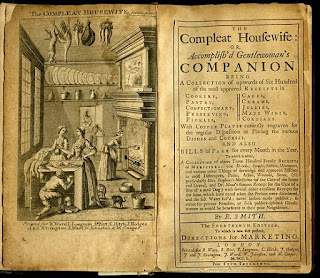

During the Georgian era, turtle soup was considered the ultimate in elegant fare. Live sea turtles were captured and kept for fresh meat by sailors. Any left were brought in by sailors returning to port in the 1740’s-1750’s and sold for very high prices to the nobility. The popularity of the turtle was assured. At one point, as many as 15,000 live turtles were brought into England in a year. Different cuts of turtle meat had flavours reminiscent of fish, veal, beef or pork. The Compleat Housewife by Eliza Smith contains instructions for cleaning and preparing turtle soup. Once the meat from the body and fins are cleaned, cut them in pieces and stew together until tender, then strain off the liquid. Thicken the liquid and put the meat back in with kyon butter (possibly a compound butter of some kind), spices, pepper, salt, shallots, sweet herbs and Madeira wine to taste. The dish is put into the deep shell of the turtle, and baked in the oven. The extreme cost of a live turtle and the flavours of the meat resulted in recipes for Mock Turtle Soup, which used a variety of substitutions for the turtle, including beef, veal, oysters, tongue and calves’ heads. Hanna Glasse’s recipe includes a calf’s head (including the tongue and brains), veal broth, force-meat balls and eggs. The 67th edition of Mrs. Rundell’s A New System of Domestic Cookery published in 1844 contains 3 recipes for Mock Turtle Soup. Mock Turtle Soup maintained its popularity into the 20th century. (One could even find canned varieties.) Lewis Carroll based his character, the Mock Turtle, in Alice in Wonderland on this soup (a turtle with the head and back feet of a cow).

The Mock Turtle from ALICE IN WONDERLAND by John Tenniel

Soup recipes evolved over time as new ingredients became available and tastes changed. A classic example of this was Mulligatawny Soup. This soup was a chicken soup flavoured with curry. Rea Tannahill in Food in History indicated this soup appeared in England in the 18th century. British trade in India had been established since the 17th century and curry became a popular seasoning during the Georgian era. By the Victorian era, this soup was very popular. The edition of Mrs. Rundell’s A New System of Domestic Cookery mentioned previously has 4 recipes. The word “mulligatawny” (also spelled Multaanee and Malagatanee) was a corruption of the Tamil for pepper water. (The Tamil are an ethic group found in India and Sri Lanka.) The basic recipe called for onions and shallots, 2 chickens (or rabbits) pepper, butter, curry powder and turmeric, 2 quarts of strong broth, lemon juice and, if desired, a little curry powder to make it hotter. Keep in mind that curry powder was a spice mix made at home, to personal taste. (See English Historical Fiction Authors blog HERE.) One variation included cloves, and some garlic; another was made with veal, and the fourth included peas. This was a good way to use up leftover meat or vegetables. Subsequent versions included chopped apples. Cream could also be added; coconut milk may have been included. This soup is also still popular today.

Over the centuries, soup has been a common thread in culinary history. As we look back at some of the older recipes, the variety of seasonings and ingredients that are used today may seem surprising. We may not combine ingredients in exactly the same way, but it is easy to imagine how some of these soups may taste and the pleasure felt by the diners as they enjoyed them, whether elegantly spooning turtle soup at a formal dinner or enjoying the warmth of mulligatawny soup on a cold fall evening.

"Fall In For Soup", engraving by Edwin Forbes 1876

Sources include:

Dickson Wright, Clarissa. A History of English Food. 2011: Random House Books, London.

Glasse, The Art of Cookery Made Plain and Easy. A new Edition, with modern Improvements. Introduction by Karen Hess. 1805: Cottom & Stewart, Alexandria, VA. (Facsimile by Applewood Books, Bedford, MA)

Rundell, Maria Eliza Kettelby. A New System of Domestic Cookery: Founded Upon Principles of Economy and Adapted to the Use of Private Families. From the Sixty-Seventh London Edition. 1844: Carey and Hart, Philadelphia, PA. (Nabu Public Domain Reprint)

Smith, Eliza. The Compleat Housewife. 16th edition, with Additions. 1858: London. (Reprint edition published 1944: Studio Editions Ltd., London)

Spurling, Hilary. Elinor Fettiplace's Receipt Book. 1986: Penguiin Books Ltd. Hammmondsworth, England.

Tannahill, Reay. Food in History. 1988: Three Rivers Press, New York, NY.

Websites:

THE FORME OF CURY. HERE

History.com. “A Spot of Curry: Anglo-Indian Cuisine” by Stephanie Butler, April 26, 2013. HERE

GoogleBooks.com. Rumble, Victoria R. SOUP THROUGH THE AGES: A Culinary History with Period Recipes. 2009: McFarland & Company, Ind. Jefferson, NC and London. HERE

All illustrations from Wikimedia Commons Images, except for the cover of Elinor Fettiplace's Receipt Book, which is a scan of my personal copy.

About the author:

Lauren Gilbert holds a BA in English and is a long-time member of JASNA. She lives in Florida with her husband, and is the author of Heyerwood; a Novel. Another book, A Rational Attachment, is in process and will be coming soon. Please visit her website HERE for more information.


Sunday, January 24, 2016

The Berry Sisters: Mary and Agnes Berry


My introduction to the Berry sisters came when they were mentioned in a novel.  In looking them up, I discovered that Mary, the older of the two, was a well-known author, and that the two sisters were personalities in society of their day, which spanned the Regency era.

Mary and Agnes Berry


Their father, Robert Berry, was the nephew of a successful and wealthy merchant, named Ferguson.  Mr. Ferguson achieved great success in London and Robert and his younger brother William were taken into his business.  Unfortunately, Robert Berry appears to have been something of a dreamer with a keener interest in literature than commerce, while William seemed to have a head for business.    Robert married a distant cousin, Elizabeth Seaton,  for love in 1762, despite the fact that she had no portion.  Robert’s income at that time was 300 pounds per year.  Mary, the couple’s first child, was born March 16, 1763 in Kirkbridge, Yorkshire.  Agnes was born May 29, 1764.  Sadly, Elizabeth Berry died in childbed in 1767 at the age of 23, and the baby died as well.   Their Grandmother Seaton cared for the two girls in Yorkshire, until they were moved to Chiswick in 1770.  Their governess’s marriage in 1775 ended their formal education.  There is an indication that, when Mary was 16, she was in love with a Mr. Bowman (or Bowden) but the relationship was disapproved and came to nothing.

In 1781, Robert Berry’s uncle died, leaving the bulk of his fortune and estate to William Berry, who took the last name of Ferguson, and a legacy of 10,000 pounds to Robert.  William, however, established an annuity for Robert of 1000 pounds per year.  Even though some sources suggest that Robert Berry’s reduced status of 300 pounds per year was a permanent state, at the time, it was still an income that allowed a comfortable life and, once Mr. Ferguson died, the family’s status definitely changed to a much higher standard of living. At this time, Mary and Agnes would have been young ladies of approximately 19 and 18 years of age.  In 1783, Mr. Berry took his daughters on a tour of Holland, Switzerland and Italy.  During this tour, the older daughter Mary took on the responsibility of acting as her sister’s and her father’s guardian.  Also in 1783, Mary began writing her journal in Florence, Italy, which became a lifelong activity.   The family returned to England via France in June of 1785.  While in Italy, Mary met General Charles O’Hara, governor of Gibraltar.


Agnes Berry


Subsequently, upon the family’s return to England, they spent some time in London and visited friends.  Attractive, well-informed, and charming, the young ladies became popular in society.  During the winter of 1787, Mary and Agnes became acquainted with Horace Walpole.  According to some sources, Mr. Walpole saw them but, because of their lack of social status, declined to be introduced them.  However, Mr. Walpole heard so many favourable comments about them that he allowed the introduction at their second meeting, and speedily became an admirer of the girls, especially of Mary.  This was the beginning of a significant and intimate friendship.  Mr. Walpole, who was in his 70’s, and the young ladies, both in their twenties, became very devoted, Mr. Walpole even referring to them as his “twin wives” (1).  He introduced them to many of his friends, and obtained a house for the Berry’s in 1789.


Mary Berry


In 1790, the Berry family went abroad for a year, maintaining a correspondence with Mr. Walpole.  On their return, he convinced them to take up residence near him in Little Strawberry Hill.  Subsequently, gossip arose about the nature of Mr. Walpole’s relationship with the Berry’s, and Mary tried to cancel the arrangement, but, citing his age, Mr. Walpole convinced her to disregard the gossip, and the family remained at Little Strawberry Hill.  Horace Walpole became the Earl of Orford in December, 1791.  There are indications that he thought of asking Mary Berry to marry him, but no indication that he ever did so.

At some point during this time, General O’Hara returned to England, and renewed his acquaintance with Mary Berry.  He became engaged to Mary before he returned to Gibralter in November of 1795.  Horace Walpole, Earl of Orford apparently liked General O’Hara, but was not aware of their engagement, which was apparently kept secret from everyone.  Mary and General O’Hara corresponded, but the engagement was broken off in June of 1796, at least in part because Mary could not make up her mind to announce their engagement out of concern for the Earl’s feelings.  This was a great sorrow to Mary for the rest of her life.

The Earl died March 2, 1797.  He left Mary and Agnes each 4000 pounds, and the house, garden and long meadow of Strawberry Hill jointly for their lives.   The earl left to Mr. Berry, Mary and Agnes his printed works and his manuscripts, to be published at their discretion with any income thereof to go to them.  Although Mr. Berry was supposed to be the editor, Mary actually did all of the work.  Mr. Berry’s contribution was a paragraph praising his daughter’s efforts in the preface.  The WORKS OF HORACE WALPOLE was published in 1798, the year after the earl’s death. 

Sometime after the Peace of Amiens in 1802, the Berry family went to Paris again.  During this visit, Mary was supposedly presented to Napoleon.     She returned to England just before her published play “Fashionable Friends” was put on at Drury Lane Theatre but failed.  (It had been a success in amateur performances at Strawberry Hill.)   Apparently, there were questions of the play’s morality.  Interestingly, Mary implied that the play had been written by Walpole.  Equally interesting, when editing Walpole’s works, she had included a play entitled “Mysterious Mother” with his work even though she had written it herself.  A third play by Mary called “The Martins” was not published or performed.  After the failure of her play at Drury Lane, she went back to France with Agnes and their father, where they travelled through the south of France into Switzerland and Germany.  The family returned to England in the fall of 1803.

At some point in this period of time, Agnes fell in love with and became engaged to a cousin, Colonel Robert Ferguson (the son of Robert Berry’s brother William).  However, the marriage did not occur.  There are indications of her uncle’s disapproval and of her own reluctance to take the final step.  At any rate, she stayed with her family.  In many respects, Agnes seems to have been in her sister’s shadow, less attractive, less lively and definitely in second place in Horace Walpole’s affections, even though Mary was proud of her sister’s artistic talent and abilities.

Mary Berry went on to publish in 1810 an annotated edition of the letters of Madame du Deffand to Horace Walpole written between 1766 and 1780 and Madame du Deffand’s correspondence with Voltaire between 1759 and 1775, for which she received 200 pounds.  Their father died May 18, 1817 at Genoa, and his annuity stopped, which resulted in Mary and Agnes having to live on their own income.   They gave up Little Strawberry Hill at this time, and took residence at Devonshire Lodge in Petersham.   In 1819, Mary produced a work on Rachel Wriothesley, Lady Russell, which included letters from Lady Russell to her husband Lord William Russell written between 1672 and 1682 as well as some other letters by Lady Russell.  Mary and Agnes became personalities, known for their gatherings in their London lodgings, where they attracted artists, writers, politicians and society’s elite, including the writers Maria Edgeworth and William Makepeace Thackeray, Lord Colchester,  the Devonshires, and the Duke of Sutherland, and the artist Thomas Lawrence.  Mary seems to have been the main draw with her liveliness and literary talent, but Agnes seemed to have a talent in arrange seating in a way that encouraged the flow of conversation.
  
Mary Berry, later in life

Mary’s most ambitious work was a major effort and became her most famous.  The first volume, titled “A Comparative View of the Social Life of England and France from the Restoration of Charles the Second to the French Revolution” was published in 1828.  The second volume “Social Life in England and France from the French Revolution in 1789 to that of July of 1830” came out in 1831.  These two volumes were reissued as a single volume under the title “England and France: a comparative View of the Social  Condition of both Countries” in the complete edition of her “Works” in 1844. 

Mary and Agnes seem to have maintained their social lifestyle as time went on, even as Agnes’ health began to deteriorate, noticeably by 1849.  She survived until her death in January 1852.  Mary did not long survive her sister, passing away November 20, 1852.  They are buried in the same grave in St. Peter’s churchyard, Petersham.  In 1865, Lady Theresa Lewis edited and published “Extracts from the Journals and Correspondence of Miss Berry from 1783 to 1852.”

(1)   Melville, Lewis.  REGENCY LADIES. P. 95
  
Sources include:
Melville, Lewis.  REGENCY LADIES.  New York: George H. Doran Company, 1926

Twickenham Museum.  “The Berry Sisters” (no author or publication date). Here.

A Web of English History.  “Mary Berry (1753-1852)” by Charles Kent, published 1885.  Website is the intellectual property of Dr. Marjory Bloy.  Here.

 Richmond.gov.uk.  “Local History Notes.  St. Peter’s Church, Petersham” (no author or publication date).   Here.

GoogleBooks.com.  ENCYCLOPEDIA OF BRITISH WRITERS, 16th, 17th and 18th CENTURIES, Alan Hager, ed.  “Berry, Mary.”  P. 20. New York: Book Builders LLC, Facts on File, 2005.  Here.

GoogleBooks.com. HORACE WALPOLE by Austin Dobson, 1893.   Here.  

Bartlebys.com.  EXTRACTS OF THE JOURNALS AND CORRESPONDENCE OF MISS BERRY.  Mary Berry (1763-1852).  Here.

Photos courtesy of Margaret Evans Porter, used with permission.

Lauren Gilbert's first published book, HEYERWOOD, A Novel, was released in 1991.  A second book, A RATIONAL ATTACHMENT, is in process.  She lives in Florida, and will be attending the Amelia Island Book Festival in February.  Find out more about her by visiting her website Here:


Sunday, May 3, 2015

A Poor Man's Divorce: The Sale of a Wife

by Lauren Gilbert


Caricature c 1820


The following notice appeared in an 1815 newspaper:
On Friday last [September 15th 1815] the common bell-man gave notice in Staines Market that the wife of ---- Issey was then at the King's Head Inn to be sold, with the consent of her husband, to any person inclined to buy her. There was a very numerous attendance to witness this singular sale, notwithstanding which only three shillings and fourpence were offered for the lot, no one choosing to contend with the bidder, for the fair object, whose merits could only be appreciated by those who knew them. This the purchaser could boast, from a long and intimate acquaintance. This degrading custom seems to be generally received by the lower classes, as of equal obligation with the most serious legal forms. 
The breakdown of a marriage is not a modern phenomenon.  Unfortunately, unhappiness in marriage was a very common situation throughout history in England (and elsewhere).  For centuries, annulment through the Catholic Church courts was an option but was not easy.  A pre-contract (an agreement to marry which was considered as binding as marriage itself), prohibited degrees of kinship (such a marriage required a dispensation; failure to obtain one would be a problem), and marriage by force or under the age of consent were all grounds for annulment.   Basically, an annulment is a statement that the marriage itself was an error.  The process was (and is) lengthy, required investigation and took several months or longer, and could be expensive in terms of donations to the church during the process.  In spite of the separation from Rome under King Henry VIII, the Protestant clergy retained similar requirements.
Divorce was another option but, again, was not easy.  In the 16th century in Europe, adultery was established as grounds for divorce and some Protestant clergy interested in ecclesiastical reform were in favour of allowing this in England, including the provision to allow the partner who had not committed adultery to remarry.  A watershed was reached when, in 1552 the Marquess of Northampton, who had separated from his first wife due to her adultery, obtained an Act of Parliament recognizing the validity of his second marriage.   Between 1700 and 1857, there were only three hundred-fourteen Acts of this nature. (1)   Women were only allowed to petition if adultery was combined with extreme cruelty and their cases had to be handled for them by a trustee as women were legally not allowed to enter into a contract.  A rare example of this is the case of Mary Eleanor Bowes, Countess of Strathmore who succeeded in obtaining a divorce, which included rescuing what remained of her inheritance and her obtaining custody of her children.  Her story is worthy of a blog of its own.  Divorce in this manner was expensive, scandalous and took a long time as well.  Obviously, it also required rank and influence.
The question comes down to this: what alternatives did someone who did not have rank or fortune have to end a marriage?  For many, the answer was simply to desert the other party.   (This was much more common for men than women.)  Given the difficulties with travel and communications, it was possible to leave one place and establish a new life in another, which some did in spite of the risk of getting caught.  Another option for a man was to put one’s wife up for sale.   Thomas Hardy used the sale of a wife as a plot device in his novel The Mayor of Casterbridge.  In The Reluctant Widow, Georgette Heyer had a character reading items aloud from a periodical, which includes this note:  On Friday, a butcher exposed his wife for sale in Smithfield Market...” (2)   How did such a thing work?
There is no way to know exactly when the process of selling a wife for the purpose of ending a marriage began.  It may have occurred as early as 1073, but the first established case occurred in 1553.  At its most basic, a man ended his marriage by selling his wife to another man.  Customs used for the sale of cattle were applied: a rope was put around the wife’s neck and she was led to the marketplace, paying toll along the way, where she was sold to the highest bidder at auction.  If this weren’t humiliating enough, the price was sometimes determined by weight.   As this was an auction, the auctioneer (possibly her husband) would have described her to the crowd of purchasers, possibly praising her virtues (which could improve the chance of sale and the purchase price) or listing her flaws (another potential source of punishment and humiliation).
This process took on an official form during the late 17th century and, once sold, the woman was considered to be married to her purchaser.  Sometimes, it must be said, there was collusion as the purchaser was the woman’s lover-in some instances, the woman apparently played an active role in her sale, surprising as it may be.  Many such sales occurred at fairs,  markets and other public places.  Smithfield Market in London (see the quote from Georgette Heyer above) was apparently a popular site for such activity as about 20 wife sales were held there in the 1790’s to 1830’s(3).  It appears that being held in public caused the sale to dissolve the existing marriage and establish the new one officially.    Also, having such a sale in public would have attracted more buyers who may have had more money to spend.   It’s unclear how many such sales may have occurred, as not all were advertised or otherwise noted.  While Kirsten Olsen considers that such sales were rare, indicating that only 91 were recorded between 1730 and 1799 (4), data in Maria Nicolaou’s work suggests a much more significant number.
The reasons for the wife sales vary as much as the reasons for divorce today: inability to get along, money problems, adultery, and so forth.  Sometimes, a soldier or sailor returned home to find that his wife had taken up with another man and simply wanted to finalize the end of his marriage.  The Marriage Act of 1753 increased government control of marriage, which made it more difficult for someone to deny that a marriage had occurred; if a divorce or annulment was out of reach, a sale could end the marriage just as effectively. 
Shockingly, such sales occurred through the 19th century into the 20th century, although they declined due to changing attitudes, especially during the Victorian era, when women became perceived as more delicate creatures in need of protection, and the sales process was perceived as uncivilized.  Also, the Marriage Act of 1857 put the issue of divorce into the civil courts which made it more accessible and affordable.  According to Maria Nicolaou, in 1919, a woman from Tottenham said that her husband had sold her, and another attempted wife sale occurred in Northumbria in 1979.(5)    
Sources include:
Houlbrooke, Ralph A.  THE ENGISH FAMILY 1450-1700.  1983: Longman Group Ltd, Harlow, Essex, England.
Heyer, Georgette.  THE RELUCTANT WIDOW.  G. P. Putnam’s Sons, New York, NY. Published 1946, 2nd American Edition, 1971.  (Footnote 2 from page 198)
Moore, Wendy.  WEDLOCK The True Story of the Disastrous Marriage and Remarkable Divorce of Mary Eleanor Bowes, Countess of Strathmore.  2009: Three Rivers Press (Random House), New York, NY.
Nicolaou, Maria.  DIVORCED, BEHEADED, SOLD Ending an English Marriage 1500-1847.  2014: Pen and Sword History, Barnsley, South Yorkshire, England.  (Footnote 3 P. 139, Footnote 5 p. 137)

Olsen, Kirsten.  DAILY LIFE IN 18th-CENTURY ENGLAND.  1999: Greenwood Press, Westport, CT.  (Footnote 4 p. 47)


Parliament.UK. “Obtaining a Divorce” (no date or author shown).  http://www.parliament.uk/about/living-heritage/transformingsociety/private-lives/relationships/overview/divorce   (Footnote 1)


Lauren Gilbert is a member of JASNA and lives in Florida with her husband.  Her first book, HEYERWOOD: A Novel, was published in 2011 and a second novel (working title A Rational Attachment) is expected to be released later this year.  Visit her website at www.lauren-gilbert.com.