Showing posts with label research. Show all posts

Wednesday, June 3, 2015

Bias in Historical Research

by Stephenie Woolterton
As historical fiction authors and historians, we study and create characters, plots, and worlds that transport our readers to the past. Although we cannot actually visit these bygone times (when will they invent that time machine?), we are able to build worlds so powerful that we hope our readers feel as though they are transported to them through their imaginations. Even if we’re writing about people who once lived, we will never be able to actually meet and speak with them. What we can do, however, is use the intensive historical detective skills we’ve gathered to construct stories of distant times and places - periods accessible only through research. An unavoidable part we encounter in this research process is bias.

What exactly is bias?

Simply put, bias is perspective. Perspective is largely the consequence of the author’s background and the current political, social, and economic circumstances of the time in which the author is writing. Bias in historical research refers to the adoption of a particular perspective from which some things become salient and others merge into the background. It is a conscious or unconscious tendency on the part of the writer or researcher to interpret what they research.

For instance, history was once predominately written by powerful white males who assumed that only wealthy white males made history. They determined what history was deemed worth recording, and the role of others (e.g. servants, wives, mothers, etc.) was felt to be insignificant. These days, historians often allow for bias in the evidence they gather, and even explain it when reconstructing what happened in the past. The problems encountered involve matters of the ‘truth’ of historical events, the question of a balance between historical details and fictional elements, and the demand for authenticity and accuracy in the material we write about. In this case, for both the novelist and the historian, meaning lies not in the chain of events themselves, but in the writer's interpretation of what occurred. Pressures to conform to existing norms can be strong. What is taken to be historically ‘true’ by powerful, highly acknowledged historians is not easy to dispute. There can be great difficulty with challenging existing historical authorities or established interpretations of how an event happened or the taken for granted, ingrained ‘facts’ about an historical figure. This can even influence what is published versus what is rejected.

Yet historians and authors do not live their everyday lives in a vacuum: gender, ethnicity, sexuality, religious beliefs, social background, and nationality all mean something. They influence the historian in terms of which topics to focus on, what questions to ask, which sources to consult, and the interpretations they glean. To practice research and to create historical stories of our own is to question and consider interpretations that are different from our own. A way to discern bias in research involves being reflective over your work, and to consider various viewpoints.

Is it possible to overcome bias?

Although complete detachment may not be possible, historians can put commitment to rational standards of historical inquiry ahead of a desire for a certain outcome, thereby significantly reducing the outright bias in their work. Even if historians are fair-minded, the information available to them is often biased. The best way to reconcile bias is to acknowledge it when using quotes or paraphrasing material, and to point out where similar sources agree or disagree. Never forget to interrogate and question your sources. Who wrote it? What was their motivation or intention? What was the context or background behind this document? Did someone have an axe to grind when they wrote it?

Historians have long been aware that the information available to them, be it in historical texts or visual sources, have often been selected for certain purposes: these artifacts reflect the concepts and interests of their creators. The historian’s job is to look at explanations that account for the motivations behind them so they can then look for coherence among various explanations of the same historical period (i.e. The French Revolution). Critical historians should always interpret their evidence cautiously.

Unfortunately, there are occasions where historians cannot get to the ‘facts’ behind biased or missing evidence. The available information may have been so culled as to yield an inaccurate impression of events. For instance, in my own research into the private life of the late eighteenth century British politician William Pitt the Younger, I have found ample evidence to suggest that large swathes of Pitt’s private papers were deliberately destroyed by his executor, Bishop Tomline. What was Tomline’s purpose for systematically destroying Pitt’s papers? His wife was in direct collusion, and together they acted to conceal something about Pitt’s domestic life that they did not approve of and felt did not fit with the posthumous image of the pure, unsullied Minister. Instead, the untarnished image of Pitt was portrayed: the stately politician without any taint or scandal. Here Tomline’s motivation was to set himself up as Pitt’s official biographer by sifting out what did not fit with the interpretation – the image – of Pitt that he intended to portray. After over two centuries, my intention through my biography of Pitt is partly to expose Tomline’s bias of Pitt’s character.

Historical writing as a cooperative endeavor: Historians working together 

A balanced and well-argued account with supporting evidence to assert your claims is central in historical research. It’s important to get your friends and colleagues to look over your work and to discuss your findings. History should be viewed as a cooperative, collective endeavor, with historians working together to arrive at and challenge accounts of the past. The freedom to question your own views, and those of others, in an open-minded way is a great method for reaching fair descriptions of the past.

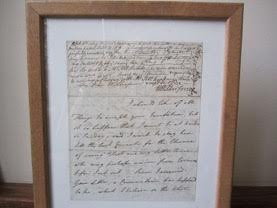
Image Source: My photo of a framed letter from William Pitt to his friend William Wilberforce (August 8, 1792) announcing his acceptance as Lord Warden of the Cinque Ports.

About the Author:

Stephenie Woolterton is currently writing a biography of William Pitt the Younger’s private life, primarily surrounding his female attachments. Her website is www.theprivatelifeofpitt.com and she’s on Twitter @anoondayeclipse.

Tuesday, June 2, 2015

Spit and Grease - Food and the Hearth

by Deborah Swift

When we lived outdoors, the fire was essential for warmth and for cooking, and the earliest 'oven' was in fact a cauldron, covered in a lid, which itself was covered in burning embers, and then was suspended above the fire.

Norwegian early cauldron

Once we built houses and moved indoors, the focal point of any room, up until the invention of electricity, remained the hearth. This was the natural gathering place and should be in any historical novel. Because of this, I pay close attention to the correct type of hearth, mantelpiece, and fire tools when I'm planning my novels. For example, poorer houses might not light a fire every day but would send food out to the baker to be cooked in his big ovens for a fee. These characters would be colder and probably a lot less cheerful than their wealthier counterparts who would have many servants managing the whole paraphernalia of fire and cookery!

Up until the invention of matches, keeping the fire going was a priority because striking a light with a tinder and flint was very much a hit and miss affair. (For more information on Tinderboxes check Wikipedia ) Nobody wanted to wake to the chore of lighting a fire, so in the evenings the fire was banked up to keep it in, and smothered by a couvrefeu (fire cover) to stop it burning too hot. (I discuss these more in this article) So characters before they retire for bed, would ensure this task was done.

Tudor fireplace with firebasket and bread oven

Here is a Tudor fireplace where you can see wooden pegs on the mantel for hanging an upright spit, or for drying cloth or herbs, and also the essential  bread oven next to the main fire. Bread was a staple food, so most houses had a bread oven if they could afford it. Fireplaces were built to be wide and deep to enable cooking to take place there. When the fireplace moved to the wall of the room in medieval times, the back of the fire was lined with a metal fire-back. The fire was raised on bricks or sometimes on a fire-basket or brazier to provide for an up-draught under the fire.

18th/19thC firebasket with 17thC back plate

Bread and Meat

Bread ovens were built into the walls next to the fire to take advantage of the heat. In addition brushwood which burns fast and hot would be burnt inside with the door closed. The ashes would be raked out and then the bread put into the still hot oven to cook. Bread was inserted and removed on a peel - a long paddle. It had to be carefully watched in case it burned. No shoving it in and then coming back a few hours later!

Woman using a peel from a painting by Millet

This method was used right up until the 20th century in the countryside in England. (see this BBC link) Meat was cooked by rotating the joint on a spit before the fire, which had to be burning bright. Until the 18th century, a horizontal spit rested on hooks or notches in front of the blaze. For smaller joints, such as fowl, fish or rabbit, a cradle spit or basket spit, in which the joint was enclosed in a cage, were used. Fenders were devised in the 17th century to stop stray embers rolling out into the room. In books set before that, your characters would be likely to have to kick the embers back in using their boot.


The spit was turned by hand, using a cog and pulley system, or by dog power. (See the 17th century engraving below!) But by the 18th century an ingenious mechanical jack that ran by clockwork had been invented. At this time too, burnished metal hasteners (mirrors to reflect the heat) were clipped to the mantelpiece.


Medical use of Fat

Fat was collected in a 'dripping tray' and the dripping served many uses - in the 17th century it was used for candles, soap, and to waterproof shoes, as well as to grease cart axles and mill gears. Fat was also used in medicine mixed with herbs to make salves, but the type of fat was important, because the fat conveyed the quality of the animal to the person. For example the fat from a lively and lithe hare was used as an ointment for rheumatism.


Obviously in smaller households, the cooking would be done over the same fire that was used to heat the living space, whereas in wealthier households the cooking would be kept away from the owners of the house in a specially designated kitchen.

When I am researching my books I always investigate how the characters were fed - who did the preparing and cooking, and where it happened in the house. Each particular period has its new invention for the preparation of food, particularly the cooking of meat on the fire. By paying attention to these I can get to know intimate details of my characters' lives.

Links:
I  recommend 'Food in England - Dorothy Hartley'
Cooking with Fire
Roasting Christmas Beef
Tudor fireplace

~~~~~~~~~~~~~

Deborah Swift ~ Word addict, book addict. Nature, art and poetry fan, and writer of thought-provoking historical fiction, published by Macmillan/St Martin's Press/Endeavour Press. Creative writing tutor and writing mentor.
www.deborahswift.com 

@swiftstory
Amazon

Wednesday, March 4, 2015

The Joy of Archival Research

by Jacqui Reiter


My first brush with archives was about seventeen years ago. I was eighteen and just returned to London from a five-year sojourn with my diplomat father in Washington DC. My university course was due to begin in September, but in the meantime I had a few weeks to kill so I travelled down to Kew and signed up for the Public Record Office.

Quite a few things have changed in the past seventeen years. For one thing, the Public Record Office is now called the National Archives (turned out it was NOT a good idea to carve “Public Record Office” above the front door in stone).

Before ...
 
... and after (spot the difference)

All documents are now ordered up via computer, so no more fiddly scrips of paper and no more VERY annoying pagers going “Brrriiiiip!” every time one of your documents reaches the reading room. Photography is permitted, nay encouraged (most desks have integral camera stands).

Quite a lot of things, though, are still the same. The desks are still about the size of a cereal packet. The staff are still super-helpful. And I still get that thrill of excitement every time I open a box, see the reams of off-white foolscap covered in browning ink, and smell the delightful almondy scent from the paper. I love that smell so much I am always reluctant to wash my hands after leaving an archive. I always do, of course, but I always feel regret as I soap up.

How often, after all, do we authors get to handle something that was actually touched by our characters or historical interests? Each letter has so much to say about the person who wrote it, and not just what’s written on the page. There are the scrawls covered in blotted finger-prints that speak of great hurry, or disturbance of mind; the occasional omission or scratched-out words where the author has changed his or her mind and left something out (sometimes you can even make out what it was!).

There are the letters that were clearly considered less important than others, which double as diaries (“Meet Smith Wednesday at 3” pencilled on the back of a packet), or “to do” lists, or sketch paper, or on one occasion was used by the recipient’s three-year-old daughter to practise her penmanship (“I LOV YOU UNKLE JOHN I KIS YOU”). There are the shakily-written letters with a post-scriptum apologising for having been written in a carriage. And then every so often there are the strings of correspondence that come together like a jigsaw puzzle: turns of phrase that don’t make sense unless matched with the responding letter; full-blown arguments conducted across the post. Archives are not just repositories of information: they are museums where users are encouraged to interact with the exhibits.

Over the years I’ve visited dozens of archives. They vary in size and holdings, and in their range of facilities, but I have never yet met an unapproachable archivist who has not been eager to help me in my research. Archivists and researchers, indeed, tend to have a symbiotic relationship of sorts, for archivists rely on users to inform them of documents that are misfiled or mislabelled, or falling apart (I found one full of “woolly bears”, or paper-eating mites, not long ago). And of course researchers depend on the archivists to keep documents well-catalogued and accessible, and in good condition, not to mention all the detective work an archivist can help you with if you ask the right questions…

Nowadays using archives (at least in the UK) is becoming easier and easier. The National Archives is putting more and more catalogues, of various levels of detail, on the web. Now that the National Archives itself is completely based at Kew, a copy of most UK archive catalogues (and some foreign ones too) are held on-site and repay a day or two of examination. But the “gateway to the archives” through the National Archive’s website, comprising of several digitised catalogues and the most wonderful Register of Archives -- fully searchable, and free -- is a truly amazing resource that any historian or novelist MUST become familiar with.

New projects are also coming online every day. For example, Southampton University is currently putting online their marvellous catalogue of the Duke of Wellington’s papers, in time for the bicentenary of Waterloo in 2015. In this case the catalogue is almost good enough to supersede the need actually to read the documents themselves, but the best thing about these catalogues is that they make it so much easier to know what is available. Sixteen years ago when I started university none of this was available. It was only just becoming available when I completed my PhD nine years ago.

None of it, of course, beats actually going to the archives and handling the letters themselves-- not just because historians mistranscribe, and going to source is often the best way to do research. It’s because reading two hundred year old (or older!) letters is the easiest form of time-travel. Sometimes in the reading room of an archive, I try to imagine my character at his desk reaching for a sheet of gold-edged foolscap, folding it in half, dipping his pen in ink, and sketching in the date. I rest my hand lightly against the edge of the page next to the inky fingerprint and think to myself, “He definitely touched this piece of paper, here."

It’s magic.

Links

National Archives catalogue (including what was formerly known as Access2Archives and the National Register of Archives)

ARCHON (National Archives list of local repositories)
Archives Hub
University of Southampton Wellington Database
British Library Manuscripts Catalogue
Institute of Historical Research

~~~~~~~~~~~~~

About the Author
Jacqui Reiter has a Phd in 18th century political history. She believes she is the world expert on the life of the 2nd Earl of Chatham, and is writing a novel about his relationship with his brother Pitt the Younger. When she finds time she blogs about her historical discoveries at http://alwayswantedtobeareiter.wordpress.com/.

Saturday, December 13, 2014

Odd Details in History Spark a Story

by Carl E. Ramsey

“There’s something wrong with this scroll….” The main hero in my recently published Arthurian screwball comedy, Sir Christian de Galis and the Fish Gravy, confronts the main heroine, a lady who only looks harmless. “It begins with sixteen kings and one duke. Then the knights are numbered one through one hundred forty-nine. But that adds up to one hundred sixty-six names. You said one hundred sixty-seven. Was someone else also removed from the Honor Roll? If so, I hope it was Sir Dagonet! Or is this scroll a fake?”

There does seem to be an error in the scroll that Sir Christian examines, or at least an inconsistency on the document as it appears on in the library of Henry VIII. Researching John Leyland’s Assertion of King Arthure, in Merlin by Norma Lorre Goodrich, I discovered that Merangis des Portz and Gauuaine le Franc are sequentially listed with the same number on a roster of Round Table knights.

And it wasn’t with just any number, but fifty-two. I designated my find, a diamond in the details and developed it into an ongoing comedy routine about scribes “who began playing cards while copying scrolls. That’s when they made their scribal error with the number fifty-two.” Incidentally, card playing in the historical middle ages is mentioned in the Parson Letters.

For punishment and to protect the two scribes from the two angry knights who “were savagely outraged when they found out.” they were sentenced to the peasant crew that cleans out the castle gardé robe pits where “the scribes’ sensational new aroma should keep them at a safe distance until things—ahem—blow over.”

Another diamond in the details, which seems just right for providing humor in future installments of Sir Christian’s quest, appears on the Bayeux Tapestry. It was brought to my attention that a right handed archer is shown placing his arrow on the right side of an archery bow. When I tried that at a Renaissance Festival I was corrected by a resident archer. Comparing notes with online contacts, Charles Bazalgette thought the tapestry artist made a mistake or the archer in the tapestry actually shot that way. However, he also was corrected when he placed the arrow on the wrong side of the bow while taking up archery as a teenager. He mentioned the archer’s paradox: when the arrow is fired on the correct side of the bow, it “flits around the bow and straightens up'. Strangely, or interestingly enough, this inconsistency in placing the arrow on supposedly “the wrong side” of the bow has been noticed on other ancient or medieval archery pictures.

A third diamond in the details which I noticed while doing research for my Arthurian comedies involves the name “Longinus” given to the centurion who stuck the pilum or spear into side of the Lord Jesus at the crucifixion. This spear then becomes a sacred sought after item. It appears in Arthurian fiction in the tale of the Dolorous Stroke and in history during the first crusade where it is supposedly found in Jerusalem in such a way that it leads the crusaders to victory.

But let’s return to the name Longinus, a name so popular and interesting that Henryk Sienkiewicz assigns it to a symbolic character in his Nobel Prize winning story, With Fire and Sword. In the Biblical tale, The Spear, by Louis de Wohl, the complete name of the crucifixion centurion is Gaius Cassius Longinus. How many ever noticed that complete name also belonged to Gaius Cassius Longinus, one of Caesar’s assassins so notorious that he is listed at the lowest level of Dante’s Inferno.

What I labeled diamonds in the details in this blog are little known facts, mistakes, or connections hidden in information that a researcher may discover when writing a story. But to get at them, he has to look through piles of boring lists, check out something odd about a picture, or while researching a name. Moving from the medieval to other world history, how many noticed that Anastasia, the name of the Russian princess, who supposedly escaped the assassination of the Tsar’s family, means “Resurrection.” In doing US veterans work, I discovered that Pvt George Phillips, the medal of honor hero that my Marine Corps League detachment is named after, was a member of 2nd Battalion, 28th Marine regiment, who raised the flag on Iwo Jima. (My only Marine Corps League colleague, who knew this fact, interesting enough, was another Iwo Jima veteran who had been knighted by a descendant of Lord Kitchener.) One last example occurred this past weekend when I was shown a large tomb in Jefferson Barracks National Cemetery where a Civil War Veteran was said to be a Medal of Honor hero, but when I later checked his name it didn’t appear on any known list. Such information in medieval stories, historical accounts, and even grave yards provide true diamonds that may be dug out of the details—and perhaps turned into intriguing stories. May the good writers and researchers discover many such diamonds in the details.

~~~~~~~~~~~~~

Carl E. Ramsey is a Marine Corps war veteran who graduated with high distinction from Concordia Teachers College (now Concordia University), Seward, Nebraska, in December, 1975. Following a thirty-five year mixed career of English teaching and IT he does veterans work and writes Christian comedy adventure in Saint Louis, Missouri.


Monday, September 22, 2014

M.M. Bennetts: The Closest Friend I Never Met

By Nancy Bilyeau

On December 11, 2011, I sent a Facebook friend request to a British writer named M.M. Bennetts with the following message: "You are the funniest person in our group. Please do me the honor of permitting Facebook friendship."

Her swift response: "Ha. Ha. Ha. Can't think what I've said. But yes, absolutely, delighted to."

And that was the beginning of it.

In December 2011 I was a woman with a debut novel one month away from publication. As we are all advised to do, I was writing a flurry of blog posts and meeting fellow authors in person and online. And enjoying myself. I loved writing my first post, one about Halloween in the Tudor era, for English Historical Fiction Authors, a group blog launched by author Debra Brown with the idea that each day a different person would post something on real history, either touched on in the research of a novel or simply of great interest.

Enter M.M.

As Debbie told me in an email: "It was in December. Things got behind with holidays, and I did not have enough posts. I invited British histfic authors from the Triberr group I was in to join, and that is when she came in. She said she could provide two or three posts if I needed them. 'Just ask,' she said. 'Anytime.' "

She was the perfect addition to the group and soon became one of its most active members. M.M. Bennetts, an accomplished author of two novels, Of Honest Fame and May 1812, was also a tireless researcher and editor and a book critic of many years with The Christian Science Monitor.

Or, as M.M. once put it to me: "I know I'll dig and dig until I get as close to the truth as possible, even if it means I annoy the hell out of everyone. And I don't care if people like me--I was too long a book critic to care about that."

You see, that was what I loved most about her. She was brilliant and talented and generous--and she had an edge. A wicked sense of humor and little tolerance for a "nincompetentpoop" or "wholly unintelligible drivel." We reviewed each other's books--mine Tudor thrillers and hers Napoleonic spy stories--and furiously promoted each other's blog posts on social media. And in 687 private Facebook messages over nearly three years (is this a record??), we would vent to each other about the difficulty of publishing novels. "The prob is at the minute over here, everything is World War I until I'm about to vomit. It's everybloodywhere." We swapped bits of hard-won experience and insight. There were a few tears but more often there were jokes, as in her priceless assessment: "The publishing industry is knee deep in horse muck. Only horse muck is good for roses and I'm not sure what they're good for."

I was a little intimidated by how many things she did well. She was a talented pianist. She was a horsewoman. She knew a lot about gardening. M.M. and I had in common a distaste for easy sentiment about historical figures. She had done years of research into Napoleon and knew about the havoc of his armies. She did not like the romanticizing of him, and she approved my similarly un-sentimental feeling toward Henry VIII.

I was nervous about my first bookstore reading, and she shot me useful advice in an email. Afterward I celebrated with her. No one was better than M.M. Bennetts at celebrating something going well for once.

On the bookstore reading: "The worst is one where no one comes. Ha ha. I once had a reading at a local shop and about an hour before really bad weather blew in and the heavens just opened and there were flash floods locally. So there I was with the bookshop owner and one friend who braved the deluge (and she was dripping...) So that was a bit tense, but you just have to laugh because there's nothing you can do about it. Though you do feel like a numpty with these stacks of books just sitting there. So chuffed it went well for you."

We kept nagging each other to visit. Only the Atlantic Ocean separated us! I'd traveled to London in the summer of 2011 to research The Chalice but I hadn't known M.M. then. When I pressed her to come to Florida for the June 2013 Historical Novel Society conference, she responded: "Me, on an airplane, with my claustrophobia? That's just not going to happen." Also: "June is the month in which Parnel sits her A-levels, has her final Speech Day, has her Leavers' Ball (parents invited) and sundry parties. You may have thought otherwise, but really, I'm just a high-end taxi service. So I have a better plan. You come here. For research for your next book. I could be nice and take you on the cakey tour!"

I wanted very much to visit, but finances wouldn't permit it. Still, we talked a lot about our agenda during my theoretical stay. I confided: "High tea is what has the power to bring me to tears."

M.M. responded: "Don't cry over it. That just ruins the tea. If you want high tea, we should go over to what used to be the family shack in Sparsholt. Now it's a posh hotel. Or there's a place down in Brockenhurst which does a fine high tea. Ginger Two has the best cake in Hampshire and that's in Winchester. Very homey--there's a pic of all the cake on my wall--the only pic. I have my priorities."

Of Honest Fame is a suspenseful and beautifully written novel. Read my review here: "A Regency Novel Like No Other." M.M. was doing an amazing job with her article writing and her editing of the EHFA anthology  Castles, Customs and Kings. But what about another novel, I asked?

"I want to--just as you say--have fun with writing again," she responded. "Enjoy my work, enjoy playing with the language and characters like a sculptor plays with clay. But there's this manic focus on numbers--how many books have you written and how many have you sold and it's all push, push, push, and no time for reflection--but at heart, books are about dreaming... which is just the opposite. So I don't know..."

This past March I received an email from M.M. that surprised and worried me: "I've been, er, fighting the big c for a few years now, am just about finished with a kind of big thing with radiotherapy to the head--they are also convinced I'm going to be fine, and I'm looking forward, but you know, I want my life back, and I want to get back in the saddle with my work."

She reassured me several times that she was getting better, suggesting I write a guest post for her blog on the Hermit of Dartford, but at the same time I noticed her witty and knowledgeable comments on the EHFA Facebook group were becoming less and less frequent.

My last email to my friend M.M. Bennetts was on August 9, alerting her to my blog post on the Hellfire Club in Medmenham Abbey: "I thought that if anyone would enjoy a bit of Georgian debauchery, it would be you!"

There was never a response. And then I knew. Yet when her daughter emailed me in that M.M. had died, peacefully, surrounded by family on August 25, I looked at the message on my phone in disbelief. I read it on the way out of my apartment building and found I couldn't get out the door. I sat in the corner of the lobby, facing the courtyard window, and I cried and cried.

I mourn her friendship, her knowledge, her warmth, her never-to-be-forgotten jokes. I wish with all my heart she'd written another novel. I hope people will find the fine ones she did write.

"We learn and we grow wise and we do it ourselves," she once emailed me.

M.M., I promise you I will try.

Love, Nancy


M.M. befriended many members of English Historical Fiction Authors besides myself, and touched readers with her storytelling gifts as well. Debbie Brown and I would love it if we all shared a memory of M.M. Bennetts in the comments section of this blog post.

M.M. Bennetts
29 July, 1957 - 25 August, 2014

Saturday, September 13, 2014

The Joy of Reenactment: Medieval Clothing

By E.M. Powell

As a historical fiction writer, so much research is done through written materials or inanimate objects stored in museums. Such resources are of course marvellous but there is one type of research that is very special in bringing history to life. I am talking of course about reenactment.

Earlier this summer, I was very fortunate in meeting a group of medieval reencators, Historia Normannis. Historia Normannis is a 12th century reenactment group, focusing primarily on the events between the reign of Henry I and King John and they bring history to life in a historically accurate, engaging and exciting way. And not only that, they were unfailingly patient and generous in giving me lots of time and answering innumerable questions.

One of the topics we discussed was the clothing of the period. They had so much valuable information and were very happy to share it via this blog.

Medieval Society

To give an indication of how clothing differed across the classes, the reenactors provided this striking line-up. As we pan from left to right, we first see the peasants with plain or non-dyed clothing. The colours and materials of the clothing become ever more sumptuous and expensive as we rise up the ranks to the right. We end the line with an Earl, the most richly-dressed of all.

Earl in full robes
The fabrics are linen and silk, and his long belt is dyed red. Originally, this would have been genuine ox-blood leather, taking its name from the dye used.

He is bare-headed with no coif or head-covering, as that helps to show his status.


The detail of the embroidery on his mantle shows a lion. But it's a twelfth century lion. Norman lions were depicted with no manes as most people had only ever seen lionesses.
Norman lion

Next we have lesser nobles, still dressed expensively.


To modern eyes, a black cloak may look unremarkable but black dye was costly, coming as it did from the iris root. It would take a whole field of irises to yield enough dye for one cloak. The black favoured by monks was actually more a dark brown, coming from the natural black wool of Welsh sheep.

The length of the cloaks may look impractical but were designed to shield the wearer from the weather. Worn when riding a horse, only the head got wet. The lanolin in the wool would have acted as a water repellent.

I also got to try one on (no, no pictures!) and they are incredibly heavy.

Again, the details are so beautifully done.


And  noblewomen of course also displayed their high status through their clothing.

Noblewomen's dress

The woman on the left wears a linen and not a wool dress. The colour is lighter as linen takes up dye less than wool. Blues and purples (from woad and clam shell dye/murex) were among the most expensive, with murex costing more than gold. Both women are wearing clothes that use colour contrast to add to their striking appearance. Necklines are high, with dresses laced tight at either side to follow the curves of a woman's body.

Their dresses have pendulum sleeves, which were a favourite fashion of noblewomen. The design was a way of demonstrating wealth (as the sleeves used extra fabric) as well as demonstrating that the wearer did not engage in any kind of manual work.


Again we see that she has a thick, beautifully decorated cloak. Her wimple, secured with a decorated pin, is white. All wimples were white as it demonstrated purity.She also has a hefty set of keys on her belt along with her Pater Noster beads.The keys suggest she has been left in charge of the estate by her husband, which occurred frequently.

Historia Normannis's sweetest reenactor!

One of the most junior reenactors was willing to be included too!

She a little bemused by the woman in hiking boots and raincoat asking her lots of questions. But she was so charming and polite, and I think she wins a special prize for utterly looking the part.

Still charming and polite (but perhaps not quite so sweet!), came our knights.

Mercenary knights

These  two would be considered mercenaries. They would own their chain mail, a horse, a shield and a sword and their ambition would be to try and serve in a household, thus guaranteeing them a living.

Set of armour and weapons
Chain mail of course gives protection against a blade and is flexible when fighting in. Well, I say flexible. I tried to pick up the mail coat in the picture and could hardly get it off the ground!

With full armour weighing in at about four stone, I guess flexibility is subjective. I was assured by the reenactors that one develops muscles to cope with wearing it. Mail of course didn't protect against blows, and men could suffer massive bruising in battle.

Mail also picked up all sorts of unmentionable debris in battle, ground into the small metal links. It was the unenviable task of a squire to clean it using only a barrel of sand.

And last, but not least, for he was doing an awful lot of the actual work, we have our peasant.

Peasant

He is dressed in his rough, plain-dyed wool, with his coif or hood to protect him against all weathers. One suspects he was probably a bit muddier in real life, but even so, his contrast to the wealth of the nobles could not be more stark.

It was a fascinating day and such an opportunity to get up close and personal with history. Historia Normannis are such a welcoming and enthusiastic group. You can find out more about them and see many more fascinating pictures of them in action at http://www.normannis.co.uk/wp/

~~~~~~~~~~~~~

E.M. Powell is the author of The Fifth Knight, a medieval thriller based on the murder of Thomas Becket in Canterbury Cathedral in 1170.

The sequel, The Blood of The Fifth Knight, will be released by Thomas & Mercer on January 1st 2015.

Amazon.com
Amazon.co.uk
Amazon.ca

Visit her website at www.empowell.com